

ASTM G132-96(2018)
(Test Method)Standard Test Method for Pin Abrasion Testing
General Information
- Abstract
SIGNIFICANCE AND USE
5.1 The amount of wear in any system will, in general, depend upon a number of system factors such as the applied load, machine characteristics, sliding speed, sliding distance, the environment, and material properties. The primary value of this wear test method lies in predicting the relative ranking of materials. This test method imposes conditions that cause measurable mass losses and it is intended to rank materials for applications in which moderate to severe abrasion occurs. Test materials should be reasonably resistant to such abrasion. Since this abrasion test does not attempt to duplicate all of the conditions that may be experienced in service (for example, abrasive particle size, shape, hardness, speed, load, and presence of a corrosive environment), there is no assurance that this test method will predict the wear rate of a given material under conditions differing from those in this test method.
SCOPE
1.1 This test method covers a laboratory procedure for determining the wear resistance of a material when relative motion is caused between an abrasive cloth, paper, or plastic film and a contacting pin of the test material. The principal factors and conditions requiring attention when using this type of apparatus to measure wear are discussed.
1.2 The values stated in SI units are to be regarded as standard. The values given in parentheses are for information only.
1.3 This standard does not purport to address all of the safety concerns, if any, associated with its use. It is the responsibility of the user of this standard to establish appropriate safety, health, and environmental practices and determine the applicability of regulatory limitations prior to use.
1.4 This international standard was developed in accordance with internationally recognized principles on standardization established in the Decision on Principles for the Development of International Standards, Guides and Recommendations issued by the World Trade Organization Technical Barriers to Trade (TBT) Committee.
- Status
- Published
- Publication Date
- 30-Nov-2018
- Technical Committee
- G02 - Wear and Erosion
- Drafting Committee
- G02.30 - Abrasive Wear
Overview
ASTM G132-96(2018), titled Standard Test Method for Pin Abrasion Testing, is an internationally recognized ASTM standard for measuring the relative wear resistance of materials under abrasive conditions using a laboratory-based pin abrasion test. This standard outlines procedures for determining how various materials respond to moderate or severe abrasion, which is crucial for applications where surface wear is a primary concern. The method involves sliding a pin of the test material against an abrasive surface and measuring the material’s loss due to wear. ASTM G132 does not attempt to replicate all possible real-world conditions but provides a highly controlled way to rank materials by their abrasion resistance.
Key Topics
- Test Procedure: The method involves two pin specimens-one of the test material, one as a reference-pressed against an abrasive medium (such as cloth, paper, or film) mounted on a flat or cylindrical surface. Mass loss due to wear is measured and converted into volume loss for objective comparison.
- Variables Controlled: Key factors include applied load, sliding speed, track length, environmental conditions (typically room air at 20-25°C), and material properties of both the test and reference specimens.
- Abrasive Media: While various abrasives may be used, 105 μm (150-grit) garnet is preferred for its repeatability and relevance to many service conditions.
- Data Analysis: Results are normalized to account for abrasivity variations in test media, with volume loss generally reported as cubic millimeters per newton per meter (mm³/Nm).
- Precision and Reproducibility: The method emphasizes the importance of proper machine set-up, specimen preparation, and normalization to achieve reliable and comparable results across different laboratories.
Applications
- Material Selection: Industries such as mining, metallurgy, construction, and manufacturing use the ASTM G132 test to select and qualify materials for components exposed to abrasive environments-examples include liners, cutting tools, wear plates, and pump components.
- Quality Control: Manufacturers of wear-resistant steels, alloys, and coatings use this standardized test for batch testing and to validate production consistency.
- Research & Development: R&D teams leverage the pin abrasion test method to compare new material formulations and to optimize their abrasion resistance before full-scale field trials.
- Comparative Analysis: Since the method focuses on reproducible, measurable mass loss, it is ideal for ranking materials within a family or for competitive benchmarking.
- Regulatory and Procurement: Engineering standards and procurement specifications often cite ASTM G132 results to ensure purchased materials meet required wear performance thresholds.
Related Standards
ASTM G132 is a cornerstone standard for wear testing, but several related documents offer complementary or alternative methods:
- ASTM G99 – Standard Test Method for Wear Testing with a Pin-on-Disk Apparatus: Focuses on two-body abrasive wear using a disk instead of an abrasive-backed surface.
- ASTM G40 – Terminology Relating to Wear and Erosion: Provides key definitions related to wear processes.
- ASTM E691 – Practice for Conducting an Interlaboratory Study to Determine the Precision of a Test Method: Supports the evaluation of reproducibility and repeatability in wear testing.
- ASTM F732 – Test Method for Wear Testing of Polymeric Materials Used in Total Joint Prostheses: Tailored for polymers in biomedical applications.
- ASTM E122 – Practice for Calculating Sample Size to Estimate the Average for a Characteristic of a Lot or Process: Useful for planning statistically significant test programs.
Keywords: ASTM G132, pin abrasion, abrasion resistance, wear testing, material ranking, wear-resistant materials, abrasive wear, wear test method, laboratory abrasion test, standard test method.
By adhering to ASTM G132-96(2018), material developers, quality engineers, and product designers can make fact-based decisions on material performance for abrasive wear applications, optimizing both durability and cost-effectiveness across industries.
Relations
- Effective Date
- 01-Dec-2018
- Effective Date
- 01-Nov-2023
- Effective Date
- 01-May-2019
- Effective Date
- 15-Nov-2018
- Effective Date
- 01-Sep-2017
- Effective Date
- 15-Mar-2017
- Effective Date
- 01-Jan-2017
- Effective Date
- 01-Jun-2016
- Effective Date
- 01-Nov-2015
- Effective Date
- 01-May-2014
- Effective Date
- 01-May-2014
- Effective Date
- 15-Oct-2013
- Effective Date
- 01-Jun-2013
- Effective Date
- 01-May-2013
- Effective Date
- 01-May-2013
Get Certified
Connect with accredited certification bodies for this standard

IMP NDT d.o.o.
Non-destructive testing services. Radiography, ultrasonic, magnetic particle, penetrant, visual inspection.
Inštitut za kovinske materiale in tehnologije
Institute of Metals and Technology. Materials testing, metallurgical analysis, NDT.
Q Techna d.o.o.
NDT and quality assurance specialist. 30+ years experience. NDT personnel certification per ISO 9712, nuclear and thermal power plant inspections, QA/
Sponsored listings
Frequently Asked Questions
ASTM G132-96(2018) is a standard published by ASTM International. Its full title is "Standard Test Method for Pin Abrasion Testing". This standard covers: SIGNIFICANCE AND USE 5.1 The amount of wear in any system will, in general, depend upon a number of system factors such as the applied load, machine characteristics, sliding speed, sliding distance, the environment, and material properties. The primary value of this wear test method lies in predicting the relative ranking of materials. This test method imposes conditions that cause measurable mass losses and it is intended to rank materials for applications in which moderate to severe abrasion occurs. Test materials should be reasonably resistant to such abrasion. Since this abrasion test does not attempt to duplicate all of the conditions that may be experienced in service (for example, abrasive particle size, shape, hardness, speed, load, and presence of a corrosive environment), there is no assurance that this test method will predict the wear rate of a given material under conditions differing from those in this test method. SCOPE 1.1 This test method covers a laboratory procedure for determining the wear resistance of a material when relative motion is caused between an abrasive cloth, paper, or plastic film and a contacting pin of the test material. The principal factors and conditions requiring attention when using this type of apparatus to measure wear are discussed. 1.2 The values stated in SI units are to be regarded as standard. The values given in parentheses are for information only. 1.3 This standard does not purport to address all of the safety concerns, if any, associated with its use. It is the responsibility of the user of this standard to establish appropriate safety, health, and environmental practices and determine the applicability of regulatory limitations prior to use. 1.4 This international standard was developed in accordance with internationally recognized principles on standardization established in the Decision on Principles for the Development of International Standards, Guides and Recommendations issued by the World Trade Organization Technical Barriers to Trade (TBT) Committee.
SIGNIFICANCE AND USE 5.1 The amount of wear in any system will, in general, depend upon a number of system factors such as the applied load, machine characteristics, sliding speed, sliding distance, the environment, and material properties. The primary value of this wear test method lies in predicting the relative ranking of materials. This test method imposes conditions that cause measurable mass losses and it is intended to rank materials for applications in which moderate to severe abrasion occurs. Test materials should be reasonably resistant to such abrasion. Since this abrasion test does not attempt to duplicate all of the conditions that may be experienced in service (for example, abrasive particle size, shape, hardness, speed, load, and presence of a corrosive environment), there is no assurance that this test method will predict the wear rate of a given material under conditions differing from those in this test method. SCOPE 1.1 This test method covers a laboratory procedure for determining the wear resistance of a material when relative motion is caused between an abrasive cloth, paper, or plastic film and a contacting pin of the test material. The principal factors and conditions requiring attention when using this type of apparatus to measure wear are discussed. 1.2 The values stated in SI units are to be regarded as standard. The values given in parentheses are for information only. 1.3 This standard does not purport to address all of the safety concerns, if any, associated with its use. It is the responsibility of the user of this standard to establish appropriate safety, health, and environmental practices and determine the applicability of regulatory limitations prior to use. 1.4 This international standard was developed in accordance with internationally recognized principles on standardization established in the Decision on Principles for the Development of International Standards, Guides and Recommendations issued by the World Trade Organization Technical Barriers to Trade (TBT) Committee.
ASTM G132-96(2018) is classified under the following ICS (International Classification for Standards) categories: 19.060 - Mechanical testing. The ICS classification helps identify the subject area and facilitates finding related standards.
ASTM G132-96(2018) has the following relationships with other standards: It is inter standard links to ASTM G132-96(2013), ASTM G99-23, ASTM A128/A128M-19, ASTM A514/A514M-18, ASTM F732-17, ASTM A128/A128M-93(2017), ASTM G99-17, ASTM G99-05(2016), ASTM G40-15, ASTM E177-14, ASTM A514/A514M-14, ASTM A514/A514M-13, ASTM G40-13, ASTM E691-13, ASTM E177-13. Understanding these relationships helps ensure you are using the most current and applicable version of the standard.
ASTM G132-96(2018) is available in PDF format for immediate download after purchase. The document can be added to your cart and obtained through the secure checkout process. Digital delivery ensures instant access to the complete standard document.
Standards Content (Sample)
This international standard was developed in accordance with internationally recognized principles on standardization established in the Decision on Principles for the
Development of International Standards, Guides and Recommendations issued by the World Trade Organization Technical Barriers to Trade (TBT) Committee.
Designation:G132 −96 (Reapproved 2018)
Standard Test Method for
Pin Abrasion Testing
This standard is issued under the fixed designation G132; the number immediately following the designation indicates the year of
original adoption or, in the case of revision, the year of last revision.Anumber in parentheses indicates the year of last reapproval.A
superscript epsilon (´) indicates an editorial change since the last revision or reapproval.
1. Scope ASTM Test Methods
E691Practice for Conducting an Interlaboratory Study to
1.1 This test method covers a laboratory procedure for
Determine the Precision of a Test Method
determining the wear resistance of a material when relative
F732Test Method for Wear Testing of Polymeric Materials
motion is caused between an abrasive cloth, paper, or plastic
Used in Total Joint Prostheses
film and a contacting pin of the test material. The principal
G40Terminology Relating to Wear and Erosion
factors and conditions requiring attention when using this type
G99Test Method for Wear Testing with a Pin-on-Disk
of apparatus to measure wear are discussed.
Apparatus
1.2 The values stated in SI units are to be regarded as
3. Terminology
standard. The values given in parentheses are for information
only.
3.1 Refer to Terminology G40 for definitions of terms
related to this test method.
1.3 This standard does not purport to address all of the
safety concerns, if any, associated with its use. It is the
4. Summary of Test Method
responsibility of the user of this standard to establish appro-
4.1 For the pin abrasion test method, two pin specimens are
priate safety, health, and environmental practices and deter-
required.Oneisofthetestmaterial.Theotherisofareference
mine the applicability of regulatory limitations prior to use.
material. Each pin, in turn, is positioned perpendicular to the
1.4 This international standard was developed in accor-
abrasivesurface,whichusuallyismountedon,orsupportedby,
dance with internationally recognized principles on standard-
a flat circular disk, another flat surface, or the cylindrical
ization established in the Decision on Principles for the
surface of a drum. The test machine permits relative motion
Development of International Standards, Guides and Recom-
between the abrasive surface and the pin surface. The wear
mendations issued by the World Trade Organization Technical
track of a pin describes a continuous, non-overlapping path
Barriers to Trade (TBT) Committee.
such as a spiral, helix, or saw-tooth curve, preferably with a
displacement between successive passes sufficient to allow the
2. Referenced Documents
other pin to trace a parallel track in the intervening space. Fig.
2.1 ASTM Standards:
1 shows some possible arrangements. The pin specimen is
A128/A128MSpecification for Steel Castings, Austenitic
pressedagainsttheabrasivesurfacewithaspecifiedloadingby
Manganese
means of dead weights or another suitable loading system.
A514/A514M Specification for High-Yield-Strength,
Rotation of the pin about its axis during testing is optional.
Quenched and Tempered Alloy Steel Plate, Suitable for
Note, however, that results with and without pin rotation or
Welding
with different loading systems may differ.
E122PracticeforCalculatingSampleSizetoEstimate,With
4.2 The amount of wear is determined by weighing both
Specified Precision, the Average for a Characteristic of a
specimens before and after testing. Mass loss values should be
Lot or Process
converted to volume losses using the best available values of
E177Practice for Use of the Terms Precision and Bias in
specimen densities. The use of length changes to indicate the
amount of wear is not recommended for the purposes of this
test method, and no procedure for processing such data is
This test method is under the jurisdiction of ASTM Committee G02 on Wear
and Erosion and is the direct responsibility of Subcommittee G02.30 on Abrasive included in this test method.
Wear.
4.3 Wear results are reported as a volume loss and as the
Current edition approved Dec. 1, 2018. Published December 2018. Originally
wear volume normalized with respect to the applied normal
approved in 1995. Last previous edition approved in 2013 as G132–96 (2013).
DOI: 10.1520/G0132-96R18.
load, to the wear path length, and to the mean wear of the
For referenced ASTM standards, visit the ASTM website, www.astm.org, or
referencespecimenonthesametypeofabrasive.Thereference
contact ASTM Customer Service at service@astm.org. For Annual Book of ASTM
specimenwearisincludedinthecalculationinordertocorrect
Standards volume information, refer to the standard’s Document Summary page on
the ASTM website. for abrasivity variations (see 4.5 and 10.2).
Copyright ©ASTM International, 100 Barr Harbor Drive, PO Box C700, West Conshohocken, PA19428-2959. United States
G132−96 (2018)
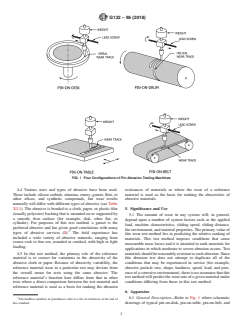
FIG. 1 Four Configurations of Pin Abrasion Testing Machines
4.4 Various sizes and types of abrasive have been used. resistances of materials or where the wear of a reference
These include silicon carbide, alumina, emery, garnet, flint, or material is used as the basis for ranking the abrasivities of
other silicas, and synthetic compounds, but wear results abrasive materials.
normally will differ with different types of abrasive (see Table
5. Significance and Use
X3.1). The abrasive is bonded to a cloth, paper, or plastic film
(usuallypolyester)backingthatismountedonorsupportedby
5.1 The amount of wear in any system will, in general,
a smooth, firm surface (for example, disk, other flat, or
depend upon a number of system factors such as the applied
cylinder). For purposes of this test method, a garnet is the
load, machine characteristics, sliding speed, sliding distance,
preferred abrasive and has given good correlations with many
theenvironment,andmaterialproperties.Theprimaryvalueof
types of abrasive services (1). The field experience has
this wear test method lies in predicting the relative ranking of
included a wide variety of abrasive minerals, ranging from
materials. This test method imposes conditions that cause
coarse rock to fine ore, rounded or crushed, with high or light
measurable mass losses and it is intended to rank materials for
loading.
applications in which moderate to severe abrasion occurs.Test
4.5 In this test method, the primary role of the reference materialsshouldbereasonablyresistanttosuchabrasion.Since
material is to correct for variations in the abrasivity of the this abrasion test does not attempt to duplicate all of the
abrasive cloth or paper. Because of abrasivity variability, the conditions that may be experienced in service (for example,
reference material wear in a particular test may deviate from abrasive particle size, shape, hardness, speed, load, and pres-
enceofacorrosiveenvironment),thereisnoassurancethatthis
the overall mean for tests using the same abrasive. The
reference material’s function here differs from that in other testmethodwillpredictthewearrateofagivenmaterialunder
conditions differing from those in this test method.
tests where a direct comparison between the test material and
reference material is used as a basis for ranking the abrasion
6. Apparatus
6.1 General Description—Refer to Fig. 1 where schematic
The boldface numbers in parentheses refer to a list of references at the end of
this standard. drawings of typical pin-on-disk, pin-on-table, pin-on-belt, and
G132−96 (2018)
pin-on-drum wear testing systems are shown. In each of the 6.6 Wear Measuring System—The balance used to measure
systems, the end of a pin, which may or may not be rotating the mass loss of specimens shall have a sensitivity of 0.0001 g
about its axis, is pressed against an abrasive surface with or better.
application of a prescribed normal force while relative motion
7. Test Specimens, Abrasive, and Sample Preparation
occurs between the pin and the abrasive surface. By moving
7.1 Materials—The test method may be applied to a variety
either the abrasive surface or the pin, or both, the pin
progressively moves over unused abrasive for a prescribed of wear-resistant materials. The only requirement is that
specimenshavingsuitabledimensionscanbepreparedandthat
wear track length.
theywillwithstandthestressesimposedduringthetestwithout
NOTE1—Otherdescriptionsofcontemporarypin-on-disk,pin-on-table,
failureorexcessiveflexure.Thistestmethodisnotintendedfor
and pin-on-drum systems may be found in Practice F732, Test Method
a material that would be unsuitable for a wear-resistant
G99, and Ref (2).
application.
6.1.1 The wear path is normally a spiral on disks, a
7.1.1 Experienceduringthedevelopmentofthistestmethod
combination of linear segments on other flats, an oval helix on
has shown that the use of Specification A514/A514M, Type B
belts, and a cylindrical helix on drums. Successive wear track
steel of Hardness 269 HB, as the reference material has very
passesofthetestpinshouldbespacedfarenoughapartsothat
adequately corrected for abrasivity variations. It is therefore
the reference pin can be tested on unused abrasive in a path
specifically recommended for that purpose. If another refer-
adjacent and parallel to that of the test pin. If, as in some
ence material is used, it must be fully described and charac-
machines,insufficientunusedabrasivespaceisleftbetweenthe
terized in the report of results.
tracks, the wear track of the reference pin should be generated
intwoequalpartslocatedimmediatelybeforeandafterthetest 7.2 Test Specimens—Pin specimens used with a pin-on-
drummachineduringthedevelopmentofthistestmethodwere
pin track (see 9.10).
circular cylinders, 6.35 mm in diameter and approximately 3
6.2 Machine Rigidity—The testing machine must be suffi-
cmlong.Moregenerally,typicalpindiametersrangefrom2to
ciently rigid and stable to keep vibrations from affecting wear
10mm.Specimensofsquarecrosssectionalsohavebeenused.
test results. The load capacities of bearings should be large
Pin ends are conformed to the abrasive surface by wearing in
relative to the loads carried. The surface that supports the
as part of the test procedure (see 9.3), so the starting shape is
abrasive should be rigid. Additional guidance concerning
not critical. However, flat ends are most common and, in most
rigidityrequirementsforweartestingmaybefoundinRef (3).
cases, require shorter times and path lengths for wearing in.
6.3 Drive System—Adrive system capable of maintaining a
7.2.1 Test specimens shall be free from scale which could
constantsteady-statespeedoftheabrasiverelativetothepinis
flake off and interfere with the specimen-abrasive contact.
needed.Forthepin-on-diskmachine,therotationalspeedmust
Porosity, unless it is an inherent characteristic of the material
vary inversely with the radial distance of the pin from the
being tested, may adversely affect test results and should be
disk’s center in order for the linear speed to be constant. For
avoided.The shank of a specimen that must be gripped should
the pin-on-table machine, there inevitably must be a point of
besmoothandregularlyshaped.Agroundsurfaceroughnessof
rest and transient deceleration and acceleration periods at each
1 µm (40 µin.) R or less is usually adequate.
a
end of each stroke, and the translational speed can be constant
7.3 Abrasive—The abrasive recommended is a 105-µm
only between the acceleration and deceleration periods. The
(150-grit) garnet, bonded to cloth, paper, or plastic (for
transient periods should be kept as short as possible. If the pin
example,polyesterfilm)withanimalglueorsyntheticresin,or
is rotated, its rotational speed should be constant.
both. The abrasive coverage is 50 to 70% of the surface area,
6.4 Cycle Counter—The test machine shall be equipped
uniformly distributed. Normally, the abrasive cloth, paper, or
with a device that will count and record the number of
film is obtained from a commercial producer. If other particle
revolutions in the case of a disk, drum, or belt, or the number
sizes of the same or another mineral are used, they should be
ofstrokesorcyclesinthecaseofanonrotatingflat.Thisdevice
in the range from 65 to 175 µm (220 to 80 grit).
should also have the capability to shut off the machine after a
7.4 Abrasivity—The abrasivity of a particular abrasive
preselected number of revolutions, strokes, or cycles.
cloth, paper, or film normally is not uniform over its surface
6.5 Pin Specimen Holder—A chuck, collet, or other device
nor is the mean abrasivity of different pieces of the same type
is required to securely hold the pin. The holder must move
of material necessarily the same.Variations in abrasivity range
freely, with negligible friction, in the direction of its longitu-
upto 620%fromtheoverallmean.Correctionsforabrasivity
dinal axis (that is, perpendicular to the abrasive surface), even
variations are made by normalizing the results of individual
if rotated. The pin must be restrained from lateral deflection
teststothemeanwearofthereferencematerialovermanytests
due to pin drag. A means of applying a load to the pin,
(see 10.2).
preferably by dead weights, shall be provided.
Acceptable cloths, papers, and films coated with garnet or other minerals may
Many lathes should be adaptable for pin-on-drum testing. The sole source of beobtainedfromauthorizeddistributorsofthe3MCo.Inquiriesmaybedirectedto
supply of the pin-on-disk machine known to the committee at this time is Falex the General Offices, 3M Center, St. Paul, MN 55102. The sole source of supply of
Corp., 1020 Airpark Dr., Sugar Grove, IL 60554. If you are aware of alternative thematerialsknowntothecommitteeatthistimeis3MCompany.Ifyouareaware
suppliers, please provide this information to ASTM International Headquarters. of alternative suppliers, please provide this information to ASTM Headquarters.
Your comments will receive careful consideration at a meeting of the responsible Your comments will receive careful consideration at a meeting of the responsible
1 1
technical committee, which you may attend. technical committee, which you may attend.
G132−96 (2018)
8. Test Parameters 9.6 Insert a pin specimen securely in the holder. Do not
allow the pin to protrude more than 4 mm. If the pin was not
8.1 Load—The magnitude of the normal force, in newtons,
rotated as it was worn in, it must be carefully repositioned in
at the wearing contact. Based on the nominal contact area of
the same orientation on any curved surface.
the specimen, the nominal contact pressure should be within
therangefrom1to2.5MPa.Ithasbeenshown (1)that,within 9.7 Apply the prescribed force on the pin perpendicular to
thisrange,thewearisessentiallyproportionaltotheloading.A the abrasive surface.
nominal contact pressure of about 2 MPa allows minimal use
9.8 Set the cycle counter to the appropriate number of
of abrasive by limiting the requisite path length without a high
revolutions or strokes to achieve the desired track length.
risk of tearing the backing material.
9.9 Begin the test with the specimen in contact under load.
8.2 Translational Speed—The mean relative sliding speed
Stop the test when the desired track length has been achieved.
(track length/sliding time) between the contacting surfaces. It
9.10 Repeat the test with the other pin. The sequence of
should be within the range from 1 to 10 cm/s.
testing the test pin and reference pin depends upon the wear
8.3 Rotational Speed—The rate at which pins are rotated.
track configuration. If the wear track on the abrasive surface
Unless it was zero it has been typically in the range from 1.57
leaves an unworn space, as the preferred configuration would,
to 5.24 rad/s (15 to 50 r/min).
either the test pin or the reference pin may be tested first and
8.4 Track Length—The distance slid, in metres. the other pin will then be tested for the same distance on the
intervening unworn abrasive. If insufficient unworn space is
8.5 Environment—Room air at a nominal temperature of 20
left, the reference pin should be tested last for the same total
to 25°C. The relative humidity and any uncommon environ-
distance on a divided track, half ahead of and half following
mental exposure should be reported.
the test pin track.
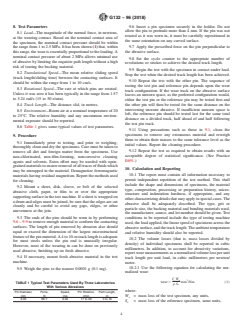
8.6 Table 1 gives some typical values of test parameters.
9.11 Using precautions such as those in 9.1, clean the
specimens to remove any extraneous material and reweigh
9. Procedure
them to obtain their masses to the same tolerance level as the
9.1 Immediately prior to testing, and prior to weighing,
initial values. Report the cleaning procedure.
thoroughlycleananddrythespecimens.Caremustbetakento
9.12 Repeat the test as required to obtain results with an
remove all dirt and foreign matter from the specimens. Use
acceptable degree of statistical significance. (See Practice
non-chlorinated, non-film-forming, noncorrosive cleaning
E691.)
agents and solvents. Extra effort may be needed with open-
grainedmaterialstoensureremovalofalltracesoffluidswhich
10. Calculation and Reporting
may be entrapped in the material. Demagnetize ferromagnetic
10.1 The report must contain all information necessary to
materialshavingresidualmagnetism.Reportthemethodsused
permit independent repetition of the test method. This shall
for cleaning.
include the shape and dimensions of specimens, the material
9.2 Mount a sheet, disk, sleeve, or belt of the selected
type, composition, processing or preparation history, micro-
abrasive cloth, paper, or film to or over the appropriate
structure and indentation hardness, if appropriate, and any
supportingsurfaceinthetestmachine.Ifasheetiswrappedon
othercharacterizingdetailsthatmayapplyinspecialcases.The
adrumandedgesmustbejoined,besurethattheedgesarecut
abrasive shall be adequately described. The type, grit or
cleanly and be careful to avoid any gaps, ridges, or other
particle size, the backing material and bonding materials used,
unevenness at the join.
themanufacturer,source,andlotnumbershouldbegiven.
...