

ASTM G195-22
(Guide)Standard Guide for Conducting Wear Tests Using a Rotary Platform Abraser
General Information
- Abstract
SIGNIFICANCE AND USE
5.1 This test guide provides a means to quantify the abrasion resistance of material surfaces, and may be related to end-use performance, or used to comparatively rank material performance, or both. The resistance of material surfaces to abrasion, as measured on a testing machine in the laboratory, is generally only one of several factors contributing to wear performance as experienced in the actual use of the material. Other factors may need to be considered in any calculation of predicted life from specific abrasion data.
5.2 The resistance of material surfaces to abrasion may be affected by factors including test conditions; type of abradant; pressure between the specimen and abradant; mounting or tension of the specimen; and type, kind, or amount of finishing materials.
5.3 Abrasion tests utilizing the rotary platform abraser may be subject to variation due to changes in the abradant during the course of specific tests. Depending on abradant type and test specimen, the abrading wheel surface may change (that is, become clogged) due to the pick-up of finishing or other materials from test specimens. To reduce this variation, the abrading wheels should be resurfaced at regularly defined intervals. See Appendix X2.
5.4 When evaluating resistance to abrasion of two or more coatings, other factors may need to be considered for an accurate comparison. Flexible coatings that include air entrainment bubbles may result in less mass loss. Coatings that include fillers may result in greater mass loss but have less change in coating thickness or less mass loss but have greater change in coating thickness. Coatings that include aggregates or particulates may generate wear debris that is not removed by the vacuum and contribute to the break-down of the coating. Coatings that have a hardness value greater than the abrasive wheel may cause the abrasive wheel to break down faster and require more wear cycles to generate measureable wear. Examples of coatings that may be...
SCOPE
1.1 This guide covers and is intended to assist in establishing procedures for conducting wear tests of rigid or flexible materials utilizing the rotary platform abraser.
1.2 The values stated in SI units are to be regarded as standard. No other units of measurement are included in this standard.
1.2.1 Exception—Non-SI units are used when stating rotational speed.
1.3 This standard does not purport to address all of the safety concerns, if any, associated with its use. It is the responsibility of the user of this standard to establish appropriate safety, health, and environmental practices and determine the applicability of regulatory limitations prior to use.
1.4 This international standard was developed in accordance with internationally recognized principles on standardization established in the Decision on Principles for the Development of International Standards, Guides and Recommendations issued by the World Trade Organization Technical Barriers to Trade (TBT) Committee.
- Status
- Published
- Publication Date
- 31-May-2022
- Technical Committee
- G02 - Wear and Erosion
- Drafting Committee
- G02.30 - Abrasive Wear
Overview
ASTM G195-22: Standard Guide for Conducting Wear Tests Using a Rotary Platform Abraser provides comprehensive guidelines for quantifying and comparing the abrasion resistance of various rigid and flexible materials. Published by ASTM International, this wear testing standard outlines procedures for evaluating the durability of material surfaces subjected to abrasive forces, supporting quality control and research and development in industries such as coatings, automotive, textiles, and flooring.
The standard emphasizes the importance of controlled laboratory abrasion tests to simulate real-world wear conditions. While laboratory abrasion resistance measurements are a critical factor in predicting product performance, ASTM G195-22 also acknowledges that end-use durability may depend on additional variables not captured in the test.
Key Topics
- Test Methodology: Details procedures for using a rotary platform abraser, including mounting specimens, selecting abrasive wheels, applying specific loads, and measuring debris removal efficiency with a vacuum system.
- Material Compatibility: Suitable for a broad array of specimens, including metals, plastics, textiles, leathers, coatings, and ceramics. Materials must be essentially flat for proper evaluation.
- Influencing Factors: Explains the influence of abradant selection, pressure, specimen mounting, finishing materials, and test conditions on abrasion results.
- Wheel and Specimen Preparation: Emphasizes the need for regular resurfacing of abrasive wheels and proper specimen conditioning to ensure repeatable, accurate results.
- Evaluation Criteria: Provides guidance on measuring mass loss, wear index, cycles to failure, thickness loss, residual breaking force, and appearance changes. Advises on correcting for specific gravity when comparing dissimilar materials.
- Reporting: Specifies data to record, including environmental conditions, wheel type, applied load, vacuum level, and observed results, as well as any deviations from the prescribed procedure.
Applications
- Product Development and Material Selection: Helps manufacturers and engineers select coatings, substrates, and finishes with optimal abrasion resistance for demanding applications.
- Quality Control: Provides a standardized approach for verifying abrasion resistance in certified production lots, protecting brands against premature wear complaints.
- Comparative Testing: Enables objective ranking of alternative materials, treatments, or coatings under consistent laboratory conditions, supporting informed decisions and innovation.
- Regulatory and Specification Compliance: Assists organizations in meeting industry-accepted requirements for durability and wear performance, particularly where referenced by other standards or procurement contracts.
- R&D and Failure Analysis: Facilitates research into new materials and aids in diagnosing product wear issues by replicating end-use scenarios in a controlled environment.
Related Standards
ASTM G195-22 references and complements numerous material-specific and test method standards for wear and abrasion resistance, including but not limited to:
- ASTM D3884 - Textile fabrics, rotary platform abrasion resistance
- ASTM D1044 - Transparent plastics, abrasion resistance by Taber Abraser
- ASTM C501 - Ceramic tile, abrasion resistance by rotary platform
- ASTM F1978 - Metallic thermal spray coatings, abrasion resistance
- ASTM D4060 - Organic coatings, abrasion resistance
For terminology, ASTM G40 defines key terms related to wear and erosion.
Conclusion
ASTM G195-22 is a vital standard for organizations seeking reliable, repeatable measures of abrasion resistance in flat material specimens. By following its comprehensive procedures, industries can effectively benchmark materials, guide product development, and assure customers of long-term durability.
Keywords: ASTM G195, rotary platform abraser, abrasion resistance, wear testing, material durability, laboratory abrasion, standard wear test, coating performance, quality control, Taber abrasion test
Relations
- Effective Date
- 15-Apr-2024
- Effective Date
- 01-Jul-2020
- Effective Date
- 01-May-2020
- Effective Date
- 01-Apr-2020
- Effective Date
- 01-Apr-2020
- Effective Date
- 01-Sep-2019
- Effective Date
- 01-Jul-2019
- Effective Date
- 01-Jan-2019
- Effective Date
- 01-Oct-2017
- Effective Date
- 01-Sep-2017
- Effective Date
- 01-Jun-2017
- Effective Date
- 01-Feb-2017
- Effective Date
- 01-Jul-2016
- Effective Date
- 01-Dec-2015
- Effective Date
- 01-Nov-2015
Get Certified
Connect with accredited certification bodies for this standard

IMP NDT d.o.o.
Non-destructive testing services. Radiography, ultrasonic, magnetic particle, penetrant, visual inspection.
Inštitut za kovinske materiale in tehnologije
Institute of Metals and Technology. Materials testing, metallurgical analysis, NDT.
Q Techna d.o.o.
NDT and quality assurance specialist. 30+ years experience. NDT personnel certification per ISO 9712, nuclear and thermal power plant inspections, QA/
Sponsored listings
Frequently Asked Questions
ASTM G195-22 is a guide published by ASTM International. Its full title is "Standard Guide for Conducting Wear Tests Using a Rotary Platform Abraser". This standard covers: SIGNIFICANCE AND USE 5.1 This test guide provides a means to quantify the abrasion resistance of material surfaces, and may be related to end-use performance, or used to comparatively rank material performance, or both. The resistance of material surfaces to abrasion, as measured on a testing machine in the laboratory, is generally only one of several factors contributing to wear performance as experienced in the actual use of the material. Other factors may need to be considered in any calculation of predicted life from specific abrasion data. 5.2 The resistance of material surfaces to abrasion may be affected by factors including test conditions; type of abradant; pressure between the specimen and abradant; mounting or tension of the specimen; and type, kind, or amount of finishing materials. 5.3 Abrasion tests utilizing the rotary platform abraser may be subject to variation due to changes in the abradant during the course of specific tests. Depending on abradant type and test specimen, the abrading wheel surface may change (that is, become clogged) due to the pick-up of finishing or other materials from test specimens. To reduce this variation, the abrading wheels should be resurfaced at regularly defined intervals. See Appendix X2. 5.4 When evaluating resistance to abrasion of two or more coatings, other factors may need to be considered for an accurate comparison. Flexible coatings that include air entrainment bubbles may result in less mass loss. Coatings that include fillers may result in greater mass loss but have less change in coating thickness or less mass loss but have greater change in coating thickness. Coatings that include aggregates or particulates may generate wear debris that is not removed by the vacuum and contribute to the break-down of the coating. Coatings that have a hardness value greater than the abrasive wheel may cause the abrasive wheel to break down faster and require more wear cycles to generate measureable wear. Examples of coatings that may be... SCOPE 1.1 This guide covers and is intended to assist in establishing procedures for conducting wear tests of rigid or flexible materials utilizing the rotary platform abraser. 1.2 The values stated in SI units are to be regarded as standard. No other units of measurement are included in this standard. 1.2.1 Exception—Non-SI units are used when stating rotational speed. 1.3 This standard does not purport to address all of the safety concerns, if any, associated with its use. It is the responsibility of the user of this standard to establish appropriate safety, health, and environmental practices and determine the applicability of regulatory limitations prior to use. 1.4 This international standard was developed in accordance with internationally recognized principles on standardization established in the Decision on Principles for the Development of International Standards, Guides and Recommendations issued by the World Trade Organization Technical Barriers to Trade (TBT) Committee.
SIGNIFICANCE AND USE 5.1 This test guide provides a means to quantify the abrasion resistance of material surfaces, and may be related to end-use performance, or used to comparatively rank material performance, or both. The resistance of material surfaces to abrasion, as measured on a testing machine in the laboratory, is generally only one of several factors contributing to wear performance as experienced in the actual use of the material. Other factors may need to be considered in any calculation of predicted life from specific abrasion data. 5.2 The resistance of material surfaces to abrasion may be affected by factors including test conditions; type of abradant; pressure between the specimen and abradant; mounting or tension of the specimen; and type, kind, or amount of finishing materials. 5.3 Abrasion tests utilizing the rotary platform abraser may be subject to variation due to changes in the abradant during the course of specific tests. Depending on abradant type and test specimen, the abrading wheel surface may change (that is, become clogged) due to the pick-up of finishing or other materials from test specimens. To reduce this variation, the abrading wheels should be resurfaced at regularly defined intervals. See Appendix X2. 5.4 When evaluating resistance to abrasion of two or more coatings, other factors may need to be considered for an accurate comparison. Flexible coatings that include air entrainment bubbles may result in less mass loss. Coatings that include fillers may result in greater mass loss but have less change in coating thickness or less mass loss but have greater change in coating thickness. Coatings that include aggregates or particulates may generate wear debris that is not removed by the vacuum and contribute to the break-down of the coating. Coatings that have a hardness value greater than the abrasive wheel may cause the abrasive wheel to break down faster and require more wear cycles to generate measureable wear. Examples of coatings that may be... SCOPE 1.1 This guide covers and is intended to assist in establishing procedures for conducting wear tests of rigid or flexible materials utilizing the rotary platform abraser. 1.2 The values stated in SI units are to be regarded as standard. No other units of measurement are included in this standard. 1.2.1 Exception—Non-SI units are used when stating rotational speed. 1.3 This standard does not purport to address all of the safety concerns, if any, associated with its use. It is the responsibility of the user of this standard to establish appropriate safety, health, and environmental practices and determine the applicability of regulatory limitations prior to use. 1.4 This international standard was developed in accordance with internationally recognized principles on standardization established in the Decision on Principles for the Development of International Standards, Guides and Recommendations issued by the World Trade Organization Technical Barriers to Trade (TBT) Committee.
ASTM G195-22 is classified under the following ICS (International Classification for Standards) categories: 19.060 - Mechanical testing. The ICS classification helps identify the subject area and facilitates finding related standards.
ASTM G195-22 has the following relationships with other standards: It is inter standard links to ASTM C957/C957M-17(2024), ASTM D4685/D4685M-15(2020), ASTM F510/F510M-20, ASTM C1353/C1353M-20e1, ASTM C1353/C1353M-20, ASTM D1044-19, ASTM D5035-11(2019), ASTM D5146-10(2019), ASTM C957/C957M-17, ASTM F1978-17, ASTM D3451-06(2017), ASTM D3794-17, ASTM D3794-16, ASTM D2205-15, ASTM G40-15. Understanding these relationships helps ensure you are using the most current and applicable version of the standard.
ASTM G195-22 is available in PDF format for immediate download after purchase. The document can be added to your cart and obtained through the secure checkout process. Digital delivery ensures instant access to the complete standard document.
Standards Content (Sample)
This international standard was developed in accordance with internationally recognized principles on standardization established in the Decision on Principles for the
Development of International Standards, Guides and Recommendations issued by the World Trade Organization Technical Barriers to Trade (TBT) Committee.
Designation: G195 − 22
Standard Guide for
Conducting Wear Tests Using a Rotary Platform Abraser
This standard is issued under the fixed designation G195; the number immediately following the designation indicates the year of
original adoption or, in the case of revision, the year of last revision. A number in parentheses indicates the year of last reapproval. A
superscript epsilon (´) indicates an editorial change since the last revision or reapproval.
1. Scope* Liquid-Applied Elastomeric Waterproofing Membrane
With Integral Wearing Surface
1.1 This guide covers and is intended to assist in establish-
C1353/C1353M Test Method for Abrasion Resistance of
ing procedures for conducting wear tests of rigid or flexible
Dimension Stone Subjected to FootTraffic Using a Rotary
materials utilizing the rotary platform abraser.
Platform Abraser
1.2 The values stated in SI units are to be regarded as
C1803 Guide for Abrasion Resistance of Mortar Surfaces
standard. No other units of measurement are included in this
Using a Rotary Platform Abraser
standard.
D154 Guide for Testing of Varnishes (Withdrawn 2018)
1.2.1 Exception—Non-SI units are used when stating rota-
D1044 Test Method for Resistance ofTransparent Plastics to
tional speed.
Surface Abrasion by the Taber Abraser
1.3 This standard does not purport to address all of the
D1475 Test Method for Density of Liquid Coatings, Inks,
safety concerns, if any, associated with its use. It is the and Related Products
responsibility of the user of this standard to establish appro-
D2205 Guide for Selection of Tests for Traffic Paints
priate safety, health, and environmental practices and deter- D3389 Test Method for Coated FabricsAbrasion Resistance
mine the applicability of regulatory limitations prior to use.
(Rotary Platform Abrader)
1.4 This international standard was developed in accor- D3451 Guide for Testing Coating Powders and Powder
dance with internationally recognized principles on standard-
Coatings
ization established in the Decision on Principles for the D3489 Test Methods for Microcellular Urethane Materials
Development of International Standards, Guides and Recom-
D3730 Guide for Testing High-Performance Interior Archi-
mendations issued by the World Trade Organization Technical tectural Wall Coatings
Barriers to Trade (TBT) Committee.
D3794 Guide for Testing Coil Coatings
D3884 Guide for Abrasion Resistance of Textile Fabrics
2. Referenced Documents
(Rotary Platform, Double-Head Method)
D4060 Test Method for Abrasion Resistance of Organic
2.1 ASTM Standards:
Coatings by the Taber Abraser
B607 Specification forAutocatalytic Nickel Boron Coatings
D4685/D4685M Test Method for Pile Fabric Abrasion
for Engineering Use
D4712 Guide for Testing Industrial Water-Reducible Coat-
B733 Specification for Autocatalytic (Electroless) Nickel-
ings (Withdrawn 2014)
Phosphorus Coatings on Metal
D5034 TestMethodforBreakingStrengthandElongationof
B893 Specification for Hard-Coat Anodizing of Magnesium
Textile Fabrics (Grab Test)
for Engineering Applications
D5035 Test Method for Breaking Force and Elongation of
C501 Test Method for Relative Resistance to Wear of
Textile Fabrics (Strip Method)
Unglazed Ceramic Tile by the Taber Abraser
D5144 Guide for Use of Protective Coating Standards in
C744 Specification for Prefaced Concrete and Calcium Sili-
Nuclear Power Plants
cate Masonry Units
D5146 Guide to Testing Solvent-Borne Architectural Coat-
C957/C957M Specification for High-Solids Content, Cold
ings
D5324 Guide for Testing Water-Borne Architectural Coat-
This guide is under the jurisdiction of ASTM Committee G02 on Wear and ings
Erosion and is the direct responsibility of Subcommittee G02.30 on Abrasive Wear.
D6037 Test Methods for Dry Abrasion Mar Resistance of
Current edition approved June 1, 2022. Published June 2022. Originally
High Gloss Coatings
approved in 2008. Last previous edition approved in 2021 as G195 – 21. DOI:
D7255 Test Method for Abrasion Resistance of Leather
10.1520/G0195-22.
For referenced ASTM standards, visit the ASTM website, www.astm.org, or
contact ASTM Customer Service at service@astm.org. For Annual Book of ASTM
Standards volume information, refer to the standard’s Document Summary page on The last approved version of this historical standard is referenced on
the ASTM website. www.astm.org.
*A Summary of Changes section appears at the end of this standard
Copyright © ASTM International, 100 Barr Harbor Drive, PO Box C700, West Conshohocken, PA 19428-2959. United States
G195 − 22
(Rotary Platform, Abraser Method) end-use performance, or used to comparatively rank material
E1795 Specification for Non-Reinforced Liquid Coating En- performance, or both. The resistance of material surfaces to
capsulation Products for Leaded Paint in Buildings abrasion, as measured on a testing machine in the laboratory, is
F362/F362M TestMethodforDeterminingtheErasabilityof generally only one of several factors contributing to wear
Inked Ribbons (Withdrawn 2016) performance as experienced in the actual use of the material.
F510/F510M Test Method for Resistance to Abrasion of Other factors may need to be considered in any calculation of
Resilient Floor Coverings Using an Abrader with a Grit predicted life from specific abrasion data.
Feed Method
5.2 The resistance of material surfaces to abrasion may be
F1344 Specification for Rubber Floor Tile
affected by factors including test conditions; type of abradant;
F1478 Test Method for Determination of Abrasion Resis-
pressure between the specimen and abradant; mounting or
tance of Images Produced from Copiers and Printers
tension of the specimen; and type, kind, or amount of finishing
(Taber Method) (Withdrawn 2020)
materials.
F1978 Test Method for Measuring Abrasion Resistance of
5.3 Abrasion tests utilizing the rotary platform abraser may
Metallic Thermal Spray Coatings by Using the Taber
be subject to variation due to changes in the abradant during
Abraser
the course of specific tests. Depending on abradant type and
F2051 Specification for Implantable Saline Filled Breast
test specimen, the abrading wheel surface may change (that is,
Prosthesis
become clogged) due to the pick-up of finishing or other
F2068 Specification for Femoral Prostheses—Metallic Im-
materials from test specimens. To reduce this variation, the
plants
abrading wheels should be resurfaced at regularly defined
G40 Terminology Relating to Wear and Erosion
intervals. See Appendix X2.
3. Terminology
5.4 When evaluating resistance to abrasion of two or more
coatings, other factors may need to be considered for an
3.1 Definitions of Terms Specific to This Standard:
accurate comparison. Flexible coatings that include air entrain-
3.1.1 abraser, n—wear testing instrument to evaluate abra-
ment bubbles may result in less mass loss. Coatings that
sion resistance, also referred to as an abrader.
include fillers may result in greater mass loss but have less
3.1.2 abrasion cycle, n—in abrasion testing, one or more
change in coating thickness or less mass loss but have greater
movements of the abradant across a material surface, or the
change in coating thickness. Coatings that include aggregates
material surface across the abradant, that permits a return to its
orparticulatesmaygenerateweardebristhatisnotremovedby
starting position. In the case of the rotary platform abraser test
the vacuum and contribute to the break-down of the coating.
method, it consists of one complete rotation of the turntable
Coatings that have a hardness value greater than the abrasive
specimen platform.
wheel may cause the abrasive wheel to break down faster and
3.1.3 resurface, v—procedure of cleaning and refreshing the
require more wear cycles to generate measureable wear.
running surface of an abrasive wheel prior to use or during
Examples of coatings that may be impacted include epoxies,
testing.
polymethyl-methacrylate(PMMA),polyurethane-methacrylate
(PUMA), methyl-methacrylate (MMA), and carbon resin.
3.2 For definitions of other wear terms used in this guide,
refer to Terminology G40.
NOTE 1—As an example, consider a urethane coating of 0.5 mm
thickness, embedded with 1.2 µm titanium particles that resulted in a
3.3 Acronyms:
53 µm loss in coating thickness and 110 mg mass loss.Asimilar urethane
3.3.1 CAMI—Coated Abrasives Manufacturers Institute
coating without titanium particles resulted in a 78 µm loss in coating
thickness and 44 mg mass loss.
4. Summary of Guide
5.5 The measurement of the relative amount of abrasion
4.1 Aspecimenisabradedusingrotaryrubbingactionunder
may be affected by the method of evaluation and influenced by
controlled conditions of pressure and abrasive action. The test
the judgment of the operator.
specimen, mounted on a turntable platform, turns on a vertical
6. Apparatus
axis, against the sliding rotation of two abrading wheels. The
wheels shall be mounted in such a way that when they are in
6.1 Rotary Platform Abraser, consisting of the elements
contact with the rotating test specimen, they rotate in opposing
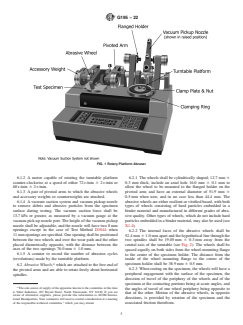
described in 6.1.1 to 6.1.5 (see Fig. 1). Also referred to as a
directions. One abrading wheel rubs the specimen outward
rotary platform, double head (RPDH) abraser or abrader.
toward the periphery and the other, inward toward the center
6.1.1 A turntable specimen platform, which is removable,
while a vacuum system removes wear debris generated during
that includes a rubber pad, clamp plate, centrally located
the test.The resulting abrasion marks form a pattern of crossed
threaded post and nut. When testing flexible specimens, the
arcs over an area of approximately 30 cm . Resistance to
turntable platform will also include a clamping ring. The
abrasion is evaluated by various means which are described in
turntable shall be motor driven, and mounted so as to produce
Section 12.
a circular surface travel of a flat specimen in the plane of its
surface. The turntable platform should rotate with no visible
5. Significance and Use
wobble. This can be checked with a dial indicator at a distance
5.1 This test guide provides a means to quantify the abra- of1.6mmfromthetopouteredgeoftheplatformtomakesure
sion resistance of material surfaces, and may be related to it runs true within 0.2 mm.
G195 − 22
FIG. 1 Rotary Platform Abraser
6.1.2 A motor capable of rotating the turntable platform 6.2.1 The wheels shall be cylindrically shaped; 12.7 mm 6
counter-clockwise at a speed of either 72 r⁄min 6 2 r⁄min or 0.3 mm thick; include an axial hole 16.0 mm 6 0.1 mm to
60 r⁄min 6 2 r⁄min. allow the wheel to be mounted to the flanged holder on the
6.1.3 A pair of pivoted arms to which the abrasive wheels pivoted arm; and have an external diameter of 51.9 mm 6
and accessory weights or counterweights are attached. 0.5 mm when new, and in no case less than 44.4 mm. The
6.1.4 A vacuum suction system and vacuum pickup nozzle abrasive wheels are either resilient or vitrified based, with both
to remove debris and abrasive particles from the specimen types of wheels consisting of hard particles embedded in a
surface during testing. The vacuum suction force shall be binder material and manufactured in different grades of abra-
13.7 kPa or greater, as measured by a vacuum gauge at the sive quality. Other types of wheels, which do not include hard
vacuum pick-up nozzle port. The height of the vacuum pickup particles embedded in a binder material, may also be used (see
nozzle shall be adjustable, and the nozzle will have two 8 mm X1.4).
openings except in the case of Test Method D1044 when
6.2.2 The internal faces of the abrasive wheels shall be
11 mmopeningsarespecified.Oneopeningshallbepositioned
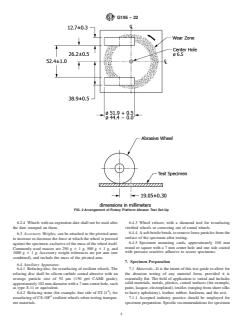
52.4 mm 6 1.0 mm apart and the hypothetical line through the
between the two wheels and over the wear path and the other
two spindles shall be 19.05 mm 6 0.3 mm away from the
placed diametrically opposite, with the distance between the
central axis of the turntable (see Fig. 2). The wheels shall be
axes of the two openings 76.0 mm 6 1.0 mm.
spaced equally on both sides from the wheel-mounting flange
6.1.5 A counter to record the number of abrasion cycles
to the center of the specimen holder. The distance from the
(revolutions) made by the turntable platform.
inside of the wheel mounting flange to the center of the
specimen holder shall be 38.9 mm 6 0.5 mm.
6.2 Abrasive Wheels, which are attached to the free end of
6.2.3 When resting on the specimen, the wheels will have a
the pivoted arms and are able to rotate freely about horizontal
peripheral engagement with the surface of the specimen, the
spindles.
direction of travel of the periphery of the wheels and of the
specimen at the contacting portions being at acute angles, and
The sole source of supply of the apparatus known to the committee at this time
the angles of travel of one wheel periphery being opposite to
is Taber Industries, 455 Bryant Street, North Tonawanda, NY 14120. If you are
that of the other. Motion of the abrasive wheels, in opposite
aware of alternative suppliers, please provide this information to ASTM Interna-
directions, is provided by rotation of the specimen and the
tional Headquarters.Your comments will receive careful consideration at a meeting
of the responsible technical committee, which you may attend. associated friction therefrom.
G195 − 22
FIG. 2 Arrangement of Rotary Platform Abraser Test Set-Up
6.2.4 Wheels with an expiration date shall not be used after 6.4.3 Wheel refacer, with a diamond tool for resurfacing
the date stamped on them. vitrified wheels or correcting out of round wheels.
6.4.4 Asoft bristle brush, to remove loose particles from the
6.3 Accessory Weights, can be attached to the pivoted arms
surface of the specimen after testing.
to increase or decrease the force at which the wheel is pressed
6.4.5 Specimen mounting cards, approximately 108 mm
against the specimen, exclusive of the mass of the wheel itself.
round or square witha7mm center hole and one side coated
Commonly used masses are 250 g 6 1 g, 500 g 61g,and
with pressure sensitive adhesive to secure specimens.
1000 g 6 1 g. Accessory weight references are per arm (not
combined), and include the mass of the pivoted arm.
7. Specimen Preparation
6.4 Auxiliary Apparatus:
7.1 Materials—It is the intent of this test guide to allow for
6.4.1 Refacing disc, for resurfacing of resilient wheels. The
the abrasion testing of any material form, provided it is
refacing disc shall be silicon carbide coated abrasive with an
essentially flat. The field of application is varied and includes
average particle size of 92 µm (150 grit CAMI grade),
solid materials, metals, plastics, coated surfaces (for example,
approximately102mmdiameterwitha7mmcenterhole,such
paint, lacquer, electroplated), textiles (ranging from sheer silks
as type S-11 or equivalent.
to heavy upholstery), leather, rubber, linoleum, and the rest.
6.4.2 Refacing stone (for example, fine side of ST-11 ), for
resurfacing of CS-10F resilient wheels when testing transpar- 7.1.1 Accepted industry practice should be employed for
ent materials. specimen preparation. Specific recommendations for specimen
G195 − 22
preparation may be available from the ASTM subcommittee constant level, prepare the resilient wheels according to the
responsible for that material. Selection and use should be manufacturer’s recommendations. See Appendix X2.
agreed upon between the interested parties.
9.2 Preparation of Vitrified Abrading Wheels—Vitrified
7.2 Specimen Thickness—The standard material thickness wheels do not require resurfacing unless the abrading surface
that can be evaluated with the rotary platform abraser is becomes clogged, chipped, or out of round. A wheel refacer
6.5 mm or less. should be used to correct any of these conditions.
NOTE 2—For materials thicker than 6.5 mm but less than 12.7 mm, an
10. Conditioning
extension nut such as type S-21 or equivalent may be used.Alternatively,
anarmheightextensionkit willpermittestingofspecimensupto40mm.
10.1 Prior to testing, condition all specimens according to
7.3 Specimen Size—The width of the resulting wear path is
established procedures specific to the material being evaluated
12.7 mm, and is located 31.75 mm from the center of the
or as agreed upon by the interested parties.
specimen.Thesizeofthespecimenmayvarydependingonthe
11. Procedure
material being evaluated:
11.1 Mount the wheels on their respective flanged holders,
7.3.1 For most rigid materials, a sample approximately
100 mm square is recommended with a 6.5 mm diameter taking care not to handle them by their abrasive surfaces. Prior
center hole. to testing, ensure that the wheels have been resurfaced accord-
7.3.2 Flexible specimens are typically circular and require ing to Section 9 if necessary.
the use of the clamp ring. If a mounting card is used, the
11.2 Depending on the type of evaluation criteria being
specimen should be approximately 105 mm in diameter with a
utilized (see Section 12), it may be necessary to measure and
6.5 mm diameter center hole. If no mounting card is used, an
record specific parameters of the unabraded specimen prior to
approximately 135 mm specimen is required such that the
conducting the test:
clamp ring will grip overlapped material.The specimen should
11.2.1 Mass loss method, weigh the specimen to the nearest
include a 6.5 mm diameter hole in the center of the specimen.
mg. If using a mounting card, weigh after the specimen has
A sample cutter or die has been found useful for preparing
been affixed to the card and conditioned in the standard testing
flexible specimens.
environment.
7.4 Mounting Card—Certain flexible specimens may 11.2.1.1 When comparing the wear resistance of materials
that have different specific gravities, a correction for the
wrinkleorshiftduringtesting.Topreventthis,amountingcard
with a pressure sensitive adhesive may be used. Prior to specific gravity of each coating must be applied to the mass
loss to give a true measure of the comparative wear resistance.
adhering, clean the back of the specimen with a soft bristle
brush to remove any loose debris. Position the specimen on the Calculate the mass loss as shown in 12.2 or wear index as
shown in 12.3, then divide the result by the material’s specific
cardsuchthatthespecimenisfreeoffolds,creases,orwrinkles
and the center holes align. gravity as determined by Test Method D1475. The use of this
correction factor provides a mass loss or wear index relative to
8. Preparation and Set-Up of Apparatus
the loss in volume of the material to which it is applied. When
comparing materials of different specific gravities, the test
8.1 The following set-up parameters are dependent on the
parameters shall be the same.
type of material being evaluated and shall be agreed upon by
11.2.2 Wear cycles per µm (or mm) or depth of wear
the interested parties. See Appendix X1 for guidance.
method, use a thickness gauge or other appropriate device to
8.1.1 Selection of Wheels—Abrasive wheels manufactured
measure the specimen thickness on four points along the path
in different grades are commercially available.
to be abraded, approximately 38 mm from the center hole and
8.1.2 Vacuum Suction—Thevacuumsuctionforceshouldbe
90° apart. Calculate the average of the readings.
adjusted to lift the abraded particles, but not lift the specimen.
8.1.3 Vacuum Pickup Nozzle—The gap between the vacuum
11.3 Mounting of Specimen—Place the test specimen face
pickup nozzle and the specimen surface should be adjusted
up over the rubber mat on the turntable platform, unless
after the specimen has been mounted.Agap of 7 mm 61mm
otherwise specified. If the turntable platform was previously
has been found to be sufficient for most materials. On certain
removed,ensureitisproperlyreplacedonthemotordriveshaft
rigid materials, a setting of 3 mm 6 1 mm has been found to
of the abraser prior to testing.
be more effective.
11.3.1 For rigid materials, secure the clamp plate and nut in
8.1.4 Abrading Wheel Loading—The mass selected should
place to hold the specimen.
permit a minimum number of abrasion cycles (for
...
This document is not an ASTM standard and is intended only to provide the user of an ASTM standard an indication of what changes have been made to the previous version. Because
it may not be technically possible to adequately depict all changes accurately, ASTM recommends that users consult prior editions as appropriate. In all cases only the current version
of the standard as published by ASTM is to be considered the official document.
Designation: G195 − 21 G195 − 22
Standard Guide for
Conducting Wear Tests Using a Rotary Platform Abraser
This standard is issued under the fixed designation G195; the number immediately following the designation indicates the year of
original adoption or, in the case of revision, the year of last revision. A number in parentheses indicates the year of last reapproval. A
superscript epsilon (´) indicates an editorial change since the last revision or reapproval.
1. Scope*
1.1 This guide covers and is intended to assist in establishing procedures for conducting wear tests of rigid or flexible materials
utilizing the rotary platform abraser.
1.2 The values stated in SI units are to be regarded as standard. No other units of measurement are included in this standard.
1.2.1 Exception—Non-SI units are used when stating rotational speed.
1.3 This standard does not purport to address all of the safety concerns, if any, associated with its use. It is the responsibility
of the user of this standard to establish appropriate safety, health, and environmental practices and determine the applicability of
regulatory limitations prior to use.
1.4 This international standard was developed in accordance with internationally recognized principles on standardization
established in the Decision on Principles for the Development of International Standards, Guides and Recommendations issued
by the World Trade Organization Technical Barriers to Trade (TBT) Committee.
2. Referenced Documents
2.1 ASTM Standards:
B607 Specification for Autocatalytic Nickel Boron Coatings for Engineering Use
B733 Specification for Autocatalytic (Electroless) Nickel-Phosphorus Coatings on Metal
B893 Specification for Hard-Coat Anodizing of Magnesium for Engineering Applications
C501 Test Method for Relative Resistance to Wear of Unglazed Ceramic Tile by the Taber Abraser
C744 Specification for Prefaced Concrete and Calcium Silicate Masonry Units
C957/C957M Specification for High-Solids Content, Cold Liquid-Applied Elastomeric Waterproofing Membrane With Integral
Wearing Surface
C1353/C1353M Test Method for Abrasion Resistance of Dimension Stone Subjected to Foot Traffic Using a Rotary Platform
Abraser
C1803 Guide for Abrasion Resistance of Mortar Surfaces Using a Rotary Platform Abraser
D154 Guide for Testing of Varnishes (Withdrawn 2018)
D1044 Test Method for Resistance of Transparent Plastics to Surface Abrasion by the Taber Abraser
D1475 Test Method for Density of Liquid Coatings, Inks, and Related Products
D2205 Guide for Selection of Tests for Traffic Paints
D3389 Test Method for Coated Fabrics Abrasion Resistance (Rotary Platform Abrader)
This guide is under the jurisdiction of ASTM Committee G02 on Wear and Erosion and is the direct responsibility of Subcommittee G02.30 on Abrasive Wear.
Current edition approved Nov. 1, 2021June 1, 2022. Published November 2021June 2022. Originally approved in 2008. Last previous edition approved in 20182021 as
G195 – 18.G195 – 21. DOI: 10.1520/G0195-21.10.1520/G0195-22.
For referenced ASTM standards, visit the ASTM website, www.astm.org, or contact ASTM Customer Service at service@astm.org. For Annual Book of ASTM Standards
volume information, refer to the standard’s Document Summary page on the ASTM website.
The last approved version of this historical standard is referenced on www.astm.org.
*A Summary of Changes section appears at the end of this standard
Copyright © ASTM International, 100 Barr Harbor Drive, PO Box C700, West Conshohocken, PA 19428-2959. United States
G195 − 22
D3451 Guide for Testing Coating Powders and Powder Coatings
D3489 Test Methods for Microcellular Urethane Materials
D3730 Guide for Testing High-Performance Interior Architectural Wall Coatings
D3794 Guide for Testing Coil Coatings
D3884 Guide for Abrasion Resistance of Textile Fabrics (Rotary Platform, Double-Head Method)
D4060 Test Method for Abrasion Resistance of Organic Coatings by the Taber Abraser
D4685/D4685M Test Method for Pile Fabric Abrasion
D4712 Guide for Testing Industrial Water-Reducible Coatings (Withdrawn 2014)
D5034 Test Method for Breaking Strength and Elongation of Textile Fabrics (Grab Test)
D5035 Test Method for Breaking Force and Elongation of Textile Fabrics (Strip Method)
D5144 Guide for Use of Protective Coating Standards in Nuclear Power Plants
D5146 Guide to Testing Solvent-Borne Architectural Coatings
D5324 Guide for Testing Water-Borne Architectural Coatings
D6037 Test Methods for Dry Abrasion Mar Resistance of High Gloss Coatings
D7255 Test Method for Abrasion Resistance of Leather (Rotary Platform, Abraser Method)
E1795 Specification for Non-Reinforced Liquid Coating Encapsulation Products for Leaded Paint in Buildings
F362/F362M Test Method for Determining the Erasability of Inked Ribbons (Withdrawn 2016)
F510/F510M Test Method for Resistance to Abrasion of Resilient Floor Coverings Using an Abrader with a Grit Feed Method
F1344 Specification for Rubber Floor Tile
F1478 Test Method for Determination of Abrasion Resistance of Images Produced from Copiers and Printers (Taber Method)
(Withdrawn 2020)
F1978 Test Method for Measuring Abrasion Resistance of Metallic Thermal Spray Coatings by Using the Taber Abraser
F2051 Specification for Implantable Saline Filled Breast Prosthesis
F2068 Specification for Femoral Prostheses—Metallic Implants
G40 Terminology Relating to Wear and Erosion
3. Terminology
3.1 Definitions of Terms Specific to This Standard:
3.1.1 abraser, n—wear testing instrument to evaluate abrasion resistance, also referred to as an abrader.
3.1.2 abrasion cycle, n—in abrasion testing, one or more movements of the abradant across a material surface, or the material
surface across the abradant, that permits a return to its starting position. In the case of the rotary platform abraser test method, it
consists of one complete rotation of the turntable specimen platform.
3.1.3 resurface, v—procedure of cleaning and refreshing the running surface of an abrasive wheel prior to use or during testing.
3.2 For definitions of other wear terms used in this guide, refer to Terminology G40.
3.3 Acronyms:
3.3.1 CAMI—Coated Abrasives Manufacturers Institute
4. Summary of Guide
4.1 A specimen is abraded using rotary rubbing action under controlled conditions of pressure and abrasive action. The test
specimen, mounted on a turntable platform, turns on a vertical axis, against the sliding rotation of two abrading wheels. The wheels
shall be mounted in such a way that when they are in contact with the rotating test specimen, they rotate in opposing directions.
One abrading wheel rubs the specimen outward toward the periphery and the other, inward toward the center while a vacuum
system removes wear debris generated during the test. The resulting abrasion marks form a pattern of crossed arcs over an area
of approximately 30 cm . Resistance to abrasion is evaluated by various means which are described in Section 12.
5. Significance and Use
5.1 This test guide provides a means to quantify the abrasion resistance of material surfaces, and may be related to end-use
performance, or used to comparatively rank material performance, or both. The resistance of material surfaces to abrasion, as
measured on a testing machine in the laboratory, is generally only one of several factors contributing to wear performance as
experienced in the actual use of the material. Other factors may need to be considered in any calculation of predicted life from
specific abrasion data.
G195 − 22
5.2 The resistance of material surfaces to abrasion may be affected by factors including test conditions; type of abradant; pressure
between the specimen and abradant; mounting or tension of the specimen; and type, kind, or amount of finishing materials.
5.3 Abrasion tests utilizing the rotary platform abraser may be subject to variation due to changes in the abradant during the course
of specific tests. Depending on abradant type and test specimen, the abrading wheel surface may change (that is, become clogged)
due to the pick-up of finishing or other materials from test specimens. To reduce this variation, the abrading wheels should be
resurfaced at regularly defined intervals. See Appendix X2.
5.4 When evaluating resistance to abrasion of two or more coatings, other factors may need to be considered for an accurate
comparison. Flexible coatings that include air entrainment bubbles may result in less mass loss. Coatings that include fillers may
result in greater mass loss but have less change in coating thickness or less mass loss but have greater change in coating thickness.
Coatings that include aggregates or particulates may generate wear debris that is not removed by the vacuum and contribute to the
break-down of the coating. Coatings that have a hardness value greater than the abrasive wheel may cause the abrasive wheel to
break down faster and require more wear cycles to generate measureable wear. Examples of coatings that may be impacted include
epoxies, polymethyl-methacrylate (PMMA), polyurethane-methacrylate (PUMA), methyl-methacrylate (MMA), and carbon resin.
NOTE 1—As an example, consider a urethane coating of 0.5 mm thickness, embedded with 1.2 μm titanium particles that resulted in a 53 μm loss in
coating thickness and 110 mg mass loss. A similar urethane coating without titanium particles resulted in a 73 μm to 78 μm loss in coating thickness and
44 mg mass loss.
5.5 The measurement of the relative amount of abrasion may be affected by the method of evaluation and influenced by the
judgment of the operator.
6. Apparatus
6.1 Rotary Platform Abraser, consisting of the elements described in 6.1.1 to 6.1.5 (see Fig. 1). Also referred to as a rotary
platform, double head (RPDH) abraser or abrader.
6.1.1 A turntable specimen platform, which is removable, that includes a rubber pad, clamp plate, centrally located threaded post
and nut. When testing flexible specimens, the turntable platform will also include a clamping ring. The turntable shall be motor
driven, and mounted so as to produce a circular surface travel of a flat specimen in the plane of its surface. The turntable platform
should rotate with no visible wobble. This can be checked with a dial indicator at a distance of 1.6 mm from the top outer edge
of the platform to make sure it runs true within 0.2 mm.
6.1.2 A motor capable of rotating the turntable platform counter-clockwise at a speed of either 72 r ⁄min 6 2 r ⁄min or 60 r ⁄min
6 2 r ⁄min.
6.1.3 A pair of pivoted arms to which the abrasive wheels and accessory weights or counterweights are attached.
6.1.4 A vacuum suction system and vacuum pickup nozzle to remove debris and abrasive particles from the specimen surface
during testing. The vacuum suction force shall be 13.7 kPa or greater, as measured by a vacuum gauge at the vacuum pick-up
nozzle port. The height of the vacuum pickup nozzle shall be adjustable, and the nozzle will have two 8 mm openings except in
the case of Test Method D1044 when 11 mm openings are specified. One opening shall be positioned between the two wheels and
over the wear path and the other placed diametrically opposite, with the distance between the axes of the two openings 76.0 mm
6 1.0 mm.
6.1.5 A counter to record the number of abrasion cycles (revolutions) made by the turntable platform.
6.2 Abrasive Wheels, which are attached to the free end of the pivoted arms and are able to rotate freely about horizontal spindles.
6.2.1 The wheels shall be cylindrically shaped; 12.7 mm 6 0.3 mm thick; include an axial hole 16.0 mm 6 0.1 mm to allow the
wheel to be mounted to the flanged holder on the pivoted arm; and have an external diameter of 51.9 mm 6 0.5 mm when new,
The sole source of supply of the apparatus known to the committee at this time is Taber Industries, 455 Bryant Street, North Tonawanda, NY 14120. If you are aware
of alternative suppliers, please provide this information to ASTM International Headquarters. Your comments will receive careful consideration at a meeting of the responsible
technical committee, which you may attend.
G195 − 22
FIG. 1 Rotary Platform Abraser
and in no case less than 44.4 mm. The abrasive wheels are either resilient or vitrified based, with both types of wheels consisting
of hard particles embedded in a binder material and manufactured in different grades of abrasive quality. Other types of wheels,
which do not include hard particles embedded in a binder material, may also be used (see X1.4).
6.2.2 The internal faces of the abrasive wheels shall be 52.4 mm 6 1.0 mm apart and the hypothetical line through the two
spindles shall be 19.05 mm 6 0.3 mm away from the central axis of the turntable (see Fig. 2). The wheels shall be spaced equally
on both sides from the wheel-mounting flange to the center of the specimen holder. The distance from the inside of the wheel
mounting flange to the center of the specimen holder shall be 38.9 mm 6 0.5 mm.
6.2.3 When resting on the specimen, the wheels will have a peripheral engagement with the surface of the specimen, the direction
of travel of the periphery of the wheels and of the specimen at the contacting portions being at acute angles, and the angles of travel
of one wheel periphery being opposite to that of the other. Motion of the abrasive wheels, in opposite directions, is provided by
rotation of the specimen and the associated friction therefrom.
6.2.4 Wheels with an expiration date shall not be used after the date stamped on them.
6.3 Accessory Weights, can be attached to the pivoted arms to increase or decrease the force at which the wheel is pressed against
the specimen, exclusive of the mass of the wheel itself. Commonly used masses are 250 g 6 1 g, 500 g 6 1 g, and 1000 g 6 1
g. Accessory weight references are per arm (not combined), and include the mass of the pivoted arm.
6.4 Auxiliary Apparatus:
6.4.1 Refacing disc, for resurfacing of resilient wheels. The refacing disc shall be silicon carbide coated abrasive with an average
particle size of 92 μm (150 grit CAMI grade), approximately 102 mm diameter with a 7 mm center hole, such as type S-11 or
equivalent.
G195 − 22
FIG. 2 Arrangement of Rotary Platform Abraser Test Set-Up
4 4
6.4.2 Refacing stone (for example, fine side of ST-11 ), for resurfacing of CS-10F resilient wheels when testing transparent
materials.
6.4.3 Wheel refacer, with a diamond tool for resurfacing vitrified wheels or correcting out of round wheels.
6.4.4 A soft bristle brush, to remove loose particles from the surface of the specimen after testing.
6.4.5 Specimen mounting cards, approximately 108 mm round or square with a 7 mm center hole and one side coated with
pressure sensitive adhesive to secure specimens.
7. Specimen Preparation
7.1 Materials—It is the intent of this test guide to allow for the abrasion testing of any material form, provided it is essentially
flat. The field of application is varied and includes solid materials, metals, plastics, coated surfaces (for example, paint, lacquer,
electroplated), textiles (ranging from sheer silks to heavy upholstery), leather, rubber, linoleum, and the rest.
G195 − 22
7.1.1 Accepted industry practice should be employed for specimen preparation. Specific recommendations for specimen
preparation may be available from the ASTM subcommittee responsible for that material. Selection and use should be agreed upon
between the interested parties.
7.2 Specimen Thickness—The standard material thickness that can be evaluated with the rotary platform abraser is 6.5 mm or less.
NOTE 2—For materials thicker than 6.5 mm but less than 12.7 mm, an extension nut such as type S-21 or equivalent may be used. Alternatively, an arm
height extension kit will permit testing of specimens up to 40 mm.
7.3 Specimen Size—The width of the resulting wear path is 12.7 mm, and is located 31.75 mm from the center of the specimen.
The size of the specimen may vary depending on the material being evaluated:
7.3.1 For most rigid materials, a sample approximately 100 mm square is recommended with a 6.5 mm diameter center hole.
7.3.2 Flexible specimens are typically circular and require the use of the clamp ring. If a mounting card is used, the specimen
should be approximately 105 mm in diameter with a 6.5 mm diameter center hole. If no mounting card is used, an approximately
135 mm specimen is required such that the clamp ring will grip overlapped material. The specimen should include a 6.5 mm
diameter hole in the center of the specimen. A sample cutter or die has been found useful for preparing flexible specimens.
7.4 Mounting Card—Certain flexible specimens may wrinkle or shift during testing. To prevent this, a mounting card with a
pressure sensitive adhesive may be used. Prior to adhering, clean the back of the specimen with a soft bristle brush to remove any
loose debris. Position the specimen on the card such that the specimen is free of folds, creases, or wrinkles and the center holes
align.
8. Preparation and Set-Up of Apparatus
8.1 The following set-up parameters are dependent on the type of material being evaluated and shall be agreed upon by the
interested parties. See Appendix X1 for guidance.
8.1.1 Selection of Wheels—Abrasive wheels manufactured in different grades are commercially available.
8.1.2 Vacuum Suction—The vacuum suction force should be adjusted to lift the abraded particles, but not lift the specimen.
8.1.3 Vacuum Pickup Nozzle—The gap between the vacuum pickup nozzle and the specimen surface should be adjusted after the
specimen has been mounted. A gap of 7 mm 6 1 mm has been found to be sufficient for most materials. On certain rigid materials,
a setting of 3 mm 6 1 mm has been found to be more effective.
8.1.4 Abrading Wheel Loading—The mass selected should permit a minimum number of abrasion cycles (for example, 150) before
the end of the test occurs. A mass of 500 g or 1000 g applied per wheel has been found to be sufficient for materials that are
considered to be durable. A mass of 250 g or 500 g applied per wheel has been found to be sufficient for less durable materials.
9. Standardization of Abrasive Wheels
9.1 Preparation of Resilient Abrading Wheels—To ensure that the abrading function of the wheels is maintained at a constant
level, prepare the resilient wheels according to the manufacturer’s recommendations. See Appendix X2.
9.2 Preparation of Vitrified Abrading Wheels—Vitrified wheels do not require resurfacing unless the abrading surface becomes
clogged, chipped, or out of round. A wheel refacer should be used to correct any of these conditions.
10. Conditioning
10.1 Prior to testing, condition all specimens according to established procedures specific to the material being evaluated or as
agreed upon by the interested parties.
G195 − 22
11. Procedure
11.1 Mount the wheels on their respective flanged holders, taking care not to handle them by their abrasive surfaces. Prior to
testing, ensure that the wheels have been resurfaced according to Section 9 if necessary.
11.2 Depending on the type of evaluation criteria being utilized (see Section 12), it may be necessary to measure and record
specific parameters of the unabraded specimen prior to conducting the test:
11.2.1 Mass loss method, weigh the specimen to the nearest mg. If using a mounting card, weigh after the specimen has been
affixed to the card and conditioned in the standard testing environment.
11.2.1.1 When comparing the wear resistance of materials that have different specific gravities, a correction for the specific gravity
of each coating must be applied to the mass loss to give a true measure of the comparative wear resistance. Calculate the mass
loss as shown in 12.2 or wear index as shown in 12.3, then divide the result by the material’s specific gravity as determined by
Test Method D1475. The use of this correction factor provides a mass loss or wear index relative to the loss in volume of the
material to which it is applied. When comparing materials of different specific gravities, the test parameters shall be the same.
11.2.2 Wear cycles per μm (or mm) or depth of wear method, use a thickness gauge or other appropriate device to measure the
specimen th
...