

ASTM D2880-23
(Specification)Standard Specification for Gas Turbine Fuel Oils
General Information
- Abstract
ABSTRACT
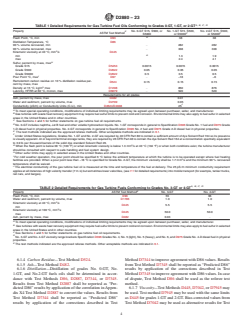
This specification covers the selection of fuels for gas turbines, excepting gas turbines used in aircraft, for the guidance of interested parties such as turbine manufacturers and the suppliers and purchasers of fuel oils. The specification sets forth the properties of fuels at the time and place of custody transfer to the user. The fuels shall be homogeneous mixtures of hydrocarbon oils free of inorganic acid, and free of excessive amounts of solid or fibrous foreign matter likely to make frequent cleaning of suitable strainers necessary. All grades containing residual components shall remain homogeneous in normal storage and not separated by gravity into light and heavy oil components outside the viscosity limits for the grade. The following test methods shall be performed to determine certain properties: flash point test, pour point test, water and sediment test, carbon residue test, ash test, distillation test, viscosity test, density test, and sulfur test.
SCOPE
1.1 This specification covers the grades of fuels for gas turbines, excepting gas turbines used in aircraft, for the guidance of interested parties such as turbine manufacturers and the suppliers and purchasers of fuel oils. These grades are described as follows:
1.1.1 Grades No. 0-GT S5000, No. 0-GT S500, and No. 0-GT S15 includes naphtha, Jet B, and other light hydrocarbon liquids that characteristically have low flash point and low viscosity as compared with kerosine and fuel oils.
1.1.2 Grades No. 1-GT S5000, No. 1-GT S500, and No. 1-GT S15 are a light distillate fuel oil suitable for use in nearly all gas turbines.
1.1.3 Grades No. 2-GT S5000, No. 2-GT S500, and No. 2-GT S15, which is a heavier distillate than Grade No. 1-GT, can be used by gas turbines not requiring the clean burning characteristics of Grade No. 1-GT. Fuel heating equipment may be required by the gas turbine depending on the fuel system design or ambient temperature conditions, or both.
1.1.4 Grade No. 3-GT may be a heavier distillate than Grade No. 2-GT, a residual fuel oil that meets the low ash requirements, or a blend of distillate with a residual fuel oil. Fuel heating will be required by the gas turbine in almost every installation.
1.1.5 Grade No. 4-GT includes most residuals and some topped crudes. Because of the wide variation and lack of control of properties, the gas turbine manufacturer should be consulted with regard to acceptable limits on properties.
1.2 Three appendixes are provided for informational purposes only and do not constitute a requirement of this specification unless mutually agreed upon between the interested parties.
1.2.1 Appendix X1 describes the five grades of gas turbine fuels covered by this specification. Further, it states the significance of various test methods used in inspecting the fuels.
1.2.2 Appendix X2 discusses the sources of fuel contaminants and notes the significance of such contaminants in the operation of gas turbines and gas turbine fuel systems. The particular significance of trace metals in gas turbine fuels is noted. Upper limits of trace metals are recommended for the various grades of gas turbine fuels, but these recommended limits do not constitute a requirement of the specification unless mutually agreed upon by the interested parties. Limitations due to the use of used or recycled oil are also noted.
Note 1: The gas turbine operator should consult Practice D4418 for methods of ensuring fuels of adequate cleanliness and for guidance on long-term storage of distillate fuels and on liquids from non-petroleum sources as gas turbine.
Note 2: The generation and dissipation of static electricity can create problems in the handling of distillate gas turbine fuel oils. For more information on the subject, see Guide D4865.
1.3 This specification, unless otherwise provided by agreement between the purchaser and the supplier, prescribes the required properties of gas turbine fuel oils at t...
- Status
- Published
- Publication Date
- 14-Jan-2023
- Technical Committee
- D02 - Petroleum Products, Liquid Fuels, and Lubricants
- Drafting Committee
- D02.E0 - Burner, Diesel and Non-Aviation Gas Turbine Fuels
Overview
ASTM D2880-23: Standard Specification for Gas Turbine Fuel Oils provides comprehensive guidelines for the selection, classification, and quality requirements of fuel oils used in gas turbines (excluding aircraft turbines). Developed by ASTM International, this standard helps ensure reliable performance, safety, and compliance for turbine manufacturers, fuel suppliers, and purchasers. It details the physical and chemical properties required of gas turbine fuels at the point of custody transfer, addresses contamination issues, and references a suite of ASTM test methods for fuel characterization.
Gas turbine fuel oils covered by this specification are predominately homogeneous hydrocarbon mixtures free of excessive inorganic acids and contaminants. The standard defines distinct fuel grades, each suited for specific turbine designs and operational conditions.
Key Topics
Fuel Grades and Properties
- Definitions for Grades 0-GT through 4-GT, differentiating by composition (from light distillates such as naphtha to residual fuels) and performance characteristics.
- Sulfur content classifications (e.g., S15, S500, S5000), critical for meeting regulatory and operational requirements.
Test Methods
- Reference to accredited ASTM fuel test methods for flash point, pour point, water and sediment, carbon residue, ash, distillation, viscosity, density, sulfur, and lubricity.
- Ensures that fuels meet specified performance and cleanliness criteria at the point of delivery.
Contaminant Management
- Discussion of allowable fuel contaminants, limits on trace metals, and best practices to minimize water, particulates, and microbial activity in storage and distribution.
Operational Guidance
- Emphasis on the need for fuel heating for heavier grades.
- Consideration of local and federal regulations which may further restrict allowable properties or contaminants.
Applications
The ASTM D2880-23 standard is widely applied across industries and energy sectors utilizing stationary or non-aviation gas turbines:
- Power Generation: Specifying suitable fuel grades ensures operational consistency, efficiency, and longevity for gas turbines in power plants.
- Industrial Operations: Manufacturing facilities leveraging gas turbines for onsite power or mechanical energy benefit from the reliability ensured by adhering to ASTM D2880-23 guidelines.
- Utility and Municipal Installations: Water treatment plants, district heating, and other critical infrastructure employ this standard to safeguard critical energy assets.
Practical implementation:
- Fuel Procurement: Fuel suppliers and purchasers use ASTM D2880-23 to specify and evaluate fuel quality before contracting and shipment.
- Quality Assurance: Turbine operators verify compliance using prescribed ASTM test methods and manage contamination risks as per the guidance.
- Maintenance Practices: Specification-compliant fuels help reduce fouling, corrosion, and unplanned downtime, supporting lifecycle management of turbine assets.
Related Standards
ASTM D2880-23 references and aligns with several other key standards in the field of petroleum products:
- ASTM D396: Specification for Fuel Oils
- ASTM D975: Specification for Diesel Fuel Oils
- ASTM D4418: Practices for Fuel Receipt, Storage, and Handling for Gas Turbines
- ASTM D4865: Guide for Generation and Dissipation of Static Electricity in Petroleum Fuel Systems
- ASTM Test Methods D93, D97, D445, D4294, D524, D2709, D6079 (and others): For measuring individual fuel properties essential to turbine operation.
In addition, users should ensure compliance with any applicable federal, state, or local regulations, which may impose stricter requirements for certain properties (notably sulfur content or dyeing).
Keywords: gas turbine fuel oils, ASTM D2880, fuel oil specification, fuel grades, turbine fuel testing, fuel contaminants, sulfur content, fuel oil properties, ASTM fuel standards, power generation fuels, industrial turbine fuels, petroleum product testing.
Relations
- Effective Date
- 01-Apr-2024
- Effective Date
- 01-Mar-2024
- Effective Date
- 15-Dec-2023
- Effective Date
- 01-Dec-2023
- Effective Date
- 01-Dec-2023
- Effective Date
- 01-Dec-2023
- Effective Date
- 01-Dec-2023
- Effective Date
- 01-Nov-2023
- Effective Date
- 01-Nov-2023
- Effective Date
- 01-Nov-2023
- Effective Date
- 01-Jul-2023
- Effective Date
- 01-Aug-2020
- Refers
ASTM D5985-02(2020) - Standard Test Method for Pour Point of Petroleum Products (Rotational Method) - Effective Date
- 01-May-2020
- Effective Date
- 15-Dec-2019
- Effective Date
- 01-Jul-2019
Get Certified
Connect with accredited certification bodies for this standard

Element Materials Technology
Materials testing and product certification.

ABS Group Brazil
ABS Group certification services in Brazil.

ABS Quality Evaluations Inc.
American Bureau of Shipping quality certification.
Sponsored listings
Frequently Asked Questions
ASTM D2880-23 is a technical specification published by ASTM International. Its full title is "Standard Specification for Gas Turbine Fuel Oils". This standard covers: ABSTRACT This specification covers the selection of fuels for gas turbines, excepting gas turbines used in aircraft, for the guidance of interested parties such as turbine manufacturers and the suppliers and purchasers of fuel oils. The specification sets forth the properties of fuels at the time and place of custody transfer to the user. The fuels shall be homogeneous mixtures of hydrocarbon oils free of inorganic acid, and free of excessive amounts of solid or fibrous foreign matter likely to make frequent cleaning of suitable strainers necessary. All grades containing residual components shall remain homogeneous in normal storage and not separated by gravity into light and heavy oil components outside the viscosity limits for the grade. The following test methods shall be performed to determine certain properties: flash point test, pour point test, water and sediment test, carbon residue test, ash test, distillation test, viscosity test, density test, and sulfur test. SCOPE 1.1 This specification covers the grades of fuels for gas turbines, excepting gas turbines used in aircraft, for the guidance of interested parties such as turbine manufacturers and the suppliers and purchasers of fuel oils. These grades are described as follows: 1.1.1 Grades No. 0-GT S5000, No. 0-GT S500, and No. 0-GT S15 includes naphtha, Jet B, and other light hydrocarbon liquids that characteristically have low flash point and low viscosity as compared with kerosine and fuel oils. 1.1.2 Grades No. 1-GT S5000, No. 1-GT S500, and No. 1-GT S15 are a light distillate fuel oil suitable for use in nearly all gas turbines. 1.1.3 Grades No. 2-GT S5000, No. 2-GT S500, and No. 2-GT S15, which is a heavier distillate than Grade No. 1-GT, can be used by gas turbines not requiring the clean burning characteristics of Grade No. 1-GT. Fuel heating equipment may be required by the gas turbine depending on the fuel system design or ambient temperature conditions, or both. 1.1.4 Grade No. 3-GT may be a heavier distillate than Grade No. 2-GT, a residual fuel oil that meets the low ash requirements, or a blend of distillate with a residual fuel oil. Fuel heating will be required by the gas turbine in almost every installation. 1.1.5 Grade No. 4-GT includes most residuals and some topped crudes. Because of the wide variation and lack of control of properties, the gas turbine manufacturer should be consulted with regard to acceptable limits on properties. 1.2 Three appendixes are provided for informational purposes only and do not constitute a requirement of this specification unless mutually agreed upon between the interested parties. 1.2.1 Appendix X1 describes the five grades of gas turbine fuels covered by this specification. Further, it states the significance of various test methods used in inspecting the fuels. 1.2.2 Appendix X2 discusses the sources of fuel contaminants and notes the significance of such contaminants in the operation of gas turbines and gas turbine fuel systems. The particular significance of trace metals in gas turbine fuels is noted. Upper limits of trace metals are recommended for the various grades of gas turbine fuels, but these recommended limits do not constitute a requirement of the specification unless mutually agreed upon by the interested parties. Limitations due to the use of used or recycled oil are also noted. Note 1: The gas turbine operator should consult Practice D4418 for methods of ensuring fuels of adequate cleanliness and for guidance on long-term storage of distillate fuels and on liquids from non-petroleum sources as gas turbine. Note 2: The generation and dissipation of static electricity can create problems in the handling of distillate gas turbine fuel oils. For more information on the subject, see Guide D4865. 1.3 This specification, unless otherwise provided by agreement between the purchaser and the supplier, prescribes the required properties of gas turbine fuel oils at t...
ABSTRACT This specification covers the selection of fuels for gas turbines, excepting gas turbines used in aircraft, for the guidance of interested parties such as turbine manufacturers and the suppliers and purchasers of fuel oils. The specification sets forth the properties of fuels at the time and place of custody transfer to the user. The fuels shall be homogeneous mixtures of hydrocarbon oils free of inorganic acid, and free of excessive amounts of solid or fibrous foreign matter likely to make frequent cleaning of suitable strainers necessary. All grades containing residual components shall remain homogeneous in normal storage and not separated by gravity into light and heavy oil components outside the viscosity limits for the grade. The following test methods shall be performed to determine certain properties: flash point test, pour point test, water and sediment test, carbon residue test, ash test, distillation test, viscosity test, density test, and sulfur test. SCOPE 1.1 This specification covers the grades of fuels for gas turbines, excepting gas turbines used in aircraft, for the guidance of interested parties such as turbine manufacturers and the suppliers and purchasers of fuel oils. These grades are described as follows: 1.1.1 Grades No. 0-GT S5000, No. 0-GT S500, and No. 0-GT S15 includes naphtha, Jet B, and other light hydrocarbon liquids that characteristically have low flash point and low viscosity as compared with kerosine and fuel oils. 1.1.2 Grades No. 1-GT S5000, No. 1-GT S500, and No. 1-GT S15 are a light distillate fuel oil suitable for use in nearly all gas turbines. 1.1.3 Grades No. 2-GT S5000, No. 2-GT S500, and No. 2-GT S15, which is a heavier distillate than Grade No. 1-GT, can be used by gas turbines not requiring the clean burning characteristics of Grade No. 1-GT. Fuel heating equipment may be required by the gas turbine depending on the fuel system design or ambient temperature conditions, or both. 1.1.4 Grade No. 3-GT may be a heavier distillate than Grade No. 2-GT, a residual fuel oil that meets the low ash requirements, or a blend of distillate with a residual fuel oil. Fuel heating will be required by the gas turbine in almost every installation. 1.1.5 Grade No. 4-GT includes most residuals and some topped crudes. Because of the wide variation and lack of control of properties, the gas turbine manufacturer should be consulted with regard to acceptable limits on properties. 1.2 Three appendixes are provided for informational purposes only and do not constitute a requirement of this specification unless mutually agreed upon between the interested parties. 1.2.1 Appendix X1 describes the five grades of gas turbine fuels covered by this specification. Further, it states the significance of various test methods used in inspecting the fuels. 1.2.2 Appendix X2 discusses the sources of fuel contaminants and notes the significance of such contaminants in the operation of gas turbines and gas turbine fuel systems. The particular significance of trace metals in gas turbine fuels is noted. Upper limits of trace metals are recommended for the various grades of gas turbine fuels, but these recommended limits do not constitute a requirement of the specification unless mutually agreed upon by the interested parties. Limitations due to the use of used or recycled oil are also noted. Note 1: The gas turbine operator should consult Practice D4418 for methods of ensuring fuels of adequate cleanliness and for guidance on long-term storage of distillate fuels and on liquids from non-petroleum sources as gas turbine. Note 2: The generation and dissipation of static electricity can create problems in the handling of distillate gas turbine fuel oils. For more information on the subject, see Guide D4865. 1.3 This specification, unless otherwise provided by agreement between the purchaser and the supplier, prescribes the required properties of gas turbine fuel oils at t...
ASTM D2880-23 is classified under the following ICS (International Classification for Standards) categories: 75.160.20 - Liquid fuels. The ICS classification helps identify the subject area and facilitates finding related standards.
ASTM D2880-23 has the following relationships with other standards: It is inter standard links to ASTM D445-24, ASTM D6749-24, ASTM D975-23a, ASTM D7094-23, ASTM D86-23a, ASTM D86-23ae1, ASTM D7345-23, ASTM D4865-23, ASTM D7945-23, ASTM D445-23, ASTM D2887-23, ASTM D93-20, ASTM D5985-02(2020), ASTM D396-19a, ASTM D5453-19a. Understanding these relationships helps ensure you are using the most current and applicable version of the standard.
ASTM D2880-23 is available in PDF format for immediate download after purchase. The document can be added to your cart and obtained through the secure checkout process. Digital delivery ensures instant access to the complete standard document.
Standards Content (Sample)
This international standard was developed in accordance with internationally recognized principles on standardization established in the Decision on Principles for the
Development of International Standards, Guides and Recommendations issued by the World Trade Organization Technical Barriers to Trade (TBT) Committee.
Designation: D2880 − 23
Standard Specification for
Gas Turbine Fuel Oils
This standard is issued under the fixed designation D2880; the number immediately following the designation indicates the year of
original adoption or, in the case of revision, the year of last revision. A number in parentheses indicates the year of last reapproval. A
superscript epsilon (´) indicates an editorial change since the last revision or reapproval.
This standard has been approved for use by agencies of the U.S. Department of Defense.
1. Scope* 1.2.2 Appendix X2 discusses the sources of fuel contami-
nants and notes the significance of such contaminants in the
1.1 This specification covers the grades of fuels for gas
operation of gas turbines and gas turbine fuel systems. The
turbines, excepting gas turbines used in aircraft, for the
particular significance of trace metals in gas turbine fuels is
guidance of interested parties such as turbine manufacturers
noted. Upper limits of trace metals are recommended for the
and the suppliers and purchasers of fuel oils. These grades are
various grades of gas turbine fuels, but these recommended
described as follows:
limits do not constitute a requirement of the specification
1.1.1 Grades No. 0-GT S5000, No. 0-GT S500, and No.
unless mutually agreed upon by the interested parties. Limita-
0-GT S15 includes naphtha, Jet B, and other light hydrocarbon
tions due to the use of used or recycled oil are also noted.
liquids that characteristically have low flash point and low
viscosity as compared with kerosine and fuel oils.
NOTE 1—The gas turbine operator should consult Practice D4418 for
methods of ensuring fuels of adequate cleanliness and for guidance on
1.1.2 Grades No. 1-GT S5000, No. 1-GT S500, and No.
long-term storage of distillate fuels and on liquids from non-petroleum
1-GT S15 are a light distillate fuel oil suitable for use in nearly
sources as gas turbine.
all gas turbines.
NOTE 2—The generation and dissipation of static electricity can create
1.1.3 Grades No. 2-GT S5000, No. 2-GT S500, and No.
problems in the handling of distillate gas turbine fuel oils. For more
2-GT S15, which is a heavier distillate than Grade No. 1-GT, information on the subject, see Guide D4865.
can be used by gas turbines not requiring the clean burning
1.3 This specification, unless otherwise provided by agree-
characteristics of Grade No. 1-GT. Fuel heating equipment
ment between the purchaser and the supplier, prescribes the
may be required by the gas turbine depending on the fuel
required properties of gas turbine fuel oils at the time and place
system design or ambient temperature conditions, or both.
of delivery.
1.1.4 Grade No. 3-GT may be a heavier distillate than Grade
1.4 Nothing in this specification shall preclude observance
No. 2-GT, a residual fuel oil that meets the low ash
of federal, state, or local regulations which may be more
requirements, or a blend of distillate with a residual fuel oil.
restrictive.
Fuel heating will be required by the gas turbine in almost every
1.5 This international standard was developed in accor-
installation.
dance with internationally recognized principles on standard-
1.1.5 Grade No. 4-GT includes most residuals and some
ization established in the Decision on Principles for the
topped crudes. Because of the wide variation and lack of
Development of International Standards, Guides and Recom-
control of properties, the gas turbine manufacturer should be
mendations issued by the World Trade Organization Technical
consulted with regard to acceptable limits on properties.
Barriers to Trade (TBT) Committee.
1.2 Three appendixes are provided for informational pur-
poses only and do not constitute a requirement of this specifi-
2. Referenced Documents
cation unless mutually agreed upon between the interested
2.1 ASTM Standards:
parties.
D56 Test Method for Flash Point by Tag Closed Cup Tester
1.2.1 Appendix X1 describes the five grades of gas turbine
D86 Test Method for Distillation of Petroleum Products and
fuels covered by this specification. Further, it states the
Liquid Fuels at Atmospheric Pressure
significance of various test methods used in inspecting the
D93 Test Methods for Flash Point by Pensky-Martens
fuels.
Closed Cup Tester
D97 Test Method for Pour Point of Petroleum Products
This specification is under the jurisdiction of ASTM Committee D02 on
Petroleum Products, Liquid Fuels, and Lubricants and is the direct responsibility of
Subcommittee D02.E0 on Burner, Diesel and Non-Aviation Gas Turbine Fuels. For referenced ASTM standards, visit the ASTM website, www.astm.org, or
Current edition approved Jan. 15, 2023. Published May 2023. Originally contact ASTM Customer Service at service@astm.org. For Annual Book of ASTM
approved in 1970. Last previous edition approved in 2020 as D2880 – 20. DOI: Standards volume information, refer to the standard’s Document Summary page on
10.1520/D2880-23. the ASTM website.
*A Summary of Changes section appears at the end of this standard
Copyright © ASTM International, 100 Barr Harbor Drive, PO Box C700, West Conshohocken, PA 19428-2959. United States
D2880 − 23
D129 Test Method for Sulfur in Petroleum Products (Gen- D5985 Test Method for Pour Point of Petroleum Products
eral High Pressure Decomposition Device Method) (Rotational Method)
D6079 Test Method for Evaluating Lubricity of Diesel Fuels
D396 Specification for Fuel Oils
D445 Test Method for Kinematic Viscosity of Transparent by the High-Frequency Reciprocating Rig (HFRR)
D6469 Guide for Microbial Contamination in Fuels and Fuel
and Opaque Liquids (and Calculation of Dynamic Viscos-
Systems
ity)
D6728 Test Method for Determination of Contaminants in
D482 Test Method for Ash from Petroleum Products
Gas Turbine and Diesel Engine Fuel by Rotating Disc
D524 Test Method for Ramsbottom Carbon Residue of
Electrode Atomic Emission Spectrometry
Petroleum Products
D6749 Test Method for Pour Point of Petroleum Products
D975 Specification for Diesel Fuel
(Automatic Air Pressure Method)
D1266 Test Method for Sulfur in Petroleum Products (Lamp
D7039 Test Method for Sulfur in Gasoline, Diesel Fuel, Jet
Method)
Fuel, Kerosine, Biodiesel, Biodiesel Blends, and
D1298 Test Method for Density, Relative Density, or API
Gasoline-Ethanol Blends by Monochromatic Wavelength
Gravity of Crude Petroleum and Liquid Petroleum Prod-
Dispersive X-ray Fluorescence Spectrometry
ucts by Hydrometer Method
D7042 Test Method for Dynamic Viscosity and Density of
D1552 Test Method for Sulfur in Petroleum Products by
Liquids by Stabinger Viscometer (and the Calculation of
High Temperature Combustion and Infrared (IR) Detec-
Kinematic Viscosity)
tion or Thermal Conductivity Detection (TCD)
D7094 Test Method for Flash Point by Modified Continu-
D1796 Test Method for Water and Sediment in Fuel Oils by
ously Closed Cup (MCCCFP) Tester
the Centrifuge Method (Laboratory Procedure)
D7220 Test Method for Sulfur in Automotive, Heating, and
D2622 Test Method for Sulfur in Petroleum Products by
Jet Fuels by Monochromatic Energy Dispersive X-ray
Wavelength Dispersive X-ray Fluorescence Spectrometry
Fluorescence Spectrometry
D2624 Test Methods for Electrical Conductivity of Aviation
D7344 Test Method for Distillation of Petroleum Products
and Distillate Fuels
and Liquid Fuels at Atmospheric Pressure (Mini Method)
D2709 Test Method for Water and Sediment in Middle
D7345 Test Method for Distillation of Petroleum Products
Distillate Fuels by Centrifuge
and Liquid Fuels at Atmospheric Pressure (Micro Distil-
D2887 Test Method for Boiling Range Distribution of Pe-
lation Method)
troleum Fractions by Gas Chromatography
D7346 Test Method for No Flow Point and Pour Point of
D3605 Test Method for Trace Metals in Gas Turbine Fuels
Petroleum Products and Liquid Fuels
by Atomic Absorption and Flame Emission Spectroscopy
D7688 Test Method for Evaluating Lubricity of Diesel Fuels
D3828 Test Methods for Flash Point by Small Scale Closed
by the High-Frequency Reciprocating Rig (HFRR) by
Cup Tester
Visual Observation
D4052 Test Method for Density, Relative Density, and API
D7945 Test Method for Determination of Dynamic Viscosity
Gravity of Liquids by Digital Density Meter
and Derived Kinematic Viscosity of Liquids by Constant
D4057 Practice for Manual Sampling of Petroleum and
Pressure Viscometer
Petroleum Products
E29 Practice for Using Significant Digits in Test Data to
D4177 Practice for Automatic Sampling of Petroleum and
Determine Conformance with Specifications
Petroleum Products
2.2 Other Documents:
D4294 Test Method for Sulfur in Petroleum and Petroleum
26 CFR Part 48 Diesel Fuel Excise Tax; Dye Color and
Products by Energy Dispersive X-ray Fluorescence Spec-
Concentration
trometry
40 CFR Part 80 Regulation of Fuels and Fuel Additives
D4306 Practice for Aviation Fuel Sample Containers for
Tests Affected by Trace Contamination
3. Terminology
D4308 Test Method for Electrical Conductivity of Liquid
3.1 Definitions:
Hydrocarbons by Precision Meter
3.1.1 contamination, n—any process which introduces con-
D4418 Practice for Receipt, Storage, and Handling of Fuels
taminants into the fuel.
for Gas Turbines
3.1.2 fuel contaminant, n—material not intended to be
D4865 Guide for Generation and Dissipation of Static Elec-
present in a fuel, whether introduced during manufacture,
tricity in Petroleum Fuel Systems
handling, distribution or storage, that makes the fuel less
D5453 Test Method for Determination of Total Sulfur in
suitable for the intended use.
Light Hydrocarbons, Spark Ignition Engine Fuel, Diesel
3.1.2.1 Discussion—Contaminants, which can be soluble in
Engine Fuel, and Engine Oil by Ultraviolet Fluorescence
the fuel or insoluble (suspended liquid droplets or solid or
D5854 Practice for Mixing and Handling of Liquid Samples
semi-solid particles), can be the result of improper processing
of Petroleum and Petroleum Products
or contamination by a wide range of materials including water,
D5949 Test Method for Pour Point of Petroleum Products
(Automatic Pressure Pulsing Method)
D5950 Test Method for Pour Point of Petroleum Products
Available from Superintendent of Documents, U. S. Government Printing
(Automatic Tilt Method) Office, Washington, DC 20402.
D2880 − 23
rust, airblown dust, deterioration of internal protective coatings 4.2 All grades containing residual components shall remain
on pipes or vessels and products of fuel degradation and homogeneous in normal storage and not separated by gravity
microbial growth. into light and heavy oil components outside the viscosity limits
3.1.2.2 Discussion—Solid or semisolid contaminants can be for the grade.
referred to as silt or sediment.
5. Detailed Requirements
3.1.3 hydrocarbon oil, n—a homogeneous mixture with
5.1 The various grades of gas turbine fuel oil shall conform
elemental composition primarily of carbon and hydrogen that
to the limiting requirements shown in Tables 1 and 2. As noted
may also contain sulfur, oxygen, or nitrogen from residual
in the supplementary footnotes to Table 1, the requirements for
impurities and contaminants associated with the fuel’s raw
Grade Nos. 1-GT and 2-GT conform in most respects to
materials and manufacturing processes and excluding added
corresponding Grade Nos. 1 and 2 fuels in Specification D396,
oxygenated materials.
and to Grade Nos. 1-D and 2-D in Specification D975. The
3.1.3.1 Discussion—Neither macro nor micro emulsions are viscosity range of Grade Nos. 3-GT and 4-GT fuel brackets the
included in this definition since neither are homogeneous Grade Nos. 4, 5, and 6 of Specification D396 and Grade No.
mixtures. 4-D of Specification D975. It is the intent that fuels meeting
Specification D396 and D975 requirements may also be
3.1.3.2 Discussion—Examples of excluded oxygenated ma-
terials are alcohols, esters, ethers, and triglycerides. supplied under these specifications provided they meet the
requirements listed in Tables 1 and 2.
3.1.3.3 Discussion—The hydrocarbon oil may be manufac-
tured from a variety of raw materials, for example, petroleum
5.2 Modifications of limiting requirements and the inclusion
(crude oil), oil sands, natural gas, coal and biomass. Appendix
of fuel additives to meet special operating conditions may be
X3 discusses some matters for consideration regarding the use
agreed upon between the interested parties.
of fuel oils from feedstocks other than petroleum.
5.3 The properties listed in this specification are those of
3.1.4 S(numerical specification maximum), n—a part of the
greatest significance in obtaining acceptable performance of
grade name that states the maximum sulfur content in ppm by
the turbine. However, trace metals, even in fractional parts per
mass (mg/kg) allowed by this specification and formatted as S
million, are detrimental to gas turbine service life. Information
followed with no space by the numerical sulfur maximum.
on the maximum concentration of critical metallic elements in
3.1.4.1 Discussion—Of the eleven fuel grades specified in
the fuel as it enters the turbine combustor(s) is provided in
this specification, nine have important distinguishing maxi-
Appendix X2. Distillate fuels are usually of satisfactory purity
mum sulfur regulatory requirements: Grades 0-GT S5000,
as refined, but suppliers rarely have control over possible
0-GT S500, 0-GT S15; No. 1-GT S5000, No. 1-GT S500, No.
contamination by trace metals in distribution and storage. The
1-GT S15; No. 2-GT S5000, No. 2-GT S500, and No. 2-GT
limits in Appendix X2, although required as the fuel enters the
S15. The remaining grades are distinguished from these grades
combustor(s), do not apply to the fuel as delivered unless
by other major properties in addition to sulfur (unregulated
mutually agreed upon by the interested parties. Fuels may,
levels), and therefore are not included in this designation
therefore, require on-site clean-up, quality control procedures,
system.
special handling, or other arrangements.
-4
3.1.4.2 Discussion—mg/kg is equivalent to μg/g, 1×10 %
by mass, and mass fraction 0.000001.
6. Test Methods
3.1.4.3 Discussion—Most, but not all, test methods to de-
6.1 The requirements enumerated in this specification shall
termine sulfur content mentioned in this specification produce
be determined in accordance with the following ASTM meth-
results in units of mg/kg. Consult the test method in use to
ods except as noted:
determine units for a particular result.
6.1.1 Flash Point—Test Methods D93, except where other
methods are prescribed by law. For all grades, Test Method
3.2 Definitions of Terms Specific to This Standard:
D3828 and D7094 may be used as an alternative with the same
3.2.1 fuel entering the combustor(s), n—the fuel that is
limits. For Grades No. 1-GT and No. 2-GT, Test Method D56
actually burned in the gas turbine. Fuel may be sampled at a
may be used as an alternative with the same limits provided the
point upstream from the point of entry into the combustor(s),
flash point is below 93 °C and the viscosity is below 5.5 mm /s
provided the sample is representative of the fuel actually
at 40 °C. This test method will give slightly lower values. In
entering the combustor(s).
case of dispute, Test Method D93 shall be used as the referee
method.
4. General Requirements
6.1.2 Pour Point—Test Method D97. For all grades, the
4.1 The grades of gas turbine fuels herein specified shall be
automatic Test Methods D5949, D5950, D5985, or D7346 may
hydrocarbon oils with the use of additives to enhance perfor-
be used as alternates with the same limits. In case of dispute,
mance properties, if required. The hydrocarbon oils shall be
Test Method D97 shall be used as the referee method.
free of inorganic acid, and free of excessive amounts of solid
6.1.3 Water and Sediment—Test Method D2709 is used for
or fibrous foreign matter likely to make frequent cleaning of
Grades 0-GT, 1-GT, and 2-GT. Test Method D1796 is used for
suitable strainers necessary.
Grades 3-GT and 4-GT.
NOTE 3—Additives are generally included in finished gas turbine fuel
oil to improve performance properties (corrosion and anti-corrosion, and
so forth). Other mutually acceptable methods may be used.
D2880 − 23
A, B, C, D
TABLE 1 Detailed Requirements for Gas Turbine Fuel Oils Conforming to Grades 0-GT, 1-GT, or 2-GT
Property No. 0-GT S15, S500, or No. 1-GT S15, S500, No. 2-GT S15, S500,
E
ASTM Test Method
F F
S5000 or S5000 or S5000
G
Flash Point, °C, min D93 38 38
Distillation Temperature, °C D86
90 % volume recovered, min { 282 282
90 % volume recovered, max { 338 338
Kinematic viscosity at 40 °C, mm /s D445
G
min 1.3 1.9
max 2.4 4.1
H
Sulfur, percent by mass, max
Grade S15 D5453 0.0015 0.0015 0.0015
Grade S500 D2622 0.05 0.05 0.05
Grade S5000 D2622 0.5 0.5 0.5
I
Pour Point °C, max D97 { –18 –6
Ramsbottom carbon residue on 10 % distillation residue per-
D524 0.15 0.15 0.15
cent by mass, max
Density at 15 °C, kg/m max D1298 { 850 876
Lubricity, HFRR at 60 °C, micron, max D6079 { 520 520
Requirements for all grades
Ash, percent by mass, max D482 0.01
Water and sediment, percent by volume, max D2709 0.05
J
Conductivity (pS/m) or Conductivity Units (C.U.), min D2624/D4308 25
A
To meet special operating conditions, modifications of individual limiting requirements may be agreed upon between purchaser, seller, and manufacturer.
B
Gas turbines with waste heat recovery equipment may require fuel sulfur limits to prevent cold end corrosion. Environmental limits may also apply to fuel sulfur in selected
areas in the United States and in other countries.
C
See Sections 4 and 5 for further statements on gas turbine fuel oil requirements.
D
No. 0-GT includes naphtha, Jet B fuel and other volatile hydrocarbon liquids. No. 1-GT corresponds in general to Specification D396 Grade No. 1 fuel and D975 Grade
1-D diesel fuel in physical properties. No. 2-GT corresponds in general to Specification D396 No. 2 fuel and D975 Grade 2-D diesel fuel in physical properties.
E
The test methods indicated are the approved referee methods. Other acceptable methods are indicated in 6.1.
F
Under United States regulations, Grades No. 1-GT and No. 2-GT are required by 40 CFR Part 80 to contain a sufficient amount of dye Solvent Red 164 so its presence
is visually apparent. At or beyond terminal storage tanks, they are required by 26 CFR Part 48 to contain the dye Solvent Red 164 at a concentration spectrally equivalent
to 3.9 lb per thousand barrels of the solid dye standard Solvent Red 26.
G 2
When the flash point is below 38 °C (100 °F) or when kinematic viscosity is below 1.3 mm /s at 40 °C (104 °F) or when both conditions exist, the turbine manufacturer
should be consulted with respect to safe handling and fuel system design.
H
Other sulfur limits may apply in selected areas in the United States and other countries.
I
For cold weather operation, the pour point should be specified 6 °C below the ambient temperature at which the turbine is to be operated except where fuel heating
facilities are provided. When a pour point less than –18 °C is specified for Grade No. 2-GT, the minimum viscosity shall be 1.7 mm /s and the minimum 90 % recovered
temperature shall be waived.
J
The electrical conductivity of the gas turbine fuel oil is measured at the time and temperature of the fuel at delivery. The 25 pS ⁄m minimum conductivity requirement
applies at all instances of high velocity transfer (7 m ⁄s) but sometimes lower velocities, (see 7.1 for detailed requirements) into mobile transport (for example, tanker trucks,
rail cars, and barges).
A, B, C, D
TABLE 2 Detailed Requirements for Gas Turbine Fuels Conforming to Grades No. 3-GT or 4-GT
E
Property ASTM Test Method No. 3-GT No. 4-GT
Flash Point, °C, min D93 55 66
Water and sediment, percent by volume, max D1796 1.0 1.0
Kinematic viscosity at 40 °C, mm /s
D445 5.5 5.5
min
Kinematic viscosity at 100 °C, mm /s
D445 50.0 50.0
max
Ash, percent by mass, max D482 0.03 {
A
To meet special operating conditions, modifications of individual limiting requirements may be agreed upon between purchaser, seller, and manufacturer.
B
Gas turbines with waste heat recovery equipment may require fuel sulfur limits to prevent cold end corrosion. Environmental limits may also apply to fuel sulfur in selected
areas in the United States and in other countries.
C
See Sections 4 and 5 for further statements on gas turbine fuel oil requirements.
D
No. 3-GT and No. 4-GT viscosity range brackets Specification D396 Grades No. 4, No. 5 (light), No. 5 (heavy), and No. 6, and D975 Grade No. 4-D diesel fuel in physical
properties.
E
The test methods indicated are the approved referee methods. Other acceptable methods are indicated in 6.1.
6.1.4 Carbon Residue—Test Method D524. Method D7344 to improve agreement with D86 values. Results
6.1.5 Ash—Test Method D482. from Test Method D7345 shall be reported as “Predicted D86”
6.1.6 Distillation—Distillation of grades No. 0-GT, No. results by application of the corrections described in Test
1-GT, and No.2-GT fuels oils shall be determined in accor- Method D7345 to improve agreement with D86 values. In case
dance with Test Methods D86, D2887, D7344, or D7345. of dispute, Test Method D86 shall be used as the referee test
Results from Test Method D2887 shall be reported as “Pre- method.
dicted D86” results by application of the correlation in Appen- 6.1.7 Viscosity—Test Methods D445, D7042, or D7945 may
dix X4 Test Method D2887 to convert the values. Results from be used. Test method D7945 may be used with the same limits
Test Method D7344 shall be reported as “Predicted D86” as D445 for grades 1-GT and 2-GT. Bias-corrected values from
results by application of the corrections described in Test Test Method D7042 may be used as alternative results for Test
D2880 − 23
Method D445. Section 15, Precision and Bias, of Test Method 7. Precautionary Notes on Conductivity
D7042 contains bias-correction information. In case of dispute,
7.1 Accumulation of static charge occurs when a hydrocar-
Test Method D445 shall be used as the referee method.
bon liquid flows with respect to another surface. The electrical
6.1.8 Density—Test Method D1298 or D4052.
conductivity requirement of 25 pS ⁄m minimum at temperature
6.1.9 Sulfur—Test Methods D2622 for all grades except S15
of delivery shall apply when the transfer conditions in Table 4
and D5453 for S15 grades. See Table 3 for alternative test
exist for the delivery into a mobile transport container (for
methods for sulfur and the corresponding fuel grades.
example, tanker trucks, railcars, and barges).
6.1.10 Lubricity—Test Methods D6079 or D7688. Test
Method D6079 shall be the referee method.
8. Keywords
6.1.11 Conductivity—Both conductivity test methods, Test
Methods D2624 and D4308 are allowed for all grades of No. 0-
8.1 fuel oils; gas turbine; petroleum and petroleum products
GT, No. 1-GT, and No. 2-GT fuels. There is no conductivity
requirement for No. 3-GT or No. 4-GT grades.
TABLE 3 Sulfur Test Methods
Sulfur Test Method Grades
D2622 (referee for all grades except S15 grades) All Grades
D129 No. 0-GT S5000, No. 1-GT S5000, No. 2-GT S5000, No. 3-GT, No. 4-GT
D1266 No. 0-GT S500, No. 1-GT S500, No. 2-GT S500
D1552 No. 0-GT S5000, No. 1-GT S5000, No. 2-GT S5000, No. 3-GT, No. 4-GT
D4294 All Grades except S15 grades
D5453 (referee for S15 grades) All Grades
D7039 S15 grades, S500 grades, S5000 grades only if the sulfur result is 2822 mg/kg or less
D7220 S15 grade, S500 grades
D2880 − 23
TABLE 4 Transfer Conditions
Maximum Pipe Diameter When Filling Tank Truck When Filling Undivided Rail Car
When Filling Marine Vessels
(for a distance of 30 s upstream of delivery nozzle) Compartments Compartments
m Fuel Velocity, m/s Fuel Velocity, m/s Fuel Velocity, m/s
0.1023 $4.9 $7.0 $7.0
0.1541 $3.24 $5.20 $7.0
0.2027 $2.47 $3.90 $7.0
0.2545 $1.96 $3.14 $7.0
APPENDIXES
(Nonmandatory Information)
X1. SIGNIFICANCE OF ASTM SPECIFICATIONS FOR GAS TURBINE FUEL OILS
X1.1 Scope control of properties, the gas turbine manufacturer should be
consulted with regard to acceptable limits on properties.
X1.1.1 Thi
...
This document is not an ASTM standard and is intended only to provide the user of an ASTM standard an indication of what changes have been made to the previous version. Because
it may not be technically possible to adequately depict all changes accurately, ASTM recommends that users consult prior editions as appropriate. In all cases only the current version
of the standard as published by ASTM is to be considered the official document.
Designation: D2880 − 20 D2880 − 23
Standard Specification for
Gas Turbine Fuel Oils
This standard is issued under the fixed designation D2880; the number immediately following the designation indicates the year of
original adoption or, in the case of revision, the year of last revision. A number in parentheses indicates the year of last reapproval. A
superscript epsilon (´) indicates an editorial change since the last revision or reapproval.
This standard has been approved for use by agencies of the U.S. Department of Defense.
1. Scope*
1.1 This specification covers the selectiongrades of fuels for gas turbines, excepting gas turbines used in aircraft, for the guidance
of interested parties such as turbine manufacturers and the suppliers and purchasers of fuel oils. The specification sets forth the
properties of fuels at the time and place of custody transfer to the user.These grades are described as follows:
1.1.1 Grades No. 0-GT S5000, No. 0-GT S500, and No. 0-GT S15 includes naphtha, Jet B, and other light hydrocarbon liquids
that characteristically have low flash point and low viscosity as compared with kerosine and fuel oils.
1.1.2 Grades No. 1-GT S5000, No. 1-GT S500, and No. 1-GT S15 are a light distillate fuel oil suitable for use in nearly all gas
turbines.
1.1.3 Grades No. 2-GT S5000, No. 2-GT S500, and No. 2-GT S15, which is a heavier distillate than Grade No. 1-GT, can be used
by gas turbines not requiring the clean burning characteristics of Grade No. 1-GT. Fuel heating equipment may be required by the
gas turbine depending on the fuel system design or ambient temperature conditions, or both.
1.1.4 Grade No. 3-GT may be a heavier distillate than Grade No. 2-GT, a residual fuel oil that meets the low ash requirements,
or a blend of distillate with a residual fuel oil. Fuel heating will be required by the gas turbine in almost every installation.
1.1.5 Grade No. 4-GT includes most residuals and some topped crudes. Because of the wide variation and lack of control of
properties, the gas turbine manufacturer should be consulted with regard to acceptable limits on properties.
1.2 Three appendixes are provided for informational purposes only and do not constitute a requirement of this specification unless
mutually agreed upon between the interested parties.
1.2.1 Appendix X1 describes the five grades of gas turbine fuels covered by this specification. Further, it states the significance
of various test methods used in inspecting the fuels.
1.2.2 Appendix X2 discusses the sources of fuel contaminants and notes the significance of such contaminants in the operation
of gas turbines and gas turbine fuel systems. The particular significance of trace metals in gas turbine fuels is noted. Upper limits
of trace metals are recommended for the various grades of gas turbine fuels, but these recommended limits do not constitute a
requirement of the specification unless mutually agreed upon by the interested parties. Limitations due to the use of used or
recycled oil are also noted.
This specification is under the jurisdiction of ASTM Committee D02 on Petroleum Products, Liquid Fuels, and Lubricants and is the direct responsibility of Subcommittee
D02.E0 on Burner, Diesel and Non-Aviation Gas Turbine Fuels.
Current edition approved May 1, 2020Jan. 15, 2023. Published May 2020May 2023. Originally approved in 1970. Last previous edition approved in 20182020 as
D2880 – 18a.D2880 – 20. DOI: 10.1520/D2880-20.10.1520/D2880-23.
*A Summary of Changes section appears at the end of this standard
Copyright © ASTM International, 100 Barr Harbor Drive, PO Box C700, West Conshohocken, PA 19428-2959. United States
D2880 − 23
NOTE 1—The gas turbine operator should consult Practice D4418 for methods of ensuring fuels of adequate cleanliness and for guidance on long-term
storage of distillate fuels and on liquids from non-petroleum sources as gas turbine.
NOTE 2—Nothing in this specification shall preclude observance of federal, state, or local regulations which may be more restrictive.
NOTE 2—The generation and dissipation of static electricity can create problems in the handling of distillate gas turbine fuel oils. For more information
on the subject, see Guide D4865.
1.3 This specification, unless otherwise provided by agreement between the purchaser and the supplier, prescribes the required
properties of gas turbine fuel oils at the time and place of delivery.
1.4 Nothing in this specification shall preclude observance of federal, state, or local regulations which may be more restrictive.
1.5 This international standard was developed in accordance with internationally recognized principles on standardization
established in the Decision on Principles for the Development of International Standards, Guides and Recommendations issued
by the World Trade Organization Technical Barriers to Trade (TBT) Committee.
2. Referenced Documents
2.1 ASTM Standards:
D56 Test Method for Flash Point by Tag Closed Cup Tester
D86 Test Method for Distillation of Petroleum Products and Liquid Fuels at Atmospheric Pressure
D93 Test Methods for Flash Point by Pensky-Martens Closed Cup Tester
D97 Test Method for Pour Point of Petroleum Products
D129 Test Method for Sulfur in Petroleum Products (General High Pressure Decomposition Device Method)
D396 Specification for Fuel Oils
D445 Test Method for Kinematic Viscosity of Transparent and Opaque Liquids (and Calculation of Dynamic Viscosity)
D482 Test Method for Ash from Petroleum Products
D524 Test Method for Ramsbottom Carbon Residue of Petroleum Products
D975 Specification for Diesel Fuel
D1266 Test Method for Sulfur in Petroleum Products (Lamp Method)
D1298 Test Method for Density, Relative Density, or API Gravity of Crude Petroleum and Liquid Petroleum Products by
Hydrometer Method
D1552 Test Method for Sulfur in Petroleum Products by High Temperature Combustion and Infrared (IR) Detection or Thermal
Conductivity Detection (TCD)
D1796 Test Method for Water and Sediment in Fuel Oils by the Centrifuge Method (Laboratory Procedure)
D2622 Test Method for Sulfur in Petroleum Products by Wavelength Dispersive X-ray Fluorescence Spectrometry
D2624 Test Methods for Electrical Conductivity of Aviation and Distillate Fuels
D2709 Test Method for Water and Sediment in Middle Distillate Fuels by Centrifuge
D2887 Test Method for Boiling Range Distribution of Petroleum Fractions by Gas Chromatography
D3605 Test Method for Trace Metals in Gas Turbine Fuels by Atomic Absorption and Flame Emission Spectroscopy
D3828 Test Methods for Flash Point by Small Scale Closed Cup Tester
D4052 Test Method for Density, Relative Density, and API Gravity of Liquids by Digital Density Meter
D4057 Practice for Manual Sampling of Petroleum and Petroleum Products
D4177 Practice for Automatic Sampling of Petroleum and Petroleum Products
D4294 Test Method for Sulfur in Petroleum and Petroleum Products by Energy Dispersive X-ray Fluorescence Spectrometry
D4306 Practice for Aviation Fuel Sample Containers for Tests Affected by Trace Contamination
D4308 Test Method for Electrical Conductivity of Liquid Hydrocarbons by Precision Meter
D4418 Practice for Receipt, Storage, and Handling of Fuels for Gas Turbines
D4865 Guide for Generation and Dissipation of Static Electricity in Petroleum Fuel Systems
D5453 Test Method for Determination of Total Sulfur in Light Hydrocarbons, Spark Ignition Engine Fuel, Diesel Engine Fuel,
and Engine Oil by Ultraviolet Fluorescence
D5854 Practice for Mixing and Handling of Liquid Samples of Petroleum and Petroleum Products
D5949 Test Method for Pour Point of Petroleum Products (Automatic Pressure Pulsing Method)
D5950 Test Method for Pour Point of Petroleum Products (Automatic Tilt Method)
D5985 Test Method for Pour Point of Petroleum Products (Rotational Method)
For referenced ASTM standards, visit the ASTM website, www.astm.org, or contact ASTM Customer Service at service@astm.org. For Annual Book of ASTM Standards
volume information, refer to the standard’s Document Summary page on the ASTM website.
D2880 − 23
D6079 Test Method for Evaluating Lubricity of Diesel Fuels by the High-Frequency Reciprocating Rig (HFRR)
D6469 Guide for Microbial Contamination in Fuels and Fuel Systems
D6728 Test Method for Determination of Contaminants in Gas Turbine and Diesel Engine Fuel by Rotating Disc Electrode
Atomic Emission Spectrometry
D6749 Test Method for Pour Point of Petroleum Products (Automatic Air Pressure Method)
D7039 Test Method for Sulfur in Gasoline, Diesel Fuel, Jet Fuel, Kerosine, Biodiesel, Biodiesel Blends, and Gasoline-Ethanol
Blends by Monochromatic Wavelength Dispersive X-ray Fluorescence Spectrometry
D7042 Test Method for Dynamic Viscosity and Density of Liquids by Stabinger Viscometer (and the Calculation of Kinematic
Viscosity)
D7094 Test Method for Flash Point by Modified Continuously Closed Cup (MCCCFP) Tester
D7220 Test Method for Sulfur in Automotive, Heating, and Jet Fuels by Monochromatic Energy Dispersive X-ray Fluorescence
Spectrometry
D7344 Test Method for Distillation of Petroleum Products and Liquid Fuels at Atmospheric Pressure (Mini Method)
D7345 Test Method for Distillation of Petroleum Products and Liquid Fuels at Atmospheric Pressure (Micro Distillation
Method)
D7346 Test Method for No Flow Point and Pour Point of Petroleum Products and Liquid Fuels
D7688 Test Method for Evaluating Lubricity of Diesel Fuels by the High-Frequency Reciprocating Rig (HFRR) by Visual
Observation
D7945 Test Method for Determination of Dynamic Viscosity and Derived Kinematic Viscosity of Liquids by Constant Pressure
Viscometer
E29 Practice for Using Significant Digits in Test Data to Determine Conformance with Specifications
2.2 Other Documents:
26 CFR Part 48 Diesel Fuel Excise Tax; Dye Color and Concentration
40 CFR Part 80 Regulation of Fuels and Fuel Additives
3. Terminology
3.1 Definitions:
3.1.1 contamination, n—any process which introduces contaminants into the fuel.
3.1.2 fuel contaminant, n—material not intended to be present in a fuel, whether introduced during manufacture, handling,
distribution or storage, that makes the fuel less suitable for the intended use.
3.1.2.1 Discussion—
Contaminants, which can be soluble in the fuel or insoluble (suspended liquid droplets or solid or semi-solid particles), can be the
result of improper processing or contamination by a wide range of materials including water, rust, airblown dust, deterioration of
internal protective coatings on pipes or vessels and products of fuel degradation and microbial growth.
3.1.2.2 Discussion—
Solid or semisolid contaminants can be referred to as silt or sediment.
3.1.3 hydrocarbon oil, n—a homogeneous mixture with elemental composition primarily of carbon and hydrogen that may also
contain sulfur, oxygen, or nitrogen from residual impurities and contaminants associated with the fuel’s raw materials and
manufacturing processes and excluding added oxygenated materials.
3.1.3.1 Discussion—
Neither macro nor micro emulsions are included in this definition since neither are homogeneous mixtures.
3.1.3.2 Discussion—
Examples of excluded oxygenated materials are alcohols, esters, ethers, and triglycerides.
3.1.3.3 Discussion—
The hydrocarbon oil may be manufactured from a variety of raw materials, for example, petroleum (crude oil), oil sands, natural
gas, coal and biomass. Appendix X3 discusses some matters for consideration regarding the use of fuel oils from feedstocks other
than petroleum.
3.1.4 S(numerical specification maximum), n—a part of the grade name that states the maximum sulfur content in ppm by mass
(mg/kg) allowed by this specification and formatted as S followed with no space by the numerical sulfur maximum.
3.1.4.1 Discussion—
Of the eleven fuel grades specified in this specification, nine have important distinguishing maximum sulfur regulatory
Available from Superintendent of Documents, U. S. Government Printing Office, Washington, DC 20402.
D2880 − 23
requirements: Grades 0-GT S5000, 0-GT S500, 0-GT S15; No. 1-GT S5000, No. 1-GT S500, No. 1-GT S15; No. 2-GT S5000,
No. 2-GT S500, and No. 2-GT S15. The remaining grades are distinguished from these grades by other major properties in addition
to sulfur (unregulated levels), and therefore are not included in this designation system.
3.1.4.2 Discussion—
-4
mg/kg is equivalent to μg/g, 1×10 % by mass, and mass fraction 0.000001.
3.1.4.3 Discussion—
Most, but not all, test methods to determine sulfur content mentioned in this specification produce results in units of mg/kg. Consult
the test method in use to determine units for a particular result.
3.2 Definitions of Terms Specific to This Standard:
3.2.1 fuel entering the combustor(s)—combustor(s), n—the fuel that is actually burned in the gas turbine. Fuel may be sampled
at a point upstream from the point of entry into the combustor(s), provided the sample is representative of the fuel actually entering
the combustor(s).
4. General Requirements
4.1 The grades of gas turbine fuels herein specified shall be hydrocarbon oils with the use of additives to enhance performance
properties, if required. The hydrocarbon oils shall be free of inorganic acid, and free of excessive amounts of solid or fibrous
foreign matter likely to make frequent cleaning of suitable strainers necessary.
NOTE 3—Additives are generally included in finished gas turbine fuel oil to improve performance properties (corrosion and anti-corrosion, and so forth).
4.2 All grades containing residual components shall remain homogeneous in normal storage and not separated by gravity into light
and heavy oil components outside the viscosity limits for the grade.
5. Detailed Requirements
5.1 The various grades of gas turbine fuel oil shall conform to the limiting requirements shown in Table 1Tables 1 and 2. As noted
in the supplementary footnotes to Table 1, the requirements for Grade Nos. 1-GT and 2-GT conform in most respects to
corresponding Grade Nos. 1 and 2 fuels in Specification D396, and to Grade Nos. 1-D and 2-D in Specification D975. The viscosity
range of Grade Nos. 3-GT and 4-GT fuel brackets the Grade Nos. 4, 5, and 6 of Specification D396 and Grade No. 4-D of
Specification D975. It is the intent that fuels meeting Specification D396 and D975 requirements may also be supplied under these
specifications provided they meet the requirements listed in Table 1Tables 1 and 2.
5.2 Modifications of limiting requirements and the inclusion of fuel additives to meet special operating conditions may be agreed
upon between the interested parties.
5.3 The properties listed in this specification are those of greatest significance in obtaining acceptable performance of the turbine.
However, trace metals, even in fractional parts per million, are detrimental to gas turbine service life. Information on the maximum
concentration of critical metallic elements in the fuel as it enters the turbine combustor(s) is provided in Appendix X2. Distillate
fuels are usually of satisfactory purity as refined, but suppliers rarely have control over possible contamination by trace metals in
distribution and storage. The limits in Appendix X2, although required as the fuel enters the combustor(s), do not apply to the fuel
as delivered unless mutually agreed upon by the interested parties. Fuels may, therefore, require on-site clean-up, quality control
procedures, special handling, or other arrangements.
6. Test Methods
6.1 The requirements enumerated in this specification shall be determined in accordance with the following ASTM methods except
as noted:
6.1.1 Flash Point—Test Methods D93, except where other methods are prescribed by law. For all grades, Test Method D3828 and
D7094 may be used as an alternative with the same limits. For Grades No. 1-GT and No. 2-GT, Test Method D56 may be used
as an alternative with the same limits provided the flash point is below 93 °C and the viscosity is below 5.5 mm /s at 40 °C. This
test method will give slightly lower values. In case of dispute, Test Method D93 shall be used as the referee method.
Other mutually acceptable methods may be used.
D2880 − 23
A,B,C
TABLE 1 Detailed Requirements for Gas Turbine Fuel Oils at Time and Place of Custody Transfer to User
E
ASTM
Grade
Property Test
F F
D
No. 0-GT No. 1-GT No. 2-GT No. 3-GTNo.
Method
Flash point 55 (130) 66 (150)
D93 38 (100) 38 (100)
G
°C (°F) min
Water and sediment D2709 0.05 0.05 0.05 . .
% vol max D1796 . . . 1.0 1.0
Distillation
Temperature D86
°C (°F)
90 % volume recovered
min . . 282 . .
max . 288 338 . .
Kinematic viscosity
H
2 mm/s D445
G
AT 40 °C (104 °F) min 1.3 1.9 5.5 5.5
max 2.4 4.1 . .
AT 100 °C (212 °F) max . . 50.0 50.0
Ramsbottom
Carbon residue . .
on
D524 0.15 0.15 0.35
10 % distillation
Residue
% mass, max
Ash
% mass, max D482 0.01 0.01 0.01 0.03 .
Density at D1298
15 °C kg/m
max . 850 876
H
Pour point −18 −6
D97 .
°C (°F) max
A, B, C, D
TABLE 1 Detailed Requirements for Gas Turbine Fuel Oils Conforming to Grades 0-GT, 1-GT, or 2-GT
Property No. 0-GT S15, S500, or No. 1-GT S15, S500, No. 2-GT S15, S500,
E
ASTM Test Method
F F
S5000 or S5000 or S5000
Flash Point,
D93 38 38
G
°C, min
Distillation Temperature, °C D86
90 % volume recovered, min { 282 282
90 % volume recovered, max { 338 338
Kinematic viscosity at 40 °C, mm /s D445
G
min 1.3 1.9
max 2.4 4.1
H
Sulfur, percent by mass, max
Grade S15 D5453 0.0015 0.0015 0.0015
Grade S500 D2622 0.05 0.05 0.05
Grade S5000 D2622 0.5 0.5 0.5
I
Pour Point °C, max D97 { –18 –6
Ramsbottom
carbon residue
on D524 0.15 0.15 0.15
10 % distillation
residue percent by mass, max
Density at 15 °C, kg/m max D1298 { 850 876
Lubricity, HFRR at 60 °C, micron, max D6079 { 520 520
Requirements for all grades
Ash, percent by mass, max D482 0.01
Water and sediment, percent by volume, max D2709 0.05
Conductivity (pS/m)
J
D2624/D4308 25
or Conductivity Units (C.U.), min
A
To meet special operating conditions, modifications of individual limiting requirements may be agreed upon between purchaser, seller, and manufacturer.
B
Gas turbines with waste heat recovery equipment may require fuel sulfur limits to prevent cold end corrosion. Environmental limits may also apply to fuel sulfur in selected
areas in the United States and in other countries.
C
See Section See Sections 4 and 5 for further statements on gas turbine fuel oil requirements.
D
The test methods indicated are the approved referee methods. Other acceptable methods are indicated in 6.1.
D
No. 0-GT includes naphtha, Jet B fuel and other volatile hydrocarbon liquids. No. 1-GT corresponds in general to specificationSpecification D396 Grade No. 1 fuel and
D975 Grade 1-D diesel fuel in physical properties. No. 2-GT corresponds in general to Specification D396 No. 2 fuel and D975 Grade 2-D diesel fuel in physical properties.
No. 3-GT and No. 4-GT viscosity range brackets specification D396 Grades No. 4, No. 5 (light), No. 5 (heavy), and No. 6, and D975 Grade No. 4-D diesel fuel in physical
properties.
E
The test methods indicated are the approved referee methods. Other acceptable methods are indicated in 6.1.
F
Under United States regulations, Grades No. 1-GT and No. 2-GT are required by 40 CFR Part 80 to contain a sufficient amount of dye Solvent Red 164 so its presence
is visually apparent. At or beyond terminal storage tanks, they are required by 26 CFR Part 48 to contain the dye Solvent Red 164 at a concentration spectrally equivalent
to 3.9 lb 3.9 lb per thousand barrels of the solid dye standard Solvent Red 26.
G 2
When the flash point is below 38 °C (100 °F) or when kinematic viscosity is below 1.3 mm /s at 40 °C (104 °F) or when both conditions exist, the turbine manufacturer
should be consulted with respect to safe handling and fuel system design.
D2880 − 23
H
Other sulfur limits may apply in selected areas in the United States and other countries.
I
For cold weather operation, the pour point should be specified 6 °C below the ambient temperature at which the turbine is to be operated except where fuel heating
facilities are provided. When a pour point less than −18 °C–18 °C is specified for Grade No. 2-GT, the minimum viscosity shall be 1.7 mm /s and the minimum 90 %
recovered temperature shall be waived.
J
The electrical conductivity of the gas turbine fuel oil is measured at the time and temperature of the fuel at delivery. The 25 pS ⁄m minimum conductivity requirement
applies at all instances of high velocity transfer (7 m ⁄s) but sometimes lower velocities, (see 7.1 for detailed requirements) into mobile transport (for example, tanker trucks,
rail cars, and barges).
A, B, C, D
TABLE 2 Detailed Requirements for Gas Turbine Fuels Conforming to Grades No. 3-GT or 4-GT
E
Property ASTM Test Method No. 3-GT No. 4-GT
Flash Point, °C, min D93 55 66
Water and sediment, percent by volume, max D1796 1.0 1.0
Kinematic viscosity at 40 °C, mm /s
D445 5.5 5.5
min
Kinematic viscosity at 100 °C, mm /s
D445 50.0 50.0
max
Ash, percent by mass, max D482 0.03 {
A
To meet special operating conditions, modifications of individual limiting requirements may be agreed upon between purchaser, seller, and manufacturer.
B
Gas turbines with waste heat recovery equipment may require fuel sulfur limits to prevent cold end corrosion. Environmental limits may also apply to fuel sulfur in selected
areas in the United States and in other countries.
C
See Sections 4 and 5 for further statements on gas turbine fuel oil requirements.
D
No. 3-GT and No. 4-GT viscosity range brackets Specification D396 Grades No. 4, No. 5 (light), No. 5 (heavy), and No. 6, and D975 Grade No. 4-D diesel fuel in physical
properties.
E
The test methods indicated are the approved referee methods. Other acceptable methods are indicated in 6.1.
6.1.2 Pour Point—Test Method D97. For all grades, the automatic Test Methods D5949, D5950, D5985, or D7346 may be used
as alternates with the same limits. In case of dispute, Test Method D97 shall be used as the referee method.
6.1.3 Water and Sediment—Test Method D2709 is used for Grades 0-GT, 1-GT, and 2-GT. Test Method D1796 is used for Grades
3-GT and 4-GT.
6.1.4 Carbon Residue—Test Method D524.
6.1.5 Ash—Test Method D482.
6.1.6 Distillation—Distillation of grades No. 0-GT, No. 1-GT, and No.2-GT fuels oils shall be determined in accordance with Test
Methods D86, D2887, D7344, or D7345. Results from Test Method D2887 shall be reported as “Predicted D86” results by
application of the correlation in Appendix X4 Test Method D2887 to convert the values. Results from Test Method D7344 shall
be reported as “Predicted D86” results by application of the corrections described in Test Method D7344 to improve agreement
with D86 values. Results from Test Method D7345 shall be reported as “Predicted D86” results by application of the corrections
described in Test Method D7345 to improve agreement with D86 values. In case of dispute, Test Method D86 shall be used as the
referee test method.
6.1.7 Viscosity—Test Methods D445, D7042, or D7945 may be used. Test method D7945 may be used with the same limits as
D445 for grades 1-GT and 2-GT. Bias-corrected values from Test Method D7042 may be used as alternative results for Test Method
D445. Section 15, Precision and Bias, of Test Method D7042 contains bias-correction information. In case of dispute, Test Method
D445 shall be used as the referee method.
6.1.8 Density—Test Method D1298 or D4052.
6.1.9 Sulfur—Test MethodTest D129, Test Methods
D1552,D2622, and D2622 D4294 can also be used for all grades. In addition, Test Method for all grades except S15 D1266 can
be used for Grades No. 0 and No. 1, but only with samples having sulfur contents of 0.4 % by mass and less (down to 0.01 %).
Test Method and D5453 can be used for Grades 0, 1, andfor S15 grades. See Table 3 2 GT oils, but only with samples having sulfur
contents of 0.8 % by mass and less (down to 0.001 %). Test Method D7220 may be used for Grades 0, 1, and 2 GT oils, but only
with samples having sulfur contents of 0.942 % by mass and less (down to 0.0003 %). Test Method for alternative D129 is the
referee sulfur test method for Specificationtest methods for sulfur D2880.and the corresponding fuel grades.
6.1.10 Lubricity—Test Methods D6079 or D7688. Test Method D6079 shall be the referee method.
D2880 − 23
TABLE 3 Sulfur Test Methods
Sulfur Test Method Grades
D2622 (referee for all grades except S15 grades) All Grades
D129 No. 0-GT S5000, No. 1-GT S5000, No. 2-GT S5000, No. 3-GT, No. 4-GT
D1266 No. 0-GT S500, No. 1-GT S500, No. 2-GT S500
D1552 No. 0-GT S5000, No. 1-GT S5000, No. 2-GT S5000, No. 3-GT, No. 4-GT
D4294 All Grades except S15 grades
D5453 (referee for S15 grades) All Grades
D7039 S15 grades, S500 grades, S5000 grades only if the sulfur result is 2822 mg/kg or less
D7220 S15 grade, S500 grades
6.1.11 Conductivity—Both conductivity test methods, Test Methods D2624 and D4308 are allowed for all grades of No. 0- GT,
No. 1-GT, and No. 2-GT fuels. There is no conductivity requirement for No. 3-GT or No. 4-GT grades.
7. Precautionary Notes on Conductivity
7.1 Accumulation of static charge occurs when a hydrocarbon liquid flows with respect to another surface. The electrical
conductivity requirement of 25 pS ⁄m minimum at temperature of delivery shall apply when the
...