

ASTM A801-21
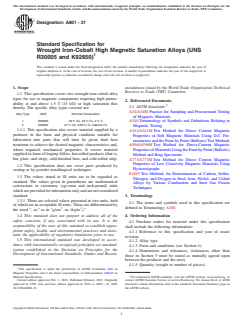
(Specification)Standard Specification for Wrought Iron-Cobalt High Magnetic Saturation Alloys (UNS R30005 and K92650)
General Information
- Abstract
ABSTRACT
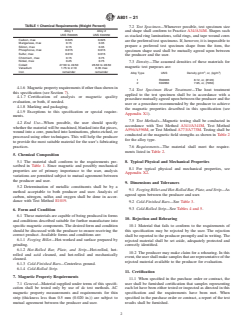
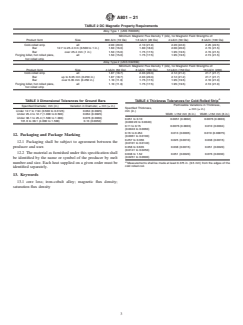
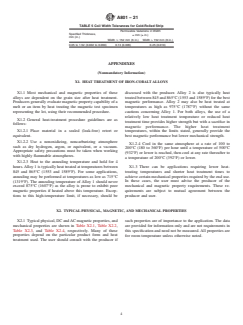
This specification covers wrought iron-cobalt high magnetic saturation alloys, UNS R30005 (49 % Co, 49% Fe, 2%V) and UNS K92650 (27 % Co, balance Fe), for use in magnetic components. The specification covers alloy supplied in form of forging billets, hot-rolled bar, hot rolled plate, cold-finished bar, and cold rolled strip. It does not cover alloy produced either by casting or by powder metallurgical techniques. The material shall conform to the chemical requirements prescribed in this specification. Magnetic property requirements and dimensional tolerances are listed. Appendices giving useful information on the heat treatment of these alloys and typical physical properties are included.
SCOPE
1.1 This specification covers two wrought iron-cobalt alloy types for use in magnetic components requiring high permeability at and above 1.5 T (15 kG) or high saturation flux density. The specific alloy types covered are:
Alloy Type
UNS
Nominal Composition
1
R30005
49 % Co, 49 % Fe, 2 % V
2
K92650
27 % Co, 0.50 % Cr, balance Fe
1.1.1 This specification also covers material supplied by a producer in the form and physical condition suitable for fabrication into parts that will later be given final heat treatment to achieve the desired magnetic characteristics and, where required, mechanical properties. It covers material supplied in form of forging billets, hot-rolled products (that is, bar, plate, and strip), cold-finished bars, and cold-rolled strip.
1.2 This specification does not cover parts produced by casting or by powder metallurgical techniques.
1.3 The values stated in SI units are to be regarded as standard. The values given in parentheses are mathematical conversions to customary (cgs-emu and inch-pound) units which are provided for information only and are not considered standard.
1.3.1 There are selected values presented in two units, both of which are in acceptable SI units. These are differentiated by the word “, or,” as in “g/cm3, or, (kg/m3).”
1.4 This standard does not purport to address all of the safety concerns, if any, associated with its use. It is the responsibility of the user of this standard to establish appropriate safety, health, and environmental practices and determine the applicability of regulatory limitations prior to use.
1.5 This international standard was developed in accordance with internationally recognized principles on standardization established in the Decision on Principles for the Development of International Standards, Guides and Recommendations issued by the World Trade Organization Technical Barriers to Trade (TBT) Committee.
- Status
- Published
- Publication Date
- 31-Jan-2021
- Technical Committee
- A06 - Magnetic Properties
- Drafting Committee
- A06.02 - Material Specifications
Buy Documents
ASTM A801-21 - Standard Specification for Wrought Iron-Cobalt High Magnetic Saturation Alloys (UNS R30005 and K92650)
REDLINE ASTM A801-21 - Standard Specification for Wrought Iron-Cobalt High Magnetic Saturation Alloys (UNS R30005 and K92650)
Overview
ASTM A801-21 specifies the requirements for wrought iron-cobalt high magnetic saturation alloys, specifically UNS R30005 and UNS K92650, used in the production of magnetic components. These alloys are designed for applications that demand high permeability at and above 1.5 tesla (T) or high saturation flux density. This specification covers alloys supplied in several wrought forms such as forging billets, hot-rolled bar, hot-rolled plate, cold-finished bar, and cold-rolled strip, but does not include materials produced by casting or powder metallurgical techniques. The standard ensures the materials meet stringent chemical composition, magnetic property, and dimensional tolerance criteria, supporting the consistent performance required in demanding electromagnetic and electronic applications.
Key Topics
- Alloy Types and Compositions
- UNS R30005: 49% cobalt, 49% iron, 2% vanadium.
- UNS K92650: 27% cobalt, 0.50% chromium, balance iron.
- Product Forms Covered
- Forging billets
- Hot-rolled bar, plate, and strip
- Cold-finished bar
- Cold-rolled strip
- Exclusions
- Does not cover cast or powder-metallurgy products.
- Key Properties
- High magnetic saturation and permeability.
- Precise chemical composition and dimensional tolerances.
- Defined magnetic properties, such as minimum magnetic flux density at specified magnetic field strengths.
- Testing and Certification
- Materials must conform to chemical and magnetic property requirements defined in the specification.
- Certified testing in line with referenced ASTM test methods for material acceptance.
- Heat Treatment and Fabrication
- Guidelines provided for heat treatment to achieve desired properties post-fabrication.
- Importance of grain size and atmosphere control in heat treating for optimal performance.
Applications
The iron-cobalt high magnetic saturation alloys outlined in ASTM A801-21 are crucial in fields where superior magnetic performance is essential. Typical applications include:
- Electrical and Magnetic Components
- Use in transformers, relays, magnetic amplifiers, and solenoids due to their high saturation flux density and permeability.
- High-Performance Magnetic Cores
- Fabrication of cores for sensors, actuators, and inductive components demanding minimal loss and maximal flux capacity.
- Precision Electronic Devices
- Components requiring low core loss, stable performance under high magnetic fields, and reliability in critical systems.
- Aerospace and Defense
- Magnetic materials for navigation, control, and instrumentation systems.
- Research and Industrial Equipment
- Devices operating in high magnetic field environments, such as scientific instruments and advanced manufacturing apparatus.
The specification mandates that material be supplied in a condition suitable for fabrication and final heat treatment, ensuring end users can achieve the exact magnetic and mechanical properties required for their finished component.
Related Standards
Several ASTM standards directly referenced or relevant to ASTM A801-21 provide additional guidance for materials selection, testing, and terminology:
- ASTM A34/A34M: Practice for Sampling and Procurement Testing of Magnetic Materials
- ASTM A340: Terminology of Symbols and Definitions Relating to Magnetic Testing
- ASTM A341/A341M: Test Method for Direct Current Magnetic Properties of Soft Magnetic Materials Using D-C Permeameters and the Ballistic Test Method
- ASTM A596/A596M: Direct-Current Magnetic Properties Test Method Using Ring Specimens
- ASTM A773/A773M: DC Magnetic Properties Test Method for Low Coercivity Magnetic Materials Using Hysteresigraphs
- ASTM E1019: Determination of Carbon, Sulfur, Nitrogen, and Oxygen in Steel, Iron, Nickel, and Cobalt Alloys
Adhering to ASTM A801-21 and its related standards ensures consistent manufacturing quality, reliable performance, and easy integration into global supply chains for magnetic materials. For organizations specifying iron-cobalt alloys in critical magnetic applications, this standard is essential to achieving consistent results and compliance with industry best practices.
Relations
- Effective Date
- 01-Dec-2023
- Effective Date
- 15-Oct-2019
- Effective Date
- 15-Jun-2019
- Effective Date
- 15-Feb-2019
- Effective Date
- 01-Jun-2018
- Effective Date
- 15-Oct-2017
- Effective Date
- 01-Jul-2017
- Effective Date
- 01-May-2016
- Effective Date
- 01-May-2016
- Effective Date
- 01-Oct-2015
- Effective Date
- 01-Oct-2014
- Effective Date
- 01-Nov-2012
- Effective Date
- 01-Oct-2011
- Effective Date
- 01-Oct-2011
- Refers
ASTM A340-03a(2011) - Standard Terminology of Symbols and Definitions Relating to Magnetic Testing - Effective Date
- 01-May-2011
Buy Documents
ASTM A801-21 - Standard Specification for Wrought Iron-Cobalt High Magnetic Saturation Alloys (UNS R30005 and K92650)
REDLINE ASTM A801-21 - Standard Specification for Wrought Iron-Cobalt High Magnetic Saturation Alloys (UNS R30005 and K92650)
Get Certified
Connect with accredited certification bodies for this standard

Element Materials Technology
Materials testing and product certification.

Inštitut za kovinske materiale in tehnologije
Institute of Metals and Technology. Materials testing, metallurgical analysis, NDT.
Sponsored listings
Frequently Asked Questions
ASTM A801-21 is a technical specification published by ASTM International. Its full title is "Standard Specification for Wrought Iron-Cobalt High Magnetic Saturation Alloys (UNS R30005 and K92650)". This standard covers: ABSTRACT This specification covers wrought iron-cobalt high magnetic saturation alloys, UNS R30005 (49 % Co, 49% Fe, 2%V) and UNS K92650 (27 % Co, balance Fe), for use in magnetic components. The specification covers alloy supplied in form of forging billets, hot-rolled bar, hot rolled plate, cold-finished bar, and cold rolled strip. It does not cover alloy produced either by casting or by powder metallurgical techniques. The material shall conform to the chemical requirements prescribed in this specification. Magnetic property requirements and dimensional tolerances are listed. Appendices giving useful information on the heat treatment of these alloys and typical physical properties are included. SCOPE 1.1 This specification covers two wrought iron-cobalt alloy types for use in magnetic components requiring high permeability at and above 1.5 T (15 kG) or high saturation flux density. The specific alloy types covered are: Alloy Type UNS Nominal Composition 1 R30005 49 % Co, 49 % Fe, 2 % V 2 K92650 27 % Co, 0.50 % Cr, balance Fe 1.1.1 This specification also covers material supplied by a producer in the form and physical condition suitable for fabrication into parts that will later be given final heat treatment to achieve the desired magnetic characteristics and, where required, mechanical properties. It covers material supplied in form of forging billets, hot-rolled products (that is, bar, plate, and strip), cold-finished bars, and cold-rolled strip. 1.2 This specification does not cover parts produced by casting or by powder metallurgical techniques. 1.3 The values stated in SI units are to be regarded as standard. The values given in parentheses are mathematical conversions to customary (cgs-emu and inch-pound) units which are provided for information only and are not considered standard. 1.3.1 There are selected values presented in two units, both of which are in acceptable SI units. These are differentiated by the word “, or,” as in “g/cm3, or, (kg/m3).” 1.4 This standard does not purport to address all of the safety concerns, if any, associated with its use. It is the responsibility of the user of this standard to establish appropriate safety, health, and environmental practices and determine the applicability of regulatory limitations prior to use. 1.5 This international standard was developed in accordance with internationally recognized principles on standardization established in the Decision on Principles for the Development of International Standards, Guides and Recommendations issued by the World Trade Organization Technical Barriers to Trade (TBT) Committee.
ABSTRACT This specification covers wrought iron-cobalt high magnetic saturation alloys, UNS R30005 (49 % Co, 49% Fe, 2%V) and UNS K92650 (27 % Co, balance Fe), for use in magnetic components. The specification covers alloy supplied in form of forging billets, hot-rolled bar, hot rolled plate, cold-finished bar, and cold rolled strip. It does not cover alloy produced either by casting or by powder metallurgical techniques. The material shall conform to the chemical requirements prescribed in this specification. Magnetic property requirements and dimensional tolerances are listed. Appendices giving useful information on the heat treatment of these alloys and typical physical properties are included. SCOPE 1.1 This specification covers two wrought iron-cobalt alloy types for use in magnetic components requiring high permeability at and above 1.5 T (15 kG) or high saturation flux density. The specific alloy types covered are: Alloy Type UNS Nominal Composition 1 R30005 49 % Co, 49 % Fe, 2 % V 2 K92650 27 % Co, 0.50 % Cr, balance Fe 1.1.1 This specification also covers material supplied by a producer in the form and physical condition suitable for fabrication into parts that will later be given final heat treatment to achieve the desired magnetic characteristics and, where required, mechanical properties. It covers material supplied in form of forging billets, hot-rolled products (that is, bar, plate, and strip), cold-finished bars, and cold-rolled strip. 1.2 This specification does not cover parts produced by casting or by powder metallurgical techniques. 1.3 The values stated in SI units are to be regarded as standard. The values given in parentheses are mathematical conversions to customary (cgs-emu and inch-pound) units which are provided for information only and are not considered standard. 1.3.1 There are selected values presented in two units, both of which are in acceptable SI units. These are differentiated by the word “, or,” as in “g/cm3, or, (kg/m3).” 1.4 This standard does not purport to address all of the safety concerns, if any, associated with its use. It is the responsibility of the user of this standard to establish appropriate safety, health, and environmental practices and determine the applicability of regulatory limitations prior to use. 1.5 This international standard was developed in accordance with internationally recognized principles on standardization established in the Decision on Principles for the Development of International Standards, Guides and Recommendations issued by the World Trade Organization Technical Barriers to Trade (TBT) Committee.
ASTM A801-21 is classified under the following ICS (International Classification for Standards) categories: 77.080.10 - Irons. The ICS classification helps identify the subject area and facilitates finding related standards.
ASTM A801-21 has the following relationships with other standards: It is inter standard links to ASTM A340-23a, ASTM A340-19b, ASTM A340-19a, ASTM A340-19, ASTM A340-18, ASTM A340-17a, ASTM A340-17, ASTM A340-16e1, ASTM A340-16, ASTM A340-15, ASTM A340-14, ASTM A34/A34M-06(2012), ASTM A341/A341M-00(2011), ASTM A341/A341M-00(2011)e1, ASTM A340-03a(2011). Understanding these relationships helps ensure you are using the most current and applicable version of the standard.
ASTM A801-21 is available in PDF format for immediate download after purchase. The document can be added to your cart and obtained through the secure checkout process. Digital delivery ensures instant access to the complete standard document.
Standards Content (Sample)
This international standard was developed in accordance with internationally recognized principles on standardization established in the Decision on Principles for the
Development of International Standards, Guides and Recommendations issued by the World Trade Organization Technical Barriers to Trade (TBT) Committee.
Designation:A801 −21
Standard Specification for
Wrought Iron-Cobalt High Magnetic Saturation Alloys (UNS
R30005 and K92650)
This standard is issued under the fixed designation A801; the number immediately following the designation indicates the year of
original adoption or, in the case of revision, the year of last revision. A number in parentheses indicates the year of last reapproval. A
superscript epsilon (´) indicates an editorial change since the last revision or reapproval.
1. Scope mendations issued by the World Trade Organization Technical
Barriers to Trade (TBT) Committee.
1.1 This specification covers two wrought iron-cobalt alloy
types for use in magnetic components requiring high perme-
2. Referenced Documents
ability at and above 1.5 T (15 kG) or high saturation flux
2.1 ASTM Standards:
density. The specific alloy types covered are:
A34/A34M Practice for Sampling and Procurement Testing
Alloy Type UNS Nominal Composition
of Magnetic Materials
1 R30005 49 % Co, 49 % Fe, 2 % V
A340 Terminology of Symbols and Definitions Relating to
2 K92650 27 % Co, 0.50 % Cr, balance Fe
Magnetic Testing
1.1.1 This specification also covers material supplied by a
A341/A341M Test Method for Direct Current Magnetic
producer in the form and physical condition suitable for
Properties of Soft Magnetic Materials Using D-C Per-
fabrication into parts that will later be given final heat
meameters and the Point by Point (Ballistic)Test Methods
treatment to achieve the desired magnetic characteristics and,
A596/A596M Test Method for Direct-Current Magnetic
where required, mechanical properties. It covers material
PropertiesofMaterialsUsingthePointbyPoint(Ballistic)
supplied in form of forging billets, hot-rolled products (that is,
Method and Ring Specimens
bar, plate, and strip), cold-finished bars, and cold-rolled strip.
A773/A773M Test Method for Direct Current Magnetic
Properties of Low Coercivity Magnetic Materials Using
1.2 This specification does not cover parts produced by
Hysteresigraphs
casting or by powder metallurgical techniques.
E1019 Test Methods for Determination of Carbon, Sulfur,
1.3 The values stated in SI units are to be regarded as
Nitrogen, and Oxygen in Steel, Iron, Nickel, and Cobalt
standard. The values given in parentheses are mathematical
Alloys by Various Combustion and Inert Gas Fusion
conversions to customary (cgs-emu and inch-pound) units
Techniques
whichareprovidedforinformationonlyandarenotconsidered
standard.
3. Terminology
1.3.1 There are selected values presented in two units, both
3.1 The terms and symbols used in this specification are
of which are in acceptable SI units. These are differentiated by
defined in Terminology A340.
3 3
the word “, or,” as in “g/cm , or, (kg/m ).”
4. Ordering Information
1.4 This standard does not purport to address all of the
safety concerns, if any, associated with its use. It is the
4.1 Purchase orders for material under this specification
responsibility of the user of this standard to establish appro-
shall include the following information:
priate safety, health, and environmental practices and deter-
4.1.1 Reference to this specification and year of issue/
mine the applicability of regulatory limitations prior to use.
revision.
1.5 This international standard was developed in accor-
4.1.2 Alloy type.
dance with internationally recognized principles on standard-
4.1.3 Form and conditions (see Section 6).
ization established in the Decision on Principles for the
4.1.4 Dimensions and tolerances, (tolerances other than
Development of International Standards, Guides and Recom-
those in Section 9 must be stated as mutually agreed upon
between the producer and the user).
4.1.5 Quantity (weight or number of pieces).
This specification is under the jurisdiction of ASTM Committee A06 on
Magnetic Properties and is the direct responsibility of Subcommittee A06.02 on
Material Specifications. For referenced ASTM standards, visit the ASTM website, www.astm.org, or
Current edition approved Feb. 1, 2021. Published February 2021. Originally contact ASTM Customer Service at service@astm.org. For Annual Book of ASTM
approved in 1999. Last previous edition approved in 2014 as A801 – 14. DOI: Standards volume information, refer to the standard’s Document Summary page on
10.1520/A0801-21. the ASTM website.
Copyright © ASTM International, 100 Barr Harbor Drive, PO Box C700, West Conshohocken, PA 19428-2959. United States
A801−21
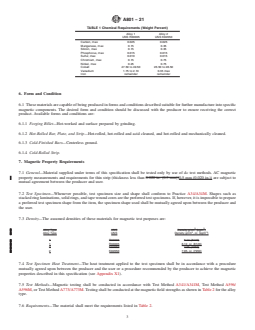
TABLE 1 Chemical Requirements (Weight Percent)
7.2 Test Specimen—Whenever possible, test specimen size
Alloy 1 Alloy 2 and shape shall conform to Practice A34/A34M. Shapes such
UNS R30005 UNS K92650
as stacked ring laminations, solid rings, and tape wound cores
Carbon, max 0.025 0.025
are the preferred test specimens. If, however, it is impossible to
Manganese, max 0.15 0.35
prepare a preferred test specimen shape from the item, the
Silicon, max 0.15 0.35
Phosphorus, max 0.015 0.015 specimen shape used shall be mutually agreed upon between
Sulfur, max 0.010 0.015
the producer and the user.
Chromium, max 0.15 0.75
Nickel, max 0.25 0.75
7.3 Density—The assumed densities of these materials for
Cobalt 47.50 to 49.50 26.50 to 28.50
magnetic test purposes are:
Vanadium 1.75 to 2.10 0.35 max
3 3
Iron remainder remainder
Alloy Type UNS Density g/cm , or, (kg/m )
1 R30005 8.12, or, (8120)
2 K92650 7.95, or, (7950)
4.1.6 Magneticpropertyrequirementsifotherthanshownin
7.4 Test Specimen Heat Treatment—The heat treatment
this specification (see Section 7).
applied to the test specimen shall be in accordance with a
4.1.7 Certification of analysis or magnetic quality
procedure mutually agreed upon between the producer and the
evaluation, or both, if needed.
user or a procedure recommended by the producer to achieve
4.1.8 Marking and packaging.
the magnetic properties described in this specification (see
4.1.9 Exceptions to this specification or special require-
Appendix X1).
ments.
7.5 Test Methods—Magnetic testing shall be conducted in
4.2 End Use—When possible, the user should specify
accordance with Test Method A341/A341M, Test Method
whetherthematerialwillbemachined,blankedintoflatpieces,
A596/A596M, or Test Method A773/A773M. Testing shall be
wound into a core, punched into laminations, photo-etched, or
conducted at the magnetic field strengths as shown in Table 2
processed using other techniques. This will help the producer
for the alloy type.
to provide the most suitable material for the user’s fabricating
practices.
7.6 Requirements—The material shall meet the require-
ments listed in Table 2.
5. Chemical Composition
5.1 The material shall conform to the requirements pre- 8. Typical Physical and Mechanical Properties
scribed in Table 1. Since magnetic and possibly mechanical
8.1 For typical physical and mechanical properties, see
properties are of primary importance to the user, analysis
Appendix X2.
variations are permitted subject to mutual agreement between
the producer and user.
9. Dimensions and Tolerances
5.2 Determination of metallic constituents shall be by a
9.1 ForgingBilletandHot-RolledBar,Plate,andStrip—As
method acceptable to both producer and user. Analysis of
agreed upon between the producer and user.
carbon, nitrogen, sulfur, and oxygen shall be done in accor-
dance with Test Method E1019.
9.2 Cold-Finished Bars—See Table 3.
9.3 Cold-Rolled Strip—See Tables 4 and 5.
6. Form and Condition
6.1 These materials are capable of being produced in forms
10. Rejection and Rehearing
and conditions described suitable for further manufacture into
specific magnetic components. The desired form and condition
10.1 Material that fails to conform to the requirements of
should be discussed with the producer to ensure receiving the
this specification may be rejected by the user. The rejection
correct product. Available forms and conditions are:
shall be reported to the producer promptly and in writing. The
6.1.1 Forging Billet—Hot-worked and surface prepared by
rejected material shall be set aside, adequately protected and
grinding.
correctly identified.
6.1.2 Hot-Rolled Bar, Plate, and Strip—Hot-rolled, hot-
10.2 The producer may make claim for a rehearing. In this
rolled and acid cleaned, and hot-rolled and mechanically
event,theusershallmakesamplesthatarerepresentativeofthe
cleaned.
rejected material available to the producer for evaluation.
6.1.3 Cold-Finished Bars—Centerless ground.
6.1.4 Cold-Rolled Strip.
11. Certification
7. Magnetic Property Requirements
11.1 When specified in the purchase order or contract, the
7.1 General—Material supplied under terms of this specifi- user shall be furnished certification that samples representing
cation shall be tested only by use of dc test methods. AC each lot have been either tested or inspected as directed in this
magnetic property measurements and requirements for thin specification and the requirements have been met. When
strip (thickness less than 0.5 mm (0.020 in.)) are subject to specified in the purchase order or contract, a report of the test
mutual agreement between the producer and user. results shall be furnished.
A801−21
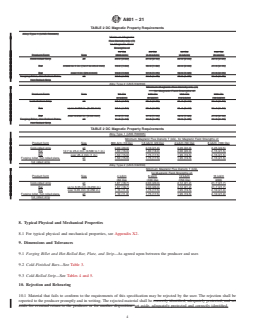
TABLE 2 DC Magnetic Property Requirements
Alloy Type 1 (UNS R30005)
Minimum Magnetic Flux Density T (kG), for Magnetic Field Strengths of:
Product form Size 800 A/m (10 Oe) 1.6 kA/m (20 Oe) 4 kA/m (50 Oe) 8 kA/m (100 Oe)
Cold-rolled strip all 2.00 (20.0) 2.10 (21.0) 2.20 (22.0) 2.25 (22.5)
Bar 12.7 to 25.4 mm (0.500 to 1 in.) 1.60 (16.0) 1.80 (18.0) 2.00 (20.0) 2.15 (21.5)
Bar over 25.4 mm (1 in.) 1.50 (15.0) 1.75 (17.5) 1.95 (19.5) 2.15 (21.5)
Forging billet, hot rolled plate, all 1.50 (15.0) 1.75 (17.5) 1.95 (19.5) 2.15 (21.5)
hot rolled strip
Alloy Type 2 (UNS K92650)
Minimum Magnetic Flux Density T (kG), for Magnetic Field Strengths of:
Product form Size 4 kA/m (50 Oe) 8 kA/m (100 Oe) 12
...
This document is not an ASTM standard and is intended only to provide the user of an ASTM standard an indication of what changes have been made to the previous version. Because
it may not be technically possible to adequately depict all changes accurately, ASTM recommends that users consult prior editions as appropriate. In all cases only the current version
of the standard as published by ASTM is to be considered the official document.
Designation: A801 − 14 A801 − 21
Standard Specification for
Wrought Iron-Cobalt High Magnetic Saturation Alloys (UNS
R30005 and K92650)
This standard is issued under the fixed designation A801; the number immediately following the designation indicates the year of
original adoption or, in the case of revision, the year of last revision. A number in parentheses indicates the year of last reapproval. A
superscript epsilon (´) indicates an editorial change since the last revision or reapproval.
1. Scope
1.1 This specification covers two wrought iron-cobalt alloy types for use in magnetic components requiring high permeability at
and above 15 kG (1.5 T)1.5 T (15 kG) or high magnetic saturation. saturation flux density. The specific alloy types covered are:
Alloy Type UNS Nominal Composition
1 R30005 49 % Co, 49 % Fe, 2 % V
2 K92650 27 % Co, 0.50 % Cr, balance Fe
1.1.1 This specification also covers material supplied by a producer in the form and physical condition suitable for fabrication into
parts that will later be given final heat treatment to achieve the desired magnetic characteristics and, where required, mechanical
properties. It covers material supplied in form of forging billets, hot-rolled products (that is, bar, plate, and strip), cold-finished
bars, and cold-rolled strip.
1.2 This specification does not cover parts produced by casting or by powder metallurgical techniques.
1.3 The values stated in customary (cgs-emu and inch-pound) SI units are to be regarded as standard. The values given in
parentheses are mathematical conversions to SI units, customary (cgs-emu and inch-pound) units which are provided for
information only and are not considered standard.
1.3.1 There are selected values presented in two units, both of which are in acceptable SI units. These are differentiated by the
3 3
word “, or,” as in “g/cm , or, (kg/m ).”
1.4 This standard does not purport to address all of the safety concerns, if any, associated with its use. It is the responsibility
of the user of this standard to establish appropriate safety safety, health, and healthenvironmental practices and determine the
applicability of regulatory limitations prior to use.
1.5 This international standard was developed in accordance with internationally recognized principles on standardization
established in the Decision on Principles for the Development of International Standards, Guides and Recommendations issued
by the World Trade Organization Technical Barriers to Trade (TBT) Committee.
This specification is under the jurisdiction of ASTM Committee A06 on Magnetic Properties and is the direct responsibility of Subcommittee A06.02 on Material
Specifications.
Current edition approved May 1, 2014Feb. 1, 2021. Published May 2014February 2021. Originally approved in 1999. Last previous edition approved in 20092014 as
A801A801 – 14.–09. DOI: 10.1520/A0801-14.10.1520/A0801-21.
Copyright © ASTM International, 100 Barr Harbor Drive, PO Box C700, West Conshohocken, PA 19428-2959. United States
A801 − 21
2. Referenced Documents
2.1 ASTM Standards:
A34/A34M Practice for Sampling and Procurement Testing of Magnetic Materials
A340 Terminology of Symbols and Definitions Relating to Magnetic Testing
A341/A341M Test Method for Direct Current Magnetic Properties of Soft Magnetic Materials Using D-C Permeameters and the
Point by Point (Ballistic) Test Methods
A596/A596M Test Method for Direct-Current Magnetic Properties of Materials Using the Point by Point (Ballistic) Method and
Ring Specimens
A773/A773M Test Method for Direct Current Magnetic Properties of Low Coercivity Magnetic Materials Using Hysteresig-
raphs
E1019 Test Methods for Determination of Carbon, Sulfur, Nitrogen, and Oxygen in Steel, Iron, Nickel, and Cobalt Alloys by
Various Combustion and Inert Gas Fusion Techniques
3. Terminology
3.1 The terms and symbols used in this specification are defined in Terminology A340.
4. Ordering Information
4.1 Purchase orders for material under this specification shall include the following information:
4.1.1 Reference to this specification and year of issue/revision,issue/revision.
4.1.2 Alloy type,type.
4.1.3 Form and conditions (see Section 6),).
4.1.4 Dimensions and tolerances, (tolerances other than those in Section 9 must be stated as mutually agreed upon between the
producer and the user),user).
4.1.5 Quantity (weight or number of pieces),pieces).
4.1.6 Magnetic property requirements if other than shown in this specification (see Section 7),).
4.1.7 Certification of analysis or magnetic quality evaluation, or both, if needed,needed.
4.1.8 Marking and packaging, andpackaging.
4.1.9 Exceptions to this specification or special requirements.
4.2 End Use—When possible, the user should specify whether the material will be machined, blanked into flat pieces, wound into
a core, punched into laminations, or photo-etched.photo-etched, or processed using other techniques. This will help the producer
to provide the most suitable material for the user’s fabricating practices.
5. Chemical Composition
5.1 The material shall conform to the requirements prescribed in Table 1. Since magnetic and possibly mechanical properties are
of primary importance to the user, analysis variations are permitted subject to mutual agreement between the producer and user.
5.2 Determination of metallic constituents shall be by a method acceptable to both producer and user. Analysis of carbon, nitrogen,
sulfur, and oxygen shall be done in accordance with Test Method E1019.
For referenced ASTM standards, visit the ASTM website, www.astm.org, or contact ASTM Customer Service at service@astm.org. For Annual Book of ASTM Standards
volume information, refer to the standard’s Document Summary page on the ASTM website.
A801 − 21
TABLE 1 Chemical Requirements (Weight Percent)
Alloy 1 Alloy 2
UNS R30005 UNS K92650
Carbon, max 0.025 0.025
Manganese, max 0.15 0.35
Silicon, max 0.15 0.35
Phosphorus, max 0.015 0.015
Sulfur, max 0.010 0.015
Chromium, max 0.15 0.75
Nickel, max 0.25 0.75
Cobalt 47.50 to 49.50 26.50 to 28.50
Vanadium 1.75 to 2.10 0.35 max
Iron remainder remainder
6. Form and Condition
6.1 These materials are capable of being produced in forms and conditions described suitable for further manufacture into specific
magnetic components. The desired form and condition should be discussed with the producer to ensure receiving the correct
product. Available forms and conditions are:
6.1.1 Forging Billet—Hot-worked and surface prepared by grinding.
6.1.2 Hot-Rolled Bar, Plate, and Strip—Hot-rolled, hot-rolled and acid cleaned, and hot-rolled and mechanically cleaned.
6.1.3 Cold-Finished Bars—Centerless ground.
6.1.4 Cold-Rolled Strip.
7. Magnetic Property Requirements
7.1 General—Material supplied under terms of this specification shall be tested only by use of dc test methods. AC magnetic
property measurements and requirements for thin strip (thickness less than 0.020 in. (0.5 mm))0.5 mm (0.020 in.)) are subject to
mutual agreement between the producer and user.
7.2 Test Specimen—Whenever possible, test specimen size and shape shall conform to Practice A34/A34M. Shapes such as
stacked ring laminations, solid rings, and tape wound cores are the preferred test specimens. If, however, it is impossible to prepare
a preferred test specimen shape from the item, the specimen shape used shall be mutually agreed upon between the producer and
the user.
7.3 Density—The assumed densities of these materials for magnetic test purposes are:
3 3
Alloy Type UNS Density g/cm (kg⁄m )
3 3
Alloy Type UNS Density g/cm , or, (kg/m )
1 R30005 8.12 (8120)
1 R30005 8.12, or, (8120)
2 K92650 7.95 (7950)
2 K92650 7.95, or, (7950)
7.4 Test Specimen Heat Treatment—The heat treatment applied to the test specimen shall be in accordance with a procedure
mutually agreed upon between the producer and the user or a procedure recommended by the producer to achieve the magnetic
properties described in this specification (see Appendix X1).
7.5 Test Methods—Magnetic testing shall be conducted in accordance with Test Method A341/A341M, Test Method A596/
A596M, or Test Method A773/A773M. Testing shall be conducted at the magnetic field strengths as shown in Table 2 for the alloy
type.
7.6 Requirements—The material shall meet the requirements listed in Table 2.
A801 − 21
TABLE 2 DC Magnetic Property Requirements
Alloy Type 1 (UNS R30005)
Minimum Magnetic
Flux Density kG, (T)
for Magnetic Field
Strengths of
10 Oe 20 Oe 50 Oe 100 Oe
Product Form Size (800 A/m) (1.6 kA/m) (4 kA/m) (8 kA/m)
Cold-rolled Strip all 20.0 (2.00) 21.0 (2.10) 22.0 (2.20) 22.5 (2.25)
Bar 0.500 to 1 in. (12.7 to 25.4 mm) 16.0 (1.60) 18.0 (1.80) 20.0 (2.00) 21.5 (2.15)
Bar over 1 in. (25.4 mm) 15.0 (1.50) 17.5 (1.75) 19.5 (1.95) 21.5 (2.15)
Forging Billet, Hot Rolled Plate, all 15.0 (1.50) 17.5 (1.75) 19.5 (1.95) 21.5 (2.15)
Hot Rolled Strip
Alloy Type 2 (UNS K92650)
Minimum Magnetic Flux Density kG, (T)
for Magnetic Field Strengths of:
Product Form Size 50 Oe 100 Oe 150 Oe 200 Oe
(4 kA/m) (8 kA/m) (12 kA/m) (16 kA/m)
Cold-Rolled Strip all 18.7 (1.87) 20.3 (2.03) 21.2 (2.12) 21.7 (2.17)
Bar up to 0.250 in. (6.35 mm) 18.7 (1.87) 20.3 (2.03) 21.2 (2.12) 21.7 (2.17)
Bar over 0.250 in. (6.35 mm) 11.0 (1.10) 17.5 (1.75) 19.5 (1.95) 21.0 (2.10)
Forging Billet, Hot Rolled Plate, all 11.0 (1.10) 17.5 (1.75) 19.5 (1.95) 21.0 (2.10)
Hot Rolled Strip
TABLE 2 DC Magnetic Property Requirements
Alloy Type 1 (UNS R30005)
Minimum Magnetic Flux Density T (kG), for Magnetic Field Strengths of:
Product form Size 800 A/m (10 Oe) 1.6 kA/m (20 Oe) 4 kA/m (50 Oe) 8 kA/m (100 Oe)
Cold-rolled strip all 2.00 (20.0) 2.10 (21.0) 2.20 (22.0) 2.25 (22.5)
Bar 12.7 to 25.4 mm (0.500 to 1 in.) 1.60 (16.0) 1.80 (18.0) 2.00 (20.0) 2.15 (21.5)
Bar over 25.4 mm (1 in.) 1.50 (15.0) 1.75 (17.5) 1.95 (19.5) 2.15 (21.5)
Forging billet, hot rolled plate, all 1.50 (15.0) 1.75 (17.5) 1.95 (19.5) 2.15 (21.5)
hot rolled strip
Alloy Type 2 (UNS K92650)
Minimum Magnetic Flux Density T (kG),
for Magnetic Field Strengths of:
Product form Size 4 kA/m 8 kA/m 12 kA/m 16 kA/m
(50 Oe) (100 Oe) (150 Oe) (200)
Cold-rolled strip all 1.87 (18.7) 2.03 (20.3) 2.12 (21.2) 21.7 (21.7)
Bar up to 6.35 mm (0.250 in.) 1.87 (18.7) 2.03 (20.3) 2.12 (21.2) 21.7 (21.7)
Bar over 6.35 mm (0.250 in.) 1.10 (11.0) 1.75 (17.5) 1.95 (19.5) 2.10 (21.0)
Forging billet, hot rolled plate, all 1.10 (11.0) 1.75 (17.5) 1.95 (19.5) 2.10 (21.0)
hot rolled strip
8. Typical Physical and Mechanical Properties
8.1 For typical physical and mechanical properties, see Appendix X2.
9. Dimensions and Tolerances
9.1 Forging Billet and Hot-Rolled Bar, Plate, and Strip—As agreed upon between the producer and user.
9.2 Cold-Finished Bars—See Table 3.
9.3 Cold-Rolled Strip—See Tables 4 and 5.
10. Rejection and Rehearing
10.1 Material that fails to conform to the requirements of this specification may be rejected by the user. The rejection shall be
reported to the producer promptly and in writing. The rejected material shall be correctly identified, adequately protected, and set
aside for eventual return to the producer or for another disposition. set aside, adequately protected and correctly identified.
A801 − 21
TABLE 3 Dimensional Tolerances for Ground Bars
Specified Diameter, in. (mm) Variation in Diameter, ±in. (±mm)
Under 0.500 to 0.3125 (12.7 to 7.94) 0.0025 (0.064)
Under 1.000 to 0.500 (25.4 to 12.7) 0.0025 (0.064)
Under 1.500 to 1.000 (38.1 to 25.4) 0.0030 (0.076)
4.000 to 1.500 (101.6 to 38.1) 0.0050 (0.13)
TABLE 3 Dimensional Tolerances for Ground Bars
Specified Diameter, mm (in.) Variation in Diameter, ± mm (± in.)
Under 12.7 to 7.94 (0.500 to 0.3125) 0.064 (0.0025)
Under 25.4 to 12.7 (1.000 to 0.500) 0.064 (0.0025)
Under 38.1 to 25.4 (1.500 to 1.000) 0.076 (0.0030)
101.6 to 38.1 (4.000 to 1.500) 0.13 (0.0050)
A
TABLE 4 Thickness Tolerances for Cold-Rolled Strip
Permissible Variations in Thickness, ±in. (±mm)
Specified Thickness, in. (mm) Width #6 in. Width >6 in.
(152 mm) (152 mm)
0.000 20 to 0.0040 0.0002 (0.0051) 0.0003 (0.0076)
(0.051 to 0.10)
0.0041 to 0.0060 0.0003 (0.0076) 0.0004 (0.010)
(0.10 to 0.15)
0.0061 to 0.0100 0.0005 (0.013) 0.000 75 (0.019)
(0.16 to 0.254)
0.0101 to 0.0140 0.0010 (0.025) 0.0015 (0.038)
(0.257 to 0.356)
0.0141 to 0.0250 0.0015 (0.038) 0.0020 (0.051)
(0.358 to 0.635)
0.0251 to 0.0600 0.0020 (0.051) 0.0030 (0.076)
(0.638 to 1.52)
A
TABLE 4 Thickness Tolerances for Cold-Rolled Strip
Permissible Variations in Thickness,
Specified Thickness,
± mm (± in.)
mm (in.)
Width #152 mm (6 in.) Width >152 mm (6 in.)
0.051 to 0.10 0.0051 (0.0002) 0.0076 (0.0003)
(0.000 20 to 0.0040)
0.11 to 0.15 0.0076 (0.0003) 0.010 (0.0004)
(0.0043 to 0.006
...