

ASTM C1557-20
(Test Method)Standard Test Method for Tensile Strength and Young's Modulus of Fibers
General Information
- Abstract
SIGNIFICANCE AND USE
5.1 Properties determined by this test method are useful in the evaluation of new fibers at the research and development levels. Fibers with diameters up to 250 × 10–6 m are covered by this test method. Very short fibers (including whiskers) call for specialized test techniques (1)3 and are not covered by this test method. This test method may also be useful in the initial screening of candidate fibers for applications in polymer, metal, or ceramic matrix composites, and for quality control purposes. Because of their nature, ceramic fibers do not have a unique tensile strength, but rather a distribution of tensile strengths. In most cases when the tensile strength of the fibers is controlled by one population of flaws, the distribution of fiber tensile strengths can be described using a two-parameter Weibull distribution, although other distributions have also been suggested (2, 3). This test method constitutes a methodology to obtain the tensile strength of a single fiber. For the purpose of determining the parameters of the distribution of fiber tensile strengths, it is recommended to follow this test method in conjunction with Practice C1239.
SCOPE
1.1 This test method covers the preparation, mounting, and testing of single fibers (obtained either from a fiber bundle or a spool) for the determination of tensile strength and Young's modulus at ambient temperature. Advanced ceramic, glass, carbon, and other fibers are covered by this test standard.
1.2 The values stated in SI units are to be regarded as standard. No other units of measurement are included in this standard.
1.3 This standard does not purport to address all of the safety concerns, if any, associated with its use. It is the responsibility of the user of this standard to establish appropriate safety, health, and environmental practices and determine the applicability of regulatory limitations prior to use.
1.4 This international standard was developed in accordance with internationally recognized principles on standardization established in the Decision on Principles for the Development of International Standards, Guides and Recommendations issued by the World Trade Organization Technical Barriers to Trade (TBT) Committee.
- Status
- Published
- Publication Date
- 31-Dec-2019
- Technical Committee
- C28 - Advanced Ceramics
- Drafting Committee
- C28.07 - Ceramic Matrix Composites
Overview
ASTM C1557-20 provides a standardized test method for determining the tensile strength and Young’s modulus of single fibers. Developed by ASTM International, this test procedure is widely used to evaluate mechanical properties of advanced ceramic, glass, carbon, and other fibers with diameters up to 250 micrometers (250 × 10⁻⁶ m). The method is essential for research and development, quality control, and initial screening of fibers for use in composites and other structural applications.
This test method outlines how to prepare, mount, and test single fibers at ambient temperature, ensuring repeatable and reliable measurement of fiber tensile properties using SI units. The standard emphasizes proper handling to avoid damaging sensitive fibers and includes considerations for accurate result interpretation.
Key Topics
- Tensile Strength and Young’s Modulus Measurement: Establishes procedures for testing single fibers to determine their mechanical strength and elastic properties.
- Applicability: Covers advanced ceramic, glass, carbon, and other structural fibers, but excludes very short fibers and whiskers that require specialized techniques.
- Fiber Handling and Alignment:
- Guidance on extracting single fibers from bundles or spools.
- Proper mounting and alignment to achieve accurate results and prevent premature failure.
- Test Environment and Rates:
- Recommendations to test under inert or rapid conditions to minimize slow crack growth effects.
- Testing parameters must be reported for transparency and reproducibility.
- Data Acquisition and Analysis:
- Requires digital or analog recording of applied force and displacements.
- Calculation methods for tensile strength and Young’s modulus from stress-strain data.
- Statistical Strength Distribution:
- Acknowledges that ceramic fibers typically have a distribution of strengths, often modeled using a Weibull distribution.
- Recommends using in conjunction with ASTM C1239 to characterize strength distributions.
Applications
- Material Development: Used extensively in the research and development of new fiber materials for use in high-performance composites and other structural applications.
- Composite Reinforcement: Initial screening and quality assurance of candidate fibers for polymer, metal, and ceramic matrix composites, where precise knowledge of fiber tensile properties is critical to design and performance.
- Quality Control: Allows manufacturers to monitor production quality and ensure fiber products meet specified tensile strength and modulus criteria.
- Failure Analysis: Supports fractography and fractographic analysis to identify strength-limiting flaws and variability in fiber properties.
- Academic and Industrial R&D: Provides a foundation for comparing fiber grades, batch consistency, and the influence of processing parameters on mechanical properties.
Related Standards
- ASTM C1239 - Practice for Reporting Uniaxial Strength Data and Estimating Weibull Distribution Parameters for Advanced Ceramics
- ASTM C1322 - Practice for Fractography and Characterization of Fracture Origins in Advanced Ceramics
- ASTM D3878 - Terminology for Composite Materials
- ASTM E4 - Practices for Force Verification of Testing Machines
- ASTM E6 - Terminology Relating to Methods of Mechanical Testing
- ASTM E1382 - Test Methods for Determining Average Grain Size Using Semiautomatic and Automatic Image Analysis
By adhering to ASTM C1557-20, laboratories and manufacturers ensure consistent, reproducible determination of fiber tensile strength and Young’s modulus, supporting innovation, product reliability, and accurate performance assessment in the rapidly advancing field of fiber-reinforced composites and advanced materials. Proper implementation of this standard not only enhances testing accuracy but also facilitates meaningful comparison across different fiber materials and production lots.
Relations
- Replaces
ASTM C1557-14 - Standard Test Method for Tensile Strength and Young’s Modulus of Fibers - Effective Date
- 01-Jan-2020
- Effective Date
- 15-Oct-2019
- Effective Date
- 01-Jul-2019
- Effective Date
- 15-Apr-2019
- Effective Date
- 01-Jul-2018
- Effective Date
- 01-Apr-2018
- Effective Date
- 01-Aug-2016
- Effective Date
- 01-Jul-2015
- Effective Date
- 01-Jul-2015
- Effective Date
- 01-Jun-2014
- Effective Date
- 01-Aug-2013
- Effective Date
- 01-May-2013
- Effective Date
- 15-Jul-2010
- Effective Date
- 01-Jun-2010
- Effective Date
- 01-Nov-2009
Frequently Asked Questions
ASTM C1557-20 is a standard published by ASTM International. Its full title is "Standard Test Method for Tensile Strength and Young's Modulus of Fibers". This standard covers: SIGNIFICANCE AND USE 5.1 Properties determined by this test method are useful in the evaluation of new fibers at the research and development levels. Fibers with diameters up to 250 × 10–6 m are covered by this test method. Very short fibers (including whiskers) call for specialized test techniques (1)3 and are not covered by this test method. This test method may also be useful in the initial screening of candidate fibers for applications in polymer, metal, or ceramic matrix composites, and for quality control purposes. Because of their nature, ceramic fibers do not have a unique tensile strength, but rather a distribution of tensile strengths. In most cases when the tensile strength of the fibers is controlled by one population of flaws, the distribution of fiber tensile strengths can be described using a two-parameter Weibull distribution, although other distributions have also been suggested (2, 3). This test method constitutes a methodology to obtain the tensile strength of a single fiber. For the purpose of determining the parameters of the distribution of fiber tensile strengths, it is recommended to follow this test method in conjunction with Practice C1239. SCOPE 1.1 This test method covers the preparation, mounting, and testing of single fibers (obtained either from a fiber bundle or a spool) for the determination of tensile strength and Young's modulus at ambient temperature. Advanced ceramic, glass, carbon, and other fibers are covered by this test standard. 1.2 The values stated in SI units are to be regarded as standard. No other units of measurement are included in this standard. 1.3 This standard does not purport to address all of the safety concerns, if any, associated with its use. It is the responsibility of the user of this standard to establish appropriate safety, health, and environmental practices and determine the applicability of regulatory limitations prior to use. 1.4 This international standard was developed in accordance with internationally recognized principles on standardization established in the Decision on Principles for the Development of International Standards, Guides and Recommendations issued by the World Trade Organization Technical Barriers to Trade (TBT) Committee.
SIGNIFICANCE AND USE 5.1 Properties determined by this test method are useful in the evaluation of new fibers at the research and development levels. Fibers with diameters up to 250 × 10–6 m are covered by this test method. Very short fibers (including whiskers) call for specialized test techniques (1)3 and are not covered by this test method. This test method may also be useful in the initial screening of candidate fibers for applications in polymer, metal, or ceramic matrix composites, and for quality control purposes. Because of their nature, ceramic fibers do not have a unique tensile strength, but rather a distribution of tensile strengths. In most cases when the tensile strength of the fibers is controlled by one population of flaws, the distribution of fiber tensile strengths can be described using a two-parameter Weibull distribution, although other distributions have also been suggested (2, 3). This test method constitutes a methodology to obtain the tensile strength of a single fiber. For the purpose of determining the parameters of the distribution of fiber tensile strengths, it is recommended to follow this test method in conjunction with Practice C1239. SCOPE 1.1 This test method covers the preparation, mounting, and testing of single fibers (obtained either from a fiber bundle or a spool) for the determination of tensile strength and Young's modulus at ambient temperature. Advanced ceramic, glass, carbon, and other fibers are covered by this test standard. 1.2 The values stated in SI units are to be regarded as standard. No other units of measurement are included in this standard. 1.3 This standard does not purport to address all of the safety concerns, if any, associated with its use. It is the responsibility of the user of this standard to establish appropriate safety, health, and environmental practices and determine the applicability of regulatory limitations prior to use. 1.4 This international standard was developed in accordance with internationally recognized principles on standardization established in the Decision on Principles for the Development of International Standards, Guides and Recommendations issued by the World Trade Organization Technical Barriers to Trade (TBT) Committee.
ASTM C1557-20 is classified under the following ICS (International Classification for Standards) categories: 81.060.30 - Advanced ceramics. The ICS classification helps identify the subject area and facilitates finding related standards.
ASTM C1557-20 has the following relationships with other standards: It is inter standard links to ASTM C1557-14, ASTM D3878-19a, ASTM C1322-15(2019), ASTM D3878-19, ASTM C1239-13(2018), ASTM D3878-18, ASTM D3878-16, ASTM C1322-15, ASTM D3878-15, ASTM E4-14, ASTM C1239-13, ASTM D3878-07(2013), ASTM C1322-05b(2010), ASTM E4-10, ASTM E4-09a. Understanding these relationships helps ensure you are using the most current and applicable version of the standard.
ASTM C1557-20 is available in PDF format for immediate download after purchase. The document can be added to your cart and obtained through the secure checkout process. Digital delivery ensures instant access to the complete standard document.
Standards Content (Sample)
This international standard was developed in accordance with internationally recognized principles on standardization established in the Decision on Principles for the
Development of International Standards, Guides and Recommendations issued by the World Trade Organization Technical Barriers to Trade (TBT) Committee.
Designation: C1557 − 20
Standard Test Method for
Tensile Strength and Young’s Modulus of Fibers
This standard is issued under the fixed designation C1557; the number immediately following the designation indicates the year of
original adoption or, in the case of revision, the year of last revision.Anumber in parentheses indicates the year of last reapproval.A
superscript epsilon (´) indicates an editorial change since the last revision or reapproval.
1. Scope 3. Terminology
1.1 This test method covers the preparation, mounting, and 3.1 Definitions:
testing of single fibers (obtained either from a fiber bundle or 3.1.1 bundle—a collection of parallel fibers. Synonym, tow.
a spool) for the determination of tensile strength and Young’s
3.1.2 mounting tab—a thin paper, cardboard, compliant
modulus at ambient temperature. Advanced ceramic, glass,
metal, or plastic strip with a center hole or longitudinal slot of
carbon, and other fibers are covered by this test standard.
fixed gage length. The mounting tab should be appropriately
designed to be self-aligning if possible, and as thin as practi-
1.2 The values stated in SI units are to be regarded as
cable to minimize fiber misalignment.
standard. No other units of measurement are included in this
standard.
3.1.3 system compliance—the contribution by the load train
system and specimen-gripping system to the indicated cross-
1.3 This standard does not purport to address all of the
head displacement, by unit of force exerted in the load train.
safety concerns, if any, associated with its use. It is the
–2
responsibility of the user of this standard to establish appro-
3.1.4 tensile strength [F/L ], n—the maximum tensile
priate safety, health, and environmental practices and deter-
stress which a material is capable of sustaining. Tensile
mine the applicability of regulatory limitations prior to use.
strengthiscalculatedfromthemaximumloadduringatension
1.4 This international standard was developed in accor-
test carried to rupture and the original cross-sectional area of
dance with internationally recognized principles on standard-
the specimen.
ization established in the Decision on Principles for the
3.2 For definitions of other terms used in this test method,
Development of International Standards, Guides and Recom-
refer to Terminologies D3878 and E6.
mendations issued by the World Trade Organization Technical
Barriers to Trade (TBT) Committee.
4. Summary of Test Method
4.1 A fiber is extracted randomly from a bundle or from a
2. Referenced Documents
spool.
2.1 ASTM Standards:
4.2 The fiber is mounted in the testing machine, and then
C1239Practice for Reporting Uniaxial Strength Data and
stressed to failure at a constant cross-head displacement rate.
EstimatingWeibull Distribution Parameters forAdvanced
Ceramics
4.3 Avalid test result is considered to be one in which fiber
C1322Practice for Fractography and Characterization of
failure doesn’t occur in the gripping region.
Fracture Origins in Advanced Ceramics
4.4 Tensile strength is calculated from the ratio of the peak
D3878Terminology for Composite Materials
force and the cross-sectional area of a plane perpendicular to
E4Practices for Force Verification of Testing Machines
the fiber axis, at the fracture location or in the vicinity of the
E6Terminology Relating to Methods of MechanicalTesting
fracture location, while Young’s modulus is determined from
E1382Test Methods for Determining Average Grain Size
thelinearregionofthetensilestressversustensilestraincurve.
Using Semiautomatic and Automatic Image Analysis
5. Significance and Use
5.1 Properties determined by this test method are useful in
This test method is under the jurisdiction of ASTM Committee C28 on
the evaluation of new fibers at the research and development
Advanced Ceramics and is the direct responsibility of Subcommittee C28.07 on
–6
Ceramic Matrix Composites. levels.Fiberswithdiametersupto250×10 marecoveredby
Current edition approved Jan. 1, 2020. Published January 2020. Originally
this test method.Very short fibers (including whiskers) call for
approved in 2003. Last previous edition approved in 2014 as C1557–14. DOI:
specializedtesttechniques (1) andarenotcoveredbythistest
10.1520/C1557-20.
For referenced ASTM standards, visit the ASTM website, www.astm.org, or
contact ASTM Customer Service at service@astm.org. For Annual Book of ASTM
Standardsvolumeinformation,refertothestandard’sDocumentSummarypageon Theboldfacenumbersinparenthesesrefertothelistofreferencesattheendof
the ASTM website. this standard.
Copyright © ASTM International, 100 Barr Harbor Drive, PO Box C700, West Conshohocken, PA 19428-2959. United States
C1557 − 20
method. This test method may also be useful in the initial 6.4 Many fibers are very sensitive to surface damage.
screening of candidate fibers for applications in polymer, Therefore, any contact with the fiber in the gage length should
metal, or ceramic matrix composites, and for quality control be avoided (4, 6).
purposes.Becauseoftheirnature,ceramicfibersdonothavea
6.5 Fiberdiameterdoes,orcan,varyalongthelengthofthe
unique tensile strength, but rather a distribution of tensile
gage section. Therefore, the user’s ability to accurately calcu-
strengths. In most cases when the tensile strength of the fibers
late and interpret tensile strength and elastic modulus is based
is controlled by one population of flaws, the distribution of
ontheuseandchoiceoftheappropriatefiberdiameterthrough
fiber tensile strengths can be described using a two-parameter
valid fractography.
Weibull distribution, although other distributions have also
been suggested (2, 3). This test method constitutes a method-
7. Apparatus
ology to obtain the tensile strength of a single fiber. For the
7.1 The apparatus described herein consists of a tensile
purpose of determining the parameters of the distribution of
testing machine with one actuator (cross-head) that operates in
fiber tensile strengths, it is recommended to follow this test
acontrollablemanner,agrippingsystem,andaloadcell.Figs.
method in conjunction with Practice C1239.
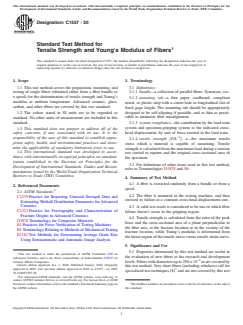
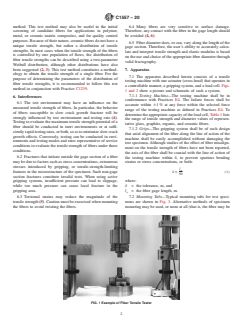
1 and 2 show a picture and schematic of such a system.
7.1.1 Testing Machine—The testing machine shall be in
6. Interferences
conformance with Practices E4. The failure forces shall be
6.1 The test environment may have an influence on the
accurate within 61% at any force within the selected force
measured tensile strength of fibers. In particular, the behavior
range of the testing machine as defined in Practices E4.To
of fibers susceptible to slow crack growth fracture will be
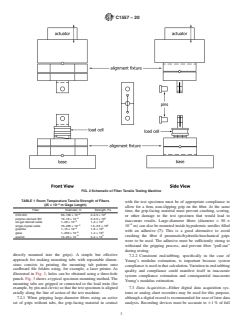
determinetheappropriatecapacityoftheloadcell,Table1lists
strongly influenced by test environment and testing rate (4).
the range of tensile strength and diameter values of represen-
Testingtoevaluatethemaximumtensilestrengthpotentialofa
tative glass, graphite, organic, and ceramic fibers.
fiber should be conducted in inert environments or at suffi-
7.1.2 Grips—The gripping system shall be of such design
cientlyrapidtestingrates,orboth,soastominimizeslowcrack
that axial alignment of the fiber along the line of action of the
growth effects. Conversely, testing can be conducted in envi-
machine shall be easily accomplished without damaging the
ronments and testing modes and rates representative of service
test specimen.Although studies of the effect of fiber misalign-
conditions to evaluate the tensile strength of fibers under those
ment on the tensile strength of fibers have not been reported,
conditions.
the axis of the fiber shall be coaxial with the line of action of
6.2 Fractures that initiate outside the gage section of a fiber the testing machine within δ, to prevent spurious bending
maybeduetofactorssuchasstressconcentrations,extraneous
strains or stress concentrations, or both:
stresses introduced by gripping, or tensile-strength-limiting
l
o
δ# (1)
features in the microstructure of the specimen. Such non-gage
section fractures constitute invalid tests. When using active
where:
gripping systems, insufficient pressure can lead to slippage,
while too much pressure can cause local fracture in the
δ = the tolerance, m, and
gripping area. l = the fiber gage length, m.
o
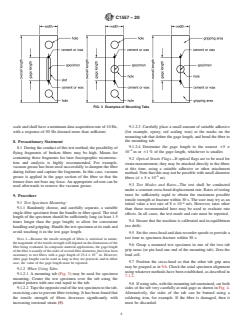
6.3 Torsional strains may reduce the magnitude of the 7.2 Mounting Tabs—Typical mounting tabs for test speci-
tensilestrength (5).Cautionmustbeexercisedwhenmounting mens are shown in Fig. 3. Alternative methods of specimen
the fibers to avoid twisting the fibers. mounting may be used, or none at all (that is, the fiber may be
FIG. 1 Example of Fiber Tensile Tester
C1557 − 20
FIG. 2 Schematic of Fiber Tensile Testing Machine
TABLE 1 Room Temperature Tensile Strength of Fibers
with the test specimen must be of appropriate compliance to
–3
(25×10 m Gage Length)
allow for a firm, non-slipping grip on the fiber. At the same
Fiber Diameter, m Strength, Pa
time, the grip-facing material must prevent crushing, scoring,
–6 9
CVD-SiC 50–150 × 10 2–3.5 × 10
or other damage to the test specimen that would lead to
–6 9
polymer-derived SiC 10–18 × 10 2–3.5 × 10
–6 9 inaccurate results. Large-diameter fibers (diameter > 50 ×
sol-gel derived oxide 1–20 × 10 1–3×10
–6 9 –6
single-crystal oxide 70–250 × 10 1.5–3.5 × 10
10 m) can also be mounted inside hypodermic needles filled
–6 9
graphite 1–15 × 10 1–6×10
with an adhesive (7). This is a good alternative to avoid
–6 9
glass 1–250 × 10 1–4×10
–6 9
crushing the fiber if pneumatic/hydraulic/mechanical grips
aramid 12–20 × 10 2–4×10
were to be used. The adhesive must be sufficiently strong to
withstand the gripping process, and prevent fiber “pull-out”
during testing.
directly mounted into the grips). A simple but effective
7.2.2 Consistent end-tabbing, specifically in the case of
approach for making mounting tabs with repeatable dimen-
Young’s modulus estimation, is important because system
sions consists in printing the mounting tab pattern onto
complianceisusedinthatcalculation.Variationinend-tabbing
cardboard file folders using, for example, a laser printer. As
quality and compliance could manifest itself in inaccurate
illustrated in Fig. 3, holes can be obtained using a three-hole
system compliance estimation and consequential inaccurate
punch.Fig.3showsatypicalspecimenmountingmethod.The
Young’s modulus estimation.
mounting tabs are gripped or connected to the load train (for
7.3 Data Acquisition—Either digital data acquisition sys-
example,bypinandclevis)sothatthetestspecimenisaligned
axially along the line of action of the test machine. tems or analog chart recorders may be used for this purpose,
althoughadigitalrecordisrecommendedforeaseoflaterdata
7.2.1 When gripping large-diameter fibers using an active
set of grips without tabs, the grip-facing material in contact analysis. Recording devices must be accurate to 61% of full
C1557 − 20
FIG. 3 Examples of Mounting Tabs
scaleandshallhaveaminimumdataacquisitionrateof10Hz, 9.1.2.3 Carefully place a small amount of suitable adhesive
with a response of 50 Hz deemed more than sufficient. (for example, epoxy, red sealing wax) at the marks on the
mounting tab that define the gage length, and bond the fiber to
8. Precautionary Statement the mounting tab.
9.1.2.4 Determine the gage length to the nearest 65×
8.1 Duringtheconductofthistestmethod,thepossibilityof
–4
10 mor 61% of the gage length, whichever is smaller.
flying fragments of broken fibers may be high. Means for
containing these fragments for later fractographic reconstruc-
9.2 Optical Strain Flags—If optical flags are to be used for
tion and analysis is highly recommended. For example,
strainmeasurement,theymaybeattacheddirectlytothefibers
vacuum grease has been used successfully to dampen the fiber
at this time, using a suitable adhesive or other attachment
during failure and capture the fragments. In this case, vacuum
method.Notethatthismaynotbepossiblewithsmall-diameter
–6
grease is applied in the gage section of the fiber so that the
fibers (d<5×10 m).
former does not bear any force.An appropriate solvent can be
9.3 Test Modes and Rates—The test shall be conducted
used afterwards to remove the vacuum grease.
underaconstantcross-headdisplacementrate.Ratesoftesting
must be sufficiently rapid to obtain the maximum possible
9. Procedure
tensile strength at fracture within 30 s. The user may try as an
–6
9.1 Test Specimen Mounting:
initial value a test rate of8×10 m/s. However, rates other
9.1.1 Randomly choose, and carefully separate, a suitable
than those recommended here may be used to evaluate rate
single-fiber specimen from the bundle or fiber spool. The total
effects. In all cases, the test mode and rate must be reported.
length of the specimen should be sufficiently long (at least 1.5
9.4 Ensurethatthemachineiscalibratedandinequilibrium
times longer than the gage length) to allow for convenient
(no drift).
handlingandgripping.Handlethetestspecimenatitsendsand
avoid touching it in the test gage length.
9.5 Setthecross-headanddatarecorderspeedstoprovidea
test time to specimen fracture within 30 s.
NOTE 1—Because the tensile strength of fibers is statistical in nature,
themagnitudeofthetensilestrengthwilldependonthedimensionsofthe
9.6 Grasp a mounted test specimen in one of the two tab
fiber being evaluated. In composite material applications, the gage length
grip areas (or pin load one end of the mounting tab). Zero the
ofthefiberisusuallyoftheorderofseveralfiberdiameters,butithasbeen
–3
customary to test fibers with a gage length of 25.4 × 10 m. However,
load cell.
other gage lengths can be used as long as they are practical, and in either
9.7 Position the cross-head so that the other tab grip area
case, the value of the gage length must be reported.
may be grasped as in 9.6. Check the axial specimen alignment
9.1.2 When Using Tabs:
usingwhatevermethodshavebeenestablished,asdescribedin
9.1.2.1 A mounting tab (Fig. 3) may be used for specimen
7.1.2.
mounting. Center the test specimen over the tab using the
printed pattern with one end taped to the tab.
9.8 Ifusingtabs,withthemountingtabunstrained,cutboth
9.1.2.2 Tapetheoppositeendofthetestspecimentothetab, sides of the tab very carefully at mid-gage as shown in Fig. 4.
exercising care to prevent fiber twisting. It has been found that Alternatively, the sides of the tab can be burned using a
the tensile strength of fibers decreases significantly with soldering iron, for example. If the fiber is damaged, then it
increasing torsional strain (5). must be discarded.
C1557 − 20
FIG. 4 Cutting Sides of Tab
usedforthecalculationoftensilestrengthdoesn’tcorrespondtothatofthe
9.9 Initiate the data recording followed by the operation of
fracture plane. The results of these simulations have shown that the
the test machine until fiber failure. Record both the cross-head
magni
...
This document is not an ASTM standard and is intended only to provide the user of an ASTM standard an indication of what changes have been made to the previous version. Because
it may not be technically possible to adequately depict all changes accurately, ASTM recommends that users consult prior editions as appropriate. In all cases only the current version
of the standard as published by ASTM is to be considered the official document.
Designation: C1557 − 14 C1557 − 20
Standard Test Method for
Tensile Strength and Young’s Modulus of Fibers
This standard is issued under the fixed designation C1557; the number immediately following the designation indicates the year of
original adoption or, in the case of revision, the year of last revision. A number in parentheses indicates the year of last reapproval. A
superscript epsilon (´) indicates an editorial change since the last revision or reapproval.
1. Scope
1.1 This test method covers the preparation, mounting, and testing of single fibers (obtained either from a fiber bundle or a
spool) for the determination of tensile strength and Young’s modulus at ambient temperature. Advanced ceramic, glass, carbon,
and other fibers are covered by this test standard.
1.2 The values stated in SI units are to be regarded as standard. No other units of measurement are included in this standard.
1.3 This standard may involve hazardous materials, operations, and equipment. This standard does not purport to address all
of the safety concerns, if any, associated with its use. It is the responsibility of the user of this standard to establish appropriate
safety safety, health, and healthenvironmental practices and determine the applicability of regulatory limitations prior to use.
1.4 This international standard was developed in accordance with internationally recognized principles on standardization
established in the Decision on Principles for the Development of International Standards, Guides and Recommendations issued
by the World Trade Organization Technical Barriers to Trade (TBT) Committee.
2. Referenced Documents
2.1 ASTM Standards:
C1239 Practice for Reporting Uniaxial Strength Data and Estimating Weibull Distribution Parameters for Advanced Ceramics
C1322 Practice for Fractography and Characterization of Fracture Origins in Advanced Ceramics
D3878 Terminology for Composite Materials
E4 Practices for Force Verification of Testing Machines
E6 Terminology Relating to Methods of Mechanical Testing
E1382 Test Methods for Determining Average Grain Size Using Semiautomatic and Automatic Image Analysis
3. Terminology
3.1 Definitions:
3.1.1 bundle—a collection of parallel fibers. Synonym, tow.
3.1.2 mounting tab—a thin paper, cardboard, compliant metal, or plastic strip with a center hole or longitudinal slot of fixed gage
length. The mounting tab should be appropriately designed to be self-aligning if possible, and as thin as practicable to minimize
fiber misalignment.
3.1.3 system compliance—the contribution by the load train system and specimen-gripping system to the indicated cross-head
displacement, by unit of force exerted in the load train.
–2
3.1.4 tensile strength [F/L ], n—the maximum tensile stress which a material is capable of sustaining. Tensile strength is
calculated from the maximum load during a tension test carried to rupture and the original cross-sectional area of the specimen.
3.2 For definitions of other terms used in this test method, refer to Terminologies D3878 and E6.
4. Summary of Test Method
4.1 A fiber is extracted randomly from a bundle or from a spool.
4.2 The fiber is mounted in the testing machine, and then stressed to failure at a constant cross-head displacement rate.
This test method is under the jurisdiction of ASTM Committee C28 on Advanced Ceramics and is the direct responsibility of Subcommittee C28.07 on Ceramic Matrix
Composites.
Current edition approved Aug. 15, 2014Jan. 1, 2020. Published October 2014January 2020. Originally approved in 2003. Last previous edition approved in 20132014 as
C1557 – 03 (2013).C1557 – 14. DOI: 10.1520/C1557-14.10.1520/C1557-20.
For referenced ASTM standards, visit the ASTM website, www.astm.org, or contact ASTM Customer Service at service@astm.org. For Annual Book of ASTM Standards
volume information, refer to the standard’s Document Summary page on the ASTM website.
Copyright © ASTM International, 100 Barr Harbor Drive, PO Box C700, West Conshohocken, PA 19428-2959. United States
C1557 − 20
4.3 A valid test result is considered to be one in which fiber failure doesn’t occur in the gripping region.
4.4 Tensile strength is calculated from the ratio of the peak force and the cross-sectional area of a plane perpendicular to the
fiber axis, at the fracture location or in the vicinity of the fracture location, while Young’s modulus is determined from the linear
region of the tensile stress versus tensile strain curve.
5. Significance and Use
5.1 Properties determined by this test method are useful in the evaluation of new fibers at the research and development levels.
-6–6
Fibers with diameters up to 250 × 10 m are covered by this test method. Very short fibers (including whiskers) call for
specialized test techniques (1) and are not covered by this test method. This test method may also be useful in the initial screening
of candidate fibers for applications in polymer, metal, or ceramic matrix composites, and for quality control purposes. Because of
their nature, ceramic fibers do not have a unique tensile strength, but rather,rather a distribution of tensile strengths. In most cases
when the tensile strength of the fibers is controlled by one population of flaws, the distribution of fiber tensile strengths can be
described using a two-parameter Weibull distribution, although other distributions have also been suggested (2, 3). This test method
constitutes a methodology to obtain the tensile strength of a single fiber. For the purpose of determining the parameters of the
distribution of fiber strengths tensile strengths, it is recommended to follow this test method in conjunction with Practice C1239.
6. Interferences
6.1 The test environment may have an influence on the measured tensile strength of fibers. In particular, the behavior of fibers
susceptible to slow crack growth fracture will be strongly influenced by test environment and testing rate (4). Testing to evaluate
the maximum tensile strength potential of a fiber should be conducted in inert environments or at sufficiently rapid testing rates,
or both, so as to minimize slow crack growth effects. Conversely, testing can be conducted in environments and testing modes and
rates representative of service conditions to evaluate the tensile strength of fibers under those conditions.
6.2 Fractures that initiate outside the gage section of a fiber may be due to factors such as stress concentrations, extraneous
stresses introduced by gripping, or strength-limitingtensile-strength-limiting features in the microstructure of the specimen. Such
non-gage section fractures constitute invalid tests. When using active gripping systems, insufficient pressure can lead to slippage,
while too much pressure can cause local fracture in the gripping area.
6.3 Torsional strains may reduce the magnitude of the tensile strength (5). Caution must be exercised when mounting the fibers
to avoid twisting the fibers.
6.4 Many fibers are very sensitive to surface damage. Therefore, any contact with the fiber in the gage length should be avoided
(4, 6).
6.5 Fiber diameter does, or can, vary along the length of the gage section. Therefore, the user’s ability to accurately calculate
and interpret tensile strength and elastic modulus is based on the use and choice of the appropriate fiber diameter through valid
fractography.
7. Apparatus
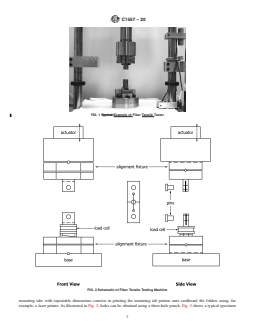
7.1 The apparatus described herein consists of a tensile testing machine with one actuator (cross-head) that operates in a
controllable manner, a gripping system, and a load cell. Fig. 1Figs. 1 and 2 and Fig. 2show a picture and schematic of such a
system.
7.1.1 Testing Machine—The testing machine shall be in conformance with PracticePractices E4. The failure forces shall be
accurate within 61 % at any force within the selected force range of the testing machine as defined in PracticePractices E4. To
determine the appropriate capacity of the load cell, theTable 1 following table lists the range of tensile strength and diameter values
of representative glass, graphite, organic, and ceramic fibers.
7.1.2 Grips—The gripping system shall be of such design that axial alignment of the fiber along the line of action of the machine
shall be easily accomplished without damaging the test specimen. Although studies of the effect of fiber misalignment on the tensile
strength of fibers have not been reported, the axis of the fiber shall be coaxial with the line of action of the testing machine within
δ, to prevent spurious bending strains and/or stress concentrations:or stress concentrations, or both:
l
o
δ# (1)
where:
δ = the tolerance, m, and
l = the fiber gage length, m.
o
7.2 Mounting Tabs—Typical mounting tabs for test specimens are shown in Fig. 3. Alternative methods of specimen mounting
may be used, or none at all (that is, the fiber may be directly mounted into the grips). A simple but effective approach for making
The boldface numbers in parentheses refer to the list of references at the end of this standard.
C1557 − 20
FIG. 1 Typical Example of Fiber Tensile Tester
FIG. 2 Schematic of Fiber Tensile Testing Machine
mounting tabs with repeatable dimensions consists in printing the mounting tab pattern onto cardboard file folders using, for
example, a laser printer. As illustrated in Fig. 3, holes can be obtained using a three-hole punch. Fig. 3 shows a typical specimen
C1557 − 20
TABLE 1 Room Temperature Tensile Strength of Fibers
-3
(25 × 10 m Gage Length)
Fiber Diameter, m Strength, Pa
-6 9
CVD-SiC 50-150 × 10 2-3.5 × 10
-6 9
polymer-derived SiC 10-18 × 10 2-3.5 × 10
-6 9
sol-gel derived oxide 1-20 × 10 1-3 × 10
-6 9
single-crystal oxide 70-250 × 10 1.5-3.5 × 10
-6 9
graphite 1-15 × 10 1-6 × 10
-6 9
glass 1-250 x× 10 1-4 × 10
-6 9
aramid 12-20 × 10 2-4 × 10
TABLE 1 Room Temperature Tensile Strength of Fibers
–3
(25 × 10 m Gage Length)
Fiber Diameter, m Strength, Pa
–6 9
CVD-SiC 50–150 × 10 2–3.5 × 10
–6 9
polymer-derived SiC 10–18 × 10 2–3.5 × 10
–6 9
sol-gel derived oxide 1–20 × 10 1–3 × 10
–6 9
single-crystal oxide 70–250 × 10 1.5–3.5 × 10
–6 9
graphite 1–15 × 10 1–6 × 10
–6 9
glass 1–250 × 10 1–4 × 10
–6 9
aramid 12–20 × 10 2–4 × 10
mounting method. The mounting tabs are gripped or connected to the load train (for example, by pin and clevis) so that the test
specimen is aligned axially along the line of action of the test machine.
7.2.1 When gripping large diameter large-diameter fibers using an active set of grips without tabs, the grip facing grip-facing
material in contact with the test specimen must be of appropriate compliance to allow for a firm, non-slipping grip on the fiber.
At the same time, the grip facing grip-facing material must prevent crushing, scoring, or other damage to the test specimen that
–6
would lead to inaccurate results. Large diameter Large-diameter fibers (diameter > 50 × 10 m) m) can also be mounted inside
hypodermic needles filled with an adhesive (7). This is a good alternative to avoid crushing the fiber if pneumatic/hydraulic/
mechanical grips were to be used. The adhesive must be sufficiently strong to withstand the gripping process, and prevent fiber
“pull-out” during testing.
7.2.2 Consistent end-tabbing, specifically in the case of Young’s modulus estimation, is important because system compliance
is used in that calculation. Variation in end-tabbing quality and compliance could manifest itself in inaccurate system compliance
estimation and consequential inaccurate Young’s modulus estimation.
7.3 Data Acquisition—At a minimum, autographic records of applied force and cross-head displacement versus time shall be
obtained. Either analog chart recorders or Either digital data acquisition systems or analog chart recorders may be used for this
purpose, although a digital record is recommended for ease of later data analysis. Ideally, an analog chart recorder or plotter shall
be used in conjunction with the digital data acquisition system to provide an immediate record of the test as a supplement to the
digital record. Recording devices must be accurate to 6 1 % 61 % of full scale and shall have a minimum data acquisition rate
of 10 Hz, with a response of 50 Hz deemed more than sufficient.
8. Precautionary Statement
8.1 During the conduct of this test method, the possibility of flying fragments of broken fibers may be high. Means for
containing these fragments for later fractographic reconstruction and analysis is highly recommended. For example, vacuum grease
has been used successfully to dampen the fiber during failure and capture the fragments. In this case, vacuum grease is applied
in the gage section of the fiber so that the former does not bear any force. An appropriate solvent can be used afterwards to remove
the vacuum grease.
9. Procedure
9.1 Test Specimen Mounting:
9.1.1 Randomly choose, and carefully separate, a suitable single-fiber specimen from the bundle or fiber spool. The total length
of the specimen should be sufficiently long (at least 1.5 times longer than the gage length) to allow for convenient handling and
gripping. Handle the test specimen at its ends and avoid touching it in the test gage length.
NOTE 1—Because the tensile strength of fibers is statistical in nature, the magnitude of the tensile strength will depend on the dimensions of the fiber
being evaluated. In composite material applications, the gage length of the fiber is usually of the order of several fiber diameters, but it has been customary
-3–3
to test fibers with a gage length of 25.4 × 10 m. However, other gage lengths can be used as long as they are practical, and in either case, the value
of the gage length must be reported.
9.1.2 When Using Tabs:
9.1.2.1 A mounting tab (Fig. 3) may be used for specimen mounting. Center the test specimen over the tab using the printed
pattern with one end taped to the tab.
C1557 − 20
FIG. 3 Examples of Mounting TabTabs
9.1.2.2 Tape the opposite end of the test specimen to the tab, exercising care to prevent fiber twisting. It has been found that
the tensile strength of fibers decreases significantly with increasing torsional strain (5).
9.1.2.3 Carefully place a small amount of suitable adhesive (for example, epoxy, red sealing wax) at the marks on the mounting
tab that define the gage length, and bond the fiber to the mounting tab.
-4–4
9.1.2.4 Determine the gage length to the nearest 6 5 65 × 10 m m or 61 % of the gage length, whichever is smaller.
9.2 Optical Strain Flags—If optical flags are to be used for strain measurement, they may be attached directly to the fibers at
this time, using a suitable adhesive or other attachment method. Note that this may not be possible with small-diameter fibers (d
-6–6
< 5 × 10 m).
9.3 Test Modes and Rates—The test shall be conducted under a constant cross-head displacement rate. Rates of testing must be
sufficiently rapid to obtain the maximum possible tensile strength at fracture within 30 s. The user may try as an initial value a
-6–6
test rate of 8 × 10 m/s. However, rates other than those recommended here may be used to evaluate rate effects. In all cases,
the test mode and rate must be reported.
9.4 Ensure that the machine is calibrated and in equilibrium (no drift).
9.5 Set the cross-head and data recorder speeds to provide a test time to specimen fracture within 30 s.
9.6 Grasp a mounted test specimen in one of the two tab grip areas (or pin load one end of the mounting tab). Zero the load
cell.
9.7 Position the cross-head so that the other tab grip area may be grasped as in 9.6. Check the axial specimen alignment using
whatever methods have been established, as described in 7.1.2.
9.8 If using tabs, with the mounting tab un-strained,unstrained, cut both sides of the tab very carefully at mid-gage as shown
in Fig. 4. Alternatively, the sides of the tab can be burned using a soldering iron, for example. If the fiber is damaged, then it must
be discarded.
9.9 Initiate the data recording followed by the operation of the test machine until fiber failure. Record both the cross-head
displacement and force, and strain if applicable.
9.10 Recover the fracture surfaces and measure the cross-sectional area of a plane normal to the axis of the fiber at the fracture
location or in the vicinity of the fracture location. Determine the fiber cross-sectional area with a linear spatial resolution of 1.0 %
of the fiber diameter or better, using laser diffraction techniques (8-11), or an image analysis system in combination with a reflected
light microscope or a scanning electron microscope (12) (see Test Methods E1382). Note that in practice, a reflected white light
-6–6
microscope can provide a maximum resolution of 0.5 × 10 m and thereforeand, therefore, its use may be impractical when
measuring the cross-sectional area of small diameter small-diameter fibers. Because stiff fibers tend to shatter upon failure, it is
recommended to capture the fiber fragments using vacuum grease, because vac
...