

ASTM E1654-94(2021)
(Guide)Standard Guide for Measuring Ionizing Radiation-Induced Spectral Changes in Optical Fibers and Cables for Use in Remote Raman FiberOptic Spectroscopy
General Information
- Abstract
SIGNIFICANCE AND USE
4.1 Ionizing environments will affect the performance of optical fibers/cables being used to transmit spectroscopic information from a remote location. Determination of the type and magnitude of the spectral variations or interferences produced by the ionizing radiation in the fiber, or both, is necessary for evaluating the performance of an optical fiber sensor system.
4.2 The results of the test can be utilized as a selection criteria for optical fibers used in optical fiber Raman spectroscopic sensor systems.
Note 1: The attenuation of optical fibers generally increases when they are exposed to ionizing radiation. This is due primarily to the trapping of radiolytic electrons and holes at defect sites in the optical materials, that is, the formation of color centers. The depopulation of these color centers by thermal or optical (photobleaching) processes, or both, causes recovery, usually resulting in a decrease in radiationinduced attenuation. Recovery of the attenuation after irradiation depends on many variables, including the temperature of the test sample, the composition of the sample, the spectrum and type of radiation employed, the total dose applied to the test sample, the light level used to measure the attenuation, and the operating spectrum. Under some continuous conditions, recovery is never complete.
SCOPE
1.1 This guide covers the method for measuring the real time, in situ radiation-induced alterations to the Raman spectral signal transmitted by a multimode, step index, silica optical fiber. This guide specifically addresses steady-state ionizing radiation (that is, alpha, beta, gamma, protons, etc.) with appropriate changes in dosimetry, and shielding considerations, depending upon the irradiation source.
1.2 The test procedure given in this guide is not intended to test the other optical and non-optical components of an optical fiber-based Raman sensor system, but may be modified to test other components in a continuous irradiation environment.
1.3 The values stated in SI units are to be regarded as standard. No other units of measurement are included in this standard.
1.4 This standard does not purport to address all of the safety concerns, if any, associated with its use. It is the responsibility of the user of this standard to establish appropriate safety, health, and environmental practices and determine the applicability of regulatory limitations prior to use.
1.5 This international standard was developed in accordance with internationally recognized principles on standardization established in the Decision on Principles for the Development of International Standards, Guides and Recommendations issued by the World Trade Organization Technical Barriers to Trade (TBT) Committee.
- Status
- Published
- Publication Date
- 31-Aug-2021
- Technical Committee
- E13 - Molecular Spectroscopy and Separation Science
- Drafting Committee
- E13.09 - Fiber Optics, Waveguides, and Optical Sensors
Overview
ASTM E1654-94(2021), titled Standard Guide for Measuring Ionizing Radiation-Induced Spectral Changes in Optical Fibers and Cables for Use in Remote Raman FiberOptic Spectroscopy, provides a comprehensive method for assessing the impact of ionizing radiation on the transmission characteristics of silica-based optical fibers and cables. This standard is essential for professionals who utilize remote Raman fiber-optic spectroscopy in environments where high-energy radiation (alpha, beta, gamma, protons, etc.) may affect system performance. By detailing procedures for real-time, in situ measurement of radiation-induced spectral changes, ASTM E1654 assists in the evaluation and selection of optical fibers for reliable remote sensing under ionizing conditions.
Key Topics
- Radiation Effects on Optical Fibers: The standard addresses how exposure to ionizing radiation can increase attenuation in optical fibers, primarily due to the formation of color centers caused by radiolytic processes.
- Performance Evaluation: It provides a method to determine the type and magnitude of spectral variations or interferences induced by radiation, which is crucial for evaluating fiber-optic sensor systems.
- Selection Criteria: Test results generated according to this standard serve as criteria for selecting optical fibers in Raman spectroscopy applications, especially where remote operation in radiation-rich environments is required.
- In Situ Real-Time Measurement: ASTM E1654 emphasizes real-time, in situ testing to reflect actual service conditions, ensuring accurate assessment of fiber performance during and after irradiation.
- System Calibration and Stability: The guide outlines rigorous practices for calibration, baseline stability, and systematic data recording to ensure repeatable and reliable results.
- Safety Considerations: Users are reminded to observe appropriate safety, health, and environmental practices due to the presence of radiation and high-intensity light sources.
Applications
- Remote Raman Fiber-Optic Spectroscopy: The primary application is in remote detection and monitoring systems where Raman spectroscopy is transmitted through optical fibers situated in ionizing environments, such as nuclear facilities, medical imaging, and space applications.
- Fiber Selection for Harsh Environments: Industries such as nuclear energy, aerospace, and defense can utilize this standard to select robust optical fibers and cables capable of maintaining signal integrity despite radiation exposure.
- Quality Assurance in Fiber Manufacturing: Fiber manufacturers and quality assurance professionals use ASTM E1654 to benchmark and certify products intended for deployment in radiation-prone environments.
- Research and Development: Laboratories conducting research into radiation effects on photonic components and developing advanced materials for radiation-hardened optical sensors rely on this guide for standardized, comparable results.
Related Standards
- ASTM E1614 - Guide for Procedure for Measuring Ionizing Radiation-Induced Attenuation in Optical Materials
- EIA-455-57 - Procedures for Optical Fiber End Preparation and Examination
- EIA-455-64 - Method for Measuring Radiation-Induced Attenuation in Optical Fibers and Cables
- MIL-STD-2196-(SH) - Glossary of Fiber Optic Terms
These related documents provide foundational terminology, measurement procedures, and best practices that complement the procedures outlined in ASTM E1654-94(2021). The synergy between these standards supports a robust framework for comprehensive testing and evaluation of optical fibers in technologically demanding applications.
Keywords: ASTM E1654, ionizing radiation, optical fibers, Raman spectroscopy, fiber optic cables, radiation-induced attenuation, remote sensing, standard guide, radiation effects, performance evaluation, fiber selection, spectroscopy standards.
Relations
- Effective Date
- 01-Nov-2004
- Effective Date
- 10-Oct-1999
Get Certified
Connect with accredited certification bodies for this standard

ANCE
Mexican certification and testing association.

Intertek Slovenia
Intertek testing, inspection, and certification services in Slovenia.

LNE (Laboratoire National de Métrologie et d'Essais)
French national laboratory for metrology and testing.
Sponsored listings
Frequently Asked Questions
ASTM E1654-94(2021) is a guide published by ASTM International. Its full title is "Standard Guide for Measuring Ionizing Radiation-Induced Spectral Changes in Optical Fibers and Cables for Use in Remote Raman FiberOptic Spectroscopy". This standard covers: SIGNIFICANCE AND USE 4.1 Ionizing environments will affect the performance of optical fibers/cables being used to transmit spectroscopic information from a remote location. Determination of the type and magnitude of the spectral variations or interferences produced by the ionizing radiation in the fiber, or both, is necessary for evaluating the performance of an optical fiber sensor system. 4.2 The results of the test can be utilized as a selection criteria for optical fibers used in optical fiber Raman spectroscopic sensor systems. Note 1: The attenuation of optical fibers generally increases when they are exposed to ionizing radiation. This is due primarily to the trapping of radiolytic electrons and holes at defect sites in the optical materials, that is, the formation of color centers. The depopulation of these color centers by thermal or optical (photobleaching) processes, or both, causes recovery, usually resulting in a decrease in radiationinduced attenuation. Recovery of the attenuation after irradiation depends on many variables, including the temperature of the test sample, the composition of the sample, the spectrum and type of radiation employed, the total dose applied to the test sample, the light level used to measure the attenuation, and the operating spectrum. Under some continuous conditions, recovery is never complete. SCOPE 1.1 This guide covers the method for measuring the real time, in situ radiation-induced alterations to the Raman spectral signal transmitted by a multimode, step index, silica optical fiber. This guide specifically addresses steady-state ionizing radiation (that is, alpha, beta, gamma, protons, etc.) with appropriate changes in dosimetry, and shielding considerations, depending upon the irradiation source. 1.2 The test procedure given in this guide is not intended to test the other optical and non-optical components of an optical fiber-based Raman sensor system, but may be modified to test other components in a continuous irradiation environment. 1.3 The values stated in SI units are to be regarded as standard. No other units of measurement are included in this standard. 1.4 This standard does not purport to address all of the safety concerns, if any, associated with its use. It is the responsibility of the user of this standard to establish appropriate safety, health, and environmental practices and determine the applicability of regulatory limitations prior to use. 1.5 This international standard was developed in accordance with internationally recognized principles on standardization established in the Decision on Principles for the Development of International Standards, Guides and Recommendations issued by the World Trade Organization Technical Barriers to Trade (TBT) Committee.
SIGNIFICANCE AND USE 4.1 Ionizing environments will affect the performance of optical fibers/cables being used to transmit spectroscopic information from a remote location. Determination of the type and magnitude of the spectral variations or interferences produced by the ionizing radiation in the fiber, or both, is necessary for evaluating the performance of an optical fiber sensor system. 4.2 The results of the test can be utilized as a selection criteria for optical fibers used in optical fiber Raman spectroscopic sensor systems. Note 1: The attenuation of optical fibers generally increases when they are exposed to ionizing radiation. This is due primarily to the trapping of radiolytic electrons and holes at defect sites in the optical materials, that is, the formation of color centers. The depopulation of these color centers by thermal or optical (photobleaching) processes, or both, causes recovery, usually resulting in a decrease in radiationinduced attenuation. Recovery of the attenuation after irradiation depends on many variables, including the temperature of the test sample, the composition of the sample, the spectrum and type of radiation employed, the total dose applied to the test sample, the light level used to measure the attenuation, and the operating spectrum. Under some continuous conditions, recovery is never complete. SCOPE 1.1 This guide covers the method for measuring the real time, in situ radiation-induced alterations to the Raman spectral signal transmitted by a multimode, step index, silica optical fiber. This guide specifically addresses steady-state ionizing radiation (that is, alpha, beta, gamma, protons, etc.) with appropriate changes in dosimetry, and shielding considerations, depending upon the irradiation source. 1.2 The test procedure given in this guide is not intended to test the other optical and non-optical components of an optical fiber-based Raman sensor system, but may be modified to test other components in a continuous irradiation environment. 1.3 The values stated in SI units are to be regarded as standard. No other units of measurement are included in this standard. 1.4 This standard does not purport to address all of the safety concerns, if any, associated with its use. It is the responsibility of the user of this standard to establish appropriate safety, health, and environmental practices and determine the applicability of regulatory limitations prior to use. 1.5 This international standard was developed in accordance with internationally recognized principles on standardization established in the Decision on Principles for the Development of International Standards, Guides and Recommendations issued by the World Trade Organization Technical Barriers to Trade (TBT) Committee.
ASTM E1654-94(2021) is classified under the following ICS (International Classification for Standards) categories: 33.180.10 - Fibres and cables. The ICS classification helps identify the subject area and facilitates finding related standards.
ASTM E1654-94(2021) has the following relationships with other standards: It is inter standard links to ASTM E1614-94(2004), ASTM E1614-94(1999). Understanding these relationships helps ensure you are using the most current and applicable version of the standard.
ASTM E1654-94(2021) is available in PDF format for immediate download after purchase. The document can be added to your cart and obtained through the secure checkout process. Digital delivery ensures instant access to the complete standard document.
Standards Content (Sample)
This international standard was developed in accordance with internationally recognized principles on standardization established in the Decision on Principles for the
Development of International Standards, Guides and Recommendations issued by the World Trade Organization Technical Barriers to Trade (TBT) Committee.
Designation: E1654 −94 (Reapproved 2021)
Standard Guide for
Measuring Ionizing Radiation-Induced Spectral Changes in
Optical Fibers and Cables for Use in Remote Raman
FiberOptic Spectroscopy
This standard is issued under the fixed designation E1654; the number immediately following the designation indicates the year of
original adoption or, in the case of revision, the year of last revision.Anumber in parentheses indicates the year of last reapproval.A
superscript epsilon (´) indicates an editorial change since the last revision or reapproval.
1. Scope Radiation-Induced Attenuation in Silica-Based Optical
Fibers and Cables for Use inRemoteFiber-Optic Spec-
1.1 This guide covers the method for measuring the real
troscopyand BroadbandSystems
time,insituradiation-inducedalterationstotheRamanspectral
2.2 EIA Standards:
signal transmitted by a multimode, step index, silica optical
2.2.1Test or inspection requirements include the following
fiber. This guide specifically addresses steady-state ionizing
references:
radiation (that is, alpha, beta, gamma, protons, etc.) with
EIA-455-57Optical Fiber End Preparation and Examination
appropriatechangesindosimetry,andshieldingconsiderations,
EIA-455-64ProcedureforMeasuringRadiation-InducedAt-
depending upon the irradiation source.
tenuation in Optical Fibers and Cables
1.2 The test procedure given in this guide is not intended to 4
2.3 Military Standard:
test the other optical and non-optical components of an optical
MIL-STD-2196-(SH)Glossary of Fiber Optic Terms
fiber-based Raman sensor system, but may be modified to test
other components in a continuous irradiation environment.
3. Terminology
1.3 The values stated in SI units are to be regarded as
3.1 Definitions—Refer to the following documents for the
standard. No other units of measurement are included in this
definition of terms used in this guide: MIL-STD-2196-(SH)
standard.
and Guide E1614.
1.4 This standard does not purport to address all of the
4. Significance and Use
safety concerns, if any, associated with its use. It is the
responsibility of the user of this standard to establish appro- 4.1 Ionizing environments will affect the performance of
priate safety, health, and environmental practices and deter- optical fibers/cables being used to transmit spectroscopic
mine the applicability of regulatory limitations prior to use. information from a remote location. Determination of the type
1.5 This international standard was developed in accor- and magnitude of the spectral variations or interferences
dance with internationally recognized principles on standard- produced by the ionizing radiation in the fiber, or both, is
ization established in the Decision on Principles for the necessary for evaluating the performance of an optical fiber
Development of International Standards, Guides and Recom- sensor system.
mendations issued by the World Trade Organization Technical
4.2 The results of the test can be utilized as a selection
Barriers to Trade (TBT) Committee.
criteria for optical fibers used in optical fiber Raman spectro-
scopic sensor systems.
2. Referenced Documents
NOTE 1—The attenuation of optical fibers generally increases when
2.1 ASTM Standards:
theyareexposedtoionizingradiation.Thisisdueprimarilytothetrapping
E1614 Guide for Procedure for Measuring Ionizing
ofradiolyticelectronsandholesatdefectsitesintheopticalmaterials,that
is, the formation of color centers.The depopulation of these color centers
by thermal or optical (photobleaching) processes, or both, causes
recovery, usually resulting in a decrease in radiationinduced attenuation.
This guide is under the jurisdiction of ASTM Committee E13 on Molecular
Recovery of the attenuation after irradiation depends on many variables,
Spectroscopy and Separation Science and is the direct responsibility of Subcom-
including the temperature of the test sample, the composition of the
mittee E13.09 on Fiber Optics, Waveguides, and Optical Sensors.
sample, the spectrum and type of radiation employed, the total dose
Current edition approved Sept. 1, 2021. Published September 2021. Originally
approved in 1994. Last previous version approved in 2013 as E1654–94 (2013).
DOI: 10.1520/E1654-94R21.
2 3
For referenced ASTM standards, visit the ASTM website, www.astm.org, or Available from Electronic Industries Alliance (EIA), 2500 Wilson Blvd.,
contact ASTM Customer Service at service@astm.org. For Annual Book of ASTM Arlington, VA 22201.
Standards volume information, refer to the standard’s Document Summary page on Available from DLA Document Services, Building 4/D, 700 Robbins Ave.,
the ASTM website. Philadelphia, PA 19111-5094, http://quicksearch.dla.mil.
Copyright © ASTM International, 100 Barr Harbor Drive, PO Box C700, West Conshohocken, PA 19428-2959. United States
E1654 − 94 (2021)
applied to the test sample, the light level used to measure the attenuation,
identifies the equipment necessary to accomplish this test
and the operating spectrum. Under some continuous conditions, recovery
procedure.
is never complete.
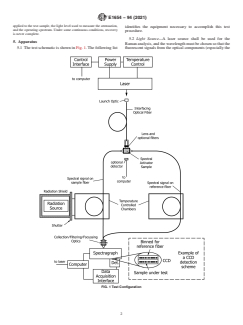
5.2 Light Source—A laser source shall be used for the
5. Apparatus
Ramananalysis,andthewavelengthmustbechosensothatthe
5.1 ThetestschematicisshowninFig.1.Thefollowinglist fluorescentsignalsfromtheopticalcomponents(especiallythe
FIG. 1 Test Configuration
E1654 − 94 (2021)
spectralactivatorsampleandopticalfibers)areminimized,and same uniform geometry as the actual fiber core material to
sothatthewavelengthcorrespondstothespectralsensitivityof ensure that dose-buildup effects are comparable to the fiber
the detection scheme. Typically, the wavelength range ex- core and the dosimeter. The dose should be expressed in gray
ploited spans from 0.4µm to 1.06 µm. The laser source must calculated for the core material.
have sufficient power to obtain the desired minimum signal-
5.9 Temperature-Controlled Container—Unless otherwise
to-noise ratio (S/N) (see 10.3).
specified, the temperature-controlled container shall have the
5.3 Focusing/Collection Optics—A number of optical ele-
capability of maintaining the specified temperature to 23°C 6
ments are needed for the launch and collection of light
2°C. The temperature of the sample/container should be
radiation into and from the optical fibers (interfacing, sample
monitored prior to and during the test.
and reference), and other instrumentation (light source,
5.10 Collection Optics into Detection System—Anappropri-
spectrograph, detector). The minimal requirement for these
atecollectionconfigurationshallbeusedatthedistalendofthe
elements shall be that the numerical aperture of the compo-
sampleandreferenceopticalfibers.Itisrecommendedthatthe
nents are matched for efficient coupling. Optics may also be
collection and focusing optic(s) is f/number matched to the
necessary to enhance the interaction of the input light with the
numerical aperture of the fibers and detection system.
spectral activator.
5.10.1 Raman analysis requires that the laser line be elimi-
5.4 Interfacing Optical Fiber—The primary requirement of
natedpriortodetection.Alaserreject(orlongpassfilter)must
the interfacing optical fiber is to provide the minimum power
be used at the entrance to the detection system. The filter
−1
to the activator sample at the proper wavelength(s). The fiber
should pass all energy at 500 cm below the laser excitation
lengthmaybeadjustedsothatthepowerrequirementsaremet.
line. The filter should be placed between the optical elements
prior to the spectrometer.
5.5 Light Radiation Filtering—Itisimportantthatallneigh-
boring laser lines are removed from the source beam prior to
5.11 Optical Detection—An optical detector with a known
interaction with the spectral activator. This can be accom-
responseovertherangeofintensitiesthatareencounteredshall
plished before or after the interfacing optical fiber. Placement
be used. A typical system for Raman might include a single-
of the filter before the interfacing fiber will eliminate the
point detector (that is, PMT) or a multichannel analyzer (that
neighboring laser lines, but any fluorescence and Raman
is, CCD array). The spectrograph must exhibit fast scanning
scattering due to the fiber or associated optics will be allowed
capabilities. As Fig. 1 indicates, it is recommended that a
to interact with the sample. Placement of the laser pass filter
single-imaging spectrometer be used with a 2D CCD detector
aftertheinterfacingfiberispreferablebecauseitwilleliminate
so that the output from the reference and sample fibers can be
any signals created within the fiber. If it is necessary to place
evaluated simultaneously. Two spectrometers operating simul-
the filter before the interfacing fiber, then the fiber should be
taneously may also be used.
kept as short as possible (several metres).
5.11.1 The optical detection system must be capable of
−1 −1
5.6 Spectral Activator Sample—The spectral activator used
obtaining the Raman spectrum from 500cm to 3000 cm
must demonstrate a strong, well-characterized Raman spectral from the excitation frequency.
signal. The sample may be either liquid, gas, or solid, depend-
5.12 Recorder System—Asuitable data recording, such as a
ing on the requirements of the optical fiber arrangement. It is
computer data acquisition system, is recommended.
recommendedthataliquidbeused,sincetheRamanscattering
5.13 Ambient Light Shielding—The irradiated fiber length
in the proposed configuration will launch similarly into the
shallbeshieldedfromambientlighttopreventphotobleaching
sample and reference fibers. Standard recommended samples
byanyexternallightsourcesandtoavoidbaselineshiftsinthe
are:acetonitrile,benzene,andcarbontetrachloride.Thesample
zero light level. An absorbing fiber coating or jacket can be
should be contained in a standard spectroscopic rectangular
used as the light shield provided that it has been demonstrated
silica cuvette.
to block ambient light and its influence on the dose within the
5.7 Optical Interconnections—The input and output ends of
fiber core has been taken into consideration.
the interfacing, reference, and sample optical fibers shall have
astabilizedopticalinterconnection,suchasaclamp,connector, NOTE2—Theaveragetotaldoseshouldbeexpressedingray(Gy,where
1 Gy=100 rads) to a precision of 65%, traceable to national standards.
splice, or weld. During an attenuation measurement, the
For typical silica core fibers, dose should be expressed in gray calculated
interconnection shall not be changed or adjusted.
for SiO , that is, Gy(SiO ).
2 2
5.8 Irradiation System—The irradiation system should have
the following characteristics:
6. Hazards
5.8.1 Dose Rate—ACo orotherirradiationsourceshallbe
6.1 Carefully trained and qualified personnel must be used
used to deliver radiation at dose rates ranging from 10Gy
to perform this test procedure since radiation (both ionizing
(SiO )/min to 100 Gy (SiO )/min. (See Note 2.)
2 2
and optical), as well as electrical, hazards will be present.
5.8.2 Radiation Energy—The energy of the gamma rays
emitted by the source should be greater than 500 KeVto avoid
7. Test Specimens
serious complications with the rapid variations in total dose as
a function of depth within the test sample. 7.1 Sample Optical Fiber—The sample fiber shall be
...