

ASTM D6820-20
(Guide)Standard Guide for Use of the Time Domain Electromagnetic Method for Geophysical Subsurface Site Investigation
General Information
- Abstract
SIGNIFICANCE AND USE
5.1 Concepts:
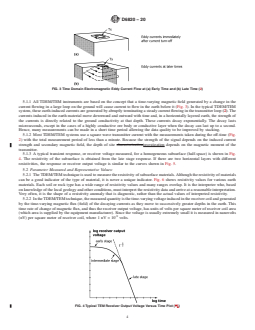
5.1.1 All TDEM/TEM instruments are based on the concept that a time-varying magnetic field generated by a change in the current flowing in a large loop on the ground will cause current to flow in the earth below it (Fig. 3). In the typical TDEM/TEM system, these earth-induced currents are generated by abruptly terminating a steady current flowing in the transmitter loop (2). The currents induced in the earth material move downward and outward with time and, in a horizontally layered earth, the strength of the currents is directly related to the ground conductivity at that depth. These currents decay exponentially. The decay lasts microseconds, except in the cases of a highly conductive ore body or conductive layer when the decay can last up to a second. Hence, many measurements can be made in a short time period allowing the data quality to be improved by stacking.
5.1.2 Most TDEM/TEM systems use a square wave transmitter current with the measurements taken during the off-time (Fig. 2) with the total measurement period of less than a minute. Because the strength of the signal depends on the induced current strength and secondary magnetic field, the depth of site investigation depends on the magnetic moment of the transmitter.
5.1.3 A typical transient response, or receiver voltage measured, for a homogeneous subsurface (half-space) is shown in Fig. 4. The resistivity of the subsurface is obtained from the late stage response. If there are two horizontal layers with different resistivities, the response or receiver output voltage is similar to the curves shown in Fig. 5.
5.2.8 Variations in temperature above freezing will affect resistivity measurements as a result of the temperature dependence of the resistivity of the pore fluid, which is of the order of 2 % per degree Celsius (1 % per degree Fahrenheit). Thus, data from measurements made in winter can be quite different from those made in summer.
5.2.9 As the ground temperature decre...
SCOPE
1.1 Purpose and Application:
1.1.1 This guide is one in a series of documents that describe geophysical site investigation methods.
1.1.2 This guide summarizes the equipment, field procedures, and interpretation methods for the assessment of subsurface materials and their pore fluids using the Time Domain Electromagnetic (TDEM) method. This method is also known as the Transient Electromagnetic (TEM) Method, and in this guide is referred to as the TDEM/TEM method. Time Domain and Transient refer to the measurement of a time-varying induced electromagnetic field.
1.1.3 The TDEM/TEM method is applicable to the subsurface site investigation for a wide range of conditions. TDEM/TEM methods measure variations in the electrical resistivity (or the reciprocal, the electrical conductivity) of the subsurface soil or rock caused by both lateral and vertical variations in various physical properties of the soil or rock. By measuring both lateral and vertical changes in resistivity, variations in subsurface conditions can be determined.
1.1.4 Electromagnetic measurements of resistivity as described in this guide are applied in geologic studies, geotechnical studies, hydrologic site investigations, and for mapping subsurface conditions at waste disposal sites (1).2 Resistivity measurements can be used to map geologic changes such as lithology, geological structure, fractures, stratigraphy, and depth to bedrock. In addition, measurement of resistivity can be applied to hydrologic site investigations such as the depth to water table, depth to aquitard, presence of coastal or inland groundwater salinity, and for the direct exploration for groundwater.
1.1.5 This standard does not address the use of TDEM/TEM method for use as metal detectors or their use in unexploded ordnance (UXO) detection and characterization. While many of the principles apply the data acquisition and interpretation differ from those set forth in this...
- Status
- Published
- Publication Date
- 31-Dec-2019
- Technical Committee
- D18 - Soil and Rock
- Drafting Committee
- D18.01 - Surface and Subsurface Investigation
Buy Documents
ASTM D6820-20 - Standard Guide for Use of the Time Domain Electromagnetic Method for Geophysical Subsurface Site Investigation
REDLINE ASTM D6820-20 - Standard Guide for Use of the Time Domain Electromagnetic Method for Geophysical Subsurface Site Investigation
Overview
ASTM D6820-20 is the Standard Guide for Use of the Time Domain Electromagnetic (TDEM) Method for Geophysical Subsurface Site Investigation. Developed by ASTM International, this guide provides comprehensive recommendations for the application of TDEM - also known as the Transient Electromagnetic (TEM) method - in characterizing the electrical resistivity of subsurface soils and rock. These geophysical methods play an essential role in geotechnical, hydrologic, environmental, and geological site assessments, enabling detailed mapping and analysis of subsurface materials.
TDEM/TEM methods measure the variation in electrical resistivity, which reflects changes in geologic materials and pore fluids in the earth. This guide outlines best practices for equipment setup, field procedures, data interpretation, and the integration of complementary data sources.
Key Topics
Principles of TDEM/TEM: The standard explains that TDEM/TEM instruments use a loop of wire on the ground to generate a rapidly changing magnetic field. This field induces currents in the earth, which move outward and downward, decaying over time depending on the subsurface conductivity. Measurements are typically taken after the transmitter current is abruptly switched off.
Measurement and Interpretation: TDEM/TEM surveys record voltage decay curves over time, which are interpreted to produce layered earth models showing variations in resistivity with depth. Data can be analyzed graphically or with specialized inversion software.
Influencing Factors: Subsurface materials’ resistivity is influenced by properties such as porosity, moisture, salinity, and the presence of clay minerals. The guide addresses environmental variables affecting resistivity, including temperature and freeze-thaw conditions.
System Components and Calibration: Descriptions are provided for the transmitter, receiver, loops, and calibration techniques, emphasizing the importance of system compatibility and regular calibration checks for data reliability.
Limitations and Interferences: The guide outlines limitations, such as the non-uniqueness of geophysical data interpretations and decreasing resolution with depth. Noise from power lines, nearby metal objects, and geologic sources can interfere with TDEM/TEM measurements.
Applications
The TDEM/TEM method is widely used for:
- Geological mapping: Identifying lithology, geological structure, fractures, and bedrock depth.
- Hydrologic investigations: Determining water table depth, locating aquitards, mapping groundwater salinity, and groundwater exploration.
- Environmental site assessment: Characterizing subsurface conditions for waste disposal, contamination studies, or construction.
- Geotechnical engineering: Supporting design and construction by providing information on soil and rock properties.
The versatility of TDEM/TEM methods makes them suitable for both broad surveys and targeted investigations, offering depth ranges from near-surface to several hundred meters, depending on equipment and survey configuration.
Related Standards
ASTM D6820-20 references and builds upon a series of ASTM guides and practices relevant to subsurface and geophysical investigations, including:
- ASTM D420 - Guide for Site Characterization for Engineering Design and Construction
- ASTM D653 - Terminology Relating to Soil, Rock, and Contained Fluids
- ASTM D5088, D5608 - Practices for Decontamination of Field Equipment
- ASTM D5753 - Guide for Geotechnical Borehole Geophysical Logging
- ASTM D6235 - Practice for Expedited Site Characterization at Hazardous Waste Sites
- ASTM D6429 - Guide for Selecting Surface Geophysical Methods
- ASTM D6431 - Guide for Using the Direct Current Resistivity Method
- ASTM D6639 - Guide for Using the Frequency Domain Electromagnetic Method
These standards provide additional context, definitions, and recommended practices to complement the effective use of the TDEM/TEM method.
For consistent, reliable geophysical subsurface site investigations, ASTM D6820-20 offers practitioners a structured approach to deploying TDEM/TEM, interpreting results, and ensuring quality in a variety of environmental and engineering applications.
Relations
- Effective Date
- 01-Jan-2020
- Effective Date
- 01-May-2020
- Effective Date
- 15-Dec-2018
- Effective Date
- 01-Feb-2018
- Refers
ASTM D5753-18 - Standard Guide for Planning and Conducting Geotechnical Borehole Geophysical Logging - Effective Date
- 01-Feb-2018
- Effective Date
- 01-Feb-2018
- Effective Date
- 01-Feb-2018
- Effective Date
- 01-Feb-2016
- Effective Date
- 01-Aug-2015
- Effective Date
- 15-Jan-2015
- Effective Date
- 01-Aug-2014
- Effective Date
- 01-Sep-2011
- Refers
ASTM D6429-99(2011)e1 - Standard Guide for Selecting Surface Geophysical Methods (Withdrawn 2020) - Effective Date
- 01-Jul-2011
- Effective Date
- 01-May-2010
- Effective Date
- 01-May-2010
Buy Documents
ASTM D6820-20 - Standard Guide for Use of the Time Domain Electromagnetic Method for Geophysical Subsurface Site Investigation
REDLINE ASTM D6820-20 - Standard Guide for Use of the Time Domain Electromagnetic Method for Geophysical Subsurface Site Investigation
Get Certified
Connect with accredited certification bodies for this standard

ANCE
Mexican certification and testing association.

Intertek Slovenia
Intertek testing, inspection, and certification services in Slovenia.

LNE (Laboratoire National de Métrologie et d'Essais)
French national laboratory for metrology and testing.
Sponsored listings
Frequently Asked Questions
ASTM D6820-20 is a guide published by ASTM International. Its full title is "Standard Guide for Use of the Time Domain Electromagnetic Method for Geophysical Subsurface Site Investigation". This standard covers: SIGNIFICANCE AND USE 5.1 Concepts: 5.1.1 All TDEM/TEM instruments are based on the concept that a time-varying magnetic field generated by a change in the current flowing in a large loop on the ground will cause current to flow in the earth below it (Fig. 3). In the typical TDEM/TEM system, these earth-induced currents are generated by abruptly terminating a steady current flowing in the transmitter loop (2). The currents induced in the earth material move downward and outward with time and, in a horizontally layered earth, the strength of the currents is directly related to the ground conductivity at that depth. These currents decay exponentially. The decay lasts microseconds, except in the cases of a highly conductive ore body or conductive layer when the decay can last up to a second. Hence, many measurements can be made in a short time period allowing the data quality to be improved by stacking. 5.1.2 Most TDEM/TEM systems use a square wave transmitter current with the measurements taken during the off-time (Fig. 2) with the total measurement period of less than a minute. Because the strength of the signal depends on the induced current strength and secondary magnetic field, the depth of site investigation depends on the magnetic moment of the transmitter. 5.1.3 A typical transient response, or receiver voltage measured, for a homogeneous subsurface (half-space) is shown in Fig. 4. The resistivity of the subsurface is obtained from the late stage response. If there are two horizontal layers with different resistivities, the response or receiver output voltage is similar to the curves shown in Fig. 5. 5.2.8 Variations in temperature above freezing will affect resistivity measurements as a result of the temperature dependence of the resistivity of the pore fluid, which is of the order of 2 % per degree Celsius (1 % per degree Fahrenheit). Thus, data from measurements made in winter can be quite different from those made in summer. 5.2.9 As the ground temperature decre... SCOPE 1.1 Purpose and Application: 1.1.1 This guide is one in a series of documents that describe geophysical site investigation methods. 1.1.2 This guide summarizes the equipment, field procedures, and interpretation methods for the assessment of subsurface materials and their pore fluids using the Time Domain Electromagnetic (TDEM) method. This method is also known as the Transient Electromagnetic (TEM) Method, and in this guide is referred to as the TDEM/TEM method. Time Domain and Transient refer to the measurement of a time-varying induced electromagnetic field. 1.1.3 The TDEM/TEM method is applicable to the subsurface site investigation for a wide range of conditions. TDEM/TEM methods measure variations in the electrical resistivity (or the reciprocal, the electrical conductivity) of the subsurface soil or rock caused by both lateral and vertical variations in various physical properties of the soil or rock. By measuring both lateral and vertical changes in resistivity, variations in subsurface conditions can be determined. 1.1.4 Electromagnetic measurements of resistivity as described in this guide are applied in geologic studies, geotechnical studies, hydrologic site investigations, and for mapping subsurface conditions at waste disposal sites (1).2 Resistivity measurements can be used to map geologic changes such as lithology, geological structure, fractures, stratigraphy, and depth to bedrock. In addition, measurement of resistivity can be applied to hydrologic site investigations such as the depth to water table, depth to aquitard, presence of coastal or inland groundwater salinity, and for the direct exploration for groundwater. 1.1.5 This standard does not address the use of TDEM/TEM method for use as metal detectors or their use in unexploded ordnance (UXO) detection and characterization. While many of the principles apply the data acquisition and interpretation differ from those set forth in this...
SIGNIFICANCE AND USE 5.1 Concepts: 5.1.1 All TDEM/TEM instruments are based on the concept that a time-varying magnetic field generated by a change in the current flowing in a large loop on the ground will cause current to flow in the earth below it (Fig. 3). In the typical TDEM/TEM system, these earth-induced currents are generated by abruptly terminating a steady current flowing in the transmitter loop (2). The currents induced in the earth material move downward and outward with time and, in a horizontally layered earth, the strength of the currents is directly related to the ground conductivity at that depth. These currents decay exponentially. The decay lasts microseconds, except in the cases of a highly conductive ore body or conductive layer when the decay can last up to a second. Hence, many measurements can be made in a short time period allowing the data quality to be improved by stacking. 5.1.2 Most TDEM/TEM systems use a square wave transmitter current with the measurements taken during the off-time (Fig. 2) with the total measurement period of less than a minute. Because the strength of the signal depends on the induced current strength and secondary magnetic field, the depth of site investigation depends on the magnetic moment of the transmitter. 5.1.3 A typical transient response, or receiver voltage measured, for a homogeneous subsurface (half-space) is shown in Fig. 4. The resistivity of the subsurface is obtained from the late stage response. If there are two horizontal layers with different resistivities, the response or receiver output voltage is similar to the curves shown in Fig. 5. 5.2.8 Variations in temperature above freezing will affect resistivity measurements as a result of the temperature dependence of the resistivity of the pore fluid, which is of the order of 2 % per degree Celsius (1 % per degree Fahrenheit). Thus, data from measurements made in winter can be quite different from those made in summer. 5.2.9 As the ground temperature decre... SCOPE 1.1 Purpose and Application: 1.1.1 This guide is one in a series of documents that describe geophysical site investigation methods. 1.1.2 This guide summarizes the equipment, field procedures, and interpretation methods for the assessment of subsurface materials and their pore fluids using the Time Domain Electromagnetic (TDEM) method. This method is also known as the Transient Electromagnetic (TEM) Method, and in this guide is referred to as the TDEM/TEM method. Time Domain and Transient refer to the measurement of a time-varying induced electromagnetic field. 1.1.3 The TDEM/TEM method is applicable to the subsurface site investigation for a wide range of conditions. TDEM/TEM methods measure variations in the electrical resistivity (or the reciprocal, the electrical conductivity) of the subsurface soil or rock caused by both lateral and vertical variations in various physical properties of the soil or rock. By measuring both lateral and vertical changes in resistivity, variations in subsurface conditions can be determined. 1.1.4 Electromagnetic measurements of resistivity as described in this guide are applied in geologic studies, geotechnical studies, hydrologic site investigations, and for mapping subsurface conditions at waste disposal sites (1).2 Resistivity measurements can be used to map geologic changes such as lithology, geological structure, fractures, stratigraphy, and depth to bedrock. In addition, measurement of resistivity can be applied to hydrologic site investigations such as the depth to water table, depth to aquitard, presence of coastal or inland groundwater salinity, and for the direct exploration for groundwater. 1.1.5 This standard does not address the use of TDEM/TEM method for use as metal detectors or their use in unexploded ordnance (UXO) detection and characterization. While many of the principles apply the data acquisition and interpretation differ from those set forth in this...
ASTM D6820-20 is classified under the following ICS (International Classification for Standards) categories: 33.100.01 - Electromagnetic compatibility in general. The ICS classification helps identify the subject area and facilitates finding related standards.
ASTM D6820-20 has the following relationships with other standards: It is inter standard links to ASTM D6820-18, ASTM D5088-20, ASTM D6235-18, ASTM D6431-18, ASTM D5753-18, ASTM D6639-18, ASTM D420-18, ASTM D5608-16, ASTM D5088-15a, ASTM D5088-15, ASTM D653-14, ASTM D653-11, ASTM D6429-99(2011)e1, ASTM D5753-05(2010), ASTM D5608-10. Understanding these relationships helps ensure you are using the most current and applicable version of the standard.
ASTM D6820-20 is available in PDF format for immediate download after purchase. The document can be added to your cart and obtained through the secure checkout process. Digital delivery ensures instant access to the complete standard document.
Standards Content (Sample)
This international standard was developed in accordance with internationally recognized principles on standardization established in the Decision on Principles for the
Development of International Standards, Guides and Recommendations issued by the World Trade Organization Technical Barriers to Trade (TBT) Committee.
Designation:D6820 −20
Standard Guide for
Use of the Time Domain Electromagnetic Method for
Geophysical Subsurface Site Investigation
This standard is issued under the fixed designation D6820; the number immediately following the designation indicates the year of
original adoption or, in the case of revision, the year of last revision.Anumber in parentheses indicates the year of last reapproval.A
superscript epsilon (´) indicates an editorial change since the last revision or reapproval.
1. Scope of the principles apply the data acquisition and interpretation
differ from those set forth in this standard guide.
1.1 Purpose and Application:
1.1.6 General references for the use of the method are
1.1.1 This guide is one in a series of documents that
McNeill (2), Kearey and Brooks (3), and Telford et al (4).
describe geophysical site investigation methods.
1.1.2 This guide summarizes the equipment, field
1.2 Limitations:
procedures, and interpretation methods for the assessment of
1.2.1 This guide provides an overview of the TDEM/TEM
subsurface materials and their pore fluids using the Time
method.Itdoesnotprovideoraddressthedetailsofthetheory,
DomainElectromagnetic(TDEM)method.Thismethodisalso
field procedures, or interpretation of the data. Numerous
knownastheTransientElectromagnetic(TEM)Method,andin
references are included for that purpose and are considered an
this guide is referred to as the TDEM/TEM method. Time
essential part of this guide. It is recommended that the user of
Domain and Transient refer to the measurement of a time-
the TDEM/TEM method be familiar with the references cited
varying induced electromagnetic field.
and with the ASTM standards D420, D653, D5088, D5608,
1.1.3 The TDEM/TEM method is applicable to the subsur-
D5730, D5753, D6235, D6429 and D6431.
face site investigation for a wide range of conditions. TDEM/
1.2.2 This guide is limited to TDEM/TEM measurements
TEM methods measure variations in the electrical resistivity
made on land. The TDEM/TEM method can be adapted for a
(orthereciprocal,theelectricalconductivity)ofthesubsurface
number of special uses on land, water, ice, within a borehole,
soil or rock caused by both lateral and vertical variations in
and airborne. Special TDEM/TEM configurations are used for
various physical properties of the soil or rock. By measuring
metal and unexploded ordnance detection. These TDEM/TEM
both lateral and vertical changes in resistivity, variations in
methods are not discussed in this guide.
subsurface conditions can be determined.
1.2.3 TheapproachessuggestedinthisguidefortheTDEM/
1.1.4 Electromagnetic measurements of resistivity as de-
TEM method are commonly used, widely accepted, and
scribed in this guide are applied in geologic studies, geotech-
proven. However, other approaches or modifications to the
nical studies, hydrologic site investigations, and for mapping
TDEM/TEM method that are technically sound may be sub-
subsurface conditions at waste disposal sites (1). Resistivity
stituted.
measurements can be used to map geologic changes such as
1.2.4 This guide offers an organized collection of informa-
lithology, geological structure, fractures, stratigraphy, and
tion or a series of options and does not recommend a specific
depth to bedrock. In addition, measurement of resistivity can
course of action. This document cannot replace education,
beappliedtohydrologicsiteinvestigationssuchasthedepthto
experience, and should be used in conjunction with profes-
water table, depth to aquitard, presence of coastal or inland
sional judgment. Not all aspects of this guide may be appli-
groundwatersalinity,andforthedirectexplorationforground-
cable in all circumstances. ThisASTM standard is not intended
water.
to represent or replace the standard of care by which the
1.1.5 ThisstandarddoesnotaddresstheuseofTDEM/TEM
adequacy of a given professional service must be judged, nor
method for use as metal detectors or their use in unexploded
should this document be applied without consideration of a
ordnance (UXO) detection and characterization. While many
project’smanyuniqueaspects.Thewordstandardinthetitleof
this document means only that the document has been ap-
1 proved through the ASTM consensus process.
ThisguideisunderthejurisdictionofASTMCommitteeD18onSoilandRock
and is the direct responsibility of Subcommittee D18.01 on Surface and Subsurface
1.3 Precautions:
Characterization.
Current edition approved Jan. 1, 2020. Published January 2020. Originally
1.3.1 It is the responsibility of the user of this guide to
approved in 2002. Last previous edition approved in 2018 as D6820–18. DOI:
follow any precautions in the equipment manufacturer’s rec-
10.1520/D6820-20.
ommendations and to establish appropriate health and safety
Theboldfacenumbersinparenthesesrefertothelistofreferencesattheendof
this standard. practices.
Copyright © ASTM International, 100 Barr Harbor Drive, PO Box C700, West Conshohocken, PA 19428-2959. United States
D6820−20
1.3.2 Ifthemethodisusedatsiteswithhazardousmaterials, D5730Guide for Site Characterization for Environmental
operations, or equipment, it is the responsibility of the user of Purposes With Emphasis on Soil, Rock, the Vadose Zone
this guide to establish appropriate safety and health practices and Groundwater (Withdrawn 2013)
and to determine the applicability of any regulations prior to D5753Guide for Planning and Conducting Geotechnical
use. Borehole Geophysical Logging
1.3.3 Thisguidedoesnotpurporttoaddressallofthesafety D6235Practice for Expedited Site Characterization of Va-
concerns that may be associated with the use of the TDEM/ dose Zone and Groundwater Contamination at Hazardous
TEM method. It must be emphasized that potentially lethal Waste Contaminated Sites
voltages exist at the output terminals of many TDEM/TEM D6429Guide for Selecting Surface Geophysical Methods
transmitters, and also across the transmitter loop, which is D6431Guide for Using the Direct Current Resistivity
sometimes uninsulated. It is the responsibility of the user of Method for Subsurface Site Characterization
thisequipmenttoassesspotentialenvironmentalsafetyhazards D6639Guide for Using the Frequency Domain Electromag-
resulting from the use of the selected equipment, establish netic Method for Subsurface Site Characterizations
appropriate safety practices and to determine the applicability
3. Terminology
of regulations prior to use.
1.3.4 Units—The values stated in SI units are regarded as
3.1 Definitions:
standard. The values given in parentheses are mathematical
3.1.1 Fordefinitionsofcommontechnicaltermsusedinthis
conversions to inch-pound units, which are provided for
standard, refer to Terminology D653.
informationonlyandarenotconsideredstandard.Reportingof
3.2 Additional Definitions:
test results in units other than SI shall not be regarded as
3.2.1 site investigation, n—in geotechnical and (hydro)geo-
nonconformance with this guide.
logical evaluations, the effort(s) to plan a scope of work and
1.4 This international standard was developed in accor-
collect data to support the assessment of the acquired data,
dance with internationally recognized principles on standard-
such as engineering, chemical and index properties, of rock,
ization established in the Decision on Principles for the
soil and/or groundwater, and possibly their spatial variability,
Development of International Standards, Guides and Recom-
at the area of interest.
mendations issued by the World Trade Organization Technical
Barriers to Trade (TBT) Committee. 4. Summary of Guide
4.1 Summary—Atypical TDEM/TEM survey configuration
2. Referenced Documents
for resistivity sounding (Fig. 1) consists of a transmitter
2.1 ASTM Standards: connected to a (usually single-turn) square loop of wire
D420Guide for Site Characterization for Engineering De-
(generally but not necessarily insulated), laid on the ground.A
sign and Construction Purposes multi-turn receiver coil, usually located at the center of the
D653Terminology Relating to Soil, Rock, and Contained
transmitter loop, is connected to a receiver through a short
Fluids length of cable. In some scenarios, it is advantageous to also
D5088Practice for Decontamination of Field Equipment
measurethehorizontalcomponent(s)(calledHxandHy)ofthe
Used at Waste Sites received signal. In addition, depending upon the project goals,
D5608Practices for Decontamination of Sampling and Non
measurements may be made both inside and outside of the
Sample Contacting Equipment Used at Low Level Radio-
transmitter loop, sometimes called a ‘fixed-loop array.’
active Waste Sites
4.1.1 The transmitter current waveform is usually a
periodic,symmetricalsquarewave(Fig.2).Aftereverysecond
quarter-period the transmitter current (typically between 1 and
The last approved version of this historical standard is referenced on
For referenced ASTM standards, visit the ASTM website, www.astm.org, or
www.astm.org.
contact ASTM Customer Service at service@astm.org. For Annual Book of ASTM
Standards volume information, refer to the standard’s Document Summary page on
the ASTM website.
FIG. 1Typical TDEM/TEM Survey Configuration (5)
D6820−20
FIG. 2Typical Time Domain Electromagnetic Waveforms (2)
40 amps) is abruptly reduced to zero for one quarter period, is proportional to the time rate of change of the magnetic field
after which it flows in the opposite direction to the previous arising from the subsurface current flow. The magnetic field is
flow.
directly proportional to the magnitude of the subsurface
4.1.2 OtherTDEM/TEMconfigurationsusetriangularwave
current. By measuring the receiver coil voltage at successively
current waveforms and measure the time-varying magnetic
later times, measurement is effectively made of the current
field while the current is on.
flow, and thus the electrical resistivity of the earth, at succes-
4.1.3 The process of abruptly reducing the transmitter
sively greater depths.
current to zero induces, in accord with Faraday’s Law, a
4.1.4 Data resulting from a TDEM/TEM sounding consist
short-durationvoltagepulseinthegroundthatcausesacurrent
of a curve of receiver coil output voltage as a function of time.
to flow in the vicinity of the transmitter wire (Fig. 3).After the
Analysis of this curve produces a layered earth model of the
transmitter current is abruptly turned off, the current loop can
variationofearthresistivityasafunctionofdepth.Theanalysis
bethoughtofasanimage,justbelowthesurfaceoftheground,
can be done graphically or with commercially available
of the transmitter loop. However, because of the resistivity of
TDEM/TEM data inversion programs.
the ground, the magnitude of the current flow immediately
4.1.5 To determine lateral variations of resistivity in the
decays. This decaying current induces a voltage pulse in the
ground, which causes more current to flow at larger distances subsurface, both transmitter and receiver are moved along
from the transmitter loop and at greater depths (Fig. 3). The profile lines on a survey grid. In this way, a three-dimensional
deeper current flow also decays, due to the resistivity of the
picture of the terrain resistivity is developed.
ground, inducing even deeper current flow. To determine the
4.1.6 TDEM/TEM surveys for geologic, engineering, hy-
resistivity as a function of depth, the magnitude of the current
drologic and environmental applications are carried out to
flow in the ground as a function of time is determined by
determine depths of layers or lateral changes in geological
measuringthevoltageinducedinthereceivercoil.Thevoltage
FIG. 3Time Domain Electromagnetic Eddy Current Flow at (a) Early Time and (b) Late Time (2)
D6820−20
conditions to a depth of tens of meters. Using larger transmit- 5.2 Parameter Measured and Representative Values:
ters and more sensitive receivers, it is possible to achieve
5.2.1 The TDEM/TEM technique is used to measure the
depths up to 1000 m (3280 ft).
resistivity of subsurface materials. Although the resistivity of
materials can be a good indicator of the type of material, it is
4.2 Complementary Data—Geologic and water table data
never a unique indicator. Fig. 6 shows resistivity values for
obtained from borehole logs, geologic maps, data from out-
variousearthmaterials.Eachsoilorrocktypehasawiderange
crops or other geological or surface geophysical methods
(Guide D6429) and borehole geophysical methods (Guide of resistivity values and many ranges overlap. It is the
D5753) are always helpful in interpreting subsurface condi- interpreter who, based on knowledge of the local geology and
tions from TDEM/TEM survey data.
otherconditions,mustinterprettheresistivitydataandarriveat
a reasonable interpretation. Very often, it is the shape of a
5. Significance and Use
resistivity anomaly that is diagnostic, rather than the actual
5.1 Concepts: values of interpreted resistivity.
5.1.1 AllTDEM/TEMinstrumentsarebasedontheconcept
5.2.2 In the TDEM/TEM technique, the measured quantity
thatatime-varyingmagneticfieldgeneratedbyachangeinthe
is the time-varying voltage induced in the receiver coil and
currentflowinginalargelooponthegroundwillcausecurrent
generated by the time-varying magnetic flux (field) of the
toflowintheearthbelowit(Fig.3).InthetypicalTDEM/TEM
decaying currents as they move to successively greater depths
system, these earth-induced currents are generated by abruptly
intheearth.Thistimerateofchangeofmagneticflux,andthus
terminatingasteadycurrentflowinginthetransmitterloop (2).
the receiver output voltage, has units of volts per square meter
Thecurrentsinducedintheearthmaterialmovedownwardand
of receiver coil area (which area is supplied by the equipment
outward with time and, in a horizontally layered earth, the
manufacturer). Since the voltage is usually extremely small it
strength of the currents is directly related to the ground
is measured in nanovolts (nV) per square meter of receiver
-9
conductivity at that depth.These currents decay exponentially.
coil, where 1 nV = 10 volts.
The decay lasts microseconds, except in the cases of a highly
5.2.3 The resistivity (usually designated in the geophysical
conductive ore body or conductive layer when the decay can
literature by the symbol ρ) represents the absolute ability of a
last up to a second. Hence, many measurements can be made
substance to prevent the flow of an electrical current. The
in a short time period allowing the data quality to be improved
reciprocal of resistivity is conductivity (usually designated by
by stacking.
the symbol σ, where σ=1/ρ), which represents the absolute
5.1.2 Most TDEM/TEM systems use a square wave trans-
ability of the same substance to allow the flow of electrical
mittercurrentwiththemeasurementstakenduringtheoff-time
current. Resistive terrain has a low value of conductivity and
(Fig. 2) with the total measurement period of less than a
vice versa. Throughout this guide, the term resistivity is used.
minute. Because the strength of the signal depends on the
Theresistivityofamaterialdependsonthephysicalproperties
induced current strength and secondary magnetic field, the
of the material and is independent of the geometry. Units of
depthofsiteinvestigationdependsonthemagneticmomentof
resistivity are ohmmeters. Units of conductivity are siemens/
the transmitter.
meter (S/m) or more commonly millisiemens/meter (mS/m),
5.1.3 A typical transient response, or receiver voltage
where 1 S/m = 1000 mS/m. Thus ρ (ohmmeters) = 1/ σ
measured,forahomogeneoussubsurface(half-space)isshown
(siemens/meter) = 1000/σ (mS/m).
in Fig. 4.The resistivity of the subsurface is obtained from the
late stage response. If there are two horizontal layers with
NOTE 1—Even in countries that use inch-pound units conductivity and
differentresistivities,theresponseorreceiveroutputvoltageis
resistivityarereportedinSIunits,albeitinS/cmand Ω.cm(insteadofS/m
similar to the curves shown in Fig. 5. and Ω.m) respectively.
FIG. 4Typical TEM Receiver Output Voltage Versus Time Plot (5)
D6820−20
FIG. 5TDEM Receiver Output Voltage for Various Earth Models (5)
FIG. 6Typical Ranges of Resistivities and Conductivities of Earth Materials (6)
5.2.4 For most applications, the pore fluid dominates the fluid. For saturated sandstones and limestones and many other
flow of electrical current and thus, the resistivity.As a general saturated substances, the resistivity, ρ, is given approximately
rule, materials that lack porosity show high resistivity (ex-
by:
amples are massive limestone, most igneous and metamorphic
2b
ρ 5 aρ φ (1)
w
rocks); materials whose pore space lacks water show high
resistivity (examples are dry sand or gravel, ice); materials where:
whose pore water is fresh show high resistivity (examples are
ρ = resistivity of the pore fluid,
w
clean gravel or sand, even when saturated); and materials
φ = porosity,
whose pore water is saline show very low resistivity. a = a constant whose value depends on the material, but is
5.2.5 The relationship between resistivity and water satura-
approximately 1, and
b = a constant whose value depends on the material (the
tion is not linear. The resistivity increases relatively slowly as
saturation decreases from 100% to between 40 and 60%, and cementation exponent), but is approximately 2.
thenincreasesmuchmorerapidlyasthesaturationcontinuesto
5.2.8 Variations in temperature above freezing will affect
decrease.
resistivity measurements as a result of the temperature depen-
5.2.6 Many geologic materials show medium or low resis-
dence of the resistivity of the pore fluid, which is of the order
tivity if clay minerals are present (examples are clay soil,
of 2% per degree Celsius (1% per degree Fahrenheit). Thus,
severely weathered rock). Clay minerals decrease the resistiv-
data from measurements made in winter can be quite different
ity because they adsorb cations in an exchangeable state on
from those made in summer.
their surfaces.
5.2.9 As the ground temperature decreases below freezing,
5.2.7 An empirical relationship known as Archie’s Law
the resistivity increases with decreasing temperature, slowly
describes an approximate relationship between the resistivity
of a matrix material, its porosity and the resistivity of the pore for fine materials (in which a significant portion of the water
D6820−20
remains unfrozen, even at quite low temperatures), and rapidly 5.4.1.1 Afundamentallimitationofallgeophysicalmethods
for coarse materials (in which the water freezes immediately). isthatagivensetofdatacannotbeassociatedwithauniqueset
of subsurface conditions. In most situations, surface geophysi-
5.2.10 Further information about factors that control the
cal measurements alone cannot resolve all ambiguities, and
electrical resistivity or conductivity of different geological
additional information, such as borehole data, is required.
materials can be found in Ward 1990 (7).
Becauseofthisinherentlimitationinthegeophysicalmethods,
5.2.11 Because the TDEM/TEM technique measures sub-
a TDEM/TEM survey alone is not considered a complete
surface resistivity, only geological or hydrological structures
assessment of subsurface conditions. Properly integrated with
that cause spatial variations in resistivity are detected by this
other geologic information,TDEM/TEM surveying is a highly
technique. If there is no resistivity contrast between the
effective method of obtaining subsurface information.
different geological materials or structures, if the resistivity
contrast is too small to be detected by the instrument, or if the 5.4.1.2 In addition, all surface geophysical methods are
resistivity of the subsurface material is very high, the TDEM/
inherently limited by decreasing resolution with depth.
TEM technique gives no useful information.
5.4.2 Limitations Specific to the TDEM/TEM Method:
5.3 Equipment—Geophysical equipment used for the 5.4.2.1 Subsurface layers are assumed horizontal within the
area of measurement.
TDEM/TEM method includes a transmitter, a transmitter loop
ofwire,atransmitterpowersupply,areceiverandoneormore
5.4.2.2 A sufficient resistivity contrast between the back-
receiver coils.
ground conditions and the feature being mapped must exist for
5.3.1 The transmitter may have power output ranging from the feature to be detected. Some significant geologic or
a few watts to tens of kilowatts. Important parameters of the hydrogeologic boundaries may have no field-measurable resis-
transmitterarethatittransmitsacleanwave-form(Fig.2),and tivitycontrastacrossthemandconsequentlycannotbedetected
that the “turn-off” characteristics are well known and ex- with this technique.
tremely stable, because they influence the initial shape of the
5.4.2.3 The TDEM/TEM method does not work well in
transient response.
highly resistive (very low conductivity) materials due to the
5.3.2 The size of the transmitter power supply determines difficulty in measuring low values of conductivity.
the depth of exploration, and can range from a few small
5.4.2.4 An interpretation of TDEM/TEM data alone does
batteries to a 10-kW, gasoline-driven generator.
not yield a unique correlation between possible geologic
5.3.3 The transmitter loop wire is usually insulated for
models and a single set of field data. This ambiguity can be
safety. The size of the loop and the amount of current flowing
significantly reduced by doing an equivalence analysis as
through it (and thus the diameter of the wire) determines the
discussedin6.12.3andcanbefurtherresolvedthroughtheuse
desired depth of exploration. The weight of the loop, which is
of sufficient supporting geologic data and by an experienced
generally stored on one or more reels, can be anywhere from a
interpreter.
few kilograms to over 100 kg (from a few pounds to over 225
5.4.3 Interferences Caused by Natural and Cultural Condi-
lb).
tions:
5.3.4 The receiver measures the time-varying characteristic
5.4.3.1 The TDEM/TEM method is sensitive to noise from
of the receiver coil output voltage at a number of points along
a variety of natural ambient and cultural sources. Spatial
the decay curve and stores this data in memory. Because the
variations in resistivity caused by geologic factors may also
voltage is small, and changes rapidly with time, the receiver
produce noise. Cultural noise be manifested as very obviously
must have excellent sensitivity, noise rejection, linearity,
erratic curve behavior such as in Fig. 7, or it may be subtle,
stability, and bandwidth. The transmitter/receiver combination
repeatable, and difficult to distinguish from valid subsurface
musthavesomefacilityforsynchronizationsothatthereceiver
changes in resistivity.
accurately records the time of transmitter current termination
5.4.3.2 Ambient Sources of Noise—Ambient sources of
or variation. This synchronization is done either with an
noise include radiated and induced responses from nearby
interconnecting timing cable or with high-stability quartz
metallic structures, and soil and rock electrochemical effects,
crystal oscillators mounted in each unit. The characteristics of
including induced polarization. InTDEM/TEM soundings, the
aTDEM/TEMreceiverandtransmitteraresufficientlyspecial-
signal-to-noise ratio (SNR) is usually good over most of the
ized that use of transmitters and receivers not specifically
measurement time range. However, at late times, the transient
designed for TDEM/TEM by their manufacturers is not rec-
response from the ground decays extremely rapidly such that,
ommended.
towards the end of the transient, the signal deteriorates com-
5.3.5 Thereceivercoilmustmatchthecharacteristicsofthe
pletely and the data become extremely noisy.
receiver itself. It may contain a built-in preamplifier so that it
5.4.3.3 Radiated and Induced Noise—Radiated noise con-
can be located some distance from the receiver. The coil must
sists of signals generated by radio, radar transmitters, and
be free from microphone noise, and it must be constructed so
lightning. The first two are not generally a problem. However,
that the transient response from the metal of the coil and the
on summer days when there is extensive local thunderstorm
coil shielding is negligible.
activity, the electrical noise from lightning strikes can cause
5.4 Limitations and Interferences:
noiseproblems.Itmaybenecessarytoincreasetheintegration
5.4.1 General Limitations Inherent to Geophysical Meth- (stacking) time or, in severe cases, to discontinue the survey
ods: until the storms have passed by or abated.
D6820−20
FIG. 7Oscillations Induced in Receiver Response by Power Lines (5)
(1)The most important source of induced noise consists of location of the receiver case itself with respect to the receiver
intensemagneticfieldsarisingfrom50/60Hzpowerlines.The coil must be followed carefully.
large signals induced in the receiver from this source (the
(1)Power lines can often be detected as metallic targets as
strength of which falls off more or less linearly with distance
well as sources of induced noise. In this case, they exhibit an
from the power line) can overload the receiver if the receiver
oscillatory response (the response from all other targets,
gain is set too high, causing serious errors. The remedy is to
including the earth, decays monotonically to zero without
reduce receiver gain to the point that overload does not occur.
oscillation). Because the frequency of the oscillation is unre-
In some cases, this may result in less accurate measurement of
lated to the receiver base frequency, the effect of power line
the transient because the available dynamic range of the
metallic response is to render the transient “noisy” (Fig. 7).
receiverisnotfullyutilized.Anotheralternativeistomovethe
Becausetheseoscillationsarisefromresponsetoeddycurrents
measurement array (particularly the receiver coil) further from
induced in the power line by the TDEM/TEM transmitter,
the power line. The equipment manufacturer’s documentation
repeating the measurement produces an identical response,
may also provide information about which repetition rates or
which is one way that these oscillators are identified.Another
basefrequencies(ifany)providethebestrejectionofthenoise
wayistotakeameasurementwiththetransmitterturnedoff.If
arising from power lines.
the noise disappears, it is a good indication that power line
(2)It was mentioned above that one of the advantages of
response is the problem. The only remedy is to move the
TDEM/TEM resistivity sounding was that measurement of the
transmitter loop further from the power line.
transientsignalfromthegroundwasmadeintheabsenceofthe
(2)Other metallic responses, such as those from buried
primary transmitter field, since measurement is made after
metallictrashorpipescanpresentaproblem.Iftheresponseis
transmitter current turnoff (Fig. 2). Modern transmitters use
large,anothersoundingsitemustbeselected.Useofadifferent
extremely effective electronic switches to terminate the large
transmitter current. Nevertheless very sensitive receivers can
geophysical instrument such as a metal detector or ground
still detect small currents that linger in the loop after turn-off.
conductivity meter is helpful to quickly survey the sounding
The magnitude of these currents and their time behavior are
site for buried metal.
availablefromtheequipmentmanufacturer,whocanadvisethe
5.4.3.5 Geologic Sources of Noise—Geologic noise arises
user as to how closely the receiver coil can be placed to the
from the presence of unsuspected geological structures or
actual transmitter loop wire.
materials, which cause variations in terrain resistivity. A rare
(3)Another source of induced noise, common to ferrite or
effect that can occur in clayey soils, is induced polarization.
iron-cored receiver coils, is microphone noise arising from
Rapid termination of the transmitter current and thus primary
minute movements of the receiver coil in the earth’s relatively
magnetic field can charge up small electrical capacitors at soil
strong magnetic field. Such movements are usually caused by
particle interfaces. These capacitors subsequently discharge,
thewind,andthecoilmustbeshieldedfromthewindnoise,or
producing current flow similar to that shown in Fig. 3, but
the measurements made at night when this source of noise is
reversed in direction. The net effect is to reduce the amplitude
minimal.Inextremecases,itmaybenecessarytoburythecoil.
of the transient response (thus increasing the apparent resistiv-
5.4.3.4 Presence of Nearby Metallic Structures—TDEM/
ity) or, in severe situations, to cause the transient response to
TEM systems are excellent metal detectors. Use of such
become negative over some portion of the measurement time
systems for resistivity sounding demands that measurements
range. Because these sources of reverse current are most
arenotmadeinthepresenceofmetal.Thisrequiresremovalof
significant in the vicinity of the transmitter loop, using the
all metallic objects not part of the survey equipment (metallic
offset configuration (described in 6.7.1.1) usually reduces the
chairs,toolboxes,etc.)fromtheareaofthesurveyinstruments.
The recommendations of the manufacturer with regard to the induced polarization effect.
D6820−20
5.5 Summary—During the course of designing and carrying 6.3.3 Assess Resistivity Contrast:
outaTDEM/TEMsurvey,thesourcesofambient,geologicand
6.3.3.1 AcriticalelementinplanningaTDEM/TEMsurvey
cultural noise must be considered and the time of occurrence
is the determination of whether there is an adequate resistivity
and location noted. The form of the interference is not always contrast to produce a measurable TDEM/TEM anomaly. An
predictable, as it not only depends upon the type of noise and
inadequate resistivity contrast makes the survey useless.
the magnitude of the noise but upon the distance from the
6.3.3.2 If no previous resistivity surveys have been made in
source of noise and possibly the time of day.
the area, information about the geology from published refer-
ences containing the geologic character of earth materials and
5.6 Alternate Methods—Insomecases,thefactorsdiscussed
publishedreportsofresistivitystudiesperformedundersimilar
above may prevent the effective use of the TDEM/TEM
conditions are required. From this information, the feasibility
method, and other surface geophysical methods such as con-
of using the TDEM/TEM resistivity sounding method at the
ventional direct current (DC) resistivity sounding (Guide
site can be assessed.
D6431), frequency domain electromagnetic surveying (Guide
6.3.3.3 Forward modeling using numerical modeling meth-
D6639) or non-geophysical methods may be required to
ods (8) should be used to calculate theTDEM/TEM resistivity
investigate subsurface conditions.
sounding data for various sets of subsurface conditions. Given
6. Procedure
the depth and the shape of the subsurface feature and the
6.1 This section includes a discussion of personnel difference in resistivity, such models can be used to assess the
feasibility of conducting a TDEM/TEM survey and to deter-
qualification, considerations for planning and implementing
the TDEM/TEM survey, and interpretation of the resistivity minethegeometryofthefield-surveyequipmentconfiguration
(see 6.7.1).
data.
6.2 Qualification of Personnel—Success of a TDEM/TEM
6.4 Survey Design:
survey, as with most geophysical techniques, is dependent
6.4.1 There must be a clear technical objective to the
upon many factors. One of the most important factors is the
TDEM/TEM survey. Target size, depth, orientation, and resis-
competence of the person(s) responsible for planning, carrying
tivity should be estimated, as well as number and distribution
out the survey, and interpreting the data. An understanding of
of targets. It is extremely important that the length of a profile
the theory, field procedures, and methods for interpretation of
line or area of survey be larger than the area of interest so that
TDEM/TEM data along with an understanding of the site
sufficient measurements are taken in background conditions to
geology is necessary to successfully complete a resistivity
establish that any detected anomaly is indeed anomalous.
survey.Personnelnothavingspecializedtrainingorexperience
6.4.2 The distance between station measurements should be
should be cautious about using this technique and solicit
closeenoughtodefinetheexpectedanomaly.Ananomalymust
assistance from qualified practitioners.
be defined by a minimum of 3 points and preferably by more
points.
6.3 Planning the Survey—Successful use of the surface
6.4.3 Preliminary location of survey lines is usually done
TDEM/TEM method depends to a great extent on careful and
withtheaidoftopographicmapsandaerialphotosifanon-site
detailed planning as discussed in this section.
visit is not possible. Consideration should be given to:
6.3.1 Objectives of the TDEM/TEM Survey—Planning and
6.4.3.1 The need for data at a given location,
design of a TDEM/TEM survey should be done with due
consideration to the objectives of the survey and the charac-
6.4.3.2 Theaccessibilityoftheareawithadequatespacefor
teristics of the site. These factors determine the survey design, the transmitter loop,
the equipment used, the level of effort, the interpretation
6.4.3.3 Theproximityofwellsortestholesforcontroldata,
method selected, and the budget necessary to achieve the
and
desired results. Considerations include site geology, desired
6.4.3.4 The extent and location of any buried structures,
depth of the site investigation, topography, and access. The
power lines, fences, or other cultural features that may intro-
presence of noise-generating activities and operational con-
duce noise into the data or noise that will prevent measure-
straints (which may restrict survey activities) must also be
ments from being made.
considered.Itisgoodpracticetoobtainasmuchoftherelevant
6.5 Survey Geometry—TDEM/TEM resistivity sounding
information as possible about the site prior to designing a
data may be obtained along a single profile line, narrow or
survey and mobilization to the field. Data from previous
widely spaced profile lines, or over a uniform grid.The station
TDEM/TEM work, other surface geophysical methods,
spacing will be determined by the resolution required. Efforts
boreholes,geologicandgeophysicallogsinthestudyarea,and
should be made, if appropriate, to avoid biasing the data by
topographic maps or aerial photos should be used to plan the
taking many more measurements in one direction than in
survey.
another.
6.3.2 Asimplegeologic/hydrologicmodelofthesubsurface
conditions at the site should be developed early in the design 6.6 System Calibration—The data from a resistivity sound-
phaseandincludethethicknessandtypeofsoilcover,depthto ing consists of a series of values of receiver output voltage e
and type of rock, depth to water table, stratigraphy and (t), measured at each of a series of successive time gates.
structure, and targets to be mapped with the TDEM/TEM Properlycalibrated,theunitsof e(t)arevoltspersquaremeter
method. This model will be used to evaluate the ability of the of receiver coil area, however, since the received signals are
TDEM/TEM technique to provide useful data. very small, it is common to use nanovolts per square meter
D6820−20
(nV/m ). The amplitudes of measured decays typically range can be measured. In the TDEM/TEM method the depth of
2 2
from many thousands of nV/m at early times to 0.1 nV/m at exploration is usually the length of the loop edge (assuming
the last time gate where there is useful signal. that the loop current is of the order of a few amperes). One
6.6.1 Modern TDEM/TEM systems are sometimes cali- might try using a 10×10-m (33×33-ft) loop carrying 3 amps
brated by placing a “Q-coil” (calibration coil) at a specified (characteristic of a low power TDEM/TEM system) in the
locationwithrespecttobothtransmitterloopandreceivercoil, initial model calculation. Before doing the calculations for this
and measuring the received signal in the normal way that shallow case, one feature accompanying the use of small (that
would also be used for measuring the terrain signals. The is, less than 60×60-m) (200×200-ft) transmitter loops for
“Q-coil” is a coil with known parameters, damped with one or shallowsoundingshouldbenoted.Insmallloops,theinducing
more resistors so as to present a variety of known transient primarymagneticfieldatthecenteroftheloopishigh,andthe
responses. This calibration technique calibrates the entire presenceofmetalsuchasthereceivercaseorthecoilcancause
system so that satisfactory results arising from the calibration sufficienttransientresponsetodistortthemeasuredsignal.This
assuretheoperatorthattheentiresystemisoperatingcorrectly. effectisreducedbyplacingthereceivercoilandreceiverabout
6.6.2 Sincetheresponseoftheearthisaddedtothe“Q-coil” 10 m (33 ft) outside of the transmitter loop and away from the
response, two measurements must be made, the first with the nearest transmitter wire. The effect of this offset on the data is
“Q-coil” open circuited (so that only the earth response is relatively small.
measured)andthesecondwiththe“Q-coil”closed,tomeasure
6.7.1.2 The first task is to determine whether the difference
both. Response from the “Q-coil” alone is determined by
between no clay layer and a clay layer 1-m thick can be
subtracting the first data set from the second.
resolved. Results of the forward layered-earth calculation are
6.6.3 The “Q-coil” calibration should be performed before
shown in Fig. 8. They indicate that the apparent resistivity
and after each project.
curves for these two cases are well separated (maximum
difference in apparent resistivity of about 10%) over a time
6.7 Detailed Survey Design:
rangefromabout8µsto100µs,aswouldbeexpectedfromthe
6.7.1 Transmitter Loop Size and Current—A common sur-
relatively shallow depth. Note that, to use this early time
vey configuration consists of a square, usually single-turn,
information would require a receiver that has many narrow,
transmitter loop, with a horizontal receiver coil located at the
early time gates in order to accurately resolve the curve. The
center.Thetwoquestionsincarryingoutaresistivitysounding
receiverandcoilwouldalsohavetohaveawidebandwidthso
are(1)howlargeshouldthesidelengthsofthetransmitterloop
as not to distort the early portion of the rapidly varying
be, and (2) how much current should the loop carry? Both
transient signal. The figure shows that resolving clay layer
questions are easily answered using one of the commercially
thickness from 1 to4m(3to13 ft)and greater should be no
available forward layered-earth modeling programs.An initial
problem.
estimateismadeaboutthepossiblegeoelectricsection(thatis,
thenumberoflayersofdifferentresistivities,andtheresistivity 6.7.1.3 Having ascertained that the physics of TDEM/TEM
sounding will allow detection of this thin layer, the next test is
andthicknessofeachlayer),andthesedataareenteredintothe
program, along with the proposed loop size and current. The toensurethatthe10×10-m(33×33-ft)transmitteroperatingat
resulting transient voltage is calculated as a function of time 3 amps will provide a sufficient SNR over the time range of
andtheoutputdatacheckedforsignal-to-noiseratio(SNR)and interest (8 to 100 µs). The same forward layered-earth calcu-
also for geoelectric resolution of the model. lationalsodisplaystheactualmeasuredvoltagesthatwouldbe
6.7.1.1 For example, a clay aquitard occurs at a depth of 20 generated from the receiver coil, and these are listed (for a
m(66ft)inotherwiseclay-freesand.Theresistivityofthesand thickness of 0 m, which will produce the lowest voltage at late
might be 100 Ωm (ohm-meters), and the clay 15 Ωm. The times)inFig.9.Thefirstcolumngivesthetimeinsecondsand
survey objective is to determine the minimum detectable thethirdcolumnthereceiveroutputvoltage,involtspersquare
thickness of the clay layer and how accurately the thickness meter, as a function of time. The typical system noise level
FIG. 8Forward Layered Earth Calculation for a Clay Layer from 0 to 4 Meter Thickness (5)
D6820−20
FIG. 9Example of Forward Response Calculation (5)
(almost invariably caused by external noise sources, see 5.4.3) loop of current (such as that shown in the ground at late time
forgatesaround100to1000µsisapproximately0.5nV/m or inFig.3)changesslowlywithdistancefromtheloopcenter.At
-10 2
5×10 V/m . From columns 1 and 3 it is seen that, for the early times, when the current loop radius is approximately the
-1 2
model chosen, the signal falls to 5×10 nV/m at a time of same as the transmitter loop radius, offsetting the receiver coil
approximately 630 µs. It is much greater than this for the early can have a significant effect. At late time, when the effective
timeswhentheapparentresistivitycurvesarewellresolved,so radius of the current loop is significantly larger than the
use of a 10×10-m (33×33-ft) transmitter loop operating at 3 transmitter loop radius, it would be expected that moving the
amps will be entirely adequate. If a 5×5-m (16×16-ft) loop receiver coil from the center of the transmitter loop to outside
is used, the dipole moment (product of transmitter current and would produce a much smaller difference. Fig. 10 shows the
loop area) falls by 4, as does the amplitude of the measured apparent resistivity curves for the receiver both at the center,
signals, and the SNR would still be excellent over the time and offset by 15 m (50 ft) from the center, of the 10×10-m
rangeofinterest.Thecalculationsshowthat,assumingthatthe (33×33-ft) transmitter loop. At late time the curves are
model realistically represents the actual conditions of virtually identical. Inversion programs allow arbitrary location
resistivity, depth, etc., the thin clay layer will be detected. The of the receiver coil.
computer program, can be used to vary some of the other 6.7.2 Survey Station Spacing—If survey stations are spaced
modelparameters,suchasthematrixandclayresistivity,tosee too closely together, survey costs will be excessive. If too far
under what different conditions the clay layer will still be apart, important detail in subsurface structures may be lost,
detectable. making the data difficult to interpret, or at the worst, requiring
6.7.1.4 The importance of carrying out these calculations that fill-in soundings be carried out later. An advantage of the
cannot be over estimated. The theory of TDEM/TEM resistiv- TDEM/TEM technique over conventional DC resistivity
ity sounding is well proven, and the value of pre-survey soundings is that for the TDEM/TEM method, the length of a
modeling, which is inexpensive and fast, is very high. side of the transmitter coil is usually less than or equal to the
6.7.1.5 It was stated in Section 6.7.1.1 that offsetting the depth of exploration. On the other hand, for conventional DC
receiver coil from the center of the transmitter loop would not resistivity sounding, the Wenner array dimension is typically
greatly affect the shape of the apparent resistivity curve at late threetofourtimestheexplorationdepthandtheSchlumberger
time.Theverticalmagneticfieldarisingfromalargehorizontal array dimension is typically three to five times the exploration
D6820−20
FIG. 10Forward Layered Earth Calculations Comparing Central Loop Sounding with Offset Transmitter Sounding (5)
depth. Thus, when terrain resistivity varies laterally, TDEM/ laying out the transmitter loop. It is more efficient to have one
TEM soundings will indicate the variations more accurately. If or even two crew teams laying out loops in advance of the
terrain resistivity variations are very closely spaced, it may be survey party, who then follow with transmitter, receiver, and
desirable or necessary to perform resistivity soundings at receiver coil to make the sounding.
station intervals equal to the length of the side of the transmit-
6.9 Survey Technique:
ter coil.
6.9.1 Having ascertained that the noise conditions will not
6.7.2.1 Ideally, a sounding technique measures conditions
interfere with the survey, lay out the first transmitter loop.
only directly under the array. For the central loop sounding
Usually the transmitter loop is
...
This document is not an ASTM standard and is intended only to provide the user of an ASTM standard an indication of what changes have been made to the previous version. Because
it may not be technically possible to adequately depict all changes accurately, ASTM recommends that users consult prior editions as appropriate. In all cases only the current version
of the standard as published by ASTM is to be considered the official document.
Designation: D6820 − 18 D6820 − 20
Standard Guide for
Use of the Time Domain Electromagnetic Method for
Geophysical Subsurface Site CharacterizationInvestigation
This standard is issued under the fixed designation D6820; the number immediately following the designation indicates the year of
original adoption or, in the case of revision, the year of last revision. A number in parentheses indicates the year of last reapproval. A
superscript epsilon (´) indicates an editorial change since the last revision or reapproval.
1. Scope*Scope
1.1 Purpose and Application:
1.1.1 This guide is one in a series of documents that describe geophysical site investigation methods.
1.1.2 This guide summarizes the equipment, field procedures, and interpretation methods for the assessment of subsurface
materials and their pore fluids using the Time Domain Electromagnetic (TDEM) method. This method is also known as the
Transient Electromagnetic (TEM) Method, and in this guide is referred to as the TDEM/TEM method. Time Domain and Transient
refer to the measurement of a time-varying induced electromagnetic field.
1.1.3 The TDEM/TEM method is applicable to the subsurface site characterizationinvestigation for a wide range of conditions.
TDEM/TEM methods measure variations in the electrical resistivity (or the reciprocal, the electrical conductivity) of the subsurface
soil or rock caused by both lateral and vertical variations in various physical properties of the soil or rock. By measuring both
lateral and vertical changes in resistivity, variations in subsurface conditions can be determined.
1.1.4 Electromagnetic measurements of resistivity as described in this guide are applied in geologic studies, geotechnical
studies, hydrologic site characterizations,investigations, and for mapping subsurface conditions at waste disposal sites (1).
Resistivity measurements can be used to map geologic changes such as lithology, geological structure, fractures, stratigraphy, and
depth to bedrock. In addition, measurement of resistivity can be applied to hydrologic site characterizationsinvestigations such as
the depth to water table, depth to aquitard, presence of coastal or inland groundwater salinity, and for the direct exploration for
groundwater.
1.1.5 This standard does not address the use of TDEM/TEM method for use as metal detectors or their use in unexploded
ordnance (UXO) detection and characterization. While many of the principles apply the data acquisition and interpretation differ
from those set forth in this standard guide.
1.1.6 General references for the use of the method are McNeill (2), Kearey and Brooks (3), and Telford et al (4).
1.2 Limitations:
1.2.1 This guide provides an overview of the TDEM/TEM method. It does not provide or address the details of the theory, field
procedures, or interpretation of the data. Numerous references are included for that purpose and are considered an essential part
of this guide. It is recommended that the user of the TDEM/TEM method be familiar with the references cited and with the ASTM
standards D420, D653, D5088, D5608, D5730, D5753, D6235, D6429 and D6431.
1.2.2 This guide is limited to TDEM/TEM measurements made on land. The TDEM/TEM method can be adapted for a number
of special uses on land, water, ice, within a borehole, and airborne. Special TDEM/TEM configurations are used for metal and
unexploded ordnance detection. These TDEM/TEM methods are not discussed in this guide.
1.2.3 The approaches suggested in this guide for the TDEM/TEM method are commonly used, widely accepted, and proven.
However, other approaches or modifications to the TDEM/TEM method that are technically sound may be substituted.
1.2.4 This guide offers an organized collection of information or a series of options and does not recommend a specific course
of action. This document cannot replace education, experience, and should be used in conjunction with professional judgment. Not
all aspects of this guide may be applicable in all circumstances. This ASTM standard is not intended to represent or replace the
standard of care by which the adequacy of a given professional service must be judged, nor should this document be applied
without consideration of a project’s many unique aspects. The word standard in the title of this document means only that the
document has been approved through the ASTM consensus process.
This guide is under the jurisdiction of ASTM Committee D18 on Soil and Rock and is the direct responsibility of Subcommittee D18.01 on Surface and Subsurface
Characterization.
Current edition approved Feb. 1, 2018Jan. 1, 2020. Published March 2018January 2020. Originally approved in 2002. Last previous edition approved in 20072018 as
D6820 – 02D6820 – 18.(2007), which was withdrawn January 2016 and reinstated February 2018. DOI: 10.1520/D6820-18. DOI: 10.1520/D6820-20.
The boldface numbers in parentheses refer to the list of references at the end of this standard.
*A Summary of Changes section appears at the end of this standard
Copyright © ASTM International, 100 Barr Harbor Drive, PO Box C700, West Conshohocken, PA 19428-2959. United States
D6820 − 20
1.3 Precautions:
1.3.1 It is the responsibility of the user of this guide to follow any precautions in the equipment manufacturer’s
recommendations and to establish appropriate health and safety practices.
1.3.2 If the method is used at sites with hazardous materials, operations, or equipment, it is the responsibility of the user of this
guide to establish appropriate safety and health practices and to determine the applicability of any regulations prior to use.
1.3.3 This guide does not purport to address all of the safety concerns that may be associated with the use of the TDEM/TEM
method. It must be emphasized that potentially lethal voltages exist at the output terminals of many TDEM/TEM transmitters, and
also across the transmitter loop, which is sometimes uninsulated. It is the responsibility of the user of this equipment to assess
potential environmental safety hazards resulting from the use of the selected equipment, establish appropriate safety practices and
to determine the applicability of regulations prior to use.
1.3.4 Units—The values stated in SI units are regarded as standard. No other units of measurement are included in this The
values given in parentheses are mathematical conversions to inch-pound units, which are provided for information only and are
not considered standard. Reporting of test results in units other than SI shall not be regarded as nonconformance with this guide.
1.4 This international standard was developed in accordance with internationally recognized principles on standardization
established in the Decision on Principles for the Development of International Standards, Guides and Recommendations issued
by the World Trade Organization Technical Barriers to Trade (TBT) Committee.
2. Referenced Documents
2.1 ASTM Standards:
D420 Guide tofor Site Characterization for Engineering Design and Construction Purposes
D653 Terminology Relating to Soil, Rock, and Contained Fluids
D5088 Practice for Decontamination of Field Equipment Used at Waste Sites
D5608 Practices for Decontamination of Sampling and Non Sample Contacting Equipment Used at Low Level Radioactive
Waste Sites
D5730 Guide for Site Characterization for Environmental Purposes With Emphasis on Soil, Rock, the Vadose Zone and
Groundwater (Withdrawn 2013)
D5753 Guide for Planning and Conducting Geotechnical Borehole Geophysical Logging
D6235 Practice for Expedited Site Characterization of Vadose Zone and Groundwater Contamination at Hazardous Waste
Contaminated Sites
D6429 Guide for Selecting Surface Geophysical Methods
D6431 Guide for Using the Direct Current Resistivity Method for Subsurface Site Characterization
D6639 Guide for Using the Frequency Domain Electromagnetic Method for Subsurface Site Characterizations
3. Terminology
3.1 Definitions:
3.1.1 For definitions of common technical terms used in this standard, refer to Terminology D653.
3.1.2 The majority of the technical terms used in this document are defined in Sheriff (5) and Bates and Jackson (6).
3.2 Additional Definitions:
3.2.1 site investigation, n—in geotechnical and (hydro)geological evaluations, the effort(s) to plan a scope of work and collect
data to support the assessment of the acquired data, such as engineering, chemical and index properties, of rock, soil and/or
groundwater, and possibly their spatial variability, at the area of interest.
FIG. 1 Typical TDEM/TEM Survey Configuration (75)
For referenced ASTM standards, visit the ASTM website, www.astm.org, or contact ASTM Customer Service at service@astm.org. For Annual Book of ASTM Standards
volume information, refer to the standard’s Document Summary page on the ASTM website.
The last approved version of this historical standard is referenced on www.astm.org.
D6820 − 20
4. Summary of Guide
4.1 Summary—A typical TDEM/TEM survey configuration for resistivity sounding (Fig. 1) consists of a transmitter connected
to a (usually single-turn) square loop of wire (generally but not necessarily insulated), laid on the ground. A multi-turn receiver
coil, usually located at the center of the transmitter loop, is connected to a receiver through a short length of cable. In some
scenarios, it is advantageous to also measure the horizontal component(s) (called Hx and Hy) of the received signal. In addition,
depending upon the project goals, measurements may be made both inside and outside of the transmitter loop, sometimes called
a ‘fixed-loop array.’
4.1.1 The transmitter current waveform is usually a periodic, symmetrical square wave (Fig. 2). After every second
quarter-period the transmitter current (typically between 1 and 40 amps) is abruptly reduced to zero for one quarter period, after
which it flows in the opposite direction to the previous flow.
4.1.2 Other TDEM/TEM configurations use triangular wave current waveforms and measure the time-varying magnetic field
while the current is on.
4.1.3 The process of abruptly reducing the transmitter current to zero induces, in accord with Faraday’s Law, a short-duration
voltage pulse in the ground that causes a current to flow in the vicinity of the transmitter wire (Fig. 3). After the transmitter current
is abruptly turned off, the current loop can be thought of as an image, just below the surface of the ground, of the transmitter loop.
However, because of the resistivity of the ground, the magnitude of the current flow immediately decays. This decaying current
induces a voltage pulse in the ground, which causes more current to flow at larger distances from the transmitter loop and at greater
depths (Fig. 3). The deeper current flow also decays, due to the resistivity of the ground, inducing even deeper current flow. To
determine the resistivity as a function of depth, the magnitude of the current flow in the ground as a function of time is determined
by measuring the voltage induced in the receiver coil. The voltage is proportional to the time rate of change of the magnetic field
arising from the subsurface current flow. The magnetic field is directly proportional to the magnitude of the subsurface current.
By measuring the receiver coil voltage at successively later times, measurement is effectively made of the current flow, and thus
the electrical resistivity of the earth, at successively greater depths.
4.1.4 Data resulting from a TDEM/TEM sounding consist of a curve of receiver coil output voltage as a function of time.
Analysis of this curve produces a layered earth model of the variation of earth resistivity as a function of depth. The analysis can
be done graphically or with commercially available TDEM/TEM data inversion programs.
4.1.5 To determine lateral variations of resistivity in the subsurface, both transmitter and receiver are moved along profile lines
on a survey grid. In this way, a three-dimensional picture of the terrain resistivity is developed.
4.1.6 TDEM/TEM surveys for geologic, engineering, hydrologic and environmental applications are carried out to determine
depths of layers or lateral changes in geological conditions to a depth of tens of meters. Using larger transmitters and more sensitive
receivers, it is possible to achieve depths up to 1000 m.m (3280 ft).
4.2 Complementary Data—Geologic and water table data obtained from borehole logs, geologic maps, data from outcrops or
other geological or surface geophysical methods (Guide D6429) and borehole geophysical methods (Guide D5753) are always
helpful in interpreting subsurface conditions from TDEM/TEM survey data.
5. Significance and Use
5.1 Concepts:
FIG. 2 Typical Time Domain Electromagnetic Waveforms (2)
D6820 − 20
FIG. 3 Time Domain Electromagnetic Eddy Current Flow at (a) Early Time and (b) Late Time (2)
5.1.1 All TDEM/TEM instruments are based on the concept that a time-varying magnetic field generated by a change in the
current flowing in a large loop on the ground will cause current to flow in the earth below it (Fig. 3). In the typical TDEM/TEM
system, these earth-induced currents are generated by abruptly terminating a steady current flowing in the transmitter loop (2). The
currents induced in the earth material move downward and outward with time and, in a horizontally layered earth, the strength of
the currents is directly related to the ground conductivity at that depth. These currents decay exponentially. The decay lasts
microseconds, except in the cases of a highly conductive ore body or conductive layer when the decay can last up to a second.
Hence, many measurements can be made in a short time period allowing the data quality to be improved by stacking.
5.1.2 Most TDEM/TEM systems use a square wave transmitter current with the measurements taken during the off-time (Fig.
2) with the total measurement period of less than a minute. Because the strength of the signal depends on the induced current
strength and secondary magnetic field, the depth of site characterizationinvestigation depends on the magnetic moment of the
transmitter.
5.1.3 A typical transient response, or receiver voltage measured, for a homogeneous subsurface (half-space) is shown in Fig.
4. The resistivity of the subsurface is obtained from the late stage response. If there are two horizontal layers with different
resistivities, the response or receiver output voltage is similar to the curves shown in Fig. 5.
5.2 Parameter Measured and Representative Values:
5.2.1 The TDEM/TEM technique is used to measure the resistivity of subsurface materials. Although the resistivity of materials
can be a good indicator of the type of material, it is never a unique indicator. Fig. 6 shows resistivity values for various earth
materials. Each soil or rock type has a wide range of resistivity values and many ranges overlap. It is the interpreter who, based
on knowledge of the local geology and other conditions, must interpret the resistivity data and arrive at a reasonable interpretation.
Very often, it is the shape of a resistivity anomaly that is diagnostic, rather than the actual values of interpreted resistivity.
5.2.2 In the TDEM/TEM technique, the measured quantity is the time-varying voltage induced in the receiver coil and generated
by the time-varying magnetic flux (field) of the decaying currents as they move to successively greater depths in the earth. This
time rate of change of magnetic flux, and thus the receiver output voltage, has units of volts per square meter of receiver coil area
(which area is supplied by the equipment manufacturer). Since the voltage is usually extremely small it is measured in nanovolts
-9
(nV) per square meter of receiver coil, where 1 nV = 10 volts.
FIG. 4 Typical TEM Receiver Output Voltage Versus Time Plot (75)
D6820 − 20
FIG. 5 TDEM Receiver Output Voltage for Various Earth Models (75)
FIG. 6 Typical Ranges of Resistivities and Conductivities of Earth Materials (56)
5.2.3 The resistivity (usually designated in the geophysical literature by the symbol ρ) represents the absolute ability of a
substance to prevent the flow of an electrical current. The reciprocal of resistivity is conductivity (usually designated by the symbol
σ, where σ = 1/ρ), which represents the absolute ability of the same substance to allow the flow of electrical current. Resistive
terrain has a low value of conductivity and vice versa. Throughout this guide, the term resistivity is used. The resistivity of a
material depends on the physical properties of the material and is independent of the geometry. Units of resistivity are ohmmeters.
Units of conductivity are siemens/meter (S/m) or more commonly millisiemens/meter (mS/m), where 1 S/m = 1000 mS/m. Thus
ρ (ohmmeters) = 1/ σ (siemens/meter) = 1000/σ (mS/m).
NOTE 1—Even in countries that use inch-pound units conductivity and resistivity are reported in SI units, albeit in S/cm and Ω.cm (instead of S/m and
Ω.m) respectively.
5.2.4 For most applications, the pore fluid dominates the flow of electrical current and thus, the resistivity. As a general rule,
materials that lack porosity show high resistivity (examples are massive limestone, most igneous and metamorphic rocks);
materials whose pore space lacks water show high resistivity (examples are dry sand or gravel, ice); materials whose pore water
is fresh show high resistivity (examples are clean gravel or sand, even when saturated); and materials whose pore water is saline
show very low resistivity.
5.2.5 The relationship between resistivity and water saturation is not linear. The resistivity increases relatively slowly as
saturation decreases from 100 % to between 40 and 60 %, and then increases much more rapidly as the saturation continues to
decrease.
5.2.6 Many geologic materials show medium or low resistivity if clay minerals are present (examples are clay soil, severely
weathered rock). Clay minerals decrease the resistivity because they adsorb cations in an exchangeable state on their surfaces.
5.2.7 An empirical relationship known as Archie’s Law describes an approximate relationship between the resistivity of a matrix
material, its porosity and the resistivity of the pore fluid. For saturated sandstones and limestones and many other saturated
substances, the resistivity, ρ, is given approximately by:
D6820 − 20
2b
ρ5 aρ φ (1)
w
where:
ρ = resistivity of the pore fluid,
w
φ = porosity,
a = a constant whose value depends on the material, but is approximately 1, and
b = a constant whose value depends on the material (the cementation exponent), but is approximately 2.
5.2.8 Variations in temperature above freezing will affect resistivity measurements as a result of the temperature dependence of
the resistivity of the pore fluid, which is of the order of 2 % per degree Celsius. Celsius (1 % per degree Fahrenheit). Thus, data
from measurements made in winter can be quite different from those made in summer.
5.2.9 As the ground temperature decreases below freezing, the resistivity increases with decreasing temperature, slowly for fine
materials (in which a significant portion of the water l remains unfrozen, even at quite low temperatures), and rapidly for coarse
materials (in which the water freezes immediately).
5.2.10 Further information about factors that control the electrical resistivity or conductivity of different geological materials
can be found in Ward 1990 (87).
5.2.11 Because the TDEM/TEM technique measures subsurface resistivity, only geological or hydrological structures that cause
spatial variations in resistivity are detected by this technique. If there is no resistivity contrast between the different geological
materials or structures, if the resistivity contrast is too small to be detected by the instrument, or if the resistivity of the subsurface
material is very high, the TDEM/TEM technique gives no useful information.
5.3 Equipment—Geophysical equipment used for the TDEM/TEM method includes a transmitter, a transmitter loop of wire, a
transmitter power supply, a receiver and one or more receiver coils.
5.3.1 The transmitter may have power output ranging from a few watts to tens of kilowatts. Important parameters of the
transmitter are that it transmits a clean wave-form (Fig. 2), and that the “turn-off” characteristics are well known and extremely
stable, because they influence the initial shape of the transient response.
5.3.2 The size of the transmitter power supply determines the depth of exploration, and can range from a few small batteries
to a 10-kW, gasoline-driven generator.
5.3.3 The transmitter loop wire is usually insulated for safety. The size of the loop and the amount of current flowing through
it (and thus the diameter of the wire) determines the desired depth of exploration. The weight of the loop, which is generally stored
on one or more reels, can be anywhere from a few kilograms to over 100 kg.kg (from a few pounds to over 225 lb).
5.3.4 The receiver measures the time-varying characteristic of the receiver coil output voltage at a number of points along the
decay curve and stores this data in memory. Because the voltage is small, and changes rapidly with time, the receiver must have
excellent sensitivity, noise rejection, linearity, stability, and bandwidth. The transmitter/receiver combination must have some
facility for synchronization so that the receiver accurately records the time of transmitter current termination or variation. This
synchronization is done either with an interconnecting timing cable or with high-stability quartz crystal oscillators mounted in each
unit. The characteristics of a TDEM/TEM receiver and transmitter are sufficiently specialized that use of transmitters and receivers
not specifically designed for TDEM/TEM by their manufacturers is not recommended.
5.3.5 The receiver coil must match the characteristics of the receiver itself. It may contain a built-in preamplifier so that it can
be located some distance from the receiver. The coil must be free from microphone noise, and it must be constructed so that the
transient response from the metal of the coil and the coil shielding is negligible.
5.4 Limitations and Interferences:
5.4.1 General Limitations Inherent to Geophysical Methods:
5.4.1.1 A fundamental limitation of all geophysical methods is that a given set of data cannot be associated with a unique set
of subsurface conditions. In most situations, surface geophysical measurements alone cannot resolve all ambiguities, and additional
information, such as borehole data, is required. Because of this inherent limitation in the geophysical methods, a TDEM/TEM
survey alone is not considered a complete assessment of subsurface conditions. Properly integrated with other geologic
information, TDEM/TEM surveying is a highly effective method of obtaining subsurface information.
5.4.1.2 In addition, all surface geophysical methods are inherently limited by decreasing resolution with depth.
5.4.2 Limitations Specific to the TDEM/TEM Method:
5.4.2.1 Subsurface layers are assumed horizontal within the area of measurement.
5.4.2.2 A sufficient resistivity contrast between the background conditions and the feature being mapped must exist for the
feature to be detected. Some significant geologic or hydrogeologic boundaries may have no field-measurable resistivity contrast
across them and consequently cannot be detected with this technique.
5.4.2.3 The TDEM/TEM method does not work well in highly resistive (very low conductivity) materials due to the difficulty
in measuring low values of conductivity.
5.4.2.4 An interpretation of TDEM/TEM data alone does not yield a unique correlation between possible geologic models and
a single set of field data. This ambiguity can be significantly reduced by doing an equivalence analysis as discussed in 6.12.3 and
can be further resolved through the use of sufficient supporting geologic data and by an experienced interpreter.
5.4.3 Interferences Caused by Natural and Cultural Conditions:
D6820 − 20
5.4.3.1 The TDEM/TEM method is sensitive to noise from a variety of natural ambient and cultural sources. Spatial variations
in resistivity caused by geologic factors may also produce noise. Cultural noise be manifested as very obviously erratic curve
behavior such as in Fig. 7, or it may be subtle, repeatable, and difficult to distinguish from valid subsurface changes in resistivity.
5.4.3.2 Ambient Sources of Noise—Ambient sources of noise include radiated and induced responses from nearby metallic
structures, and soil and rock electrochemical effects, including induced polarization. In TDEM/TEM soundings, the signal-to-noise
ratio (SNR) is usually good over most of the measurement time range. However, at late times, the transient response from the
ground decays extremely rapidly such that, towards the end of the transient, the signal deteriorates completely and the data become
extremely noisy.
5.4.3.3 Radiated and Induced Noise—Radiated noise consists of signals generated by radio, radar transmitters, and lightning.
The first two are not generally a problem. However, on summer days when there is extensive local thunderstorm activity, the
electrical noise from lightning strikes can cause noise problems. It may be necessary to increase the integration (stacking) time or,
in severe cases, to discontinue the survey until the storms have passed by or abated.
(1) The most important source of induced noise consists of intense magnetic fields arising from 50/60 Hz power lines. The large
signals induced in the receiver from this source (the strength of which falls off more or less linearly with distance from the power
line) can overload the receiver if the receiver gain is set too high, causing serious errors. The remedy is to reduce receiver gain
to the point that overload does not occur. In some cases, this may result in less accurate measurement of the transient because the
available dynamic range of the receiver is not fully utilized. Another alternative is to move the measurement array (particularly
the receiver coil) further from the power line. The equipment manufacturer’s documentation may also provide information about
which repetition rates or base frequencies (if any) provide the best rejection of the noise arising from power lines.
(2) It was mentioned above that one of the advantages of TDEM/TEM resistivity sounding was that measurement of the
transient signal from the ground was made in the absence of the primary transmitter field, since measurement is made after
transmitter current turnoff (Fig. 2). Modern transmitters use extremely effective electronic switches to terminate the large
transmitter current. Nevertheless very sensitive receivers can still detect small currents that linger in the loop after turn-off. The
magnitude of these currents and their time behavior are available from the equipment manufacturer, who can advise the user as
to how closely the receiver coil can be placed to the actual transmitter loop wire.
(3) Another source of induced noise, common to ferrite or iron-cored receiver coils, is microphone noise arising from minute
movements of the receiver coil in the earth’s relatively strong magnetic field. Such movements are usually caused by the wind,
and the coil must be shielded from the wind noise, or the measurements made at night when this source of noise is minimal. In
extreme cases, it may be necessary to bury the coil.
5.4.3.4 Presence of Nearby Metallic Structures—TDEM/TEM systems are excellent metal detectors. Use of such systems for
resistivity sounding demands that measurements are not made in the presence of metal. This requires removal of all metallic objects
not part of the survey equipment (metallic chairs, toolboxes, etc.) from the area of the survey instruments. The recommendations
of the manufacturer with regard to the location of the receiver case itself with respect to the receiver coil must be followed
carefully.
(1) Power lines can often be detected as metallic targets as well as sources of induced noise. In this case, they exhibit an
oscillatory response (the response from all other targets, including the earth, decays monotonically to zero without oscillation).
Because the frequency of the oscillation is unrelated to the receiver base frequency, the effect of power line metallic response is
to render the transient “noisy” (Fig. 7). Because these oscillations arise from response to eddy currents induced in the power line
by the TDEM/TEM transmitter, repeating the measurement produces an identical response, which is one way that these oscillators
are identified. Another way is to take a measurement with the transmitter turned off. If the noise disappears, it is a good indication
that power line response is the problem. The only remedy is to move the transmitter loop further from the power line.
FIG. 7 Oscillations Induced in Receiver Response by Power Lines (75)
D6820 − 20
(2) Other metallic responses, such as those from buried metallic trash or pipes can present a problem. If the response is large,
another sounding site must be selected. Use of a different geophysical instrument such as a metal detector or ground conductivity
meter is helpful to quickly survey the sounding site for buried metal.
5.4.3.5 Geologic Sources of Noise—Geologic noise arises from the presence of unsuspected geological structures or materials,
which cause variations in terrain resistivity. A rare effect that can occur in clayey soils, is induced polarization. Rapid termination
of the transmitter current and thus primary magnetic field can charge up small electrical capacitors at soil particle interfaces. These
capacitors subsequently discharge, producing current flow similar to that shown in Fig. 3, but reversed in direction. The net effect
is to reduce the amplitude of the transient response (thus increasing the apparent resistivity) or, in severe situations, to cause the
transient response to become negative over some portion of the measurement time range. Because these sources of reverse current
are most significant in the vicinity of the transmitter loop, using the offset configuration (described in 6.7.1.1) usually reduces the
induced polarization effect.
5.5 Summary—During the course of designing and carrying out a TDEM/TEM survey, the sources of ambient, geologic and
cultural noise must be considered and the time of occurrence and location noted. The form of the interference is not always
predictable, as it not only depends upon the type of noise and the magnitude of the noise but upon the distance from the source
of noise and possibly the time of day.
5.6 Alternate Methods—In some cases, the factors discussed above may prevent the effective use of the TDEM/TEM method,
and other surface geophysical methods such as conventional direct current (DC) resistivity sounding (Guide D6431), frequency
domain electromagnetic surveying (Guide D6639) or non-geophysical methods may be required to investigate subsurface
conditions.
6. Procedure
6.1 This section includes a discussion of personnel qualification, considerations for planning and implementing the TDEM/TEM
survey, and interpretation of the resistivity data.
6.2 Qualification of Personnel—Success of a TDEM/TEM survey, as with most geophysical techniques, is dependent upon
many factors. One of the most important factors is the competence of the person(s) responsible for planning, carrying out the
survey, and interpreting the data. An understanding of the theory, field procedures, and methods for interpretation of TDEM/TEM
data along with an understanding of the site geology is necessary to successfully complete a resistivity survey. Personnel not having
specialized training or experience should be cautious about using this technique and solicit assistance from qualified practitioners.
6.3 Planning the Survey—Successful use of the surface TDEM/TEM method depends to a great extent on careful and detailed
planning as discussed in this section.
6.3.1 Objectives of the TDEM/TEM Survey—Planning and design of a TDEM/TEM survey should be done with due
consideration to the objectives of the survey and the characteristics of the site. These factors determine the survey design, the
equipment used, the level of effort, the interpretation method selected, and the budget necessary to achieve the desired results.
Considerations include site geology, desired depth of the site characterization,investigation, topography, and access. The presence
of noise-generating activities and operational constraints (which may restrict survey activities) must also be considered. It is good
practice to obtain as much of the relevant information as possible about the site prior to designing a survey and mobilization to
the field. Data from previous TDEM/TEM work, other surface geophysical methods, boreholes, geologic and geophysical logs in
the study area, and topographic maps or aerial photos should be used to plan the survey.
6.3.2 A simple geologic/hydrologic model of the subsurface conditions at the site should be developed early in the design phase
and include the thickness and type of soil cover, depth to and type of rock, depth to water table, stratigraphy and structure, and
targets to be mapped with the TDEM/TEM method. This model will be used to evaluate the ability of the TDEM/TEM technique
to provide useful data.
6.3.3 Assess Resistivity Contrast:
6.3.3.1 A critical element in planning a TDEM/TEM survey is the determination of whether there is an adequate resistivity
contrast to produce a measurable TDEM/TEM anomaly. An inadequate resistivity contrast makes the survey useless.
6.3.3.2 If no previous resistivity surveys have been made in the area, information about the geology from published references
containing the geologic character of earth materials and published reports of resistivity studies performed under similar conditions
are required. From this information, the feasibility of using the TDEM/TEM resistivity sounding method at the site can be assessed.
6.3.3.3 Forward modeling using numerical modeling methods (98) should be used to calculate the TDEM/TEM resistivity
sounding data for various sets of subsurface conditions. Given the depth and the shape of the subsurface feature and the difference
in resistivity, such models can be used to assess the feasibility of conducting a TDEM/TEM survey and to determine the geometry
of the field-survey equipment configuration (see 6.7.1).
6.4 Survey Design:
6.4.1 There must be a clear technical objective to the TDEM/TEM survey. Target size, depth, orientation, and resistivity should
be estimated, as well as number and distribution of targets. It is extremely important that the length of a profile line or area of
survey be larger than the area of interest so that sufficient measurements are taken in background conditions to establish that any
detected anomaly is indeed anomalous.
D6820 − 20
6.4.2 The distance between station measurements should be close enough to define the expected anomaly. An anomaly must be
defined by a minimum of 3 points and preferably by more points.
6.4.3 Preliminary location of survey lines is usually done with the aid of topographic maps and aerial photos if an on-site visit
is not possible. Consideration should be given to:
6.4.3.1 The need for data at a given location,
6.4.3.2 The accessibility of the area with adequate space for the transmitter loop,
6.4.3.3 The proximity of wells or test holes for control data, and
6.4.3.4 The extent and location of any buried structures, power lines, fences, or other cultural features that may introduce noise
into the data or noise that will prevent measurements from being made.
6.5 Survey Geometry—TDEM/TEM resistivity sounding data may be obtained along a single profile line, narrow or widely
spaced profile lines, or over a uniform grid. The station spacing will be determined by the resolution required. Efforts should be
made, if appropriate, to avoid biasing the data by taking many more measurements in one direction than in another.
6.6 System Calibration—The data from a resistivity sounding consists of a series of values of receiver output voltage e (t),
measured at each of a series of successive time gates. Properly calibrated, the units of e (t) are volts per square meter of receiver
coil area, however, since the received signals are very small, it is common to use nanovolts per square meter (nV/m ). The
2 2
amplitudes of measured decays typically range from many thousands of nV/m at early times to 0.1 nV/m at the last time gate
where there is useful signal.
6.6.1 Modern TDEM/TEM systems are sometimes calibrated by placing a “Q-coil” (calibration coil) at a specified location with
respect to both transmitter loop and receiver coil, and measuring the received signal in the normal way that would also be used
for measuring the terrain signals. The “Q-coil” is a coil with known parameters, damped with one or more resistors so as to present
a variety of known transient responses. This calibration technique calibrates the entire system so that satisfactory results arising
from the calibration assure the operator that the entire system is operating correctly.
6.6.2 Since the response of the earth is added to the “Q-coil” response, two measurements must be made, the first with the
“Q-coil” open circuited (so that only the earth response is measured) and the second with the “Q-coil” closed, to measure both.
Response from the “Q-coil” alone is determined by subtracting the first data set from the second.
6.6.3 The “Q-coil” calibration should be performed before and after each project.
6.7 Detailed Survey Design:
6.7.1 Transmitter Loop Size and Current—A common survey configuration consists of a square, usually single-turn, transmitter
loop, with a horizontal receiver coil located at the center. The two questions in carrying out a resistivity sounding are (1) how large
should the side lengths of the transmitter loop be, and (2) how much current should the loop carry? Both questions are easily
answered using one of the commercially available forward layered-earth modeling programs. An initial estimate is made about the
possible geoelectric section (that is, the number of layers of different resistivities, and the resistivity and thickness of each layer),
and these data are entered into the program, along with the proposed loop size and current. The resulting transient voltage is
calculated as a function of time and the output data checked for signal-to-noise ratio (SNR) and also for geoelectric resolution of
the model.
6.7.1.1 For example, a clay aquitard occurs at a depth of 20 m (66 ft) in otherwise clay-free sand. The resistivity of the sand
might be 100 Ωm (ohm-meters), and the clay 15 Ωm. The survey objective is to determine the minimum detectable thickness of
the clay layer and how accurately the thickness can be measured. In the TDEM/TEM method the depth of exploration is usually
the length of the loop edge (assuming that the loop current is of the order of a few amperes). One might try using a 10×10-m
10 × 10-m (33 × 33-ft) loop carrying 3 amps (characteristic of a low power TDEM/TEM system) in the initial model calculation.
Before doing the calculations for this shallow case, one feature accompanying the use of small (that is, less than 60×60-m)
(200 × 200-ft) transmitter loops for shallow sounding should be noted. In small loops, the inducing primary magnetic field at the
center of the loop is high, and the presence of metal such as the receiver case or the coil can cause sufficient transient response
to distort the measured signal. This effect is reduced by placing the receiver coil and receiver about 10 m (33 ft) outside of the
transmitter loop and away from the nearest transmitter wire. The effect of this offset on the data is relatively small.
6.7.1.2 The first task is to determine whether the difference between no clay layer and a clay layer 1-m thick can be resolved.
Results of the forward layered-earth calculation are shown in Fig. 8. They indicate that the apparent resistivity curves for these
two cases are well separated (maximum difference in apparent resistivity of about 10 %) over a time range from about 8 μs to 100
μs, as would be expected from the relatively shallow depth. Note that, to use this early time information would require a receiver
that has many narrow, early time gates in order to accurately resolve the curve. The receiver and coil would also have to have a
wide bandwidth so as not to distort the early portion of the rapidly varying transient signal. The figure shows that resolving clay
layer thickness from 1 to 4 m and (3 to 13 ft)and greater should be no problem.
6.7.1.3 Having ascertained that the physics of TDEM/TEM sounding will allow detection of this thin layer, the next test is to
ensure that the 10×10-m (33 × 33-ft) transmitter operating at 3 amps will provide a sufficient SNR over the time range of interest
(8 to 100 μs). The same forward layered-earth calculation also displays the actual measured voltages that would be generated from
the receiver coil, and these are listed (for a thickness of 0 m, which will produce the lowest voltage at late times) in Fig. 9. The
first column gives the time in seconds and the third column the receiver output voltage, in volts per square meter, as a function
D6820 − 20
FIG. 8 Forward Layered Earth Calculation for a Clay Layer from 0 to 4 Meter Thickness (75)
FIG. 9 Example of Forward Response Calculation (75)
of time. The typical system noise level (almost invariably caused by external noise sources, see 5.4.3) for gates around 100 to 1000
2 -10 2
μs is approximately 0.5 nV/m or 5×105 × 10 V/m . From columns 1 and 3 it is seen that, for the model chosen, the signal falls
-1 2
to 5×105 × 10 nV/m at a time of approximately 630 μs. It is much greater than this for the early times when the apparent
resistivity curves are well resolved, so use of a 10×10-m 10 × 10-m (33 × 33-ft) transmitter loop operating at 3 amps will be
entirely adequate. If a 5×5-m 5 × 5-m (16 × 16-ft) loop is used, the dipole moment (product of transmitter current and loop area)
falls by 4, as does the amplitude of the measured signals, and the SNR would still be excellent over the time range of interest. The
calculations show that, assuming that the model realistically represents the actual conditions of resistivity, depth, etc., the thin clay
layer will be detected. The computer program, can be used to vary some of the other model parameters, such as the matrix and
clay resistivity, to see under what different conditions the clay layer will still be detectable.
D6820 − 20
6.7.1.4 The importance of carrying out these calculations cannot be over estimated. The theory of TDEM/TEM resistivity
sounding is well proven, and the value of pre-survey modeling, which is inexpensive and fast, is very high.
6.7.1.5 It was stated in Section 6.7.1.1 that offsetting the receiver coil from the center of the transmitter loop would not greatly
affect the shape of the apparent resistivity curve at late time. The vertical magnetic field arising from a large horizontal loop of
current (such as that shown in the ground at late time in Fig. 3) changes slowly with distance from the loop center. At early times,
when the current loop radius is approximately the same as the transmitter loop radius, offsetting the receiver coil can have a
significant effect. At late time, when the effective radius of the current loop is significantly larger than the transmitter loop radius,
it would be expected that moving the receiver coil from the center of the transmitter loop to outside would produce a much smaller
difference. Fig. 10 shows the apparent resistivity curves for the receiver both at the center, and offset by 15 m (50 ft) from the
center, of the 10×10-m 10 × 10-m (33 × 33-ft) transmitter loop. At late time the curves are virtually identical. Inversion programs
allow arbitrary location of the receiver coil.
6.7.2 Survey Station Spacing—If survey statio
...