

ASTM E2875/E2875M-12(2021)
(Guide)Standard Guide for Personal Protective Equipment for the Handling of Flat Glass
General Information
- Abstract
SIGNIFICANCE AND USE
4.1 The goal of this guide is to aid in the selection of PPE for the handling of glass that will best protect the affected employee from the remaining hazards identified in the local hazard assessment process.
4.2 This guide assumes that a proper hazard assessment has been conducted, the hazards have been mitigated to the greatest extent possible by non-PPE means (engineering, administrative, or work practice controls), and a hazard still exists that can only feasibly be controlled by the use of PPE.
SCOPE
1.1 This guide covers the minimum requirements for proper personal protective equipment (PPE) for the safe handling of flat glass.
1.2 Purpose—When engineering, administrative, and work practice controls are not feasible, the remaining hazard must be controlled with personal protective equipment (PPE). This guide will provide direction on what PPE should be utilized. Following this guidance will help to minimize the possibility or severity of injuries, or both, to personnel while working with or in the vicinity of flat glass.
1.3 Nothing in this guide shall be interpreted as requiring any action that violates any statute or requirement of any federal, state, or other regulatory agency.
1.4 This guide may be used by employers and employees. The required PPE shall be evaluated on a regular basis to determine suitability.
1.5 Units—The values stated in either SI units or inch-pound units are to be regarded separately as standard. The values stated in each system may not be exact equivalents; therefore, each system shall be used independently of the other. Combining values from the two systems may result in nonconformance with the standard.
1.6 This standard does not purport to address all of the safety concerns, if any, associated with its use. It is the responsibility of the user of this standard to establish appropriate safety, health, and environmental practices and determine the applicability of regulatory limitations prior to use.
1.7 This international standard was developed in accordance with internationally recognized principles on standardization established in the Decision on Principles for the Development of International Standards, Guides and Recommendations issued by the World Trade Organization Technical Barriers to Trade (TBT) Committee.
- Status
- Published
- Publication Date
- 31-Dec-2020
- Technical Committee
- E34 - Occupational Health and Safety
- Drafting Committee
- E34.10 - Industrial Safety
Overview
ASTM E2875/E2875M-12(2021): Standard Guide for Personal Protective Equipment for the Handling of Flat Glass is a widely recognized standard developed by ASTM International. This guide establishes the minimum requirements for the selection and use of personal protective equipment (PPE) in tasks involving the handling of flat glass when engineering, administrative, or work practice controls do not adequately eliminate hazards. Its primary objective is to help minimize workplace injuries among employees exposed to the risks associated with handling glass, based on the findings of a comprehensive local hazard assessment.
Key Topics
Risk Assessment Foundation
The standard underscores the importance of conducting a thorough risk assessment before PPE selection. Only once all feasible engineering, administrative, or work practice controls are implemented should PPE be considered as the final protective measure.Minimum PPE Requirements
Guidance is provided on the selection of proper PPE-such as safety glasses, gloves, sleeves, aprons, and safety shoes-based on specific exposure and task requirements identified during the risk assessment process.Critical and Noncritical Body Areas
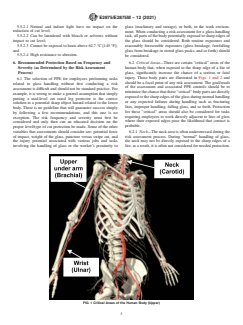
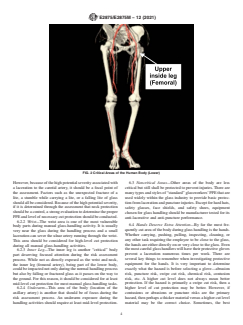
Special attention is given to the protection of critical areas susceptible to severe or fatal injuries, including the neck (carotid artery), wrist (ulnar artery), inner leg (femoral artery), and underarm (axillary artery). Routine protection for hands, arms, and legs is also addressed.Cut Resistance Levels
PPE materials are evaluated using standards such as ANSI/ISEA 105, ASTM F1790, and EN 388, which classify cut protection levels based on resistance performance. Materials like aramid fibers, high-density polyethylene fibers (HPPE), and composite yarns are common in cut-resistant PPE for glass handling.Regular Evaluation and Suitability
The standard recommends ongoing evaluation of PPE suitability to ensure consistent protection in dynamic workplace conditions.Compliance and Safety Considerations
The guide emphasizes adherence to all applicable federal, state, and local safety regulations alongside ASTM recommendations. Health, safety, and environmental factors must be incorporated into workplace practices.
Applications
Glass Manufacturing Facilities
Used to define PPE requirements for workers directly involved with processing, transporting, or storing flat, untampered glass.Construction and Glazing Operations
Applied by glaziers, installers, and contractors handling raw panes, where risk of glass breakage or accidental contact is present.Warehousing and Distribution
Provides safe handling practices for employees overseeing the storage and movement of glass lites and sheets.Health and Safety Training
Functions as a reference for developing training programs on PPE selection specific to glass handling hazards.Regulatory Compliance and Auditing
Serves as a baseline for internal audits and compliance checks to ensure PPE utilization aligns with industry best practices and legal requirements.
Related Standards
- ASTM F1790: Test Method for Measuring Cut Resistance of Materials Used in Protective Clothing
- ANSI/ISEA 105: Standard for Hand Protection Selection Criteria
- EN 388: Standard for Protective Gloves Against Mechanical Risks
- ASTM C162: Terminology of Glass and Glass Products
- ASTM E1542: Terminology Relating to Occupational Health and Safety
- ASTM F1494: Terminology Relating to Protective Clothing
Practical Value
By following ASTM E2875/E2875M-12(2021), employers and safety professionals can systematically identify residual hazards in the glass handling process, select appropriate personal protective equipment, and implement effective safety protocols. This minimizes the incidence and severity of injuries, ensuring compliance with relevant regulations and promoting a safer work environment for all personnel involved with flat glass. The standard guides regular review and adaptation of PPE solutions, supporting ongoing safety improvements in diverse glass-handling applications.
Keywords: personal protective equipment, flat glass safety, glass handling, cut resistance, PPE standards, workplace safety, risk assessment, ASTM E2875.
Relations
- Effective Date
- 01-Oct-2023
- Effective Date
- 01-Jan-2020
- Effective Date
- 01-Feb-2018
- Effective Date
- 01-Nov-2015
- Effective Date
- 01-Jul-2013
- Effective Date
- 01-Feb-2011
- Effective Date
- 01-Aug-2010
- Effective Date
- 01-Oct-2005
- Effective Date
- 01-Oct-2005
- Effective Date
- 01-Jan-2005
- Effective Date
- 01-Jun-2004
- Effective Date
- 01-Apr-2004
- Effective Date
- 01-Mar-2004
- Effective Date
- 10-Jul-2003
- Effective Date
- 10-Jul-2003
Get Certified
Connect with accredited certification bodies for this standard

CIS Institut d.o.o.
Personal Protective Equipment (PPE) certification body. Notified Body NB-2890 for EU Regulation 2016/425 PPE.

Kiwa BDA Testing
Building and construction product certification.
Kmetijski inštitut Slovenije
Agricultural Institute of Slovenia. Soil testing, plant health, agricultural product analysis.
Sponsored listings
Frequently Asked Questions
ASTM E2875/E2875M-12(2021) is a guide published by ASTM International. Its full title is "Standard Guide for Personal Protective Equipment for the Handling of Flat Glass". This standard covers: SIGNIFICANCE AND USE 4.1 The goal of this guide is to aid in the selection of PPE for the handling of glass that will best protect the affected employee from the remaining hazards identified in the local hazard assessment process. 4.2 This guide assumes that a proper hazard assessment has been conducted, the hazards have been mitigated to the greatest extent possible by non-PPE means (engineering, administrative, or work practice controls), and a hazard still exists that can only feasibly be controlled by the use of PPE. SCOPE 1.1 This guide covers the minimum requirements for proper personal protective equipment (PPE) for the safe handling of flat glass. 1.2 Purpose—When engineering, administrative, and work practice controls are not feasible, the remaining hazard must be controlled with personal protective equipment (PPE). This guide will provide direction on what PPE should be utilized. Following this guidance will help to minimize the possibility or severity of injuries, or both, to personnel while working with or in the vicinity of flat glass. 1.3 Nothing in this guide shall be interpreted as requiring any action that violates any statute or requirement of any federal, state, or other regulatory agency. 1.4 This guide may be used by employers and employees. The required PPE shall be evaluated on a regular basis to determine suitability. 1.5 Units—The values stated in either SI units or inch-pound units are to be regarded separately as standard. The values stated in each system may not be exact equivalents; therefore, each system shall be used independently of the other. Combining values from the two systems may result in nonconformance with the standard. 1.6 This standard does not purport to address all of the safety concerns, if any, associated with its use. It is the responsibility of the user of this standard to establish appropriate safety, health, and environmental practices and determine the applicability of regulatory limitations prior to use. 1.7 This international standard was developed in accordance with internationally recognized principles on standardization established in the Decision on Principles for the Development of International Standards, Guides and Recommendations issued by the World Trade Organization Technical Barriers to Trade (TBT) Committee.
SIGNIFICANCE AND USE 4.1 The goal of this guide is to aid in the selection of PPE for the handling of glass that will best protect the affected employee from the remaining hazards identified in the local hazard assessment process. 4.2 This guide assumes that a proper hazard assessment has been conducted, the hazards have been mitigated to the greatest extent possible by non-PPE means (engineering, administrative, or work practice controls), and a hazard still exists that can only feasibly be controlled by the use of PPE. SCOPE 1.1 This guide covers the minimum requirements for proper personal protective equipment (PPE) for the safe handling of flat glass. 1.2 Purpose—When engineering, administrative, and work practice controls are not feasible, the remaining hazard must be controlled with personal protective equipment (PPE). This guide will provide direction on what PPE should be utilized. Following this guidance will help to minimize the possibility or severity of injuries, or both, to personnel while working with or in the vicinity of flat glass. 1.3 Nothing in this guide shall be interpreted as requiring any action that violates any statute or requirement of any federal, state, or other regulatory agency. 1.4 This guide may be used by employers and employees. The required PPE shall be evaluated on a regular basis to determine suitability. 1.5 Units—The values stated in either SI units or inch-pound units are to be regarded separately as standard. The values stated in each system may not be exact equivalents; therefore, each system shall be used independently of the other. Combining values from the two systems may result in nonconformance with the standard. 1.6 This standard does not purport to address all of the safety concerns, if any, associated with its use. It is the responsibility of the user of this standard to establish appropriate safety, health, and environmental practices and determine the applicability of regulatory limitations prior to use. 1.7 This international standard was developed in accordance with internationally recognized principles on standardization established in the Decision on Principles for the Development of International Standards, Guides and Recommendations issued by the World Trade Organization Technical Barriers to Trade (TBT) Committee.
ASTM E2875/E2875M-12(2021) is classified under the following ICS (International Classification for Standards) categories: 13.340.10 - Protective clothing; 81.100 - Equipment for the glass and ceramics industries. The ICS classification helps identify the subject area and facilitates finding related standards.
ASTM E2875/E2875M-12(2021) has the following relationships with other standards: It is inter standard links to ASTM C162-23, ASTM E1542-20, ASTM E1542-18, ASTM C162-05(2015), ASTM F1494-13, ASTM F1494-03(2011), ASTM E1542-10, ASTM C162-05, ASTM C162-05(2010), ASTM F1790-05, ASTM C162-04, ASTM E1542-93(2004), ASTM F1790-04, ASTM F1494-03, ASTM C162-03. Understanding these relationships helps ensure you are using the most current and applicable version of the standard.
ASTM E2875/E2875M-12(2021) is available in PDF format for immediate download after purchase. The document can be added to your cart and obtained through the secure checkout process. Digital delivery ensures instant access to the complete standard document.
Standards Content (Sample)
This international standard was developed in accordance with internationally recognized principles on standardization established in the Decision on Principles for the
Development of International Standards, Guides and Recommendations issued by the World Trade Organization Technical Barriers to Trade (TBT) Committee.
Designation: E2875/E2875M − 12 (Reapproved 2021)
Standard Guide for
Personal Protective Equipment for the Handling of Flat
Glass
ThisstandardisissuedunderthefixeddesignationE2875/E2875M;thenumberimmediatelyfollowingthedesignationindicatestheyear
of original adoption or, in the case of revision, the year of last revision. A number in parentheses indicates the year of last reapproval.
A superscript epsilon (´) indicates an editorial change since the last revision or reapproval.
1. Scope 2. Referenced Documents
1.1 This guide covers the minimum requirements for proper
2.1 ASTM Standards:
personal protective equipment (PPE) for the safe handling of
C162 Terminology of Glass and Glass Products
flat glass.
E1542 Terminology Relating to Occupational Health and
Safety
1.2 Purpose—When engineering, administrative, and work
F1494 Terminology Relating to Protective Clothing
practice controls are not feasible, the remaining hazard must be
F1790 Test Method for Measuring Cut Resistance of Mate-
controlled with personal protective equipment (PPE). This
rials Used in Protective Clothing with CPP Test Equip-
guide will provide direction on what PPE should be utilized.
ment
Followingthisguidancewillhelptominimizethepossibilityor
severityofinjuries,orboth,topersonnelwhileworkingwithor
2.2 Other Standards:
in the vicinity of flat glass.
ANSI/ISEA 105 American National Standard for Hand
Protection Selection Criteria
1.3 Nothing in this guide shall be interpreted as requiring
EN 388 Protective Gloves Giving Protection from Mechani-
any action that violates any statute or requirement of any
cal Risks
federal, state, or other regulatory agency.
1.4 This guide may be used by employers and employees.
3. Terminology
The required PPE shall be evaluated on a regular basis to
3.1 Definitions—For additional definitions and terms relat-
determine suitability.
ing to this guide, please refer to Terminologies C162, E1542,
1.5 Units—The values stated in either SI units or inch-
and F1494.
pound units are to be regarded separately as standard. The
3.2 Definitions of Terms Specific to This Standard:
values stated in each system may not be exact equivalents;
3.2.1 flat glass, n—general term covering glass in its an-
therefore,eachsystemshallbeusedindependentlyoftheother.
nealed state, such as sheet glass, lite of glass, float glass,
Combining values from the two systems may result in noncon-
various forms of rolled glass, and raw products derived from
formance with the standard.
glass.
1.6 This standard does not purport to address all of the
3.2.1.1 Discussion—This definition is not intended to apply
safety concerns, if any, associated with its use. It is the
to heat-tempered or laminated glass products. With heat-
responsibility of the user of this standard to establish appro-
tempered or laminated glass products, defer to your local risk
priate safety, health, and environmental practices and deter-
assessment.
mine the applicability of regulatory limitations prior to use.
1.7 This international standard was developed in accor-
3.2.2 lite, n—another term for a pane or piece of glass.
dance with internationally recognized principles on standard- Sometimes spelled “light” in the industry literature, but spelled
ization established in the Decision on Principles for the
“lite” in this text to avoid confusion with light as in “visible
Development of International Standards, Guides and Recom- light.”
mendations issued by the World Trade Organization Technical
Barriers to Trade (TBT) Committee.
For referenced ASTM standards, visit the ASTM website, www.astm.org, or
contact ASTM Customer Service at service@astm.org. For Annual Book of ASTM
This guide is under the jurisdiction ofASTM Committee E34 on Occupational Standards volume information, refer to the standard’s Document Summary page on
Health and Safety and is the direct responsibility of Subcommittee E34.10 on the ASTM website.
Industrial Safety. Available from the International Safety EquipmentAssociation, 1901 N. Moore
Current edition approved Jan. 1, 2021. Published January 2021. Originally St., Arlington, VA 22209-1762.
approved in 2012. Last previous edition approved in 2012 as E2875/E2875M – 12. Available from American National Standards Institute (ANSI), 25 W. 43rd St.,
DOI:10.1520/E2875_E2875M-12R21. 4th Floor, New York, NY 10036, http://www.ansi.org.
Copyright © ASTM International, 100 Barr Harbor Drive, PO Box C700, West Conshohocken, PA 19428-2959. United States
E2875/E2875M − 12 (2021)
TABLE 2 EN 388 Cut Performance Levels
4. Significance and Use
Performance Average Cut Index
4.1 The goal of this guide is to aid in the selection of PPE
1 1.2–2.4
for the handling of glass that will best protect the affected
2 2.5–4.9
3 5.0–9.9
employee from the remaining hazards identified in the local
4 10.0–19.9
hazard assessment process.
5 20–
4.2 This guide assumes that a proper hazard assessment has
beenconducted,thehazardshavebeenmitigatedtothegreatest
5.4 Primary fabrics that are available to meet the needs and
extent possible by non-PPE means (engineering,
administrative, or work practice controls), and a hazard still demands of cut resistance are:
5.4.1 Aramid Fibers—Aramid fibers are a class of heat-
exists that can only feasibly be controlled by the use of PPE.
resistantandstrongsyntheticfibers.Theyareusedinaerospace
5. Level of Cut Protection
and military applications, for ballistics-rated body armor
fabric, and as an asbestos substitute. The name is a shortened
5.1 Cut-resistant clothing (gloves and body protection) is
form of aromatic polyamide.They are fibers in which the chain
evaluated primarily by two standards: Test Method F1790 and
molecules are highly oriented along the fiber axis so the
EN 388.
strength of the chemical bond can be exploited.
NOTE 1—The two standards are not interchangeable and need to be
5.4.2 High-Density Polyethylene Fibers—Ultra-high mo-
distinguished as to their unique testing outcomes.
lecular weight polyethylene (UHMWPE), also known as high-
NOTE 2—Cut ratings are a starting point for selecting the proper PPE.
In general terms, a higher cut level means better cut protection, but that is modulus polyethylene (HMPE) or high-performance polyeth-
not always the case. There will be some tasks where a “thicker” material
ylene (HPPE), is a subset of the thermoplastic polyethylene. It
with a lower level of cut protection may actually protect better than a
has extremely long chains, with molecular weight numbering
“thinner” material with a higher level of cut protection. Introducing a
in the millions, usually between 2 and 6 million. The longer
change (process, job, equipment, etc.) or new PPE for a task should
chain serves to transfer load more effectively to the polymer
include the proper assessment and trials to ensure the garment does indeed
get the desired result.
backbone by strengthening intermolecular interactions. The
result is a very tough material, with the highest impact strength
5.2 In Test Method F1790, cut-resistant material is evalu-
of any thermoplastic presently made. It is highly resistant to
ated. The process of evaluation or cut protection performance
corrosive chemicals with the exception of oxidizing acids. It
test (CPPT) involves the amount of pressure or gram weight
has extremely low moisture absorption and is highly resistant
applied to a razor blade while moving the blade over the fabric
to abrasion (15 times more resistant to abrasion than carbon
without cutting through for at least 20 mm [0.8 in.].The higher
steel).
the load in gram weight applied to the blade without cut-
5.4.3 Composite or Engineered Yarns—Composite or engi-
through for the prescribed distance of travel, the better the cut
neered yarns consist of two or more components. These yarns
resistance of the fabric. This result is termed the cut or rating
are constructed to offer a higher level of cut resistance (ASTM
forceofthefabric.TestMethodF1790cutorratingforcelevels
Level 3 and above). The addition of a steel or fiberglass core
are listed in Table 1.
with a fiber wrapped around it allows for a greater rating force
5.3 In EN 388 or the Couptest, cut-resistant material is
than a singular component standing alone. Features of such
evaluated. The process of the evaluation involves a constant
combinations are strength, hardness, lubricity or slickness, and
weight on a circular blade that is moved back and forth across
rolling action (knit construction theoretically creating a ball-
a test specimen by the test machine. The machine (Couptest)
bearing effect as the blade meets the knitted fabric). These
also rotates the blade against the direction that it is being
features increase the rating force to Levels 3 and above on the
moved, which intensifies the slicing action. The test indicates
ASTM scale.
how many repetitive cuts on the same position are needed to
NOTE 3—Test Method F1790 CPPT tests for cut resistance only.
cut through. The result of the test is termed the cut index,
NOTE 4—The EN 388 test results in Table 2 describe more than cut
which informs of how much better the sample resists cut as
resistance.Thetestalsodescribespuncture,tearandabrasionofthefabric,
compared to a reference cotton fabric.Aperformance level for
or physical and mechanical aggressions.
the material is ranked from 0 to 5. The higher the number of
5.5 Working conditions will differ when examining the
cycles needed to cut through the material, the greater the cut
available cut-resistant fabrics currently on the market.
resistance of the fabric. The EN 388 cut index levels are listed
Essentially, the differences are as follows:
in Table 2.
5.5.1 Para-Arami
...