

ASTM E2540-16(2022)
(Test Method)Standard Test Method for Measurement of Retroreflective Signs Using a Portable Retroreflectometer at a 0.5 Degree Observation Angle
General Information
- Abstract
SIGNIFICANCE AND USE
5.1 Measurements made by this test method are related to the night time brightness of retroreflective traffic signs approximately facing the driver of a mid-sized automobile equipped with tungsten filament headlights at about 100 m distance.
5.2 Retroreflective material used on traffic signs degrades with time and requires periodic measurement to ensure that the performance of the retroflection provides adequate safety to the driver.
5.3 The quality of the sign as to material used, age, and wear pattern will have an effect on the coefficient of retroreflection. These conditions need to be observed and noted by the user.
5.4 This test method is not intended for use for the measurement of signs when the instrument entrance and observation angles differ from those specified herein.
SCOPE
1.1 This test method covers measurement of the retroreflective properties of sign materials such as traffic signs and symbols (vertical surfaces) using a portable retroreflectometer that can be used in the field. The portable retroreflectometer is a hand-held instrument with a defined standard geometry that can be placed in contact with sign material to measure the retroreflection in a standard geometry. The measurements can be compared to minimum requirements to determine the need for replacement. Entrance and observation angles specified in this test method are those used currently in the United States and may differ from the angles used elsewhere in the world.
1.2 This test method is intended to be used for the field measurement of traffic signs but may be used to measure the performance of materials before placing the sign in the field or before placing the sign material on the sign face.
1.3 The values stated in SI units are to be regarded as standard. No other units of measurement are included in this standard.
1.4 This standard does not purport to address all of the safety concerns, if any, associated with its use. It is the responsibility of the user of this standard to establish appropriate safety, health, and environmental practices and determine the applicability of regulatory limitations prior to use.
1.5 This international standard was developed in accordance with internationally recognized principles on standardization established in the Decision on Principles for the Development of International Standards, Guides and Recommendations issued by the World Trade Organization Technical Barriers to Trade (TBT) Committee.
- Status
- Published
- Publication Date
- 31-Jan-2022
- Technical Committee
- E12 - Color and Appearance
- Drafting Committee
- E12.10 - Retroreflection
Overview
ASTM E2540-16(2022) is the globally recognized standard test method for measuring the retroreflective properties of traffic signs and similar materials using a portable retroreflectometer at a 0.5 degree observation angle. Developed by ASTM International, this standard provides a field-usable, standardized approach for assessing the nighttime brightness of retroreflective signs, which is critical for road safety and sign maintenance programs. The method ensures that the retroreflection values of traffic signs meet established minimum safety requirements, guiding decisions on sign replacement and maintenance.
Key Topics
- Retroreflective Sign Measurement: Focuses on the use of portable, hand-held retroreflectometers to measure retroreflection directly in the field or on new materials prior to installation.
- Standard Geometry: Ensures measurements are made at a defined observation angle (0.5°) and entrance angle (typically -4°), reflecting the conditions an automobile driver would experience at night.
- Importance of Regular Testing: Highlights the effect of material degradation, age, and weathering on sign performance, underlining the need for periodic measurement to maintain adequate driver safety.
- Instrument and Measurement Types:
- Point and annular aperture instruments
- Procedures for calibration and standardization
- Reporting protocols and vital measurement parameters
- Test Applicability: Applies strictly to measurements matching the specified geometry; not recommended for other entrance or observation angles.
Applications
ASTM E2540-16(2022) plays a crucial role in:
- Traffic Sign Maintenance: Helping road maintenance authorities and safety inspectors objectively evaluate sign performance and decide when replacement is necessary.
- Quality Assurance for Sign Manufacturers: Ensuring that new retroreflective sign materials and products meet the required retroreflection standards before deployment.
- Field Assessment and Asset Management: Enabling efficient, on-site measurement of retroreflectivity using portable instruments, reducing the need for laboratory-based testing.
- Regulatory Compliance: Supporting compliance with local, national, and international regulations, as well as meeting World Trade Organization (WTO) principles for technical barriers to trade.
- Enhanced Roadway Safety: Contributing to safer nighttime driving conditions by maintaining highly visible and effective traffic control devices.
Related Standards
Several ASTM and related standards complement or reference ASTM E2540-16(2022):
- ASTM E177: Practice for Use of the Terms Precision and Bias in ASTM Test Methods.
- ASTM E284: Terminology of Appearance - provides key definition of terms.
- ASTM E691: Practice for Conducting an Interlaboratory Study to Determine the Precision of a Test Method.
- ASTM E808: Practice for Describing Retroreflection.
- ASTM E809: Practice for Measuring Photometric Characteristics of Retroreflectors.
- ASTM E810: Test Method for Coefficient of Retroreflection of Retroreflective Sheeting Utilizing the Coplanar Geometry.
Practical Value
Implementing ASTM E2540-16(2022) helps improve road safety by ensuring traffic signs maintain their required visibility over time. The standard offers:
- Repeatable and Reproducible Measurement Processes: Ensures consistency between different instruments and laboratories.
- Clear Reporting Requirements: Facilitates traceable, transparent documentation of measurement, including instrument type, date, location, color, type, age, and results.
- Guidance for Error Reduction: Highlights sources of measurement error and recommends best practices for reliable retroreflectivity assessment.
- Support for International Harmonization: Aligns with WTO technical barriers to trade principles, facilitating global trade in compliant retroreflective materials and devices.
Keywords: ASTM E2540-16, retroreflective sign measurement, portable retroreflectometer, 0.5 degree observation angle, traffic sign retroreflectivity, field measurement, sign maintenance, road safety, standard test method, ASTM International.
Relations
- Effective Date
- 01-Dec-2023
- Effective Date
- 01-Jan-2016
- Effective Date
- 01-May-2014
- Effective Date
- 01-Nov-2013
- Effective Date
- 01-Jun-2013
- Effective Date
- 01-May-2013
- Effective Date
- 01-May-2013
- Effective Date
- 01-Jan-2013
- Effective Date
- 01-Jul-2012
- Effective Date
- 01-Nov-2011
- Effective Date
- 01-Oct-2010
- Effective Date
- 01-Jun-2009
- Effective Date
- 01-Feb-2009
- Effective Date
- 01-Jan-2009
- Effective Date
- 01-Oct-2008
Get Certified
Connect with accredited certification bodies for this standard

Zavod za gradbeništvo Slovenije (ZAG) - Inšpekcija
ZAG inspection body for construction products, structures, and materials.
Sponsored listings
Frequently Asked Questions
ASTM E2540-16(2022) is a standard published by ASTM International. Its full title is "Standard Test Method for Measurement of Retroreflective Signs Using a Portable Retroreflectometer at a 0.5 Degree Observation Angle". This standard covers: SIGNIFICANCE AND USE 5.1 Measurements made by this test method are related to the night time brightness of retroreflective traffic signs approximately facing the driver of a mid-sized automobile equipped with tungsten filament headlights at about 100 m distance. 5.2 Retroreflective material used on traffic signs degrades with time and requires periodic measurement to ensure that the performance of the retroflection provides adequate safety to the driver. 5.3 The quality of the sign as to material used, age, and wear pattern will have an effect on the coefficient of retroreflection. These conditions need to be observed and noted by the user. 5.4 This test method is not intended for use for the measurement of signs when the instrument entrance and observation angles differ from those specified herein. SCOPE 1.1 This test method covers measurement of the retroreflective properties of sign materials such as traffic signs and symbols (vertical surfaces) using a portable retroreflectometer that can be used in the field. The portable retroreflectometer is a hand-held instrument with a defined standard geometry that can be placed in contact with sign material to measure the retroreflection in a standard geometry. The measurements can be compared to minimum requirements to determine the need for replacement. Entrance and observation angles specified in this test method are those used currently in the United States and may differ from the angles used elsewhere in the world. 1.2 This test method is intended to be used for the field measurement of traffic signs but may be used to measure the performance of materials before placing the sign in the field or before placing the sign material on the sign face. 1.3 The values stated in SI units are to be regarded as standard. No other units of measurement are included in this standard. 1.4 This standard does not purport to address all of the safety concerns, if any, associated with its use. It is the responsibility of the user of this standard to establish appropriate safety, health, and environmental practices and determine the applicability of regulatory limitations prior to use. 1.5 This international standard was developed in accordance with internationally recognized principles on standardization established in the Decision on Principles for the Development of International Standards, Guides and Recommendations issued by the World Trade Organization Technical Barriers to Trade (TBT) Committee.
SIGNIFICANCE AND USE 5.1 Measurements made by this test method are related to the night time brightness of retroreflective traffic signs approximately facing the driver of a mid-sized automobile equipped with tungsten filament headlights at about 100 m distance. 5.2 Retroreflective material used on traffic signs degrades with time and requires periodic measurement to ensure that the performance of the retroflection provides adequate safety to the driver. 5.3 The quality of the sign as to material used, age, and wear pattern will have an effect on the coefficient of retroreflection. These conditions need to be observed and noted by the user. 5.4 This test method is not intended for use for the measurement of signs when the instrument entrance and observation angles differ from those specified herein. SCOPE 1.1 This test method covers measurement of the retroreflective properties of sign materials such as traffic signs and symbols (vertical surfaces) using a portable retroreflectometer that can be used in the field. The portable retroreflectometer is a hand-held instrument with a defined standard geometry that can be placed in contact with sign material to measure the retroreflection in a standard geometry. The measurements can be compared to minimum requirements to determine the need for replacement. Entrance and observation angles specified in this test method are those used currently in the United States and may differ from the angles used elsewhere in the world. 1.2 This test method is intended to be used for the field measurement of traffic signs but may be used to measure the performance of materials before placing the sign in the field or before placing the sign material on the sign face. 1.3 The values stated in SI units are to be regarded as standard. No other units of measurement are included in this standard. 1.4 This standard does not purport to address all of the safety concerns, if any, associated with its use. It is the responsibility of the user of this standard to establish appropriate safety, health, and environmental practices and determine the applicability of regulatory limitations prior to use. 1.5 This international standard was developed in accordance with internationally recognized principles on standardization established in the Decision on Principles for the Development of International Standards, Guides and Recommendations issued by the World Trade Organization Technical Barriers to Trade (TBT) Committee.
ASTM E2540-16(2022) is classified under the following ICS (International Classification for Standards) categories: 93.080.40 - Street lighting and related equipment. The ICS classification helps identify the subject area and facilitates finding related standards.
ASTM E2540-16(2022) has the following relationships with other standards: It is inter standard links to ASTM E808-23, ASTM E808-01(2016), ASTM E177-14, ASTM E284-13b, ASTM E284-13a, ASTM E691-13, ASTM E177-13, ASTM E284-13, ASTM E284-12, ASTM E691-11, ASTM E177-10, ASTM E284-09a, ASTM E808-01(2009), ASTM E284-09, ASTM E177-08. Understanding these relationships helps ensure you are using the most current and applicable version of the standard.
ASTM E2540-16(2022) is available in PDF format for immediate download after purchase. The document can be added to your cart and obtained through the secure checkout process. Digital delivery ensures instant access to the complete standard document.
Standards Content (Sample)
This international standard was developed in accordance with internationally recognized principles on standardization established in the Decision on Principles for the
Development of International Standards, Guides and Recommendations issued by the World Trade Organization Technical Barriers to Trade (TBT) Committee.
Designation:E2540 −16 (Reapproved 2022)
Standard Test Method for
Measurement of Retroreflective Signs Using a Portable
Retroreflectometer at a 0.5 Degree Observation Angle
This standard is issued under the fixed designation E2540; the number immediately following the designation indicates the year of
original adoption or, in the case of revision, the year of last revision. A number in parentheses indicates the year of last reapproval. A
superscript epsilon (´) indicates an editorial change since the last revision or reapproval.
1. Scope 2. Referenced Documents
1.1 This test method covers measurement of the retroreflec- 2.1 ASTM Standards:
tive properties of sign materials such as traffic signs and E177 Practice for Use of the Terms Precision and Bias in
symbols (vertical surfaces) using a portable retroreflectometer ASTM Test Methods
that can be used in the field. The portable retroreflectometer is E284 Terminology of Appearance
a hand-held instrument with a defined standard geometry that E691 Practice for Conducting an Interlaboratory Study to
can be placed in contact with sign material to measure the Determine the Precision of a Test Method
retroreflection in a standard geometry. The measurements can E808 Practice for Describing Retroreflection
be compared to minimum requirements to determine the need E809 Practice for Measuring Photometric Characteristics of
for replacement. Entrance and observation angles specified in Retroreflectors
this test method are those used currently in the United States E810 Test Method for Coefficient of Retroreflection of
and may differ from the angles used elsewhere in the world. Retroreflective Sheeting Utilizing the Coplanar Geometry
1.2 This test method is intended to be used for the field
3. Terminology
measurement of traffic signs but may be used to measure the
3.1 The terminology used in this test method generally
performance of materials before placing the sign in the field or
agrees with that used in Terminology E284.
before placing the sign material on the sign face.
3.2 Definitions—The delimiting phrase “in retroreflection”
1.3 The values stated in SI units are to be regarded as
applies to each of the following definitions when used outside
standard. No other units of measurement are included in this
the context of this or other retroreflection standards.
standard.
3.2.1 annular geometry, n—the portable instrument retrore-
1.4 This standard does not purport to address all of the
flection collection method where the retroreflected lux is
safety concerns, if any, associated with its use. It is the
collected in an annulus 0.1 degrees wide centered on the
responsibility of the user of this standard to establish appro-
illumination axis.
priate safety, health, and environmental practices and deter-
3.2.1.1 Discussion—The angle measured from the illumina-
mine the applicability of regulatory limitations prior to use.
tion axis to the circle which divides the annulus into equal
1.5 This international standard was developed in accor-
areas corresponds to a specific observation angle.
dance with internationally recognized principles on standard-
3.2.2 coeffıcient of retroreflection, R , n—of a plane retrore-
A
ization established in the Decision on Principles for the
flecting surface, the ratio of the coefficient of luminous
Development of International Standards, Guides and Recom-
intensity (R ) of a plane retroreflecting surface to its area (A),
I
mendations issued by the World Trade Organization Technical
–1 –2
expressed in candelas per lux per square metre (cd · lx ·m ).
Barriers to Trade (TBT) Committee.
3.2.3 datum axis, n—a designated half-line from the retrore-
flector center perpendicular to the retroreflector axis.
This test method is under the jurisdiction of ASTM Committee E12 on Color
and Appearance and is the direct responsibility of Subcommittee E12.10 on
Retroreflection. For referenced ASTM standards, visit the ASTM website, www.astm.org, or
Current edition approved Feb. 1, 2022. Published February 2022. Originally contact ASTM Customer Service at service@astm.org. For Annual Book of ASTM
ɛ1
approved in 2008. Last previous edition approved in 2016 as E2540 – 16 . DOI: Standards volume information, refer to the standard’s Document Summary page on
10.1520/E2540-16R22. the ASTM website.
Copyright © ASTM International, 100 Barr Harbor Drive, PO Box C700, West Conshohocken, PA 19428-2959. United States
E2540−16 (2022)
3.2.4 entrance angle, β,n—the angle between the illumina- four readings shall be taken and averaged for each retroreflec-
tion axis and the retroreflector axis. tive color on the sign to be tested.
3.2.5 entrance half-plane, n—the half plane that originates
5. Significance and Use
on the line of the illumination axis and contains the retrore-
flector axis.
5.1 Measurements made by this test method are related to
thenighttimebrightnessofretroreflectivetrafficsignsapproxi-
3.2.6 instrument standard, n—working standard used to
mately facing the driver of a mid-sized automobile equipped
standardize the portable retroreflectometer.
with tungsten filament headlights at about 100 m distance.
3.2.7 observation angle, α,n—the angle between the illu-
5.2 Retroreflective material used on traffic signs degrades
mination axis and the observation axis.
with time and requires periodic measurement to ensure that the
3.2.8 observation half-plane, n—the half plane that origi-
performanceoftheretroflectionprovidesadequatesafetytothe
nates on the line of the illumination axis and contains the
driver.
observation axis.
5.3 Thequalityofthesignastomaterialused,age,andwear
3.2.9 orientation angle, ω,n—the angle in a plane perpen-
s
pattern will have an effect on the coefficient of retroreflection.
dicular to the retroreflector axis from the entrance half-plane to
These conditions need to be observed and noted by the user.
the datum axis, measured counter-clockwise from the view-
point of the source.
5.4 This test method is not intended for use for the mea-
surement of signs when the instrument entrance and observa-
3.2.10 portable retroreflectometer, n—a hand-held instru-
tion angles differ from those specified herein.
ment that can be used in the field or in the laboratory for
measurement of retroreflectance.
6. Apparatus
3.2.10.1 Discussion—In this test method, “portable retrore-
flectometer”referstoahand-heldinstrumentthatcanbeplaced
6.1 Portable Retroreflectometer—The retroreflectometer
in contact with sign material to measure the retroreflection in a
shall be portable, with the capability of being placed at various
standard geometry.
locations on the signs. The retroreflectometer shall be con-
3.2.11 presentation angle, γ,n—the dihedral angle from the structed so that placement on the sign will preclude stray light
(daylight) from entering the measurement area of the instru-
entrance half-plane to the observation half-plane, measured
counter-clockwise from the viewpoint of the source. ment and affecting the reading.
3.2.12 retroreflection, n—a reflection in which the reflected 6.2 Instrument Standard, or standards of desired color(s)
rays are returned preferentially in directions close to the
and material(s).
opposite of the direction of the incident rays, this property
6.3 Light Source Requirements:
being maintained over wide variations of the direction of the
6.3.1 The projection optics shall be such that the illumi-
incident rays.
nance at any point over the measurement area shall be within
3.2.13 rotation angle,ε,n—the angle in a plane perpendicu-
10 % of the average illuminance.
lar to the retroreflector axis from the observation half-plane to
6.3.2 The aperture angle of the source as determined from
the datum axis, measured counter-clockwise from the view-
the center of the measurement area shall be not greater than
point of the source.
0.1°.
3.3 Definitions of entrance angle components β and β,as
1 2 6.4 Receiver Requirements:
well as other geometrical terms undefined in this test method,
6.4.1 The receiver shall have sufficient sensitivity and range
may be found in Practice E808.
to accommodate coefficient of retroreflection values from 0.1
–1 –2
to 1999.9 cd · lx ·m .
4. Summary of Test Method
6.4.2 The combined spectral distribution of the light source
and the spectral responsivity of the receiver shall match the
4.1 This test method involves the use of commercial por-
combined spectral distribution of CIE Illuminant A and the
table retroreflectometers for determining the retroreflectivity of
V(λ) spectral luminous efficiency function according to the
highway signing materials.
following criterion: For any choice of plano-parallel colored
4.2 The entrance angle shall be –4°.
absorptive filter mounted in front of a white retroreflective
4.3 The observation angle shall be 0.5°. sample, the ratio of the R measured with the filter to the R
A A
measured without the filter shall be within 10 % of the
4.4 The portable retroreflectometer uses an instrument stan-
Illuminant A luminous transmittance of an air spaced pair of
dard for standardization.
two such filters.
4.5 After standardization, the retroreflectometer is placed in
6.4.3 The instrument may be either an instrument with point
contactwiththesigntobetested,ensuringthatonlythedesired
geometry, a “point instrument,” or an instrument with annular
portion of the sign is within the measurement area of the
geometry, an “annular instrument,” depending on the shape of
instrument.
thereceiveraperture(seeFig.1).Pointandannularinstruments
4.6 The reading displayed by the retroreflectometer is re- make geometrically different measurements of R , which may
A
corded. The retroreflectometer is then moved to another produce values differing on the order of 10 %. Both measure-
position on the sign, and this value is recorded.Aminimum of ments are valid for most purposes, but the user should learn the
E2540−16 (2022)
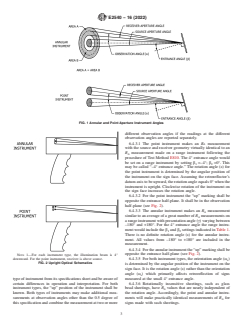
FIG. 1 Annular and Point Aperture Instrument Angles
different observation angles if the readings at the different
observation angles are reported separately.
6.4.3.1 The point instrument makes an R measurement
A
with the source and receiver geometry virtually identical to an
R measurement made on a range instrument following the
A
procedure of Test Method E810. The 4° entrance angle would
be set on a range instrument by setting β =–4°; β =0°. This
1 2
may be called “–4° entrance angle.” The rotation angle (ε) for
the point instrument is determined by the angular position of
the instrument on the sign face. Assuming the retroreflector’s
datum axis to be upward, the rotation angle equals 0° when the
instrument is upright. Clockwise rotation of the instrument on
the sign face increases the rotation angle.
6.4.3.2 For the point instrument the “up” marking shall be
opposite the entrance half-plane. It shall be in the observation
half-plane (see Fig. 2).
6.4.3.3 The annular instrument makes an R measurement
A
similar to an average of a great number of R measurements on
A
a range instrument with presentation angle (γ) varying between
–180° and +180°. For the 4° entrance angle the range instru-
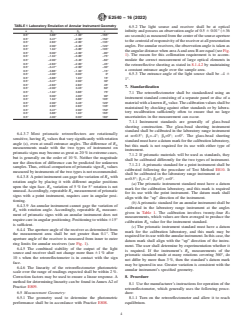
ment would include the β and β settings indicated in Table 1.
1 2
There is no definite rotation angle (ε) for the annular instru-
ment. All values from –180° to +180° are included in the
measurement.
6.4.3.4 Fortheannularinstrumentthe“up”markingshallbe
opposite the entrance half-plane (see Fig. 2).
NOTE 1—For each instrument type, the illumination beam is 4°
downward. For the point instrument, receiver is above source.
6.4.3.5 For both instrument types, the orientation angle (ω )
s
FIG. 2 Upright Optical Schematics
is determined by the angular position of the instrument on the
sign face. It is the rotation angle (ε) rather than the orientation
angle (ω ) which primarily affects retroreflection of signs
s
measured at the small 4° entrance angle.
type of instrument from its specifications sheet and be aware of
certain differences in operation and interpretation. For both 6.4.3.6 Rotationally insensitive sheetings, such as glass
instrument types, the “up” position of the instrument shall be bead sheetings, have R values that are nearly independent of
A
known. Both types of instruments may make additional mea- the rotation angle. Accordingly, the point and annular instru-
surements at observation angles other than the 0.5 degree of ments will make practically identical measurements of R for
A
this specification and combine the measurement at two or more signs made with such sheetings.
E2540−16 (2022)
TABLE 1 Laboratory Emulation of Annular Instrument Geometry
6.5.2 The light source and receiver shall be at optical
αβ β ε infinity and possess an observation angle of 0.5 6 0.01° (636
1 2
0.5° 3.86° −1.03° −165°
arcseconds)asmeasuredfromthecenterofthesourceaperture
0.5° 3.47° −2.00° −150°
tothecentroidofresponsivityofthereceiveratallpresentation
0.5° 2.83° −2.83° −135°
0.5° 2.00° −3.46° −120° angles. For annular receivers, the observation angle is taken as
0.5° 1.04° −3.86° −105°
the angular distance when areaAand area B are equal (see Fig.
0.5° 0.00° −4.00° −90°
1). The reason for this collimation requirement is to accom-
0.5° −1.04° −3.86° −75°
0.5° −2.00° −3.46° −60°
modate the correct measurement of large optical elements in
0.5° −2.83° −2.83° −45°
the retroreflective sheeting as stated in 8.1.4.2 by maintaining
0.5° −3.47° −2.00° −30°
a constant entrance angle over the sample area.
0.5° −3.86° −1.03° −15°
0.5° −4.00° 0.00° 0° 6.5.3 The entrance angle of the light source shall be –4 6
0.5° −3.86° 1.03° 15°
1°.
0.5° −3.47° 2.00° 30°
0.5° −2.83° 2.83° 45°
7. Standardization
0.5° −2.00° 3.46° 60°
0.5° −1.04° 3.86° 75°
7.1 The retroreflectometer shall be standardized using an
0.5° 0.00° 4.00° 90°
instrument standard consisting of a separate panel or disc of a
0.5° 1.04° 3.86° 105°
0.5° 2.00° 3.46° 120° materialwithaknown R value.Thecalibrationvaluesshallbe
A
0.5° 2.83° 2.83° 135°
maintained by checking against other standards or by labora-
0.5° 3.47° 2.00° 150°
tory recalibration sufficiently often to ensure that no large
0.5° 3.86° 1.03° 165°
0.5° 4.00° 0.00° 180°
uncertainties in the measurement can occur.
7.1.1 Instrument standards are generally of glass-bead
sheeting construction. The glass-bead sheeting instrument
standard shall be calibrated in the laboratory range instrument
6.4.3.7 Most prismatic retroreflectors are rotationally
at α=0.5°; β =–4°; β =0°; ε=0°. The glass-bead sheeting
1 2
sensitive, having R values that vary significantly with rotation
A
standardmusthaveadatummarkforthecalibrationlaboratory,
angle (ε), even at small entrance angles. The difference of R
A
but this mark is not required for its use with either type of
measurements made with the two types of instrument on
instrument.
prismatic signs may become as great as 20 % in extreme cases,
7.1.2 If prismatic materials will be used as standards, they
but is generally on the order of 10 %. Neither the magnitude
shall be calibrated differently for the two types of instrument.
nor the direction of difference can be predicted for unknown
7.1.2.1 A prismatic standard for a point instrument shall be
samples. Thus, critical comparison of prismatic sign R values
A
calibrated following the procedure of Test Method E810.It
measured by instruments of the two types is not recommended.
shall be calibrated in the laboratory range instrument at
6.4.3.8 Apoint instrument can gage the variation of R with
A
α=0.5°; β =–4°; β =0°; ε=0°.
1 2
rotation angle by placing it with different angular positions
(a) The prismatic instrument standard must have a datum
upon the sign face. R va
...