

ASTM C226-22
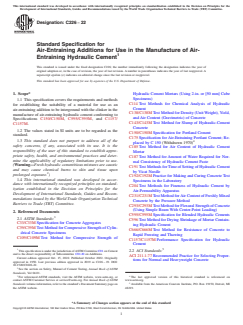
(Specification)Standard Specification for Air-Entraining Additions for Use in the Manufacture of Air-Entraining Hydraulic Cement
General Information
- Abstract
ABSTRACT
This specification covers deals with air-entraining additions for use in the manufacture of air-entraining hydraulic cement. The materials used are: cement, aggregates, and reference addition. The grading requirements for fine and coarse aggregates are specified. The following are the test methods for cement samples: chemical analysis of cement, determination of addition in the finished cement, fineness of cement, normal consistency, time of setting, autoclave expansion, air content of mortar, compressive strength of mortar, and length change of mortar. Concrete mixture preparation, weighing, proportions, and mixing methods are detailed. The test on plastic concrete is done in accordance with the following methods: consistency and unit weight and air content. The following are tests for hardened concrete: compressive strength, flexural strength, and resistance to freezing and thawing.
SCOPE
1.1 This specification covers the requirements and methods for establishing the suitability of a material for use as an air-entraining addition to be interground with the clinker in the manufacture of air-entraining hydraulic cement conforming to Specifications C150/C150M, C595/C595M, and C1157/C1157M.
1.2 The values stated in SI units are to be regarded as the standard.
1.3 This standard does not purport to address all of the safety concerns, if any, associated with its use. It is the responsibility of the user of this standard to establish appropriate safety, health, and environmental practices and determine the applicability of regulatory limitations prior to use. (Warning—Fresh hydraulic cementitious mixtures are caustic and may cause chemical burns to skin and tissue upon prolonged exposure.2)
1.4 This international standard was developed in accordance with internationally recognized principles on standardization established in the Decision on Principles for the Development of International Standards, Guides and Recommendations issued by the World Trade Organization Technical Barriers to Trade (TBT) Committee.
- Status
- Published
- Publication Date
- 14-Oct-2022
- Technical Committee
- C01 - Cement
- Drafting Committee
- C01.20 - Additions
Buy Documents
ASTM C226-22 - Standard Specification for Air-Entraining Additions for Use in the Manufacture of Air-Entraining Hydraulic Cement
REDLINE ASTM C226-22 - Standard Specification for Air-Entraining Additions for Use in the Manufacture of Air-Entraining Hydraulic Cement
Overview
ASTM C226-22 is the internationally recognized standard specification for air-entraining additions used in the manufacture of air-entraining hydraulic cement. Developed by ASTM International, this standard establishes requirements for the materials, testing methods, and performance criteria for air-entraining additives that are interground with cement clinker. Adherence to ASTM C226-22 ensures the production of hydraulic cements capable of delivering improved workability, durability, and resistance to freezing and thawing, especially in cold weather environments and demanding construction applications.
By following this specification, manufacturers and suppliers can ensure that air-entraining additions meet strict quality, consistency, and performance standards, supporting cement products that align with specifications such as ASTM C150/C150M, ASTM C595/C595M, and ASTM C1157/C1157M.
Key Topics
- Material Requirements: Defines acceptable materials for use as air-entraining additions in hydraulic cement, including reference additions and aggregate grading requirements.
- Performance Standards: Outlines performance properties for cements containing these additions, such as setting time, compressive strength, air content, flexural strength, and durability under freezing and thawing.
- Test Methods: Specifies laboratory procedures for evaluating:
- Chemical composition and consistency
- Fineness and normal consistency of cement
- Time of setting and autoclave expansion
- Compressive and flexural strengths, and length change of mortar
- Air content of both mortar and plastic concrete
- Sampling and Evaluation: Details protocols for sample preparation, weighing, mixing, and the creation of test specimens for comprehensive quality assessment.
- Reporting: Identifies required elements in test reports, such as material identification, test results, and compliance statements for regulatory and quality assurance purposes.
Applications
The ASTM C226-22 standard is integral to various sectors of the construction and materials industries, providing key guidelines for:
- Hydraulic Cement Manufacturing: Ensuring air-entraining additions are consistently blended for the production of air-entraining Portland cement, blended hydraulic cements, and performance hydraulic cements.
- Ready-Mixed Concrete Production: Supporting the creation of concrete with enhanced durability and workability for infrastructure, roads, bridges, and cold climate constructions.
- Quality Assurance in Construction: Providing a basis for independent laboratory testing and compliance verification throughout the supply chain.
- Specification and Procurement: Assisting engineers, architects, and contractors in project specification and procurement of hydraulic cements with validated air-entraining performance.
- Research and Development: Enabling material scientists to develop new admixtures and cementitious products that meet or exceed industry benchmarks for freeze-thaw resistance and longevity.
Related Standards
Organizations operating under ASTM C226-22 may also reference the following standards for a comprehensive approach to cement and concrete quality:
- ASTM C33/C33M: Specification for Concrete Aggregates
- ASTM C39/C39M: Test Method for Compressive Strength of Cylindrical Concrete Specimens
- ASTM C109/C109M: Test Method for Compressive Strength of Hydraulic Cement Mortars
- ASTM C150/C150M: Specification for Portland Cement
- ASTM C185: Test Method for Air Content of Hydraulic Cement Mortar
- ASTM C595/C595M: Specification for Blended Hydraulic Cements
- ASTM C1157/C1157M: Performance Specification for Hydraulic Cement
- ASTM C138/C138M, C143/C143M, C231/C231M, C151/C151M, C293/C293M, C596, C666/C666M: Various test methods for density, setting times, air content, expansion, strength, shrinkage, and freeze-thaw resistance
Practical Value
Compliance with ASTM C226-22 provides tangible benefits, including enhanced concrete durability, uniformity, and quality control. It ensures that air-entraining additions are reliable and effective, reduces the risk of concrete damage from freeze-thaw cycles, and supports sustainable, long-lasting infrastructure. This standard is essential for manufacturers, suppliers, and project stakeholders who require consistent, high-performance air-entraining hydraulic cements in their construction projects.
Relations
- Effective Date
- 01-Jan-2024
- Refers
ASTM C204-24 - Standard Test Methods for Fineness of Hydraulic Cement by Air-Permeability Apparatus - Effective Date
- 01-Jan-2024
- Effective Date
- 15-Dec-2023
- Refers
ASTM C596-23 - Standard Test Method for Drying Shrinkage of Mortar Containing Hydraulic Cement - Effective Date
- 01-Dec-2023
- Refers
ASTM C39/C39M-23 - Standard Test Method for Compressive Strength of Cylindrical Concrete Specimens - Effective Date
- 01-Dec-2023
- Effective Date
- 01-Oct-2023
- Effective Date
- 01-Apr-2020
- Effective Date
- 01-Dec-2019
- Effective Date
- 01-Apr-2019
- Refers
ASTM C596-18 - Standard Test Method for Drying Shrinkage of Mortar Containing Hydraulic Cement - Effective Date
- 01-Dec-2018
- Refers
ASTM C39/C39M-17b - Standard Test Method for Compressive Strength of Cylindrical Concrete Specimens - Effective Date
- 01-Aug-2017
- Effective Date
- 15-Jun-2017
- Refers
ASTM C596-09(2017) - Standard Test Method for Drying Shrinkage of Mortar Containing Hydraulic Cement - Effective Date
- 01-May-2017
- Effective Date
- 01-Apr-2017
- Refers
ASTM C39/C39M-16b - Standard Test Method for Compressive Strength of Cylindrical Concrete Specimens - Effective Date
- 01-Aug-2016
Buy Documents
ASTM C226-22 - Standard Specification for Air-Entraining Additions for Use in the Manufacture of Air-Entraining Hydraulic Cement
REDLINE ASTM C226-22 - Standard Specification for Air-Entraining Additions for Use in the Manufacture of Air-Entraining Hydraulic Cement
Get Certified
Connect with accredited certification bodies for this standard

DIBt (Deutsches Institut für Bautechnik)
German Institute for Building Technology.
DIN CERTCO
DIN Group product certification.

Aboma Certification B.V.
Specialized in construction, metal, and transport sectors.
Sponsored listings
Frequently Asked Questions
ASTM C226-22 is a technical specification published by ASTM International. Its full title is "Standard Specification for Air-Entraining Additions for Use in the Manufacture of Air-Entraining Hydraulic Cement". This standard covers: ABSTRACT This specification covers deals with air-entraining additions for use in the manufacture of air-entraining hydraulic cement. The materials used are: cement, aggregates, and reference addition. The grading requirements for fine and coarse aggregates are specified. The following are the test methods for cement samples: chemical analysis of cement, determination of addition in the finished cement, fineness of cement, normal consistency, time of setting, autoclave expansion, air content of mortar, compressive strength of mortar, and length change of mortar. Concrete mixture preparation, weighing, proportions, and mixing methods are detailed. The test on plastic concrete is done in accordance with the following methods: consistency and unit weight and air content. The following are tests for hardened concrete: compressive strength, flexural strength, and resistance to freezing and thawing. SCOPE 1.1 This specification covers the requirements and methods for establishing the suitability of a material for use as an air-entraining addition to be interground with the clinker in the manufacture of air-entraining hydraulic cement conforming to Specifications C150/C150M, C595/C595M, and C1157/C1157M. 1.2 The values stated in SI units are to be regarded as the standard. 1.3 This standard does not purport to address all of the safety concerns, if any, associated with its use. It is the responsibility of the user of this standard to establish appropriate safety, health, and environmental practices and determine the applicability of regulatory limitations prior to use. (Warning—Fresh hydraulic cementitious mixtures are caustic and may cause chemical burns to skin and tissue upon prolonged exposure.2) 1.4 This international standard was developed in accordance with internationally recognized principles on standardization established in the Decision on Principles for the Development of International Standards, Guides and Recommendations issued by the World Trade Organization Technical Barriers to Trade (TBT) Committee.
ABSTRACT This specification covers deals with air-entraining additions for use in the manufacture of air-entraining hydraulic cement. The materials used are: cement, aggregates, and reference addition. The grading requirements for fine and coarse aggregates are specified. The following are the test methods for cement samples: chemical analysis of cement, determination of addition in the finished cement, fineness of cement, normal consistency, time of setting, autoclave expansion, air content of mortar, compressive strength of mortar, and length change of mortar. Concrete mixture preparation, weighing, proportions, and mixing methods are detailed. The test on plastic concrete is done in accordance with the following methods: consistency and unit weight and air content. The following are tests for hardened concrete: compressive strength, flexural strength, and resistance to freezing and thawing. SCOPE 1.1 This specification covers the requirements and methods for establishing the suitability of a material for use as an air-entraining addition to be interground with the clinker in the manufacture of air-entraining hydraulic cement conforming to Specifications C150/C150M, C595/C595M, and C1157/C1157M. 1.2 The values stated in SI units are to be regarded as the standard. 1.3 This standard does not purport to address all of the safety concerns, if any, associated with its use. It is the responsibility of the user of this standard to establish appropriate safety, health, and environmental practices and determine the applicability of regulatory limitations prior to use. (Warning—Fresh hydraulic cementitious mixtures are caustic and may cause chemical burns to skin and tissue upon prolonged exposure.2) 1.4 This international standard was developed in accordance with internationally recognized principles on standardization established in the Decision on Principles for the Development of International Standards, Guides and Recommendations issued by the World Trade Organization Technical Barriers to Trade (TBT) Committee.
ASTM C226-22 is classified under the following ICS (International Classification for Standards) categories: 91.100.10 - Cement. Gypsum. Lime. Mortar. The ICS classification helps identify the subject area and facilitates finding related standards.
ASTM C226-22 has the following relationships with other standards: It is inter standard links to ASTM C231/C231M-24, ASTM C204-24, ASTM C109/C109M-23, ASTM C596-23, ASTM C39/C39M-23, ASTM C114-23, ASTM C185-20, ASTM C185-19, ASTM C150/C150M-19, ASTM C596-18, ASTM C39/C39M-17b, ASTM C1157/C1157M-17, ASTM C596-09(2017), ASTM C595/C595M-17, ASTM C39/C39M-16b. Understanding these relationships helps ensure you are using the most current and applicable version of the standard.
ASTM C226-22 is available in PDF format for immediate download after purchase. The document can be added to your cart and obtained through the secure checkout process. Digital delivery ensures instant access to the complete standard document.
Standards Content (Sample)
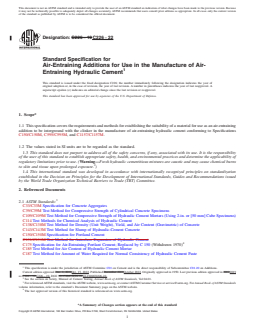
This international standard was developed in accordance with internationally recognized principles on standardization established in the Decision on Principles for the
Development of International Standards, Guides and Recommendations issued by the World Trade Organization Technical Barriers to Trade (TBT) Committee.
Designation:C226 −22
Standard Specification for
Air-Entraining Additions for Use in the Manufacture of Air-
Entraining Hydraulic Cement
This standard is issued under the fixed designation C226; the number immediately following the designation indicates the year of
original adoption or, in the case of revision, the year of last revision. A number in parentheses indicates the year of last reapproval. A
superscript epsilon (´) indicates an editorial change since the last revision or reapproval.
This standard has been approved for use by agencies of the U.S. Department of Defense.
1. Scope* Hydraulic Cement Mortars (Using 2-in. or [50 mm] Cube
Specimens)
1.1 This specification covers the requirements and methods
C114 Test Methods for Chemical Analysis of Hydraulic
for establishing the suitability of a material for use as an
Cement
air-entraining addition to be interground with the clinker in the
C138/C138M Test Method for Density (Unit Weight),Yield,
manufacture of air-entraining hydraulic cement conforming to
and Air Content (Gravimetric) of Concrete
Specifications C150/C150M, C595/C595M, and C1157/
C143/C143M Test Method for Slump of Hydraulic-Cement
C1157M.
Concrete
1.2 The values stated in SI units are to be regarded as the
C150/C150M Specification for Portland Cement
standard.
C175 Specification for Air-Entraining Portlant Cement; Re-
1.3 This standard does not purport to address all of the
placed by C 150 (Withdrawn 1970)
safety concerns, if any, associated with its use. It is the
C185 Test Method for Air Content of Hydraulic Cement
responsibility of the user of this standard to establish appro-
Mortar
priate safety, health, and environmental practices and deter-
C187 Test Method for Amount of Water Required for Nor-
mine the applicability of regulatory limitations prior to use.
mal Consistency of Hydraulic Cement Paste
(Warning—Fresh hydraulic cementitious mixtures are caustic
C191 TestMethodsforTimeofSettingofHydraulicCement
and may cause chemical burns to skin and tissue upon
by Vicat Needle
prolonged exposure. )
C192/C192M Practice for Making and Curing Concrete Test
1.4 This international standard was developed in accor-
Specimens in the Laboratory
dance with internationally recognized principles on standard-
C204 Test Methods for Fineness of Hydraulic Cement by
ization established in the Decision on Principles for the
Air-Permeability Apparatus
Development of International Standards, Guides and Recom-
C231/C231M Test Method forAir Content of Freshly Mixed
mendations issued by the World Trade Organization Technical
Concrete by the Pressure Method
Barriers to Trade (TBT) Committee.
C293/C293M TestMethodforFlexuralStrengthofConcrete
(Using Simple Beam With Center-Point Loading)
2. Referenced Documents
C595/C595M Specification for Blended Hydraulic Cements
2.1 ASTM Standards:
C596 Test Method for Drying Shrinkage of Mortar Contain-
C33/C33M Specification for Concrete Aggregates
ing Hydraulic Cement
C39/C39M Test Method for Compressive Strength of Cylin-
C666/C666M Test Method for Resistance of Concrete to
drical Concrete Specimens
Rapid Freezing and Thawing
C109/C109M Test Method for Compressive Strength of
C1157/C1157M Performance Specification for Hydraulic
Cement
This specification is under the jurisdiction ofASTM Commitee C01 on Cement
2.2 ACI Standards:
and is the direct responsibility of Subcommittee C01.20 on Additions.
ACI 211.1-77 Recommended Practice for Selecting Propor-
Current edition approved Oct. 15, 2022. Published October 2022. Originally
tions for Normal and Heavyweight Concrete
approved in 1950. Last previous edition approved in 2019 as C226 – 19. DOI:
10.1520/C0226-22.
See the section on Safety, Manual of Cement Testing, Annual Book of ASTM
Standards, Vol 04.01.
3 4
For referenced ASTM standards, visit the ASTM website, www.astm.org, or The last approved version of this historical standard is referenced on
contact ASTM Customer Service at service@astm.org. For Annual Book of ASTM www.astm.org.
Standards volume information, refer to the standard’s Document Summary page on Available from the American Concrete Institute, P.O. Box 19150, Detroit, MI
the ASTM website. 48219.
*A Summary of Changes section appears at the end of this standard
Copyright © ASTM International, 100 Barr Harbor Drive, PO Box C700, West Conshohocken, PA 19428-2959. United States
C226−22
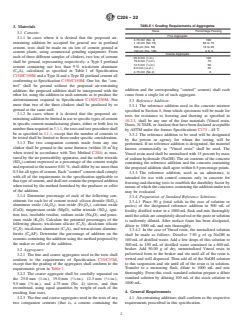
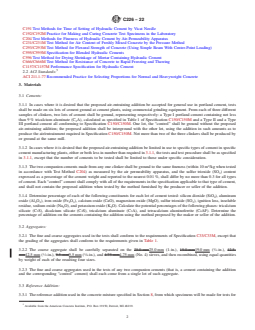
TABLE 1 Grading Requirements of Aggregates
3. Materials
Sieve Percentage Passing
3.1 Cements:
Fine Aggregate
3.1.1 In cases where it is desired that the proposed air-
4.75 mm (No. 4) 100
entraining addition be accepted for general use in portland
1.18 mm (No.16) 65 to 75
300 µm (No. 50) 15 to 20
cement, tests shall be made on six lots of cement ground at
150 µm (No. 100) 2 to 5
cement plants, using commercial grinding equipment. From
Coarse Aggregate
each of three different samples of clinkers, two lots of cement
25.0 mm (1-in.) 100
19.0 mm ( ⁄4-in.) 75
shall be ground, representing respectively: a Type I portland
12.5 mm ( ⁄2-in.) 50
cement containing not less than 9 % tricalcium aluminate
9.5 mm ( ⁄8-in.) 25
(C A), calculated as specified in Table 1 of Specification
4.75 mm (No.4) 0
C150/C150M and a Type II and a Type III portland cement all
conforming to Specification C150/C150M. One lot, the “con-
trol” shall be ground without the proposed air-entraining
addition and the corresponding “control” cement) shall each
addition; the proposed addition shall be interground with the
come from a single lot of such aggregate.
other lot, using the addition in such amounts as to produce the
air/entrainment required in Specification C150/C150M. Not
3.3 Reference Addition:
more than two of the three clinkers shall be produced by or
3.3.1 The reference addition used in the concrete mixture
ground at the same mill.
specified in Section 8, from which specimens will be made for
3.1.2 In cases where it is desired that the proposed air-
tests for resistance to freezing and thawing as specified in
entrainingadditionbelimitedinusetospecifictypesofcement
10.2.3, shall be any one of the four materials (Vinsol resin,
in specific cement manufacturing plants, either or both less in
Darex, N-TAIR, orAiralon) that have been declared acceptable
numberthanrequiredin3.1.1,thetestsandtestprocedureshall
by ASTM under the former Specifications C175–48T.
be as specified in 3.1.1, except that the number of cements to
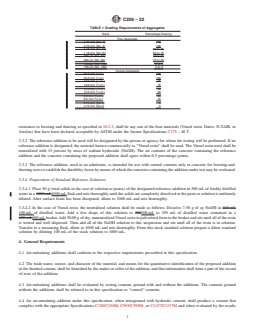
3.3.2 The reference addition to be used will be designated
be tested shall be limited to those under specific consideration.
by the person or agency for whom the testing will be
3.1.3 The two companion cements made from any one
performed. If no reference addition is designated, the material
clinker shall be ground to the same fineness (within 10 m /kg
known commercially as “Vinsol resin” shall be used. The
when tested in accordance with Test Method C204) as mea-
Vinsol resin used shall be neutralized with 15 percent by mass
sured by the air permeability apparatus, and the sulfur trioxide
of sodium hydroxide (NaOH). The air contents of the concrete
(SO ) content expressed as a percentage of the cement weight
3 containing the reference addition and the concrete containing
and reported to the nearest 0.01 %, shall differ by no more than
the proposed addition shall agree within 0.5 percentage points.
0.3foralltypesofcement.Each“control”cementshallcomply
3.3.3 The reference addition, used as an admixture, is
with all of the requirements in the specification applicable to
intended for use with control cements only in concrete for
thattypeofcement,andshallnotcontaintheproposedaddition
freezing-and-thawing tests to establish the durability factor by
when tested by the method furnished by the producer or seller
meansofwhichtheconcretescontainingtheadditionundertest
of the addition.
may be evaluated.
3.1.4 Determine percentage of each of the following con-
3.3.4 Preparation of Standard Reference Solutions:
stituents for each lot of cement tested: silicon dioxide (SiO ),
2 3.3.4.1 Place 50 g (total solids in the case of solution or
aluminum oxide (Al O ), iron oxide (Fe O ), calcium oxide
2 3 2 3 pastes) of the designated reference addition in 500 mL of
(CaO), magnesium oxide (MgO), sulfur trioxide (SO ), igni-
3 freshly distilled water in a 1000 mL flask and mix thoroughly
tion loss, insoluble residue, sodium oxide (Na O), and potas-
2 untilthesolidsarecompletelydissolvedorthepasteorsolution
sium oxide (K O). Calculate the potential percentages of the
is uniformly diluted. After surface foam has been dissipated,
following phases: tricalcium silicate (C S), dicalcium silicate
3 dilute to 1000 mL and mix thoroughly.
(C S), tricalcium aluminate (C A), and tetracalcium alumino-
2 3
3.3.4.2 In the case of Vinsol resin, the neutralized solution
ferrite (C AF). Determine the percentage of addition on the
4 shall be made as follows: Dissolve 7.50 g of cp NaOH in
cements containing the addition using the method proposed by
100 mL of distilled water. Add a few drops of this solution to
the maker or seller of the addition.
300 mL to 350 mL of distilled water contained in a 600 mL
beaker. Add 50.00 g of dry, unneutralized Vinsol resin in
3.2 Aggregates:
pulverized form to the beaker and stir until all of the resin is
3.2.1 The fine and coarse aggregates used in the tests shall
wetted and well dispersed. Then add all of the NaOH solution
conform to the requirements of Specification C33/C33M,
to this suspension and stir until all of the resin is in solution.
except that the grading of the aggregates shall conform to the
Transfer to a measuring flask, dilute to 1000 mL and mix
requirements given in Table 1.
thoroughly. From this stock standard solution prepare a dilute
3.2.2 The coarse aggregate shall be carefully separated on
3 1
standard solution by diluting 100 mL of the stock solution to
the 25.0 mm (1-in.), 19.0 mm ( ⁄4-in.), 12.5 mm ( ⁄2-in.),
1000 mL.
9.5 mm ( ⁄8-in.), and 4.75 mm (No. 4) sieves, and then
recombined, using equal quantities by weight of each of the
4. General Requirements
resulting four sizes.
3.2.3 The fine and coarse aggregates used in the tests of any 4.1 Air-entraining additions shall conform to the respective
two companion cements (that is, a cement containing the requirements prescribed in this specification.
C226−22
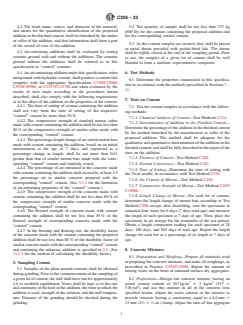
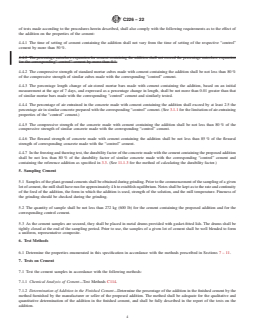
4.2 The trade name, source, and character of the material, 5.2 The quantity of sample shall be not less than 272 kg
and means for the quantitative identification of the proposed (600 lb) for the cement containing the proposed addition and
additioninthefinishedcement,shallbefurnishedbythemaker
for the corresponding control cement.
or seller of the addition, and that information shall form a part
5.3 As the cement samples are secured, they shall be placed
of the record of tests of the addition.
in metal drums provided with gasket-fitted lids. The drums
4.3 Air-entraining additions shall be evaluated by testing
shall be tightly closed at the end of the sampling period. Prior
cements ground with and without the additions. The cements
to use, the samples of a given lot of cement shall be well
ground without the additions shall be referred to in this
blended to form a uniform, representative composite.
specification as “control” cements.
4.4 Anair-entrainingadditionunderthisspecification,when 6
...
This document is not an ASTM standard and is intended only to provide the user of an ASTM standard an indication of what changes have been made to the previous version. Because
it may not be technically possible to adequately depict all changes accurately, ASTM recommends that users consult prior editions as appropriate. In all cases only the current version
of the standard as published by ASTM is to be considered the official document.
Designation: C226 − 19 C226 − 22
Standard Specification for
Air-Entraining Additions for Use in the Manufacture of Air-
Entraining Hydraulic Cement
This standard is issued under the fixed designation C226; the number immediately following the designation indicates the year of
original adoption or, in the case of revision, the year of last revision. A number in parentheses indicates the year of last reapproval. A
superscript epsilon (´) indicates an editorial change since the last revision or reapproval.
This standard has been approved for use by agencies of the U.S. Department of Defense.
1. Scope*
1.1 This specification covers the requirements and methods for establishing the suitability of a material for use as an air-entraining
addition to be interground with the clinker in the manufacture of air-entraining hydraulic cement conforming to Specifications
C150/C150M, C595/C595M, and C1157/C1157M.
1.2 The values stated in SI units are to be regarded as the standard.
1.3 This standard does not purport to address all of the safety concerns, if any, associated with its use. It is the responsibility
of the user of this standard to establish appropriate safety, health, and environmental practices and determine the applicability of
regulatory limitations prior to use. (Warning—Fresh hydraulic cementitious mixtures are caustic and may cause chemical burns
to skin and tissue upon prolonged exposure. )
1.4 This international standard was developed in accordance with internationally recognized principles on standardization
established in the Decision on Principles for the Development of International Standards, Guides and Recommendations issued
by the World Trade Organization Technical Barriers to Trade (TBT) Committee.
2. Referenced Documents
2.1 ASTM Standards:
C33/C33M Specification for Concrete Aggregates
C39/C39M Test Method for Compressive Strength of Cylindrical Concrete Specimens
C109/C109M Test Method for Compressive Strength of Hydraulic Cement Mortars (Using 2-in. or [50 mm] Cube Specimens)
C114 Test Methods for Chemical Analysis of Hydraulic Cement
C138/C138M Test Method for Density (Unit Weight), Yield, and Air Content (Gravimetric) of Concrete
C143/C143M Test Method for Slump of Hydraulic-Cement Concrete
C150/C150M Specification for Portland Cement
C151/C151M Test Method for Autoclave Expansion of Hydraulic Cement
C175 Specification for Air-Entraining Portlant Cement; Replaced by C 150 (Withdrawn 1970)
C185 Test Method for Air Content of Hydraulic Cement Mortar
C187 Test Method for Amount of Water Required for Normal Consistency of Hydraulic Cement Paste
This specification is under the jurisdiction of ASTM Commitee C01 on Cement and is the direct responsibility of Subcommittee C01.20 on Additions.
Current edition approved Dec. 1, 2019Oct. 15, 2022. Published December 2019October 2022. Originally approved in 1950. Last previous edition approved in 20122019
as C226 – 12.C226 – 19. DOI: 10.1520/C0226-19.10.1520/C0226-22.
See the section on Safety, Manual of Cement Testing, Annual Book of ASTM Standards, Vol 04.01.
For referenced ASTM standards, visit the ASTM website, www.astm.org, or contact ASTM Customer Service at service@astm.org. For Annual Book of ASTM Standards
volume information, refer to the standard’s Document Summary page on the ASTM website.
The last approved version of this historical standard is referenced on www.astm.org.
*A Summary of Changes section appears at the end of this standard
Copyright © ASTM International, 100 Barr Harbor Drive, PO Box C700, West Conshohocken, PA 19428-2959. United States
C226 − 22
C191 Test Methods for Time of Setting of Hydraulic Cement by Vicat Needle
C192/C192M Practice for Making and Curing Concrete Test Specimens in the Laboratory
C204 Test Methods for Fineness of Hydraulic Cement by Air-Permeability Apparatus
C231/C231M Test Method for Air Content of Freshly Mixed Concrete by the Pressure Method
C293/C293M Test Method for Flexural Strength of Concrete (Using Simple Beam With Center-Point Loading)
C595/C595M Specification for Blended Hydraulic Cements
C596 Test Method for Drying Shrinkage of Mortar Containing Hydraulic Cement
C666/C666M Test Method for Resistance of Concrete to Rapid Freezing and Thawing
C1157/C1157M Performance Specification for Hydraulic Cement
2.2 ACI Standards:
ACI 211.1-77 Recommended Practice for Selecting Proportions for Normal and Heavyweight Concrete
3. Materials
3.1 Cements:
3.1.1 In cases where it is desired that the proposed air-entraining addition be accepted for general use in portland cement, tests
shall be made on six lots of cement ground at cement plants, using commercial grinding equipment. From each of three different
samples of clinkers, two lots of cement shall be ground, representing respectively: a Type I portland cement containing not less
than 9 % tricalcium aluminate (C A), calculated as specified in Table 1 of Specification C150/C150M and a Type II and a Type
III portland cement all conforming to Specification C150/C150M. One lot, the “control” shall be ground without the proposed
air-entraining addition; the proposed addition shall be interground with the other lot, using the addition in such amounts as to
produce the air/entrainment required in Specification C150/C150M. Not more than two of the three clinkers shall be produced by
or ground at the same mill.
3.1.2 In cases where it is desired that the proposed air-entraining addition be limited in use to specific types of cement in specific
cement manufacturing plants, either or both less in number than required in 3.1.1, the tests and test procedure shall be as specified
in 3.1.1, except that the number of cements to be tested shall be limited to those under specific consideration.
3.1.3 The two companion cements made from any one clinker shall be ground to the same fineness (within 10 m /kg when tested
in accordance with Test Method C204) as measured by the air permeability apparatus, and the sulfur trioxide (SO ) content
expressed as a percentage of the cement weight and reported to the nearest 0.01 %, shall differ by no more than 0.3 for all types
of cement. Each “control” cement shall comply with all of the requirements in the specification applicable to that type of cement,
and shall not contain the proposed addition when tested by the method furnished by the producer or seller of the addition.
3.1.4 Determine percentage of each of the following constituents for each lot of cement tested: silicon dioxide (SiO ), aluminum
oxide (Al O ), iron oxide (Fe O ), calcium oxide (CaO), magnesium oxide (MgO), sulfur trioxide (SO ), ignition loss, insoluble
2 3 2 3 3
residue, sodium oxide (Na O), and potassium oxide (K O). Calculate the potential percentages of the following phases: tricalcium
2 2
silicate (C S), dicalcium silicate (C S), tricalcium aluminate (C A), and tetracalcium aluminoferrite (C AF). Determine the
3 2 3 4
percentage of addition on the cements containing the addition using the method proposed by the maker or seller of the addition.
3.2 Aggregates:
3.2.1 The fine and coarse aggregates used in the tests shall conform to the requirements of Specification C33/C33M, except that
the grading of the aggregates shall conform to the requirements given in Table 1.
3.2.2 The coarse aggregate shall be carefully separated on the 25.0-mm25.0 mm (1-in.), 19.0-mm19.0 mm ( ⁄4-in.), 12.5-
1 3
mm12.5 mm ( ⁄2-in.), 9.5-mm9.5 mm ( ⁄8-in.), and 4.75-mm4.75 mm (No. 4) sieves, and then recombined, using equal quantities
by weight of each of the resulting four sizes.
3.2.3 The fine and coarse aggregates used in the tests of any two companion cements (that is, a cement containing the addition
and the corresponding “control” cement) shall each come from a single lot of such aggregate.
3.3 Reference Addition:
3.3.1 The reference addition used in the concrete mixture specified in Section 8, from which specimens will be made for tests for
Available from the American Concrete Institute, P.O. Box 19150, Detroit, MI 48219.
C226 − 22
TABLE 1 Grading Requirements of Aggregates
Sieve Percentage Passing
Fine Aggregate
4.75-mm (No. 4) 100
4.75 mm (No. 4) 100
1.18-mm (No.16) 65 to 75
1.18 mm (No.16) 65 to 75
300-μm (No. 50) 15 to 20
300 μm (No. 50) 15 to 20
150-μm (No. 100) 2 to 5
150 μm (No. 100) 2 to 5
Coarse Aggregate
25.0-mm (1-in.) 100
25.0 mm (1-in.) 100
19.0-mm ( ⁄4-in.) 75
19.0 mm ( ⁄4-in.) 75
12.5-mm ( ⁄2-in.) 50
12.5 mm ( ⁄2-in.) 50
9.5-mm ( ⁄8-in.) 25
9.5 mm ( ⁄8-in.) 25
4.75-mm (No.4) 0
4.75 mm (No.4) 0
resistance to freezing and thawing as specified in 10.2.3, shall be any one of the four materials (Vinsol resin, Darex, N-TAIR, or
Airalon) that have been declared acceptable by ASTM under the former Specifications C175 – 48 T.
3.3.2 The reference addition to be used will be designated by the person or agency for whom the testing will be performed. If no
reference addition is designated, the material known commercially as “Vinsol resin” shall be used. The Vinsol resin used shall be
neutralized with 15 percent by mass of sodium hydroxide (NaOH). The air contents of the concrete containing the reference
addition and the concrete containing the proposed addition shall agree within 0.5 percentage points.
3.3.3 The reference addition, used as an admixture, is intended for use with control cements only in concrete for freezing-and-
thawing tests to establish the durability factor by means of which the concretes containing the addition under test may be evaluated.
3.3.4 Preparation of Standard Reference Solutions:
3.3.4.1 Place 50 g (total solids in the case of solution or pastes) of the designated reference addition in 500 mL of freshly distilled
water in a 1000-mL1000 mL flask and mix thoroughly until the solids are completely dissolved or the paste or solution is uniformly
diluted. After surface foam has been dissipated, dilute to 1000 mL and mix thoroughly.
3.3.4.2 In the case of Vinsol resin, the neutralized solution shall be made as follows: Dissolve 7.50 g of cp NaOH in 100 mL
100 mL of distilled water. Add a few drops of this solution to 300300 mL to 350 mL of distilled water contained in a
600-mL600 mL beaker. Add 50.00 g of dry, unneutralized Vinsol resin in pulverized form to the beaker and stir until all of the resin
is wetted and well dispersed. Then add all of the NaOH solution to this suspension and stir until all of the resin is in solution.
Transfer to a measuring flask, dilute to 1000 mL and mix thoroughly. From this stock standard solution prepare a dilute standard
solution by diluting 100 mL of the stock solution to 1000 mL.
4. General Requirements
4.1 Air-entraining additions shall conform to the respective requirements prescribed in this specification.
4.2 The trade name, source, and character of the material, and means for the quantitative identification of the proposed addition
in the finished cement, shall be furnished by the maker or seller of the addition, and that information shall form a part of the record
of tests of the addition.
4.3 Air-entraining additions shall be evaluated by testing cements ground with and without the additions. The cements ground
without the additions shall be referred to in this specification as “control” cements.
4.4 An air-entraining addition under this specification, when interground with hydraulic cement, shall produce a cement that
complies with the appropriate Specifications C150/C150M, C595/C595M, or C1157/C1157M and when evaluated by the results
C226 − 22
of tests made according to the procedures herein described, shall also comply with the following requirements as to the effect of
the addition on the properties of the cement:
4.4.1 The time of setting of ce
...