

ASTM C1353/C1353M-20e1
(Test Method)Standard Test Method for Abrasion Resistance of Dimension Stone Subjected to Foot Traffic Using a Rotary Platform Abraser
General Information
- Abstract
SIGNIFICANCE AND USE
5.1 This test method provides a means to quantify the abrasion resistance of dimension stone and may be related to end-use performance, or used to comparatively rank material performance, or both. The resistance of dimension stone to abrasion, as measured on a testing machine in the laboratory, is generally only one of several factors contributing to wear performance as experienced in the actual use of the material. Calculation of predicted life should not be based on specific abrasion data alone.
5.2 The resistance of dimension stone to abrasion may be affected by factors including test conditions; type of abradant; pressure between the specimen and abradant; mounting of the specimen; and type, kind, or amount of finishing materials.
5.3 Abrasion tests utilizing the rotary platform abraser may be subject to variation due to changes in the abradant during the course of specific tests. Depending on abradant type and test specimen, the abrading wheel surface may change (that is, become clogged) due to pick-up of finishing or other materials from test specimens. To reduce this variation, the abrading wheels may require resurfacing.
SCOPE
1.1 This test method covers the establishment of an index of abrasion resistance by determination of loss of volume resulting from abrasion of dimension stone as described in Terminology C119 and is based on Guide G195.
1.2 The values stated in either inch-pound units or SI units are to be regarded separately as standard. The values stated in each system may not be exact equivalents; therefore, each system shall be used independently of the other. Combining values from the two systems may result in non-conformance with the standard.
1.2.1 Exception—The formula for calculation of the result of this test method relies on the use of SI units; all measurements of weight in this test method shall be recorded in SI units.
1.2.2 Exception—As the equipment used in this test method was designed and initially fabricated using dimensions in inch-pound units, the values of equipment dimensions stated in SI units have been given as exact conversions to the nearest 0.1 mm.
1.3 This test method uses a rotary platform abraser to determine the loss in volume of dimension stone caused by abrasion under controlled conditions.
1.4 This test method is useful in indicating the differences in abrasion resistance between the various dimension stones. This test method provides one element in comparing stones of the same type.
1.5 This standard does not purport to address all of the safety concerns, if any, associated with its use. It is the responsibility of the user of this standard to establish appropriate safety, health, and environmental practices and determine the applicability of regulatory limitations prior to use.
1.6 This international standard was developed in accordance with internationally recognized principles on standardization established in the Decision on Principles for the Development of International Standards, Guides and Recommendations issued by the World Trade Organization Technical Barriers to Trade (TBT) Committee.
- Status
- Published
- Publication Date
- 31-Mar-2020
- Technical Committee
- C18 - Dimension Stone
- Drafting Committee
- C18.01 - Test Methods
Overview
ASTM C1353/C1353M-20e1 is the internationally recognized standard test method for evaluating the abrasion resistance of dimension stone subjected to foot traffic using a rotary platform abraser. Developed by ASTM International, this test method provides a reliable means to quantify how different types of dimension stone perform under abrasive conditions similar to those experienced in real-world foot traffic environments. The method establishes a standardized index of abrasion resistance, enabling comparative rankings and informed material selection for construction and architectural applications.
Key Topics
- Abrasion Resistance Testing: The test measures the loss in volume of a stone specimen caused by abrasion, using a rotary platform abraser under controlled laboratory conditions.
- Standardized Procedure: Involves mounting flat, regularly shaped stone specimens onto a motor-driven turntable platform, rotating against two abrading wheels, with a vacuum system to remove wear debris.
- Index of Abrasion Resistance: Calculation of stone wear is based on the loss of weight after a set number of abrasion cycles, reflecting the material's durability.
- Variables Impacting Results: Resistance to abrasion can vary depending on test settings, the type and state of abrading wheels, pressure applied, specimen mounting, stone finish, and environmental factors.
- Consistent Reporting: The method prescribes detailed criteria for reporting test conditions, specimen identification, bulk specific gravity, and test results to ensure repeatability and transparency.
Applications
- Dimension Stone Selection: Enables architects, engineers, and builders to compare the abrasion resistance of various stones-such as granite, marble, and slate-when specifying materials for high-traffic floors, stairs, and sidewalks.
- Quality Assurance: Used by stone suppliers, fabricators, and construction professionals to certify that supplied stone meets required durability standards for wear resistance.
- Material Comparison: Assists in the comparative ranking of stones of the same or different types, supporting data-driven decisions for restoration, renovation, or new construction.
- Research and Development: Provides a standardized benchmark for researchers and product developers to assess improvements in finishing processes or treatments aimed at enhancing stone durability.
Related Standards
- ASTM C97 - Test Methods for Absorption and Bulk Specific Gravity of Dimension Stone
- ASTM C119 - Terminology Relating to Dimension Stone
- ASTM C121 - Test Method for Water Absorption of Slate
- ASTM C1799 - Guide to Dimension Stone Test Specimen Sampling and Preparation
- ASTM G195 - Guide for Conducting Wear Tests Using a Rotary Platform Abraser
Practical Value
Implementing ASTM C1353/C1353M-20e1 ensures that construction and design professionals have robust, laboratory-tested data when choosing dimension stone for environments with anticipated foot traffic. By following this standard, stakeholders can enhance the long-term performance, safety, and customer satisfaction of their stone installations. Regular application of this test method also supports compliance with project specifications, reduces the risk of premature wear, and provides a scientific basis for material warranties or guarantees-making it an essential practice in the stone supply and construction industries.
Keywords: abrasion resistance, dimension stone, rotary platform abraser, ASTM C1353, stone durability, foot traffic, wear testing, construction standards, material selection.
Relations
- Effective Date
- 01-Apr-2020
- Effective Date
- 01-May-2019
- Effective Date
- 01-May-2016
- Effective Date
- 01-Dec-2014
- Effective Date
- 01-Dec-2014
- Effective Date
- 01-Nov-2013
- Effective Date
- 01-Jul-2013
- Effective Date
- 15-Jun-2011
- Effective Date
- 01-Oct-2008
- Refers
ASTM G195-08 - Standard Guide for Conducting Wear Tests Using a Rotary Platform, Double-Head Abraser - Effective Date
- 01-May-2008
- Effective Date
- 01-Feb-2008
- Effective Date
- 01-Feb-2008
- Effective Date
- 01-Feb-2008
- Effective Date
- 01-Feb-2008
- Effective Date
- 01-Aug-2007
Get Certified
Connect with accredited certification bodies for this standard

DVS-ZERT GmbH
German welding certification society.
CARES (UK Certification Authority for Reinforcing Steels)
UK certification for reinforcing steels and construction.
EWF/IIW (European/International Welding Federation)
International welding personnel certification.
Sponsored listings
Frequently Asked Questions
ASTM C1353/C1353M-20e1 is a standard published by ASTM International. Its full title is "Standard Test Method for Abrasion Resistance of Dimension Stone Subjected to Foot Traffic Using a Rotary Platform Abraser". This standard covers: SIGNIFICANCE AND USE 5.1 This test method provides a means to quantify the abrasion resistance of dimension stone and may be related to end-use performance, or used to comparatively rank material performance, or both. The resistance of dimension stone to abrasion, as measured on a testing machine in the laboratory, is generally only one of several factors contributing to wear performance as experienced in the actual use of the material. Calculation of predicted life should not be based on specific abrasion data alone. 5.2 The resistance of dimension stone to abrasion may be affected by factors including test conditions; type of abradant; pressure between the specimen and abradant; mounting of the specimen; and type, kind, or amount of finishing materials. 5.3 Abrasion tests utilizing the rotary platform abraser may be subject to variation due to changes in the abradant during the course of specific tests. Depending on abradant type and test specimen, the abrading wheel surface may change (that is, become clogged) due to pick-up of finishing or other materials from test specimens. To reduce this variation, the abrading wheels may require resurfacing. SCOPE 1.1 This test method covers the establishment of an index of abrasion resistance by determination of loss of volume resulting from abrasion of dimension stone as described in Terminology C119 and is based on Guide G195. 1.2 The values stated in either inch-pound units or SI units are to be regarded separately as standard. The values stated in each system may not be exact equivalents; therefore, each system shall be used independently of the other. Combining values from the two systems may result in non-conformance with the standard. 1.2.1 Exception—The formula for calculation of the result of this test method relies on the use of SI units; all measurements of weight in this test method shall be recorded in SI units. 1.2.2 Exception—As the equipment used in this test method was designed and initially fabricated using dimensions in inch-pound units, the values of equipment dimensions stated in SI units have been given as exact conversions to the nearest 0.1 mm. 1.3 This test method uses a rotary platform abraser to determine the loss in volume of dimension stone caused by abrasion under controlled conditions. 1.4 This test method is useful in indicating the differences in abrasion resistance between the various dimension stones. This test method provides one element in comparing stones of the same type. 1.5 This standard does not purport to address all of the safety concerns, if any, associated with its use. It is the responsibility of the user of this standard to establish appropriate safety, health, and environmental practices and determine the applicability of regulatory limitations prior to use. 1.6 This international standard was developed in accordance with internationally recognized principles on standardization established in the Decision on Principles for the Development of International Standards, Guides and Recommendations issued by the World Trade Organization Technical Barriers to Trade (TBT) Committee.
SIGNIFICANCE AND USE 5.1 This test method provides a means to quantify the abrasion resistance of dimension stone and may be related to end-use performance, or used to comparatively rank material performance, or both. The resistance of dimension stone to abrasion, as measured on a testing machine in the laboratory, is generally only one of several factors contributing to wear performance as experienced in the actual use of the material. Calculation of predicted life should not be based on specific abrasion data alone. 5.2 The resistance of dimension stone to abrasion may be affected by factors including test conditions; type of abradant; pressure between the specimen and abradant; mounting of the specimen; and type, kind, or amount of finishing materials. 5.3 Abrasion tests utilizing the rotary platform abraser may be subject to variation due to changes in the abradant during the course of specific tests. Depending on abradant type and test specimen, the abrading wheel surface may change (that is, become clogged) due to pick-up of finishing or other materials from test specimens. To reduce this variation, the abrading wheels may require resurfacing. SCOPE 1.1 This test method covers the establishment of an index of abrasion resistance by determination of loss of volume resulting from abrasion of dimension stone as described in Terminology C119 and is based on Guide G195. 1.2 The values stated in either inch-pound units or SI units are to be regarded separately as standard. The values stated in each system may not be exact equivalents; therefore, each system shall be used independently of the other. Combining values from the two systems may result in non-conformance with the standard. 1.2.1 Exception—The formula for calculation of the result of this test method relies on the use of SI units; all measurements of weight in this test method shall be recorded in SI units. 1.2.2 Exception—As the equipment used in this test method was designed and initially fabricated using dimensions in inch-pound units, the values of equipment dimensions stated in SI units have been given as exact conversions to the nearest 0.1 mm. 1.3 This test method uses a rotary platform abraser to determine the loss in volume of dimension stone caused by abrasion under controlled conditions. 1.4 This test method is useful in indicating the differences in abrasion resistance between the various dimension stones. This test method provides one element in comparing stones of the same type. 1.5 This standard does not purport to address all of the safety concerns, if any, associated with its use. It is the responsibility of the user of this standard to establish appropriate safety, health, and environmental practices and determine the applicability of regulatory limitations prior to use. 1.6 This international standard was developed in accordance with internationally recognized principles on standardization established in the Decision on Principles for the Development of International Standards, Guides and Recommendations issued by the World Trade Organization Technical Barriers to Trade (TBT) Committee.
ASTM C1353/C1353M-20e1 is classified under the following ICS (International Classification for Standards) categories: 25.100.70 - Abrasives. The ICS classification helps identify the subject area and facilitates finding related standards.
ASTM C1353/C1353M-20e1 has the following relationships with other standards: It is inter standard links to ASTM C1353/C1353M-20, ASTM C119-19, ASTM C119-16, ASTM C119-14e1, ASTM C119-14, ASTM G195-13a, ASTM G195-13, ASTM C119-11, ASTM C97-02(2008), ASTM G195-08, ASTM C119-08, ASTM C119-08e2, ASTM C119-08e1, ASTM C119-08e3, ASTM C119-07a. Understanding these relationships helps ensure you are using the most current and applicable version of the standard.
ASTM C1353/C1353M-20e1 is available in PDF format for immediate download after purchase. The document can be added to your cart and obtained through the secure checkout process. Digital delivery ensures instant access to the complete standard document.
Standards Content (Sample)
This international standard was developed in accordance with internationally recognized principles on standardization established in the Decision on Principles for the
Development of International Standards, Guides and Recommendations issued by the World Trade Organization Technical Barriers to Trade (TBT) Committee.
´1
Designation: C1353/C1353M − 20
Standard Test Method for
Abrasion Resistance of Dimension Stone Subjected to Foot
Traffic Using a Rotary Platform Abraser
This standard is issued under the fixed designation C1353/C1353M; the number immediately following the designation indicates the
year of original adoption or, in the case of revision, the year of last revision. A number in parentheses indicates the year of last
reapproval. A superscript epsilon (´) indicates an editorial change since the last revision or reapproval.
ε NOTE—In 6.1.1, the value in the last sentence was corrected editorially from 0.008 in. [0.02 mm] to 0.008 in. [0.2 mm]
in May 2020.
1. Scope* 1.6 This international standard was developed in accor-
dance with internationally recognized principles on standard-
1.1 This test method covers the establishment of an index of
ization established in the Decision on Principles for the
abrasion resistance by determination of loss of volume result-
Development of International Standards, Guides and Recom-
ing from abrasion of dimension stone as described in Termi-
mendations issued by the World Trade Organization Technical
nology C119 and is based on Guide G195.
Barriers to Trade (TBT) Committee.
1.2 The values stated in either inch-pound units or SI units
are to be regarded separately as standard. The values stated in
2. Referenced Documents
each system may not be exact equivalents; therefore, each
2.1 ASTM Standards:
system shall be used independently of the other. Combining
C97 Test Methods forAbsorption and Bulk Specific Gravity
values from the two systems may result in non-conformance
of Dimension Stone
with the standard.
C119 Terminology Relating to Dimension Stone
1.2.1 Exception—The formula for calculation of the result
C121 Test Method for Water Absorption of Slate
of this test method relies on the use of SI units; all measure-
C1799 Guide to Dimension Stone Test Specimen Sampling
ments of weight in this test method shall be recorded in SI
and Preparation
units.
G195 Guide for Conducting Wear Tests Using a Rotary
1.2.2 Exception—As the equipment used in this test method
Platform Abraser
was designed and initially fabricated using dimensions in
inch-pound units, the values of equipment dimensions stated in
3. Terminology
SIunitshavebeengivenasexactconversionstothenearest0.1
3.1 Definitions of Terms Specific to This Standard:
mm.
3.1.1 abraser—wear testing instrument to evaluate abrasion
1.3 This test method uses a rotary platform abraser to
resistance, also referred to as an abrader.
determine the loss in volume of dimension stone caused by
3.1.2 abrasion cycle—in abrasion testing, one or more
abrasion under controlled conditions.
movements of the abradant across a material surface, or the
1.4 Thistestmethodisusefulinindicatingthedifferencesin
material surface across the abradant, that permits a return to its
abrasion resistance between the various dimension stones.This
starting position. In the case of the rotary platform test method,
test method provides one element in comparing stones of the
it consists of one complete rotation of the specimen.
same type.
3.1.3 index of abrasion resistance, n—a number calculated
1.5 This standard does not purport to address all of the
fromtheweightlossofaspecimensubjectedtoagivennumber
safety concerns, if any, associated with its use. It is the
of revolutions against a standard bonded abrasive wheel.
responsibility of the user of this standard to establish appro-
3.1.4 resurface—procedure of cleaning and refreshing the
priate safety, health, and environmental practices and deter-
running surface of an abrasive wheel prior to or during use in
mine the applicability of regulatory limitations prior to use.
testing.
3.1.5 sample, n—a geometrically regular block of stone.
This test method is under the jurisdiction of ASTM Committee C18 on
Dimension Stone and is the direct responsibility of Subcommittee C18.01 on Test
Methods. For referenced ASTM standards, visit the ASTM website, www.astm.org, or
Current edition approved April 1, 2020. Published May 2020. Originally contact ASTM Customer Service at service@astm.org. For Annual Book of ASTM
approved in 1996. Last previous edition approved in 2015 as C1353 – 15a. DOI: Standards volume information, refer to the standard’s Document Summary page on
10.1520/C1353_C1353M-20E01. the ASTM website.
*A Summary of Changes section appears at the end of this standard
Copyright © ASTM International, 100 Barr Harbor Drive, PO Box C700, West Conshohocken, PA 19428-2959. United States
´1
C1353/C1353M − 20
3.1.6 test specimen, n—a flat prism of specified size and 5.3 Abrasion tests utilizing the rotary platform abraser may
shape cut from the submitted sample. be subject to variation due to changes in the abradant during
the course of specific tests. Depending on abradant type and
3.2 For definitions of other terms used in this standard, refer
test specimen, the abrading wheel surface may change (that is,
to Terminology C119.
become clogged) due to pick-up of finishing or other materials
from test specimens. To reduce this variation, the abrading
4. Summary of Test Method
wheels may require resurfacing.
4.1 Aspecimenisabradedusingrotaryrubbingactionunder
controlled conditions of pressure and abrasive action. The test
6. Apparatus
specimen is mounted on a turntable platform and turns on a
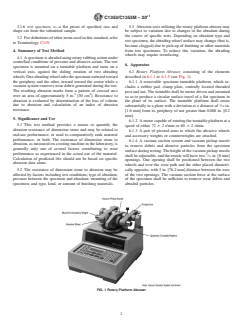
vertical axis, against the sliding rotation of two abrading 6.1 Rotary Platform Abraser, consisting of the elements
wheels.Oneabradingwheelrubsthespecimenoutwardtoward described in 6.1.1 to 6.1.5 (see Fig. 1).
the periphery and the other, inward toward the center while a
6.1.1 A removable specimen turntable platform, which in-
vacuum system removes wear debris generated during the test.
cludes a rubber pad, clamp plate, centrally located threaded
The resulting abrasion marks form a pattern of crossed arcs
post and nut. The turntable shall be motor driven and mounted
2 2
over an area of approximately 5 in. [30 cm ]. Resistance to
so as to produce a circular surface travel of a flat specimen in
abrasion is evaluated by determination of the loss of volume
the plane of its surface. The turntable platform shall rotate
due to abrasion and calculation of an index of abrasion
substantially in a plane with a deviation at a distance of ⁄16 in.
resistance.
[1.6 mm] from its periphery of not greater than 0.008 in. [0.2
mm].
5. Significance and Use
6.1.2 Amotor capable of rotating the turntable platform at a
5.1 This test method provides a means to quantify the
speed of either 72 6 2 r/min or 60 6 2 r/min.
abrasion resistance of dimension stone and may be related to
6.1.3 A pair of pivoted arms to which the abrasive wheels
end-use performance, or used to comparatively rank material
and accessory weights or counterweights are attached.
performance, or both. The resistance of dimension stone to
6.1.4 A vacuum suction system and vacuum pickup nozzle
abrasion, as measured on a testing machine in the laboratory, is
to remove debris and abrasive particles from the specimen
generally only one of several factors contributing to wear
surface during testing.The height of the vacuum pickup nozzle
performance as experienced in the actual use of the material.
shall be adjustable, and the nozzle will have two ⁄16 in. [8 mm]
Calculation of predicted life should not be based on specific
openings. One opening shall be positioned between the two
abrasion data alone.
wheels and over the wear path and the other placed diametri-
5.2 The resistance of dimension stone to abrasion may be
cally opposite, with 3 in. [76.2 mm] distance between the axes
affected by factors including test conditions; type of abradant; of the two openings. The vacuum suction force at the surface
pressure between the specimen and abradant; mounting of the of the specimen shall be sufficient to remove wear debris and
specimen; and type, kind, or amount of finishing materials. abraded particles.
FIG. 1 Rotary Platform Abraser
´1
C1353/C1353M − 20
6.1.5 A counter to record the number of abrasion cycles directions, is provided by rotation of the specimen and the
(revolutions) made by the turntable platform. associated friction therefrom.
6.2 Abrasive Wheels , which are attached to the free end of
6.3 Accessory Weights, to be attached to the pivoted arms to
the pivoted arms and are able to rotate freely about horizontal provide a force of 2.2 lb [1000 g], when the wheel is pressed
spindles.
against the specimen, exclusive of the mass of the wheel itself.
6.2.1 The wheels shall be cylindrically shaped, have a Accessory weight references are per arm (not combined), and
3 1
diameter between 2 and 1 ⁄4 in. [52 and 45 mm], a width of ⁄2 include the mass of the pivoted arm.
in. [12.7 mm], and include an axial hole ⁄8 in. [16.0 mm] in
6.4 Auxiliary Apparatus:
diameter to allow the wheel to be mounted to the flanged
6.4.1 Wheel refacer , with a diamond tool for resurfacing
holder on the pivoted arms. The abrasive wheels shall be
vitrified wheels or correcting out of round wheels.
vitrified based, consisting of hard particles embedded in a
6.4.2 Asoft bristle brush, to remove loose particles from the
binder material. H-22 Calibrade wheels are the required grade
abrasive wheels or surface of the specimen.
of abrasive for this test method.
1 6.5 Balance, with a capacity of 1 lb [500 g] and capable of
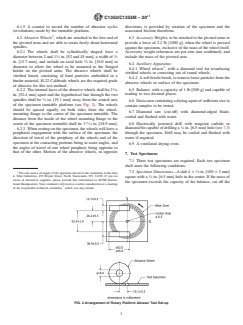
6.2.2 The internal faces of the abrasive wheels shall be 2 ⁄16
reading to two decimal places.
in. [52.4 mm] apart and the hypothetical line through the two
spindles shall be ⁄4 in. [19.1 mm] away from the central axis
6.6 Desiccator containing a drying agent of sufficient size to
of the specimen turntable platform (see Fig. 2). The wheels
contain samples to be tested.
should be spaced equally on both sides from the wheel-
6.7 Diamond saw (cut-off) with diamond-edged blade,
mounting flange to the center of the specimen turntable. The
cooled and flushed with water.
distance from the inside of the wheel mounting flange to the
6.8 Electrically powered drill with tungsten carbide or
center of the specimen turntable shall be 1 ⁄32 in. [38.9 mm].
6.2.3 When resting on the specimen, the wheels will have a diamond bit capable of drilling a ⁄4 in. [6.5 mm] hole (see 7.3)
through the specimen. Drill may be cooled and flushed with
peripheral engagement with the surface of the specimen, the
direction of travel of the periphery of the wheels and of the water if required.
specimen at the contacting portions being at acute angles, and
6.9 A ventilated drying oven.
the
...