

ASTM D3499-19
(Test Method)Standard Test Method for Toughness of Wood Structural Panels
General Information
- Abstract
SIGNIFICANCE AND USE
3.1 The failure of wood-based materials with impact loads is sometimes an important criteria in design considerations. In addition, some effects on the mechanical properties of wood, such as decay, are best evaluated by measuring its toughness. This test method serves to evaluate the toughness of structural panel products while Methods D143 can be used to measure the toughness of solid clear wood specimens.
SCOPE
1.1 This test method for toughness of wood structural panels covers the determination of energy necessary to cause failure by impact loading of a beam specimen which is simply supported and loaded at midspan. Wood structural panels in use include plywood, oriented strand board, and composites of veneer and of wood-based layers.
1.2 The values stated in inch-pound units are to be regarded as standard. The values given in parentheses are mathematical conversions to SI units that are provided for information only and are not considered standard.
1.3 This standard does not purport to address all of the safety concerns, if any, associated with its use. It is the responsibility of the user of this standard to establish appropriate safety, health, and environmental practices and determine the applicability of regulatory limitations prior to use.
1.4 This international standard was developed in accordance with internationally recognized principles on standardization established in the Decision on Principles for the Development of International Standards, Guides and Recommendations issued by the World Trade Organization Technical Barriers to Trade (TBT) Committee.
- Status
- Published
- Publication Date
- 28-Feb-2019
- Technical Committee
- D07 - Wood
- Drafting Committee
- D07.03 - Panel Products




Overview
ASTM D3499-19: Standard Test Method for Toughness of Wood Structural Panels is an internationally recognized test method developed by ASTM. This standard outlines procedures for determining the energy required to cause failure of wood structural panels by impact loading. The scope covers panels such as plywood, oriented strand board (OSB), waferboard, and composite materials made from veneer or other wood-based layers. Ensuring accurate measurement of panel toughness is critical for assessing performance in structural applications, especially where impact loads or potential material decay are important design considerations.
Key Topics
Toughness Measurement
Evaluates the energy required for failure of a panel under impact loading, which helps assess durability and resilience in real-world conditions.Applicable Panel Types
Encompasses a variety of wood structural panels, including:- Plywood
- Oriented strand board (OSB)
- Waferboard
- Laminated veneer panels
- Other wood-based composites
Test Procedure
- Specimens are shaped to standard dimensions and supported as a beam on two pins.
- Impact is applied at the center using a toughness testing machine equipped with a pendulum.
- The load is delivered to achieve complete failure in a single motion.
- Data collected includes initial and final swing angles, from which toughness is calculated.
Conditioning and Moisture Control
- Specimens are conditioned to stable moisture content, typically using a controlled atmosphere.
- Moisture content and specific gravity are measured alongside mechanical testing for comprehensive results.
Data Reporting
- Detailed descriptions of species, construction, and adhesive types used.
- Reporting includes thickness, length, span, moisture content, specific gravity, and measured toughness.
Applications
The ASTM D3499-19 test method provides practical value in a variety of contexts:
Structural Engineering and Design
- Used in specifying material requirements for building envelopes and load-bearing applications.
- Enables assessment of how panels will behave under accidental impacts or dynamic loads.
Quality Control and Product Development
- Manufacturers utilize this standard to verify product performance, compare different wood panel products, and ensure compliance with building codes and market requirements.
Evaluation of Aging and Decay
- Measurement of toughness aids in identifying degradation from decay, insect infestation, or moisture exposure, which is vital for maintenance and service life estimation.
Regulatory and Safety Compliance
- Referenced by agencies, including the U.S. Department of Defense, for procurement and construction projects requiring certified material performance.
Research and Comparative Testing
- Utilized in research settings to compare new adhesives, manufacturing processes, or raw materials for wood-based panels.
Related Standards
For comprehensive evaluation, ASTM D3499-19 is often used in conjunction with related standards:
- ASTM D143 – Test Methods for Small Clear Specimens of Timber: Focuses on measuring toughness and other properties in solid wood samples.
- ASTM D2395 – Test Methods for Density and Specific Gravity (Relative Density) of Wood and Wood-Based Materials: Provides procedures for determining the physical properties critical for structural calculations.
- ASTM D4442 – Test Methods for Direct Moisture Content Measurement of Wood and Wood-Based Materials: Essential for ensuring consistent specimen conditioning prior to mechanical testing.
By incorporating ASTM D3499-19 into quality assurance, design, and research processes, professionals gain reliable, standardized measurements of wood structural panel toughness for safe and effective material utilization in a wide range of construction and industrial settings.
Relations
- Effective Date
- 01-Mar-2019
- Effective Date
- 15-Nov-2023
- Effective Date
- 01-Mar-2020
- Effective Date
- 15-Nov-2016
- Effective Date
- 01-Jun-2015
- Effective Date
- 01-May-2014
- Effective Date
- 01-May-2014
- Effective Date
- 01-Sep-2009
- Effective Date
- 15-Nov-2007
- Refers
ASTM D2395-07ae1 - Standard Test Methods for Specific Gravity of Wood and Wood-Based Materials - Effective Date
- 01-Jul-2007
- Effective Date
- 01-Jul-2007
- Effective Date
- 10-Apr-2007
- Effective Date
- 01-Apr-2007
- Effective Date
- 01-Apr-2007
- Effective Date
- 01-Oct-2006
Get Certified
Connect with accredited certification bodies for this standard

Gozdarski inštitut Slovenije
Slovenian Forestry Institute. Forest management certification support, timber testing.
Sponsored listings
Frequently Asked Questions
ASTM D3499-19 is a standard published by ASTM International. Its full title is "Standard Test Method for Toughness of Wood Structural Panels". This standard covers: SIGNIFICANCE AND USE 3.1 The failure of wood-based materials with impact loads is sometimes an important criteria in design considerations. In addition, some effects on the mechanical properties of wood, such as decay, are best evaluated by measuring its toughness. This test method serves to evaluate the toughness of structural panel products while Methods D143 can be used to measure the toughness of solid clear wood specimens. SCOPE 1.1 This test method for toughness of wood structural panels covers the determination of energy necessary to cause failure by impact loading of a beam specimen which is simply supported and loaded at midspan. Wood structural panels in use include plywood, oriented strand board, and composites of veneer and of wood-based layers. 1.2 The values stated in inch-pound units are to be regarded as standard. The values given in parentheses are mathematical conversions to SI units that are provided for information only and are not considered standard. 1.3 This standard does not purport to address all of the safety concerns, if any, associated with its use. It is the responsibility of the user of this standard to establish appropriate safety, health, and environmental practices and determine the applicability of regulatory limitations prior to use. 1.4 This international standard was developed in accordance with internationally recognized principles on standardization established in the Decision on Principles for the Development of International Standards, Guides and Recommendations issued by the World Trade Organization Technical Barriers to Trade (TBT) Committee.
SIGNIFICANCE AND USE 3.1 The failure of wood-based materials with impact loads is sometimes an important criteria in design considerations. In addition, some effects on the mechanical properties of wood, such as decay, are best evaluated by measuring its toughness. This test method serves to evaluate the toughness of structural panel products while Methods D143 can be used to measure the toughness of solid clear wood specimens. SCOPE 1.1 This test method for toughness of wood structural panels covers the determination of energy necessary to cause failure by impact loading of a beam specimen which is simply supported and loaded at midspan. Wood structural panels in use include plywood, oriented strand board, and composites of veneer and of wood-based layers. 1.2 The values stated in inch-pound units are to be regarded as standard. The values given in parentheses are mathematical conversions to SI units that are provided for information only and are not considered standard. 1.3 This standard does not purport to address all of the safety concerns, if any, associated with its use. It is the responsibility of the user of this standard to establish appropriate safety, health, and environmental practices and determine the applicability of regulatory limitations prior to use. 1.4 This international standard was developed in accordance with internationally recognized principles on standardization established in the Decision on Principles for the Development of International Standards, Guides and Recommendations issued by the World Trade Organization Technical Barriers to Trade (TBT) Committee.
ASTM D3499-19 is classified under the following ICS (International Classification for Standards) categories: 79.060.10 - Plywood. The ICS classification helps identify the subject area and facilitates finding related standards.
ASTM D3499-19 has the following relationships with other standards: It is inter standard links to ASTM D3499-11, ASTM D143-23, ASTM D4442-20, ASTM D4442-16, ASTM D4442-15, ASTM D2395-14, ASTM D2395-14e1, ASTM D143-09, ASTM D4442-07, ASTM D2395-07ae1, ASTM D2395-07a, ASTM D143-94(2000)e1, ASTM D143-94(2007), ASTM D2395-07, ASTM D2395-06. Understanding these relationships helps ensure you are using the most current and applicable version of the standard.
ASTM D3499-19 is available in PDF format for immediate download after purchase. The document can be added to your cart and obtained through the secure checkout process. Digital delivery ensures instant access to the complete standard document.
Standards Content (Sample)
This international standard was developed in accordance with internationally recognized principles on standardization established in the Decision on Principles for the
Development of International Standards, Guides and Recommendations issued by the World Trade Organization Technical Barriers to Trade (TBT) Committee.
Designation: D3499 − 19
Standard Test Method for
Toughness of Wood Structural Panels
This standard is issued under the fixed designation D3499; the number immediately following the designation indicates the year of
original adoption or, in the case of revision, the year of last revision. A number in parentheses indicates the year of last reapproval. A
superscript epsilon (´) indicates an editorial change since the last revision or reapproval.
This standard has been approved for use by agencies of the U.S. Department of Defense.
1. Scope addition, some effects on the mechanical properties of wood,
such as decay, are best evaluated by measuring its toughness.
1.1 Thistestmethodfortoughnessofwoodstructuralpanels
This test method serves to evaluate the toughness of structural
covers the determination of energy necessary to cause failure
panel products while Methods D143 can be used to measure
by impact loading of a beam specimen which is simply
the toughness of solid clear wood specimens.
supportedandloadedatmidspan.Woodstructuralpanelsinuse
include plywood, oriented strand board, and composites of
4. Apparatus
veneer and of wood-based layers.
4.1 The toughness testing machine (Note 1) shall consist of
1.2 The values stated in inch-pound units are to be regarded
a frame supporting a pendulum, being so arranged that a
as standard. The values given in parentheses are mathematical
measured amount of the energy from the fall of the pendulum
conversions to SI units that are provided for information only
may be applied to a test specimen. The pendulum shall consist
and are not considered standard.
of a bar to which is fastened a weight adjustable to different
1.3 This standard does not purport to address all of the
positions and shall carry at its upper end a drum or pulley
safety concerns, if any, associated with its use. It is the
whose center provides the axis of rotation. The force shall be
responsibility of the user of this standard to establish appro-
applied to the specimen by means of a flexible steel cable
priate safety, health, and environmental practices and deter-
passing over the drum.Astationary graduated scale or dial and
mine the applicability of regulatory limitations prior to use.
a vernier operated by the moving drum shall be provided for
1.4 This international standard was developed in accor-
reading the angles through which the pendulum swings. The
dance with internationally recognized principles on standard-
machine shall be adjusted before test so that the pendulum
ization established in the Decision on Principles for the
hangs truly vertical and adjusted to correct for friction. The
Development of International Standards, Guides and Recom-
cable shall be adjusted so that the load is applied to the
mendations issued by the World Trade Organization Technical
specimen when the pendulum swings to within approximately
Barriers to Trade (TBT) Committee.
15°oftheverticalsoastoproducecompletefailurebythetime
2. Referenced Documents
the downward swing is completed.
2.1 ASTM Standards:
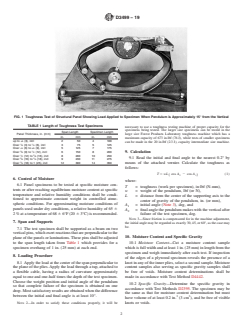
NOTE 1—The set-up shown in Fig. 1 has been found to give satisfactory
D143 Test Methods for Small Clear Specimens of Timber
results. Several types of machines such as the Forest Products Laboratory
D2395 Test Methods for Density and Specific Gravity (Rela-
Toughness Machine and toughness testers from Izod and Amsler have
been used but insufficient information is available to decide whether one
tive Density) of Wood and Wood-Based Materials
procedure is superior to another or whether the results by different test
D4442 Test Methods for Direct Moisture Content Measure-
machines can be directly correlated.
ment of Wood and Wood-Based Materials
3. Significance and Use 5. Test Specimen
3.1 The failure of wood-based materials with impact loads
5.1 The toughness test specimen shall be ⁄8 in. (16 mm) in
is sometimes an important criteria in design considerations. In 5
widthformateriallessthan ⁄8in.(16mm)inthickness,andthe
thickness of the specimen shall be equal to that of the material.
This test method is under the jurisdiction of ASTM Committee D07 on Wood 5
For material more than ⁄8 in. (16 mm) in thickness, the width
and is the direct responsibility of Subcommittee D07.03 on Panel Products.
shall be equal to the thickness of the material, thus making the
Current edition approved March 1, 2019. Published May 2019. Originally
specimen square in cross section. The length shall be deter-
approved in 1976. Last previous edition approved in 2011 as D3499 – 11. DOI:
10.1520/D3499-19.
mined from the thickness of the material in accordance with
For referenced ASTM standards, visit the ASTM website, www.astm.org, or
Table 1. The actual cross-sectional dimensions, and the speci-
contact ASTM Customer Service at service@astm.org. For Annual Book of ASTM
men and span length shall be measured to an accuracy of not
Standards volume information, refer to the standard’s Document Summary page on
the ASTM website. less than 60.3 % or 0.001 in. (0.02 mm) whichever is larger.
Copyright © ASTM International, 100 Barr Harbor Drive, PO Box C700, West Conshohocken, PA 19428-2959. United States
D3499 − 19
FIG. 1 Toughness Test of Structural Panel Showing Load Applied to Specimen When Pendulum is Approximately 15° from the Vertical
TABLE 1 Length of Toughness Test Spec
...
This document is not an ASTM standard and is intended only to provide the user of an ASTM standard an indication of what changes have been made to the previous version. Because
it may not be technically possible to adequately depict all changes accurately, ASTM recommends that users consult prior editions as appropriate. In all cases only the current version
of the standard as published by ASTM is to be considered the official document.
Designation: D3499 − 11 D3499 − 19
Standard Test Method for
Toughness of Wood-BasedWood Structural Panels
This standard is issued under the fixed designation D3499; the number immediately following the designation indicates the year of
original adoption or, in the case of revision, the year of last revision. A number in parentheses indicates the year of last reapproval. A
superscript epsilon (´) indicates an editorial change since the last revision or reapproval.
This standard has been approved for use by agencies of the U.S. Department of Defense.
1. Scope
1.1 This test method for toughness of wood-basedwood structural panels covers the determination of energy necessary to cause
failure by impact loading of a beam specimen which is simply supported and loaded at midspan. Wood-basedWood structural
panels in use include plywood, waferboard, oriented strand board, and composites of veneer and of wood-based layers.
1.2 The values stated in inch-pound units are to be regarded as standard. The values given in parentheses are mathematical
conversions to SI units that are provided for information only and are not considered standard.
1.3 This standard does not purport to address all of the safety concerns, if any, associated with its use. It is the responsibility
of the user of this standard to establish appropriate safety safety, health, and healthenvironmental practices and determine the
applicability of regulatory limitations prior to use.
1.4 This international standard was developed in accordance with internationally recognized principles on standardization
established in the Decision on Principles for the Development of International Standards, Guides and Recommendations issued
by the World Trade Organization Technical Barriers to Trade (TBT) Committee.
2. Referenced Documents
2.1 ASTM Standards:
D143 Test Methods for Small Clear Specimens of Timber
D2395 Test Methods for Density and Specific Gravity (Relative Density) of Wood and Wood-Based Materials
D4442 Test Methods for Direct Moisture Content Measurement of Wood and Wood-Based Materials
3. Significance and Use
3.1 The failure of wood-based materials with impact loads is sometimes an important criteria in design considerations. In
addition, some effects on the mechanical properties of wood, such as decay, are best evaluated by measuring its toughness. This
test method serves to evaluate the toughness of structural panel products while Methods D143 can be used to measure the
toughness of solid clear wood specimens.
4. Apparatus
4.1 The toughness testing machine (Note 1) shall consist of a frame supporting a pendulum, being so arranged that a measured
amount of the energy from the fall of the pendulum may be applied to a test specimen. The pendulum shall consist of a bar to which
is fastened a weight adjustable to different positions and shall carry at its upper end a drum or pulley whose center provides the
axis of rotation. The force shall be applied to the specimen by means of a flexible steel cable passing over the drum. A stationary
graduated scale or dial and a vernier operated by the moving drum shall be provided for reading the angles through which the
pendulum swings. The machine shall be adjusted before test so that the pendulum hangs truly vertical and adjusted to correct for
friction. The cable shall be adjusted so that the load is applied to the specimen when the pendulum swings to within approximately
15° of the vertical so as to produce complete failure by the time the downward swing is completed.
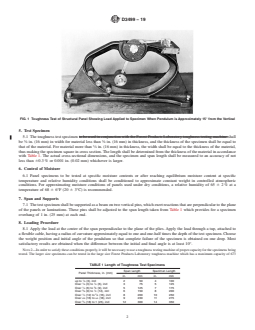
NOTE 1—The set-up shown in Fig. 1 has been found to give satisfactory results. Several types of machines such as the Forest Products Laboratory
Toughness Machine and toughness testers from Izod and Amsler have been used but insufficient information is available to decide whether one procedure
is superior to another or whether the results by different test machines can be directly correlated.
This test method is under the jurisdiction of ASTM Committee D07 on Wood and is the direct responsibility of Subcommittee D07.03 on Panel Products.
Current edition approved May 1, 2011March 1, 2019. Published June 2011May 2019. Originally approved in 1976. Last previous edition approved in 20002011 as
D3499 – 94 (2005).D3499 – 11. DOI: 10.1520/D3499-11.10.1520/D3499-19.
For referenced ASTM standards, visit the ASTM website, www.astm.org, or contact ASTM Customer Service at service@astm.org. For Annual Book of ASTM Standards
volume information, refer to the standard’s Document Summary page on the ASTM website.
Copyright © ASTM International, 100 Barr Harbor Drive, PO Box C700, West Conshohocken, PA 19428-2959. United States
D3499 − 19
FIG. 1 Toughness Test of Structural Panel Showing Load Applied to Specimen When Pendulum is Approximately 15° from the Vertical
5. Test Specimen
5.1 The toughness test specimen to be used in conjunction with the Forest Products Laboratory toughness testing machine shall
5 5
be ⁄8 in. (16 mm) in width for material less than ⁄8 in. (16 mm) in thickness, and the thickness of the specimen shall be equal to
that of the material. For material more than ⁄8 in. (16 mm) in thickness, the width shall be equal to the thickness of the material,
thus making the specimen square in cross section. The length shall be determined from the thickness of the material in accordance
with Table 1. The actual cross-sectional dimensions, and the specimen and span length shall be measured to a
...