

ASTM D7169-23
(Test Method)Standard Test Method for Boiling Point Distribution of Samples with Residues Such as Crude Oils and Atmospheric and Vacuum Residues by High Temperature Gas Chromatography
General Information
- Abstract
SIGNIFICANCE AND USE
5.1 The determination of the boiling point distribution of crude oils and vacuum residues, as well as other petroleum fractions, yields important information for refinery operation. These boiling point distributions provide information as to the potential mass percent yield of products. This test method may provide useful information that can aid in establishing operational conditions in the refinery. Knowledge of the amount of residue produced is important in determining the economics of the refining process.
SCOPE
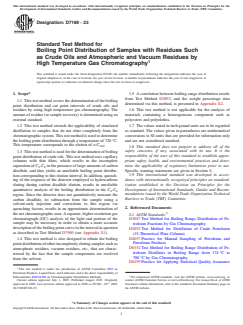
1.1 This test method covers the determination of the boiling point distribution and cut point intervals of crude oils and residues by using high temperature gas chromatography. The amount of residue (or sample recovery) is determined using an external standard.
1.2 This test method extends the applicability of simulated distillation to samples that do not elute completely from the chromatographic system. This test method is used to determine the boiling point distribution through a temperature of 720 °C. This temperature corresponds to the elution of n-C100.
1.3 This test method is used for the determination of boiling point distribution of crude oils. This test method uses capillary columns with thin films, which results in the incomplete separation of C4-C8 in the presence of large amounts of carbon disulfide, and thus yields an unreliable boiling point distribution corresponding to this elution interval. In addition, quenching of the response of the detector employed to hydrocarbons eluting during carbon disulfide elution, results in unreliable quantitative analysis of the boiling distribution in the C4-C8 region. Since the detector does not quantitatively measure the carbon disulfide, its subtraction from the sample using a solvent-only injection and corrections to this region via quenching factors, results in an approximate determination of the net chromatographic area. A separate, higher resolution gas chromatograph (GC) analysis of the light end portion of the sample may be necessary in order to obtain a more accurate description of the boiling point curve in the interval in question as described in Test Method D7900 (see Appendix X1).
1.4 This test method is also designed to obtain the boiling point distribution of other incompletely eluting samples such as atmospheric residues, vacuum residues, etc., that are characterized by the fact that the sample components are resolved from the solvent.
1.5 A correlation between boiling range distribution results from Test Method D2892, and the weight percentage data determined via this method, is presented in Appendix X2.
1.6 This test method is not applicable for the analysis of materials containing a heterogeneous component such as polyesters and polyolefins.
1.7 The values stated in inch-pound units are to be regarded as standard. The values given in parentheses are mathematical conversions to SI units that are provided for information only and are not considered standard.
1.8 This standard does not purport to address all of the safety concerns, if any, associated with its use. It is the responsibility of the user of this standard to establish appropriate safety, health, and environmental practices and determine the applicability of regulatory limitations prior to use. Specific warning statements are given in Section 8.
1.9 This international standard was developed in accordance with internationally recognized principles on standardization established in the Decision on Principles for the Development of International Standards, Guides and Recommendations issued by the World Trade Organization Technical Barriers to Trade (TBT) Committee.
- Status
- Published
- Publication Date
- 30-Jun-2023
- Technical Committee
- D02 - Petroleum Products, Liquid Fuels, and Lubricants
- Drafting Committee
- D02.04.0H - Chromatographic Distribution Methods
Buy Documents
ASTM D7169-23 - Standard Test Method for Boiling Point Distribution of Samples with Residues Such as Crude Oils and Atmospheric and Vacuum Residues by High Temperature Gas Chromatography
REDLINE ASTM D7169-23 - Standard Test Method for Boiling Point Distribution of Samples with Residues Such as Crude Oils and Atmospheric and Vacuum Residues by High Temperature Gas Chromatography
Overview
ASTM D7169-23: Standard Test Method for Boiling Point Distribution of Samples with Residues Such as Crude Oils and Atmospheric and Vacuum Residues by High Temperature Gas Chromatography provides a comprehensive, standardized approach to determining the boiling point distribution and cut point intervals of petroleum samples containing substantial residues. Developed by ASTM International, this method is crucial for characterizing complex hydrocarbon mixtures such as crude oils, atmospheric residues, and vacuum residues, using high temperature gas chromatography (HTGC).
Understanding the boiling point distribution is essential for petroleum refiners to optimize operations, maximize yield, and assess economic viability. The standard offers a reliable means to simulate distillation processes, especially when dealing with samples that are not fully eluted during chromatographic analysis.
Key Topics
- Boiling Point Distribution: Accurately determines the boiling range and cut point intervals for samples including heavy petroleum fractions, using capillary columns and external standards in HTGC up to 720°C.
- Sample Types: Applies to crude oils, atmospheric and vacuum residues, and other incompletely eluting petroleum fractions; not applicable to heterogeneous materials like polyesters or polyolefins.
- Simulated Distillation Extension: This method extends simulated distillation to account for non-volatile residues, improving analysis of samples that do not fully elute.
- Quantification of Residue: Utilizes external standards to determine the mass percent of residue, aiding in refinery yield calculation and operational planning.
- Data Quality and Corrections: Provides instructions for correcting detector response (quenching) in zones where solvent co-elution can interfere with accurate measurement, and suggests supplementary analysis (e.g., ASTM D7900) for improved accuracy across the C4-C8 region.
- Correlation with Other Methods: Offers weight percent data comparable to other distillation methods, such as ASTM D2892, assisting users transitioning between analytical techniques.
Applications
Practical Value for Industry:
- Refinery Optimization: Enables refineries to determine product yield potentials and make informed operational decisions.
- Economic Analysis: Quantifies residue and liquid yields, directly supporting refinery economics and planning.
- Quality Control and Assurance: Standardizes the process for boiling point analysis, allowing for consistent data across labs and facilities.
- Compliance and Reporting: Assists in meeting regulatory and technical quality requirements for crude oil and petroleum product characterization.
Typical Use Cases:
- Crude Oil Assay: Detailed boiling point profiling during crude oil evaluation.
- Residue Analysis: Characterizing atmospheric and vacuum residues in refining streams for process design and monitoring.
- Simulated Distillation: Providing a rapid alternative to traditional physical distillation, especially beneficial for samples with incomplete elution characteristics.
Related Standards
To ensure best practices and comprehensive analysis, ASTM D7169-23 references several related standards:
- ASTM D2887 - Test Method for Boiling Range Distribution of Petroleum Fractions by Gas Chromatography
- ASTM D2892 - Test Method for Distillation of Crude Petroleum (15-Theoretical Plate Column)
- ASTM D4057 - Practice for Manual Sampling of Petroleum and Petroleum Products
- ASTM D6352 - Test Method for Boiling Range Distribution of Petroleum Distillates (174°C to 700°C)
- ASTM D7500 - Test Method for Boiling Range Distribution of Distillates and Lubricating Base Oils (100°C to 735°C)
- ASTM D7900 - Test Method for Light Hydrocarbons in Stabilized Crude Oils by Gas Chromatography
- ASTM E594/E1510 - Practices for Testing Flame Ionization Detectors and Installing GC Columns
Adoption and Global Relevance:
ASTM D7169-23 was developed in accordance with recognized international standardization principles, ensuring reliability and acceptance worldwide within the oil and gas industry.
By delivering a robust and reproducible means of determining boiling point distribution for complex petroleum samples, ASTM D7169-23 remains a critical tool for refiners, labs, and stakeholders seeking actionable insights for processing and economic assessment.
Relations
- Effective Date
- 25-Oct-2011
- Effective Date
- 01-Dec-2023
- Effective Date
- 01-Nov-2023
- Effective Date
- 01-Jul-2023
- Effective Date
- 01-Jun-2020
- Effective Date
- 01-Dec-2019
- Effective Date
- 01-Dec-2019
- Effective Date
- 01-Dec-2019
- Effective Date
- 01-Sep-2019
- Effective Date
- 01-Jul-2019
- Effective Date
- 01-Oct-2018
- Effective Date
- 01-Apr-2018
- Effective Date
- 15-Dec-2017
- Effective Date
- 15-Nov-2017
- Effective Date
- 01-Oct-2017
Buy Documents
ASTM D7169-23 - Standard Test Method for Boiling Point Distribution of Samples with Residues Such as Crude Oils and Atmospheric and Vacuum Residues by High Temperature Gas Chromatography
REDLINE ASTM D7169-23 - Standard Test Method for Boiling Point Distribution of Samples with Residues Such as Crude Oils and Atmospheric and Vacuum Residues by High Temperature Gas Chromatography
Get Certified
Connect with accredited certification bodies for this standard

ECOCERT
Organic and sustainability certification.

Eurofins Food Testing Global
Global leader in food, environment, and pharmaceutical product testing.

Intertek Bangladesh
Intertek certification and testing services in Bangladesh.
Sponsored listings
Frequently Asked Questions
ASTM D7169-23 is a standard published by ASTM International. Its full title is "Standard Test Method for Boiling Point Distribution of Samples with Residues Such as Crude Oils and Atmospheric and Vacuum Residues by High Temperature Gas Chromatography". This standard covers: SIGNIFICANCE AND USE 5.1 The determination of the boiling point distribution of crude oils and vacuum residues, as well as other petroleum fractions, yields important information for refinery operation. These boiling point distributions provide information as to the potential mass percent yield of products. This test method may provide useful information that can aid in establishing operational conditions in the refinery. Knowledge of the amount of residue produced is important in determining the economics of the refining process. SCOPE 1.1 This test method covers the determination of the boiling point distribution and cut point intervals of crude oils and residues by using high temperature gas chromatography. The amount of residue (or sample recovery) is determined using an external standard. 1.2 This test method extends the applicability of simulated distillation to samples that do not elute completely from the chromatographic system. This test method is used to determine the boiling point distribution through a temperature of 720 °C. This temperature corresponds to the elution of n-C100. 1.3 This test method is used for the determination of boiling point distribution of crude oils. This test method uses capillary columns with thin films, which results in the incomplete separation of C4-C8 in the presence of large amounts of carbon disulfide, and thus yields an unreliable boiling point distribution corresponding to this elution interval. In addition, quenching of the response of the detector employed to hydrocarbons eluting during carbon disulfide elution, results in unreliable quantitative analysis of the boiling distribution in the C4-C8 region. Since the detector does not quantitatively measure the carbon disulfide, its subtraction from the sample using a solvent-only injection and corrections to this region via quenching factors, results in an approximate determination of the net chromatographic area. A separate, higher resolution gas chromatograph (GC) analysis of the light end portion of the sample may be necessary in order to obtain a more accurate description of the boiling point curve in the interval in question as described in Test Method D7900 (see Appendix X1). 1.4 This test method is also designed to obtain the boiling point distribution of other incompletely eluting samples such as atmospheric residues, vacuum residues, etc., that are characterized by the fact that the sample components are resolved from the solvent. 1.5 A correlation between boiling range distribution results from Test Method D2892, and the weight percentage data determined via this method, is presented in Appendix X2. 1.6 This test method is not applicable for the analysis of materials containing a heterogeneous component such as polyesters and polyolefins. 1.7 The values stated in inch-pound units are to be regarded as standard. The values given in parentheses are mathematical conversions to SI units that are provided for information only and are not considered standard. 1.8 This standard does not purport to address all of the safety concerns, if any, associated with its use. It is the responsibility of the user of this standard to establish appropriate safety, health, and environmental practices and determine the applicability of regulatory limitations prior to use. Specific warning statements are given in Section 8. 1.9 This international standard was developed in accordance with internationally recognized principles on standardization established in the Decision on Principles for the Development of International Standards, Guides and Recommendations issued by the World Trade Organization Technical Barriers to Trade (TBT) Committee.
SIGNIFICANCE AND USE 5.1 The determination of the boiling point distribution of crude oils and vacuum residues, as well as other petroleum fractions, yields important information for refinery operation. These boiling point distributions provide information as to the potential mass percent yield of products. This test method may provide useful information that can aid in establishing operational conditions in the refinery. Knowledge of the amount of residue produced is important in determining the economics of the refining process. SCOPE 1.1 This test method covers the determination of the boiling point distribution and cut point intervals of crude oils and residues by using high temperature gas chromatography. The amount of residue (or sample recovery) is determined using an external standard. 1.2 This test method extends the applicability of simulated distillation to samples that do not elute completely from the chromatographic system. This test method is used to determine the boiling point distribution through a temperature of 720 °C. This temperature corresponds to the elution of n-C100. 1.3 This test method is used for the determination of boiling point distribution of crude oils. This test method uses capillary columns with thin films, which results in the incomplete separation of C4-C8 in the presence of large amounts of carbon disulfide, and thus yields an unreliable boiling point distribution corresponding to this elution interval. In addition, quenching of the response of the detector employed to hydrocarbons eluting during carbon disulfide elution, results in unreliable quantitative analysis of the boiling distribution in the C4-C8 region. Since the detector does not quantitatively measure the carbon disulfide, its subtraction from the sample using a solvent-only injection and corrections to this region via quenching factors, results in an approximate determination of the net chromatographic area. A separate, higher resolution gas chromatograph (GC) analysis of the light end portion of the sample may be necessary in order to obtain a more accurate description of the boiling point curve in the interval in question as described in Test Method D7900 (see Appendix X1). 1.4 This test method is also designed to obtain the boiling point distribution of other incompletely eluting samples such as atmospheric residues, vacuum residues, etc., that are characterized by the fact that the sample components are resolved from the solvent. 1.5 A correlation between boiling range distribution results from Test Method D2892, and the weight percentage data determined via this method, is presented in Appendix X2. 1.6 This test method is not applicable for the analysis of materials containing a heterogeneous component such as polyesters and polyolefins. 1.7 The values stated in inch-pound units are to be regarded as standard. The values given in parentheses are mathematical conversions to SI units that are provided for information only and are not considered standard. 1.8 This standard does not purport to address all of the safety concerns, if any, associated with its use. It is the responsibility of the user of this standard to establish appropriate safety, health, and environmental practices and determine the applicability of regulatory limitations prior to use. Specific warning statements are given in Section 8. 1.9 This international standard was developed in accordance with internationally recognized principles on standardization established in the Decision on Principles for the Development of International Standards, Guides and Recommendations issued by the World Trade Organization Technical Barriers to Trade (TBT) Committee.
ASTM D7169-23 is classified under the following ICS (International Classification for Standards) categories: 71.040.50 - Physicochemical methods of analysis. The ICS classification helps identify the subject area and facilitates finding related standards.
ASTM D7169-23 has the following relationships with other standards: It is inter standard links to ASTM D5307-97(2007), ASTM D6299-23a, ASTM D2892-23, ASTM D2887-23, ASTM D2892-20, ASTM D7500-15(2019), ASTM D6352-19e1, ASTM D6352-19, ASTM E594-96(2019), ASTM D2887-19, ASTM D7900-18, ASTM D2892-18, ASTM D6299-17b, ASTM D6299-17a, ASTM D7900-17. Understanding these relationships helps ensure you are using the most current and applicable version of the standard.
ASTM D7169-23 is available in PDF format for immediate download after purchase. The document can be added to your cart and obtained through the secure checkout process. Digital delivery ensures instant access to the complete standard document.
Standards Content (Sample)
This international standard was developed in accordance with internationally recognized principles on standardization established in the Decision on Principles for the
Development of International Standards, Guides and Recommendations issued by the World Trade Organization Technical Barriers to Trade (TBT) Committee.
Designation: D7169 − 23
Standard Test Method for
Boiling Point Distribution of Samples with Residues Such
as Crude Oils and Atmospheric and Vacuum Residues by
High Temperature Gas Chromatography
This standard is issued under the fixed designation D7169; the number immediately following the designation indicates the year of
original adoption or, in the case of revision, the year of last revision. A number in parentheses indicates the year of last reapproval. A
superscript epsilon (´) indicates an editorial change since the last revision or reapproval.
1. Scope* 1.5 A correlation between boiling range distribution results
from Test Method D2892, and the weight percentage data
1.1 This test method covers the determination of the boiling
determined via this method, is presented in Appendix X2.
point distribution and cut point intervals of crude oils and
residues by using high temperature gas chromatography. The 1.6 This test method is not applicable for the analysis of
amount of residue (or sample recovery) is determined using an materials containing a heterogeneous component such as
external standard. polyesters and polyolefins.
1.2 This test method extends the applicability of simulated 1.7 The values stated in inch-pound units are to be regarded
distillation to samples that do not elute completely from the as standard. The values given in parentheses are mathematical
chromatographic system. This test method is used to determine conversions to SI units that are provided for information only
the boiling point distribution through a temperature of 720 °C. and are not considered standard.
This temperature corresponds to the elution of n-C .
1.8 This standard does not purport to address all of the
safety concerns, if any, associated with its use. It is the
1.3 This test method is used for the determination of boiling
responsibility of the user of this standard to establish appro-
point distribution of crude oils. This test method uses capillary
priate safety, health, and environmental practices and deter-
columns with thin films, which results in the incomplete
mine the applicability of regulatory limitations prior to use.
separation of C -C in the presence of large amounts of carbon
4 8
Specific warning statements are given in Section 8.
disulfide, and thus yields an unreliable boiling point distribu-
1.9 This international standard was developed in accor-
tion corresponding to this elution interval. In addition, quench-
dance with internationally recognized principles on standard-
ing of the response of the detector employed to hydrocarbons
ization established in the Decision on Principles for the
eluting during carbon disulfide elution, results in unreliable
Development of International Standards, Guides and Recom-
quantitative analysis of the boiling distribution in the C -C
4 8
mendations issued by the World Trade Organization Technical
region. Since the detector does not quantitatively measure the
Barriers to Trade (TBT) Committee.
carbon disulfide, its subtraction from the sample using a
solvent-only injection and corrections to this region via
2. Referenced Documents
quenching factors, results in an approximate determination of
the net chromatographic area. A separate, higher resolution gas
2.1 ASTM Standards:
chromatograph (GC) analysis of the light end portion of the
D2887 Test Method for Boiling Range Distribution of Pe-
sample may be necessary in order to obtain a more accurate
troleum Fractions by Gas Chromatography
description of the boiling point curve in the interval in question
D2892 Test Method for Distillation of Crude Petroleum
as described in Test Method D7900 (see Appendix X1).
(15-Theoretical Plate Column)
D4057 Practice for Manual Sampling of Petroleum and
1.4 This test method is also designed to obtain the boiling
Petroleum Products
point distribution of other incompletely eluting samples such as
D6352 Test Method for Boiling Range Distribution of Pe-
atmospheric residues, vacuum residues, etc., that are charac-
troleum Distillates in Boiling Range from 174 °C to
terized by the fact that the sample components are resolved
700 °C by Gas Chromatography
from the solvent.
D6299 Practice for Applying Statistical Quality Assurance
This test method is under the jurisdiction of ASTM Committee D02 on
Petroleum Products, Liquid Fuels, and Lubricants and is the direct responsibility of
Subcommittee D02.04.0H on Chromatographic Distribution Methods. For referenced ASTM standards, visit the ASTM website, www.astm.org, or
Current edition approved July 1, 2023. Published August 2023. Originally contact ASTM Customer Service at service@astm.org. For Annual Book of ASTM
ɛ1
approved in 2005. Last previous edition approved in 2020 as D7169 – 20 . DOI: Standards volume information, refer to the standard’s Document Summary page on
10.1520/D7169-23. the ASTM website.
*A Summary of Changes section appears at the end of this standard
Copyright © ASTM International, 100 Barr Harbor Drive, PO Box C700, West Conshohocken, PA 19428-2959. United States
D7169 − 23
and Control Charting Techniques to Evaluate Analytical from the net area of the standard (A ), mass of standard
STD
Measurement System Performance (M ), and mass of solvent (M ) used in the solution of
STD SLSTD
D7500 Test Method for Determination of Boiling Range the standard. A fully eluting sample, such as Reference Oil
Distribution of Distillates and Lubricating Base Oils—in 5010 or Gravimetric Blend No. 1, is used in obtaining the
Boiling Range from 100 °C to 735 °C by Gas Chroma- response factor.
tography
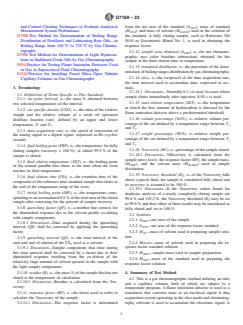
3.1.12 sample area obtained (A ), n—the net chromato-
SMP
D7900 Test Method for Determination of Light Hydrocar-
graphic area (after baseline subtraction) obtained for the
bons in Stabilized Crude Oils by Gas Chromatography
sample at the final elution time or temperature.
E594 Practice for Testing Flame Ionization Detectors Used
3.1.13 simulated distillation, n—the procedure of the deter-
in Gas or Supercritical Fluid Chromatography
mination of boiling ranges distribution by gas chromatography.
E1510 Practice for Installing Fused Silica Open Tubular
3.1.14 slice, n—the reciprocal of the data acquisition rate;
Capillary Columns in Gas Chromatographs
the time interval used to accumulate data, expressed in sec-
onds.
3. Terminology
3.1.14.1 Discussion—Normally 0.1 s is used. In cases where
3.1 Definitions of Terms Specific to This Standard:
sample elutes immediately after injection, 0.05 s is used.
3.1.1 cut point interval, n—the mass % obtained between
3.1.15 start elution temperature (SET), n—the temperature
two selected temperatures of the interval.
at which the first amount of hydrocarbon is detected by the
3.1.2 cut specific density (CSD), n—the ratio of the relative
flame ionization detector above a predetermined threshold.
weight and the relative volume of a crude oil specimen
3.1.16 volume percentage (Vol%), n—relative volume per-
distillate fraction (cut), defined by an upper and lower
centage of the cut defined by a temperature range between T
temperature, T and T . 1
1 2
and T .
3.1.3 data acquisition rate, n—the speed of conversion of
3.1.17 weight percentage (Wt%), n—relative weight per-
the analog signal to a digital signal, expressed in Hz (cycles/
centage of the cut defined by a temperature range between T
second). 1
and T .
3.1.4 final boiling point (FBP), n—the temperature, for fully
3.1.18 %recovery (RC), n—percentage of the sample eluted.
eluting samples (recovery = 100 %), at which 99.5 % of the
3.1.18.1 Discussion—%Recovery is calculated from the
sample is eluted.
sample area (A ), the response factor (RF), the sample mass,
SMP
3.1.5 final elution temperature (FET), n—the boiling point
(M ), and the solvent mass (M ) used in sample
SMP SLSMP
of the normal paraffin that elutes at the time when the oven
dissolution.
reaches its final temperature.
3.1.19 %recovery threshold (R ), n—if the %recovery falls
t
3.1.6 final elution time (FEt), n—the retention time of the
above a preset limit, the sample is considered fully eluted and
component of the reference time standard sample that elutes at
its recovery is assumed to be 100 %.
the end of the temperature ramp of the oven.
3.1.19.1 Discussion—If the %recovery values found for
3.1.7 initial boiling point (IBP), n—the temperature corre-
duplicate analyses of a nearly completely eluting sample are
sponding to an accumulated 0.5 % of the total area of the eluted
99.6 % and 101.2 %, the %recovery threshold (R ) may be set
t
sample after correcting for the percent of sample recovery.
to 99.6 % and thus either of these results may be considered as
3.1.8 quenching factor (QF), n—a number that corrects for fully eluted and set to 100 %.
the diminished response due to the solvent profile co-eluting
3.2 Symbols:
with sample components.
3.2.1 A —net area of the sample
SMP
3.1.8.1 Discussion—Data acquired during the quenching
3.2.2 A —net area of the response factor standard
STD
interval (QI) shall be corrected by applying the quenching
3.2.3 M —mass of solvent used in preparing sample solu-
factor.
SL
tion
3.1.9 quenching interval (QI), n—the time interval of the
3.2.4 M —mass of solvent used in preparing the re-
start and end of elution of the CS used as a solvent.
SLSTD
sponse factor standard solution
3.1.9.1 Discussion—Sample components that elute during
this time interval shall be corrected by a factor due to their
3.2.5 M —sample mass used in sample preparation
SMP
diminished response resulting from the co-elution of the
3.2.6 M —mass of the standard used in preparing the
STD
relatively large amount of solvent present in the sample with
response factor solution
the light sample components.
4. Summary of Test Method
3.1.10 residue (R), n—the mass % of the sample that has not
eluted at the temperature of calculation.
4.1 This is a gas chromatographic method utilizing an inlet
3.1.10.1 Discussion—Residue is calculated from the %re-
and a capillary column, both of which are subject to a
covery.
temperature program. A flame ionization detector is used as a
3.1.11 response factor (RF), n—the factor used in order to transducer that converts mass to an electrical signal A data
calculate the %recovery of the sample. acquisition system operating in the slice mode and chromatog-
3.1.11.1 Discussion—The response factor is determined raphy software is used to accumulate the electronic signal. A
D7169 − 23
A
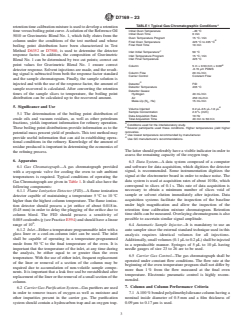
TABLE 1 Typical Gas Chromatographic Conditions
retention time calibration mixture is used to develop a retention
Initial Oven Temperature −20 °C
time versus boiling point curve. A solution of the Reference Oil
Initial Oven Time 0 min
5010 or Gravimetric Blend No. 1, which fully elutes from the
Oven Temperature Program 15 °C ⁄ min
B
column under the conditions of the test method and whose
Final Oven Temperature 425 °C to 435 °C
Final Hold Time 10 min
boiling point distribution have been characterized in Test
Method D6352 or D7500, is used to determine the detector
C
Inlet Initial Temperature 50 °C
response factor. In addition, the composition of Gravimetric
Inlet Temperature Program 15 °C ⁄ min
Inlet Final Temperature 425 °C
Blend No. 1 can be determined by two cut points; correct cut
point values for Gravimetric Blend No. 1 ensure correct
B
Column 5 m × 0.53 mm × 0.09
-0.15 μm PDMS
detector response. Solvent injections are made, and the result-
Column Flow 20 mL/min
ing signal is subtracted from both the response factor standard
Carrier Control Constant Flow
and the sample chromatogram. Finally, the sample solution is
D
Detector FID
injected and with the use of the response factor, the amount of
Detector Temperature 435 °C
sample recovered is calculated. After converting the retention
Detector Gases:
times of the sample slices to temperature, the boiling point
Hydrogen 40 mL/min
Air 450 mL/min
distribution can be calculated up to the recovered amount.
Make-Up (N , He) 15 mL/min
5. Significance and Use B
Volume Injected 0.2 μL-0.5 μL-1.0 μL
Sample Concentration 2.0 % (m/m)
5.1 The determination of the boiling point distribution of
Data Acquisition Rate 10 Hz
crude oils and vacuum residues, as well as other petroleum
Total Acquisition Time 40 min to 50 min
fractions, yields important information for refinery operation. A
Conditions used for the interlaboratory study.
B
These boiling point distributions provide information as to the Several participants used these conditions. Higher temperatures yield higher
recoveries.
potential mass percent yield of products. This test method may
C
Use lowest temperature recommended by manufacturer.
provide useful information that can aid in establishing opera- D
Use GC manufacturer’s recommendations.
tional conditions in the refinery. Knowledge of the amount of
residue produced is important in determining the economics of
The latter should preferably have a visible indicator in order to
the refining process.
assess the remaining capacity of the oxygen trap.
6. Apparatus
6.3 Data System—A data system composed of a computer
and software for data acquisition, which digitizes the detector
6.1 Gas Chromatograph—A gas chromatograph provided
signal, is recommended. Some instrumentation digitizes the
with a cryogenic valve for cooling the oven to sub ambient
signal at the electrometer board in order to reduce noise. The
temperatures is required. Typical conditions of operating the
data system is used at acquisition rates of about 10 Hz, which
Gas Chromatograph are given in Table 1. It shall also have the
correspond to slices of 0.1 s. This rate of data acquisition is
following components:
necessary to obtain a minimum number of slices void of
6.1.1 Flame Ionization Detector (FID)—A flame ionization
sample or solvent elution immediately after injection. Data
detector capable of maintaining a temperature 5 °C to 10 °C
acquisition systems facilitate the inspection of the baseline
higher than the highest column temperature. The flame ioniza-
under high magnification and allow the inspection of the
tion detector should possess a jet orifice of about 0.018 in.
retention time calibration mixture chromatogram. Retention
(0.45 mm) in order to delay the plugging of the orifice due to
time shifts can be measured. Overlaying chromatograms is also
column bleed. The FID should possess a sensitivity of
possible to ascertain similar signal amplitude.
0.005 coulombs ⁄g (see Practice E594) and should have a linear
range of 10 .
6.4 Automatic Sample Injector—It is mandatory to use an
6.1.2 Inlet—Either a temperature programmable inlet with a
auto sampler since the external standard technique used in this
glass liner or a cool-on-column inlet can be used. The inlet
analysis requires identical volumes for all injections.
shall be capable of operating in a temperature-programmed
Additionally, small volumes (0.1 μL to 0.2 μL) shall be injected
mode from 50 °C to the final temperature of the oven. It is
in a reproducible manner. Syringes of 5 μL to 10 μL having
important that the temperature of the inlet, at any time during
needle gauges of size 23 to 26 are to be used.
the analysis, be either equal to or greater than the oven
6.5 Carrier Gas Control—The gas chromatograph shall be
temperature. With the use of either inlet, frequent replacement
operated under constant flow conditions. The flow rate at the
of the liner or removal of a section of the column may be
beginning of the oven temperature program shall not differ by
required due to accumulation of non-volatile sample compo-
more than 1 % from the flow measured at the final oven
nents. It is important that a leak free seal be reestablished after
temperature. Electronic pneumatic control is highly recom-
replacement of the liner or the removal of a small section of the
mended.
column.
7. Column and Column Performance Criteria
6.2 Carrier Gas Purification System—Gas purifiers are used
in order to remove traces of oxygen as well as moisture and 7.1 A 100 % bonded polydimethylsiloxane column having a
other impurities present in the carrier gas. The purification nominal inside diameter of 0.5 mm and a film thickness of
system should contain a hydrocarbon trap and an oxygen trap. 0.09 μm to 0.17 μm is used.
D7169 − 23
7.2 The column used should be capable of sustaining these paraffins are absent in the Polywax. Furthermore the
temperatures of 435 °C under temperature programming. Alu- amounts of the paraffins are chosen so as to facilitate identi-
minum covered fused silica and metal columns have been fying the carbons in the retention time calibration mixture
successfully used. chromatogram. Alternatively, a successful mixture that has
been used may be prepared by the procedure described in 8.4.1
7.3 The column should be capable of eluting carbon number
– 8.4.3 which requires the preparation first of the n-paraffin
100 at its highest temperature. It is important that C be
mixture (see 8.3) and then spiking an aliquot of this mix to a
eluted during the temperature program cycle of the oven.
weighed amount of Polywax 655 or 1000.
7.4 Column resolution is determined from the separation of
8.4.1 Place approximately 20 mL of CS into a round
carbons 50 and 52 in the retention time calibration mixture
bottom 50 mL flask. Transfer with care.
chromatogram. The resolution should be between 1.8 to 4.0.
8.4.2 Prepare a mixture of the paraffins listed in 8.3 as
See Eq 1 in 13.1.
follows. Weigh 500 mg of each component into a 20 mL vial.
7.5 The column shall be capable of allowing the start of the
Add an additional 500 mg for dodecane and about 20 mg of
elution of n-C prior to the solvent elution, which is CS , at
tetracontane. Store this mixture at 4 °C and use it as a spiking
5 2
−20 °C. The descending edge of the n-C peak co-elutes with
mixture in the preparation of the Polywax 655 retention time
the solvent. It is to be noted that at these low temperatures
calibration mixture. These additional quantities are spiked to
liquid phases may turn solid, and retention shifts may be
ease the identification of the n-paraffins; other n-paraffins may
observed during the elution of compounds at these low oven
be chosen as peak markers.
temperatures.
8.4.3 Weigh about 25 mg of the Polywax 655 and add it to
the vessel prepared in 8.4.1. Add approximately 10 mg of the
7.6 Column Overloading—The prevention of column over-
paraffin spiking mixture prepared in 8.4.2. Stir the solution
loading is carried out by determining the skewness of a
under a fume hood and heat with an infrared lamp (about
selected peak among the components of the retention time
200 W) placed at a safe distance (about 15 cm to 20 cm) from
calibration mixture chromatogram. Any paraffin with a carbon
the mixture for a period of 20 min or until the solution is clear.
number between C and C may be chosen. The skewness
12 24
Other precautionary methods of dissolution are acceptable.
should be between 0.8 and 2.0. See Eq 2 in 13.2.
Careful attention should be given to avoid the ignition of the
7.7 Column Flow—Helium is used as carrier. Column flow
CS (see 8.1).
rate is set to 20 mL ⁄min.
8.4.4 Transfer a 2 mL aliquot of the final mixture obtained
in 8.4.3 into a 2 mL auto sampler vial and seal it firmly. This
8. Reagents and Materials
solution can be used for about one week if stored at 4 °C. The
8.1 Carbon Disulfide (CS ), 99+ % pure. (Warning—
contents of this vial are injected in order to obtain the retention
Extremely flammable and toxic liquid.) Used as a solvent to
time–boiling point curve.
dilute the sample and standards as well. Use gloves and safety
glasses when handling the CS in a well-ventilated area or
NOTE 1—Polywax is a trademark of the Baker Petrolite Corporation
(Barnsdall, OK). This retention time calibration mixture is commercially
fume hood. It is recommended to use adjustable-volume bottle
available from chromatographic supply houses as well as from companies
dispensers and/or pipettors to minimize direct handling and
that build simulated distillation analyzers. The retention time calibration
avoid cross-contamination of CS . Wash vials containing CS
2 2
mixture may differ among supply houses in that docosane, tetracosane and
should be capped with a solvent resistant septa.
hexacosane are also added to the Polywax 655 or Polywax 1000 in order
to enhance the concentration of these hydrocarbons in the polywaxes.
8.2 Polywax 655 or Polywax 1000—Used as a component
of the retention time calibration mixture. Since these Poly-
8.5 Detector Relative Response Test Mixture—It is neces-
waxes have carbon 22 as the first component, it shall be sary to initially validate the response of the entire gas chro-
complemented with the mixture of paraffins described in 8.4.1
matographic system. Since this test method assumes that all
and 8.4.3 so that the entire range of carbon numbers (C -C ) hydrocarbons have the same relative response regardless of
5 100
is present in the sample.
their retention time, a solution shall be prepared in order to
determine the relative response factors. An alternative proce-
8.3 Paraffıns—The following normal paraffins are used in
dure is to use a gravimetric blend as specified in Test Method
the preparation of the retention time calibration mixture:
D7500.
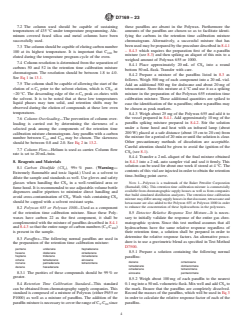
pentane undecane heptadecane
8.5.1 Prepare a solution containing the following normal
hexane dodecane octadecane
heptane tridecane nonadecane
paraffins:
octane tetradecane eicosane
decane octacosane
nonane pentadecane tetracontane
tetradecane dotriacontane
decane hexadecane
octadecane tetracontane
8.3.1 The purities of these compounds should be 99 % or
eicosane pentacontane
greater.
8.5.2 Weigh about 100 mg of each paraffin to the nearest
8.4 Retention Time Calibration Standard—This standard 0.1 mg into a 50 mL volumetric flask. Mix well and add CS to
can be obtained from chromatography supply companies. This the mark. Ensure that the paraffins are completely dissolved.
standard is composed of a mixture of Polywax (either P655 or Record the masses of the paraffins, which will be used in Eq 3
P1000) as well as a mixture of paraffins. The addition of the in order to calculate the relative response factor of each of the
paraffin mixture is necessary to cover the range of C -C since paraffins.
5 20
D7169 − 23
8.5.3 Record the assayed purity of each paraffin for use in material in all sections of this method where Reference Oil
Eq 3. 5010 is used.
8.5.4 Transfer an aliquot of the mixture prepared in 8.5.2 to
8.7 Gases—The following compressed gases are utilized for
a 2 mL injection vial. Ensure that the components are in
the operation of the gas chromatograph:
solution prior to the transfer. Warm the vial if necessary. Inject
8.7.1 Nitrogen, 99.999 %. (Warning—Compressed gas un-
0.1 μL to 0.2 μL.
der high pressure.) Total impurities should not exceed
8.6 QC Materials—This method requires the use of QC 10 mL ⁄m . This gas is used as detector makeup. Helium has
materials in order to validate the boiling point distribution and also been used as makeup gas.
detector response factor and to determine the sample recovery. 8.7.2 Hydrogen, 99.999 %. (Warning—Extremely flam-
New QC materials are required to have their accepted reference mable gas under high pressure.) Total impurities should not
values (ARV) validated according to Practice D6299. A mini- exceed 10 mL ⁄m . This gas is used as fuel for the operation of
mum of 16 laboratories are required to participate in the the detector.
evaluation of the QC material. In addition, the existing QC 8.7.3 Air, 99.999 %. (Warning—Compressed gas under
material must be analyzed during the evaluation of the new QC high pressure and supports combustion.) Total impurities
reference material whenever possible. should not exceed 10 mL ⁄m . This gas is used to sustain
8.6.1 Reference Oil 5010—The 5010 Reference Oil has combustion in the FID detector.
been used as a QC material since the inception of this method, 8.7.4 Helium, 99.999 %. (Warning—Compressed gas un-
and therefore, there are limited supplies of this material der high pressure.) This gas is used as carrier gas and should
remaining. not contain more than 5 mL ⁄m of O . The total amount of
8.6.2 Gravimetric Blend No. 1—This gravimetric blend was impurities should not exceed 10 mL ⁄m .
prepared from two different fractions that were mixed gravi-
9. Preparation of the Gas Chromatograph
metrically in equal weight proportions. The use of a gravimet-
ric blend is described in Test Method D7500. The consensus
9.1 A summary of the conditions used for developing the
boiling point distribution and cut point values for Gravimetric
precision statement is given in Table 1.
Blend No. 1 obtained from an ILS (RR:D02-1926 ) are shown
9.2 Column Installation—The column is installed using
in Table 2. Gravimetric Blend No. 1 can be used as a QC
graphite ferrules and an electronic leak detector is used to
ascertain the absence of leaks. Follow the instructions given in
Test Method D2887 and Practice E1510 for the installation of
Supporting data have been filed at ASTM International Headquarters and may
silica or aluminum clad silica columns. Metal columns require
be obtained by requesting Research Report RR:D02-1926. Contact ASTM Customer
slightly different techniques in cutting and installation. Follow
Service at service@astm.org.
the recommendations of the column supplier.
TABLE 2 Boiling Point Values and Cut Points for Gravimetric
9.3 Detector Temperature—Select a detector temperature
A,B
Blend No. 1
that is at least 5 °C to 10 °C higher than the highest oven
Allowed
temperature.
Allowed
% Off BP, °C Deviation, BP, °F
Deviation, °F
°C
9.4 Initial Oven Temperature—The initial temperature of
IBP 186.6 1.9 367.9 3.4
the oven is chosen according to the sample type to be analyzed
5 206.2 2.2 403.1 4.0
as follows:
10 215.6 1.9 420.1 3.3
15 219.3 2.0 426.8 3.5 9.4.1 Crude Oil Samples—Crude oil samples may contain
20 226.0 2.0 438.8 3.6
hydrocarbons starting from methane, C , C , and C which
2 3 4
25 230.5 2.2 447.0 4.0
probably co-eleute with C . Therefore, even at an initial
30 236.3 2.3 457.4 4.1
35 239.2 2.7 462.6 4.9
temperature of −20 °C, C and C are partially resolved from
5 6
40 247.3 2.6 477.1 4.7
the CS . Further decreases in oven temperature do not increase
45 255.0 2.6 491.1 4.8
the separation of C from C -C hydrocarbons which co-elute
5 1 4
55 495.0 5.6 923.0 10.1
with n-C .
60 510.9 4.2 951.5 7.6
9.4.2 Residues and Samples Having Higher IBP—For
65 523.0 4.0 973.4 7.1
samples that have an initial boiling point of 100 °C or greater,
70 533.6 3.4 992.4 6.2
75 542.9 3.3 1009.3 6.0
such as vacuum residues or atmospheric residues, the initial
80 552.7 3.5 1026.8 6.3
oven temperature can be set to between 35 °C and 40 °C.
85 562.6 3.6 1044.6 6.5
Ensure that the sample is resolved from the solvent peak at the
90 573.3 3.6 1064.0 6.4
95 588.2 3.6 1090.7 6.5
initial oven temperature selected. If the light ends cannot be
FBP 629.0 7.9 1164.2 14.3
separated from the solvent, then proceed as in 9.4.1. If the user
Cut Point 1 SET - 330 °C (626 °F) 49.43 % ± 0.58 %
does not know the type of sample to be analyzed, all samples
Cut Point 2 330 °C (626 °F) - EET 50.57 % ± 0.58 %
A
The data is interpreted using the 95 % / 95 % tolerance margin where a user
can be analyzed with an initial temperature of −20 °C.
can be 95 % confident that at least 95 % of all future measurements at any of
the listed distillation or cut points (for example, 20 % Off), by multiple labs, will
10. Sample Preparation
fall within their corresponding allowed deviations (for example, 2.0 °C of
226.0 °C).
10.1 Ensure that the sample is a representative sample.
B 3
ILS results for Gravimetric Blend No. 1 are detailed in RR:D02-1926.
Follow the guidelines established in Practice D4057. Samples
D7169 − 23
should be handled according to their content of volatile
W = peak width (s) at half height for the n-C .
2 52
components. If the sample is submitted for other analyses,
13.1.1 Ensure that the resolution, R, is between 1.8 to 4.0.
remove a small aliquot (~10 mL) early in the testing sequence
13.2 Skewness Test for Column Overloading—Select a com-
in order to avoid loss of volatile components. Allow sample to
ponent between C -C of the previous chromatogram or of
warm to room temperature prior to weighing.
12 24
the chromatogram of the retention time calibration mixture
10.2 Samples that are solid or semi-solid at room tempera-
prepared in 8.4. For the component selected, determine the
ture may require heating up to as high as 60 °C in order to pour
skewness as follows. The skewness, s, is calculated by Eq 2:
them into a weighed container. Only samples that are soluble in
ILS participants reported skewness of 0.8 to 2.0 for peaks C to
carbon disulfide (CS ) can be analyzed by this test method.
C .
10.3 Weigh 0.2 g to 0.25 g of the sample to the nearest
s 5 ~a1b!/2a (2)
0.1 mg. Add 10 mL of CS . Record this weight also to the
nearest 0.1 mg. Enter these values in the data acquisition where:
system if appropriate.
s = skewness of the peak,
a = left time segment measured at 10 % of the peak height
10.4 Store all prepared solutions at a temperature of 4 °C.
and that intersects the perpendicular from the apex of the
Care should be taken that the solution is prepared a short time
peak to the retention time axis, and
prior to running the analysis. Samples can be stored in the auto
b = right time segment measured at 10 % of the peak height
sampler vials.
and that intersects the perpendicular from the peak apex
10.5 Prepare as many vials of a sample as are necessary to
to the retention time axis. Ensure that the skewness is
carry out multiple analyses of that sample. Do not use the same
between 0.8 and 2.0. Data acquisition systems can
vial to run duplicates; use separate vials containing the same
calculate this parameter.
solution.
13.3 Determination of Detector Relative Response
Factors—Prepare the gas chromatograph for the injection of
11. Preparation of the Response Factor Standard
the detector test mixture prepared in 8.5. Inject 0.1 μL to 0.2 μL
11.1 Weigh 0.2 g to 0.25 g of Reference Oil 5010 or
of this sample. Calculate the relative response factor, F , of
i
Gravimetric Blend No. 1 to the nearest 0.1 mg. Add 10 mL of
each paraffin relative to eicosane as follows:
CS and record the weight of the solvent to the nearest 0.1 mg.
M × P × Ac
Store this solution at 4 °C, if not used immediately. i i 20
F 5 (3)
i
A × Mc × Pc
i 20 20
12. Preparation of the Apparatus and Data System
where:
12.1 After the column is installed and checked for leaks,
M = mass of the paraffin in mg,
i
prepare the gas chromatograph to analyze the sample according
Mc = mass of the eicosane in mg,
to the typical conditions given in Table 1.
A = peak area of the paraffin,
i
Ac = peak area of the eicosane,
12.2 Set the acquisition system to digitize the data at 10 Hz. 20
P = % purity of the paraffin as recorded in 8.5.3, and
i
This will result in a slice width of 0.1 s. This data acquisition
Pc = % purity of eicosane.
rate is kept constant for all samples, standards, and the solvent
blank in order to acquire the same number of slices. The
13.3.1 The relative response factor, F , should have a value
i
baseline chromatogram may contain the same or larger number
of between 0.9 and 1.10. Failure to achieve this range may be
of slices than the sample chromatograms, depending on when
due to inlet problems, lack of constant flow, or partial blockage
the data acquisition stops. Thus, various chromatograms taken
of the flame tip orifice, or a combination thereof.
in a sequence may differ by 5 to 10 slices. This fact is of no
consequence with regard to the calculations.
14. Analytical Sequence
12.3 Arrange to save the acquired data files. Build the 14.1 Set up a sequence of the samples to be analyzed. The
sequence of samples to be injected by the gas chromatograph.
sequence will contain the order of the samples to be injected
into the column. This schedule should be designed to achieve
13. Verification of System Performance
maximum reproducibility. A suggested order of the samples to
be analyzed is described in 14.2 – 14.6. If time constraints
13.1 Column Resolution—Prepare the gas chromatograph
require a shorter sequence, the user shall ensure that there is no
for injection of the retention time calibration mixture prepared
carryover between samples and sample types.
in 8.4. Inject 0.1 μL to 0.2 μL of this sample. Determine the
column resolution as follows:
14.2 Blank Run—At the beginning of each sequence, after
any column maintenance is performed, make a blank run. It
R 5 2 t 2 t / 1.699 W 1W (1)
~ ! ~ ! ~ !
2 1 2 1
may take more than 2 blanks to show a stable plateau with no
where:
indication of residual elution. A blank run constitutes an
R = resolution,
identical solvent injection having the same volume as the
t = retention time (s) for the n-C paraffin,
2 50
sample injection. An acceptable blank run should show a stable
t = retention time (s) for the n-C paraffin,
1 52
plateau at the highest temperature of the oven (see 15.3).
W = peak width (s) at half height of the n-C peak, and
1 50
Furthermore, it should not show any indication of carryover or
D7169 − 23
residual sample elution. It should also not contain any ghost 15.3.1 It is recommended that a QC material be analyzed at
peaks. A typical blank sample run is shown in Fig. A1.1. the beginning and end of every sequence. The QC sample
Several blanks may be necessary after column installation or should have the same matrix as the samples analyzed.
after an idle period of the gas chromatograph. Verification of
15.4 Baseline or Blank Runs—Inspect, in the data system,
acceptable blanks is obtained by analyzing the Reference Oil
the chromatograms of the blank solvent injections to verify that
5010 or a gravimetric blend and a QC material.
the blank signal obtained does not differ substantially from that
obtained during the sample analysis. Check that the baseline
14.3 Retention Time Calibration Mixture—Insert the reten-
tion time calibration mixture vial prepared in 8.4 into the auto exhibits a gradual rise up to the isothermal section of the
chromatogram and ensure that there is a gradual transition back
sampler for injection. A typical chromatogram of the retention
time calibration mixture is shown in Fig. A1.2. The insert in the to the plateau of the baseline. Disregard any baseline that
shows material eluting near the highest temperature of the
Fig. A1.2 shows the best separation possible for the C , CS ,
5 2
C , and C and shows good peak shape for the C and C column. Also disregard any baseline that shows ghost peaks.
6 7 6 7
Overlay the baseline signal with the sample signal as shown in
hydrocarbons. Identify all carbons up to C .
Fig. A1.6. Use only those sample signals that asymptotically
14.4 Response Factor Standard—Insert the vial containing
approach the baseline signals. Reject any sample run where the
Reference Oil 5010 prepared in 8.5, which is used as a
baseline signal at the end of the run exceeds in value the
response factor standard. Inject this standard in duplicate.
sample run. Reject any sample run at which at the end of the
Gravimetric Blend No. 1 can also be used in order to obtain the
run the signal exceeds the baseline signal by 10 %. It is
response factor. A typical chromatogram of the reference oil
recommended that a new full blank analysis be performed at
analyzed at an initial oven temperature of −20 °C is shown in
regular intervals (for example, after every 4 to 5 samples) in a
Fig. A1.3. A typical chromatogram of Gravimetric Blend No. 1
sequence of samples to ensure good baseline data for subse-
obtained at –20 °C is shown in Fig. A1.9. Verify that the
quent samples.
response factor calculated by Eq 4 does not vary by more than
15.4.1 Determine the Quenching Interval—Select the time
2 % for either of the two reference materials.
that the solvent peak starts to elute. Determine when the
14.5 Sample Analysis—Insert the sample vials prepared in
solvent peak has eluted. Note the times of this interval in
10.3. Inject samples. Analyzing a QC material with acceptable
minutes. An expanded time scale chromatogram of the solvent
results before the analysis of unknown samples is strongly
peak is shown in Fig. A1.7.
recommended.
15.4.2 Determine the Magnitude of Solvent Response—
Using the data system, overlay the solvent chromatograms and
in
14.6 Additional Blank Runs—Insert a vial containing CS
verify that the profiles are similar. Verify that the total areas do
order to obtain a second blank run. Carry out a blank run after
not differ by more than 3 % from each other.
each sample injection, and verify the absence of carryover
from the previous samples. An ambient temperature version of
15.5 External Standard Response Factor Chromatogram—
the method with faster oven ramping can be employed for these
Inspect the external standard chromatogram obtained from the
clean-out runs in between samples to reduce run time and use
injection of Reference Oil 5010 or Gravimetric Blend No. 1.
of cryogenic fluids.
For Reference Oil 5010, verify that the boiling point distribu-
tion is within the consensus values as indicated in Test Method
15. Verification of Acquired Data D6352. Typical boiling point distribution values for Reference
Oil 5010, obtained with this test method, are shown in Table 3.
15.1 Inspect all chromatograms by loading the data files in
For Gravimetric Blend No. 1, the boiling point values should
the data acquisition system. Observe that the signal magnitude
fall within the allowed deviations listed in Table 2. Correct any
for each sample injected is approximately the same as that for
chromatography errors if the consensus values are not obtained
the retention time calibration mixture and the Reference Oil
(see 16.1.7).
5010 or Gravimetric Blend No. 1 chromatograms.
15.2 Verification of the Retention Time Calibration Mixture
16. Calculations
Chromatogram—Inspect the chromatograms acquired during a NOTE 2—The calculations are listed in this section. The chromatogram
for the Reference Oil 5010, Gravimetric Blend No. 1, the sample, and the
sequence run. Do not use a chromatogram where the peaks do
baseline shall be zeroed as given in 16.1.2.
not meet the criteria of skewness as defined in 13.2. Inspect the
NOTE 3—The baseline chromatogram is subtracted from the Reference
chromatogram for the components C -C and the solvent peak
5 7
Oil 5010 or Gravimetric Blend No. 1 and from the sample chromatogram
as shown in the insert of Fig. A1.2. The peaks should not
in order to obtain the net area as shown in 16.1.4.
present peak splitting nor peak tailing.
16.1 Zeroing of the Reference Oil or the Gravimetric Blend
15.3 Sample Chromatograms—Inspect the sample chro- Chromatogram:
matograms and verify that the chromatograms can be overlaid 16.1.1 Examine the chromatogram obtained for Reference
to a duplicate chromatogram and show that the profile is Oil 5010 (external standard) or Gravimetric Blend No. 1, and
reproducible. Fig. A1.4 shows a chromatogram of a 30°API ensure, by visual inspection of the chromatogram in the data
crude oil where the solvent peak is not resolved from the system, that the first 5 slices contain neither sample nor solvent
sample components. Fig. A1.5 shows a typical chromatogram elution.
of an atmospheric residue where the solvent peak is resolved 16.1.2 Set up an array that contains slices obtained from the
from the sample components. Reference Oil 5010 or Gravimetric Blend No. 1 chromatogram.
D7169 − 23
TABLE 3 Consensus Values Obtained for the Boiling Point
16.1.8 Calculation of the Gravimetric Blend No. 1 Cut
A
Distribution of Reference Oil 5010 Used as External Standard
Points—Gravimetric Blend No. 1 consists of two cuts with an
Allowable Allowable
approximately 50:50 stoichiometric composition. The actual
%BP avg °C avg °F
Differences, °C Differences, °F
percentage of each cut, as shown in Table 2, was determined by
IBP 428 9 801 16
means of an ILS (RR:D02-1926 ). Verifying the achievement
5 477 3 891 5
10 493 3 918 5
of the gravimetric composition within the allowed deviation
15 502 3 936 5
shown in Table 2 is indicative of the correct operation of the
20 510 3 950 6
detector and the gas chromatographic system.
25 518 4 963 6
30 524 4 975 7
16.2 Zeroing of Sample Chromatograms:
35 531 4 987 7
40 537 4 998 8
16.2.1 In the case of crude oil analysis or samples in which
45 543 4 1008 8
the solvent peak is not resolved from the sample components,
50 548 4 1019 8
ensure, by visual inspection of the chromatogram in the data
55 554 4 1030 8
60 560 4 1040 8 system, that the first 5 slices contain neither sample nor solvent
65 566 4 1051 8
elution. If there is sample elution, decrease the number of slices
70 572 4 1062 8
for the averaging to 3 or increase the digitization rate given in
75 578 5 1073 9
80 585 4 1086 8 12.2.
85 593 4 1099 7
16.2.2 Zeroing the Sample Chromatogram—Proceed in a
90 602 4 1116 8
manner analogous to that described in 16.1.2.
95 616 4 1140 7
FBP 655 18 1213 32
16.2.3 Zeroing the Blank Baseline Chromatogram—Carry
A
As reported in Test Method D6352. out an analogous calculation as in 16.1.3.
16.3 Blank Baseline Subtraction from the Sample
Chromatogram—Carry out an analogous calculation as in
Calculate the average of the first five area slices. Subtract the
16.1.4.
average slice area from each slice in the Reference Oil 5010 or
16.4 Quenching Correction—For crude oil samples, a
Gravimetric Blend No. 1 chromatogram. Set negative numbers
quenching factor is used to correct for the diminished FID
to zero.
response when the CS co-elutes with sample components.
16.1.3 Zero the blank baseline chromatogram by carrying
This factor is applied to the time segment corresponding to the
out an analogous calculation as in 16.1.2.
elution of CS . In the interlaboratory study, the factor of 1.930
16.1.4 Blank Baseline Subtraction from the Reference Oil
was applied. This value is determined from experiments made
5010 or Gravimetric Blend No. 1 Chromatogram—Subtract
by dissolving butane, pentane, and hexane in toluene. The
each zeroed blank baseline slice from the corresponding zeroed
solution is analyzed by injecting it under conditions identical to
Reference Oil 5010 or Gravimetric Blend No. 1 slice. If there
sample analysis. The areas for the components are compared to
are negative slices, set the slice values to zero.
the areas obtained by gradually adding weighed aliquots of CS
16.1.5 Determination of the End of Elution Time of Refer-
to the original solution. Alternatively the quenching value can
ence Oil 5010 or Gravimetric Blend No. 1—Since it is a
be checked by performing a glass distillation by Test Method
requirement that the sample chosen to obtain a response factor
D2892. Samples that do not have components that co-elute
shall fully elute prior to the FEt time, the end of sample elution
with solvent, for example, residues or the Reference Oil 5010
for this chromatogram is to be determined as described in Test
or Gravimetric Blend No. 1, do not require the quenching
Method D6352, using the algorithm to determine the time the
correction.
signal of the completely eluted sample returns to baseline.
16.4.1 Determine the Quenching Interval—Select the time
16.1.6 Determination of the Area of the Chromatogram for
that the solvent peak starts to elute. Determine when the
Reference Oil 5010 or Gravimetric Blend No. 1—Determine
solvent peak has eluted. Note the times of this interval in
the end time of solvent elution. Sum all of the slices from the
minutes. An expanded time scale chromatogram of the solvent
end of solvent elution to the end of sample elution. This is the
peak is shown in Fig. A1.7.
area of the standard, A .
STD
16.4.2 Locate the slices of the quenching interval. For
16.1.7 Calculation of the Boiling Point Distribution of
samples in which the solvent component co-elutes with the
Reference Oil 5010 or Gravimetric Blend No. 1—The resulting
sample chromatogram (that is, crude oils), determine the
corrected slices obtained for Reference Oil 5010 or Gravimet-
quenching interval, Q.I., as described in 16.4.1. Find the
ric Blend No. 1 are submitted to a Test Method D6352
closest slice corresponding to the beginning of elu
...
This document is not an ASTM standard and is intended only to provide the user of an ASTM standard an indication of what changes have been made to the previous version. Because
it may not be technically possible to adequately depict all changes accurately, ASTM recommends that users consult prior editions as appropriate. In all cases only the current version
of the standard as published by ASTM is to be considered the official document.
´1
Designation: D7169 − 20 D7169 − 23
Standard Test Method for
Boiling Point Distribution of Samples with Residues Such
as Crude Oils and Atmospheric and Vacuum Residues by
High Temperature Gas Chromatography
This standard is issued under the fixed designation D7169; the number immediately following the designation indicates the year of
original adoption or, in the case of revision, the year of last revision. A number in parentheses indicates the year of last reapproval. A
superscript epsilon (´) indicates an editorial change since the last revision or reapproval.
ε NOTE—Editorially corrected Table 2 in August 2020.
1. Scope*
1.1 This test method covers the determination of the boiling point distribution and cut point intervals of crude oils and residues
by using high temperature gas chromatography. The amount of residue (or sample recovery) is determined using an external
standard.
1.2 This test method extends the applicability of simulated distillation to samples that do not elute completely from the
chromatographic system. This test method is used to determine the boiling point distribution through a temperature of 720 °C. This
temperature corresponds to the elution of n-C .
1.3 This test method is used for the determination of boiling point distribution of crude oils. This test method uses capillary
columns with thin films, which results in the incomplete separation of C -C in the presence of large amounts of carbon disulfide,
4 8
and thus yields an unreliable boiling point distribution corresponding to this elution interval. In addition, quenching of the response
of the detector employed to hydrocarbons eluting during carbon disulfide elution, results in unreliable quantitative analysis of the
boiling distribution in the C -C region. Since the detector does not quantitatively measure the carbon disulfide, its subtraction from
4 8
the sample using a solvent-only injection and corrections to this region via quenching factors, results in an approximate
determination of the net chromatographic area. A separate, higher resolution gas chromatograph (GC) analysis of the light end
portion of the sample may be necessary in order to obtain a more accurate description of the boiling point curve in the interval
in question as described in Test Method D7900 (see Appendix X1).
1.4 This test method is also designed to obtain the boiling point distribution of other incompletely eluting samples such as
atmospheric residues, vacuum residues, etc., that are characterized by the fact that the sample components are resolved from the
solvent.
1.5 A correlation between boiling range distribution results from Test Method D2892, and the weight percentage data determined
via this method, is presented in Appendix X2.
1.6 This test method is not applicable for the analysis of materials containing a heterogeneous component such as polyesters and
polyolefins.
This test method is under the jurisdiction of ASTM Committee D02 on Petroleum Products, Liquid Fuels, and Lubricants and is the direct responsibility of Subcommittee
D02.04.0H on Chromatographic Distribution Methods.
Current edition approved May 1, 2020July 1, 2023. Published June 2020August 2023. Originally approved in 2005. Last previous edition approved in 20192020 as
ɛ1
D7169 – 19.D7169 – 20 . DOI: 10.1520/D7169-20E01.10.1520/D7169-23.
*A Summary of Changes section appears at the end of this standard
Copyright © ASTM International, 100 Barr Harbor Drive, PO Box C700, West Conshohocken, PA 19428-2959. United States
D7169 − 23
1.7 The values stated in inch-pound units are to be regarded as standard. The values given in parentheses are mathematical
conversions to SI units that are provided for information only and are not considered standard.
1.8 This standard does not purport to address all of the safety concerns, if any, associated with its use. It is the responsibility
of the user of this standard to establish appropriate safety, health, and environmental practices and determine the applicability of
regulatory limitations prior to use. Specific warning statements are given in Section 8.
1.9 This international standard was developed in accordance with internationally recognized principles on standardization
established in the Decision on Principles for the Development of International Standards, Guides and Recommendations issued
by the World Trade Organization Technical Barriers to Trade (TBT) Committee.
2. Referenced Documents
2.1 ASTM Standards:
D2887 Test Method for Boiling Range Distribution of Petroleum Fractions by Gas Chromatography
D2892 Test Method for Distillation of Crude Petroleum (15-Theoretical Plate Column)
D4057 Practice for Manual Sampling of Petroleum and Petroleum Products
D6352 Test Method for Boiling Range Distribution of Petroleum Distillates in Boiling Range from 174 °C to 700 °C by Gas
Chromatography
D6299 Practice for Applying Statistical Quality Assurance and Control Charting Techniques to Evaluate Analytical Measure-
ment System Performance
D7500 Test Method for Determination of Boiling Range Distribution of Distillates and Lubricating Base Oils—in Boiling Range
from 100 °C to 735 °C by Gas Chromatography
D7900 Test Method for Determination of Light Hydrocarbons in Stabilized Crude Oils by Gas Chromatography
E594 Practice for Testing Flame Ionization Detectors Used in Gas or Supercritical Fluid Chromatography
E1510 Practice for Installing Fused Silica Open Tubular Capillary Columns in Gas Chromatographs
3. Terminology
3.1 Definitions of Terms Specific to This Standard:
3.1.1 cut point interval, n—the mass % obtained between two selected temperatures of the interval.
3.1.2 cut specific density (CSD), n—the ratio of the relative weight and the relative volume of a crude oil specimen distillate
fraction (cut), defined by an upper and lower temperature, T and T .
1 2
3.1.3 data acquisition rate, n—the speed of conversion of the analog signal to a digital signal, expressed in Hz (cycles/second).
3.1.4 final boiling point (FBP), n—the temperature, for fully eluting samples (recovery = 100 %), at which 99.5 % of the sample
is eluted.
3.1.5 final elution temperature (FET), n—the boiling point of the normal paraffin that elutes at the time when the oven reaches
its final temperature.
3.1.6 final elution time (FEt), n—the retention time of the component of the reference time standard sample that elutes at the end
of the temperature ramp of the oven.
3.1.5 final elution temperature (FET), n—the boiling point of the normal paraffin that elutes at the time when the oven reaches
its final temperature.
3.1.7 initial boiling point (IBP), n—the temperature corresponding to an accumulated 0.5 % of the total area of the eluted sample
after correcting for the percent of sample recovery.
3.1.8 quenching factor (QF), n—a number that corrects for the diminished response due to the solvent profile co-eluting with
sample components.
For referenced ASTM standards, visit the ASTM website, www.astm.org, or contact ASTM Customer Service at service@astm.org. For Annual Book of ASTM Standards
volume information, refer to the standard’s Document Summary page on the ASTM website.
D7169 − 23
3.1.8.1 Discussion—
Data acquired during the quenching interval (QI) shall be corrected by applying the quenching factor.
3.1.9 quenching interval (QI), n—the time interval of the start and end of elution of the CS used as a solvent.
3.1.9.1 Discussion—
Sample components that elute during this time interval shall be corrected by a factor due to their diminished response resulting
from the co-elution of the relatively large amount of solvent present in the sample with the light sample components.
3.1.10 residue (R), n—the mass % of the sample that has not eluted at the temperature of calculation.
3.1.10.1 Discussion—
Residue is calculated from the %recovery.
3.1.11 response factor (RF), n—the factor used in order to calculate the %recovery of the sample.
3.1.11.1 Discussion—
The response factor is determined from the net area of the standard (A ), mass of standard (M ), and mass of solvent (M )
STD STD SLSTD
used in the solution of the standard. A fully eluting sample, such as Reference Oil 5010 or Gravimetric Blend No. 1, is used in
obtaining the response factor.
3.1.12 sample area obtained (A ) , ), n—the net chromatographic area (after baseline subtraction) obtained for the sample at
SMP
the final elution time or temperature.
3.1.13 simulated distillation, n—the procedure of the determination of boiling ranges distribution by gas chromatography.
3.1.14 slice, n—the reciprocal of the data acquisition rate; the time interval used to accumulate data, expressed in seconds.
3.1.14.1 Discussion—
Normally 0.1 s is used. In cases where sample elutes immediately after injection, 0.05 s is used.
3.1.15 start elution temperature (SET), n—the temperature at which the first amount of hydrocarbon is detected by the flame
ionization detector above a predetermined threshold.
3.1.16 volume percentage (Vol%), n—relative volume percentage of the cut defined by a temperature range between T and T .
1 2
3.1.17 weight percentage (Wt%), n—relative weight percentage of the cut defined by a temperature range between T and T .
1 2
3.1.18 %recovery (RC), n—percentage of the sample eluted.
3.1.18.1 Discussion—
%Recovery is calculated from the sample area (A ), the response factor (RF), the sample mass, (M ), and the solvent mass
SMP SMP
(M ) used in sample dissolution.
SLSMP
3.1.19 %recovery threshold (R ) , ), n—if the %recovery falls above a preset limit, the sample is considered fully eluted and its
t
recovery is assumed to be 100 %.
3.1.19.1 Discussion—
If the %recovery values found for duplicate analyses of a nearly completely eluting sample are 99.6 % and 101.2 %, the %recovery
threshold (R ) may be set to 99.6 % and thus either of these results may be considered as fully eluted and set to 100 %.
t
3.2 Symbols:
3.2.1 A —net area of the sample
SMP
3.2.2 A —net area of the response factor standard
STD
3.2.3 M —mass of solvent used in preparing sample solution
SL
3.2.4 M —mass of solvent used in preparing the response factor standard solution
SLSTD
D7169 − 23
3.2.5 M —sample mass used in sample preparation
SMP
3.2.6 M —mass of the standard used in preparing the response factor solution
STD
4. Summary of Test Method
4.1 This is a gas chromatographic method utilizing an inlet and a capillary column, both of which are subject to a temperature
program. A flame ionization detector is used as a transducer that converts mass to an electrical signal A data acquisition system
operating in the slice mode and chromatography software is used to accumulate the electronic signal. A retention time calibration
mixture is used to develop a retention time versus boiling point curve. A solution of the Reference Oil 5010 or Gravimetric Blend
No. 1, which fully elutes from the column under the conditions of the test method and whose boiling point distribution have been
characterized in Test Method D6352 or D7500, is used to determine the detector response factor. In addition, the composition of
Gravimetric Blend No. 1 can be determined by two cut points; correct cut point values for Gravimetric Blend No. 1 ensure correct
detector response. Solvent injections are made, and the resulting signal is subtracted from both the response factor standard and
the sample chromatogram. Finally, the sample solution is injected and with the use of the response factor, the amount of sample
recovered is calculated. After converting the retention times of the sample slices to temperature, the boiling point distribution can
be calculated up to the recovered amount.
5. Significance and Use
5.1 The determination of the boiling point distribution of crude oils and vacuum residues, as well as other petroleum fractions,
yields important information for refinery operation. These boiling point distributions provide information as to the potential mass
percent yield of products. This test method may provide useful information that can aid in establishing operational conditions in
the refinery. Knowledge of the amount of residue produced is important in determining the economics of the refining process.
6. Apparatus
6.1 Gas Chromatograph—A gas chromatograph provided with a cryogenic valve for cooling the oven to sub ambient temperatures
is required. Typical conditions of operating the Gas Chromatograph are given in Table 1. It shall also have the following
components:
A
TABLE 1 Typical Gas Chromatographic Conditions
Initial Oven Temperature −20 °C
Initial Oven Time 0 min
Oven Temperature Program 15 °C ⁄ min
B
Final Oven Temperature 425 °C to 435 °C
Final Hold Time 10 min
C
Inlet Initial Temperature 50 °C
Inlet Temperature Program 15 °C ⁄ min
Inlet Final Temperature 425 °C
B
Column 5 m × 0.53 mm × 0.09
-0.15 μm PDMS
Column Flow 20 mL/min
Carrier Control Constant Flow
D
Detector FID
Detector Temperature 435 °C
Detector Gases:
Hydrogen 40 mL/min
Air 450 mL/min
Make-Up (N , He) 15 mL/min
B
Volume Injected 0.2 μL-0.5 μL-1.0 μL
Sample Concentration 2.0 % (m/m)
Data Acquisition Rate 10 Hz
Total Acquisition Time 40 min to 50 min
A
Conditions used for the interlaboratory study.
B
Several participants used these conditions. Higher temperatures yield higher
recoveries.
C
Use lowest temperature recommended by manufacturer.
D
Use GC manufacturer’s recommendations.
D7169 − 23
6.1.1 Flame Ionization Detector (FID)—A flame ionization detector capable of maintaining a temperature 5 °C to 10 °C higher
than the highest column temperature. The flame ionization detector should possess a jet orifice of about 0.018 in. (0.45 mm) in
order to delay the plugging of the orifice due to column bleed. The FID should possess a sensitivity of 0.005 coulombs ⁄g (see
Practice E594) and should have a linear range of 10 .
6.1.2 Inlet—Either a temperature programmable inlet with a glass liner or a cool-on-column inlet can be used. The inlet shall be
capable of operating in a temperature-programmed mode from 50 °C to the final temperature of the oven. It is important that the
temperature of the inlet, at any time during the analysis, be either equal to or greater than the oven temperature. With the use of
either inlet, frequent replacement of the liner or removal of a section of the column may be required due to accumulation of
non-volatile sample components. It is important that a leak free seal be reestablished after replacement of the liner or the removal
of a small section of the column.
6.2 Carrier Gas Purification System—Gas purifiers are used in order to remove traces of oxygen as well as moisture and other
impurities present in the carrier gas. The purification system should contain a hydrocarbon trap and an oxygen trap. The latter
should preferably have a visible indicator in order to assess the remaining capacity of the oxygen trap.
6.3 Data System—A data system composed of a computer and software for data acquisition, which digitizes the detector signal,
is recommended. Some instrumentation digitizes the signal at the electrometer board in order to reduce noise. The data system is
used at acquisition rates of about 10 Hz, which correspond to slices of 0.1 s. This rate of data acquisition is necessary to obtain
a minimum number of slices void of sample or solvent elution immediately after injection. Data acquisition systems facilitate the
inspection of the baseline under high magnification and allow the inspection of the retention time calibration mixture
chromatogram. Retention time shifts can be measured. Overlaying chromatograms is also possible to ascertain similar signal
amplitude.
6.4 Automatic Sample Injector—It is mandatory to use an auto sampler since the external standard technique used in this analysis
requires identical volumes for all injections. Additionally, small volumes (0.1 μL to 0.2 μL) shall be injected in a reproducible
manner. Syringes of 5 μL to 10 μL having needle gauges of size 23 to 26 are to be used.
6.5 Carrier Gas Control—The gas chromatograph shall be operated under constant flow conditions. The flow rate at the beginning
of the oven temperature program shall not differ by more than 1 % from the flow measured at the final oven temperature. Electronic
pneumatic control is highly recommended.
7. Column and Column Performance Criteria
7.1 A 100 % bonded polydimethylsiloxane column having a nominal inside diameter of 0.5 mm and a film thickness of 0.09 μm
to 0.17 μm is used.
7.2 The column used should be capable of sustaining temperatures of 435 °C under temperature programming. Aluminum covered
fused silica and metal columns have been successfully used.
7.3 The column should be capable of eluting carbon number 100 at its highest temperature. It is important that C be eluted
during the temperature program cycle of the oven.
7.4 Column resolution is determined from the separation of carbons 50 and 52 in the retention time calibration mixture
chromatogram. The resolution should be between 1.8 to 4.0. See Eq 1 in 13.1.
7.5 The column shall be capable of allowing the start of the elution of n-C prior to the solvent elution, which is CS , at −20 °C.
5 2
The descending edge of the n-C peak co-elutes with the solvent. It is to be noted that at these low temperatures liquid phases may
turn solid, and retention shifts may be observed during the elution of compounds at these low oven temperatures.
7.6 Column Overloading—The prevention of column overloading is carried out by determining the skewness of a selected peak
among the components of the retention time calibration mixture chromatogram. Any paraffin with a carbon number between C
and C may be chosen. The skewness should be between 0.8 and 2.0. See Eq 2 in 13.2.
D7169 − 23
7.7 Column Flow—Helium is used as carrier. Column flow rate is set to 20 mL ⁄min.
8. Reagents and Materials
8.1 Carbon Disulfide (CS ), 99+ % pure. (Warning—Extremely flammable and toxic liquid.) Used as a solvent to dilute the
sample and standards as well. Use gloves and safety glasses when handling the CS in a well-ventilated area or fume hood. It is
recommended to use adjustable-volume bottle dispensers and/or pipettors to minimize direct handling and avoid cross-
contamination of CS . Wash vials containing CS should be capped with a solvent resistant septa.
2 2
8.2 Polywax 655 or Polywax 1000—Used as a component of the retention time calibration mixture. Since these Polywaxes have
carbon 22 as the first component, it shall be complemented with the mixture of paraffins described in 8.4.1 and 8.4.3 so that the
entire range of carbon numbers (C -C ) is present in the sample.
5 100
8.3 Paraffıns—The following normal paraffins are used in the preparation of the retention time calibration mixture:
pentane undecane heptadecane
hexane dodecane octadecane
heptane tridecane nonadecane
octane tetradecane eicosane
nonane pentadecane tetracontane
decane hexadecane
8.3.1 The purities of these compounds should be 99 % or greater.
8.4 Retention Time Calibration Standard—This standard can be obtained from chromatography supply companies. This standard
is composed of a mixture of Polywax (either P655 or P1000) as well as a mixture of paraffins. The addition of the paraffin mixture
is necessary to cover the range of C -C since these paraffins are absent in the Polywax. Furthermore the amounts of the paraffins
5 20
are chosen so as to facilitate identifying the carbons in the retention time calibration mixture chromatogram. Alternatively, a
successful mixture that has been used may be prepared by the procedure described in 8.4.1 – 8.4.3 which requires the preparation
first of the n-paraffin mixture (see 8.3) and then spiking an aliquot of this mix to a weighed amount of Polywax 655 or 1000.
8.4.1 Place approximately 20 mL of CS into a round bottom 50 mL flask. Transfer with care.
8.4.2 Prepare a mixture of the paraffins listed in 8.3 as follows. Weigh 500 mg of each component into a 20 mL vial. Add an
additional 500 mg for dodecane and about 20 mg of tetracontane. Store this mixture at 4 °C and use it as a spiking mixture in the
preparation of the Polywax 655 retention time calibration mixture. These additional quantities are spiked to ease the identification
of the n-paraffins; other n-paraffins may be chosen as peak markers.
8.4.3 Weigh about 25 mg of the Polywax 655 and add it to the vessel prepared in 8.4.1. Add approximately 10 mg of the paraffin
spiking mixture prepared in 8.4.2. Stir the solution under a fume hood and heat with an infrared lamp (about 200 W) placed at a
safe distance (about 15 cm to 20 cm) from the mixture for a period of 20 min or until the solution is clear. Other precautionary
methods of dissolution are acceptable. Careful attention should be given to avoid the ignition of the CS (see 8.1).
8.4.4 Transfer a 2 mL aliquot of the final mixture obtained in 8.4.3 into a 2 mL auto sampler vial and seal it firmly. This solution
can be used for about one week if stored at 4 °C. The contents of this vial are injected in order to obtain the retention time–boiling
point curve.
NOTE 1—Polywax is a trademark of the Baker Petrolite Corporation (Barnsdall, OK). This retention time calibration mixture is commercially available
from chromatographic supply houses as well as from companies that build simulated distillation analyzers. The retention time calibration mixture may
differ among supply houses in that docosane, tetracosane and hexacosane are also added to the Polywax 655 or Polywax 1000 in order to enhance the
concentration of these hydrocarbons in the polywaxes.
8.5 Detector Relative Response Test Mixture—It is necessary to initially validate the response of the entire gas chromatographic
system. Since this test method assumes that all hydrocarbons have the same relative response regardless of their retention time,
a solution shall be prepared in order to determine the relative response factors. An alternative procedure is to use a gravimetric
blend as specified in Test Method D7500.
D7169 − 23
8.5.1 Prepare a solution containing the following normal paraffins:
decane octacosane
tetradecane dotriacontane
octadecane tetracontane
eicosane pentacontane
8.5.2 Weigh about 100 mg of each paraffin to the nearest 0.1 mg into a 50 mL volumetric flask. Mix well and add CS to the mark.
Ensure that the paraffins are completely dissolved. Record the masses of the paraffins, which will be used in Eq 3 in order to
calculate the relative response factor of each of the paraffins.
8.5.3 Record the assayed purity of each paraffin for use in Eq 3.
8.5.4 Transfer an aliquot of the mixture prepared in 8.5.2 to a 2 mL injection vial. Ensure that the components are in solution prior
to the transfer. Warm the vial if necessary. Inject 0.1 μL to 0.2 μL.
8.6 QC Materials—This method requires the use of QC materials in order to validate the boiling point distribution and detector
response factor and to determine the sample recovery. New QC materials are required to have their accepted reference values
(ARV) validated according to Practice D6299. A minimum of 16 laboratories are required to participate in the evaluation of the
QC material. In addition, the existing QC material must be analyzed during the evaluation of the new QC reference material
whenever possible.
8.6.1 Reference Oil 5010—The 5010 Reference Oil has been used as a QC material since the inception of this method, and
therefore, there are limited supplies of this material remaining.
8.6.2 Gravimetric Blend No. 1—This gravimetric blend was prepared from two different fractions that were mixed gravimetrically
in equal weight proportions. The use of a gravimetric blend is described in Test Method D7500. The consensus boiling point
distribution and cut point values for Gravimetric Blend No. 1 obtained from an ILS (RR:D02-1926 ) are shown in Table 2.
Gravimetric Blend No. 1 can be used as a QC material in all sections of this method where Reference Oil 5010 is used.
8.7 Gases—The following compressed gases are utilized for the operation of the gas chromatograph:
8.7.1 Nitrogen, 99.999 %. (Warning—Compressed gas under high pressure.) Total impurities should not exceed 10 mL ⁄m . This
gas is used as detector makeup. Helium has also been used as makeup gas.
8.7.2 Hydrogen, 99.999 %. (Warning—Extremely flammable gas under high pressure.) Total impurities should not exceed
10 mL ⁄m . This gas is used as fuel for the operation of the detector.
8.7.3 Air, 99.999 %. (Warning—Compressed gas under high pressure and supports combustion.) Total impurities should not
exceed 10 mL ⁄m . This gas is used to sustain combustion in the FID detector.
8.7.4 Helium, 99.999 %. (Warning—Compressed gas under high pressure.) This gas is used as carrier gas and should not contain
3 3
more than 5 mL ⁄m of O . The total amount of impurities should not exceed 10 mL ⁄m .
9. Preparation of the Gas Chromatograph
9.1 A summary of the conditions used for developing the precision statement is given in Table 1.
9.2 Column Installation—The column is installed using graphite ferrules and an electronic leak detector is used to ascertain the
absence of leaks. Follow the instructions given in Test Method D2887 and Practice E1510 for the installation of silica or aluminum
clad silica columns. Metal columns require slightly different techniques in cutting and installation. Follow the recommendations
of the column supplier.
Supporting data have been filed at ASTM International Headquarters and may be obtained by requesting Research Report RR:D02-1926. Contact ASTM Customer
Service at service@astm.org.
D7169 − 23
TABLE 2 Boiling Point Values and Cut Points for Gravimetric
A,B
Blend No. 1
Allowed
Allowed
% Off BP, °C Deviation, BP, °F
Deviation, °F
°C
IBP 186.6 1.9 367.9 3.4
5 206.2 2.2 403.1 4.0
10 215.6 1.9 420.1 3.3
15 219.3 2.0 426.8 3.5
20 226.0 2.0 438.8 3.6
25 230.5 2.2 447.0 4.0
30 236.3 2.3 457.4 4.1
35 239.2 2.7 462.6 4.9
40 247.3 2.6 477.1† 4.7
40 247.3 2.6 477.1 4.7
45 255.0 2.6 491.1 4.8
55 495.0 5.6 923.0 10.1
60 510.9 4.2 951.5 7.6
65 523.0 4.0 973.4 7.1
70 533.6 3.4 992.4 6.2
75 542.9 3.3 1009.3 6.0
80 552.7 3.5 1026.8 6.3
85 562.6 3.6 1044.6 6.5
90 573.3 3.6 1064.0 6.4
95 588.2 3.6 1090.7 6.5
FBP 629.0 7.9 1164.2 14.3
Cut Point 1 SET - 330 °C (626 °F) 49.43 % ± 0.58 %
Cut Point 2 330 °C (626 °F) - EET 50.57 % ± 0.58 %
A
The data is interpreted using the 95 % / 95 % tolerance margin where a user
can be 95 % confident that at least 95 % of all future measurements at any of
the listed distillation or cut points (for example, 20 % Off), by multiple labs, will
fall within their corresponding allowed deviations (for example, 2.0 °C of
226.0 °C).
B 3
ILS results for Gravimetric Blend No. 1 are detailed in RR:D02-1926.
† Editorially corrected.
9.3 Detector Temperature—Select a detector temperature that is at least 5 °C to 10 °C higher than the highest oven temperature.
9.4 Initial Oven Temperature—The initial temperature of the oven is chosen according to the sample type to be analyzed as
follows:
9.4.1 Crude Oil Samples—Crude oil samples may contain hydrocarbons starting from methane, C , C , and C which probably
2 3 4
co-eleute with C . Therefore, even at an initial temperature of −20 °C, C and C are partially resolved from the CS . Further
5 5 6 2
decreases in oven temperature do not increase the separation of C from C -C hydrocarbons which co-elute with n-C .
5 1 4 5
9.4.2 Residues and Samples Having Higher IBP—For samples that have an initial boiling point of 100 °C or greater, such as
vacuum residues or atmospheric residues, the initial oven temperature can be set to between 35 °C and 40 °C. Ensure that the
sample is resolved from the solvent peak at the initial oven temperature selected. If the light ends cannot be separated from the
solvent, then proceed as in 9.4.1. If the user does not know the type of sample to be analyzed, all samples can be analyzed with
an initial temperature of −20 °C.
10. Sample Preparation
10.1 Ensure that the sample is a representative sample. Follow the guidelines established in Practice D4057. Samples should be
handled according to their content of volatile components. If the sample is submitted for other analyses, remove a small aliquot
(~10 mL) early in the testing sequence in order to avoid loss of volatile components. Allow sample to warm to room temperature
prior to weighing.
10.2 Samples that are solid or semi-solid at room temperature may require heating up to as high as 60 °C in order to pour them
into a weighed container. Only samples that are soluble in carbon disulfide (CS ) can be analyzed by this test method.
10.3 Weigh 0.2 g to 0.25 g of the sample to the nearest 0.1 mg. Add 10 mL of CS . Record this weight also to the nearest 0.1 mg.
Enter these values in the data acquisition system if appropriate.
D7169 − 23
10.4 Store all prepared solutions at a temperature of 4 °C. Care should be taken that the solution is prepared a short time prior
to running the analysis. Samples can be stored in the auto sampler vials.
10.5 Prepare as many vials of a sample as are necessary to carry out multiple analyses of that sample. Do not use the same vial
to run duplicates; use separate vials containing the same solution.
11. Preparation of the Response Factor Standard
11.1 Weigh 0.2 g to 0.25 g of Reference Oil 5010 or Gravimetric Blend No. 1 to the nearest 0.1 mg. Add 10 mL of CS and record
the weight of the solvent to the nearest 0.1 mg. Store this solution at 4 °C, if not used immediately.
12. Preparation of the Apparatus and Data System
12.1 After the column is installed and checked for leaks, prepare the gas chromatograph to analyze the sample according to the
typical conditions given in Table 1.
12.2 Set the acquisition system to digitize the data at 10 Hz. This will result in a slice width of 0.1 s. This data acquisition rate
is kept constant for all samples, standards, and the solvent blank in order to acquire the same number of slices. The baseline
chromatogram may contain the same or larger number of slices than the sample chromatograms, depending on when the data
acquisition stops. Thus, various chromatograms taken in a sequence may differ by 5 to 10 slices. This fact is of no consequence
with regard to the calculations.
12.3 Arrange to save the acquired data files. Build the sequence of samples to be injected by the gas chromatograph.
13. Verification of System Performance
13.1 Column Resolution—Prepare the gas chromatograph for injection of the retention time calibration mixture prepared in 8.4.
Inject 0.1 μL to 0.2 μL of this sample. Determine the column resolution as follows:
R 5 2~t 2 t !/~1.699! ~W 1W ! (1)
2 1 2 1
where:
R = resolution,
t = retention time (s) for the n-C paraffin,
2 50
t = retention time (s) for the n-C paraffin,
1 52
W = peak width (s) at half height of the n-C peak, and
1 50
W = peak width (s) at half height for the n-C .
2 52
13.1.1 Ensure that the resolution, R, is between 1.8 to 4.0.
13.2 Skewness Test for Column Overloading—Select a component between C -C of the previous chromatogram or of the
12 24
chromatogram of the retention time calibration mixture prepared in 8.4. For the component selected, determine the skewness as
follows. The skewness, s, is calculated by Eq 2: ILS participants reported skewness of 0.8 to 2.0 for peaks C to C .
7 100
s 5 ~a1b!/2a (2)
where:
s = skewness of the peak,
a = left time segment measured at 10 % of the peak height and that intersects the perpendicular from the apex of the peak to
the retention time axis, and
b = right time segment measured at 10 % of the peak height and that intersects the perpendicular from the peak apex to the
retention time axis. Ensure that the skewness is between 0.8 and 2.0. Data acquisition systems can calculate this parameter.
13.3 Determination of Detector Relative Response Factors—Prepare the gas chromatograph for the injection of the detector test
mixture prepared in 8.5. Inject 0.1 μL to 0.2 μL of this sample. Calculate the relative response factor, F , of each paraffin relative
i
to eicosane as follows:
D7169 − 23
M ×P ×Ac
i i 20
F 5 (3)
i
A ×Mc ×Pc
i 20 20
where:
M = mass of the paraffin in mg,
i
Mc = mass of the eicosane in mg,
A = peak area of the paraffin,
i
Ac = peak area of the eicosane,
P = % purity of the paraffin as recorded in 8.5.3, and
i
Pc = % purity of eicosane.
13.3.1 The relative response factor, F , should have a value of between 0.9 and 1.10. Failure to achieve this range may be due to
i
inlet problems, lack of constant flow, or partial blockage of the flame tip orifice, or a combination thereof.
14. Analytical Sequence
14.1 Set up a sequence of the samples to be analyzed. The sequence will contain the order of the samples to be injected into the
column. This schedule should be designed to achieve maximum reproducibility. A suggested order of the samples to be analyzed
is described in 14.2 – 14.6. If time constraints require a shorter sequence, the user shall ensure that there is no carryover between
samples and sample types.
14.2 Blank Run—At the beginning of each sequence, after any column maintenance is performed, make a blank run. It may take
more than 2 blanks to show a stable plateau with no indication of residual elution. A blank run constitutes an identical solvent
injection having the same volume as the sample injection. An acceptable blank run should show a stable plateau at the highest
temperature of the oven (see 15.3). Furthermore, it should not show any indication of carryover or residual sample elution. It
should also not contain any ghost peaks. A typical blank sample run is shown in Fig. A1.1. Several blanks may be necessary after
column installation or after an idle period of the gas chromatograph. Verification of acceptable blanks is obtained by analyzing the
Reference Oil 5010 or a gravimetric blend and a QC material.
14.3 Retention Time Calibration Mixture—Insert the retention time calibration mixture vial prepared in 8.4 into the auto sampler
for injection. A typical chromatogram of the retention time calibration mixture is shown in Fig. A1.2. The insert in the Fig. A1.2
shows the best separation possible for the C , CS , C , and C and shows good peak shape for the C and C hydrocarbons. Identify
5 2 6 7 6 7
all carbons up to C .
14.4 Response Factor Standard—Insert the vial containing Reference Oil 5010 prepared in 8.5, which is used as a response factor
standard. Inject this standard in duplicate. Gravimetric Blend No. 1 can also be used in order to obtain the response factor. A typical
chromatogram of the reference oil analyzed at an initial oven temperature of −20 °C is shown in Fig. A1.3. A typical chromatogram
of Gravimetric Blend No. 1 obtained at –20 °C is shown in Fig. A1.9. Verify that the response factor calculated by Eq 4 does not
vary by more than 2 % for either of the two reference materials.
14.5 Sample Analysis—Insert the sample vials prepared in 10.3. Inject samples. Analyzing a QC material with acceptable results
before the analysis of unknown samples is strongly recommended.
14.6 Additional Blank Runs—Insert a vial containing CS in order to obtain a second blank run. Carry out a blank run after each
sample injection, and verify the absence of carryover from the previous samples. An ambient temperature version of the method
with faster oven ramping can be employed for these clean-out runs in between samples to reduce run time and use of cryogenic
fluids.
15. Verification of Acquired Data
15.1 Inspect all chromatograms by loading the data files in the data acquisition system. Observe that the signal magnitude for each
sample injected is approximately the same as that for the retention time calibration mixture and the Reference Oil 5010 or
Gravimetric Blend No. 1 chromatograms.
15.2 Verification of the Retention Time Calibration Mixture Chromatogram—Inspect the chromatograms acquired during a
D7169 − 23
sequence run. Do not use a chromatogram where the peaks do not meet the criteria of skewness as defined in 13.2. Inspect the
chromatogram for the components C -C and the solvent peak as shown in the insert of Fig. A1.2. The peaks should not present
5 7
peak splitting nor peak tailing.
15.3 Sample Chromatograms—Inspect the sample chromatograms and verify that the chromatograms can be overlaid to a
duplicate chromatogram and show that the profile is reproducible. Fig. A1.4 shows a chromatogram of a 30°API crude oil where
the solvent peak is not resolved from the sample components. Fig. A1.5 shows a typical chromatogram of an atmospheric residue
where the solvent peak is resolved from the sample components.
15.3.1 It is recommended that a QC material be analyzed at the beginning and end of every sequence. The QC sample should have
the same matrix as the samples analyzed.
15.4 Baseline or Blank Runs—Inspect, in the data system, the chromatograms of the blank solvent injections to verify that the
blank signal obtained does not differ substantially from that obtained during the sample analysis. Check that the baseline exhibits
a gradual rise up to the isothermal section of the chromatogram and ensure that there is a gradual transition back to the plateau
of the baseline. Disregard any baseline that shows material eluting near the highest temperature of the column. Also disregard any
baseline that shows ghost peaks. Overlay the baseline signal with the sample signal as shown in Fig. A1.6. Use only those sample
signals that asymptotically approach the baseline signals. Reject any sample run where the baseline signal at the end of the run
exceeds in value the sample run. Reject any sample run at which at the end of the run the signal exceeds the baseline signal by
10 %. It is recommended that a new full blank analysis be performed at regular intervals (for example, after every 4 to 5 samples)
in a sequence of samples to ensure good baseline data for subsequent samples.
15.4.1 Determine the Quenching Interval—Select the time that the solvent peak starts to elute. Determine when the solvent peak
has eluted. Note the times of this interval in minutes. An expanded time scale chromatogram of the solvent peak is shown in Fig.
A1.7.
15.4.2 Determine the Magnitude of Solvent Response—Using the data system, overlay the solvent chromatograms and verify that
the profiles are similar. Verify that the total areas do not differ by more than 3 % from each other.
15.5 External Standard Response Factor Chromatogram—Inspect the external standard chromatogram obtained from the injection
of Reference Oil 5010 or Gravimetric Blend No. 1. For Reference Oil 5010, verify that the boiling point distribution is within the
consensus values as indicated in Test Method D6352. Typical boiling point distribution values for Reference Oil 5010, obtained
with this test method, are shown in Table 3. For Gravimetric Blend No. 1, the boiling point values should fall within the allowed
deviations listed in Table 2. Correct any chromatography errors if the consensus values are not obtained (see 16.1.7).
TABLE 3 Consensus Values Obtained for the Boiling Point
A
Distribution of Reference Oil 5010 Used as External Standard
Allowable Allowable
%BP avg °C avg °F
Differences, °C Differences, °F
IBP 428 9 801 16
5 477 3 891 5
10 493 3 918 5
15 502 3 936 5
20 510 3 950 6
25 518 4 963 6
30 524 4 975 7
35 531 4 987 7
40 537 4 998 8
45 543 4 1008 8
50 548 4 1019 8
55 554 4 1030 8
60 560 4 1040 8
65 566 4 1051 8
70 572 4 1062 8
75 578 5 1073 9
80 585 4 1086 8
85 593 4 1099 7
90 602 4 1116 8
95 616 4 1140 7
FBP 655 18 1213 32
A
As reported in Test Method D6352.
D7169 − 23
16. Calculations
NOTE 2—The calculations are listed in this section. The chromatogram for the Reference Oil 5010, Gravimetric Blend No. 1, the sample, and the baseline
shall be zeroed as given in 16.1.2.
NOTE 3—The baseline chromatogram is subtracted from the Reference Oil 5010 or Gravimetric Blend No. 1 and from the sample chromatogram in order
to obtain the net area as shown in 16.1.4.
16.1 Zeroing of the Reference Oil or the Gravimetric Blend Chromatogram:
16.1.1 Examine the chromatogram obtained for Reference Oil 5010 (external standard) or Gravimetric Blend No. 1, and ensure,
by visual inspection of the chromatogram in the data system, that the first 5 slices contain neither sample nor solvent elution.
16.1.2 Set up an array that contains slices obtained from the Reference Oil 5010 or Gravimetric Blend No. 1 chromatogram.
Calculate the average of the first five area slices. Subtract the average slice area from each slice in the Reference Oil 5010 or
Gravimetric Blend No. 1 chromatogram. Set negative numbers to zero.
16.1.3 Zero the blank baseline chromatogram by carrying out an analogous calculation as in 16.1.2.
16.1.4 Blank Baseline Subtraction from the Reference Oil 5010 or Gravimetric Blend No. 1 Chromatogram—Subtract each zeroed
blank baseline slice from the corresponding zeroed Reference Oil 5010 or Gravimetric Blend No. 1 slice. If there are negative
slices, set the slice values to zero.
16.1.5 Determination of the End of Elution Time of Reference Oil 5010 or Gravimetric Blend No. 1—Since it is a requirement that
the sample chosen to obtain a response factor shall fully elute prior to the FEt time, the end of sample elution for this chromatogram
is to be determined as described in Test Method D6352, using the algorithm to determine the time the signal of the completely
eluted sample returns to baseline.
16.1.6 Determination of the Area of the Chromatogram for Reference Oil 5010 or Gravimetric Blend No. 1—Determine the end
time of solvent elution. Sum all of the slices from the end of solvent elution to the end of sample elution. This is the area of the
standard, A .
STD
16.1.7 Calculation of the Boiling Point Distribution of Reference Oil 5010 or Gravimetric Blend No. 1—The resulting corrected
slices obtained for Reference Oil 5010 or Gravimetric Blend No. 1 are submitted to a Test Method D6352 calculation for boiling
point distribution. A comparison of the values obtained with the consensus values listed in Table 3 or Table 2 shall be made and
all the boiling point values shall fall within the specified windows. If this requirement is not met, correct any chromatographic
problems prior to proceeding with sample analysis. Typical problems found in this step are: contaminated solvent; problems in
sample preparation; sample residue in the inlet or column, or both; quality of the baseline used, a partially blocked detector jet,
or a combination thereof.
16.1.8 Calculation of the Gravimetric Blend No. 1 Cut Points—Gravimetric Blend No. 1 consists of two cuts with an
approximately 50:50 stoichiometric composition. The actual percentage of each cut, as shown in Table 2, was determined by means
of an ILS (RR:D02-1926 ). Verifying the achievement of the gravimetric composition within the allowed deviation shown in Table
2 is indicative of the correct operation of the detector and the gas chromatographic system.
16.2 Zeroing of Sample Chromatograms:
16.2.1 In the case of crude oil analysis or samples in which the solvent peak is not resolved from the sample components, ensure,
by visual inspection of the chromatogram in the data system, that the first 5 slices contain neither sample nor solvent elution. If
there is sample elution, decrease the number of slices for the averaging to 3 or increase the digitization rate given in 12.2.
16.2.2 Zeroing the Sample Chromatogram—Proceed in a manner analogous to that described in 16.1.2.
16.2.3 Zeroing the Blank Baseline Chromatogram—Carry out an analogous calculation as in 16.1.3.
16.3 Blank Baseline Subtraction from the Sample Chromatogram—Carry out an analogous calculation as in 16.1.4.
16.4 Quenching Correction—For crude oil samples, a quenching factor is used to correct for the diminished FID response when
D7169 − 23
the CS co-elutes with sample components. This factor is applied
...