

ASTM D4524-20
(Test Method)Standard Test Method for Composition of Plumage
General Information
- Abstract
SIGNIFICANCE AND USE
5.1 This test method may be used for acceptance testing of commercial shipments of bulk plumage. Acceptance tolerances of content must be established between the purchaser and seller of bulk shipments of plumage, which also must comply with state and federal agency regulations, as appropriate.
5.1.1 In case of a dispute arising from differences in reported test results when using Test Method D4524 for acceptance testing of commercial shipments, the purchaser and the supplier should conduct comparative tests to determine if there is a statistical bias between their laboratories. Competent statistical assistance is recommended for the investigation of bias. As a minimum, the two parties should take a group of test specimens that are as homogeneous as possible and that are from a lot of material of the type in question. The test specimens should then be randomly assigned in equal numbers to each laboratory for testing. The average results from the two laboratories should be compared using Student's t-test for unpaired data and an acceptable probability level chosen by the two parties before the testing is begun. If a bias is found, either its cause must be found and corrected or the purchaser and the supplier must agree to interpret test results in the light of the known bias.
5.2 This test method may also be applicable to the acceptance of consumer products that use plumage as a filling material. Such consumer products include pillows, comforters, sleeping bags, garments, furniture, and mattresses. Acceptance tolerances of content are established by distributors, importers, state or federal regulatory agencies. See 5.1.1.
SCOPE
1.1 This test method covers the quantitative determination of the components found in plumage. The test method is applicable for plumage found in bulk form or in finished consumer products.
1.2 The values stated in SI units are to be regarded as standard. No other units of measurement are included in this standard.
1.3 This standard does not purport to address all of the safety concerns, if any, associated with its use. It is the responsibility of the user of this standard to establish appropriate safety, health, and environmental practices and determine the applicability of regulatory limitations prior to use.
1.4 This international standard was developed in accordance with internationally recognized principles on standardization established in the Decision on Principles for the Development of International Standards, Guides and Recommendations issued by the World Trade Organization Technical Barriers to Trade (TBT) Committee.
- Status
- Published
- Publication Date
- 31-Jan-2020
- Technical Committee
- D13 - Textiles
- Drafting Committee
- D13.61 - Apparel

Overview
ASTM D4524-20: Standard Test Method for Composition of Plumage establishes a quantitative process for determining the composition of plumage materials. Developed by ASTM International, this standard is widely recognized for its role in ensuring the consistent evaluation of plumage found in bulk shipments or finished consumer products. Its primary application is in quality assurance for the textile, bedding, and apparel industries, where feather and down materials are commonly used as filling.
By specifying procedures for separating, identifying, and quantifying the various components of plumage, ASTM D4524-20 enables both producers and purchasers to assess compliance with contractual, state, and federal regulatory requirements. This standard promotes transparency in commerce and supports consumer protection by ensuring accurate labeling and content verification.
Key Topics
- Quantitative Analysis of Plumage: This test method details systematic steps to separate and identify material components in a sample of plumage.
- Sampling and Testing Procedures: Specific instructions for random sampling, laboratory procedure, and specimen handling are outlined to maximize reliability and reproducibility.
- Dispute Resolution: In cases where test results differ between parties, the standard provides guidance for comparative testing and statistical analysis, including recommended use of Student’s t-test.
- Reporting Results: Clear protocols are provided for documenting the percentage of each identified plumage component after testing.
- Regulatory Compliance: The method supports adherence to regulations and guidelines issued by relevant authorities, thus ensuring product integrity and legal conformity.
Applications
ASTM D4524-20 is crucial for a variety of entities and products, including:
- Acceptance Testing: Used by manufacturers, importers, and distributors to confirm that shipments of bulk plumage meet agreed-upon content specifications.
- Consumer Product Quality Control: Relevant for items such as pillows, comforters, sleeping bags, garments, furniture, and mattresses where accurate plumage content labeling is required.
- Regulated Trade: Ensures compliance with state and federal guidelines, supporting both import/export processes and local commerce.
- Laboratory Analysis: Facilitates the work of quality control labs and third-party testing services by providing a standardized approach to feather and down material assessment.
- Dispute Mediation: Offers statistically validated procedures to resolve content disputes between suppliers and buyers, promoting fair trade practices.
Related Standards
Several additional standards are referred to or may be used in conjunction with ASTM D4524-20, including:
- ASTM D123: Terminology Relating to Textiles - Provides essential definitions applicable to the interpretation and execution of D4524-20.
- ASTM D7022: Terminology Relating to Feather-Filled and Down-Filled Products - Assists in accurate identification of various plumage components.
- Fed Std. No. 148a–1964: Method 2, Determination of Composition Feather Filling Materials - An earlier reference for composition determination.
- FTC Guides for the Feather and Down Products Industry: Regulatory guides ensuring fair labeling and marketing of feather and down products.
Practical Value
By adhering to ASTM D4524-20, organizations in the textile, bedding, and apparel industries can:
- Standardize Quality Control: Ensure uniformity and comparability of test results for plumage composition.
- Enhance Customer Trust: Foster credibility through accurate content labeling and regulatory compliance.
- Reduce Disputes: Provide an impartial, statistical framework for resolving quality disagreements.
- Meet International Trade Requirements: Align with international best practices for feather and down product testing and certification.
Keywords: ASTM D4524-20, composition of plumage, feather and down testing, bedding standards, textile quality assurance, consumer product compliance, sampling procedure, test method for plumage, regulatory standards, acceptance testing, laboratory testing.
Relations
- Effective Date
- 01-Feb-2020
- Effective Date
- 01-Mar-2017
- Effective Date
- 15-Sep-2015
- Effective Date
- 01-Sep-2015
- Effective Date
- 01-Apr-2015
- Effective Date
- 01-Oct-2013
- Effective Date
- 01-Oct-2013
- Effective Date
- 15-Jun-2013
- Effective Date
- 15-Jun-2013
- Effective Date
- 15-May-2013
- Effective Date
- 01-Feb-2012
- Effective Date
- 01-Feb-2012
- Effective Date
- 15-Jan-2009
- Effective Date
- 15-Jan-2009
- Effective Date
- 15-Jan-2009
Get Certified
Connect with accredited certification bodies for this standard

Control Union Certifications
Global certification for agriculture and sustainability.

Hohenstein Institut
Textile testing and certification.

Bureau Veritas Bangladesh
Bureau Veritas certification services in Bangladesh.
Sponsored listings
Frequently Asked Questions
ASTM D4524-20 is a standard published by ASTM International. Its full title is "Standard Test Method for Composition of Plumage". This standard covers: SIGNIFICANCE AND USE 5.1 This test method may be used for acceptance testing of commercial shipments of bulk plumage. Acceptance tolerances of content must be established between the purchaser and seller of bulk shipments of plumage, which also must comply with state and federal agency regulations, as appropriate. 5.1.1 In case of a dispute arising from differences in reported test results when using Test Method D4524 for acceptance testing of commercial shipments, the purchaser and the supplier should conduct comparative tests to determine if there is a statistical bias between their laboratories. Competent statistical assistance is recommended for the investigation of bias. As a minimum, the two parties should take a group of test specimens that are as homogeneous as possible and that are from a lot of material of the type in question. The test specimens should then be randomly assigned in equal numbers to each laboratory for testing. The average results from the two laboratories should be compared using Student's t-test for unpaired data and an acceptable probability level chosen by the two parties before the testing is begun. If a bias is found, either its cause must be found and corrected or the purchaser and the supplier must agree to interpret test results in the light of the known bias. 5.2 This test method may also be applicable to the acceptance of consumer products that use plumage as a filling material. Such consumer products include pillows, comforters, sleeping bags, garments, furniture, and mattresses. Acceptance tolerances of content are established by distributors, importers, state or federal regulatory agencies. See 5.1.1. SCOPE 1.1 This test method covers the quantitative determination of the components found in plumage. The test method is applicable for plumage found in bulk form or in finished consumer products. 1.2 The values stated in SI units are to be regarded as standard. No other units of measurement are included in this standard. 1.3 This standard does not purport to address all of the safety concerns, if any, associated with its use. It is the responsibility of the user of this standard to establish appropriate safety, health, and environmental practices and determine the applicability of regulatory limitations prior to use. 1.4 This international standard was developed in accordance with internationally recognized principles on standardization established in the Decision on Principles for the Development of International Standards, Guides and Recommendations issued by the World Trade Organization Technical Barriers to Trade (TBT) Committee.
SIGNIFICANCE AND USE 5.1 This test method may be used for acceptance testing of commercial shipments of bulk plumage. Acceptance tolerances of content must be established between the purchaser and seller of bulk shipments of plumage, which also must comply with state and federal agency regulations, as appropriate. 5.1.1 In case of a dispute arising from differences in reported test results when using Test Method D4524 for acceptance testing of commercial shipments, the purchaser and the supplier should conduct comparative tests to determine if there is a statistical bias between their laboratories. Competent statistical assistance is recommended for the investigation of bias. As a minimum, the two parties should take a group of test specimens that are as homogeneous as possible and that are from a lot of material of the type in question. The test specimens should then be randomly assigned in equal numbers to each laboratory for testing. The average results from the two laboratories should be compared using Student's t-test for unpaired data and an acceptable probability level chosen by the two parties before the testing is begun. If a bias is found, either its cause must be found and corrected or the purchaser and the supplier must agree to interpret test results in the light of the known bias. 5.2 This test method may also be applicable to the acceptance of consumer products that use plumage as a filling material. Such consumer products include pillows, comforters, sleeping bags, garments, furniture, and mattresses. Acceptance tolerances of content are established by distributors, importers, state or federal regulatory agencies. See 5.1.1. SCOPE 1.1 This test method covers the quantitative determination of the components found in plumage. The test method is applicable for plumage found in bulk form or in finished consumer products. 1.2 The values stated in SI units are to be regarded as standard. No other units of measurement are included in this standard. 1.3 This standard does not purport to address all of the safety concerns, if any, associated with its use. It is the responsibility of the user of this standard to establish appropriate safety, health, and environmental practices and determine the applicability of regulatory limitations prior to use. 1.4 This international standard was developed in accordance with internationally recognized principles on standardization established in the Decision on Principles for the Development of International Standards, Guides and Recommendations issued by the World Trade Organization Technical Barriers to Trade (TBT) Committee.
ASTM D4524-20 is classified under the following ICS (International Classification for Standards) categories: 59.040 - Textile auxiliary materials. The ICS classification helps identify the subject area and facilitates finding related standards.
ASTM D4524-20 has the following relationships with other standards: It is inter standard links to ASTM D4524-86(2012), ASTM D123-17, ASTM D123-15b, ASTM D123-15a, ASTM D123-15, ASTM D7022-13, ASTM D7022-13e1, ASTM D123-13a, ASTM D123-13ae1, ASTM D123-13, ASTM D123-12e1, ASTM D123-12, ASTM D123-09, ASTM D123-09e1, ASTM D123-09e2. Understanding these relationships helps ensure you are using the most current and applicable version of the standard.
ASTM D4524-20 is available in PDF format for immediate download after purchase. The document can be added to your cart and obtained through the secure checkout process. Digital delivery ensures instant access to the complete standard document.
Standards Content (Sample)
This international standard was developed in accordance with internationally recognized principles on standardization established in the Decision on Principles for the
Development of International Standards, Guides and Recommendations issued by the World Trade Organization Technical Barriers to Trade (TBT) Committee.
Designation: D4524 − 20
Standard Test Method for
Composition of Plumage
This standard is issued under the fixed designation D4524; the number immediately following the designation indicates the year of
original adoption or, in the case of revision, the year of last revision. A number in parentheses indicates the year of last reapproval. A
superscript epsilon (´) indicates an editorial change since the last revision or reapproval.
1. Scope FTC Guides for the Feather and Down Products Industry,
1.1 This test method covers the quantitative determination
of the components found in plumage. The test method is
3. Terminology
applicable for plumage found in bulk form or in finished
3.1 For all terminology related toApparel, see Terminology
consumer products.
D7022.
1.2 The values stated in SI units are to be regarded as
3.1.1 The following terms are relevant to this standard:
standard. No other units of measurement are included in this
plumage.
standard.
3.2 For the definitions of all other textile terms, refer to
1.3 This standard does not purport to address all of the
Terminology D123.
safety concerns, if any, associated with its use. It is the
4. Summary of Test Method
responsibility of the user of this standard to establish appro-
priate safety, health, and environmental practices and deter-
4.1 Arepresentative sample of plumage is selected from the
mine the applicability of regulatory limitations prior to use.
product being tested. The contents of the sample are identified
1.4 This international standard was developed in accor-
and separated into component parts. Those component parts
dance with internationally recognized principles on standard-
are measured and reported as a percentage of the whole.
ization established in the Decision on Principles for the
Development of International Standards, Guides and Recom- 5. Significance and Use
mendations issued by the World Trade Organization Technical
5.1 This test method may be used for acceptance testing of
Barriers to Trade (TBT) Committee.
commercial shipments of bulk plumage.Acceptance tolerances
ofcontentmustbeestablishedbetweenthepurchaserandseller
2. Referenced Documents
of bulk shipments of plumage, which also must comply with
state and federal agency regulations, as appropriate.
2.1 ASTM Standards:
5.1.1 In case of a dispute arising from differences in
D123 Terminology Relating to Textiles
reported test results when using Test Method D4524 for
D7022 Terminology Relating to Apparel
acceptance testing of commercial shipments, the purchaser and
2.2 Other Documents:
the supplier should conduct comparative tests to determine if
Fed Std. No. 148a–1964 Method 2: Determination of Com-
there is a statistical bias between their laboratories. Competent
position Feather Filling Materials
statistical assistance is recommended for the investigation of
ABFLO: Quantitative Determination of Feather and
bias.As a minimum, the two parties should take a group of test
Down in Plumage
specimens that are as homogeneous as possible and that are
from a lot of material of the type in question. The test
specimens should then be randomly assigned in equal numbers
to each laboratory for testing.The average results from the two
This test method is under the jurisdiction ofASTM Committee D13 on Textiles
and is the direct responsibility of Subcommittee D13.61 on Apparel.
laboratories should be compared using Student’s t-test for
Current edition approved Feb. 1, 2020. Published March 2020. Originally
unpaireddataandanacceptableprobabilitylevelchosenbythe
approved in 1986. Last previous edition approved in 2012 as D4524 – 86 (2012).
two parties before the testing is begun. If a bias is found, either
DOI: 10.1520/D4524-20.
For referenced ASTM standards, visit the ASTM website, www.astm.org, or its cause must be found and corrected or the purchaser and the
contact ASTM Customer Service at service@astm.org. For Annual Book of ASTM
supplier must agree to interpret test results in the light of the
Standards volume information, refer to the standard’s Document Summary page on
known bias.
the ASTM website.
Available from the General Services Administration Business Service Center,
1800 F Street, NW, Washington, DC 20407.
4 5
Available from Association of Bedding and Law Officials, Texas Dept. of Available from the Federal Trade Commission, 600 Pennsylvania Ave. N.W.,
Health, 1100 W. 49th St., Austin, TX 78756. Washington, DC 20580.
Copyright © ASTM International, 100 Barr Harbor Drive, PO Box C700, West Conshohocken, PA 19428-2959. United States
D4524 − 20
5.2 This test method may also be applicable to the accep- 6.3 Forceps, suitable for picking up components of the
tance of consumer products that use plumage as a filling plumage.
material. Such consumer products include pillows, comforters,
6.4 Balance, having a capability adequate for weighing
sleeping bags, garments, furniture, and mattresses.Acceptance
specimens and containers with a sensitivity of 0.0001 g.
tolerances of content are established by distributors, importers,
6.5 Mixing Containers—One large box or container ap-
state or federal regulatory agencies. See 5.1.1.
proximately 500 by 500 by 500 mm that is used to hold the
sample plumage to be analyzed. Another smaller mixing
6. Apparatus
container approximately 300 by 300 by 150 mm. The interior
6.1 Separating Cabinet—A box or cabinet for separating
of the mixing boxes shall be smooth to avoid plumage
and identifying the components of plumage. The box should
entrapment.
have the following approximate dimensions:
Base—450 by 300 mm (18 by 12 in.) wide
7. Sampling
Front—150 mm (6 in.) high
Back—300 mm (12 in.) high
7.1 Lot Sample—As a lot sample for acceptance testing,
The top of the box will be glass to permit the separation to
select at random the number of bales, bags, or other shipping
be observed visually. The front of the box will have an open containers as directed in an applicable material specification or
section that will permit the operator’s hands to enter the
other agreement between the purchaser and the supplier. In the
cabinet. Sufficient freedom of movement must be allowed so absence of such an agreement, randomly select 30 % of the
that the components can be examined and segregated. The
shipping containers. From each of the shipping containers
cabinet should be equipped with a light to provide sufficient selected,removeasamplesufficientinmasstoobtainatotallot
illuminationofitsinterior.Theinteriorcabinetcolormustbeof
sample of 300 g. Consider the shipping containers to be the
dark color to provide contrast with the plumage. See Fig. 1. primary sampling units. (See Note 1).
6.2 Weighing Containers—Ten tared weighing bottles or
NOTE 1—An adequate specification or other agreement between the
purchaser and the supplier requires taking into account the variab
...
This document is not an ASTM standard and is intended only to provide the user of an ASTM standard an indication of what changes have been made to the previous version. Because
it may not be technically possible to adequately depict all changes accurately, ASTM recommends that users consult prior editions as appropriate. In all cases only the current version
of the standard as published by ASTM is to be considered the official document.
Designation: D4524 − 86 (Reapproved 2012) D4524 − 20
Standard Test Method for
Composition of Plumage
This standard is issued under the fixed designation D4524; the number immediately following the designation indicates the year of
original adoption or, in the case of revision, the year of last revision. A number in parentheses indicates the year of last reapproval. A
superscript epsilon (´) indicates an editorial change since the last revision or reapproval.
1. Scope
1.1 This test method covers the quantitative determination of the components found in plumage. The test method is applicable
for plumage found in bulk form or in finished consumer products.
1.2 The values stated in SI units are to be regarded as standard. No other units of measurement are included in this standard.
1.3 This standard does not purport to address all of the safety concerns, if any, associated with its use. It is the responsibility
of the user of this standard to establish appropriate safety safety, health, and healthenvironmental practices and determine the
applicability of regulatory limitations prior to use.
1.4 This international standard was developed in accordance with internationally recognized principles on standardization
established in the Decision on Principles for the Development of International Standards, Guides and Recommendations issued
by the World Trade Organization Technical Barriers to Trade (TBT) Committee.
2. Referenced Documents
2.1 ASTM Standards:
D123 Terminology Relating to Textiles
D4523D7022 Terminology Relating to Feather-Filled and Down-Filled ProductsApparel (Withdrawn 2002)
2.2 Other Documents:
Fed Std. No. 148a–1964 Method 2: Determination of Composition Feather Filling Materials
ABFLO: Quantitative Determination of Feather and
Down in Plumage
FTC Guides for the Feather and Down Products Industry, 19711998
3. Terminology
3.1 Definitions:
3.1.1 plumage, n—the outgrowth of fowl, consisting of feathers and down (waterfowl) or feathers only (nonwaterfowl).
3.1 For all terminology related to Apparel, see Terminology D7022.
3.1.1 The following terms are relevant to this standard: plumage.
3.2 For the definitions of terms used in this standard, all other textile terms, refer to Terminology D123 and Terminology D4523.
4. Summary of Test Method
4.1 A representative sample of plumage is selected from the product being tested. The contents of the sample are identified and
separated into component parts. Those component parts are measured and reported as a percentage of the whole.
5. Significance and Use
5.1 This test method may be used for acceptance testing of commercial shipments of bulk plumage. Acceptance tolerances of
content must be established between the purchaser and seller of bulk shipments of plumage, which also must comply with state
and federal agency regulations, as appropriate.
This test method is under the jurisdiction of ASTM Committee D13 on Textiles and is the direct responsibility of Subcommittee D13.61 on Apparel.
Current edition approved Feb. 1, 2012Feb. 1, 2020. Published February 2012March 2020. Originally approved in 1986. Last previous edition approved in 20052012 as
D4524 – 86 (2005).(2012). DOI: 10.1520/D4524-86R12.10.1520/D4524-20.
For referenced ASTM standards, visit the ASTM website, www.astm.org, or contact ASTM Customer Service at service@astm.org. For Annual Book of ASTM Standards
volume information, refer to the standard’s Document Summary page on the ASTM website.
Available from the General Services Administration Business Service Center, 1800 F Street, NW, Washington, DC 20407.
Available from Association of Bedding and Law Officials, Texas Dept. of Health, 1100 W. 49th St., Austin, TX 78756.
Available from the Federal Trade Commission, 600 Pennsylvania Ave. N.W., Washington, DC 20580.
Copyright © ASTM International, 100 Barr Harbor Drive, PO Box C700, West Conshohocken, PA 19428-2959. United States
D4524 − 20
5.1.1 In case of a dispute arising from differences in reported test results when using Test Method D4524 for acceptance testing
of commercial shipments, the purchaser and the supplier should conduct comparative tests to determine if there is a statistical bias
between their laboratories. Competent statistical assistance is recommended for the investigation of bias. As a minimum, the two
parties should take a group of test specimens that are as homogeneous as possible and that are from a lot of material of the type
in question. The test specimens should then be randomly assigned in equal numbers to each laboratory for testing. The average
results from the two laboratories should be compared using Student’s t-test for unpaired data and an acceptable probability level
chosen by the two parties before the testing is begun. If a bias is found, either its cause must be found and corrected or the purchaser
and the supplier must agree to interpret test results in the light of the known bias.
5.2 This test method may also be applicable to the acceptance of consumer products that use plumage as a filling material. Such
consumer products include pillows, comforters, sleeping bags, garments, furniture, and mattresses. Acceptance tolerances of
content are established by distributors, importers, state or federal regulatory agencies. See 5.1.1.
6. Apparatus
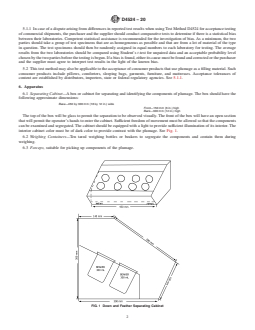
6.1 Separating Cabinet—A box or cabinet for separating and identifying the components of plumage. The box should have the
following approximate dimensions:
Base—450 by 300 mm (18 by 12 in.) wide
Front—150 mm (6 in.) high
Back—300 mm (12 in.) high
The top of the box will be glass to permit the separation to be observed visually. The front of the box will have an open section
that will permit the operator’s hands to enter the cabinet. Sufficient freedom of movement must be allowed so that the components
can be examined and segregated. The cabinet should be equipped with a light to provide sufficient illumination of its interior. The
interior cabinet color must be of dark color to provide contrast with the plumage. See Fig. 1.
6.2 Weighing Containers—Ten tared weighing bottles or beakers to segregate the components and contain them during
weighing.
6.3 Forceps, suitable for picking up components of the plumage.
FIG. 1 Down and Feather Separating Cabinet
D4524 − 20
6.4 Balance, having a capability adequate for weighing specimens and containers with a sensitivity of 0.0001 g.
6.5 Mixing Containers—One large box or container approximately 500 by 500 by 500 mm that is used to hold the sample
plumage to be analyzed. Another smaller mixing container approximately 300 by 300 by 150 mm. The interior of the mixing boxes
shall be smooth to avoid plumage entrapment.
7. Sampling
7.1 Lot Sample—As a lot sample for acceptance testing, select at random the number of bales, bags, or other shipping containers
as directed in an applicable material specification or other agreement between the purchaser and the supplier. In the absence of such
an agreement, randomly select 30 % of the sh
...