

ASTM D5592-94(2018)
(Guide)Standard Guide for Material Properties Needed in Engineering Design Using Plastics
General Information
- Abstract
SIGNIFICANCE AND USE
4.1 This guide is intended to serve as a reference to the plastics community for material properties needed in engineering design.
4.2 Product datasheets or product literature typically report single-point values at ambient conditions and hence, by their very nature, are inadequate for engineering design and structural analysis of a component or system. A detailed property profile for the particular grade chosen for a given part not only enhances the confidence of the design engineer by allowing a more realistic assessment of the material under close-to-actual service environments but also may avoid premature failure of the designed component and potential liability litigation later. Additionally, it would also eliminate use of larger “design safety factors” that result in “overengineering” or “overdesign.” Not only is such overdesign unwarranted, but it adds to the total part cost, resulting in a good example of ineffective design with plastics and a prime target for substitution by other materials.
4.3 One of the problems faced by design engineers is access to comparable data among similar products from different material suppliers because of the lack of standardized reporting format in the plastics industry. ISO 10350.1, ISO 11403-1, and ISO 11403-2 are intended to address the comparability of data issue only as far as single-point and multipoint data for material selection. This guide attempts to serve as a means to standardize the format to report comparable data for engineering design. It is essential that incorporating standardized test specimen geometry and specific test conditions as recommended in Guide D1999, Practice D3641, or ISO 3167 and ISO 294-1 are an integral part of the data generation.
SCOPE
1.1 This guide covers the essential material properties needed for designing with plastics. Its purpose is to raise the awareness of the plastics community regarding the specific considerations involved in using the appropriate material properties in design calculations.
1.2 This guide is intended only as a convenient resource for engineering design. It should be noted that the specific operating conditions (temperature, applied stress or strain, environment, etc. and corresponding duration of such exposures) could vary significantly from one application to another. It is, therefore, the responsibility of the user to perform any pertinent tests under actual conditions of use to determine the suitability of the material in the intended application.
1.3 The applicable ISO and ASTM standard methods for the relevant material properties are listed in this guide for the benefit of design engineers.
1.4 It should be noted that for some of the desired properties, no ASTM or ISO standards exist. These include pvT data, no-flow temperature, ejection temperature, and fatigue in tension. In these instances, relying on available test methods is suggested.
1.5 The values stated in SI units are to be regarded as standard. No other units of measurement are included in this standard.
1.6 This standard does not purport to address all of the safety concerns, if any, associated with its use. It is the responsibility of the user of this standard to establish appropriate safety, health, and environmental practices and determine the applicability of regulatory limitations prior to use.
Note 1: There is no known ISO equivalent to this standard.
1.7 This international standard was developed in accordance with internationally recognized principles on standardization established in the Decision on Principles for the Development of International Standards, Guides and Recommendations issued by the World Trade Organization Technical Barriers to Trade (TBT) Committee.
- Status
- Published
- Publication Date
- 31-Mar-2018
- Technical Committee
- D20 - Plastics
- Drafting Committee
- D20.10 - Mechanical Properties
Overview
ASTM D5592-94(2018) – Standard Guide for Material Properties Needed in Engineering Design Using Plastics provides essential guidance for engineers and designers working with plastic materials in structural, manufacturing, and assembly applications. Developed by ASTM International, this standard addresses the limitations of using single-point datasheet values and emphasizes the need for comprehensive material property profiles. The guide promotes standardized data reporting to ensure accurate engineering design, minimize overdesign, and enable reliable component performance.
Key Topics
- Material Property Profiles: Highlights key plastic material properties necessary for robust engineering design, moving beyond ambient single-point values to account for real-world operating conditions.
- Design Calculations: Stresses the importance of assessing material behavior under specific service environments, including factors such as temperature, applied stress, environment, and exposure duration.
- Data Standardization: Recommends standardized reporting formats and test conditions for comparability across different suppliers, using both ASTM and ISO testing methods where applicable.
- Categories of Material Properties:
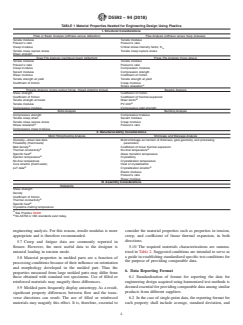
- Structural Analysis: Properties like tensile modulus, Poisson’s ratio, creep modulus, and critical stress intensity are essential for assessing component integrity and geometry.
- Manufacturability: Focuses on properties required for molding, cooling, and evaluation of dimensional stability, including viscosity, flowability, melt density, and shrinkage.
- Assembly Considerations: Covers weldability, compatibility of components, coefficient of friction, and thermal properties relevant to joining and assembling parts.
Applications
ASTM D5592-94(2018) serves as a practical reference in multiple industries where plastics are used for engineered components, including automotive, aerospace, electronics, consumer goods, and industrial equipment. Key applications include:
- Component Design and Analysis: Utilized in finite element analysis (FEA) and CAD/CAE workflows to predict behavior and optimize plastic part geometry.
- Material Selection: Enables designers to accurately compare plastic grades for suitability in target environments, enhancing confidence in long-term product performance.
- Quality Assurance & Compliance: Supports standardized material characterization for regulatory requirements, risk assessment, and documentation.
- Failure Prevention: Helps in selecting appropriate plastics to avoid premature failures and reduce liability risks by accounting for actual service conditions and mechanical stresses.
Related Standards
Several referenced ASTM and ISO standards underpin the data generation and reporting formats recommended in ASTM D5592-94(2018), including:
- ASTM Standards:
- D638: Test Method for Tensile Properties of Plastics
- D695: Test Method for Compressive Properties of Rigid Plastics
- D2990: Test Methods for Creep and Creep-Rupture of Plastics
- D3045: Practice for Heat Aging of Plastics Without Load
- D3835: Capillary Rheometer Testing of Polymeric Materials
- D3641: Practice for Injection Molding Test Specimens
- ISO Standards:
- ISO 527: Determination of Tensile Properties
- ISO 899: Creep Behaviour Testing
- ISO 11403: Acquisition and Presentation of Multipoint Data
- ISO 294-1: Injection Moulding of Test Specimens
Other referenced standards address aspects such as UV exposure (ISO 4892-2), coefficient of friction (ISO 8295), and thermal properties (E228).
Keywords: ASTM D5592, engineering plastics, material properties, structural design, plastic component testing, plastics data sheet, ASTM standards, ISO standards, manufacturability, finite element analysis, CAD/CAE, quality assurance, material selection, plastics engineering design, property characterization.
Relations
- Effective Date
- 01-Apr-2018
- Effective Date
- 15-Feb-2024
- Effective Date
- 01-Feb-2024
- Effective Date
- 01-Feb-2024
- Effective Date
- 01-Nov-2023
- Effective Date
- 01-Oct-2023
- Effective Date
- 01-Feb-2020
- Effective Date
- 01-Jan-2020
- Effective Date
- 01-Aug-2019
- Effective Date
- 15-Apr-2019
- Effective Date
- 01-Feb-2019
- Effective Date
- 01-Dec-2018
- Effective Date
- 01-Nov-2018
- Effective Date
- 01-Aug-2018
- Effective Date
- 15-Aug-2017
Get Certified
Connect with accredited certification bodies for this standard

DIN CERTCO
DIN Group product certification.

Smithers Quality Assessments
US management systems and product certification.
Sponsored listings
Frequently Asked Questions
ASTM D5592-94(2018) is a guide published by ASTM International. Its full title is "Standard Guide for Material Properties Needed in Engineering Design Using Plastics". This standard covers: SIGNIFICANCE AND USE 4.1 This guide is intended to serve as a reference to the plastics community for material properties needed in engineering design. 4.2 Product datasheets or product literature typically report single-point values at ambient conditions and hence, by their very nature, are inadequate for engineering design and structural analysis of a component or system. A detailed property profile for the particular grade chosen for a given part not only enhances the confidence of the design engineer by allowing a more realistic assessment of the material under close-to-actual service environments but also may avoid premature failure of the designed component and potential liability litigation later. Additionally, it would also eliminate use of larger “design safety factors” that result in “overengineering” or “overdesign.” Not only is such overdesign unwarranted, but it adds to the total part cost, resulting in a good example of ineffective design with plastics and a prime target for substitution by other materials. 4.3 One of the problems faced by design engineers is access to comparable data among similar products from different material suppliers because of the lack of standardized reporting format in the plastics industry. ISO 10350.1, ISO 11403-1, and ISO 11403-2 are intended to address the comparability of data issue only as far as single-point and multipoint data for material selection. This guide attempts to serve as a means to standardize the format to report comparable data for engineering design. It is essential that incorporating standardized test specimen geometry and specific test conditions as recommended in Guide D1999, Practice D3641, or ISO 3167 and ISO 294-1 are an integral part of the data generation. SCOPE 1.1 This guide covers the essential material properties needed for designing with plastics. Its purpose is to raise the awareness of the plastics community regarding the specific considerations involved in using the appropriate material properties in design calculations. 1.2 This guide is intended only as a convenient resource for engineering design. It should be noted that the specific operating conditions (temperature, applied stress or strain, environment, etc. and corresponding duration of such exposures) could vary significantly from one application to another. It is, therefore, the responsibility of the user to perform any pertinent tests under actual conditions of use to determine the suitability of the material in the intended application. 1.3 The applicable ISO and ASTM standard methods for the relevant material properties are listed in this guide for the benefit of design engineers. 1.4 It should be noted that for some of the desired properties, no ASTM or ISO standards exist. These include pvT data, no-flow temperature, ejection temperature, and fatigue in tension. In these instances, relying on available test methods is suggested. 1.5 The values stated in SI units are to be regarded as standard. No other units of measurement are included in this standard. 1.6 This standard does not purport to address all of the safety concerns, if any, associated with its use. It is the responsibility of the user of this standard to establish appropriate safety, health, and environmental practices and determine the applicability of regulatory limitations prior to use. Note 1: There is no known ISO equivalent to this standard. 1.7 This international standard was developed in accordance with internationally recognized principles on standardization established in the Decision on Principles for the Development of International Standards, Guides and Recommendations issued by the World Trade Organization Technical Barriers to Trade (TBT) Committee.
SIGNIFICANCE AND USE 4.1 This guide is intended to serve as a reference to the plastics community for material properties needed in engineering design. 4.2 Product datasheets or product literature typically report single-point values at ambient conditions and hence, by their very nature, are inadequate for engineering design and structural analysis of a component or system. A detailed property profile for the particular grade chosen for a given part not only enhances the confidence of the design engineer by allowing a more realistic assessment of the material under close-to-actual service environments but also may avoid premature failure of the designed component and potential liability litigation later. Additionally, it would also eliminate use of larger “design safety factors” that result in “overengineering” or “overdesign.” Not only is such overdesign unwarranted, but it adds to the total part cost, resulting in a good example of ineffective design with plastics and a prime target for substitution by other materials. 4.3 One of the problems faced by design engineers is access to comparable data among similar products from different material suppliers because of the lack of standardized reporting format in the plastics industry. ISO 10350.1, ISO 11403-1, and ISO 11403-2 are intended to address the comparability of data issue only as far as single-point and multipoint data for material selection. This guide attempts to serve as a means to standardize the format to report comparable data for engineering design. It is essential that incorporating standardized test specimen geometry and specific test conditions as recommended in Guide D1999, Practice D3641, or ISO 3167 and ISO 294-1 are an integral part of the data generation. SCOPE 1.1 This guide covers the essential material properties needed for designing with plastics. Its purpose is to raise the awareness of the plastics community regarding the specific considerations involved in using the appropriate material properties in design calculations. 1.2 This guide is intended only as a convenient resource for engineering design. It should be noted that the specific operating conditions (temperature, applied stress or strain, environment, etc. and corresponding duration of such exposures) could vary significantly from one application to another. It is, therefore, the responsibility of the user to perform any pertinent tests under actual conditions of use to determine the suitability of the material in the intended application. 1.3 The applicable ISO and ASTM standard methods for the relevant material properties are listed in this guide for the benefit of design engineers. 1.4 It should be noted that for some of the desired properties, no ASTM or ISO standards exist. These include pvT data, no-flow temperature, ejection temperature, and fatigue in tension. In these instances, relying on available test methods is suggested. 1.5 The values stated in SI units are to be regarded as standard. No other units of measurement are included in this standard. 1.6 This standard does not purport to address all of the safety concerns, if any, associated with its use. It is the responsibility of the user of this standard to establish appropriate safety, health, and environmental practices and determine the applicability of regulatory limitations prior to use. Note 1: There is no known ISO equivalent to this standard. 1.7 This international standard was developed in accordance with internationally recognized principles on standardization established in the Decision on Principles for the Development of International Standards, Guides and Recommendations issued by the World Trade Organization Technical Barriers to Trade (TBT) Committee.
ASTM D5592-94(2018) is classified under the following ICS (International Classification for Standards) categories: 21.020 - Characteristics and design of machines, apparatus, equipment; 83.080.01 - Plastics in general. The ICS classification helps identify the subject area and facilitates finding related standards.
ASTM D5592-94(2018) has the following relationships with other standards: It is inter standard links to ASTM D5592-94(2010), ASTM E1823-24a, ASTM E1823-24, ASTM D883-24, ASTM D883-23, ASTM D2565-23, ASTM E1823-20, ASTM D883-20, ASTM D883-19c, ASTM D883-19a, ASTM D883-19, ASTM D883-18a, ASTM D883-18, ASTM D3045-18, ASTM D883-17. Understanding these relationships helps ensure you are using the most current and applicable version of the standard.
ASTM D5592-94(2018) is available in PDF format for immediate download after purchase. The document can be added to your cart and obtained through the secure checkout process. Digital delivery ensures instant access to the complete standard document.
Standards Content (Sample)
This international standard was developed in accordance with internationally recognized principles on standardization established in the Decision on Principles for the
Development of International Standards, Guides and Recommendations issued by the World Trade Organization Technical Barriers to Trade (TBT) Committee.
Designation: D5592 − 94 (Reapproved 2018)
Standard Guide for
Material Properties Needed in Engineering Design Using
Plastics
This standard is issued under the fixed designation D5592; the number immediately following the designation indicates the year of
original adoption or, in the case of revision, the year of last revision. A number in parentheses indicates the year of last reapproval. A
superscript epsilon (´) indicates an editorial change since the last revision or reapproval.
INTRODUCTION
Plastics are increasingly being used in durable applications as structural components on a basis
comparable with traditional materials such as steels and aluminum, as well as high performance
composite systems. Unlike many consumer-goods applications, where plastics typically serve as
enclosures, these durables applications primarily involve load-bearing components exposed to rather
broad varying operating environments over the life cycle of the product. This necessitates access to
material property profiles over a wide range of conditions, rather than typical values reported at room
temperature.Inordertodesigneffectivelywithplastics,thedesignermusttakeintoaccounttheeffects
of time, temperature, rate, and environment on the performance of plastics, and the consequences of
failure.
1. Scope 1.5 The values stated in SI units are to be regarded as
standard. No other units of measurement are included in this
1.1 This guide covers the essential material properties
standard.
needed for designing with plastics. Its purpose is to raise the
1.6 This standard does not purport to address all of the
awareness of the plastics community regarding the specific
safety concerns, if any, associated with its use. It is the
considerations involved in using the appropriate material
responsibility of the user of this standard to establish appro-
properties in design calculations.
priate safety, health, and environmental practices and deter-
1.2 This guide is intended only as a convenient resource for
mine the applicability of regulatory limitations prior to use.
engineering design. It should be noted that the specific oper-
NOTE 1—There is no known ISO equivalent to this standard.
ating conditions (temperature, applied stress or strain,
1.7 This international standard was developed in accor-
environment, etc. and corresponding duration of such expo-
dance with internationally recognized principles on standard-
sures) could vary significantly from one application to another.
ization established in the Decision on Principles for the
It is, therefore, the responsibility of the user to perform any
Development of International Standards, Guides and Recom-
pertinent tests under actual conditions of use to determine the
mendations issued by the World Trade Organization Technical
suitability of the material in the intended application.
Barriers to Trade (TBT) Committee.
1.3 TheapplicableISOandASTMstandardmethodsforthe
2. Referenced Documents
relevant material properties are listed in this guide for the
benefit of design engineers.
2.1 ASTM Standards:
D543 Practices for Evaluating the Resistance of Plastics to
1.4 It should be noted that for some of the desired
Chemical Reagents
properties, no ASTM or ISO standards exist. These include
D638 Test Method for Tensile Properties of Plastics
pvT data, no-flow temperature, ejection temperature, and
D695 Test Method for Compressive Properties of Rigid
fatigue in tension. In these instances, relying on available test
Plastics
methods is suggested.
D883 Terminology Relating to Plastics
D1435 Practice for Outdoor Weathering of Plastics
This guide is under the jurisdiction of ASTM Committee D20 on Plastics and
is the direct responsibility of Subcommittee D20.10 on Mechanical Properties. For referenced ASTM standards, visit the ASTM website, www.astm.org, or
Current edition approved April 1, 2018. Published April 2018. Originally contact ASTM Customer Service at service@astm.org. For Annual Book of ASTM
approved in 1994. Last previous edition approved in 2010 as D5592 - 94 (2010). Standards volume information, refer to the standard’s Document Summary page on
DOI: 10.1520/D5592-94R18. the ASTM website.
*A Summary of Changes section appears at the end of this standard
Copyright © ASTM International, 100 Barr Harbor Drive, PO Box C700, West Conshohocken, PA 19428-2959. United States
D5592 − 94 (2018)
D1894 Test Method for Static and Kinetic Coefficients of ISO 4892-2 Plastics—Methods of Exposure to Laboratory
Friction of Plastic Film and Sheeting Light Sources—Part 2: Xenon Arc Sources
D1999 Guide for Selection of Specimens and Test Param-
ISO 6721-2 Plastics—Determination of Dynamic Mechani-
eters from ISO/IEC Standards (Withdrawn 2000)
cal Properties—Part 2: Torsion Pendulum
D2565 Practice for Xenon-Arc Exposure of Plastics In-
ISO 8295 Plastics—Film and Sheeting—Determination of
tended for Outdoor Applications
the Coefficients of Friction
D2990 Test Methods for Tensile, Compressive, and Flexural
ISO 10350.1 Plastics—Acquisition and Presentation of
Creep and Creep-Rupture of Plastics
Comparable Single-Point Data— Part 1: Moulding Mate-
D2991 Test Method for Stress-Relaxation of Plastics (With-
rials
drawn 1990)
ISO 11403-1 Plastics—Acquisition and Presentation of
D3045 Practice for Heat Aging of Plastics Without Load
Comparable Multipoint Data—Part 1: Mechanical Prop-
D3123 Test Method for Spiral Flow of Low-Pressure Ther-
erties
mosetting Molding Compounds
ISO 11403-2 Plastics—Acquisition and Presentation of
D3418 Test Method for Transition Temperatures and En-
Comparable Multipoint Data—Part 2: Thermal and Pro-
thalpies of Fusion and Crystallization of Polymers by
cessing Properties
Differential Scanning Calorimetry
ISO 11443 Plastics—Determination of the Fluidity of Plas-
D3641 Practice for Injection Molding Test Specimens of
tics Using Capillary and Slit-Die Rheometers
Thermoplastic Molding and Extrusion Materials
D3835 Test Method for Determination of Properties of
3. Terminology
Polymeric Materials by Means of a Capillary Rheometer
3.1 Definitions:
D4473 Test Method for Plastics: Dynamic Mechanical Prop-
erties: Cure Behavior 3.1.1 aging—the effect on materials of exposure to an
environment for an interval of time (see Terminology D883).
D5045 Test Methods for Plane-Strain Fracture Toughness
and Strain Energy Release Rate of Plastic Materials
3.1.2 coeffıcient of friction—a measure of the resistance to
D5279 Test Method for Plastics: Dynamic Mechanical Prop-
sliding of one surface in contact with another surface.
erties: In Torsion
3.1.3 coeffıcient of linear thermal expansion—the change in
E6 Terminology Relating to Methods of Mechanical Testing
linear dimension per unit of original length of a material for a
E228 Test Method for Linear Thermal Expansion of Solid
unit change in temperature.
Materials With a Push-Rod Dilatometer
E1823 TerminologyRelatingtoFatigueandFractureTesting
3.1.4 compressive strength—the compressive stress that a
2.2 ISO Standards:
material is capable of sustaining. In the case of a material that
ISO 175 Plastics—Determination of the Effects of Immer-
does not fail in compression by a shattering fracture, the value
sion in Liquid Chemicals
for compressive strength is an arbitrary value depending upon
ISO 294-1 Plastics—Injection Moulding of Test Specimens
the degree of distortion that is regarded as indicating complete
of Thermoplastic Materials—General Principles, and
failure of the material (modified from Terminology E6).
Moulding of Multipurpose and Bar Test Specimens
3.1.5 creep—the time-dependent increase in strain in re-
ISO 527-1 Plastics—Determination of Tensile Properties—
sponse to applied stress (modified from Terminology E6).
Part 1: General Principles
ISO 527-2 Plastics—Determination of Tensile Properties—
3.1.6 creep modulus—the ratio of initial applied stress to
Part 2: Test Conditions for Moulding and Extrusion
creep strain (see Test Method D2990).
Plastics
3.1.7 creep rupture stress—stresstoproducematerialfailure
ISO 527-4 Plastics—Determination of Tensile Properties—
corresponding to a fixed time to rupture (modified from Test
Part 4:Test Conditions for Isotropic and Orthotropic Fibre
Method D2990).
Reinforced Plastic Composites
ISO604 Plastics—DeterminationofCompressiveProperties
3.1.8 critical stress intensity factor—toughness parameter
ISO 899-1 Plastics—Determination of Creep Behaviour -
indicative of the resistance of a material to fracture at fracture
Tensile Creep
initiation (see Test Method D5045).
ISO 899-2 Plastics—Determination of Creep Behaviour -
3.1.9 engineering stress—stress based on initial cross sec-
Flexural Creep by Three-Point Loading
tional area of the specimen.
ISO 2578 Plastics—Determination of Time-Temperature
Limits After Prolonged Exposure to Heat
3.1.10 fatigue—the process of progressive localized perma-
ISO 3167 Plastics—Multipurpose Test Specimens
nent deleterious change or loss of properties occurring in a
ISO 4607 Plastics—Methods of Exposure to Natural Weath-
material subjected to cyclic loading conditions (modified from
ering
Definitions E1823).
3.1.11 Poisson’s ratio—the absolute value of the ratio of
The last approved version of this historical standard is referenced on
transverse strain to the corresponding axial strain resulting
www.astm.org.
4 from uniformly distributed axial stress below the proportional
Available fromAmerican National Standards Institute (ANSI), 25 W. 43rd St.,
4th Floor, New York, NY 10036, http://www.ansi.org. limit of the material (see Terminology D883).
D5592 − 94 (2018)
3.1.12 proportional limit—the greatest stress that a material materialsuppliersbecauseofthelackofstandardizedreporting
is capable of sustaining without any deviation from propor- format in the plastics industry. ISO 10350.1, ISO 11403-1, and
tionality of stress to strain (Hooke’s law) (see Test Method ISO 11403-2 are intended to address the comparability of data
D638). issue only as far as single-point and multipoint data for
material selection. This guide attempts to serve as a means to
3.1.13 PV limit—the limiting combination of pressure and
standardize the format to report comparable data for engineer-
velocity that will cause failure of any polymer rubbing against
ing design. It is essential that incorporating standardized test
another surface without lubrication at a specific ambient
specimen geometry and specific test conditions as recom-
temperature and tested in a specific geometry.
mended in Guide D1999, Practice D3641, or ISO 3167 and
3.1.14 secant modulus—the ratio of engineering stress to
ISO 294-1 are an integral part of the data generation.
corresponding strain at a designated strain point on the
stress-strain curve (see Test Method D638).
5. Material Properties in Engineering Design
3.1.15 shear modulus—the quotient of the shearing stress
5.1 Finite element analysis is an integral part of computer
and the resulting angular deformation of the test specimen
aided design/engineering (CAD/CAE). It serves as a powerful
measured in the range of small recoverable deformations (see
tool for design engineers in performing engineering analysis of
ISO 6721-2).
plastics components to predict the performance. The material
data inputs required for carrying out these analyses essentially
3.1.16 shear strength—the maximum shear stress that a
material is capable of sustaining. Shear strength is calculated constitute the minimum data needed in engineering design.
from the maximum load during a shear or torsion test and is
5.2 The material properties essential in engineering design
based on the original dimensions of the cross section of the
can be grouped into three main categories; (1) properties
specimen (see Terminology E6).
essential for structural analysis, (2) properties essential for
assessing manufacturability, and (3) properties essential for
3.1.17 tensile modulus—the ratio of engineering stress to
corresponding strain below the proportional limit of a material evaluating assembly. The properties essential for structural
analysis are employed in assessing the structural integrity of
in tension (modified from Test Method D638).
the designed part over its useful life or in determining the
3.1.18 tensile stress at break—the tensile stress sustained by
required geometry of the part to ensure structural integrity.The
the material at break (modified from Test Method D638).
properties essential for assessing manufacturability are em-
3.1.1
...