

EN 4500-002:2026
(Main)Aerospace series - Metallic materials - Rules for drafting and presentation of material standards - Part 002: Specific rules for aluminium, aluminium alloys and magnesium alloys
- Abstract
The EN 4500 series specifies the rules for the drafting and presentation of metallic material standards for aerospace applications.
This Part 002 specifies the "Specific rules for aluminium, aluminium alloys and magnesium alloys".
- Status
- Not Published
- Publication Date
- 06-Oct-2026
- Technical Committee
- ASD-STAN - Aerospace
- Drafting Committee
- ASD-STAN/D 4/S 3 - Steels & Heat Resisting Alloys
- Current Stage
- 6055 - CEN Ratification completed (DOR) - Publishing
- Start Date
- 26-Jul-2026
- Completion Date
- 26-Jul-2026

EN 4500-002:2026 is a CEN European Standard in the aerospace metallic-materials series. It gives the specific rules for drafting and presenting material standards for aluminium, aluminium alloys and magnesium alloys, so it is mainly used by people who write, review, or apply aerospace material specifications. In practice, it tells a standards writer how to structure the title, scope, tables, test lines, and supporting references for those materials.
What does EN 4500-002:2026 specify?
EN 4500-002:2026 specifies the rules for drafting and presentation of metallic material standards for aerospace applications, limited here to aluminium, aluminium alloys and magnesium alloys. It is a rules document for writing standards, not a product standard itself.
The document is organized into:
- Clause 1 Scope
- Clause 2 Normative references
- Clause 3 Terms and definitions
- Clause 4 Rules for drafting a European standard for aerospace metallic materials
- Annexes A to E
| Annex | What it covers |
|---|---|
| Annex A | Completion of the title page |
| Annex B | Completion of the introduction |
| Annex C | Completion of the scope, normative references, terms and definitions, and requirements |
| Annex D | Completion of Table 1 |
| Annex E | Completion of the bibliography |
Annex C is normative and gives the example structure to be applied. The other annexes are informative and show how to complete the standard in practice.
What are the key requirements of EN 4500-002:2026?
How a standard is to be drafted
Clause 4.1 says the examples in the annexes are only illustrations. EN 4500-002:2026 makes clear that real standards may need additional terms as technology develops. For a writer, that means the annexes show the format, but the final content still has to fit the actual product and process.
Clause 4.2.1 points to Annex A for the title page, and Clause 4.2.3 gives acceptable wording for surface condition, form, and additional information. This matters because the title and product description have to be written in a controlled way, so readers can immediately see the product form and intended use.
Clause 4.2.2 allows two use conditions, such as T4 and T42 or T6 and T62, to be quoted together when they have the same mechanical properties and are metallurgically the same. That is important when a standard can cover more than one designation without changing the technical meaning.
How material condition and composition are to be stated
Clause 4.3.2 sets the default expectation that standards for extruded bars, sections and drawn tubes are prepared for supply in the Tx511 condition according to EN 515. The same standards can also be used for Tx510, but then the scope must be completed as shown in Annex C. In practice, this forces the writer to declare the supply condition clearly.
Clause 4.5.2 controls chemical composition presentation. For aluminium alloys, the order of elements and limits follows the registration for that alloy designation; for magnesium alloys, the order follows the format registered in ASTM B275. That keeps composition tables consistent across aerospace standards.
Clause 4.5.10 and Clause 4.5.11 require delivery condition, heat treatment, and use condition to use the temper designations from EN 515 or EN 1753. Clause 4.5.17 says cladding thickness on each face is given as a percentage of the total thickness. For clad products, that makes the cladding level explicit instead of leaving it implicit.
How Table 1 is to be used
Clause 4.5 turns Table 1 into the core structure for a material standard. It covers material designation, chemical composition, form, method of production, limit dimensions, technical specification, dimensional standard, delivery and use conditions, test samples and pieces, directions for testing, and the property lines that follow.
Some lines need special handling:
- Line 3, method of melting, is not normally used for aluminium, aluminium alloys and magnesium alloys.
- Line 20, impact strength, is also not normally used.
- Lines 27 and 97 are not used.
- Lines 95 and 96 cover marking inspection and dimensional inspection.
- Line 99 is for typical use.
- Line 100 is for product qualification.
Clause 4.5.26 gives the most detailed instructions. Electrical conductivity on line 32 uses only mandatory values, while line 82 is used for batch uniformity checks. Stress corrosion on line 39 and fracture toughness on line 40 can be mandatory or used in dispute situations, and notch yield ratio on line 47 can be used as a substitute for fracture toughness. That matters because the standard writer has to decide whether a property is a requirement, a check on consistency, or a fallback test.
Clause 4.5.26 also covers cladding chemical composition and batch uniformity. For batch uniformity, electrical conductivity may be shown as a reference to the technical specification or as a typical value, and hardness may be given with typical value and permitted variation. This gives a standard writer a way to state production consistency without overcomplicating the table.
What terms does EN 4500-002:2026 define?
EN 4500-002:2026 relies on the terms in EN 4259 and EN 4500-001, and on the temper-related terms in EN 515 and EN 1753. The following terms are central to applying the document:
- Temper designation - the code for delivery or heat-treatment condition, such as T4, T42, T6, T62, Tx510 and Tx511.
- Tx511 - the default supply condition for standards for extruded bars, sections and drawn tubes.
- Tx510 - an alternative supply condition that can be used when the scope is completed accordingly.
- Batch uniformity - the check used to show that conductivity or hardness stays within the permitted spread for a batch.
- Cladding - the surface layer on each face of a semi-finished product, expressed here as a percentage of total thickness.
- Stress corrosion - a property that may require mandatory testing or dispute testing under line 39.
- Fracture toughness - a crack-resistance property that may be mandatory or used in dispute testing, with notch yield ratio as a substitute test.
- Product qualification - the qualification stage where the standard links technical requirements to an agreed qualification programme.
Who uses EN 4500-002:2026?
EN 4500-002:2026 is used by standards developers, aerospace materials engineers, and technical committees that write product standards for metallic materials. It is also relevant to manufacturers and suppliers of aluminium and magnesium semi-finished products, because it shows how the product standard should be structured.
Quality managers, buyers, and test laboratories use it when they need to check that a material standard names the right form, temper, inspections, tests, and qualification route. In practice, it helps them read a specification and see which items are mandatory requirements and which are examples or supporting information.
What changed in EN 4500-002:2026 from the previous edition?
EN 4500-002:2026 supersedes EN 4500-002:2024. The foreword states these significant changes:
- addition of line 4.3, “Further intended processing”, and line 5.2, “Dimensional standard”, in the body and in Annex D
- introductory sentences added to Table 1 in Annex C to make its normative status clear
- editorial changes to clarify whether references to other documents or annexes are normative or informative
- restructuring and simplification of the template to create a single continuous table
Which standards are used with EN 4500-002:2026?
EN 4500-002:2026 uses several companion standards and references:
- EN 4259 - general terms and definitions for aerospace metallic materials
- EN 4500-001 - the general drafting rules for the EN 4500 series
- EN 515 and EN 1753 - temper designations for aluminium alloys and magnesium alloys
- ASTM B275 - composition ordering for magnesium alloy listings
- EN 4258 - the general organization of aerospace metallic-material standardization
- EN 4400-1, EN 4400-2, EN 4400-3, EN 4400-6 - technical specifications used in the worked examples for plate, sheet and strip, bar and section, and forging stock
- EN 2002-001, EN 2002-17, EN 2002-20, EN 2002-23, EN 2004-10, EN 2043, EN 2070-4, EN 2070-5, EN 2716, EN 2718, EN 2720, EN 6018 - test methods, corrosion methods, density measurement, residual stress measurement, and qualification support used in the examples and bibliography
- EN 4500-003, EN 4500-004, EN 4500-005, EN 4500-006 - the other parts of the EN 4500 series for heat resisting alloys, titanium and titanium alloys, steels, and filler metals for brazing
What does the EN 4500-002:2026 document contain?
EN 4500-002:2026 contains the drafting rules, plus worked examples showing how those rules are applied. Clause 4 covers title wording, introduction, scope, Table 1, and bibliography, and the annexes show completed examples.
Annex C gives a full example for an aluminium alloy clad sheet and strip standard, including scope, references, and requirements. Annex D expands Table 1 into detailed entries for composition, heat treatment, mechanical properties, corrosion, conductivity, batch uniformity, fatigue, bearing stress, marking inspection, dimensional inspection, notes, typical use, and product qualification.
Annex A and Annex B show how to complete the title page and introduction, and Annex E shows how to complete the bibliography.
Relations
- Effective Date
- 11-Jun-2025
Get Certified
Connect with accredited certification bodies for this standard

BUREAU VERITAS Certification Germany
Bureau Veritas certification in Germany.

Element Materials Technology
Materials testing and product certification.

AQMS Ltd.
AQMS provides ISO certification to SMEs across the UK.
Sponsored listings
Frequently Asked Questions
EN 4500-002:2026 is a draft published by the European Committee for Standardization (CEN). Its full title is "Aerospace series - Metallic materials - Rules for drafting and presentation of material standards - Part 002: Specific rules for aluminium, aluminium alloys and magnesium alloys". This standard covers: The EN 4500 series specifies the rules for the drafting and presentation of metallic material standards for aerospace applications. This Part 002 specifies the "Specific rules for aluminium, aluminium alloys and magnesium alloys".
The EN 4500 series specifies the rules for the drafting and presentation of metallic material standards for aerospace applications. This Part 002 specifies the "Specific rules for aluminium, aluminium alloys and magnesium alloys".
EN 4500-002:2026 is classified under the following ICS (International Classification for Standards) categories: 49.025.15 - Non-ferrous alloys in general. The ICS classification helps identify the subject area and facilitates finding related standards.
EN 4500-002:2026 has the following relationships with other standards: It is inter standard links to EN 4500-002:2024. Understanding these relationships helps ensure you are using the most current and applicable version of the standard.
EN 4500-002:2026 is available in PDF format for immediate download after purchase. The document can be added to your cart and obtained through the secure checkout process. Digital delivery ensures instant access to the complete standard document.
Standards Content (Sample)
SLOVENSKI STANDARD
oSIST prEN 4500-002:2025
01-oktober-2025
Aeronavtika - Kovinski materiali - Pravila za načrtovanje in predstavljanje
standarov za materiale - 002. del: Posebna pravila za aluminij, aluminijeve in
magnezijeve zlitine
Aerospace series - Metallic materials - Rules for drafting and presentation of material
standards - Part 002: Specific rules for aluminium, aluminium alloys and magnesium
alloys
Luft- und Raumfahrt - Metallische Werkstoffe - Regeln für das Erstellen und die
Gestaltung von Werkstoffnormen - Teil 002: Besondere Regeln für Aluminium,
Aluminiumlegierungen und Magnesiumlegierungen
Série aérospatiale - Matériaux métalliques - Règles pour la rédaction et la présentation
des normes de matériaux - Partie 002 : Règles spécifiques à l'aluminium, aux alliages
d'aluminium et aux alliages de magnésium
Ta slovenski standard je istoveten z: prEN 4500-002
ICS:
01.120 Standardizacija. Splošna Standardization. General
pravila rules
49.025.20 Aluminij Aluminium
oSIST prEN 4500-002:2025 en,fr,de
2003-01.Slovenski inštitut za standardizacijo. Razmnoževanje celote ali delov tega standarda ni dovoljeno.
oSIST prEN 4500-002:2025
oSIST prEN 4500-002:2025
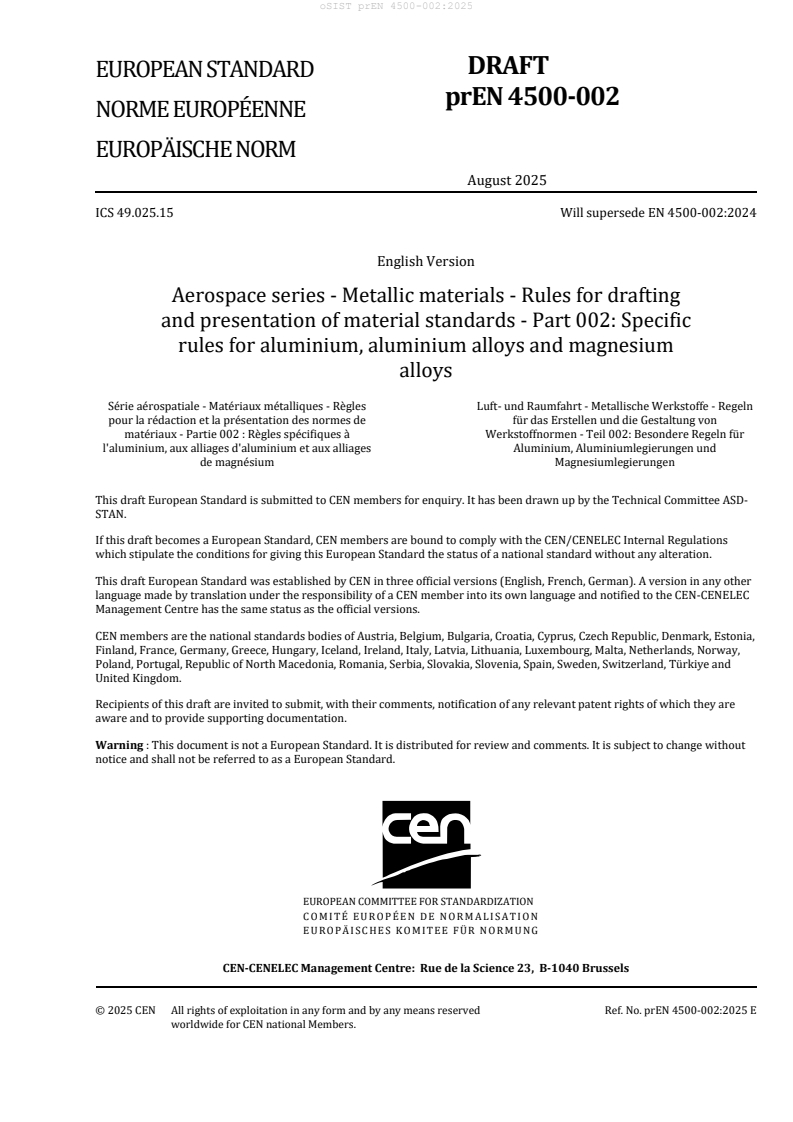
DRAFT
EUROPEAN STANDARD
prEN 4500-002
NORME EUROPÉENNE
EUROPÄISCHE NORM
August 2025
ICS 49.025.15 Will supersede EN 4500-002:2024
English Version
Aerospace series - Metallic materials - Rules for drafting
and presentation of material standards - Part 002: Specific
rules for aluminium, aluminium alloys and magnesium
alloys
Série aérospatiale - Matériaux métalliques - Règles Luft- und Raumfahrt - Metallische Werkstoffe - Regeln
pour la rédaction et la présentation des normes de für das Erstellen und die Gestaltung von
matériaux - Partie 002 : Règles spécifiques à Werkstoffnormen - Teil 002: Besondere Regeln für
l'aluminium, aux alliages d'aluminium et aux alliages Aluminium, Aluminiumlegierungen und
de magnésium Magnesiumlegierungen
This draft European Standard is submitted to CEN members for enquiry. It has been drawn up by the Technical Committee ASD-
STAN.
If this draft becomes a European Standard, CEN members are bound to comply with the CEN/CENELEC Internal Regulations
which stipulate the conditions for giving this European Standard the status of a national standard without any alteration.
This draft European Standard was established by CEN in three official versions (English, French, German). A version in any other
language made by translation under the responsibility of a CEN member into its own language and notified to the CEN-CENELEC
Management Centre has the same status as the official versions.
CEN members are the national standards bodies of Austria, Belgium, Bulgaria, Croatia, Cyprus, Czech Republic, Denmark, Estonia,
Finland, France, Germany, Greece, Hungary, Iceland, Ireland, Italy, Latvia, Lithuania, Luxembourg, Malta, Netherlands, Norway,
Poland, Portugal, Republic of North Macedonia, Romania, Serbia, Slovakia, Slovenia, Spain, Sweden, Switzerland, Türkiye and
United Kingdom.
Recipients of this draft are invited to submit, with their comments, notification of any relevant patent rights of which they are
aware and to provide supporting documentation.
Warning : This document is not a European Standard. It is distributed for review and comments. It is subject to change without
notice and shall not be referred to as a European Standard.
EUROPEAN COMMITTEE FOR STANDARDIZATION
COMITÉ EUROPÉEN DE NORMALISATION
EUROPÄISCHES KOMITEE FÜR NORMUNG
CEN-CENELEC Management Centre: Rue de la Science 23, B-1040 Brussels
© 2025 CEN All rights of exploitation in any form and by any means reserved Ref. No. prEN 4500-002:2025 E
worldwide for CEN national Members.
oSIST prEN 4500-002:2025
prEN 4500-002:2025 (E)
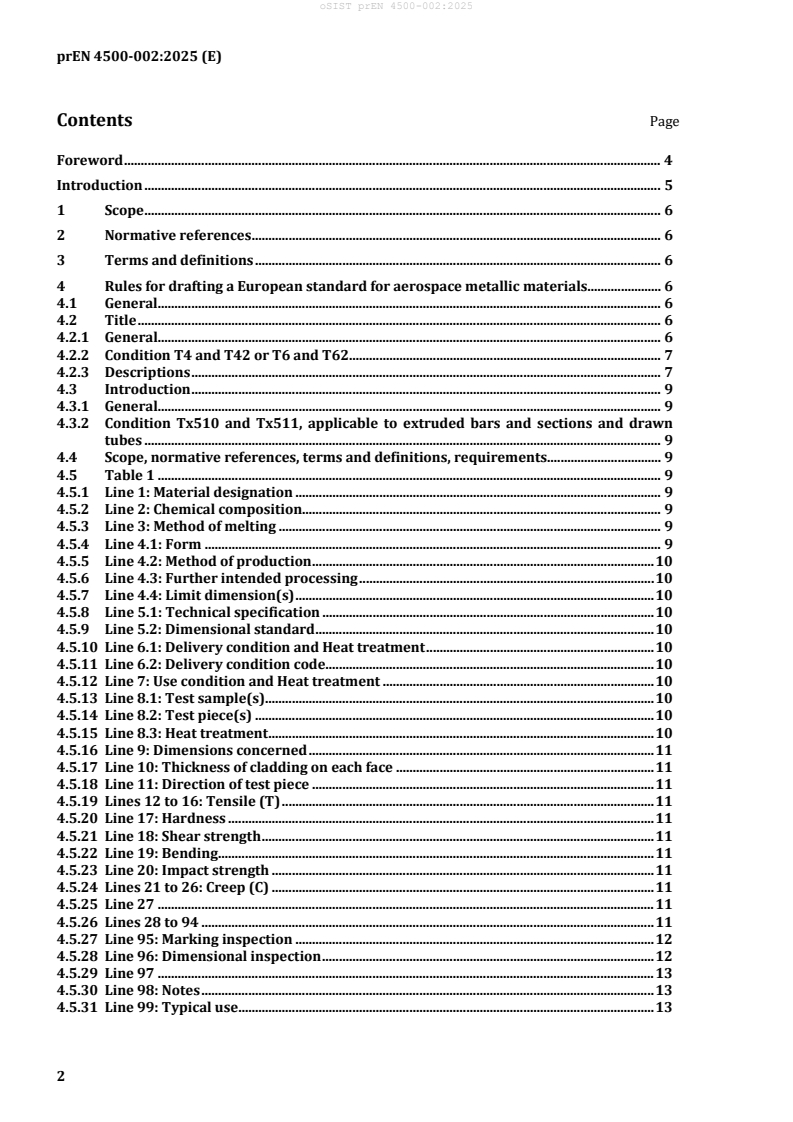
Contents Page
Foreword . 4
Introduction . 5
1 Scope . 6
2 Normative references . 6
3 Terms and definitions . 6
4 Rules for drafting a European standard for aerospace metallic materials. 6
4.1 General. 6
4.2 Title . 6
4.2.1 General. 6
4.2.2 Condition T4 and T42 or T6 and T62 . 7
4.2.3 Descriptions . 7
4.3 Introduction . 9
4.3.1 General. 9
4.3.2 Condition Tx510 and Tx511, applicable to extruded bars and sections and drawn
tubes . 9
4.4 Scope, normative references, terms and definitions, requirements . 9
4.5 Table 1 . 9
4.5.1 Line 1: Material designation . 9
4.5.2 Line 2: Chemical composition. 9
4.5.3 Line 3: Method of melting . 9
4.5.4 Line 4.1: Form . 9
4.5.5 Line 4.2: Method of production . 10
4.5.6 Line 4.3: Further intended processing . 10
4.5.7 Line 4.4: Limit dimension(s) . 10
4.5.8 Line 5.1: Technical specification . 10
4.5.9 Line 5.2: Dimensional standard . 10
4.5.10 Line 6.1: Delivery condition and Heat treatment . 10
4.5.11 Line 6.2: Delivery condition code . 10
4.5.12 Line 7: Use condition and Heat treatment . 10
4.5.13 Line 8.1: Test sample(s) . 10
4.5.14 Line 8.2: Test piece(s) . 10
4.5.15 Line 8.3: Heat treatment . 10
4.5.16 Line 9: Dimensions concerned . 11
4.5.17 Line 10: Thickness of cladding on each face . 11
4.5.18 Line 11: Direction of test piece . 11
4.5.19 Lines 12 to 16: Tensile (T) . 11
4.5.20 Line 17: Hardness . 11
4.5.21 Line 18: Shear strength . 11
4.5.22 Line 19: Bending . 11
4.5.23 Line 20: Impact strength . 11
4.5.24 Lines 21 to 26: Creep (C) . 11
4.5.25 Line 27 . 11
4.5.26 Lines 28 to 94 . 11
4.5.27 Line 95: Marking inspection . 12
4.5.28 Line 96: Dimensional inspection . 12
4.5.29 Line 97 . 13
4.5.30 Line 98: Notes . 13
4.5.31 Line 99: Typical use . 13
oSIST prEN 4500-002:2025
prEN 4500-002:2025 (E)
4.5.32 Line 100: Product qualification . 13
4.6 Bibliography . 13
Annex A (informative) Completion of title page . 14
Annex B (informative) Completion of the introduction . 15
Annex C (normative) Completion of the scope, normative references, terms and definitions,
and requirements . 16
Annex D (informative) Completion of Table 1 . 17
Annex E (informative) Completion of the bibliography. 28
Bibliography . 29
oSIST prEN 4500-002:2025
prEN 4500-002:2025 (E)
Foreword
This document (prEN 4500-002:2025) has been prepared by the Technical Committee ASD-STAN/D04
“Materials”.
This document is currently submitted to the CEN Enquiry
This document will supersede EN 4500-002:2024.
prEN 4500-002:2025 includes the following significant technical changes with respect to
EN 4500-002:2024:
— addition of the lines 4.3 "Further intended processing" and 5.2 "Dimensional standard" in the body
of the document and in Annex D;
— addition of introductory sentences to Table 1 in Annex C to highlight the fact that the table is a
normative element and that all the documents that it lists shall be applied;
— overall editorial modifications to give clarity on the normative or informative nature of the
references made to other documents or Annexes;
— restructuring of the document and simplification of the Template to achieve a single continuous table.
This document has been prepared under a standardization request addressed to CEN by the European
Commission. The Standing Committee of the EFTA States subsequently approves these requests for its
Member States.
oSIST prEN 4500-002:2025
prEN 4500-002:2025 (E)
Introduction
This document is part of the series of EN metallic material standards for aerospace applications.
The general organization of this series is described in EN 4258.
The EN 4500 series (Aerospace series — Metallic materials — Rules for drafting and presentation of
material standards) is composed by the following documents:
— General rules EN 4500-001;
— Specific rules for aluminium, aluminium alloys and EN 4500-002;
magnesium alloys
— Specific rules for heat-resisting alloys EN 4500-003;
— Specific rules for titanium and titanium alloys EN 4500-004;
— Specific rules for steels EN 4500-005;
— Specific rules for filler metals for welding EN 4500-002 to EN 4500-005;
— Specific rules for filler metals for brazing EN 4500-006.
Basis for the drafting of all European standards is CEN/CENELEC Internal Regulations — Part 3: Principles
and rules for the structure and drafting of CEN and CENELEC documents.
oSIST prEN 4500-002:2025
prEN 4500-002:2025 (E)
1 Scope
The EN 4500 series specifies the rules for the drafting and presentation of metallic material standards
for aerospace applications.
This Part 002 specifies the “Specific rules for aluminium, aluminium alloys and magnesium alloys”.
2 Normative references
The following documents are referred to in the text in such a way that some or all of their content
constitutes requirements of this document. For dated references, only the edition cited applies. For
undated references, the latest edition of the referenced document (including any amendments) applies.
EN 515, Aluminium and aluminium alloys - Wrought products - Temper designations
EN 1753, Magnesium and magnesium alloys - Magnesium alloy ingots and castings
EN 4259, Aerospace series - Metallic materials - Definition of general terms
EN 4500-001, Aerospace series - Metallic materials - Rules for drafting and presentation of material
standards - Part 001: General rules
ASTM B275, Standard Practice for Codification of Certain Zinc, Tin and Lead Die Castings
3 Terms and definitions
For the purposes of this document, the terms and definitions given in EN 4259 and EN 4500-001 apply.
For temper designations, the terms and definitions given in EN 515 and EN 1753 apply.
ISO and IEC maintain terminology databases for use in standardization at the following addresses:
— ISO Online browsing platform: available at https://www.iso.org/obp/
— IEC Electropedia: available at https://www.electropedia.org/
4 Rules for drafting a European standard for aerospace metallic materials
4.1 General
Examples given in Annexes are only intended to illustrate the rules for drafting and presentation and
might not correspond to real standardized EN semi-finished products. Technological development can
require the use of terms additional to those listed.
4.2 Title
4.2.1 General
Shall be according to EN 4500-001.
See also Annex A of this document.
Published by American Society for Testing and Materials (ASTM International), available at:
https://www.astm.org/
oSIST prEN 4500-002:2025
prEN 4500-002:2025 (E)
4.2.2 Condition T4 and T42 or T6 and T62
It is permissible to quote two use conditions (e.g. T4 and T42 or T6 and T62) in the same material
standard providing they have the same mechanical properties and are metallurgically the same.
See Annex B.
4.2.3 Descriptions
4.2.3.1 General
The following are examples of some descriptions which may be used.
4.2.3.2 Surface condition entries
a) Where unclad or as manufactured, no entry required;
b) Clad;
c) Machined.
4.2.3.3 Form entries
a) Sheets and strips;
b) Plates;
c) Bars;
The term may be qualified with one or more of the following terms:
1) extruded;
2) drawn;
3) rolled.
d) Sections;
The term may be qualified with the following term:
1) extruded.
e) Bars and sections;
The term may be qualified with the following term:
1) extruded.
f) Tubes;
The term may be qualified with one or more of the following terms:
1) extruded;
2) drawn.
oSIST prEN 4500-002:2025
prEN 4500-002:2025 (E)
g) Wires;
h) Forging stock;
The term may be qualified with one or more of the following terms:
1) cast;
2) extruded.
i) Forgings.
The term may be qualified with one or more of the following terms:
1) die;
2) hand.
j) Remelting stock;
k) Castings;
The term may be qualified with one or more of the following terms:
1) sand;
2) permanent mould;
3) investment;
4) high-strength.
4.2.3.4 Additional information entries
— With peripheral coarse grain control;
— For structural applications;
— For hydraulic applications;
— For superplastic forming;
— Damage tolerant;
— For the manufacture of rivets;
— For the manufacture of fasteners;
— For machining;
— For welding.
oSIST prEN 4500-002:2025
prEN 4500-002:2025 (E)
4.3 Introduction
4.3.1 General
Shall be according to EN 4500-001.
See also Annex B of this document.
4.3.2 Condition Tx510 and Tx511, applicable to extruded bars and sections and drawn tubes
Material standards shall be prepared on the basis that all material will be supplied in the Tx511 condition
according to EN 515.
These standards can also be used to supply material in the Tx510 condition according to EN 515. In this
case, the scope shall be completed according to Annex C of this document.
4.4 Scope, normative references, terms and definitions, requirements
Shall be according to EN 4500-001.
See also Annex C of this document.
4.5 Table 1
4.5.1 Line 1: Material designation
Shall be according to EN 4500-001.
See also Annex D of this document.
4.5.2 Line 2: Chemical composition
The chemical composition shall be written in accordance with EN 4500-001 and the following rules:
a) aluminium alloys:
1) wrought products
The order of presentation of elements and chemical composition limits shall conform to that
registered with the Aluminium Association for that alloy designation;
2) cast products
The order of presentation of elements shall conform to the Aluminium Association order used for
wrought products;
b) magnesium alloys:
The order of presentation of elements and chemical composition limits shall conform to that
registered with the American Society for Testing and Materials, Committee B-7; currently listed in
ASTM B275.
4.5.3 Line 3: Method of melting
Not normally used for aluminium, aluminium alloys and magnesium alloys.
4.5.4 Line 4.1: Form
Shall be according to EN 4500-001.
See also Annex D of this document.
oSIST prEN 4500-002:2025
prEN 4500-002:2025 (E)
4.5.5 Line 4.2: Method of production
Shall be according to EN 4500-001.
See also Annex D of this document.
The applicable terms given in 4.2 shall be used.
4.5.6 Line 4.3: Further intended processing
Shall be according to EN 4500-001.
See also Annex D of this document.
4.5.7 Line 4.4: Limit dimension(s)
Shall be according to EN 4500-001.
See also Annex D of this document.
4.5.8 Line 5.1: Technical specification
Shall be according to EN 4500-001.
See also Annex D of this document.
4.5.9 Line 5.2: Dimensional standard
This line shall indicate the applicable dimensional standard.
4.5.10 Line 6.1: Delivery condition and Heat treatment
Shall be according to EN 4500-001.
The temper designations shall be in accordance with EN 515 or EN 1753.
See also Annex D of this document.
4.5.11 Line 6.2: Delivery condition code
Shall be according to EN 4500-001.
See also Annex D of this document.
4.5.12 Line 7: Use condition and Heat treatment
Shall be according to EN 4500-001.
The temper designations shall be in accordance with EN 515 or EN 1753.
See also 4.2.2 and Annex D of this document
4.5.13 Line 8.1: Test sample(s)
Shall be according to EN 4500-001.
See also Annex D of this document.
4.5.14 Line 8.2: Test piece(s)
Shall be according to EN 4500-001.
See also Annex D of this document.
4.5.15 Line 8.3: Heat treatment
Shall be according to EN 450
...