

EN 14459:2021
(Main)Safety and control devices for burners and appliances burning gaseous or liquid fuels - Control functions in electronic systems - Methods for classification and assessment
- Abstract
EN 13611:2019, Clause 1 is replaced by the following:
This document specifies methods for the classification and assessment of function blocks for burners and appliances burning one or more gaseous or liquid fuels with particular regards to their fault behaviour and preventative measures.
This document is applicable to new control function blocks, not covered by dedicated control standards.
- Status
- Published
- Publication Date
- 23-Nov-2021
- Withdrawal Date
- 30-May-2022
- Technical Committee
- CEN/TC 58 - Safety and control devices for burners and appliances burning gaseous or liquid fuels
- Drafting Committee
- CEN/TC 58/WG 11 - Generics
- Current Stage
- 6060 - Definitive text made available (DAV) - Publishing
- Start Date
- 24-Nov-2021
- Due Date
- 11-Aug-2022
- Completion Date
- 24-Nov-2021



Overview
EN 14459:2021 - "Safety and control devices for burners and appliances burning gaseous or liquid fuels - Control functions in electronic systems - Methods for classification and assessment" (CEN) defines methods to classify and assess electronic control function blocks for burners and appliances using gaseous or liquid fuels, with particular regard to their fault behaviour and preventative measures. It is intended for new control function blocks not covered by dedicated control standards and is to be used in conjunction with EN 13611:2019 (with specific clause replacements and additions).
Key topics and technical requirements
EN 14459:2021 structures technical guidance and requirements across design, testing and assessment, including:
- Classification of control functions - classes, groups and types of control relevant to safety and functional behaviour.
- Test conditions and measurement uncertainty - establishing reproducible test environments.
- Design and construction - mechanical, materials, gas and electrical parts, and protection against internal faults.
- Performance testing - leak‑tightness, torsion/bending, rated flow, durability, long‑term performance and data exchange.
- Electrical requirements and EMC - protection by enclosure, immunity to voltage dips, surges, RF disturbances and electrostatic discharge.
- Safety assessment methods - normative annexes provide methods to determine Safety Integrity Level (SIL) and Performance Level (PL), and guidance on translation of appliance risk into control requirements.
- Documentation and marking - required marking, instructions and warning notices for safe use and compliance.
- Informative and normative annexes - risk assessment examples, fault mode tables for electronic components, reset functions, materials requirements and environmental guidance.
(Annexes J, K and L address SIL/PL determination and their relationship; Annexes AA–BB give practical risk assessment examples.)
Practical applications and who uses it
EN 14459:2021 is used by:
- Manufacturers and designers of burner and heating appliance control electronics to define functional safety and preventive measures during design.
- Safety engineers and system integrators performing risk assessments and selecting appropriate control architectures or redundancies.
- Test laboratories and certification bodies verifying conformity with performance, EMC and safety requirements.
- Standards committees and regulators harmonising appliance safety across markets.
Typical uses include specifying control block behaviour for new electronic controls, determining required SIL/PL for safety‑related functions, designing fault‑tolerant measures and preparing compliance documentation.
Related standards
- EN 13611:2019 - referenced and used together with EN 14459:2021 (certain clauses adapted).
- Other CEN/TC 58 standards on safety and control devices for burners and appliances.
Keywords: EN 14459:2021, control functions, electronic systems, burners, gaseous fuels, liquid fuels, classification, assessment, fault behaviour, SIL, PL, EMC, leak‑tightness, risk assessment.
Relations
- Effective Date
- 08-Jun-2022
- Effective Date
- 28-Jan-2026
- Effective Date
- 10-Feb-2026
- Effective Date
- 28-Jan-2026
- Effective Date
- 28-Jan-2026
- Referred By
EN 26:2015 - Gas-fired instantaneous water heaters for the production of domestic hot water - Effective Date
- 28-Jan-2026
- Effective Date
- 28-Jan-2026
- Effective Date
- 28-Jan-2026
Get Certified
Connect with accredited certification bodies for this standard

DIBt (Deutsches Institut für Bautechnik)
German Institute for Building Technology.
DIN CERTCO
DIN Group product certification.

Aboma Certification B.V.
Specialized in construction, metal, and transport sectors.
Sponsored listings
Frequently Asked Questions
EN 14459:2021 is a standard published by the European Committee for Standardization (CEN). Its full title is "Safety and control devices for burners and appliances burning gaseous or liquid fuels - Control functions in electronic systems - Methods for classification and assessment". This standard covers: EN 13611:2019, Clause 1 is replaced by the following: This document specifies methods for the classification and assessment of function blocks for burners and appliances burning one or more gaseous or liquid fuels with particular regards to their fault behaviour and preventative measures. This document is applicable to new control function blocks, not covered by dedicated control standards.
EN 13611:2019, Clause 1 is replaced by the following: This document specifies methods for the classification and assessment of function blocks for burners and appliances burning one or more gaseous or liquid fuels with particular regards to their fault behaviour and preventative measures. This document is applicable to new control function blocks, not covered by dedicated control standards.
EN 14459:2021 is classified under the following ICS (International Classification for Standards) categories: 91.140.40 - Gas supply systems; 97.100.20 - Gas heaters. The ICS classification helps identify the subject area and facilitates finding related standards.
EN 14459:2021 has the following relationships with other standards: It is inter standard links to EN 14459:2015, EN 13611:2019, EN 50465:2015, EN 88-3:2022, EN 126:2025, EN 26:2015, EN 89:2015, EN 88-3:2022+A1:2024. Understanding these relationships helps ensure you are using the most current and applicable version of the standard.
EN 14459:2021 is associated with the following European legislation: EU Directives/Regulations: 2014/68/EU, 2016/426. When a standard is cited in the Official Journal of the European Union, products manufactured in conformity with it benefit from a presumption of conformity with the essential requirements of the corresponding EU directive or regulation.
EN 14459:2021 is available in PDF format for immediate download after purchase. The document can be added to your cart and obtained through the secure checkout process. Digital delivery ensures instant access to the complete standard document.
Standards Content (Sample)
SLOVENSKI STANDARD
01-april-2022
Nadomešča:
SIST EN 14459:2016
Varnostne in nadzorne naprave za gorilnike in aparate na plin ali tekoča goriva -
Regulacijske in nadzorne funkcije v elektronskih sistemih - Metode za razvrščanje
in ocenjevanje
Safety and control devices for burners and appliances burning gaseous or liquid fuels -
Control functions in electronic systems - Methods for classification and assessment
Sicherheits- und Regeleinrichtungen für Brenner und Brennstoffgeräte für gasförmige
oder flüssige Brennstoffe - Regel- und Steuerfunktionen in elektronischen Systemen -
Verfahren für die Klassifizierung und Bewertung
Dispositifs de commande et de sécurité pour brûleurs et appareils utilisant des
combustibles gazeux ou liquides - Fonctions de commande des systèmes électroniques
- Méthodes de classification et dévaluation
Ta slovenski standard je istoveten z: EN 14459:2021
ICS:
27.060.01 Gorilniki in grelniki vode na Burners and boilers in
splošno general
91.140.40 Sistemi za oskrbo s plinom Gas supply systems
97.100.01 Grelniki na splošno Heating appliances in
general
2003-01.Slovenski inštitut za standardizacijo. Razmnoževanje celote ali delov tega standarda ni dovoljeno.
EN 14459
EUROPEAN STANDARD
NORME EUROPÉENNE
November 2021
EUROPÄISCHE NORM
ICS 91.140.40; 97.100.20 Supersedes EN 14459:2015
English Version
Safety and control devices for burners and appliances
burning gaseous or liquid fuels - Control functions in
electronic systems - Methods for classification and
assessment
Dispositifs de commande et de sécurité pour brûleurs Sicherheits- und Regeleinrichtungen für Brenner und
et appareils utilisant des combustibles gazeux ou Brennstoffgeräte für gasförmige oder flüssige
liquides - Fonctions de commande des systèmes Brennstoffe - Regel- und Steuerfunktionen in
électroniques - Méthodes de classification et elektronischen Systemen - Verfahren für die
d'évaluation Klassifizierung und Bewertung
This European Standard was approved by CEN on 24 October 2021.
CEN members are bound to comply with the CEN/CENELEC Internal Regulations which stipulate the conditions for giving this
European Standard the status of a national standard without any alteration. Up-to-date lists and bibliographical references
concerning such national standards may be obtained on application to the CEN-CENELEC Management Centre or to any CEN
member.
This European Standard exists in three official versions (English, French, German). A version in any other language made by
translation under the responsibility of a CEN member into its own language and notified to the CEN-CENELEC Management
Centre has the same status as the official versions.
CEN members are the national standards bodies of Austria, Belgium, Bulgaria, Croatia, Cyprus, Czech Republic, Denmark, Estonia,
Finland, France, Germany, Greece, Hungary, Iceland, Ireland, Italy, Latvia, Lithuania, Luxembourg, Malta, Netherlands, Norway,
Poland, Portugal, Republic of North Macedonia, Romania, Serbia, Slovakia, Slovenia, Spain, Sweden, Switzerland, Turkey and
United Kingdom.
EUROPEAN COMMITTEE FOR STANDARDIZATION
COMITÉ EUROPÉEN DE NORMALISATION
EUROPÄISCHES KOMITEE FÜR NORMUNG
CEN-CENELEC Management Centre: Rue de la Science 23, B-1040 Brussels
© 2021 CEN All rights of exploitation in any form and by any means reserved Ref. No. EN 14459:2021 E
worldwide for CEN national Members.
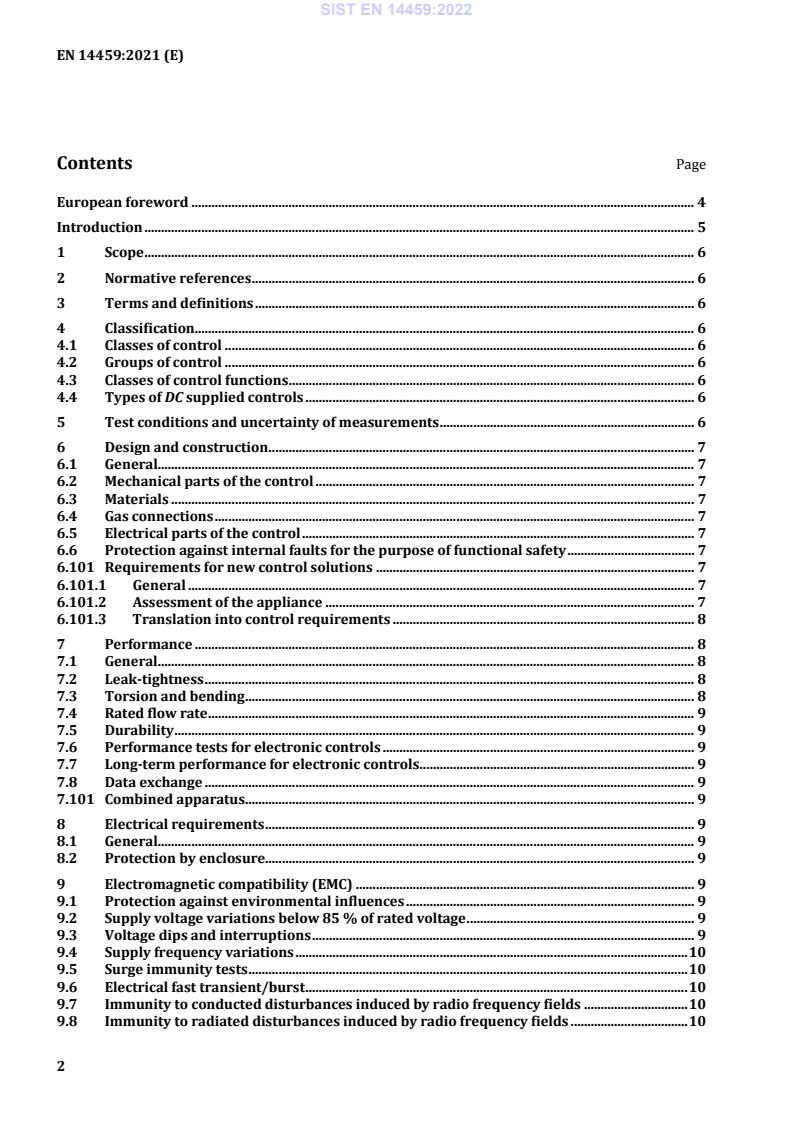
Contents Page
European foreword . 4
Introduction . 5
1 Scope . 6
2 Normative references . 6
3 Terms and definitions . 6
4 Classification. 6
4.1 Classes of control . 6
4.2 Groups of control . 6
4.3 Classes of control functions . 6
4.4 Types of DC supplied controls . 6
5 Test conditions and uncertainty of measurements . 6
6 Design and construction . 7
6.1 General. 7
6.2 Mechanical parts of the control . 7
6.3 Materials . 7
6.4 Gas connections . 7
6.5 Electrical parts of the control . 7
6.6 Protection against internal faults for the purpose of functional safety . 7
6.101 Requirements for new control solutions . 7
6.101.1 General . 7
6.101.2 Assessment of the appliance . 7
6.101.3 Translation into control requirements . 8
7 Performance . 8
7.1 General. 8
7.2 Leak-tightness . 8
7.3 Torsion and bending . 8
7.4 Rated flow rate . 9
7.5 Durability . 9
7.6 Performance tests for electronic controls . 9
7.7 Long-term performance for electronic controls . 9
7.8 Data exchange . 9
7.101 Combined apparatus. 9
8 Electrical requirements . 9
8.1 General. 9
8.2 Protection by enclosure. 9
9 Electromagnetic compatibility (EMC) . 9
9.1 Protection against environmental influences . 9
9.2 Supply voltage variations below 85 % of rated voltage . 9
9.3 Voltage dips and interruptions . 9
9.4 Supply frequency variations . 10
9.5 Surge immunity tests . 10
9.6 Electrical fast transient/burst . 10
9.7 Immunity to conducted disturbances induced by radio frequency fields . 10
9.8 Immunity to radiated disturbances induced by radio frequency fields . 10
9.9 Electrostatic discharge test . 10
9.10 Power frequency magnetic field immunity tests . 10
9.11 Harmonics and interharmonics including mains signalling at a. c. power port, low
frequency immunity tests . 10
10 Marking, instructions . 10
10.1 Marking . 10
10.2 Instructions . 10
10.3 Warning notice . 10
Annex A (informative) Abbreviations and symbols . 11
Annex B (informative) Leak-tightness tests for gas controls – volumetric method . 12
Annex C (informative) Leak-tightness tests for gas controls – pressure loss method . 13
Annex D (normative) Calculation of pressure loss into leakage rate . 14
Annex E (normative) Electrical/electronic component fault modes . 15
Annex F (normative) Additional requirements for safety accessories and pressure
accessories as defined in EU Directive 2014/68/EU . 16
Annex G (normative) Materials for pressurized parts . 17
Annex H (normative) Additional materials for pressurized parts. 18
Annex I (normative) Requirements for controls used in DC supplied burners and
appliances burning gaseous or liquid fuels . 19
Annex J (normative) Method for the determination of a Safety Integrity Level (SIL) . 20
Annex K (normative) Method for the determination of a Performance Level (PL) . 21
Annex L (informative) Relationship between Safety Integrity Level (SIL) and
Performance Level (PL) . 22
Annex M (normative) Reset functions . 23
Annex N (informative) Guidance document on Environmental Aspects . 24
Annex O (normative) Seals of elastomer, cork and synthetic fibre mixtures . 25
Annex AA (informative) Example of a risk assessment method . 26
Annex BB (informative) Example of a risk assessment according to method described in
Annex AA . 28
BB.1 General . 28
BB.2 Risks . 28
BB.3 Risk assessment . 28
Annex CC (informative) Realization of a protective measure . 31
Annex DD (informative) Hazards in gas and oil appliances handled by control functions . 33
Annex EE (informative) Classification of control functions based on the determination of
basic risks . 37
Bibliography . 41
European foreword
This document (EN 14459:2021) has been prepared by Technical Committee CEN/TC 58 “Safety and
control devices for burners and appliances burning gaseous or liquid fuels”, the secretariat of which is
held by BSI.
This European Standard shall be given the status of a national standard, either by publication of an
identical text or by endorsement, at the latest by May 2022, and conflicting national standards shall be
withdrawn at the latest by May 2022.
Attention is drawn to the possibility that some of the elements of this document may be the subject of
patent rights. CEN shall not be held responsible for identifying any or all such patent rights.
This document supersedes EN 14459:2015.
The following significant changes compared to the previous edition have been incorporated in this
document:
a) Alignment with EN 13611:2019;
b) Clause 2 “Normative references” has been updated;
c) The Bibliography has been updated.
Any feedback and questions on this document should be directed to the users’ national standards body.
A complete listing of these bodies can be found on the CEN website.
According to the CEN-CENELEC Internal Regulations, the national standards organisations of the
following countries are bound to implement this European Standard: Austria, Belgium, Bulgaria, Croatia,
Cyprus, Czech Republic, Denmark, Estonia, Finland, France, Germany, Greece, Hungary, Iceland, Ireland,
Italy, Latvia, Lithuania, Luxembourg, Malta, Netherlands, Norway, Poland, Portugal, Republic of North
Macedonia, Romania, Serbia, Slovakia, Slovenia, Spain, Sweden, Switzerland, Turkey and the United
Kingdom.
Introduction
This document is intended to be used in conjunction with EN 13611:2019.
This document refers to clauses of EN 13611:2019 or adapts it by stating “with the following
modification”, “with the following addition”, “is replaced by the following” or “is not applicable” in the
corresponding clause.
This document adds clauses or subclauses to the structure of EN 13611:2019 which are particular to this
document. Subclauses which are additional to those in EN 13611 are numbered starting from 101.
Additional Annexes are designated as Annex AA, Annex BB, Annex CC, etc. It should be noted that these
clauses, subclauses and Annexes are not indicated as an addition.
Control systems are designed to control and protect gas and/or oil appliances and the combustion
process. All functions are performed depending on their safety relevance within a specific tolerance of
measures and time with a specific certainty under external influences and internal failures.
It was concluded by CEN/TC 58 that it is not always necessary to protect against the consequences of
hazardous events with uniform measures as hazards differ in severity and the probability of unwanted
occurrences may differ. As there exist large differences of interpretation on what level of protection is
necessary against certain hazards, there is a need for guidance to bring the safety philosophy for gas and
oil appliances and controls in line. The discussions of CEN/TC 58 regarding safety related control
functions and the use of control systems in the appliances show that it is worthwhile to refine the basic
safety philosophy of gas and oil appliances into different risk levels.
For the evaluation of preventative measures concerning fault tolerance and avoidance of hazards, it is
essential to classify control functions with regard to their fault behaviour. For the classification of control
functions, their integration into the complete safety concept of the appliance should be taken into account.
In the appliance standards, only specific fault conditions are considered when controls conforming to
CEN/TC 58 standards are used, e.g. flame simulation and air proving before each new start. In some cases
(e.g. switch contacts) shorting is excluded, when certain tests have proven that the probability of a fault
occurrence is low. For gas valves, a single shut-off valve is considered insufficient.
This document gives methods for the assessment of control functions in controls for burners and
appliances burning one or more gaseous or liquid fuels for which no specific product standards are
actually available. The assessment is described in three steps:
— assessment of the application,
— translation into control requirements,
— assessment of the control solution,
leading to defined classes for the specified control function(s)and a set of safety measures with
additional/modified construction and test requirements for the application and/or the specified control
function(s).
The assessment is focused on the controlled parameters (e.g. high/low temperature, pressure, flow,
combustion quality) in the combustion process and in the functionality of the controls (e.g. open/closed;
lock/unlock; start/stop). Each control function needs to be classified according to the required safety
aspects (Class A, B, C).
To analyse the effect of fault conditions it is essential to know the specific application and to determine
the related risks.
1 Scope
EN 13611:2019, Clause 1 is replaced by the following:
This document specifies methods for the classification and assessment of function blocks for burners and
appliances burning one or more gaseous or liquid fuels with particular regards to their fault behaviour
and preventative measures.
This document is applicable to new control function blocks, not covered by dedicated control standards.
2 Normative references
The following documents are referred to in the text in such a way that some or all of their content
constitutes requirements of this document. For dated references, only the edition cited applies. For
undated references, the latest edition of the referenced document (including any amendments) applies.
EN 13611:2019, Safety and control devices for burners and appliances burning gaseous and/or liquid fuels
- General requirements
3 Terms and definitions
For the purposes of this document, the terms and definitions given in EN 13611:2019 apply with the
following modifications.
ISO and IEC maintain terminological databases for use in standardization at the following addresses:
— IEC Electropedia: available at https://www.electropedia.org/
— ISO Online browsing platform: available at https://www.iso.org/obp
3.101
function block
part of an electric or electronic system which realises at least one control function with one input and one
output signal
4 Classification
4.1 Classes of control
EN 13611:2019, 4.1 is not applicable.
4.2 Groups of control
Shall be according to EN 13611:2019, 4.2.
4.3 Classes of control functions
Shall be according to EN 13611:2019, 4.3 with the following addition:
The class of the control function shall be determined from the results of the risk assessment in 6.101 and
specified in the instructions.
4.4 Types of DC supplied controls
Shall be according to EN 13611:2019, 4.4.
5 Test conditions and uncertainty of measurements
Shall be according to EN 13611:2019, Clause 5.
6 Design and construction
6.1 General
Shall be according to EN 13611:2019, 6.1 with the following addition:
The specific assessment shall be performed according to 6.101. Its outcome shall be verified concerning
its impact to the applicability of 6.1 to 6.6.
6.2 Mechanical parts of the control
Shall be according to EN 13611:2019, 6.2.
6.3 Materials
Shall be according to EN 13611:2019, 6.3.
6.4 Gas connections
Shall be according to EN 13611:2019, 6.4.
6.5 Electrical parts of the control
Shall be according to EN 13611:2019, 6.5.
6.6 Protection against internal faults for the purpose of functional safety
Shall be according to EN 13611:2019, 6.6.
6.101 Requirements for new control solutions
6.101.1 General
Appliance designs are based on safe operation avoiding any harm for persons, domestic animals or
property when normally used. Possible hazards arising from the appliance can be expressed in inherent
risks, being considered in relation to the combustion (use) of gas and oil and heating of water.
For known control and appliance solutions, risks are considered to be covered by the requirements in the
dedicated control standards and appliance standards.
Appliances with new control solutions shall be subjected to a further risk assessment according to 6.101.2
depending on their design, either:
— well-known appliance designs, or
— new appliance solutions.
6.101.2 Assessment of the appliance
The required protective measures, resulting from a risk assessment on the new or well-known appliance
design or solution are the basis for the assessment of new control solutions. The risk assessment shall be
performed and documented in order to identify the risks and the required protective measures covering
these risks.
At least the following information shall be specified:
— classification of basic hazards;
— Annex AA gives examples of existing basic hazards in gas and/or oil appliances;
— risk assessment and the resulting protective measures;
— Annex EE specifies a method for classification of control functions;
— classification of protective measures;
— fault tolerating time for specific faults;
— additional requirements for the application.
Based on this information the following measures may be taken:
— specification of controls according to known control standards; and/or
— additional appliance construction requirements; and/or
— specification of new type of control based on the required protective measure and/or the additional
requirements.
In Annex AA, a risk assessment method on appliance level is given.
In Annex BB and Annex DD examples are given for the method described in Annex AA.
6.101.3 Translation into control requirements
If – based on the outcome of the risk assessment on the appliance –new types of controls are required,
the protective measures and, where possible, the additional requirements from this risk assessment have
to be translated into control requirements.
A further assessment on the foreseen control solution shall be performed and documented including the
assumptions made and reasoning how the required safety level is achieved.
This outcome shall lead to a conclusion:
— on relevant class of control function(s) according to 4.3;
— on additional or modified construction(s), performance or EMC requirements;
— on further fault modes to be considered in the fault assessment of 6.6;
— on the need to extend the list of markings and the contents of the instructions.
For specific faults, a fault reaction time shall be specified for the control, taking into account the fault
tolerating time of the application as a maximum.
Annex CC provides guidance for the realization of protective measures by controls.
7 Performance
7.1 General
Shall be according to EN 13611:2019, 7.1 with the following addition:
The outcome of the specific assessment according to 6.101 shall be verified concerning its impact to the
applicability of the requirements of Clause 7.
7.2 Leak-tightness
Shall be according to EN 13611:2019, 7.2.
7.3 Torsion and bending
Shall be according to EN 13611:2019, 7.3.
7.4 Rated flow rate
Shall be according to EN 13611:2019, 7.4.
7.5 Durability
Shall be according to EN 13611:2019, 7.5.
7.6 Performance tests for electronic controls
Shall be according to EN 13611:2019, 7.6.
7.7 Long-term performance for electronic controls
Shall be according to EN 13611:2019, 7.7.
7.8 Data exchange
Shall be according to EN 13611:2019, 7.8.
7.101 Combined apparatus
If a system consists of two or more combined apparatuses with different control functions, the
interconnection and interference of the involved apparatus shall be c
...