


EN 206-2:2026
(Main)Concrete - Specification, performance, production and conformity - Part 2: Conformity assessment and certification
General Information
- Abstract
(1) This document specifies the scheme for the conformity assessment and assessment criteria for concrete.
(2) The document provides technical rules for assessment of the performance of the concrete and actions to be followed in the event of non-conformity of the product or negative assessment.
(3) This document gives provisions and guidance for certification of factory production control and of the concrete.
- Status
- Published
- Publication Date
- 03-Mar-2026
- Technical Committee
- CEN/TC 104 - Concrete ( performance, production, placing and compliance criteria )
- Drafting Committee
- CEN/TC 104/SC 1 - Revision of ENV 206
- Current Stage
- 6060 - Definitive text made available (DAV) - Publishing
- Start Date
- 04-Mar-2026
- Due Date
- 26-Dec-2025
- Completion Date
- 04-Mar-2026
Buy Documents


Overview
EN 206-2:2026 is a European standard developed by CEN that addresses the conformity assessment and certification processes for concrete. As Part 2 in the EN 206 series, it complements the core requirements for concrete specification, performance, production, and conformity, by providing a detailed framework for verifying product compliance and managing certification activities within the concrete industry. The standard applies to all parties involved in concrete production and quality management, offering robust procedures for assessing product conformity and handling non-conformities.
Key Topics
EN 206-2:2026 covers several essential areas for concrete producers, regulators, specifiers, and certification bodies:
- Conformity Assessment Schemes: Outlines systematic approaches to verify that concrete meets specified requirements, including assessment methods for both initial and continuous production.
- Assessment Criteria: Defines clear technical rules and criteria for evaluating performance characteristics such as compressive strength, tensile strength, exposure resistance, and other specified properties, using standardized testing procedures.
- Non-Conformity Management: Details corrective actions to address non-compliance or negative assessment results, including notification protocols and supplementary testing.
- Certification Requirements: Provides guidance for implementing and maintaining certification of both concrete products and factory production control in line with recognized international standards and accreditation practices.
- Roles and Responsibilities: Clarifies the tasks of producers, third-party assessment bodies, and certification agencies, ensuring impartiality, competence, and consistent results.
Applications
EN 206-2:2026 is crucial for a wide range of stakeholders across the construction sector:
- Concrete Producers: Enables effective implementation of factory production control and quality assurance systems, leading to improved product reliability and reduced risk of construction defects.
- Certification Bodies: Supports consistent certification processes based on established schemes, fostering trust in certified products across European and international markets.
- Regulatory Authorities: Offers a harmonized approach to assessing conformity and monitoring compliance with statutory requirements for concrete used in construction works.
- Specifiers and Contractors: Facilitates the selection and verification of concrete products that meet project-specific requirements, including specified performance in challenging environments.
- Quality Managers: Assists in developing robust documentation and control systems for ongoing compliance with quality and conformity standards.
Practical benefits include:
- Reliable assurance of concrete performance for structural safety and durability
- Efficient management of non-conformities with clear corrective protocols
- Streamlined certification and surveillance to meet client and regulatory expectations
- Alignment with broader European and international quality assessment frameworks
Related Standards
EN 206-2:2026 is part of a broader family of concrete standards and is frequently used in conjunction with:
- EN 206-1:2026 - Specification, performance, production and conformity: Covers requirements for concrete and factory production control.
- EN 206-3:2026 - Additional requirements for concrete in special geotechnical works.
- EN ISO/IEC 17065 - Conformity assessment: Requirements for bodies certifying products, processes and services.
- EN ISO/IEC 17067 - Fundamentals of product certification and guidelines for certification schemes.
- EN 12350-1, EN 12390-7 - Test methods for fresh and hardened concrete.
- EN 12504-1, EN 13791 - Testing core samples and assessment of in-situ concrete strength.
Conclusion
EN 206-2:2026 strengthens quality assurance within the concrete industry by providing a clear, harmonized framework for conformity assessment and certification. Its adoption leads to more robust production processes, consumer confidence, and improved compliance with European and international requirements for concrete in construction. By understanding and applying this standard, organizations position themselves at the forefront of quality and reliability in construction materials.
Relations
- Effective Date
- 04-Oct-2023
- Effective Date
- 15-Apr-2026
- Effective Date
- 15-Apr-2026
- Effective Date
- 15-Apr-2026
- Effective Date
- 23-Sep-2026
- Effective Date
- 11-Mar-2026
- Effective Date
- 11-Mar-2026
- Effective Date
- 11-Mar-2026
- Effective Date
- 11-Mar-2026
- Effective Date
- 11-Mar-2026
- Effective Date
- 11-Mar-2026
- Effective Date
- 11-Mar-2026
- Effective Date
- 11-Mar-2026
- Referred By
EN 12390-2:2019 - Testing hardened concrete - Part 2: Making and curing specimens for strength tests - Effective Date
- 11-Mar-2026
- Effective Date
- 11-Mar-2026
Buy Documents
Get Certified
Connect with accredited certification bodies for this standard

DIBt (Deutsches Institut für Bautechnik)
German Institute for Building Technology.
DIN CERTCO
DIN Group product certification.

Aboma Certification B.V.
Specialized in construction, metal, and transport sectors.
Sponsored listings
Frequently Asked Questions
EN 206-2:2026 is a standard published by the European Committee for Standardization (CEN). Its full title is "Concrete - Specification, performance, production and conformity - Part 2: Conformity assessment and certification". This standard covers: (1) This document specifies the scheme for the conformity assessment and assessment criteria for concrete. (2) The document provides technical rules for assessment of the performance of the concrete and actions to be followed in the event of non-conformity of the product or negative assessment. (3) This document gives provisions and guidance for certification of factory production control and of the concrete.
(1) This document specifies the scheme for the conformity assessment and assessment criteria for concrete. (2) The document provides technical rules for assessment of the performance of the concrete and actions to be followed in the event of non-conformity of the product or negative assessment. (3) This document gives provisions and guidance for certification of factory production control and of the concrete.
EN 206-2:2026 is classified under the following ICS (International Classification for Standards) categories: 91.100.30 - Concrete and concrete products. The ICS classification helps identify the subject area and facilitates finding related standards.
EN 206-2:2026 has the following relationships with other standards: It is inter standard links to EN 206:2013+A2:2021, EN 206-1:2026, EN 12350-1:2019, EN 12390-7:2019, EN 14679:2026, EN 1992-4:2018, EN 13877-1:2004, EN 13877-1:2023, EN 13263-2:2005+A1:2009, EN 15815:2011, EN 13381-5:2014, EN 1881:2006, EN 14974:2006+A1:2010, EN 12390-2:2019, EN 15050:2007+A1:2012. Understanding these relationships helps ensure you are using the most current and applicable version of the standard.
EN 206-2:2026 is available in PDF format for immediate download after purchase. The document can be added to your cart and obtained through the secure checkout process. Digital delivery ensures instant access to the complete standard document.
Standards Content (Sample)
SLOVENSKI STANDARD
01-maj-2026
Beton - Specifikacija, lastnosti, proizvodnja in skladnost - 2. del: Ugotavljanje
skladnosti in certificiranje
Concrete - Specification, performance, production and conformity - Part 2: Conformity
assessment and certification
Beton - Festlegung, Eigenschaften, Herstellung und Konformität - Teil 2:
Konformitätsbewertung und Zertifizierung
Béton - Spécification, performances, production et conformité - Partie 2 : Évaluation de
la conformité et certification
Ta slovenski standard je istoveten z: EN 206-2:2026
ICS:
03.120.20 Certificiranje proizvodov in Product and company
podjetij. Ugotavljanje certification. Conformity
skladnosti assessment
91.100.30 Beton in betonski izdelki Concrete and concrete
products
2003-01.Slovenski inštitut za standardizacijo. Razmnoževanje celote ali delov tega standarda ni dovoljeno.
EN 206-2
EUROPEAN STANDARD
NORME EUROPÉENNE
March 2026
EUROPÄISCHE NORM
ICS 91.100.30 Supersedes EN 206:2013+A2:2021
English Version
Concrete - Specification, performance, production and
conformity - Part 2: Conformity assessment and
certification
Béton - Spécification, performances, production et Beton - Festlegung, Eigenschaften, Herstellung und
conformité - Partie 2 : Évaluation de la conformité et Konformität - Teil 2: Konformitätsbewertung und
certification Zertifizierung
This European Standard was approved by CEN on 19 January 2026.
CEN members are bound to comply with the CEN/CENELEC Internal Regulations which stipulate the conditions for giving this
European Standard the status of a national standard without any alteration. Up-to-date lists and bibliographical references
concerning such national standards may be obtained on application to the CEN-CENELEC Management Centre or to any CEN
member.
This European Standard exists in three official versions (English, French, German). A version in any other language made by
translation under the responsibility of a CEN member into its own language and notified to the CEN-CENELEC Management
Centre has the same status as the official versions.
CEN members are the national standards bodies of Austria, Belgium, Bulgaria, Croatia, Cyprus, Czech Republic, Denmark, Estonia,
Finland, France, Germany, Greece, Hungary, Iceland, Ireland, Italy, Latvia, Lithuania, Luxembourg, Malta, Netherlands, Norway,
Poland, Portugal, Republic of North Macedonia, Romania, Serbia, Slovakia, Slovenia, Spain, Sweden, Switzerland, Türkiye and
United Kingdom.
EUROPEAN COMMITTEE FOR STANDARDIZATION
COMITÉ EUROPÉEN DE NORMALISATION
EUROPÄISCHES KOMITEE FÜR NORMUNG
CEN-CENELEC Management Centre: Rue de la Science 23, B-1040 Brussels
© 2026 CEN All rights of exploitation in any form and by any means reserved Ref. No. EN 206-2:2026 E
worldwide for CEN national Members.
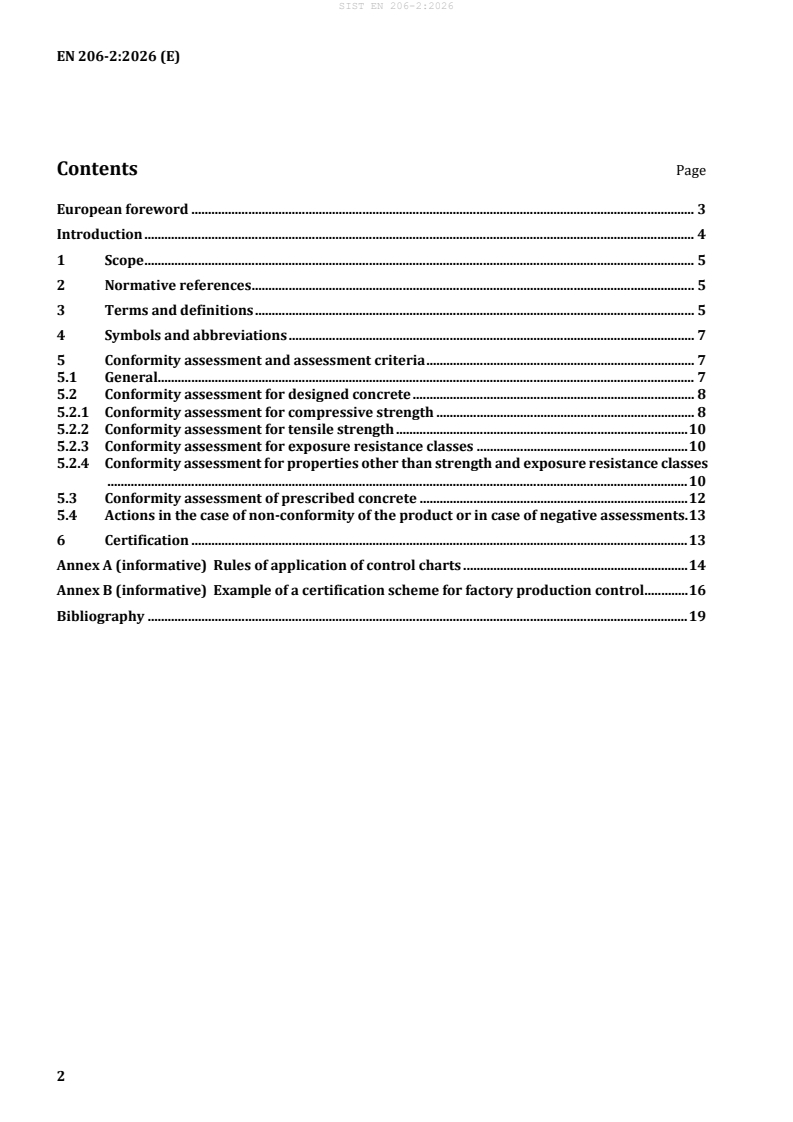
Contents Page
European foreword . 3
Introduction . 4
1 Scope . 5
2 Normative references . 5
3 Terms and definitions . 5
4 Symbols and abbreviations . 7
5 Conformity assessment and assessment criteria . 7
5.1 General. 7
5.2 Conformity assessment for designed concrete . 8
5.2.1 Conformity assessment for compressive strength . 8
5.2.2 Conformity assessment for tensile strength . 10
5.2.3 Conformity assessment for exposure resistance classes . 10
5.2.4 Conformity assessment for properties other than strength and exposure resistance classes
............................................................................................................................................................................. 10
5.3 Conformity assessment of prescribed concrete . 12
5.4 Actions in the case of non-conformity of the product or in case of negative assessments. 13
6 Certification . 13
Annex A (informative) Rules of application of control charts . 14
Annex B (informative) Example of a certification scheme for factory production control . 16
Bibliography . 19
European foreword
This document (EN 206-2:2026) has been prepared by Technical Committee CEN/TC 104 “Concrete and
related products”, the secretariat of which is held by SN.
This European Standard shall be given the status of a national standard, either by publication of an
identical text or by endorsement, at the latest by September 2026, and conflicting national standards shall
be withdrawn at the latest by September 2026.
Attention is drawn to the possibility that some of the elements of this document may be the subject of
patent rights. CEN shall not be held responsible for identifying any or all such patent rights.
This document, together with EN 206-1:2026 and EN 206-3:2026, supersedes EN 206:2013+A2:2021.
The EN 206 series under the general title Concrete — Specification, performance, production and
conformity comprises the following parts:
— Part 1: Performance, requirements, factory production control and assessment criteria for individual
values;
— Part 2: Conformity assessment and certification;
— Part 3: Additional requirements for specification and conformity of concrete for special geotechnical
works
Any feedback and questions on this document should be directed to the users’ national standards body.
A complete listing of these bodies can be found on the CEN website.
According to the CEN-CENELEC Internal Regulations, the national standards organisations of the
following countries are bound to implement this European Standard: Austria, Belgium, Bulgaria, Croatia,
Cyprus, Czech Republic, Denmark, Estonia, Finland, France, Germany, Greece, Hungary, Iceland, Ireland,
Italy, Latvia, Lithuania, Luxembourg, Malta, Netherlands, Norway, Poland, Portugal, Republic of North
Macedonia, Romania, Serbia, Slovakia, Slovenia, Spain, Sweden, Switzerland, Türkiye and the United
Kingdom.
Introduction
0.1 General
This document defines provisions for conformity assessment of concrete.
EN 206-1 gives the necessary information allowing the evaluation of conformity of concrete. This
document, i.e. EN 206-2:2026, contains conformity assessment requirements for concrete.
0.2 Provisions valid in the place of use for EN 206-2
(1) This document will be applied under different legal frameworks and different regional safety
requirements. Where general solutions were not possible, the relevant clauses contain permission for the
application of provisions valid in the place of use of the concrete.
(2) National choice is allowed in this document where explicitly stated that provisions valid in the place
of use may be given.
(3) The national standard implementing EN 206-2 can have a National Annex or complementary standard
containing all national choices to be used in the relevant country.
(4) National choice is allowed in EN 206-2 in the following:
5.1 (4) 5.2.1.3 (5) 5.2.4.1 (1) 6 (1)
NOTE The National Annex can contain, directly or by reference, non-contradictory complementary information
for ease of implementation, provided it does not alter any provisions of this document.
1 Scope
(1) This document specifies the scheme for the conformity assessment and assessment criteria for
concrete.
(2) The document provides technical rules for assessment of the performance of the concrete and actions
to be followed in the event of non-conformity of the product or negative assessment.
(3) This document gives provisions and guidance for certification of factory production control and of the
concrete.
2 Normative references
The following documents are referred to in the text in such a way that some or all of their content
constitutes requirements of this document. For dated references, only the edition cited applies. For
undated references, the latest edition of the referenced document (including any amendments) applies.
EN 206-1:2026, Concrete — Specification, performance, production and conformity — Part 1:
Performance, requirements, factory production control and assessment criteria for individual values
EN 12350-1, Testing fresh concrete — Part 1: Sampling and common apparatus
EN 12390-7, Testing hardened concrete — Part 7: Density of hardened concrete
3 Terms and definitions
For the purposes of this document, the terms and definitions of EN 206-1 and the following apply.
ISO and IEC maintain terminology databases for use in standardization at the following addresses:
— IEC Electropedia: available at https://www.electropedia.org/
— ISO Online browsing platform: available at https://www.iso.org/obp
3.1
average outgoing quality
AOQ
fr: qualité moyenne après contrôle AOQ
de: Durchschlupf AOQ
percentage of the unknown distribution below the required characteristic value multiplied by the
corresponding acceptance probability of that distribution when using the applied conformity assessment
Note 1 to entry: In the case of strength, the word ‘required’ refers to the characteristic strength for the specified
compressive strength class or the characteristic strength of the reference concrete of the family.
3.2
average outgoing quality limit
AOQL
fr: limite de la qualité moyenne après contrôle AOQL
de: maximaler Durchschlupf AOQL
maximum average fraction below the required characteristic value in the accepted (or outgoing) concrete
production
3.3
acceptable quality level
AQL
fr: niveau de qualité acceptable NQA
de: annehmbare Qualitätsgrenze AQL
percentage of the unknown distribution worse than the specified characteristic of the property under
consideration that is considered satisfactory for the production of concrete
3.4
accreditation
third-party attestation related to a conformity assessment body conveying formal demonstration of its
competence, impartiality and consistent operation in performing specific conformity assessment
activities
[SOURCE: EN ISO/IEC 17000:2020, 7.7]
3.5
certification
third-party attestation related to an object of conformity assessment, with the exception of conformity
accreditation
[SOURCE: EN ISO/IEC 17000:2020, 7.6]
3.6
certification scheme
certification system related to specified products, to which the same specified requirements, specific
rules and procedures apply
Note 1 to entry: The rules, procedures and management for implementing product, process and service
certification are stipulated by the certification scheme.
[SOURCE: EN ISO/IEC 17065:2012, 3.9, modified - Notes 1, 2 and 4 to entry have been removed]
3.7
conformity assessment
demonstration that specified requirements are fulfilled
[SOURCE: EN ISO/IEC 17000:2020, 4.1, modified – Notes to entry has been removed]
3.8
conformity assessment body
body that performs conformity assessment activities, excluding accreditation
[SOURCE: EN ISO/IEC 17000:2020, 4.6]
3.9
declaration
first-party attestation
[SOURCE: EN ISO/IEC 17000:2020, 7.5]
3.10
verification
fr: vérification
de: Nachweise
confirmation by examination of objective evidence that specified requirements have been fulfilled
4 Symbols and abbreviations
For the purposes of this document, the following symbols and abbreviations apply:
AOQ Average outgoing quality
AOQL Average outgoing quality limit
AQL Average quality level
f Compressive strength of concrete determined by testing cubes
c,cube
f Compressive strength of concrete determined by testing cylinders
c,cyl
f Characteristic compressive strength of concrete
ck
NOTE 1 Where used in this document, this applies to both fck,cyl and fck,cube.
f Characteristic compressive strength of concrete determined by testing cubes
ck,cube
f Characteristic compressive strength of concrete determined by testing cylinders
ck,cyl
f Mean compressive strength of concrete
cm
NOTE 2 Where used in this document, this applies to both fcm,cyl and fcm,cube.
f Mean compressive strength of concrete at the age of (j) days
cm,j
n Number
σ Estimate for the standard deviation of a population
5 Conformity assessment and assessment criteria
5.1 General
(1) Conformity assessment comprises the combination of actions and decisions to be taken in accordance
with conformity rules adopted in advance to assess the conformity of the concrete with its specification.
NOTE 1 The properties of concrete used for conformity assessment are those measured by the appropriate tests
using standardized procedures. The actual values of the properties of the concrete in the structure may differ from
those determined by the tests depending on, e.g. dimensions of the structures, placing, compaction, curing and
environment.
(2) Where tests for factory production control according to EN 206-1 are the same as those required for
conformity assessment, they are permitted to be taken into account for the assessment of conformity.
Also other test data on the delivered concrete may be used in the conformity assessment.
(3) The conformity or non-conformity is judged against the assessment criteria. Conformity assessment
by a party different from the producer applies for the concrete delivered and not for the whole
production. Non-conformity shall lead to further action at the place of production and on the construction
site (see 5.4).
(4) Provisions valid in the place of use may give additional provisions on knowledge, training and
experience for the personnel responsible for the different tasks in assessment.
NOTE 2 The outcome of conformity assessment depends on the party assessing conformity or results. The result
of a conformity assessment by the producer is a declaration of conformity. The assessment by a 2nd party results
in a report on the assessment. The outcome of a 3rd party assessment is a report on the assessment and an optional
certification by the 3rd party. 2nd and 3rd party positive assessments increase confidence in the declaration of
conformity. Negative assessments create doubt in the declaration of conformity and initiate a series of actions.
5.2 Conformity assessment for designed concrete
5.2.1 Conformity assessment for compressive strength
5.2.1.1 General
(1) In the sampling and testing plan and the assessment criteria distinction is made between initial
production and continuous production.
(2) Initial production covers the production until at least 35 test results are available.
(3) Continuous production is achieved when at least 35 test results are obtained over a period not
exceeding 12 months.
(4) If the production has been suspended more than 12 months, the criteria, sampling and testing plan
given for initial production shall be adopted.
(5) During continuous production, the sampling and testing plan and the criteria for initial production
may be adopted.
(6) Unless specified otherwise, the compressive strength is determined on specimens tested at 28 days.
5.2.1.2 Sampling and testing
(1) The test result shall be that obtained from an individual specimen or the average of the results when
two or more specimens made from one sample are tested at the same age.
(2) Where two or more specimens are made from one sample and the range of the test values is more
than 15 % of the mean then the results shall be disregarded unless an investigation reveals an acceptable
reason to justify disregarding an individual test value.
5.2.1.3 Assessment criteria for compressive strength
(1) The achievement of the specified characteristic strength shall be assessed by one of the following
methods:
Method A: Initial production
(2) The mean strength of non-overlapping or overlapping groups of three consecutive results shall
satisfy:
ff≥( + 4) N/mm (1)
cm ck
NOTE 1 The assessment criteria are developed on the basis of non-overlapping test results. Application of the
criteria to overlapping test results increases the risk of rejection.
Method B: Continuous production
(3) Conformity assessment shall be made on test results taken during an assessment period that shall not
exceed the period given by one of the following options depending on the rate of testing:
— for assessment with lower testing rates (number of test results for designed concrete less than 35
per three months), the assessment period shall comprise at least 15 results and not more than 35
consecutive results taken over a period not exceeding 6 months;
— for assessment with higher testing rates (number of test results for designed concrete 35 or more
per three months) the assessment period shall comprise at least 15 consecutive results and not
exceed three months.
(4) The mean strength of non-overlapping or overlapping groups of consecutive test results obtained
from a single concrete or a concrete family according to EN 206-1 in an assessment period shall satisfy:
(2)
ff≥+( 1,)48σ N/mm
cm ck
NOTE 2 Formula (2) permits to achieve a maximum average outgoing quality (AOQ) not exceeding 5,0 %.
(5) The standard deviation of Formula (2) shall conform to the following formula:
2 2
χχ
0,975;nn−−1 0,;025 1
σσ≤≤s (3)
n
nn− 1 − 1
( ) ( )
where
χ is the α -fractile of a chi-squared distribution with ν = n – 1 degrees of freedom
αν;
s is the standard deviation of n consecutive test results
n
NOTE 3 Tabulated values can be found in EN 206-1:2026 Table 20.
Method C: Use of control charts
(6) Method C is an option for assessing conformity by the use of control charts when conditions of Method
B are established. Choice on the implementation of method C may be given in provisions valid in the place
of use.
(7) The control system shall comprise the application of a recognized model of control chart and have the
following characteristics:
— achieve a maximum average outgoing quality (AOQ) not exceeding 5,0 %;
— aim to ensure conformity of the relevant production with the required characteristic strength;
— include regular monitoring of strength and standard deviation or deviations from target values;
— where applicable, include one or more procedures for speeding the response of the system (e.g. use
of early strength data, use of concrete families);
— define and apply clear decision rules for conformity and warning limits;
— when the control chart shows that the standard deviation is ≥ 0,5 N/mm above the currently applied
value, change the applied value.
NOTE 4 As a control chart comprises successive sampling plans (with a known standard deviation), the
operating-characteristic curve of the individual sampling plan can be established. The AOQ curve is then determined
by multiplying each percentage of all possible results below the required characteristic strength in the production
by the corresponding acceptance probability.
NOTE 5 Annex A gives a method of application for cusum control charts and for Shewhart control charts with
examples of conformity rules that achieve an average o
...
SLOVENSKI STANDARD
01-maj-2026
Beton - Specifikacija, lastnosti, proizvodnja in skladnost - 2. del: Ugotavljanje
skladnosti in certificiranje
Concrete - Specification, performance, production and conformity - Part 2: Conformity
assessment and certification
Beton - Festlegung, Eigenschaften, Herstellung und Konformität - Teil 2:
Konformitätsbewertung und Zertifizierung
Béton - Spécification, performances, production et conformité - Partie 2 : Évaluation de
la conformité et certification
Ta slovenski standard je istoveten z: EN 206-2:2026
ICS:
03.120.20 Certificiranje proizvodov in Product and company
podjetij. Ugotavljanje certification. Conformity
skladnosti assessment
91.100.30 Beton in betonski izdelki Concrete and concrete
products
2003-01.Slovenski inštitut za standardizacijo. Razmnoževanje celote ali delov tega standarda ni dovoljeno.
EN 206-2
EUROPÄISCHE NORM
EUROPEAN STANDARD
März 2026
NORME EUROPÉENNE
ICS 91.100.30 Ersetzt EN 206:2013+A2:2021
Deutsche Fassung
Beton - Festlegung, Eigenschaften, Herstellung und
Konformität - Teil 2: Konformitätsbewertung und
Zertifizierung
Concrete - Specification, performance, production and Béton - Spécification, performances, production et
conformity - Part 2: Conformity assessment and conformité - Partie 2 : Évaluation de la conformité et
certification certification
Diese Europäische Norm wurde vom CEN am 19. Januar 2026 angenommen.
Die CEN-Mitglieder sind gehalten, die CEN/CENELEC-Geschäftsordnung zu erfüllen, in der die Bedingungen festgelegt sind, unter
denen dieser Europäischen Norm ohne jede Änderung der Status einer nationalen Norm zu geben ist. Auf dem letzten Stand
befindliche Listen dieser nationalen Normen mit ihren bibliographischen Angaben sind beim CEN-CENELEC-Management-
Zentrum oder bei jedem CEN-Mitglied auf Anfrage erhältlich.
Diese Europäische Norm besteht in drei offiziellen Fassungen (Deutsch, Englisch, Französisch). Eine Fassung in einer anderen
Sprache, die von einem CEN-Mitglied in eigener Verantwortung durch Übersetzung in seine Landessprache gemacht und dem
Management-Zentrum mitgeteilt worden ist, hat den gleichen Status wie die offiziellen Fassungen.
CEN-Mitglieder sind die nationalen Normungsinstitute von Belgien, Bulgarien, Dänemark, Deutschland, Estland, Finnland,
Frankreich, Griechenland, Irland, Island, Italien, Kroatien, Lettland, Litauen, Luxemburg, Malta, den Niederlanden, Norwegen,
Österreich, Polen, Portugal, der Republik Nordmazedonien, Rumänien, Schweden, der Schweiz, Serbien, der Slowakei, Slowenien,
Spanien, der Tschechischen Republik, der Türkei, Ungarn, dem Vereinigten Königreich und Zypern.
EUROPÄISCHES KOMITEE FÜR NORMUNG
EUROPEAN COMMITTEE FOR STANDARDIZATION
COMITÉ EUROPÉEN DE NORMALISATION
CEN-CENELEC Management-Zentrum: Rue de la Science 23, B-1040 Brüssel
© 2026 CEN Alle Rechte der Verwertung, gleich in welcher Form und in welchem Ref. Nr. EN 206-2:2026 D
Verfahren, sind weltweit den nationalen Mitgliedern von CEN
vorbehalten.
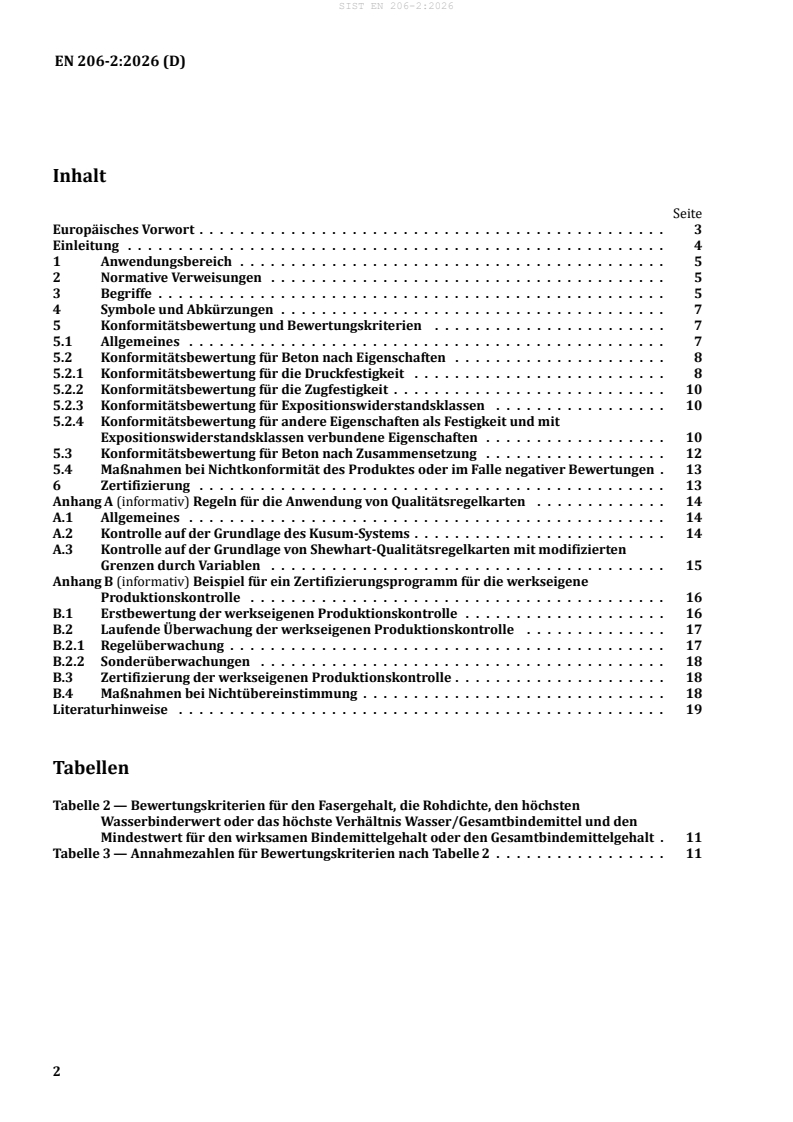
Inhalt
Seite
Europäisches Vorwort . 3
Einleitung . . . . . 4
1 Anwendungsbereich . 5
2 Normative Verweisungen . 5
3 Begriffe . . . . 5
4 Symbole und Abkürzungen . . 7
5 Konformitätsbewertung und Bewertungskriterien . 7
5.1 Allgemeines . . 7
5.2 Konformitätsbewertung für Beton nach Eigenschaften . 8
5.2.1 Konformitätsbewertung für die Druckfestigkeit . 8
5.2.2 Konformitätsbewertung für die Zugfestigkeit . 10
5.2.3 Konformitätsbewertung für Expositionswiderstandsklassen . 10
5.2.4 Konformitätsbewertung für andere Eigenschaften als Festigkeit und mit
Expositionswiderstandsklassen verbundene Eigenschaften . 10
5.3 Konformitätsbewertung für Beton nach Zusammensetzung . 12
5.4 Maßnahmen bei Nichtkonformität des Produktes oder im Falle negativer Bewertungen . 13
6 Zertifizierung . 13
AnhangA (informativ) Regeln für die Anwendung von Qualitätsregelkarten . 14
A.1 Allgemeines . . 14
A.2 Kontrolle auf der Grundlage des Kusum-Systems . 14
A.3 Kontrolle auf der Grundlage von Shewhart-Qualitätsregelkarten mit modifizierten
Grenzen durch Variablen . 15
AnhangB (informativ) Beispiel für ein Zertifizierungsprogramm für die werkseigene
Produktionskontrolle . . 16
B.1 Erstbewertung der werkseigenen Produktionskontrolle . 16
B.2 Laufende Überwachung der werkseigenen Produktionskontrolle . 17
B.2.1 Regelüberwachung . . 17
B.2.2 Sonderüberwachungen . . 18
B.3 Zertifizierung der werkseigenen Produktionskontrolle . 18
B.4 Maßnahmen bei Nichtübereinstimmung . 18
Literaturhinweise . . 19
Tabellen
Tabelle 2— Bewertungskriterien für den Fasergehalt, die Rohdichte, den höchsten
Wasserbinderwert oder das höchste Verhältnis Wasser/Gesamtbindemittel und den
Mindestwert für den wirksamen Bindemittelgehalt oder den Gesamtbindemittelgehalt . 11
Tabelle 3— Annahmezahlen für Bewertungskriterien nach Tabelle2 . 11
Europäisches Vorwort
Dieses Dokument (EN206-2:2026) wurde vom Technischen Komitee CEN/TC104 „Beton und zugehörige Pro-
dukte“ erarbeitet, dessen Sekretariat von SN gehalten wird.
Diese Europäische Norm muss den Status einer nationalen Norm erhalten, entweder durch Veröffentlichung
eines identischen Textes oder durch Anerkennung bis September2026, und etwaige entgegenstehende natio-
nale Normen müssen bis September2026 zurückgezogen werden.
Es wird auf die Möglichkeit hingewiesen, dass einige Elemente dieses Dokuments Patentrechte berühren kön-
nen. CEN ist nicht dafür verantwortlich, einige oder alle diesbezüglichen Patentrechte zu identifizieren.
Dieses Dokument, zusammen mit EN206-1:2026 und EN206-3:2026, ersetzt EN206:2013+A2:2021.
Die NormenreiheEN206 besteht unter dem allgemeinen Titel Beton— Festlegung, Eigenschaften, Herstellung
und Konformität aus den folgenden Teilen:
— Teil1: Eigenschaften, Anforderungen, werkseigene Produktionskontrolle und Bewertungskriterien für ein-
zelne Werte;
— Teil2: Konformitätsbewertung und Zertifizierung;
— Teil3: Zusätzliche Anforderungen an die Festlegung und Konformität von Beton für spezielle geotechnische
Arbeiten
Rückmeldungen oder Fragen zu diesem Dokument sollten an das jeweilige nationale Normungsinstitut des
Anwenders gerichtet werden. Eine vollständige Liste dieser Institute ist auf den Internetseiten von CEN abruf-
bar.
Entsprechend der CEN-CENELEC-Geschäftsordnung sind die nationalen Normungsinstitute der folgenden
Länder gehalten, diese Europäische Norm zu übernehmen: Belgien, Bulgarien, Dänemark, Deutschland, die
Republik Nordmazedonien, Estland, Finnland, Frankreich, Griechenland, Irland, Island, Italien, Kroatien,
Lettland, Litauen, Luxemburg, Malta, Niederlande, Norwegen, O�sterreich, Polen, Portugal, Rumänien, Schwe-
den, Schweiz, Serbien, Slowakei, Slowenien, Spanien, Tschechische Republik, Türkei, Ungarn, Vereinigtes
Königreich und Zypern.
Einleitung
0.1 Allgemeines
Dieses Dokument legt Regeln für die Konformitätsbewertung von Beton fest.
EN206-1 enthält die notwendigen Angaben, welche die Beurteilung der Konformität von Beton erlauben. Die-
ses Dokument, d.h. EN206-2:2026, enthält Anforderungen an die Konformitätsbewertung von Beton.
0.2 Am Ort der Verwendung geltende Regeln bezüglich EN206-2
(1)Dieses Dokument wird unter unterschiedlichen gesetzlichen Rahmenbedingungen und unterschiedlichen
regionalen Sicherheitsanforderungen angewendet werden. Wenn allgemeine Lösungen nicht möglich waren,
lassen die einschlägigen Abschnitte die Anwendung von Regeln zu, die am Ort der Verwendung des Betons
gelten.
(2)Nationale Festlegungen sind in diesem Dokument zulässig, wenn ausdrücklich angegeben ist, dass am Ort
der Verwendung gültige Regeln angegeben werden dürfen.
(3)Die nationale Norm zur Umsetzung von EN206-2 kann einen Nationalen Anhang oder eine ergänzende
Norm enthalten, die alle nationalen Festlegungen beinhalten, die in dem jeweiligen Land anzuwenden sind.
(4)Nationale Festlegungen werden in EN206-2 in den folgenden (Unter)-Abschnitten zugelassen:
5.1 (4) 5.2.1.3 (5) 5.2.4.1 (1) 6 (1)
ANMERKUNG Der Nationale Anhang kann direkt oder durch Verweisung widerspruchsfreie ergänzende Informationen
zur Erleichterung der Umsetzung enthalten, sofern diese keine Festlegungen dieses Dokuments ändern.
1 Anwendungsbereich
(1)Dieses Dokument legt das Programm für die Konformitätsbewertung sowie Bewertungskriterien für Beton
fest.
(2)Das Dokument stellt technische Regeln für die Bewertung der Leistungsfähigkeit des Betons sowie zu befol-
gende Maßnahmen bereit, die im Falle einer Nichtkonformität des Produkts oder einer negativen Bewertung
zu ergreifen sind.
(3)Dieses Dokument enthält Regeln und Anleitungen für die Zertifizierung der werkseigenen Produktionskon-
trolle und des Betons.
2 Normative Verweisungen
Die folgenden Dokumente werden im Text in solcher Weise in Bezug genommen, dass einige Teile davon oder
ihr gesamter Inhalt Anforderungen des vorliegenden Dokuments darstellen. Bei datierten Verweisungen gilt
nur die in Bezug genommene Ausgabe. Bei undatierten Verweisungen gilt die letzte Ausgabe des in Bezug
genommenen Dokuments (einschließlich aller A�nderungen).
EN206-1:2026, Beton— Festlegung, Eigenschaften, Herstellung und Konformität— Teil1: Eigenschaften,
Anforderungen, werkseigene Produktionskontrolle und Bewertungskriterien für einzelne Werte
EN12350-1, Prüfung von Frischbeton— Teil1: Probenahme und Prüfgeräte
EN12390-7, Prüfung von Festbeton— Teil7: Rohdichte von Festbeton
3 Begriffe
Für die Anwendung dieses Dokuments gelten die Begriffe nach EN206-1 sowie die folgenden Begriffe.
ISO und IEC stellen terminologische Datenbanken für die Verwendung in der Normung unter den folgenden
Adressen bereit:
— IEC Electropedia: verfügbar unter https://www.electropedia.org/
— ISO Online Browsing Platform: verfügbar unter https://www.iso.org/obp
3.1
Durchschlupf
AOQ
Prozentsatz der unbekannten Verteilung unterhalb des erforderlichen charakteristischen Wertes, multipliziert
mit der entsprechenden Annahmewahrscheinlichkeit dieser Verteilung bei Anwendung der festgelegten Vor-
gehensweise zur Konformitätsbeurteilung
Anmerkung1 zum Begriff: Im Falle der Festigkeit bezieht sich das Wort „erforderlich“ auf die charakteristische Festig-
keit für die festgelegte Druckfestigkeitsklasse oder auf die charakteristische Festigkeit des Referenzbetons der Familie.
fr qualité moyenne après contrôle AOQ
en average outgoing quality AOQ
3.2
maximaler Durchschlupf
AOQL
größter durchschnittlicher Anteil unterhalb des erforderlichen charakteristischen Werts des angenommenen
(bzw. ausgelieferten) Betons
fr limite de la qualité moyenne après contrôle AOQL
en average outgoing quality limit
3.3
annehmbare Qualitätsgrenze
AQL
Anteil der unbekannten Verteilung einer betrachteten Eigenschaft, der unterhalb eines festgelegten Werts liegt
und in Bezug auf die Produktion des Betons als annehmbar angesehen wird
fr niveau de qualité acceptable NQA
en acceptable quality level AQL
3.4
Akkreditierung
Bestätigung durch eine dritte Seite, die formal darlegt, dass eine Konformitätsbewertungsstelle die Kompe-
tenz, Unparteilichkeit sowie einheitliche Arbeitsweise besitzt, bestimmte Konformitätsbewertungstätigkeiten
durchzuführen
[QUELLE: ENISO/IEC17000:2020, 7.7]
3.5
Zertifizierung
Bestätigung durch eine dritte Seite, bezogen auf einen Gegenstand der Konformitätsbewertung, ausgenommen
Akkreditierung
[QUELLE: ENISO/IEC17000:2020, 7.6]
3.6
Zertifizierungsprogramm
Zertifizierungssystem, das sich auf bestimmte Produkte bezieht, auf welche dieselben festgelegten Anforde-
rungen, spezifischen Regeln und Verfahren angewendet werden
Anmerkung1 zum Begriff: Die Regeln, Verfahren sowie Leitung und Lenkung der Zertifizierung von Produkten, Prozes-
sen und Dienstleistungen werden durch das Zertifizierungsprogramm festgelegt.
[QUELLE: ENISO/IEC17065:2012, 3.9, modifiziert– Anmerkung1, Anmerkung2 und Anmerkung4 zum
Begriff wurden gelöscht.]
3.7
Konformitätsbewertung
Darlegung, dass festgelegte Anforderungen erfüllt sind
[QUELLE: ENISO/IEC17000:2020, 4.1, modifiziert– Anmerkungen zum Begriff wurden gelöscht.]
3.8
Konformitätsbewertungsstelle
Stelle, die Konformitätsbewertungstätigkeiten durchführt, jedoch keine Akkreditierung
[QUELLE: ENISO/IEC17000:2020, 4.6]
3.9
Erklärung
Bestätigung durch eine erste Seite
[QUELLE: ENISO/IEC17000:2020, 7.5]
3.10
Nachweise
Bestätigung durch U�berprüfung objektiver Erkenntnisse, dass die festgelegten Anforderungen erfüllt worden
sind
fr vérification
en verification
4 Symbole und Abkürzungen
Für die Anwendung dieses Dokuments gelten die folgenden Symbole und Abkürzungen.
AOQ Durchschlupf
AOQL maximaler Durchschlupf
AQL annehmbare Qualitätsgrenze
DoPC Leistungs- und Konformitätserklärung
f Betondruckfestigkeit, bestimmt durch Prüfung von Würfeln
c,cube
f Betondruckfestigkeit, bestimmt durch Prüfung von Zylindern
c,cyl
f charakteristische Betondruckfestigkeit
ck
ANMERKUNG1 Bei Anwendung in diesem Dokument gilt dies sowohl für f als auch für f .
ck,cyl ck,cube
f charakteristische Betondruckfestigkeit, geprüft am Würfel
ck,cube
f charakteristische Betondruckfestigkeit, geprüft am Zylinder
ck,cyl
f mittlere Druckfestigkeit des Betons
cm
ANMERKUNG2 Bei Anwendung in diesem Dokument gilt dies sowohl für f als auch für f .
cm,cyl cm,cube
f mittlere Druckfestigkeit des Betons im Alter von (j) Tagen
cm,j
n Anzahl
σ Schätzwert für die Standardabweichung einer Grundgesamtheit
5 Konformitätsbewertung und Bewertungskriterien
5.1 Allgemeines
(1)Konformitätsbewertung umfasst die Kombination von Handlungen und Entscheidungen, die in U�berein-
stimmung mit im Voraus angenommenen Regeln über die Konformität durchgeführt bzw. getroffen werden
müssen, um die Konformität des Betons mit seiner Festlegung zu bewerten.
ANMERKUNG1 Die Betoneigenschaften, die bei der Konformitätsbewertung berücksichtigt werden, sind mit genorm-
ten Prüfverfahren gemessene Eigenschaften. Die tatsächlichen Werte der Betoneigenschaften im Bauwerk können von
den anhand der Prüfungen ermittelten abweichen, abhängig von z.B. Abmessungen des Bauwerks, Einbringen, Verdich-
ten, Nachbehandeln und klimatischen Bedingungen.
(2)Sind Prüfungen zur werkseigenen Produktionskontrolle nach EN206-1 dieselben wie die für die Konformi-
tätsbewertung geforderten, dann dürfen sie für die Bewertung der Konformität herangezogen werden. Andere
Prüfdaten zum gelieferten Beton dürfen ebenfalls bei der Konformitätsbewertung angewendet werden.
(3)Die Konformität oder Nichtkonformität wird durch Vergleich mit den Konformitätskriterien beurteilt. Eine
Konformitätsbewertung durch eine andere Partei als den Hersteller gilt für den gelieferten Beton und nicht für
die gesamte Produktion. Nichtkonformität muss zu weiteren Maßnahmen am Ort der Herstellung und auf der
Baustelle führen (siehe 5.4).
(4)Die am Ort der Verwendung geltenden Regeln dürfen zusätzliche Regeln zur Kenntnis, zur Schulung und
Erfahrung des für die verschiedenen Bewertungsaufgaben zuständigen Personals enthalten.
ANMERKUNG2 Das Ergebnis der Konformitätsbewertung hängt von der Seite ab, die die Konformität oder Ergebnisse
bewertet. Das Ergebnis einer Konformitätsbewertung durch den Hersteller ist eine Leistungs- und Konformitätserklärung
(DoPC, en: declaration of performance and conformity). Die Bewertung durch eine Zweitpartei führt zu einem Bericht über
die Bewertung. Das Ergebnis einer Bewertung durch eine Drittpartei ist ein Bericht über die Bewertung und eine freige-
stellte Zertifizierung durch die Drittpartei. Positive Bewertung durch Zweit- und Drittparteien erhöhen das Vertrauen in
die Leistungs- und Konformitätserklärung (DoPC). Negative Bewertungen führen zu Zweifeln an der DoPC und zur Einlei-
tung einer Reihe von Maßnahmen.
5.2 Konformitätsbewertung für Beton nach Eigenschaften
5.2.1 Konformitätsbewertung für die Druckfestigkeit
5.2.1.1 Allgemeines
(1)Für den Probenahme- und Prüfplan und die Bewertungskriterien wird zwischen Erstherstellung und ste-
tiger Herstellung unterschieden.
(2)Die Erstherstellung betrifft die Herstellung bis zum Erreichen von mindestens 35Prüfergebnissen.
(3)Stetige Herstellung ist erreicht, wenn innerhalb eines Zeitraumes von nicht mehr als 12 Monaten mindes-
tens 35 Prüfergebnisse erhalten wurden.
(4)Wenn die Herstellung für mehr als 12Monate unterbrochen wurde, müssen die Kriterien sowie der
Probenahme- und Prüfplan, die für die Erstherstellung angegeben sind, übernommen werden.
(5)Während der stetigen Herstellung dürfen der Probenahme- und Prüfplan und die Kriterien für die Ersther-
stellung übernommen werden.
(6)Sofern nicht anders festgelegt, ist die Druckfestigkeit an Probekörpern im Alter von 28 Tagen zu bestimmen.
5.2.1.2 Probenahme und Prüfung
(1)Das Prüfergebnis muss das an einem einzelnen Probekörper erzielte Ergebnis sein oder der Mittelwert der
Ergebnisse, wenn zwei oder mehr aus einer Probe hergestellte Probekörper im selben Alter geprüft werden.
(2)Wenn zwei oder mehrere Probekörper aus einer Probe hergestellt werden und die Variationsbreite der
Prüfwerte mehr als 15% des Mittelwertes beträgt, müssen die Ergebnisse außer Betracht bleiben, falls nicht
eine Untersuchung einen annehmbaren Grund für das Verwerfen eines einzelnen Prüfwertes ergibt.
5.2.1.3 Bewertungskriterien für die Druckfestigkeit
(1)Das Erreichen der festgelegten charakteristischen Festigkeit ist durch eines der folgenden Verfahren zu
beurteilen:
Verfahren A: Erstherstellung
(2)Die mittlere Festigkeit von drei aufeinanderfolgenden Ergebnissen für nicht überlappende oder überlap-
pende Gruppen muss die folgende Bedingung erfüllen:
𝑓 ≥(𝑓 + 4) N/mm (1)
𝑐𝑚 𝑐𝑘
ANMERKUNG1 Die Bewertungskriterien wurden auf der Grundlage von nicht überlappenden Ergebnissen entwickelt.
Die Anwendung der Kriterien auf überlappende Prüfergebnisse erhöht das Risiko der Zurückweisung.
Verfahren B: Stetige Herstellung
(3)Die Konformitätsbewertung muss auf der Grundlage von Prüfergebnissen erfolgen, die während eines
Bewertungszeitraums erhalten wurden, der abhängig von der Prüfhäufigkeit den durch eine der folgenden
Möglichkeiten vorgegebenen Zeitraum nicht überschreiten darf:
— für Herstellwerke mit niedrigerer Prüfhäufigkeit (Anzahl der Prüfergebnisse für Beton nach Eigenschaften
weniger als 35 innerhalb von drei Monaten) muss der Nachweiszeitraum mindestens 15 Ergebnisse und
höchstens 35aufeinanderfolgende Ergebnisse umfassen, die über einen Zeitraum von höchstens 6 Mona-
ten erhalten wurden;
— für eine Bewertung mit höherer Prüfhäufigkeit (Anzahl der Prüfergebnisse für Beton nach Eigenschaften
mindestens 35Prüfergebnisse innerhalb von drei Monaten) muss der Bewertungszeitraum mindestens
15aufeinanderfolgende Ergebnisse umfassen, die über einen Zeitraum von höchstens dreiMonaten erhal-
ten wurden.
(4)Die mittlere Festigkeit von nicht überlappenden oder überlappenden Gruppen aufeinanderfolgender Prüf-
ergebnisse, die während eines Bewertungszeitraums für einen einzelnen Beton oder für eine Betonfamilie nach
EN206-1 erhalten wurden, muss die folgende Bedingung erfüllen:
𝑓 ≥(𝑓 + 1,48𝜎) N/mm (2)
cm ck
ANMERKUNG2 Gleichung(2) ermöglicht das Erreichen eines Durchschlupfes (AOQ) von höchstens 5,0%.
(5)Die Standardabweichung von Gleichung(2) muss der folgenden Gleichung entsprechen:
2 2
𝜒 𝜒
0,975;𝑛−1 0,025;𝑛−1
√ √
𝜎≤𝑠 ≤ 𝜎 (3)
𝑛
( ) ( )
𝑛−1 𝑛−1
Dabei ist
𝜒 ist das α-Fraktil einer Chi-Quadrat-Verteilung mit ν=n– 1 Freiheitsgraden
𝛼;𝜈
s ist die Standardabweichung von n aufeinanderfolgenden Prüfergebnissen
n
ANMERKUNG3 Tabellenwerte sind in EN206-1:2026 Tabelle20 enthalten.
Verfahren C: Anwendung von Qualitätsregelkarten
(6)VerfahrenC ist eine Möglichkeit zur Bewertung der Konformität durch Anwendung von Qualitätsregelkar-
ten, wenn Bedingungen des VerfahrensB nachgewiesen werden. Die Entscheidung zur Umsetzung von Verfah-
renC darf in am Verwendungsort geltenden Regeln angegeben werden.
(7)Das Steuerungssystem muss die Anwendung eines anerkannten Modells von Qualitätsregelkarten enthal-
ten und die folgenden Merkmale aufweisen:
— Erreichen eines Durchschlupfes (AOQ) ≤ 5,0%;
— Nachweis der Konformität der relevanten Produktion mit der erforderlichen charakteristischen Festigkeit;
— Einschließen einer regelmäßigen U�berwachung der Festigkeit und Standardabweichung oder Abweichun-
gen von Zielwerten;
— sofern zutreffend, Aufnahme eines oder mehrerer Verfahren zur Verbesserung der Leistungsfähigkeit des
Systems (z.B. Auswertung von Daten zur Frühfestigkeit, Anwendung von Betonfamilien);
— Festlegung und Anwendung von eindeutigen Entscheidungsregeln für Konformitäts- und Warngrenzen;
— wenn die Qualitätsregelkarte zeigt, dass die Standardabweichung den aktuell verwendeten Wert um
≥0,5N/mm übersteigt, wird der verwendete Wert geändert.
ANMERKUNG4 Da eine Qualitätsregelkarte aufeinanderfolgende Probenahmepläne (mit bekannter Standardabwei-
chung) umfasst, kann die Operationscharakteristik eines einzelnen Probenahmeplans ermittelt werden. AOQ wird dann
durch Multiplikation des Prozentsatzes an möglichen Ergebnissen unterhalb der erforderlichen charakteristischen Fes-
tigkeit der Produktion mit der entsprechenden Annahmewahrscheinlichkeit bestimmt.
ANMERKUNG5 AnhangA enthält ein Verfahren für die Anwendung von Qualitätsregelkarten nach dem Kusum-
Verfahren und dem Shewhart-Verfahren mit Beispielen für Konformitätsregeln, mit denen ein maximaler Durchschlupf
von≤5,0% erreicht wird. Hinweise zu anderen Werten als den in AnhangA angegebenen sind in CEN/TR16369
enthalten, der hinsichtlich Qualitätsregelkarten nach dem Kusum-Verfahren auf dem Papier von Caspeel und Taerwe[15]
basiert.
5.2.2 Konformitätsbewertung für die Zugfestigkeit
(1)Die am Ort der Verwendung geltenden Regeln dürfen zusätzliche Regeln für die Konformitätsbewertung
der Zugfestigkeit enthalten.
5.2.3 Konformitätsbewertung für Expositionswiderstandsklassen
(1)Die am Ort der Verwendung geltenden Regeln dürfen zusätzliche Regeln für die Konformitätsbewertung
der Expositionswiderstandsklassen von Beton enthalten.
5.2.4 Konformitätsbewertung für andere
...