

EN 13555:2021
(Main)Flanges and their joints - Gasket parameters and test procedures relevant to the design rules for gasketed circular flange connections
- Abstract
This document specifies the gasket parameters required by EN 1591-1 and provides the test procedures for establishing the values of these parameters.
Gaskets which are wholly based upon elastomers, or based upon elastomers with only the inclusion of particulate fillers or particulate reinforcement, as opposed to gaskets combining elastomers, fillers and fibrous reinforcement, are beyond the scope of this document.
NOTE The testing procedures given might be applicable to gaskets of other shapes and dimensions.
- Status
- Published
- Publication Date
- 09-Feb-2021
- Withdrawal Date
- 30-Aug-2021
- Technical Committee
- CEN/TC 74 - Flanges and their joints
- Drafting Committee
- CEN/TC 74/WG 8 - Gaskets
- Current Stage
- 9060 - Closure of 2 Year Review Enquiry - Review Enquiry
- Start Date
- 02-Sep-2026
- Completion Date
- 02-Sep-2026



Overview
EN 13555:2021 - "Flanges and their joints - Gasket parameters and test procedures relevant to the design rules for gasketed circular flange connections" (CEN) specifies the gasket parameters required by EN 1591‑1 and the standardized test procedures to establish those values. The standard provides a test framework for generating the sealing and mechanical characteristics used in the calculation and design of gasketed circular flange connections. Note: gaskets made wholly of elastomers (or elastomers with only particulate fillers/reinforcement) are outside the scope.
Key topics
- Gasket parameters defined - includes sealing parameters and mechanical/thermal properties used by EN 1591‑1, for example:
- Sealing pressure parameters (Q, Qmin(L), Qsmin(L), Qsmax)
- Relaxation/load factor (PR)
- Unloading modulus (EG)
- Creep (ΔeGc)
- Axial coefficient of thermal expansion (αG)
- Static friction coefficient (µG)
- Assembly surface pressure (QA)
- Standardized test procedures - methods for measuring:
- Compression curves and compression creep
- Determination of Q (sealing parameter) at ambient and elevated temperatures
- Leakage measurement and transferability to service conditions
- Measurement of gasket thickness, dimensions and surface finish effects
- Static friction and thermal expansion tests
- Test rig and equipment guidance - design of platens, metal foils, measurement techniques and schematic annexes for compression, leakage and other test rigs.
- Reporting and interpretation - required test report details and guidance (informative Annex I) for interpreting results and acceptable modification of measured characteristics.
- Exclusions & applicability - type-testing procedures primarily; not intended for routine QC. Procedures may be applicable to other gasket shapes/dimensions.
Applications / Who uses this standard
- Design engineers using EN 1591‑1 for flange connection calculations - to obtain validated gasket parameters for accurate gasketed flange design.
- Gasket manufacturers - for type testing and providing certified parameter data to customers.
- Testing laboratories - to perform reproducible compression, leakage and thermal/creep testing.
- Piping/vessel engineers and asset owners - to select and verify gasket materials for process conditions (pressure, temperature, leakage class).
- Quality and certification bodies - for conformity assessment and technical documentation.
Related standards (applicable)
- EN 1591‑1 (design rules for gasketed circular flange connections)
- EN 1092‑1, EN 1759‑1 (flanges)
- EN 1514 / EN 12560 series (gasket dimensions and types)
- EN 1779 (leak testing criteria)
Keywords: EN 13555:2021, gasket parameters, gasket test procedures, flange connections, EN 1591‑1, sealing parameter Q, compression creep, leakage measurement.
Relations
- Effective Date
- 17-Feb-2021
- Refers
EN 1779:2026 - Non-destructive testing - Leak testing - Criteria for method and technique selection - Effective Date
- 14-Oct-2026
- Effective Date
- 28-Jan-2026
- Effective Date
- 28-Jan-2026
- Effective Date
- 28-Jan-2026
- Effective Date
- 28-Jan-2026
- Effective Date
- 28-Jan-2026
- Effective Date
- 28-Jan-2026
- Effective Date
- 28-Jan-2026
- Effective Date
- 28-Jan-2026
- Effective Date
- 28-Jan-2026
- Refers
EN 1779:1999 - Non-destructive testing - Leak testing - Criteria for method and technique selection - Effective Date
- 28-Jan-2026
- Effective Date
- 28-Jan-2026
- Effective Date
- 28-Jan-2026
- Effective Date
- 28-Jan-2026
Get Certified
Connect with accredited certification bodies for this standard

Institut za varilstvo d.o.o. (Welding Institute)
Slovenia's leading welding institute since 1952. ISO 3834, EN 1090, pressure equipment certification, NDT personnel, welder qualification. Only IIW Au
Sponsored listings
Frequently Asked Questions
EN 13555:2021 is a standard published by the European Committee for Standardization (CEN). Its full title is "Flanges and their joints - Gasket parameters and test procedures relevant to the design rules for gasketed circular flange connections". This standard covers: This document specifies the gasket parameters required by EN 1591-1 and provides the test procedures for establishing the values of these parameters. Gaskets which are wholly based upon elastomers, or based upon elastomers with only the inclusion of particulate fillers or particulate reinforcement, as opposed to gaskets combining elastomers, fillers and fibrous reinforcement, are beyond the scope of this document. NOTE The testing procedures given might be applicable to gaskets of other shapes and dimensions.
This document specifies the gasket parameters required by EN 1591-1 and provides the test procedures for establishing the values of these parameters. Gaskets which are wholly based upon elastomers, or based upon elastomers with only the inclusion of particulate fillers or particulate reinforcement, as opposed to gaskets combining elastomers, fillers and fibrous reinforcement, are beyond the scope of this document. NOTE The testing procedures given might be applicable to gaskets of other shapes and dimensions.
EN 13555:2021 is classified under the following ICS (International Classification for Standards) categories: 23.040.60 - Flanges, couplings and joints; 23.040.80 - Seals for pipe and hose assemblies. The ICS classification helps identify the subject area and facilitates finding related standards.
EN 13555:2021 has the following relationships with other standards: It is inter standard links to EN 13555:2014, EN 1779:2026, EN 1514-6:2003, EN 12560-3:2001, EN 12560-7:2004, EN 1514-1:2024, EN 1514-4:1997, EN 1591-1:2013, EN 1514-3:1997, EN 12560-6:2003, EN 1514-2:2014+A1:2021, EN 1779:1999, EN 1514-7:2004, EN 12560-1:2024, EN 12560-5:2001. Understanding these relationships helps ensure you are using the most current and applicable version of the standard.
EN 13555:2021 is available in PDF format for immediate download after purchase. The document can be added to your cart and obtained through the secure checkout process. Digital delivery ensures instant access to the complete standard document.
Standards Content (Sample)
SLOVENSKI STANDARD
01-april-2021
Nadomešča:
SIST EN 13555:2014
Prirobnice in prirobnični spoji - Preskusni postopki in parametri tesnil, ki so
potrebni za konstruiranje prirobničnih spojev, sestavljenih iz okroglih prirobnic in
tesnil
Flanges and their joints - Gasket parameters and test procedures relevant to the design
rules for gasketed circular flange connections
Flansche und ihre Verbindungen - Dichtungskennwerte und Prüfverfahren für die
Anwendung der Regeln für die Auslegung von Flanschverbindungen mit runden
Flanschen und Dichtungen
Brides et leurs assemblages - Paramètres de joints et procédures d'essai relatives aux
règles de calcul des assemblages à brides circulaires avec joint
Ta slovenski standard je istoveten z: EN 13555:2021
ICS:
23.040.60 Prirobnice, oglavki in spojni Flanges, couplings and joints
elementi
23.040.80 Tesnila za cevne zveze Seals for pipe and hose
assemblies
2003-01.Slovenski inštitut za standardizacijo. Razmnoževanje celote ali delov tega standarda ni dovoljeno.
EN 13555
EUROPEAN STANDARD
NORME EUROPÉENNE
February 2021
EUROPÄISCHE NORM
ICS 23.040.60; 23.040.80 Supersedes EN 13555:2014
English Version
Flanges and their joints - Gasket parameters and test
procedures relevant to the design rules for gasketed
circular flange connections
Brides et leurs assemblages - Paramètres de joints et Flansche und ihre Verbindungen - Dichtungskennwerte
procédures d'essai relatives aux règles de calcul des und Prüfverfahren für die Anwendung der Regeln für
assemblages à brides circulaires avec joint die Auslegung von Flanschverbindungen mit runden
Flanschen und Dichtungen
This European Standard was approved by CEN on 27 December 2020.
CEN members are bound to comply with the CEN/CENELEC Internal Regulations which stipulate the conditions for giving this
European Standard the status of a national standard without any alteration. Up-to-date lists and bibliographical references
concerning such national standards may be obtained on application to the CEN-CENELEC Management Centre or to any CEN
member.
This European Standard exists in three official versions (English, French, German). A version in any other language made by
translation under the responsibility of a CEN member into its own language and notified to the CEN-CENELEC Management
Centre has the same status as the official versions.
CEN members are the national standards bodies of Austria, Belgium, Bulgaria, Croatia, Cyprus, Czech Republic, Denmark, Estonia,
Finland, France, Germany, Greece, Hungary, Iceland, Ireland, Italy, Latvia, Lithuania, Luxembourg, Malta, Netherlands, Norway,
Poland, Portugal, Republic of North Macedonia, Romania, Serbia, Slovakia, Slovenia, Spain, Sweden, Switzerland, Turkey and
United Kingdom.
EUROPEAN COMMITTEE FOR STANDARDIZATION
COMITÉ EUROPÉEN DE NORMALISATION
EUROPÄISCHES KOMITEE FÜR NORMUNG
CEN-CENELEC Management Centre: Rue de la Science 23, B-1040 Brussels
© 2021 CEN All rights of exploitation in any form and by any means reserved Ref. No. EN 13555:2021 E
worldwide for CEN national Members.
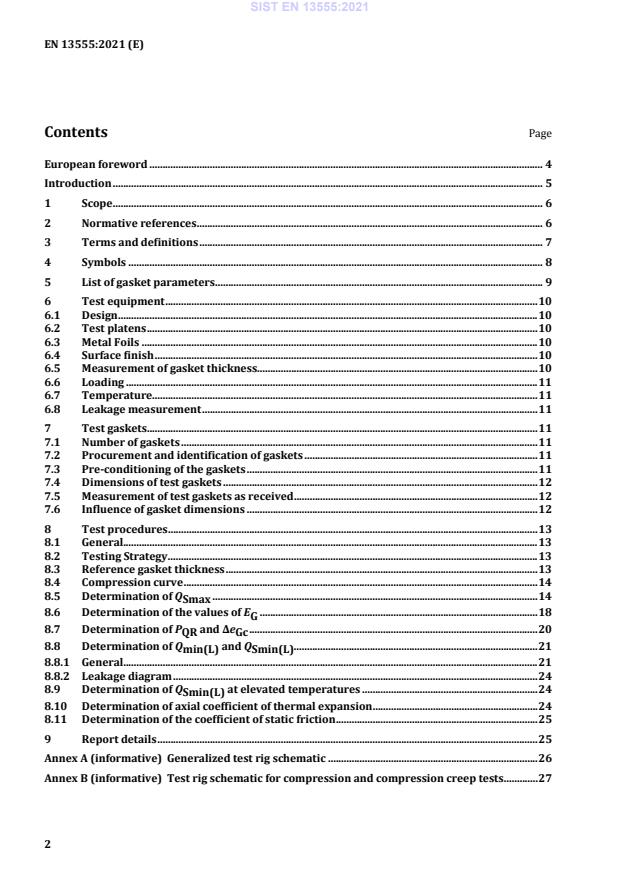
Contents Page
European foreword . 4
Introduction . 5
1 Scope . 6
2 Normative references . 6
3 Terms and definitions . 7
4 Symbols . 8
5 List of gasket parameters . 9
6 Test equipment . 10
6.1 Design . 10
6.2 Test platens . 10
6.3 Metal Foils . 10
6.4 Surface finish . 10
6.5 Measurement of gasket thickness . 10
6.6 Loading . 11
6.7 Temperature. 11
6.8 Leakage measurement . 11
7 Test gaskets . 11
7.1 Number of gaskets . 11
7.2 Procurement and identification of gaskets . 11
7.3 Pre-conditioning of the gaskets . 11
7.4 Dimensions of test gaskets . 12
7.5 Measurement of test gaskets as received . 12
7.6 Influence of gasket dimensions . 12
8 Test procedures . 13
8.1 General. 13
8.2 Testing Strategy . 13
8.3 Reference gasket thickness . 13
8.4 Compression curve . 14
8.5 Determination of Q . 14
Smax
8.6 Determination of the values of E . 18
G
8.7 Determination of P and Δe . 20
QR Gc
8.8 Determination of Q and Q . 21
min(L) Smin(L)
8.8.1 General. 21
8.8.2 Leakage diagram . 24
8.9 Determination of Q at elevated temperatures . 24
Smin(L)
8.10 Determination of axial coefficient of thermal expansion . 24
8.11 Determination of the coefficient of static friction . 25
9 Report details . 25
Annex A (informative) Generalized test rig schematic . 26
Annex B (informative) Test rig schematic for compression and compression creep tests . 27
Annex C (informative) Test rig schematic for ambient temperature leakage measurement . 28
Annex D (informative) Schematic of leakage rig allowing use of interchangeable face plate . 29
Annex E (informative) Transferability of measured leakage rates to service conditions . 30
Annex F (informative) The measurement of the sealing parameter Q after long
Smin(L)
term service simulating exposure to elevated temperature . 31
Annex G (informative) Determination of the sealing characteristics of strip sealing
materials available in coil form . 33
Annex H (informative) Proposed method for the determination of the coefficient of static
friction, µ , of gaskets . 34
G
Annex I (informative) Guideline for interpretation of test results and acceptable
modification of measured characteristics . 36
Bibliography . 40
European foreword
This document (EN 13555:2021) has been prepared by Technical Committee CEN/TC 74 “Flanges and
their joints”, the secretariat of which is held by DIN.
This European Standard shall be given the status of a national standard, either by publication of an
identical text or by endorsement, at the latest by August 2021, and conflicting national standards shall
be withdrawn at the latest by August 2021.
Attention is drawn to the possibility that some of the elements of this document may be the subject of
patent rights. CEN shall not be held responsible for identifying any or all such patent rights.
This document supersedes EN 13555:2014.
In comparison with the previous edition, the following technical modifications have been made:
a) in Clause 2 the list of normative references has been revised;
b) in Clause 3 the list of definitions has been revised;
c) in Clause 5 the list of gasket parameters has been revised;
d) in 8.5 on the determination of Q has been revised;
Smax
e) a new informative Annex I on the guideline for interpretation of test results and acceptable
modification of measured characteristics has been added.
According to the CEN-CENELEC Internal Regulations, the national standards organisations of the
following countries are bound to implement this European Standard: Austria, Belgium, Bulgaria,
Croatia, Cyprus, Czech Republic, Denmark, Estonia, Finland, France, Germany, Greece, Hungary, Iceland,
Ireland, Italy, Latvia, Lithuania, Luxembourg, Malta, Netherlands, Norway, Poland, Portugal, Republic of
North Macedonia, Romania, Serbia, Slovakia, Slovenia, Spain, Sweden, Switzerland, Turkey and the
United Kingdom.
Introduction
This document provides the test procedures to allow the generation of the gasket parameters to enable
the design formulas established in EN 1591-1 to be employed. The same test procedures may be used
for “Type Testing” of gaskets and gasket materials. These procedures are not for routine quality control
purposes.
1 Scope
This document specifies the gasket parameters required by EN 1591-1 and provides the test
procedures for establishing the values of these parameters.
Gaskets which are wholly based upon elastomers, or based upon elastomers with only the inclusion of
particulate fillers or particulate reinforcement, as opposed to gaskets combining elastomers, fillers and
fibrous reinforcement, are beyond the scope of this document.
NOTE The testing procedures given might be applicable to gaskets of other shapes and dimensions.
2 Normative references
The following documents are referred to in the text in such a way that some or all of their content
constitutes requirements of this document. For dated references, only the edition cited applies. For
undated references, the latest edition of the referenced document (including any amendments) applies.
EN 1092-1, Flanges and their joints - Circular flanges for pipes, valves, fittings and accessories, PN
designated - Part 1: Steel flanges
EN 1514-1, Flanges and their joints - Dimensions of gaskets for PN-designated flanges - Part 1: Non-
metallic flat gaskets with or without inserts
EN 1514-2, Flanges and their joints - Gaskets for PN-designated flanges - Part 2: Spiral wound gaskets for
use with steel flanges
EN 1514-3, Flanges and their joints - Dimensions of gaskets for PN-designated flanges - Part 3: Non-
metallic PTFE envelope gaskets
EN 1514-4, Flanges and their joints - Dimensions of gaskets for PN-designated flanges - Part 4:
Corrugated, flat or grooved metallic and filled metallic gaskets for use with steel flanges
EN 1514-6, Flanges and their joints - Dimensions of gaskets for PN-designated flanges - Part 6: Covered
serrated metal gaskets for use with steel flanges
EN 1514-7, Flanges and their joints - Gaskets for PN-designated flanges - Part 7: Covered metal jacketed
gaskets for use with steel flanges
EN 1591-1:2013, Flanges and their joints - Design rules for gasketed circular flange connections - Part 1:
Calculation
EN 1759-1, Flanges and their joint - Circular flanges for pipes, valves, fittings and accessories, Class
designated - Part 1: Steel flanges, NPS 1/2 to 24
EN 1779, Non-destructive testing - Leak testing - Criteria for method and technique selection
EN 12560-1, Flanges and their joints - Gaskets for Class-designated flanges - Part 1: Non-metallic flat
gaskets with or without inserts
EN 12560-2, Flanges and their joints - Dimensions of gaskets for Class-designated flanges - Part 2: Spiral
wound gaskets for use with steel flanges
EN 12560-3, Flanges and their joints - Gaskets for Class-designated flanges - Part 3: Non-metallic PTFE
envelope gaskets
EN 12560-4, Flanges and their joints - Gaskets for Class-designated flanges - Part 4: Corrugated, flat or
grooved metallic and filled metallic gaskets for use with steel flanges
EN 12560-5, Flanges and their joints - Gaskets for Class-designated flanges - Part 5: Metallic ring joint
gaskets for use with steel flanges
EN 12560-6, Flanges and their joints - Gaskets for Class-designated flanges - Part 6: Covered serrated
metal gaskets for use with steel flanges
EN 12560-7, Flanges and their joints - Gaskets for Class-designated flanges - Part 7: Covered metal
jacketed gaskets for use with steel flanges
3 Terms and definitions
For the purposes of this document, the following terms and definitions apply.
ISO and IEC maintain terminological databases for use in standardization at the following addresses:
— IEC Electropedia: available at http://www.electropedia.org/
— ISO Online browsing platform: available at https://www.iso.org/obp
3.1
Q
Smax
maximum surface pressure that may be imposed on the gasket at the indicated temperatures without
collapse or “crash”, compressive failure or damage of the stressed area of the gasket such that failure is
imminent
3.2
Q
min(L)
minimum gasket surface pressure on assembly required at the ambient temperature in order to seat the
gasket into the flange facing roughness and close the internal leakage channels so that the tightness
class is to the required level L for the internal test pressure
3.3
Q
Smin(L)
minimum gasket surface pressure required under the service pressure conditions, (i.e.) after off-loading
and at the service temperature, so that the required tightness class L is maintained for the internal test
pressure
3.4
L
N
tightness classes that denotes maximum limit of defined leak rates (see Table 1)
Note 1 to entry: Additional, better, tightness classes can be introduced as required by continuing the series.
Table 1 — Tightness classes
Tightness class L L L L
N 1,0 0,1 0,01
–1 –1
≤ 1,0 ≤ 0,1 ≤ 0,01
Specific leak rate [mg s m ]
3.5
P
QR
factor allowing for the effect on the imposed load of the relaxation of the gasket between the completion
of bolt up and long term experience of the service temperature
3.6
E
G
unloading modulus of elasticity that is determined from the thickness recovery of the gasket between
the initial compression surface pressure and unloading to a third of this initial surface pressure
3.7
α
G
coefficient of thermal expansion of the gasket under the service conditions of temperature and gasket
surface pressure in the axial direction
3.8
Δe
Gc
additional change in thickness of the gasket or sealing element due to creep between the completion of
the loading and the end of the test period
3.9
µ
G
static friction factor between the gasket and the flange facing during service conditions and under
external loading
3.10
Q
A
gasket surface pressure in the assembly condition
4 Symbols
For the purposes of this document, the following notations apply.
Where units are applicable, they are shown in brackets. Where units are not applicable, no indication is
given.
α the axial coefficient of thermal expansion of gasket –1
G [K ]
µ static friction factor between the gasket and the flange facing —
G
e gasket or sealing element thickness [mm]
G
Δe change in gasket or sealing element thickness due to creep [mm]
Gc
A area of gasket subjected to surface pressure 2
G [mm ]
d internal diameter of gasket [mm]
d internal diameter of area of gasket subjected to surface pressure [mm]
s
D external diameter of gasket [mm]
D external diameter of area of gasket subjected to surface pressure [mm]
s
E unloading modulus of elasticity of the gasket [MPa]
G
L tightness class — subscript N indicates the maximum specific leakage rate –1 –
N [mg s m
for that tightness class
]
P creep relaxation factor, the ratio of the residual and initial surface —
QR
pressures
Q surface pressure [MPa]
Q gasket surface pressure at assembly prior to unloading [MPa]
A
Q the minimum level of surface pressure required for leakage rate class L on [MPa]
min(L)
assembly
Q the minimum level of surface pressure required for leakage rate class L [MPa]
Smin(L)
after off-loading
Q the maximum surface pressure that can be safely imposed upon the gasket [MPa]
Smax
at the service temperature without damage
Concordance with EN 1591-1:
Q , the gasket surface pressure at assembly is the gasket stress at the load situation 0 and is defined by
A
Q in EN 1591-1.
A
5 List of gasket parameters
The gasket parameters relevant to the calculation procedures for the design of bolted flange
connections as given in EN 1591-1 are shown in Table 2 together with the test procedures applicable
for determining the value of the parameter in each case.
Table 2 — Gasket parameters and test procedures
Gasket parameter Definition Test procedure(s)
Subclause Subclause
Q 3.1 8.5
Smax
Q 3.2 8.8
min(L)
Q 3.3 8.8 and 8.9
Smin(L)
P 3.5 8.7
QR
E 3.6 8.6
G
α 3.7 8.10
G
Δe 3.8 8.7
Gc
µ 3.9 8.11
G
6 Test equipment
6.1 Design
Schematics of test rigs for compression, creep relaxation, and tightness measurement are shown in
informative Annexes A to D, Figures A.1, B.1, C.1 and D.1. Annex A is a generalized schematic with the
other figures providing further detail for specific aspects of the tests.
6.2 Test platens
The test platens, and heater assembly where appropriate, shall be sufficiently rigid so that any load
imposed on the gasket can be withstood and so that there is no platen deformation which results in
gasket surface pressure variation. This rigidity aspect can also be important when gasket elastic
recovery is being investigated.
The dimensions of the test platen raised faces shall be as given in EN 1092-1 for a DN 40/PN 40 gasket
and EN 1759-1 for an NPS 4 CLASS 300 gasket.
For testing in tongue and groove geometries the dimensions of the test platens should be in accordance
with EN 1092-1, Form C and Form D or EN 1759-1.
6.3 Metal Foils
Experience has shown that during hot compression tests, that is the P , Q and elevated
QR Smax
temperature tightness tests, some gasket materials are likely to adhere badly enough to the test platens
during the test to cause difficulty in the removal of the gasket after the completion of the test and
damage the platen surface finish.
To avoid such damage, stainless steel foils or shims of thickness of 0,05 mm placed between the test
gasket and the platens during P and Q tests may be used.
QR Smax
Where foils or shims are used the fact of their use shall be included in the test report.
Foils or shims shall not be re-used or used in tightness tests at any temperature nor in the Coefficient of
Static Friction determination defined in 8.11 and provisionally detailed in Annex H.
6.4 Surface finish
The platen surface finish shall be within the range specified by the relevant flange standards in the
EN 1092 series and EN 1759 series. For sheet materials where the standards are EN 1092-1 and
EN 1759-1 the finish should be as specified below.
The surface finish of the test platens shall conform to the following:
3,2 µm < R < 6,3 µm
a
Exceptions to this range are acceptable where the gasket is intended for use with a surface finish
outside of this range. In this case the surface finish used shall be recorded.
Before each test, the freedom from debris from the previous test and from scratch and impact damage
to the surface finish of the platens shall be checked visually.
6.5 Measurement of gasket thickness
For those procedures where the gasket thickness shall be monitored during the test there shall be
either three displacement transducers at 120° spacing around the circumference of the platens or one
displacement transducer placed on the central line.
However, for a leak test, the use of an axial transducer is not recommended as it introduces a sealing
complication to the rig design.
6.6 Loading
Any loading means may be used that allows the gasket to be loaded and unloaded at a required and
consistent rate. The rate of loading and unloading to be used is fixed as:
0,5 MPa/s for all types of gasket except for PTFE based gaskets when 0,1 MPa/s shall be used.
The loading shall be recorded as a function of time.
6.7 Temperature
The rate of increase of temperature in all elevated temperature tests shall be 2 K/min.
6.8 Leakage measurement
EN 1779 gives the limits that can be achieved by various method of leakage measurement. The
information given in that document shall be taken into account when selecting a measurement system.
For modern, high performance, sealing materials and gasket styles, the most appropriate method of
measurement is very likely to be mass spectrometry.
7 Test gaskets
7.1 Number of gaskets
At least two gaskets for each type of test shall be tested.
NOTE More rigorous guidance on the number of repeat tests required for each test type will be available for
the next revision of this document.
7.2 Procurement and identification of gaskets
The gaskets to be tested shall be selected at random from production gaskets or shall be cut from sheet
representative of normal production. Prior to selection for test the gaskets or sheet shall have been
stored in accordance with the recommendations of the manufacturer and the time since manufacture
should be within any time limit set by the manufacturer.
Some basic checks shall be made in order to ensure that the gaskets or sheet are acceptable by the
normal quality assurance criteria before the tests to this document are carried out. The results of these
checks shall be recorded.
In all cases, full traceability to production shall be maintained.
7.3 Pre-conditioning of the gaskets
For every gasket type where the sealing element is not solid metal the gasket shall be conditioned as
indicated below before any of the tests of this document are carried out.
The test gasket shall be held for at least 48 hours in air with a relative humidity of (50 ± 6) % at ambient
temperature.
The required relative humidity can for example be generated and maintained by the use of a saturated
solution of magnesium nitrate hexahydrate, Mg (NO ) 6H O. The test gaskets that are to be held at the
3 2 2
required relative humidity should be stored above a saturated solution of the salt, containing an excess
of the solid salt, in a glass container fitted with a ground glass lid and held in an area at ambient
temperature.
The test gaskets shall be removed from the conditioning atmosphere no more than 30 min before the
test is carried out.
7.4 Dimensions of test gaskets
The test gasket dimensions shall be either of those specified in Table 3.
Table 3 — Test gasket dimensions for Raised Face Flanges
Raised face dimensions
Flange description Gasket dimensions according to
according to
DN 40/PN 40 EN 1092-1 EN 1514-1 to EN 1514-7 (according to the type of gasket)
EN 12560-1 to EN 12560-7 (according to the type of
NPS 4 CLASS 300 EN 1759-1
gasket)
For convenience for sheet materials the gasket dimensions are given below:
EN 1514-1 ID 49 mm OD 92 mm
EN 12560-1 ID 115 mm OD 181 mm
Where the intended service is in tongue and groove flanges, the test gasket size is specified in
EN 1092-1 or in EN 1759-1, and the test shall be carried out with test platens which have a tongue and
groove configuration. Some required adjustments to the test parameters for gasket tapes are
summarised in Annex G.
Tolerance of the platens for tongue and groove configurations shall be as given below:
— negative tolerance for tongue width;
— positive tolerance for groove width.
If this mode of testing is used it shall be clearly stated in the report.
7.5 Measurement of test gaskets as received
The internal and external diameter of the gasket or sealing face shall be measured with an appropriate
device such as micrometer, caliper or circometer (π tape) at ambient temperature.
Except where a circometer is used, the measurement shall be taken at not less than four positions
around the gasket and the mean diameter shall be reported.
The mean values shall conform to the theoretical values within the tolerances given in the appropriate
document or the supplier's information.
The as received thickness of the gasket or sealing element shall be measured by a micrometer or other
suitable device with contact faces wide enough to provide a measurement without penetration. The
value of the reference gasket thickness is obtained by measuring the gasket thickness under a 1 MPa
surface pressure at ambient temperature and after a one minute stabilization period. The
measurements of thickness shall be taken at not less than four positions around the gasket or ring and
the mean reported. The measured thickness shall be within the tolerances given in the appropriate
document or the supplier's information if no document exists.
Where the gasket has centering or locating rings associated with the sealing element then the thickness
of the rings shall also be measured and reported.
7.6 Influence of gasket dimensions
For gaskets the test results obtained are influenced by their thickness. For sheet materials the thickness
of the gasket as a function of the surface pressure shall be recorded. This information is generated by
the ambient temperature compression test, see 8.3.
8 Test procedures
8.1 General
For all the test procedures detailed in this document, the ambient laboratory temperature during the
testing shall be (23 ± 5) °C and the temperature of the test platens at the start of all tests shall be
(23 ± 2) °C.
When testing is carried out at elevated temperature it is recommended, for reasons of uniformity, that
the test temperature be selected from those in Table 4.
Table 4 — Recommended Elevated Temperature
T [°C] 50 100 125 150 175 200 225 250 275 300 350 400 450 500 550 600
T [K] 323 373 398 423 448 473 498 523 548 573 623 673 723 773 823 873
In all cases the rate of increase of temperature shall be 2 K/min.
The surface pressure on gaskets shall be calculated using the area subjected to surface pressure by the
flange facings as given below:
π
2 2
A Dd− (1)
( )
G ss
Where the contact area between the test platen and the gasket is fixed by raised faces as part of the
design of the test platens, or the gasket overlaps the contact area of the test platens, then the stressed
area is calculated from the above with D being whichever is the smaller of the outside diameter of the
S
gasket, D, the outside diameter of the platen contact region, or, where used, the outside diameter of the
raised face and with d replaced by whichever is the greater of the inside diameter of the gasket, d, the
s
inside diameter of the platen contact area or, where used, the inside diameter of the raised face
8.2 Testing Strategy
The two most important properties of a gasket are the ability to create and to maintain a seal. This is
reflected in the testing carried out as the calculation method in EN 1591-1 recognizes these features.
However, this means that the data generated is not only of value for use in the calculation method but
that it is useful to aid the development of better gaskets.
There are two types of testing detailed in this document which reflect these properties. In the former
case there are tests from which the values of Q and Q are determined and in the latter
min(L) Smin(L)
case tests from which Q , E and P , Δe and µ are determined.
Smax G QR Gc G
The determination of Q may for sheet material result is an overestimation of the capability of the
Smax
sheet and it is important that all values of Q for sheet are verified by conducting a test for P and
Smax QR
Δe at the same temperature and surface pressure as for the Q value.
Gc Smax
8.3 Reference gasket thickness
The reference gasket thickness that shall be used in all tests is the thickness value determined at
ambient temperature after the imposition of a surface pressure of 1 MPa for 1 minute.
=
8.4 Compression curve
A curve of the compressed thickness as a function of the surface pressure with the gasket loaded at the
rate specified in 6.6 shall be included as part of the report specified in Clause 9, see also 7.6.
Therefore, it is useful to know the thickness of the gasket under a given surface pressure at ambient
temperature.
8.5 Determination of Q
Smax
For some soft gasket
...