


EN 18159:2026
(Main)Double skin metal faced insulating sandwich panels for roofing and cladding - Environmental product declarations - Product category rules complementary to EN 15804 for double skin metal faced insulating sandwich panels for roofing and cladding
General Information
- Abstract
This document provides product category rules (c-PCR), that are complementary to EN 15804:2012+A2:2019, for Type III environmental declarations for sandwich panels within the scope of prEN 14509-1:2025 and prEN 14509-2:2025, which are used for non-structural and structural purposes in building envelopes and for sandwich panels with perforated faces and for sandwich panels with core materials others than defined in prEN 14509-1:2025 and prEN 14509-2:2025.
Manufactured on industrial plant, double skin metal faced insulating sandwich panels are designed to be laid with overlapping edges in the following applications:
- roofs and discontinuous roofing;
- outer walls and wall cladding;
- walls (incl. partition walls) and (suspended) ceilings inside the building envelope.
This document is intended to be used cradle-to-grave, declaring modules A1-A3, modules C1-C4 and module D, according to EN 15804:2012+A2:2019
NOTE The assessment of social and economic performances at product level is not covered by this document.
- Status
- Not Published
- Publication Date
- 20-Oct-2026
- Technical Committee
- CEN/TC 128 - Roof covering products for discontinuous laying and products for wall cladding
- Drafting Committee
- CEN/TC 128/SC 11/WG 10 - Sandwich panels - c-PCR
- Current Stage
- 5060 - Closure of Vote - Formal Approval
- Start Date
- 13-Aug-2026
- Due Date
- 27-Oct-2026
- Completion Date
- 13-Aug-2026

Overview
EN 18159:2026 establishes complementary product category rules (c-PCR) for Environmental Product Declarations (EPD) specific to double skin metal faced insulating sandwich panels used in roofing and cladding. Developed by CEN, this standard aligns with the requirements of EN 15804:2012+A2:2019 and covers panels as defined in prEN 14509-1:2025 and prEN 14509-2:2025. It covers both non-structural and structural products, including those with perforated faces or non-traditional core materials. EN 18159:2026 provides cradle-to-grave assessment guidance, encompassing the full product life cycle from raw material extraction through recycling, reuse, or disposal.
These insulated sandwich panels are manufactured in industrial plants and are engineered for use as roofing, external wall cladding, partition walls, and ceilings within building envelopes. The standard supports the creation of Type III EPDs, facilitating environmental transparency and comparability across the construction industry. This is vital for sustainability-focused procurement, building certifications, and regulatory compliance.
Key Topics
- Product Category Rules (PCR): Guidance specifically relating to double skin metal faced sandwich panels, ensuring EPDs reflect relevant life cycle stages and impacts.
- EPD Scope and Modules: Specifies environmental impact reporting for stages A1-A3 (production), C1-C4 (end-of-life), and D (benefits and loads beyond system boundaries), with optional inclusion of construction process and use phases.
- Material Considerations: Covers a variety of face materials (e.g., steel, aluminum, copper) and core materials (e.g., mineral wool, polyurethane, phenolic foam, EPS, XPS).
- Reference Service Life (RSL): Guidance for declaring an RSL (at least 50 years) based on typical product performance under standard conditions and appropriate maintenance.
- Lifecycle Assessment (LCA) Requirements: Instructions for inventory analysis, data quality, system boundaries, and allocation of impacts in compliance with EN 15804.
- Waste and End-of-Life Scenarios: Includes models and recommended data for deconstruction, transport, recycling, reuse, and disposal at the product’s end-of-life.
- Additional Environmental Indicators: Addresses the declaration of supplementary indicators, in line with national requirements or specific market demands.
- Transparency in Communication: Mandates clear and standardized presentation of EPD content for ease of comparison and decision-making.
Applications
Double skin metal faced insulating sandwich panels are widely used in:
- Roofing and Discontinuous Roofing: Providing thermal insulation, weather resistance, and structural performance for various building types.
- External Walls and Cladding: Supporting energy-efficient facade solutions and modern architectural designs.
- Partition Walls and Ceilings: Delivering lightweight, insulating, and quick-to-install options for internal building applications.
The EPDs prepared in line with EN 18159:2026 are valuable for:
- Architectural and construction professionals seeking to evaluate and compare the environmental impacts of building materials.
- Manufacturers aiming to demonstrate sustainability credentials to clients, specifiers, and certification bodies.
- Organizations participating in green building rating schemes (such as BREEAM or LEED), where verified EPDs are required.
- Regulatory compliance, especially where product transparency and environmental performance reporting are mandated.
Related Standards
To ensure comprehensive application and alignment of EPDs for double skin metal faced insulating sandwich panels, the following standards are closely related:
- EN 15804:2012+A2:2019 - Core rules for the environmental product category of construction products.
- prEN 14509-1:2025 and prEN 14509-2:2025 - Product standards for factory-made double skin metal faced insulating sandwich panels for self-supporting and structural applications.
- EN 16783:2017 - EPD product category rules for factory-made and in-situ formed thermal insulation products.
- EN ISO 9229:2020 - Thermal insulation - Vocabulary.
By adhering to EN 18159:2026, industry stakeholders can ensure that EPDs for sandwich panels are robust, regionally harmonized, and effective in supporting the sustainability objectives of the built environment.
Get Certified
Connect with accredited certification bodies for this standard

ICC Evaluation Service
Building products evaluation and certification.

QAI Laboratories
Building and construction product testing and certification.

Aboma Certification B.V.
Specialized in construction, metal, and transport sectors.
Sponsored listings
Frequently Asked Questions
EN 18159:2026 is a draft published by the European Committee for Standardization (CEN). Its full title is "Double skin metal faced insulating sandwich panels for roofing and cladding - Environmental product declarations - Product category rules complementary to EN 15804 for double skin metal faced insulating sandwich panels for roofing and cladding". This standard covers: This document provides product category rules (c-PCR), that are complementary to EN 15804:2012+A2:2019, for Type III environmental declarations for sandwich panels within the scope of prEN 14509-1:2025 and prEN 14509-2:2025, which are used for non-structural and structural purposes in building envelopes and for sandwich panels with perforated faces and for sandwich panels with core materials others than defined in prEN 14509-1:2025 and prEN 14509-2:2025. Manufactured on industrial plant, double skin metal faced insulating sandwich panels are designed to be laid with overlapping edges in the following applications: - roofs and discontinuous roofing; - outer walls and wall cladding; - walls (incl. partition walls) and (suspended) ceilings inside the building envelope. This document is intended to be used cradle-to-grave, declaring modules A1-A3, modules C1-C4 and module D, according to EN 15804:2012+A2:2019 NOTE The assessment of social and economic performances at product level is not covered by this document.
This document provides product category rules (c-PCR), that are complementary to EN 15804:2012+A2:2019, for Type III environmental declarations for sandwich panels within the scope of prEN 14509-1:2025 and prEN 14509-2:2025, which are used for non-structural and structural purposes in building envelopes and for sandwich panels with perforated faces and for sandwich panels with core materials others than defined in prEN 14509-1:2025 and prEN 14509-2:2025. Manufactured on industrial plant, double skin metal faced insulating sandwich panels are designed to be laid with overlapping edges in the following applications: - roofs and discontinuous roofing; - outer walls and wall cladding; - walls (incl. partition walls) and (suspended) ceilings inside the building envelope. This document is intended to be used cradle-to-grave, declaring modules A1-A3, modules C1-C4 and module D, according to EN 15804:2012+A2:2019 NOTE The assessment of social and economic performances at product level is not covered by this document.
EN 18159:2026 is classified under the following ICS (International Classification for Standards) categories: 91.040.01 - Buildings in general; 91.060.01 - Elements of buildings in general. The ICS classification helps identify the subject area and facilitates finding related standards.
EN 18159:2026 is associated with the following European legislation: EU Directives/Regulations: 305/2011; Standardization Mandates: M/616. When a standard is cited in the Official Journal of the European Union, products manufactured in conformity with it benefit from a presumption of conformity with the essential requirements of the corresponding EU directive or regulation.
EN 18159:2026 is available in PDF format for immediate download after purchase. The document can be added to your cart and obtained through the secure checkout process. Digital delivery ensures instant access to the complete standard document.
Standards Content (Sample)
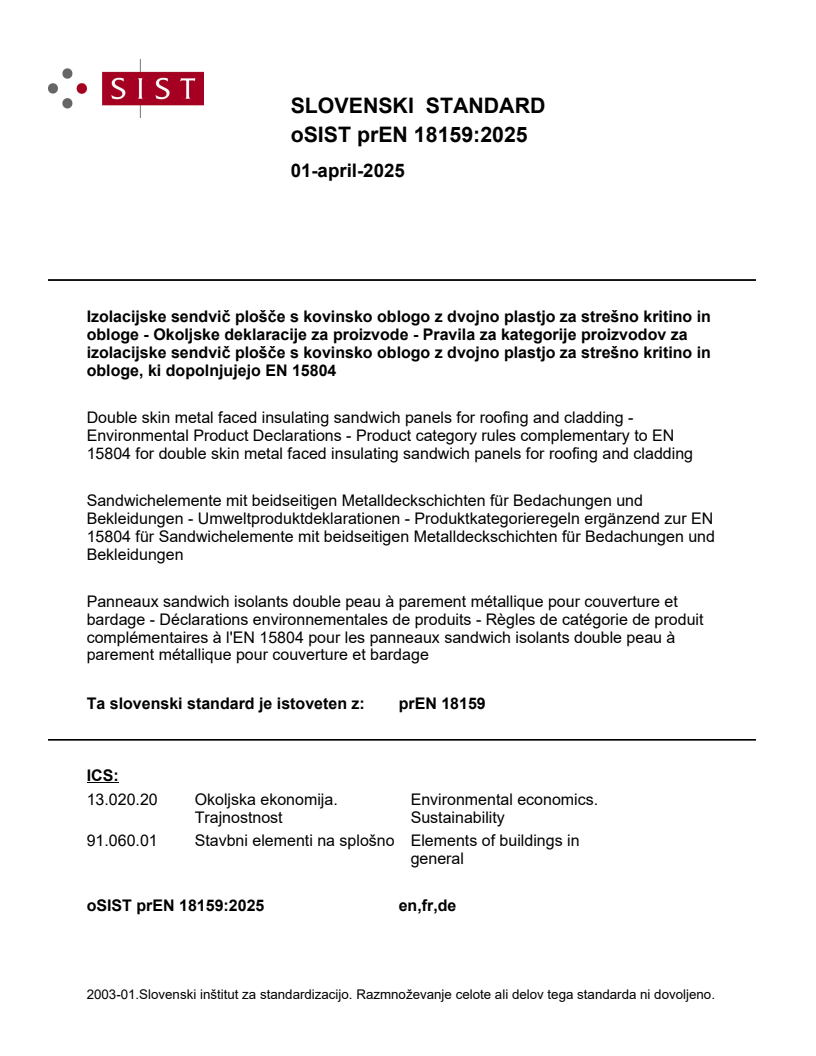
SLOVENSKI STANDARD
oSIST prEN 18159:2025
01-april-2025
Izolacijske sendvič plošče s kovinsko oblogo z dvojno plastjo za strešno kritino in
obloge - Okoljske deklaracije za proizvode - Pravila za kategorije proizvodov za
izolacijske sendvič plošče s kovinsko oblogo z dvojno plastjo za strešno kritino in
obloge, ki dopolnjujejo EN 15804
Double skin metal faced insulating sandwich panels for roofing and cladding -
Environmental Product Declarations - Product category rules complementary to EN
15804 for double skin metal faced insulating sandwich panels for roofing and cladding
Sandwichelemente mit beidseitigen Metalldeckschichten für Bedachungen und
Bekleidungen - Umweltproduktdeklarationen - Produktkategorieregeln ergänzend zur EN
15804 für Sandwichelemente mit beidseitigen Metalldeckschichten für Bedachungen und
Bekleidungen
Panneaux sandwich isolants double peau à parement métallique pour couverture et
bardage - Déclarations environnementales de produits - Règles de catégorie de produit
complémentaires à l'EN 15804 pour les panneaux sandwich isolants double peau à
parement métallique pour couverture et bardage
Ta slovenski standard je istoveten z: prEN 18159
ICS:
13.020.20 Okoljska ekonomija. Environmental economics.
Trajnostnost Sustainability
91.060.01 Stavbni elementi na splošno Elements of buildings in
general
oSIST prEN 18159:2025 en,fr,de
2003-01.Slovenski inštitut za standardizacijo. Razmnoževanje celote ali delov tega standarda ni dovoljeno.
oSIST prEN 18159:2025
oSIST prEN 18159:2025
DRAFT
EUROPEAN STANDARD
prEN 18159
NORME EUROPÉENNE
EUROPÄISCHE NORM
February 2025
ICS 91.060.01
English Version
Double skin metal faced insulating sandwich panels for
roofing and cladding - Environmental Product
Declarations - Product category rules complementary to
EN 15804 for double skin metal faced insulating sandwich
panels for roofing and cladding
Sandwichelemente mit beidseitigen
Metalldeckschichten für Bedachungen und
Bekleidungen - Umweltproduktdeklarationen -
Produktkategorieregeln ergänzend zur EN 15804 für
Sandwichelemente mit beidseitigen
Metalldeckschichten für Bedachungen und
Bekleidungen
This draft European Standard is submitted to CEN members for enquiry. It has been drawn up by the Technical Committee
CEN/TC 128.
If this draft becomes a European Standard, CEN members are bound to comply with the CEN/CENELEC Internal Regulations
which stipulate the conditions for giving this European Standard the status of a national standard without any alteration.
This draft European Standard was established by CEN in three official versions (English, French, German). A version in any other
language made by translation under the responsibility of a CEN member into its own language and notified to the CEN-CENELEC
Management Centre has the same status as the official versions.
CEN members are the national standards bodies of Austria, Belgium, Bulgaria, Croatia, Cyprus, Czech Republic, Denmark, Estonia,
Finland, France, Germany, Greece, Hungary, Iceland, Ireland, Italy, Latvia, Lithuania, Luxembourg, Malta, Netherlands, Norway,
Poland, Portugal, Republic of North Macedonia, Romania, Serbia, Slovakia, Slovenia, Spain, Sweden, Switzerland, Türkiye and
United Kingdom.
Recipients of this draft are invited to submit, with their comments, notification of any relevant patent rights of which they are
aware and to provide supporting documentation.
Warning : This document is not a European Standard. It is distributed for review and comments. It is subject to change without
notice and shall not be referred to as a European Standard.
EUROPEAN COMMITTEE FOR STANDARDIZATION
COMITÉ EUROPÉEN DE NORMALISATION
EUROPÄISCHES KOMITEE FÜR NORMUNG
CEN-CENELEC Management Centre: Rue de la Science 23, B-1040 Brussels
© 2025 CEN All rights of exploitation in any form and by any means reserved Ref. No. prEN 18159:2025 E
worldwide for CEN national Members.
oSIST prEN 18159:2025
prEN 18159:2025 (E)
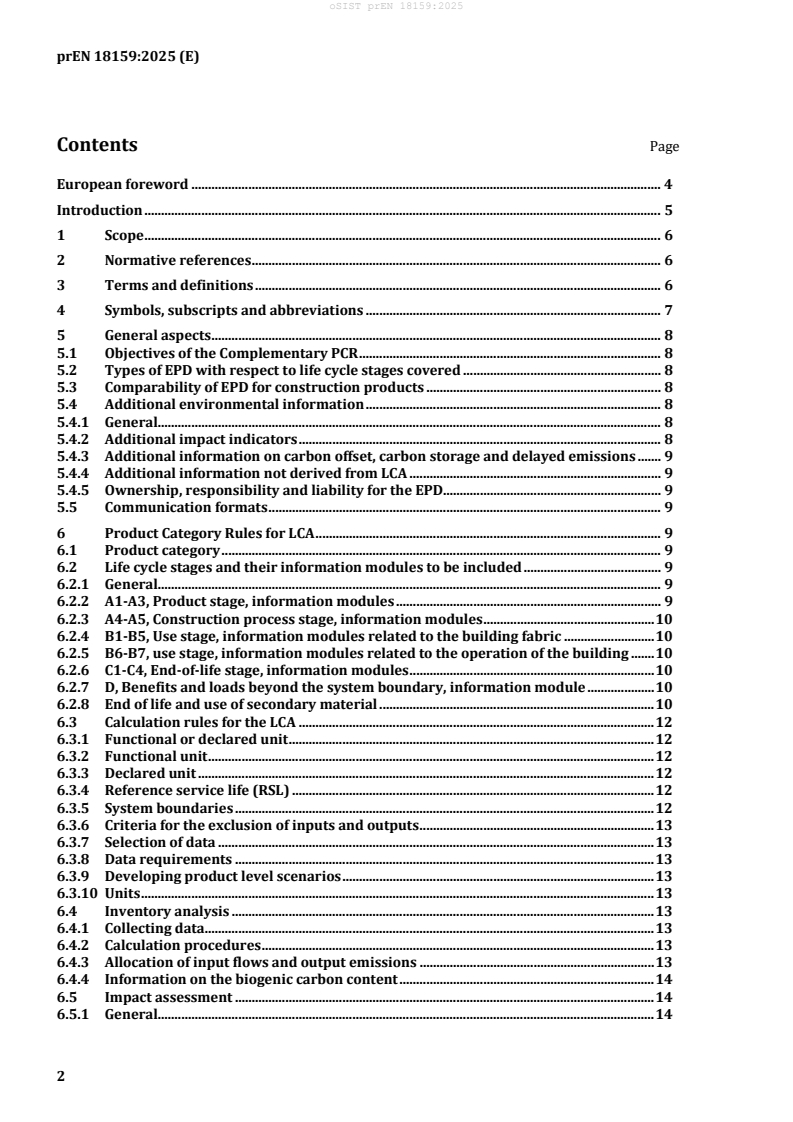
Contents Page
European foreword . 4
Introduction . 5
1 Scope . 6
2 Normative references . 6
3 Terms and definitions . 6
4 Symbols, subscripts and abbreviations . 7
5 General aspects . 8
5.1 Objectives of the Complementary PCR . 8
5.2 Types of EPD with respect to life cycle stages covered . 8
5.3 Comparability of EPD for construction products . 8
5.4 Additional environmental information . 8
5.4.1 General. 8
5.4.2 Additional impact indicators . 8
5.4.3 Additional information on carbon offset, carbon storage and delayed emissions . 9
5.4.4 Additional information not derived from LCA . 9
5.4.5 Ownership, responsibility and liability for the EPD. 9
5.5 Communication formats . 9
6 Product Category Rules for LCA . 9
6.1 Product category . 9
6.2 Life cycle stages and their information modules to be included . 9
6.2.1 General. 9
6.2.2 A1-A3, Product stage, information modules . 9
6.2.3 A4-A5, Construction process stage, information modules . 10
6.2.4 B1-B5, Use stage, information modules related to the building fabric . 10
6.2.5 B6-B7, use stage, information modules related to the operation of the building . 10
6.2.6 C1-C4, End-of-life stage, information modules . 10
6.2.7 D, Benefits and loads beyond the system boundary, information module . 10
6.2.8 End of life and use of secondary material . 10
6.3 Calculation rules for the LCA . 12
6.3.1 Functional or declared unit . 12
6.3.2 Functional unit . 12
6.3.3 Declared unit . 12
6.3.4 Reference service life (RSL) . 12
6.3.5 System boundaries . 12
6.3.6 Criteria for the exclusion of inputs and outputs . 13
6.3.7 Selection of data . 13
6.3.8 Data requirements . 13
6.3.9 Developing product level scenarios . 13
6.3.10 Units . 13
6.4 Inventory analysis . 13
6.4.1 Collecting data . 13
6.4.2 Calculation procedures . 13
6.4.3 Allocation of input flows and output emissions . 13
6.4.4 Information on the biogenic carbon content . 14
6.5 Impact assessment . 14
6.5.1 General. 14
oSIST prEN 18159:2025
prEN 18159:2025 (E)
6.5.2 Core environmental impact indicators . 14
6.5.3 Additional environmental impact indicators . 14
7 Content of the EPD . 14
7.1 Declaration of general information . 14
7.2 Declaration of environmental indicators derived from LCA . 14
7.2.1 General . 14
7.2.2 Rules for declaring LCA information per module . 14
7.2.3 Indicators describing environmental impacts based on Life Cycle Impact Assessment
(LCIA) . 14
7.2.4 Indicators describing resource use and environmental information based on Life
Cycle Inventory (LCI) . 14
7.2.5 Information on biogenic carbon content . 15
7.3 Scenarios and additional technical information . 15
7.3.1 General . 15
7.3.2 Construction process stage . 15
7.3.3 B1-B7 use stage . 15
7.3.4 End-of-life . 15
7.4 Additional information on release of dangerous substances to indoor air, soil and
water during the use stage . 15
7.4.1 Indoor air . 15
7.4.2 Soil and water . 15
7.5 Aggregation of information modules . 16
8 Project report . 16
8.1 General . 16
8.2 LCA-related elements of the project report . 16
8.3 Documentation on additional information . 16
8.4 Data availability for verification . 16
9 Verification and validity of an EPD. 16
Annex A (normative) Requirements and guidance on the reference service life. 17
Annex B (informative) Waste . 18
Annex C (normative) Impact categories and related indicators, methodologies and
characterization factors (CF) . 19
Annex D (informative) End of life formulae . 20
Annex E (informative) Schemes to be applied for data quality assessment of generic and
specific data . 21
Annex F (informative) Illustration of material flows of sandwich panels . 22
Annex G (informative) Default data for transport (module A4) . 23
Annex H (normative) Default data for installation (module A5). 25
Annex I (normative) Default data for deconstruction (module C1) . 26
Annex J (informative) Default data for transport (module C2) . 27
Annex K (informative) Default rates of reuse, recycling and losses. 28
Annex L (informative) Interpolation rules . 29
Annex M (informative) Selection of Additional Environmental Indicators . 30
Bibliography . 32
oSIST prEN 18159:2025
prEN 18159:2025 (E)
European foreword
This document (prEN 18159:2025) has been prepared by Technical Committee CEN/TC 128/SC 11/WG
10 “Double skin metal faced insulating sandwich panels for roofing and cladding”, the secretariat of which
is held by NBN.
This document is currently submitted to the CEN Enquiry.
This document is intended to be used in conjunction with EN 15804:2012+A2:2019 and EN 16783:2017.
oSIST prEN 18159:2025
prEN 18159:2025 (E)
Introduction
As in EN 15804:2012+A2:2019, in addition:
This document provides rules for Environmental Product Declarations (EPD) for metal faced insulating
sandwich panels for structural and non-structural purposes in building envelopes. These sandwich
panels consist of a thermal insulating core, e.g. of mineral wool or polyurethane, between outer layers of
metal. Both sides of the core are bonded firmly to the two outer layers.
This document complements the core product category rules for all construction products and services
as established in EN 15804:2012+A2:2019.
oSIST prEN 18159:2025
prEN 18159:2025 (E)
1 Scope
This document provides product category rules (c-PCR), that are complementary to
EN 15804:2012+A2:2019, for Type III environmental declarations for sandwich panels within the scope
of prEN 14509-1:2024 and prEN 14509-2:2024, which are used for non-structural and structural
purposes in building envelopes and for sandwich panels with perforated faces and with core materials
others than defined in prEN 14509-1:2024 and prEN 14509-2:2024.
Manufactured on industrial plant, double skin metal faced insulating sandwich panels are designed to be
laid with overlapping edges in the following applications:
— roofs and discontinuous roofing,
— outer walls and wall cladding,
— walls (incl. partition walls) and (suspended) ceilings inside the building envelope
This document is intended to be used for cradle-to-gate with options or cradle to grave assessment
according EN 15804, 5.2.
NOTE The assessment of social and economic performances at product level is not covered by this document.
2 Normative references
The following documents are referred to in the text in such a way that some or all of their content
constitutes requirements of this document. For dated references, only the edition cited applies. For
undated references, the latest edition of the referenced document (including any amendments) applies.
prEN 14509-1:2024, Factory-made double skin metal faced insulating sandwich panels — Part 1: Self-
supporting applications
prEN 14509-2:2024, Factory-made double skin metal faced insulating sandwich panels — Part 2:
structural applications
EN 15804:2012+A2:2019, Sustainability of construction works — Environmental product declarations —
Core rules for the product category of construction products
EN 16783:2017, Thermal insulation products – Environmental Product Declarations (EPD) – Product
Category Rules (PCR) complementary to EN 15804 for factory made and in-situ formed products
EN ISO 9229:2020, Thermal insulation — Vocabulary (ISO 9229:2020)
3 Terms and definitions
For the purposes of this document, the terms and definitions given in EN 15804:2012+A2:2019 and the
following apply.
3.1
core
layer of material, having thermal insulating properties, which is bonded between two metal faces
Note 1 to entry: Panels with special edge details in the longitudinal joints might utilize different core materials
from the main insulating core (e.g. for improved fire performance) if these edge details have no influence on the
mechanical performance of the panel.
As impacted by EN 15804:2012+A2:2019/AC:2021
oSIST prEN 18159:2025
prEN 18159:2025 (E)
3.2
face
flat, lightly profiled or profiled thin metal sheet bonded to the core
3.3
mineral wool (MW)
insulating wool produced from molten stone, slag or glass
[SOURCE: EN 13162:2012+A1:2015]
3.4
stone wool (SW)
insulating wool produced from molten stone
3.5
glass wool (GW)
insulating wool produced from molten glass
3.6
phenolic foam (PF)
insulating foam produced from PF
[SOURCE: EN 13166:2012+A2:2016]
3.7
expanded polystyrene (EPS)
insulating foam produced from EPS
[SOURCE: EN 13163:2012+A2:2016]
3.8
extruded polystyrene foam (XPS)
insulating foam produced from XPS
[SOURCE: EN 13164:2012+A1:2015]
3.9
polyurethane (PU)
insulating rigid foam produced from PUR or PIR
[SOURCE: EN 13165:2012+A2:2016]
4 Symbols, subscripts and abbreviations
For the purposes of this document, the abbreviations given in prEN 14509-1:2024, prEN 14509-2:2024,
EN ISO 9229:2020, EN 16783:2017 and EN 15804:2012+A2:2019 and the following apply.
oSIST prEN 18159:2025
prEN 18159:2025 (E)
For the purposes of this document, the following symbols, subscripts and abbreviations apply.
EPD Environmental product declaration
PCR Product category rules
LCA Life cycle assessment
LCI Life cycle inventory analysis
LCIA Life cycle impact assessment
RSL Reference service life
c-PCR Complementary product category rules
CF Characterization factor
ND Not declared
5 General aspects
5.1 Objectives of the Complementary PCR
As in EN 15804:2012+A2:2019.
5.2 Types of EPD with respect to life cycle stages covered
As in EN 15804:2012+A2:2019.
5.3 Comparability of EPD for construction products
As in EN 15804:2012+A2:2019.
5.4 Additional environmental information
5.4.1 General
As in EN 15804:2012+A2:2019.
5.4.2 Additional impact indicators
As in EN 15804:2012+A2:2019, in addition:
For faces, the following additional environmental impact indicators in EN 15804:2012+A2:2019 should
not be declared in the EPD except if mandatory in a country or market for declaration where the EPD is
intended to be used:
— Eco-toxicity (Freshwater)
— Human toxicity, cancer effects
— Human toxicity, non-cancer effects
NOTE 1 Under the current EN15804:2012+A2:2021 the additional indicators are optional, due to high
uncertainties and limited experience with the indicator.
The additional impact indicator designated in EN 15804:2012+A2:2021 as ‘Potential incidence of disease
due to Particulate Matter emissions (PM)’ should not be declared when doubt has been identified about
the reliability of source data.
NOTE 2 See also Annex M.
oSIST prEN 18159:2025
prEN 18159:2025 (E)
5.4.3 Additional information on carbon offset, carbon storage and delayed emissions
As in EN 15804:2012+A2:2019.
5.4.4 Additional information not derived from LCA
As in EN 15804:2012+A2:2019.
5.5 Ownership, responsibility and liability for the EPD
As in EN 15804:2012+A2:2019.
5.6 Communication formats
As in EN 15804:2012+A2:2019.
6 Product Category Rules for LCA
6.1 Product category
The product category referred to in this document includes all sandwich panels considered within the
scope of prEN 14509-1:2024 and prEN 14509-2:2024 which are used for structural and non-structural
purposes in building envelopes and for sandwich panels with perforated faces and with core materials
others than defined in prEN 14509-1:2024 and prEN 14509-2:2024.
Face materials (e.g. steel, stainless steel, aluminium, copper) and core materials (e.g. PU, SW, GW, PF, XPS,
EPS) have to be specified in an EPD.
6.2 Life cycle stages and their information modules to be included
6.2.1 General
As in EN 15804:2012+A2:2019, in addition:
For faces, impacts from transport in all life cycle modules shall be included where relevant. Specific
impact data shall be calculated from actual distances and transport modes when they are known.
For core materials, general information on life cycle stages is given in EN 16783:2017.
An illustration of material flows is given in Annex F.
6.2.2 A1-A3, Product stage, information modules
As in EN 15804:2012+A2:2019.
A separa
...