

EN 18179:2026
(Main)Food authenticity - Method for detecting previously frozen poultry meat by determination of HADH activity
- Abstract
This document specifies a procedure for determining hydroxyacyl-coenzyme A dehydrogenase (HADH) activity in poultry meat samples by spectrophotometry. The results provide an indication of whether poultry breast meat has been previously frozen, based on the ratio of relative HADH activity, and can be used to verify the labelling of poultry breast meat sold as chilled poultry.
This document is applicable specifically to chicken breast meat. It is not applicable to other cuts and/or types of meat unless these have been validated and appropriate limits have been established.
When following the procedure outlined in this document, for a single sample pressing results in 96,6 % of samples being correctly classified. If a correct classification rate of 99,9 % is required, three sample pressings are necessary; i.e. three chicken breasts (one pressing from each), selected randomly from a batch.
This document is not applicable to minced meat or to poultry preparations.
- Status
- Published
- Publication Date
- 01-Sep-2026
- Technical Committee
- CEN/TC 460 - Food Authenticity
- Drafting Committee
- CEN/TC 460/WG 8 - Spectrophotometric methods
- Current Stage
- 6060 - Definitive text made available (DAV) - Publishing
- Start Date
- 02-Sep-2026
- Due Date
- 10-Aug-2026
- Completion Date
- 02-Sep-2026

EN 18179:2026 is a CEN European Standard for detecting whether chicken breast meat has been previously frozen by measuring hydroxyacyl-coenzyme A dehydrogenase (HADH) activity with spectrophotometry. It is used to help verify the labelling of chilled poultry breast meat. The method is written for chicken breast meat, not for minced meat or poultry preparations.
What does EN 18179:2026 specify?
EN 18179:2026 specifies a laboratory procedure for preparing chicken breast sub-samples, pressing out meat juice, measuring HADH activity, and interpreting the result through an activity ratio. The document is organized into scope, references, terms, symbols, principle, reagents, apparatus, procedure, calculations, precision, and test report, with three informative annexes.
| Annex | What it covers |
|---|---|
| Annex A | Validation through a collaborative study |
| Annex B | Historical threshold values |
| Annex C | Specifications for the “Juice” extraction press |
The scope also states a practical sampling point: a single sample pressing gives 96.6 % correct classification, while three sample pressings are needed if a 99.9 % correct classification rate is required. In practice, that affects how many chicken breasts a laboratory should take from a batch when stronger confidence is needed.
What are the key requirements of EN 18179:2026?
EN 18179:2026 is built around comparing the HADH activity of an untreated sub-sample with a laboratory-frozen sub-sample from the same chicken breast. The main steps are straightforward: prepare the sample in a defined way, press out juice, measure the enzyme reaction at 340 nm, and compare the activity ratio R with the threshold value.
Sample preparation and pressing
Clause 8 requires two sub-samples from each test sample, each about 30 mm by 30 mm by 25 mm. One sub-sample is tested on the day of cutting, and the other is frozen at (−18 ± 2) °C for at least 48 h, then thawed slowly for 24 h at 2 °C to 5 °C before pressing. In practice, the freezing step creates the comparison point that shows whether the original meat had already been frozen.
Clause 8 also requires the meat juice to be collected with the specified press, diluted with phosphate buffer, and filtered through a 0.45 μm syringe filter. Unfiltered juice is not to be stored because it may contain meat residues that interfere with the measurement.
Reagents, apparatus, and measurement
Clause 6 limits the analysis to recognized reagent grades and water meeting EN ISO 3696:1995. The method uses a phosphate buffer at pH 6.00 ± 0.05, EDTA, NADH, acetoacetyl-coenzyme A, and sodium hydroxide. Clause 7 specifies the needed equipment, including the meat press, 340 nm spectrophotometer, pH meter, water bath, cuvettes, filters, syringes, and pipettors.
Clause 8.4 describes the reaction mix and timing at 25 °C. The assay reads the decrease in absorbance at 340 nm over 3 min, using two aliquots of each sample extract and averaging the readings. In practice, the laboratory is measuring how fast the reaction signal drops, which is the basis for the enzyme result.
Calculations and interpretation
Clause 9 turns the absorbance change into HADH activity and then into the enzyme activity ratio R. The result for the unfrozen sub-sample is compared with the frozen sub-sample, and Annex B gives the chicken breast threshold value used for interpretation. If R is greater than the threshold, the sample is considered to have been previously frozen and thawed.
Precision and reporting
Clause 10 summarizes repeatability and reproducibility and points to Annex A for the collaborative study behind the precision data. Clause 11 requires the test report to identify the sample, state the standard used, record the dates, number of replicates, the R value, any deviations, and any unusual observations. That gives buyers, auditors, and regulators a traceable record of how the result was obtained.
What terms does EN 18179:2026 define?
EN 18179:2026 defines the key measurement terms used by the method and names the main chemical abbreviations used in the reagents.
- HADH activity - the activity of hydroxyacyl-coenzyme A dehydrogenase in meat press juice, expressed in U/mL.
- Enzyme activity ratio R - the ratio of HADH activity measured on the unfrozen sub-sample to that measured after the laboratory freezing step.
- EDTA - ethylenediamine tetra acetic acid, used in the reaction mixture.
- HADH - hydroxyacyl-coenzyme A dehydrogenase, the enzyme measured by the method.
- NADH - ß-nicotinamide adenine dinucleotide, reduced-form, disodium salt hydrate, used in the spectrophotometric reaction.
Who uses EN 18179:2026?
EN 18179:2026 is used by food authenticity laboratories, official control laboratories, and other testing bodies that need to check whether chilled chicken breast meat was previously frozen. It is also relevant to quality managers, poultry processors, and enforcement teams that verify product labelling against storage history. The method supports routine inspection, batch checking, and dispute testing where chilled status is being assessed.
Which standards are used with EN 18179:2026?
EN 18179:2026 relies on one normative reference and one statistical standard named in the annexes.
| Standard | What it contributes |
|---|---|
| EN ISO 3696:1995 | Water quality specification for reagent preparation and analysis |
| ISO 5725-3 | Statistical treatment of the collaborative study data in Annex A |
What does the EN 18179:2026 document contain?
EN 18179:2026 contains a complete laboratory method, not just a threshold. It includes the principle, reagent preparation, apparatus list, sub-sampling and freezing instructions, pressing procedure, spectrophotometric measurement at 340 nm, calculation formulas, precision data, and reporting requirements. The document also includes figures for sample preparation and pressing, a reagent table, a calculation section, and precision summaries. Annex A explains validation by collaborative study, Annex B gives the historical threshold discussion, and Annex C specifies the juice extraction press.
Get Certified
Connect with accredited certification bodies for this standard

BSI Group
BSI (British Standards Institution) is the business standards company that helps organizations make excellence a habit.

Bureau Veritas
Bureau Veritas is a world leader in laboratory testing, inspection and certification services.

DNV
DNV is an independent assurance and risk management provider.
Sponsored listings
Frequently Asked Questions
EN 18179:2026 is a standard published by the European Committee for Standardization (CEN). Its full title is "Food authenticity - Method for detecting previously frozen poultry meat by determination of HADH activity". This standard covers: This document specifies a procedure for determining hydroxyacyl-coenzyme A dehydrogenase (HADH) activity in poultry meat samples by spectrophotometry. The results provide an indication of whether poultry breast meat has been previously frozen, based on the ratio of relative HADH activity, and can be used to verify the labelling of poultry breast meat sold as chilled poultry. This document is applicable specifically to chicken breast meat. It is not applicable to other cuts and/or types of meat unless these have been validated and appropriate limits have been established. When following the procedure outlined in this document, for a single sample pressing results in 96,6 % of samples being correctly classified. If a correct classification rate of 99,9 % is required, three sample pressings are necessary; i.e. three chicken breasts (one pressing from each), selected randomly from a batch. This document is not applicable to minced meat or to poultry preparations.
This document specifies a procedure for determining hydroxyacyl-coenzyme A dehydrogenase (HADH) activity in poultry meat samples by spectrophotometry. The results provide an indication of whether poultry breast meat has been previously frozen, based on the ratio of relative HADH activity, and can be used to verify the labelling of poultry breast meat sold as chilled poultry. This document is applicable specifically to chicken breast meat. It is not applicable to other cuts and/or types of meat unless these have been validated and appropriate limits have been established. When following the procedure outlined in this document, for a single sample pressing results in 96,6 % of samples being correctly classified. If a correct classification rate of 99,9 % is required, three sample pressings are necessary; i.e. three chicken breasts (one pressing from each), selected randomly from a batch. This document is not applicable to minced meat or to poultry preparations.
EN 18179:2026 is classified under the following ICS (International Classification for Standards) categories: 67.120.20 - Poultry and eggs. The ICS classification helps identify the subject area and facilitates finding related standards.
EN 18179:2026 is available in PDF format for immediate download after purchase. The document can be added to your cart and obtained through the secure checkout process. Digital delivery ensures instant access to the complete standard document.
Standards Content (Sample)
SLOVENSKI STANDARD
01-november-2026
Pristnost živil - Metoda za odkrivanje predhodno zamrznjenega perutninskega
mesa z določanjem aktivnosti HADH
Food authenticity - Method for detecting previously frozen poultry meat by determination
of HADH activity
Lebensmittelauthentizität - Verfahren zum Nachweis von zuvor gefrorenem
Geflügelfleisch durch Bestimmung der HADH-Aktivität
Authenticité des aliments - Méthode de détection de la viande de volaille préalablement
congelée par détermination de l'activité HADH
Ta slovenski standard je istoveten z: EN 18179:2026
ICS:
67.120.20 Perutnina in jajca Poultry and eggs
2003-01.Slovenski inštitut za standardizacijo. Razmnoževanje celote ali delov tega standarda ni dovoljeno.
EN 18179
EUROPEAN STANDARD
NORME EUROPÉENNE
September 2026
EUROPÄISCHE NORM
ICS 67.120.20
English Version
Food authenticity - Method for detecting previously frozen
poultry meat by determination of HADH activity
Authenticité des aliments - Méthode de détection de la Lebensmittelauthentizität - Verfahren zum Nachweis
viande de volaille préalablement congelée par von zuvor gefrorenem Geflügelfleisch durch
détermination de l'activité de la HADH Bestimmung der HADH-Aktivität
This European Standard was approved by CEN on 26 July 2026.
CEN members are bound to comply with the CEN/CENELEC Internal Regulations which stipulate the conditions for giving this
European Standard the status of a national standard without any alteration. Up-to-date lists and bibliographical references
concerning such national standards may be obtained on application to the CEN-CENELEC Management Centre or to any CEN
member.
This European Standard exists in three official versions (English, French, German). A version in any other language made by
translation under the responsibility of a CEN member into its own language and notified to the CEN-CENELEC Management
Centre has the same status as the official versions.
CEN members are the national standards bodies of Austria, Belgium, Bulgaria, Croatia, Cyprus, Czech Republic, Denmark, Estonia,
Finland, France, Germany, Greece, Hungary, Iceland, Ireland, Italy, Latvia, Lithuania, Luxembourg, Malta, Netherlands, Norway,
Poland, Portugal, Republic of North Macedonia, Romania, Serbia, Slovakia, Slovenia, Spain, Sweden, Switzerland, Türkiye and
United Kingdom.
EUROPEAN COMMITTEE FOR STANDARDIZATION
COMITÉ EUROPÉEN DE NORMALISATION
EUROPÄISCHES KOMITEE FÜR NORMUNG
CEN-CENELEC Management Centre: Rue de la Science 23, B-1040 Brussels
© 2026 CEN All rights of exploitation in any form and by any means reserved Ref. No. EN 18179:2026 E
worldwide for CEN national Members.
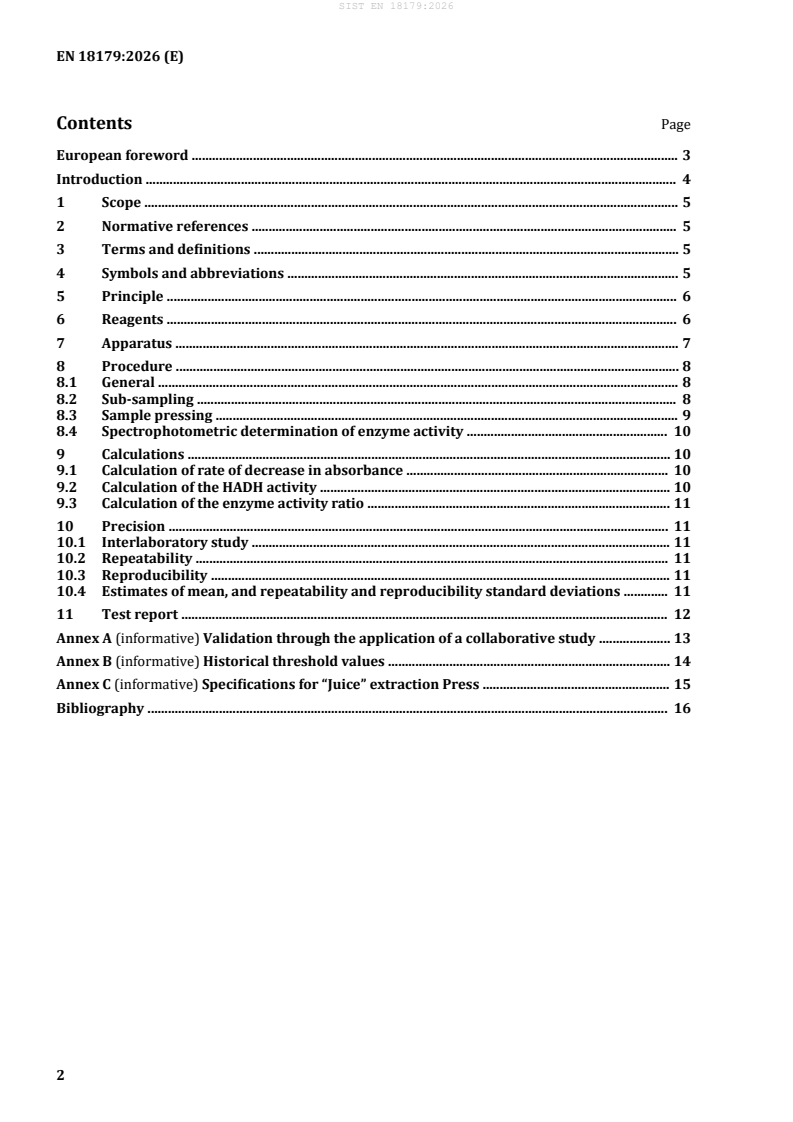
Contents Page
European foreword . 3
Introduction . 4
1 Scope . 5
2 Normative references . 5
3 Terms and definitions . 5
4 Symbols and abbreviations . 5
5 Principle . 6
6 Reagents . 6
7 Apparatus . 7
8 Procedure . 8
8.1 General . 8
8.2 Sub-sampling . 8
8.3 Sample pressing . 9
8.4 Spectrophotometric determination of enzyme activity . 10
9 Calculations . 10
9.1 Calculation of rate of decrease in absorbance . 10
9.2 Calculation of the HADH activity . 10
9.3 Calculation of the enzyme activity ratio . 11
10 Precision . 11
10.1 Interlaboratory study . 11
10.2 Repeatability . 11
10.3 Reproducibility . 11
10.4 Estimates of mean, and repeatability and reproducibility standard deviations . 11
11 Test report . 12
Annex A (informative) Validation through the application of a collaborative study . 13
Annex B (informative) Historical threshold values . 14
Annex C (informative) Specifications for “Juice” extraction Press . 15
Bibliography . 16
European foreword
This document (EN 18179:2026) has been prepared by Technical Committee CEN/TC 460 “Food
Authenticity”, the secretariat of which is held by DIN.
This European Standard shall be given the status of a national standard, either by publication of an
identical text or by endorsement, at the latest by March 2027, and conflicting national standards shall
be withdrawn at the latest by March 2027.
Attention is drawn to the possibility that some of the elements of this document may be the subject of
patent rights. CEN shall not be held responsible for identifying any or all such patent rights.
Any feedback and questions on this document should be directed to the users’ national standards body.
A complete listing of these bodies can be found on the CEN website.
According to the CEN-CENELEC Internal Regulations, the national standards organisations of the
following countries are bound to implement this European Standard: Austria, Belgium, Bulgaria, Croatia,
Cyprus, Czech Republic, Denmark, Estonia, Finland, France, Germany, Greece, Hungary, Iceland, Ireland,
Italy, Latvia, Lithuania, Luxembourg, Malta, Netherlands, Norway, Poland, Portugal, Republic of North
Macedonia, Romania, Serbia, Slovakia, Slovenia, Spain, Sweden, Switzerland, Tu�rkiye and the United
Kingdom.
Introduction
The EC poultry meat marketing standards Regulation (Commission Regulation (EC) No 543/2008[1])
requires that poultrymeat (whole birds and portions) be labelled according to the storage conditions
employed (fresh, frozen, or rapidly frozen) and defines the temperature conditions associated with each
category. However, refrigeration technologies are now available that do not comply with the conditions
specified in the Regulation and can result in the mislabelling of poultry meat. There is therefore a need
for a robust analytical method capable of distinguishing between fresh and previously frozen poultry
to support enforcement of the relevant regulatory legislation.
1 Scope
This document specifies a procedure for determining hydroxyacyl-coenzyme A dehydrogenase (HADH)
activity in poultry meat samples by spectrophotometry. The results provide an indication of whether
poultry breast meat has been previously frozen, based on the ratio of relative HADH activity, and can
be used to verify the labelling of poultry breast meat sold as chilled poultry.
This document is applicable specifically to chicken breast meat. It is not applicable to other cuts
and/or types of meat unless these have been validated and appropriate limits have been established.
When following the procedure outlined in this document, for a single sample pressing results in 96,6
% of samples being correctly classified. If a correct classification rate of 99,9 % is required, three sample
pressings are necessary; i.e. three chicken breasts (one pressing from each), selected randomly from a
batch.
This document is not applicable to minced meat or to poultry preparations.
2 Normative references
The following documents are referred to in the text in such a way that some or all of their content
constitutes requirements of this document. For dated references, only the edition cited applies. For
undated references, the latest edition of the referenced document (including any amendments) applies.
EN ISO 3696:1995, Water for analytical laboratory use - Specification and test methods (ISO 3696:1987)
3 Terms and definitions
For the purposes of this document, the following terms and definitions apply.
ISO and IEC maintain terminology databases for use in standardization at the following addresses:
— ISO Online browsing platform: available at https://www.iso.org/obp
— IEC Electropedia: available at https://www.electropedia.org/
3.1
HADH activity
enzyme activity of hydroxyacyl-coenzyme A dehydrogenase, expressed in international units per mL of
meat press juice (U/mL), 1 U representing 1 micromole of substrate converted per minute at pH 6,0
and 25 °C
Note 1 to entry: Enzyme Commission number: EC 1.1.1.35
3.2
enzyme activity ratio
R
X X
ratio of the HADH activity obtained for samples analysed before ( ) and after ( ) a laboratory
0 1
freezing step
X
Note 1 to entry: R =
X
4 Symbols and abbreviations
EDTA ethylenediamine tetra acetic acid
HADH hydroxyacyl-coenzyme A dehydrogenase
NADH ß-nicotinamide adenine dinucleotide, reduced-form, disodium salt hydrate
5 Principle
HADH is a muscle mitochondrial enzyme that is released when mitochondrial membranes are damaged
during freezing and thawing. The HADH activity (3.1) of intracellular fluid pressed from “as received”
and “laboratory-frozen” sub-samples of a meat sample is determined using absorbance spectroscopy,
and the ratio between these activities can be used as an indicator of the thermal history of the sample.
Two sub-samples are prepared for each poultry breast sample using the procedure described. The first
sub-sample is analysed directly, while the second is analysed after freezing for at least two days at (−20
± 2) °C. After thawing, where required, meat juice is expressed from the sample and diluted with
phosphate buffer. HADH activity (3.1) is measured as the rate of decrease in absorbance at 340 nm in
the treated sample extract using a UV spectrophotometer. The ratio (R ) of HADH activity (3.1) between
the original and laboratory-frozen sub-samples is then used to determine whether the meat sample has
previously been frozen, by comparison with threshold limits (see Annex A).
6 Reagents
During the analysis, unless otherwise stated, only reagents of recognized laboratory reagent grade
General Purpose Reagent (GPR) or analytical reagent grade (AR) shall be used and distilled or
demineralized water or water of equivalent purity according to EN ISO 3696:1995.
6.1 Potassium dihydrogen orthophosphate (KH PO ), 0,1 mol/L solution. CAS No. 7778-77-0.
2 4
Weigh (13,6 ± 0,1) g into a volumetric flask and make to 1 L with water.
K HPO *3H O
6.2 Dipotassium hydrogen orthophosphate trihydrate ( ), 0,1 mol/L solution.
2 4 2
CAS No. 16788-57-1.
Weigh (22,8 ± 0,1) g into a volumetric flask and make to 1 L with water.
6.3 Potassium phosphate buffer solution, pH 6,00 ± 0,05,
To 1 L of potassium dihydrogen orthophosphate solution, (6.1), slowly add the dipotassium hydrogen
orthophosphate solution (6.2) until a pH of 6,00 ± 0,05 is obtained using a pH meter. The solution can
be stored under refrigeration (approximately 4 °C) for at least one month. The pH should be checked
before use.
6.4 Ethylenediamine tetraacetic acid, disodium salt (EDTA) solution (26,9 mmol/L) CAS No.
6381-92-6.
Weigh out (0,500 ± 0,01) g EDTA disodium salt into a 50 mL beaker, and add approximately 40 mL of
water. Warm on a hotplate, with stirring, until dissolved. Transfer quantitatively to a 50 mL volumetric
flask with water, make up to the mark and mix. This solution can be stored under refrigeration for at
least one month.
6.5 ß-Nicotinamide adenine dinucleotide, reduced-form, disodium salt hydrate (NADH)
solution, (7,05 mmol/L) CAS No. 606-68-8.
Weigh (25 ± 2) mg of NADH into a 5 mL volumetric flask. Make up to the mark with water and mix. The
solution can be stored for up to a week a refrigerator.
The weight taken should be corrected for the % purity, and the water content, if necessary, as described
on the supplier’s information sheet for the product used.
Purified water is often slightly acid which can adversely affect the stability of the NADH in solution. The
pH of the water used should be checked using a pH meter and if less than 7,0, a drop of 0,01 mol/L
sodium hydroxide should be added to raise the pH to between 7,0 and 8,0.
6.6 Acetoacetyl – coenzyme A solution, sodium salt solution, (5,9 mmol/L). CAS No. 1420-36-6.
Add 1 mL of water into a vial conta
...