


CEN/TR 18365:2026
(Main)Adaptation to climate change - Guidelines on using climate data in infrastructure standards
General Information
- Abstract
This document specifies what future climate data is and where to find relevant climate data suited for infrastructure climate
adaptation and resilience-building needs. This document gives support to standards writers and users, whether detailed climate data
and information is specified in a standard, such as in a National Annex, or the standard requires the user to determine relevant
climate data and information as a separate exercise. This document focuses on the following climate system data: wind,
temperature, precipitation, humidity, sea level rise. In addition, Information is provided for how data is to achieve cross-border
consistency where necessary.
This document is intended for infrastructure owners, designers, operators and maintainers and staff of central/ regional authorities
who are responsible for infrastructure within countries that are associated with CEN/CENELEC. ‘Users’ includes the national
standards’ bodies and authorities who will be responsible for the use of climate data in national annexes to standards where they
exist.
- Status
- Not Published
- Publication Date
- 30-Aug-2026
- Technical Committee
- CEN/TC 467 - Climate Change
- Drafting Committee
- WG 2 - Adaptation
- Current Stage
- 6055 - CEN Ratification completed (DOR) - Publishing
- Start Date
- 17-Aug-2026
- Due Date
- 26-Jun-2026
- Completion Date
- 17-Aug-2026

Overview
CEN/TR 18365:2026 provides comprehensive guidelines on the use of climate data in infrastructure standards, focusing on adaptation to climate change and supporting resilience-building in the built environment. Developed by the European Committee for Standardization (CEN), this technical report aims to help infrastructure owners, designers, operators, maintainers, and authorities across CEN/CENELEC member countries to identify and apply reliable climate data needed for both new infrastructure projects and the retrofitting of existing assets.
The document details what constitutes climate data, where practitioners can access relevant data for adaptation, and how this data should be integrated into standards and practices. Special attention is given to variables such as wind, temperature, precipitation, humidity, and sea level rise. It also addresses the need for cross-border consistency in climate data usage, which is crucial for pan-European infrastructure networks.
Key Topics
- Definition and Scope of Climate Data: The document clarifies what future climate data entails, its sources, and its relevance for infrastructure adaptation and resilience.
- Guidance for Standards Writers and Users: Instructions are provided on whether climate data is specified within a standard (e.g., National Annexes) or if the user must determine the appropriate data independently.
- Climate Variables: Focused on critical climate system data relevant for infrastructure, including wind, temperature, precipitation, humidity, and sea level rise.
- Policy and Standardization Frameworks: Outlines how EU frameworks such as the European Green Deal, Climate Law, and Adaptation Strategy drive the integration of climate adaptation into construction and infrastructure regulation.
- Structural Eurocodes: Explains the evolving role of Eurocodes in requiring climate data considerations, including the introduction of adaptation provisions and factors of change in the new generation of Eurocodes.
- Data Sourcing and Quality: Offers advice on sourcing reliable climate data, comparing pan-European and national datasets, assuring data quality, and maintaining cross-border consistency.
- Risk Assessment: Presents methodologies for hazard identification, vulnerability, and impact assessment as part of resilient infrastructure design.
Applications
Practical applications of CEN/TR 18365:2026 include:
- Infrastructure Planning and Design: Ensuring designers and engineers integrate accurate, forward-looking climate data (e.g., projected rainfall or wind speeds) into risk assessments and asset specifications.
- Standard Development and Revision: Providing a reference framework for standards developers and national standards bodies to embed updated climate criteria and adaptation needs in regional or national standards.
- Asset Management and Maintenance: Guiding operators and maintainers to anticipate and address climate impacts throughout the infrastructure asset lifecycle, from construction to decommissioning.
- Public Authorities and Regulators: Offering tools for governments and authorities to develop climate-resilient infrastructure policies and regulatory measures, ensuring harmonized practices across bordering countries.
- Risk and Vulnerability Analysis: Supporting infrastructure stakeholders in performing robust risk and vulnerability assessments informed by credible climate data, leading to informed investment in adaptation and resilience measures.
Related Standards
For optimal implementation, users of CEN/TR 18365:2026 should also be familiar with the following standards and frameworks:
- EN ISO 14090:2019: Climate change adaptation principles and guidelines.
- EN ISO 14091:2021: Guidelines for climate-related risk assessments.
- Structural Eurocodes (EN 1990 - EN 1999): Standards for design and safety of buildings and civil engineering works.
- Relevant National Annexes: National adaptations and parameters to Eurocodes reflecting local climate conditions.
- Other International Standards: ISO, IEC, ITU, and ASHRAE standards addressing climate resilience in infrastructure.
CEN/TR 18365:2026 is essential for all stakeholders aiming to build, operate, and maintain infrastructure that is resilient, sustainable, and compliant with the latest climate adaptation requirements. Integrating high-quality climate data ensures that infrastructure across Europe can withstand future climate variability and extreme events. This technical report is a valuable resource for promoting harmonized, science-based approaches to climate change adaptation in infrastructure standards.
Relations
- Effective Date
- 28-Jan-2026
- Effective Date
- 28-Jan-2026
- Effective Date
- 28-Jan-2026
Get Certified
Connect with accredited certification bodies for this standard

BSI Group
BSI (British Standards Institution) is the business standards company that helps organizations make excellence a habit.

Bureau Veritas
Bureau Veritas is a world leader in laboratory testing, inspection and certification services.

DNV
DNV is an independent assurance and risk management provider.
Sponsored listings
Frequently Asked Questions
CEN/TR 18365:2026 is a draft published by the European Committee for Standardization (CEN). Its full title is "Adaptation to climate change - Guidelines on using climate data in infrastructure standards". This standard covers: This document specifies what future climate data is and where to find relevant climate data suited for infrastructure climate adaptation and resilience-building needs. This document gives support to standards writers and users, whether detailed climate data and information is specified in a standard, such as in a National Annex, or the standard requires the user to determine relevant climate data and information as a separate exercise. This document focuses on the following climate system data: wind, temperature, precipitation, humidity, sea level rise. In addition, Information is provided for how data is to achieve cross-border consistency where necessary. This document is intended for infrastructure owners, designers, operators and maintainers and staff of central/ regional authorities who are responsible for infrastructure within countries that are associated with CEN/CENELEC. ‘Users’ includes the national standards’ bodies and authorities who will be responsible for the use of climate data in national annexes to standards where they exist.
This document specifies what future climate data is and where to find relevant climate data suited for infrastructure climate adaptation and resilience-building needs. This document gives support to standards writers and users, whether detailed climate data and information is specified in a standard, such as in a National Annex, or the standard requires the user to determine relevant climate data and information as a separate exercise. This document focuses on the following climate system data: wind, temperature, precipitation, humidity, sea level rise. In addition, Information is provided for how data is to achieve cross-border consistency where necessary. This document is intended for infrastructure owners, designers, operators and maintainers and staff of central/ regional authorities who are responsible for infrastructure within countries that are associated with CEN/CENELEC. ‘Users’ includes the national standards’ bodies and authorities who will be responsible for the use of climate data in national annexes to standards where they exist.
CEN/TR 18365:2026 is classified under the following ICS (International Classification for Standards) categories: 01.120 - Standardization. General rules; 13.020.40 - Pollution, pollution control and conservation. The ICS classification helps identify the subject area and facilitates finding related standards.
CEN/TR 18365:2026 has the following relationships with other standards: It is inter standard links to EN ISO 15589-2:2024, EN ISO 9351:2025, EN ISO 9519:2023. Understanding these relationships helps ensure you are using the most current and applicable version of the standard.
CEN/TR 18365:2026 is available in PDF format for immediate download after purchase. The document can be added to your cart and obtained through the secure checkout process. Digital delivery ensures instant access to the complete standard document.
Standards Content (Sample)
SLOVENSKI STANDARD
01-julij-2026
Prilagajanje podnebnim spremembam - Smernice za uporabo podnebnih podatkov
v standardih za infrastrukturo
Adaptation to climate change - Guidelines on using climate data in infrastructure
standards
Anpassung an die Folgen des Klimawandels - Leitlinien zur Verwendung von Klimadaten
in Infrastrukturstandards
Ta slovenski standard je istoveten z: FprCEN/TR 18365
ICS:
01.120 Standardizacija. Splošna Standardization. General
pravila rules
13.020.40 Onesnaževanje, nadzor nad Pollution, pollution control
onesnaževanjem in and conservation
ohranjanje
2003-01.Slovenski inštitut za standardizacijo. Razmnoževanje celote ali delov tega standarda ni dovoljeno.
FINAL DRAFT
TECHNICAL REPORT
FprCEN/TR 18365
RAPPORT TECHNIQUE
TECHNISCHER REPORT
April 2026
ICS 01.120; 13.020.40
English Version
Adaptation to climate change - Guidelines on using climate
data in infrastructure standards
Anpassung an die Folgen des Klimawandels - Leitlinien
zur Verwendung von Klimadaten in
Infrastrukturstandards
This draft Technical Report is submitted to CEN members for Vote. It has been drawn up by the Technical Committee CEN/TC
467.
CEN members are the national standards bodies of Austria, Belgium, Bulgaria, Croatia, Cyprus, Czech Republic, Denmark, Estonia,
Finland, France, Germany, Greece, Hungary, Iceland, Ireland, Italy, Latvia, Lithuania, Luxembourg, Malta, Netherlands, Norway,
Poland, Portugal, Republic of North Macedonia, Romania, Serbia, Slovakia, Slovenia, Spain, Sweden, Switzerland, Türkiye and
United Kingdom.
Recipients of this draft are invited to submit, with their comments, notification of any relevant patent rights of which they are
aware and to provide supporting documentation.
Warning : This document is not a Technical Report. It is distributed for review and comments. It is subject to change without
notice and shall not be referred to as a Technical Report.
EUROPEAN COMMITTEE FOR STANDARDIZATION
COMITÉ EUROPÉEN DE NORMALISATION
EUROPÄISCHES KOMITEE FÜR NORMUNG
CEN-CENELEC Management Centre: Rue de la Science 23, B-1040 Brussels
© 2026 CEN All rights of exploitation in any form and by any means reserved Ref. No. FprCEN/TR 18365:2026 E
worldwide for CEN national Members.
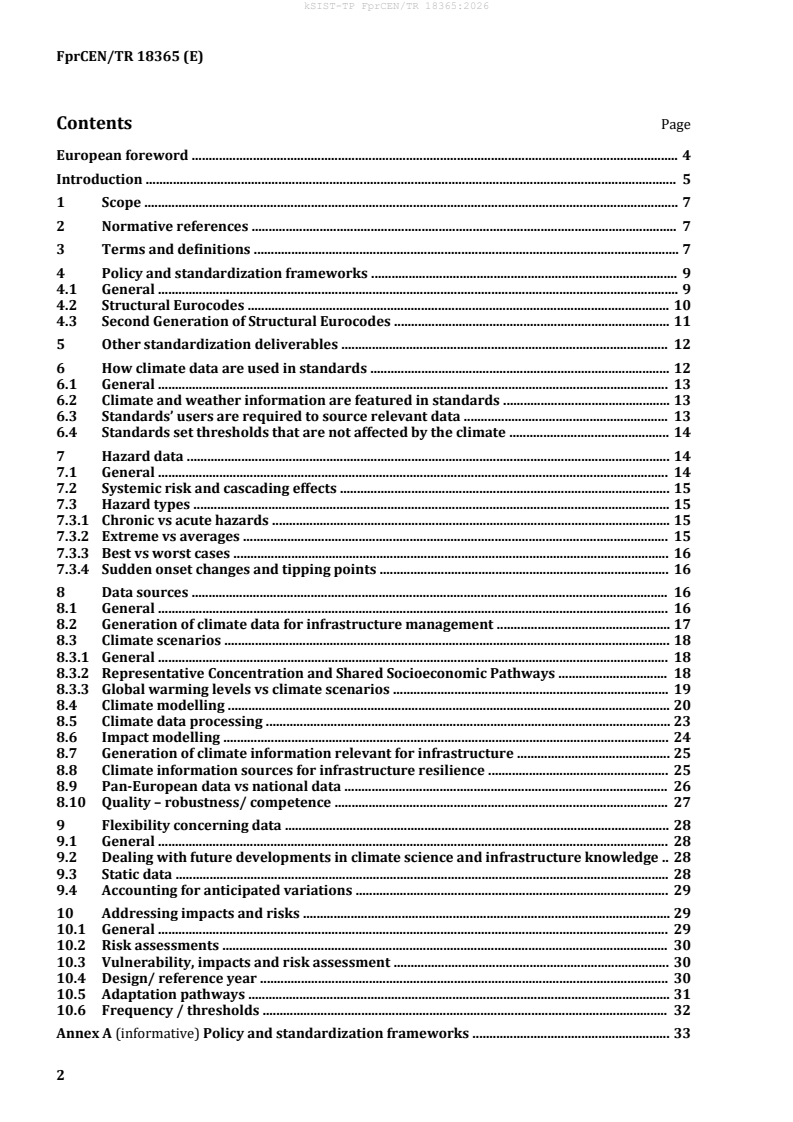
FprCEN/TR 18365 (E)
Contents Page
European foreword . 4
Introduction . 5
1 Scope . 7
2 Normative references . 7
3 Terms and definitions . 7
4 Policy and standardization frameworks . 9
4.1 General . 9
4.2 Structural Eurocodes . 10
4.3 Second Generation of Structural Eurocodes . 11
5 Other standardization deliverables . 12
6 How climate data are used in standards . 12
6.1 General . 13
6.2 Climate and weather information are featured in standards . 13
6.3 Standards’ users are required to source relevant data . 13
6.4 Standards set thresholds that are not affected by the climate . 14
7 Hazard data . 14
7.1 General . 14
7.2 Systemic risk and cascading effects . 15
7.3 Hazard types . 15
7.3.1 Chronic vs acute hazards . 15
7.3.2 Extreme vs averages . 15
7.3.3 Best vs worst cases . 16
7.3.4 Sudden onset changes and tipping points . 16
8 Data sources . 16
8.1 General . 16
8.2 Generation of climate data for infrastructure management . 17
8.3 Climate scenarios . 18
8.3.1 General . 18
8.3.2 Representative Concentration and Shared Socioeconomic Pathways . 18
8.3.3 Global warming levels vs climate scenarios . 19
8.4 Climate modelling . 20
8.5 Climate data processing . 23
8.6 Impact modelling . 24
8.7 Generation of climate information relevant for infrastructure . 25
8.8 Climate information sources for infrastructure resilience . 25
8.9 Pan-European data vs national data . 26
8.10 Quality – robustness/ competence . 27
9 Flexibility concerning data . 28
9.1 General . 28
9.2 Dealing with future developments in climate science and infrastructure knowledge . 28
9.3 Static data . 28
9.4 Accounting for anticipated variations . 29
10 Addressing impacts and risks . 29
10.1 General . 29
10.2 Risk assessments . 30
10.3 Vulnerability, impacts and risk assessment . 30
10.4 Design/ reference year . 30
10.5 Adaptation pathways . 31
10.6 Frequency / thresholds . 32
Annex A (informative) Policy and standardization frameworks . 33
FprCEN/TR 18365 (E)
Annex B (informative) Examples of organizations that draft their own standards and codes
of practice . 35
Annex C (informative) Comparison of emission and warming level scenarios . 37
Annex D (informative) Factors of change for climatic load maps in Structural Eurocodes . 39
Bibliography . 44
FprCEN/TR 18365 (E)
European foreword
This document (FprCEN/TR 18365:2026) has been prepared by Technical Committee CEN/TC 467
Climate Change, the secretariat of which is held by UNI.
This document is currently submitted to the Vote on TR.
FprCEN/TR 18365 (E)
Introduction
The increase in damage caused by climate change as well as the geopolitical and security landscape, is
forcing Europeans to ask not only how climate change will affect future generations but also what we
must prepare for today. This involves possible disruptions to the economy, the supply chain, and society,
underscoring the significance of coordinated and common EU efforts to tackle these issues. As stated
by Special Adviser Niinistö� in the report "Safer together: a path towards a fully prepared Union", the
EU's preparedness is urgent, and we need to awaken to a new, unstable reality [1].
The World Economic Forum estimates that climate change impacts are likely to cause 14,5 million more
deaths and $12,5 trillion in economic losses worldwide by 2050, as projections indicate higher
morbidity and mortality from climate-intensified natural disasters [2]. Exposure to global warming of
3°C above preindustrial levels would result in an annual wellfare loss in the EU of 175 billion EUR, 1,38%
of the EU Gross domestic product (GDP) [3]. The Copernicus Climate Change Service reported that 2024
is the first year to exceed 1,5°C above pre-industrial level, with a high increase in extreme temperatures
[4]. Climate change mitigation-related legislation and regulation initiatives addressing climate change
have therefore steadily increased over the past few years, as noted in the assessment by the
Intergovernmental Panel on Climate Change [5].
There is scientific consensus that climate change is happening and humans are the cause. The extent of
climate change that we can expect will be a result of how effective we are at climate change mitigation
through reducing our emissions and removing carbon (or equivalent) from our atmosphere. Not
knowing how effective we will be at doing so creates considerable uncertainty about what we can expect.
In addition, given the time lag between emissions and impacts, there is a need to adapt to the inevitable
future climate change that is already locked in or "committed" resulting from past emissions. This
uncertainty is a product of the complexities in predicting how the climate and earth’s eco-systems will
react, as well as predicting the extent to which human behaviours will be able to respond (both in
reducing carbon in the atmosphere, and in developing adaptation measures).
In terms of infrastructure and the built environment, rapid changes in climate as evidenced in recent
years and long infrastructure life-cycles means that infrastructure operators, owners and designers will
need to consider projected climate data in standards. It can seem difficult for users of standards to find
and use practical and reliable data about future climate conditions. Additionally, climate data that can
be sourced are not necessarily aligned to the needs of the standardization sector or the intended end
users. However, those working on standards are already very familiar with ensuring weather risks have
been considered appropriately. Climate change brings a different dimension to this.
Users of this Technical Report can gain a level of understanding about what is available in terms of
climate data, and how to use these data to design, operate and maintain infrastructure in a safe, climate-
resilient way. The Technical Report permits informed choices to be made by infrastructure owners,
designers, operators and maintainers as to whether they need to engage specialist expertise at any stage
of the infrastructure life-cycle, such as:
— Climate adaptation infrastructure experts;
— Climate data providers;
— Meteorological service providers;
— Climate service providers.
In any case, those that commission such expert services ought to assure themselves that service
providers are competent in the expert area chosen.
This Technical Report has ten principal areas set out in the main body. They are as follows:
— Policy and standardization frameworks;
— Other standardization deliverables;
FprCEN/TR 18365 (E)
— How climate data are used in standards;
— Hazard data;
— Data sources;
— Flexibility concerning data;
— Addressing impacts and risks.
FprCEN/TR 18365 (E)
1 Scope
This document specifies what climate data from climate projections are and where to find relevant
climate data suited for infrastructure climate adaptation and resilience-building needs. This document
gives support to both standards users and standards writers (with the emphasis on the former) whether
detailed climate data and information is specified in a standard, such as in a National Annex, or the
standard requires the user to determine relevant climate data and information as a separate exercise.
This document is relevant to all climate system data. Users of this Technical Report can also find this
document helpful in dealing with derived climate system data, e.g. atmospheric pollution, flööding,
ground water levels, wave heights. In addition, guidance is provided for designers of cross-border
infrastructure systems, for example on the harmonisation of climate data used.
This document is intended for infrastructure owners, designers, operators and maintainers and staff of
central/ regional authorities who are responsible for infrastructure within countries that are associated
with CEN/CENELEC. Users includes the national standards’ bodies and authorities who will be
responsible for the use of climate data in national annexes to standards.
The document does not define or prescribe the broader climate service delivery process, co-production
methodologies, or stakeholder engagement practices.
2 Normative references
There are no normative references in this document.
3 Terms and definitions
For the purposes of this document, the following terms and definitiöns apply.
— ISO Online browsing platform: available at http://www.iso.org/obp
— IEC Electropedia: available at http://www.electropedia.org/
3.1
climate
statistical description of weather in terms of the mean and variability of relevant quantities over a period
of time ranging from months to thousands or millions of years
Note 1 to entry: The classical period for averaging these variables is 30 years, as defined by the World
Meteorological Organization.
Note 2 to entry: The relevant quantities are most often near-surface variables such as temperature, precipitation
and wind.
[SOURCE: EN ISO 14090:2019 [6], Definitiön 3.4]
3.2
climatic action map
representation of an area providing the characteristic values of climatic actions to be used for
structural design
Note 1 to entry: According to the definitiön in EN 1990-1:2023+A1:2026 [7] , characteristic values of climatic
actions are based upon a 2% probability that its time-varying part is exceeded during a one-year reference period.
3.3
weather
state of the atmosphere at a particular time, as defined by the various meteorological elements, including
temperature, precipitation, atmospheric pressure, wind and humidity
FprCEN/TR 18365 (E)
3.4
climate change
change in climate (3.1) that persists for an extended period, typically decades or longer
Note 1 to entry: Climate change can be identified by such means as statistical tests (e.g. on changes in the mean,
variability).
Note 2 to entry: Climate change might be due to natural processes, internal to the climate system, or external
forcing such as modulations of the solar cycles, volcanic eruptions, and persistent anthropogenic changes in the
composition of the atmosphere or in land use.
[SOURCE: EN ISO 14090:2019 [6], Definitiön 3.5]
3.5
climate model
qualitative or quantitative representation of the climate system (3.6) based on the physical, chemical
and biological properties of its components, their interactions and feedback processes and accounting
for some of its known properties
[SOURCE: IPCC, 2021: Annex VII: Glossary [8]]
3.6
climate system
global system consisting of five major components: the atmosphere, the hydrosphere, the cryosphere,
the lithosphere and the biosphere and the interactions between them
[SOURCE: IPCC, 2021: Annex VII: Glossary [8]]
3.7
climate projection
simulated response of the climate system (3.6) to a scenario of future emissions or concentrations of
greenhouse gases (GHGs) and aerosols and changes in land use, generally derived using climate models
(3.5)
[SOURCE: IPCC, 2021: Annex VII: Glossary [8]]
3.8
climate change mitigation
human intervention to reduce emissions or enhance the sinks of greenhouse gases
Note 1 to entry: Regardless of the efforts to mitigate climate change, Europe's future will see a notably altered and
potentially very different climate. The effects of climate change are already occurring, advancing faster than
projected, and are expected to increase in both frequency and magnitude.
[SOURCE: IPCC, 2021: Annex VII: Glossary [8]]
3.9
climate change adaptation
process of adjustment to actual or expected climate and its effects
[SOURCE: EN ISO 14090:2019 [6], Definitiön 3.1]
3.10
risk
effect of uncertainty
Note 1 to entry: An effect is a deviation from the expected. It can be positive, negative or both. An effect can arise
as a result of a response, or failure to respond, to an opportunity or to a threat related to objectives.
Note 2 to entry: Uncertainty is the state, even partial, of deficiency of information related to, understanding or
knowledge of, an event, its consequence, or likelihood.
[SOURCE: EN ISO 14091:2021 [9], Definitiön 3.13]
FprCEN/TR 18365 (E)
3.11
impact
effect on natural and human systems
Note 1 to entry: In the context of climate change (3.4), the term "impact" is used primarily to refer to the effects
on natural and human systems of extreme weather and climate events and of climate change. Impacts generally
refer to effects on lives, livelihoods, health, ecosystems, economies, societies, cultures, services and infrastructure
due to the interaction of climate change or hazardous climate events occurring within a specific time period and
the vulnerability (3.12) of an exposed society or system. Impacts are also referred to as consequences and
outcomes. The impacts of climate change on geophysical systems, including flööds, droughts and sea level rise,
are a subset of impacts called "physical impacts".
[SOURCE: EN ISO 14090:2019 [6], Definitiön 3.8]
3.12
vulnerability
propensity or predisposition to be adversely affected
Note 1 to entry: Vulnerability encompasses a variety of concepts and elements including sensitivity or
susceptibility to harm and lack of capacity to cope and adapt.
[SOURCE: EN ISO 14090:2019 [6], Definitiön 3.15]
3.13
hazard
potential source of harm
Note 1 to entry: The potential for harm can be in terms of loss of life, injury or other health impacts, as well as
damage and loss to property, infrastructure, livelihoods, service provision, ecosystems and environmental
resources.
Note 2 to entry: In this document, the term usually refers to climate-related physical events or trends or their
physical impacts.
Note 3 to entry: Hazard comprises slow-onset developments (e.g. rising temperatures over the long term) as well
as rapidly developing climatic extremes (e.g. a heatwave or a landslide) or increased variability.
[SOURCE: EN ISO 14090:2019 [6], Definitiön 3.7]
4 Policy and standardization frameworks
4.1 General
The construction ecosystem is central to the European Union's (EU) strategic goals, underpinning
societal wellbeing and economic resilience. As detailed in Annex A, the EU's response to escalating
climate risks involves multiple initiatives to integrate climate adaptation into buildings and
infrastructure. The European Green Deal and the legally binding European Climate Law set the
framework for achieving climate neutrality by 2050, mandating Member States to reduce vulnerabilities
and build adaptive capacity. The EU Adaptation Strategy highlights the need for climate-resilient
infrastructure, updated standards, and risk-aware spatial planning.
Complementary initiatives include the EU Missions on Climate Adaptation, aiming to support 150
regions in becoming climate-resilient by 2030, and the New European Bauhaus, which promotes
sustainable, inclusive, and aesthetic solutions.
The European Climate Risk Assessment (EUCRA) provides a comprehensive assessment of the major
climate risks facing Europe today and in the future. It identifies major 36 climate risks that threaten our
energy and food security, ecosystems, infrastructure, water resources, financial systems, and people's
health. The report also seeks to help identify priorities for future adaptation-related investments and
provide an EU-wide point of reference for assessing climate threats, urging climate-proof designs change
related risks and updated standards. The revised Construction Products Regulation of 2024 facilitates
FprCEN/TR 18365 (E)
sustainability while easing burdens on SMEs. Infrastructure-specific strategies such as the TEN-T
Regulation and the Critical Entities Resilience Directive integrate climate risk and adaptation into trans-
European networks.
Standardization plays a key role in achieving a climate neutral, resilient and circular economy in the
context of infrastructure and the built environment, with the Eurocodes forming the backbone of EU
construction safety standards. Updated guidance will mandate the integration of future climate data
into infrastructure design. Research by the Joint Research Centre of the European Commission support
the uptake of climate adaptation into standardization for the built environment by elaborating pilot
studies on climatic loading trends on structures and on adverse phenomena triggered by the climate
change. Results highlight the need to update the climatic loading for structural design in Europe and
address climate-change induced corrosion. These coordinated efforts, underpinned by the European
Preparedness Union Strategy and the EU Strategic Agenda 2024–2029, affirm the EU’s commitment to
building a climate-resilient built environment.
4.2 Structural Eurocodes
The Structural Eurocodes (often referred to as ‘Eurocodes’) are a series of 10 European Standards, EN
1990, EN 1991 to EN 1999, providing a common approach for the design of buildings and other civil
engineering works and construction products. The European Commission has supported, from the very
beginning in 1975, the development and elaboration of the Eurocodes, and contributed to the funding
of their drafting. The publication of the Eurocodes by CEN in May 2007 marked a major milestone in
the European standardization for the construction sector, since the Eurocodes introduced common
technical rules for calculating the mechanical and fire resistance, and the stability of constructions and
construction products. The Eurocodes are also distinguished as a tool for accelerating the process of
convergence of different national and regional regulatory approaches. In the Commission
Recommendation 2003/887/EC2 on the implementation and use of Eurocodes for construction works
and structural construction products, the European Commission recommends that Member States:
— Adopt the Eurocodes as a suitable tool for designing construction works, checking them mechanical
resistance of components, or checking the stability of structures.
— Refer to the Eurocodes in their national provisions for conformity assessment.
In fact, the Eurocodes are the recommended means of giving a presumption of conformity with the basic
requirements of the Construction Products Regulation (CPR) for construction works and products that
bear the CE Marking, in particular the Basic Requirements "Mechanical resistance and stability" and
"Safety in case of fire". The objective of the CPR is to achieve the proper functioning of the internal
market for construction products by establishing harmonized rules on how to express their
performance. In addition, the Eurocodes are the preferred reference for technical specificatiöns in public
work contracts in the EU and EFTA countries. Voluntary application of standards is one of the founding
principles of the European Standardization. However, the national legislative provisions can refer to
standards making the compliance with them compulsory. Thus, in relation to the implementation
procedure of the Eurocodes Parts, it is important to stress that the regulatory environment in each
country is very important. In the different regulatory environments, the national regulations either refer
to standards – thus making the compliance with them compulsory – or introduce directly a set of design
rules. In the latter case, no National Standards exist, and hence there is no need to withdraw cönflicting
standards. Contrary, there are countries where the rules for structural design are enforced by legislative
acts, i.e., national regulations.
An enquiry performed by the European Commission in 2014 to 2015 aiming to establish the state of
implementation of the Eurocodes in the EU Member States in their specific regulatory and
standardization environment, and their place in Public Procurement, showed that the Eurocodes were
already accepted as National Standards in the EU Member States by that period [10]. In more than half
of the analyzed countries, the National legislative provisions referred to standards and, in many cases,
made compliance with them compulsory. The enquiry clearly showed two main approaches in the
national implementation of the Eurocodes: as voluntary National Standards and via a Regulatory
Framework, which encompasses different number of Parts in the different countries. Furthermore,
more than a half of the analyzed countries reported a good place of the Eurocodes in Public Procurement
FprCEN/TR 18365 (E)
at a national level. The Eurocodes recognize the responsibility of regulatory authorities in each Member
State and have safeguarded their right to determine values related to regulatory safety matters at a
national level. The National Standard transposing the Eurocode Part, when published by a National
Standards Body, is composed of the Eurocode text (preceded by a National Title page and by a National
Foreword), generally followed by a National Annex (NA) that contains the Nationally Determined
Parameters (NDPs) to a given Eurocode part. The Eurocodes provide minimum requirements and
National Annexes can give additional requirements and recommendations. It is worth underlining the
role of the National Standards Bodies of the countries implementing the Eurocodes which are
responsible for setting up the NDPs values and publishing the National Annexes, on behalf of and with
the agreement of the national competent authorities. Currently, EN 1991 Actions on structures contains
127 NDPs relevant for the definitiön of the climatic actions in the Eurocodes. The concerned NDPs are
present in three parts of EN 1991, namely parts 1-3 General Actions – Snow loads, 1-4 – General Actions
– Wind actions and 1-5 General Actions – Thermal actions. Examples of NDPs related for the definitiön
of the climatic actions in the Eurocodes are maps of the characteristic value of snow load on the ground
(snow load maps), maps for the fundamental value of the basic wind velocity (wind maps) and maps of
annual minimum and annual maximum shade air temperature (thermal maps).]
4.3 Second Generation of Structural Eurocodes
In 2012, the European Commission issued the Mandate M/515 for amending existing Eurocodes and
extending the scope of structural Eurocodes. In 2014, CEN/TC 250 on Structural Eurocodes embarked
on a large-scale project anticipated to last six years or longer to answer the request of Mandate M/515,
which is leading to the development of the second generation of the structural Eurocodes. CEN/TC 250
successfully completed the largest Standardization Request under M/515 at the end of 2022, and the
definitive text of the second generation of the structural Eurocodes parts approved by formal vote, will
be available for National Standard Bodies no later than 30 March 2026. The date of publication for all
2G Eurocode parts will be for all the 30 September 2027.
The Mandate M/515 recognised climate change effects as a key aspect for structural design, to be
embraced within the second generation of the structural Eurocodes with the aim to increase resilience
of long-life infrastructure assets. An Ad Hoc Group (AHG) "Climate Change" was established by
CEN/TC 250 in 2020 to elaborate a common approach to cover climate change impact across EN 1991
parts related to climatic actions. The AHG developed a set of recommendations based on the latest
available research outcomes, clarifying that current climatic action maps or other guidance didn't cover
climate change and proposing the use of the factors of change. The above recommendations were
approved by CEN/TC 250 and passed to its Sub-Committee 1 to be implemented in the climatic action
standards.
The treatment of climate change was thus included in the second generation of the structural Eurocodes
parts related to climatic actions by introducing the factor of change approach as the default method.
This method consists of applying a scaling or delta factor to the characteristic values of the action given
by the code, and can be adopted, further detailed or mödified by the CEN member states. Factors of
change to address the impact of a changing climate are introduced in the second generation of the
Structural Eurocodes final drafts of EN 1991-1-3 [11] for ground snow loads, EN 1991-1-4 [12] for
fundamental basic wind velocity, EN 1991-1-5 [13] for maximum and minimum shade air temperature,
and in EN 1991-1-9 [14] for atmospheric icing. These parts of EN 1991 include a clause with additional
pröject-specific requirements to account for the effects of climate change which can be specified by the
relevant authority or agreed upon by relevant parties for specific projects. At the time of publication of
this document, these EN standards have not yet been published by the national standardization bodies.
The second generation of Structural Eurocodes, and more in detail EN 1990-1:2023+A1:2026
[7] ,include specific requirements for providing sufficient levels of robustness to structures designed
according to the Eurocodes. EN 1990-1:2023+A1:2026 [7] in paragraph 4.4 states: “A structure should
be designed to have an adequate level of robustness so that, during its design service life it will not be
damaged by unforeseen adverse events, such as the failure or collapse of a structural member or part of a
structure, to an extent disproportionate to the original cause.”. Climate change related effects on
structures can be interpreted as “unforeseen adverse events” due to the uncertainties in their
quantificatiön, therefore provisions in the Eurocodes to provide robustness are carefully considered.
FprCEN/TR 18365 (E)
Further guidance on the achievement of adequate level of robustness is given in the informative Annex
E to EN 1990-1:2023+A1:2026 [7] , and more detailed guidance is expected to be given in the National
Annexes to the Eurocodes. CEN member states are thus invited to consider a detailed implementation
framework at national level of robustness provisions also in view of the limitation of the impact of
climate related adverse events.
5 Other standardization deliverables
European Standards have historically been developed through the European Committee for
Standardization (CEN) and the European Committee for Electrotechnical Standardization (CENELEC)
in response to mandates issued by the European Commission. In 2012, the European Commission issued
for example Mandate M/526 to enhance climate resilience by emphasizing alignment with EU policies
such as the Green Deal and climate adaptation, integrating new knowledge and technologies, and
incorporating safety, resilience, and sustainability into energy, transport, and the built environment.
These mandates are driven by regulatory or policy objectives, such as harmonising the internal market
or addressing societal challenges like climate change.
Key milestones in their development include:
— 1980s–1990s: Concentration on harmonizing product and safety standards to support the Single
Market.
— 2000s–2010s: Growing emphasis on sustainability, performance-based design, and digitalisation,
such as Building Information Modeling (BIM).
— Post-2010s: Transition towards resilience, lifecycle thinking, and alignment with climate
adaptation and mitigation goals.
Additionally, 'other standards' encompass any written instruction, rule, specificatiön, or guideline not
drafted by national standards bodies like NSBs or CEN/CENELEC. They can be drafted internally by an
organization for their own specific use or for application across a sector or industry. Examples of
organizations that draft their own standards and codes of practice are given in Annex B. The standards
can be drafted by consensus across a wide set of stakeholders and can be imposed or applied voluntarily
or they can be issued without agreement. Such documents can apply to supply chains and be written to
contracts.
Other standards can refer to climate data or processed climate data, e.g. return periods for flööd risk
and drainage assessments, heat thresholds for buildings, wind speed limits for safe operation of airport
equipment and durability specificatiöns for cabling. Standards' users can wish to familiarise themselves
with the methodologies used to derive such data. These other standards would benefit from adopting
the counsel offered in this Technical Report.
In addition, organizations like ISO, IEC, ITU, and ASHRAE develop essential global standards for
infrastructure, covering areas such as construction, energy systems, and smart technologies. National
bodies such as UNE (Spain), BSI (UK), and DIN (Germany) typically adopt or adapt these international
standards, ensuring alignment with local regulations while maintaining global consistency. NSBs would:
a) Directly adopt international standards as national standards;
b) Adapt them with mödificatiöns for local relevance; or,
c) Translate and harmonize them to ensure consistency with national legislation.
This process ensures technical coherence, supports international interoperability, and promotes global
best practices in infrastructure development.
6 How climate data are used in standards
FprCEN/TR 18365 (E)
6.1 General
Climate and weather data are crucial for implementing standards related to climate impacts. Research
conducted during the preparation of this Technical Report identified three common approaches
employed by standards writers:
— Climate and weather data are featured in the standard;
— Standards’ users are required to source relevant data;
— Standards set thresholds that are not affected by the climate.
These approaches are described further below.
6.2 Climate and weather information are featured in standards
The second generation of Structural Eurocodes promote the method of featuring climate and weather
information in standard, specifying climate criteria for infrastructure designers to adhere to. The criteria
relate to variables directly computed by climate models such as temperatures, wind speeds and snow
loading where characteristic loadings are given in the codes.
In this way, work for infrastructure designers is reduced as relevant data are offered, which can be set
out in annexes as nationally determined parameters (NDPs). National standards’ bodies (NSB) have a
right to determine NDPs and these annexes can be useful as local conditions are specified.
In the Second Generation Structural Eurocodes, there are clauses about additional pröject-specific
requirements to account for the effects of climate change. These clauses permit requirements to be
specified by relevant authorities and climate experts including methods to be agreed for specific projects
as mentioned in 4.3. This approach is considered as a model for other standards as it offers ways to
keep track of developing science and knowledge.
Benefits:
— Flexibility in approach enables highly detailed, place-specific data for projects
— At its simplest application, standards users do not need to carry out research into the relevant
thresholds and ranges of climate data, as these are predefined in standards
— For more general application, data will be available that allows the standard user to take into
account future climate hazards
Disadvantages:
— Uncertainties in climate projections and downscaling limits can result in extreme values from
granular approaches
— Potential inconsistencies arise when different projects in similar areas or sectors employ varying
approaches, impacting design data consistency
— NDPs can lack consistency, posing challenges for international infrastructure systems across
national boundaries
6.3 Standards’ users are required to source relevant data
This is where standards guide users to source a range of climate or weather data then analyze, for
instance, the averages and extremes, which can be at a location. An example is the series of standards
under ISO 15927 Hygrothermal performance of buildings - Calculation and presentation of climatic data.
Benefits:
— Standards users can determine the best way, for them, to determine the relevant data for their
project
FprCEN/TR 18365 (E)
— Locally sourced data can be used
— Highly granular climate and weather data can be derived
Disadvantages:
— Unless potential downsides are identified in the standard, adherence to such an approach might
result in spurious data leading to sub-optimal or at the extreme, unsafe designs
— Potential for a lack of consistency from project to project leading to unreliable performance,
perhaps within a wider infrastructure system
— No guidelines yet exist on how to address this approach
6.4 Standards set thresholds that are not affected by the climate
Some infrastructure standards specify performance criteria related to thresholds and ranges of climate
data such as maximum wind speeds. This means that the parameters are determined independently of
the climate. This is the case in the example of EN 1915-1:2013 [15] Aircraft ground support equipment
– General requirements - Part 1: Basic safety requirements. Here a wind speed threshold is stated which
is not ‘future climate data’ dependent. However, this threshold can change as the extent and frequency
of climate events changes; the future frequency of exceedance of this threshold might have a bearing
on airport operations, necessitating more frequent safety-related suspension of operations.
Benefits:
— Standards users do not need to carry out research into the relevant thresholds and ranges of climate
data; these are specified
Disadvantages:
— This approach can lead to unintended consequences where thresholds or ranges of climate
parameters are exceeded more frequently; operations might become unreliable and inconsistent,
for example
— Updating standards to keep up with, for example, the increased frequency of climate events, would
require a more flexible approach, which, in turn could be a benefit
7 Hazard data
7.1 General
Hazard data can ideally be presented in a format that is tailored to the users' knowledge and skills. It is
important to note that different types of hazard data can be utilized, such as raw data and processed data.
In terms of raw hazard data, users need to evaluate the data's origin and determine its suitability for
specific tasks. Considerations include whether extreme values are necessary, if averages are
appropriate, and if further processing is needed to extract meaningful parameters.
Examples of processed data include:
— Flooding - water depth, duration and discharge quantities variously for fluvial, surface water,
coastal and groundwater phenomena;
— Sea-level rise, storm surge;
— Relative humidity;
— Number of lightning storms;
FprCEN/TR 18365 (E)
— Number of hail storms;
— Diurnal temperature range;
— Vegetation growth rates;
— Solar gain.
7.2 Systemic risk and cascading effects
By taking a systemic approach and evaluating the whole environment of an infrastructure systems, sub-
system or component, one can identify cascading risks and rank - prioritise - these in terms of wider
systemic impacts. This can be done, for example, for various key structural forms or infrastructure
systems and importantly can be used to influence design and operational considerations. The
considerations might be around structural redundancy (e.g. different load paths), system redundancy
(alternative routes), forecasting systems (early warning operations).
Examples of cascading failures include:
— The failure of one infrastructure system affects multiple other systems, leading to cascade failure,
such as a power outage due to heat stress, which in turn impacts road traffic signals and railway
p
...