


EN 13501-1:2018
(Main)Fire classification of construction products and building elements - Part 1: Classification using data from reaction to fire tests
Fire classification of construction products and building elements - Part 1: Classification using data from reaction to fire tests
This document provides the reaction to fire classification procedure for all construction products, including products incorporated within building elements with the exception of power, control and communication cables which are covered by EN 13501-6.
Products are considered in relation to their end use application.
This document applies to three categories, which are treated separately in this document:
- construction products, excluding floorings and linear pipe thermal insulation products;
- floorings;
- linear pipe thermal insulation products.
NOTE For CE marking of construction products under the Construction Product Regulation ((EC) 305/2011) the NPD option can be used when no reaction of fire performance is to be declared.
Klassifizierung von Bauprodukten und Bauarten zu ihrem Brandverhalten - Teil 1: Klassifizierung mit den Ergebnissen aus den Prüfungen zum Brandverhalten von Bauprodukten
Dieses Dokument legt das Verfahren fest zur Klassifizierung des Brandverhaltens von Bauprodukten einschlie߬lich der Bauprodukte innerhalb von Bauteilen, ausgenommen Starkstromkabel und –leitungen, Steuer- und Kommunikationskabel, die von EN 13501 6 erfasst werden.
Bauprodukte werden unter Berücksichtigung ihrer praktischen Anwendung betrachtet.
Dieses Dokument gilt für drei Kategorien von Bauprodukten, die in diesem Dokument getrennt behandelt werden:
- Bauprodukte, mit Ausnahme von Bodenbelägen und Rohrisolierungen;
- Bodenbeläge;
- Rohrisolierungen.
ANMERKUNG Für die CE Kennzeichnung von Bauprodukten unter der Bauproduktenverordnung ((EU) 305/2011) kann die Option „keine Leistung festgelegt“ (NPD: No Performance Determined) angewendet werden, wenn das Brand-verhalten nicht angegeben wird.
Classement au feu des produits et éléments de construction - Partie 1: Classement à partir des données d’essais de réaction au feu
Le présent document fournit le mode opératoire de classement de réaction au feu de tous les produits de construction, y compris les produits contenus dans les éléments de construction, à l’exception des câbles de puissance, de commande et de communication qui sont couverts par l’EN 13501-6.
Les produits sont considérés en fonction de leur utilisation finale.
Le présent document s’applique à trois catégories de produits qui sont traitées séparément dans le présent document :
- produits de construction, à l’exception des revêtements de sol et des produits d’isolation thermique pour conduite linéaire ;
- revêtements de sol ;
- produits d’isolation thermique pour conduite linéaire.
NOTE Pour le marquage CE des produits de construction sous couvert du Règlement Produits de construction (UE) n° 305/2011, les lettres « NPD » (« performance non déterminée ») peuvent être utilisées lorsqu’aucune déclaration des performances de réaction au feu n’est prévue.
Požarna klasifikacija gradbenih proizvodov in elementov stavb - 1. del: Klasifikacija po podatkih iz preskusov odziva na ogenj
Ta evropski standard vsebuje odziv na postopek klasifikacije požarov za vse gradbene proizvode, vključno s proizvodi v elementih stavb.
Proizvodi so obravnavani v povezavi z njihovo končno uporabo.
Ta dokument se uporablja za tri kategorije, ki so v tem evropskem standardu obravnavane ločeno:
– konstrukcijski proizvodi, razen talne obloge in proizvodi za toplotno izolacijo ravnih cevi;
– talne obloge;
– proizvodi za toplotno izolacijo ravnih cevi.
General Information
- Status
- Published
- Publication Date
- 18-Dec-2018
- Withdrawal Date
- 29-Sep-2020
- Technical Committee
- CEN/TC 127 - Fire safety in buildings
- Drafting Committee
- CEN/TC 127/WG 7 - Classification
- Current Stage
- 6060 - Definitive text made available (DAV) - Publishing
- Start Date
- 19-Dec-2018
- Due Date
- 30-Jan-2019
- Completion Date
- 19-Dec-2018
Relations
- Effective Date
- 24-Aug-2016
- Effective Date
- 04-Feb-2026
- Effective Date
- 28-Jan-2026
- Effective Date
- 28-Jan-2026
- Effective Date
- 28-Jan-2026
- Refers
EN ISO 1182:2020 - Reaction to fire tests for products - Non-combustibility test (ISO 1182:2020) - Effective Date
- 28-Jan-2026
- Effective Date
- 28-Jan-2026
- Effective Date
- 28-Jan-2026
- Effective Date
- 28-Jan-2026
- Effective Date
- 11-Mar-2026
- Effective Date
- 11-Mar-2026
- Effective Date
- 10-Feb-2026
- Effective Date
- 10-Feb-2026
- Effective Date
- 09-Feb-2026
- Effective Date
- 09-Feb-2026
Overview
EN 13501-1:2018 is a European standard developed by CEN (European Committee for Standardization) that specifies the procedure for fire classification of construction products and building elements, based on their reaction to fire tests. This standard applies to all construction products used in buildings, except power, control, and communication cables, which are addressed by EN 13501-6. EN 13501-1:2018 plays a critical role in ensuring fire safety in the European construction market and supports harmonized regulations for the CE marking of products under the Construction Product Regulation (CPR EU 305/2011).
Key Topics
- Scope and Applicability
- Covers all construction products including those incorporated into building elements.
- Divides products into three main categories:
- Construction products (excluding floorings and linear pipe thermal insulation).
- Floorings.
- Linear pipe thermal insulation products.
- Fire Classification System
- Defines reaction to fire classes (e.g., A1, A2, B, C, D, E, F) based on standardized fire testing methods.
- Details additional ratings for smoke production (s1, s2, s3) and flaming droplets/particles (d0, d1, d2).
- Separate classifications for floorings (A1fl, A2fl, etc.) and linear pipe insulation (A1L, A2L, etc.).
- Testing and Assessment
- Utilizes referenced European and international test standards, such as EN ISO 1182, EN ISO 1716, EN 13823, EN ISO 11925-2, and EN ISO 9239-1.
- Test methods assess combustibility, ignitability, heat of combustion, and flame spread.
- Includes rules for specimen preparation, number of tests required, and field of application considerations.
- Classification Reporting
- Provides structure and minimum content for reaction to fire classification reports.
- Incorporates procedures for direct and extended applications to reflect varied real-world conditions.
- Enables the Notified Product Declaration (NPD) option if no reaction to fire performance is declared for CE marking.
Applications
The EN 13501-1:2018 fire classification system is integral to:
- Building product manufacturers: Ensuring product compliance for European markets and facilitating CE marking.
- Architects, specifiers, and engineers: Selecting suitable materials based on harmonized fire performance classes to meet building regulations and project specifications.
- Certification bodies and testing laboratories: Conducting and reporting standardized reaction to fire tests required for product classification.
- Regulatory authorities: Assessing and enforcing compliance of construction materials and building systems in accordance with European fire safety legislation.
Products classified under EN 13501-1 are used across a wide range of building applications, including internal walls, insulation, flooring systems, and pipe insulation, providing essential information for mitigating fire risks in buildings.
Related Standards
EN 13501-1:2018 is part of a broader family of related standards, including:
- EN 13501-2: Classification using data from fire resistance tests (excluding ventilation services)
- EN 13501-3: Fire resistance of service installations (ducts and dampers)
- EN 13501-4: Fire resistance of smoke control systems
- EN 13501-5: External fire exposure to roofs
- EN 13501-6: Reaction to fire for power, control, and communication cables
- EN 15725: Extended application reports for fire performance
- CEN/TS 15117: Guidance on direct and extended application
EN 13501-1:2018 is foundational in the harmonized European approach to fire safety in construction, ensuring consistent fire classification for building products and enhancing the safety, design, and regulatory compliance of modern buildings.



Get Certified
Connect with accredited certification bodies for this standard

CIS Institut d.o.o.
Personal Protective Equipment (PPE) certification body. Notified Body NB-2890 for EU Regulation 2016/425 PPE.

Kiwa BDA Testing
Building and construction product certification.
Kmetijski inštitut Slovenije
Agricultural Institute of Slovenia. Soil testing, plant health, agricultural product analysis.
Sponsored listings
Frequently Asked Questions
EN 13501-1:2018 is a standard published by the European Committee for Standardization (CEN). Its full title is "Fire classification of construction products and building elements - Part 1: Classification using data from reaction to fire tests". This standard covers: This document provides the reaction to fire classification procedure for all construction products, including products incorporated within building elements with the exception of power, control and communication cables which are covered by EN 13501-6. Products are considered in relation to their end use application. This document applies to three categories, which are treated separately in this document: - construction products, excluding floorings and linear pipe thermal insulation products; - floorings; - linear pipe thermal insulation products. NOTE For CE marking of construction products under the Construction Product Regulation ((EC) 305/2011) the NPD option can be used when no reaction of fire performance is to be declared.
This document provides the reaction to fire classification procedure for all construction products, including products incorporated within building elements with the exception of power, control and communication cables which are covered by EN 13501-6. Products are considered in relation to their end use application. This document applies to three categories, which are treated separately in this document: - construction products, excluding floorings and linear pipe thermal insulation products; - floorings; - linear pipe thermal insulation products. NOTE For CE marking of construction products under the Construction Product Regulation ((EC) 305/2011) the NPD option can be used when no reaction of fire performance is to be declared.
EN 13501-1:2018 is classified under the following ICS (International Classification for Standards) categories: 13.220.50 - Fire-resistance of building materials and elements. The ICS classification helps identify the subject area and facilitates finding related standards.
EN 13501-1:2018 has the following relationships with other standards: It is inter standard links to EN 13501-1:2007+A1:2009, EN ISO 11925-2:2026, CEN/TS 15117:2005, EN ISO 9239-1:2025, EN ISO 1716:2010, EN ISO 1182:2020, EN 15725:2023, EN ISO 11925-2:2020, EN 13823:2020+A1:2022, EN 13807:2026, EN 17192:2026, CEN/TS 45545-2:2009, EN 50465:2015, EN 50583-1:2016, EN 50380:2017. Understanding these relationships helps ensure you are using the most current and applicable version of the standard.
EN 13501-1:2018 is associated with the following European legislation: EU Directives/Regulations: 2016/797/EU, 2016/797/EU, 2016/797/EU, 2016/797/EU, 2016/797/EU, 2016/797/EU, 2016/797/EU, 2016/797/EU, 2016/797/EU, 2016/797/EU, 2016/797/EU, 2016/797/EU, 2016/797/EU, 305/2011; Standardization Mandates: M/117. When a standard is cited in the Official Journal of the European Union, products manufactured in conformity with it benefit from a presumption of conformity with the essential requirements of the corresponding EU directive or regulation.
EN 13501-1:2018 is available in PDF format for immediate download after purchase. The document can be added to your cart and obtained through the secure checkout process. Digital delivery ensures instant access to the complete standard document.
Standards Content (Sample)
2003-01.Slovenski inštitut za standardizacijo. Razmnoževanje celote ali delov tega standarda ni dovoljeno.Požarna klasifikacija gradbenih proizvodov in elementov stavb - 1. del: Klasifikacija po podatkih iz preskusov odziva na ogenjKlassifizierung von Bauprodukten und Bauarten zu ihrem Brandverhalten - Teil 1: Klassifizierung mit den Ergebnissen aus den Prüfungen zum Brandverhalten von BauproduktenClassement au feu des produits et éléments de construction - Partie 1: Classement à partir des données d’essais de réaction au feuFire classification of construction products and building elements - Part 1: Classification using data from reaction to fire tests13.220.50Požarna odpornost gradbenih materialov in elementovFire-resistance of building materials and elementsICS:Ta slovenski standard je istoveten z:EN 13501-1:2018SIST EN 13501-1:2019en,fr,de01-marec-2019SIST EN 13501-1:2019SLOVENSKI
STANDARDSIST EN 13501-1:2007+A1:20091DGRPHãþD
EUROPEAN STANDARD NORME EUROPÉENNE EUROPÄISCHE NORM
EN 13501-1
December
t r s z ICS
s uä t t rä w r Supersedes EN
s u w r sæ sã t r r y ªA sã t r r {English Version
Fire classification of construction products and building elements æ Part
sã Classification using data from reaction to fire tests Classement au feu des produits et éléments de construction æ Partie
sã Classement à partir des données d 5essais de réaction au feu
Klassifizierung von Bauprodukten und Bauarten zu ihrem Brandverhalten æ Teil
sã Klassifizierung mit den Ergebnissen aus den Prüfungen zum Brandverhalten von Bauprodukten This European Standard was approved by CEN on
{ November
t r s zä
egulations which stipulate the conditions for giving this European Standard the status of a national standard without any alterationä Upætoædate lists and bibliographical references concerning such national standards may be obtained on application to the CENæCENELEC Management Centre or to any CEN memberä
translation under the responsibility of a CEN member into its own language and notified to the CENæCENELEC Management Centre has the same status as the official versionsä
CEN members are the national standards bodies of Austriaá Belgiumá Bulgariaá Croatiaá Cyprusá Czech Republicá Denmarká Estoniaá Finlandá Former Yugoslav Republic of Macedoniaá Franceá Germanyá Greeceá Hungaryá Icelandá Irelandá Italyá Latviaá Lithuaniaá Luxembourgá Maltaá Netherlandsá Norwayá Polandá Portugalá Romaniaá Serbiaá Slovakiaá Sloveniaá Spainá Swedená Switzerlandá Turkey and United Kingdomä
EUROPEAN COMMITTEE FOR STANDARDIZATION COMITÉ EUROPÉEN DE NORMALISATION EUROPÄISCHES KOMITEE FÜR NORMUNG
CEN-CENELEC Management Centre:
Rue de la Science 23,
B-1040 Brussels
t r s z CEN All rights of exploitation in any form and by any means reserved worldwide for CEN national Membersä Refä Noä EN
s u w r sæ sã t r s z ESIST EN 13501-1:2019
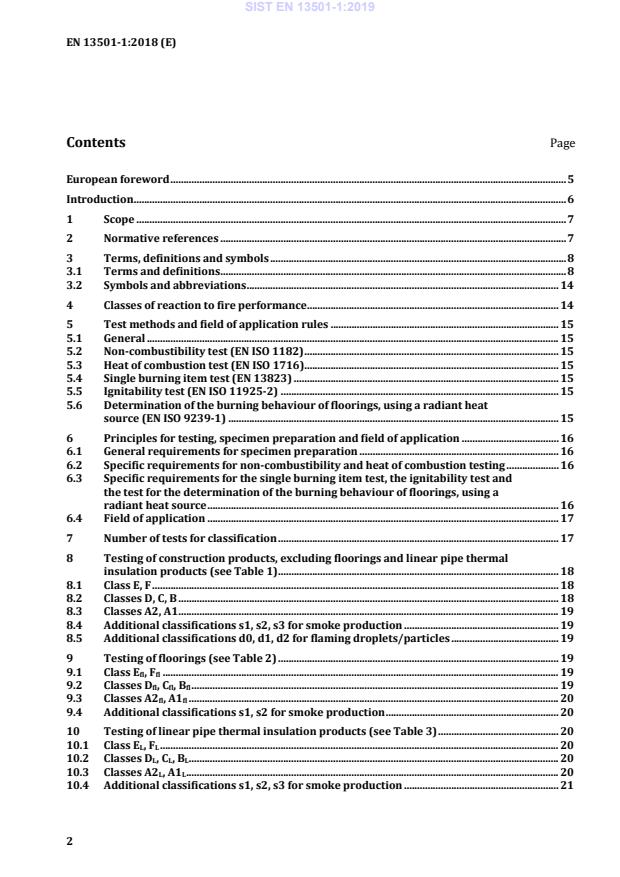
Background information for the application of the Commission delegated regulation 2016/364 on classification of reaction to fire performance of construction products pursuant to regulation N°305/2011 of the European parliament and of the Council . 44 A.1 General . 44 A.2 Assumptions . 44 SIST EN 13501-1:2019
Reaction to fire classification report . 51 B.1 Introduction . 51 B.2 Details of classified product . 51 B.2.1 General . 51 B.2.2 Product description . 51 B.3 Reports and results in support of this classification . 52 B.3.1 Specific conditions(**) . 52 B.3.2 Reports . 52 B.3.3 Results . 52 B.4 Classification and field of application . 53 B.4.1 Reference of classification . 53 B.4.2 Classification . 53 B.4.3 Field of application . 54 B.5 Limitations . 54 Bibliography . 55
1,0 kg/m2 or a thickness
·
sá r mm is considered to be a substantial component 3.1.6 non-substantial component material that does not constitute a significant part of a non-homogeneous product. A layer with a mass/unit area < 1,0 kg/m2 and a thickness < 1,0 mm is considered to be a non-substantial component Note 1 to entry: Two or more non-substantial layers that are adjacent to each other (i.e. with no substantial component(s) in between the layers) are regarded as one non-substantial component when they collectively comply with the requirements for a layer being a non-substantial component. 3.1.7 internal non-substantial component non-substantial component that is covered on both sides by at least one substantial component 3.1.8 external non-substantial component non-substantial component that is not covered on one side by a substantial component SIST EN 13501-1:2019
processes, the fully developed fire stage, the fire decay stage, and the environment and systems that will impact on the course of the fire. Note 3 to entry: Unlike deterministic fire analysis, where fire scenarios are individually selected and used as design fire scenarios, in fire risk assessment,, fire scenarios are used as representative fire scenarios within fire scenario clusters. [SOURCE: EN ISO 13943:2017, 3.152] 3.1.17 reference scenario hazard situation used as a reference for a given test method or classification system 3.1.18 fire situation stage in the development of a fire, characterised by the nature, severity and size of the thermal attack on the products involved 3.1.19 combustion exothermic reaction of a substance with an oxidizing agent Note 1 to entry: Combustion generally emits effluent accompanied by flames and/or visible light. [SOURCE: EN ISO 13943:2017, 3.55] 3.1.20 heat of combustion thermal energy produced by combustion of unit of mass of a given substance Note 1 to entry: It is expressed in joules per kilogram. [SOURCE: EN ISO 13943:2017, 3.203] 3.1.21 gross heat of combustion (PCS) heat of combustion of a substance when the combustion is complete and any produced water is entirely condensed under specified conditions [SOURCE: EN ISO 13943:2017, 3.198] SIST EN 13501-1:2019
The typical unit is kJCbg «1. Note 3 to entry: The net heat of combustion may be calculated from the gross heat of combustion. [SOURCE: EN ISO 13943:2017, 3.280] 3.1.23 contribution to fire energy released by a product influencing the fire growth both in pre- and post-flashover situations 3.1.24 ignitability measure of the ease with which a test specimen can be ignited, under specified conditions [SOURCE: EN ISO 13943:2017, 3.212] 3.1.25 heat release thermal energy produced by combustion
Note 1 to entry: The typical unit is J. [SOURCE: EN ISO 13943:2017, 3.205] 3.1.26 small fire attack thermal attack produced by a small flame like a match or a lighter 3.1.27 level of exposure intensity, duration and extent of the thermal attack on a product 3.1.28 flame spread vertical flame spread (Fs) is the highest point reached by the flame tip, as evaluated in the test in EN ISO 11925-2 Note 1 to entry: Lateral flame spread is the furthest extent of travel of a sustained flame, as specified in the EN 13823 test. SIST EN 13501-1:2019
[SOURCE: EN ISO 13943:2017, 3.184] 3.1.32 flaming droplets/particles material separating from the specimen during the fire test and continuing to flame for a minimum period as described by the test method 3.1.33 critical heat flux at extinguishment (CHF) incident heat flux at the surface of a specimen at the point where the flame ceases to advance and may subsequently go out Note 1 to entry: The heat flux value reported is based on interpolations of measurements with a non-combustible calibration board. Note 2 to entry: The typical unit is kW/m2. 3.1.34 heat flux at X minutes (HF-X) total heat flux received by the specimen at the most distant spread of flame position observed during the first X minutes of the test Note 1 to entry: The typical unit is kW/m2. 3.1.35 critical heat flux (CHF) heat flux at which the flame extinguishes (CHF) or the heat flux after a test period of 30 min (HF-30), whichever is the lower value Note 1 to entry: It is the flux corresponding with the furthest extent of spread of flame within 30 min. SIST EN 13501-1:2019
For the classes A2 and B, FIGRA = FIGRA0,2MJ For the classes C and D, FIGRA = FIGRA0,4MJ For the classes A2L, BL, and CL, FIGRA = FIGRA0,2MJ For the class DL, FIGRA = FIGRA0,4MJ 3.1.38 FIGRA0,2MJ maximum of the quotient of heat release rate from the specimen and the time of its occurrence using a THR-threshold of 0,2 MJ Note 1 to entry: FIGRA0,2MJ is defined in more detail in EN 13823. 3.1.39 FIGRA0,4MJ maximum of the quotient of heat release rate from the specimen and the time of its occurrence using a THR threshold of 0,4 MJ Note 1 to entry: The FIGRA0,4MJ is defined in more detail in EN 13823. 3.1.40 SMOGRA smoke growth rate. The maximum of the quotient of smoke production rate from the specimen and the time of its occurrence Note 1 to entry: The SMOGRA is defined in more detail in EN 13823. 3.1.41 direct field of application outcome of a process (involving the application of defined rules) whereby a test result is deemed to be equally valid for variations in one or more of the product properties and/or intended end use applications 3.1.42 extended field of application outcome of a process (involving the application of defined rules that may incorporate calculation procedures) that predicts, for a variation of a product property and/or its intended end use application(s), a test result on the basis of one or more test results to the same test standard 3.1.43 extended application result predicted result for performance parameter obtained following the process of extended field of application SIST EN 13501-1:2019
smoke growth rate [m2/s2] tf duration of sustained flaming [s] (duration of flaming) THR600s total heat release within 600 s [MJ] TSP600s total smoke production within 600 s [m2] m’
mean value of the set of results of a continuous parameter determined in accordance with the relevant test method using the minimum number of tests as specified in the test method m
mean value of the set of results of a continuous parameter determined in accordance with the procedure in 7.3 and used for classification 4 Classes of reaction to fire performance The classes with their corresponding fire performance are given in: — Table 1 for construction products excluding floorings and linear pipe thermal insulation products; — Table 2 for floorings; — Table 3 for linear pipe thermal insulation products. Products classified in a given class are deemed to satisfy all the requirements of any lower class. SIST EN 13501-1:2019
...
Questions, Comments and Discussion
Ask us and Technical Secretary will try to provide an answer. You can facilitate discussion about the standard in here.
Loading comments...