

EN 212:2026
(Main)Wood preservatives - General guidance on sampling and preparation for analysis of wood preservatives and treated timber
- Abstract
This document gives guidance on the general procedures in the sampling and preparation for analysis of wood preservatives and preservative-treated timber.
This document is applicable to the provision of appropriate samples for analysis which can be used to check the content of active and other ingredients in preservative formulations, and the content of active and other ingredients of wood preservatives in treated timber, either before, during or after the service life of the timber.
NOTE 1 Methods of sampling creosote and creosote-treated timber are described in other standards: EN 1014-1, EN 1014-2 and EN 12490.
NOTE 2 No attempt has been made in this document to lay down detailed procedures to be adopted for control purposes at manufacturing plants where large volumes of preservatives are sampled. Nor does it attempt to establish procedures for checking the compliance of batches of treated timber with specifications demanding a defined level of treatment (see 6.2).
- Status
- Published
- Publication Date
- 25-Aug-2026
- Technical Committee
- CEN/TC 38 - Durability of wood and derived materials
- Drafting Committee
- CEN/TC 38/WG 26 - Physical/chemical factors (analytical methods)
- Current Stage
- 6060 - Definitive text made available (DAV) - Publishing
- Start Date
- 26-Aug-2026
- Due Date
- 29-Sep-2026
- Completion Date
- 26-Aug-2026

EN 212:2026 is a CEN European Standard for sampling and preparing wood preservatives and preservative-treated timber for analysis. It gives general guidance on how to take representative samples so laboratories can check active ingredients in preservative formulations and in treated timber before, during or after service life. It is aimed at people who sample, test, specify, or assess preservative-treated wood.
What does EN 212:2026 specify?
EN 212:2026 specifies general procedures for sampling wood preservatives and preservative-treated timber and for preparing those samples for analysis. It also includes a method for determining the moisture content of preservative-treated timber and guidance on converting samples into a form suitable for chemical analysis.
The document is organized into clauses on scope, normative references, terms and definitions, safety precautions, sampling of preservatives, sampling of treated timber, moisture content determination, general considerations for conversion for analysis, and the sampling report. The bibliography points to related standards for creosote, creosote-treated timber, water determination, and sampling vocabulary.
What are the key requirements of EN 212:2026?
Representative sampling is the main objective - Clause 5 and Clause 6 stress that samples should reflect the whole consignment or lot. In practice, the sampling plan has to match the preservative, the treatment method, and the analytical purpose.
Suspect consignments must be treated as special cases - Clause 5.1.2 treats damaged containers, uncertain contents, or obvious variation as reasons to flag a consignment. That means the sample should be reported in full and only accepted by agreement of the parties concerned.
Container selection follows a defined rule - Clause 5.1.3 gives the minimum number of containers to sample as the nearest whole number to the square root of half the total number of containers, chosen at random. This matters because it sets a consistent minimum level of coverage.
Sampling tools and containers must not react with the preservative - Clause 5.1.4 requires inert materials, with different advice for hydrocarbon-solvent preservatives and for fluorine- and boron-based preservatives. This avoids contamination or loss of the preservative before analysis.
Different physical forms need different sampling techniques - Clauses 5.2, 5.3, and 5.4 separate solid, paste, and liquid preservatives. Each has its own sampling device and mixing approach, so the sample can be taken without bias from settling, stratification, or container shape.
Treated timber sampling must account for wood structure - Clause 6 explains that heartwood, sapwood, end grain, timber dimensions, and service conditions affect preservative distribution. In practice, the sampler must avoid knots, splits, and contamination, and choose the sampling position to match the purpose of the analysis.
Clause 6.2 links sampling to the treatment question being checked - EN 351-1 and EN 351-2 are used when the aim is to check penetration and retention against a treatment specification. Other procedures in Clause 6 cover average cross-sectional retention, lateral retention, end-grain retention, core retention, thin sections, and wood dust.
Moisture content is determined by controlled drying - Clause 7 uses oven drying at (103 ± 2) °C with repeated weighing to constant mass, and points to Dean and Stark distillation when volatile substances are present. That tells the reader how to measure moisture while limiting loss of preservative.
What terms does EN 212:2026 define?
- Sampling unit - A defined quantity of material with a boundary, such as a container or a time interval in a flow.
- Sample - One or more sampling units, or increments from one unit, taken for examination.
- Representative sample - A sample assumed to have the same composition as the whole material when the material is treated as homogeneous.
- Sampling plan - The planned method for selecting, withdrawing, and preparing samples so a decision can be made about a lot.
- Consignment - The quantity of material covered by one order or shipping document.
- Lot - The total quantity of material sampled under one sampling plan.
- Batch - A definite quantity produced under presumed uniform conditions.
- Final sample - The sample prepared under the sampling plan for possible subdivision for testing, reference, or storage.
Who uses EN 212:2026?
EN 212:2026 is used by laboratories, sampling personnel, quality control teams, certification bodies, and national authorities working with wood preservatives and preservative-treated timber. It is also relevant to people checking treated timber in service, handling disputed consignments, or preparing samples for chemical analysis in research, compliance, or arbitration work.
What changed in EN 212:2026 from the previous edition?
EN 212:2026 replaces EN 212:2003. The European foreword states two significant technical changes: Figures 1 and 6 were deleted, and Figures 2 to 5 were updated and renumbered as Figures 1 to 4.
Which standards are used with EN 212:2026?
- EN 351-1 - gives the classification used to specify preservative penetration and retention in treated solid wood.
- EN 351-2 - gives guidance on sampling treated timber specifically to check compliance with EN 351-1.
- EN 1014-1 - provides sampling and analysis procedures for creosote.
- EN 1014-2 - provides sampling of creosote from creosoted timber for later analysis.
- EN 12490 - gives determination of penetration and retention of creosote in treated wood and is also named for moisture-content work when appropriate.
- ISO 3733 - provides a distillation method for water when drying may not be suitable.
- ISO 6206:1979 - supplies vocabulary used for sampling terms such as consignment, lot, and batch.
What does the EN 212:2026 document contain?
EN 212:2026 contains practical sampling guidance for preservatives in solid, paste, and liquid form, plus several timber-sampling approaches for cross-section, lateral, end-grain, core, thin-section, and dust samples. It also includes safety precautions, a moisture-content method with an oven-drying procedure and calculation, and guidance on homogenizing or reducing samples for analysis.
The document includes figures for penetration profiles, core-section sampling, and borers, along with a sampling report checklist. Those parts support field sampling, laboratory preparation, testing, and documentation.
Relations
- Effective Date
- 28-Jan-2023
- Effective Date
- 16-Sep-2026
- Effective Date
- 16-Sep-2026
- Effective Date
- 30-Sep-2026
- Referred By
CEN/TR 16420:2012 - Analytical Method for the Analysis of Propiconazole in treated Wood Samples - Effective Date
- 02-Sep-2026
- Effective Date
- 02-Sep-2026
- Effective Date
- 02-Sep-2026
- Effective Date
- 02-Sep-2026
Get Certified
Connect with accredited certification bodies for this standard

ECOCERT
Organic and sustainability certification.

Eurofins Food Testing Global
Global leader in food, environment, and pharmaceutical product testing.

Intertek Bangladesh
Intertek certification and testing services in Bangladesh.
Sponsored listings
Frequently Asked Questions
EN 212:2026 is a standard published by the European Committee for Standardization (CEN). Its full title is "Wood preservatives - General guidance on sampling and preparation for analysis of wood preservatives and treated timber". This standard covers: This document gives guidance on the general procedures in the sampling and preparation for analysis of wood preservatives and preservative-treated timber. This document is applicable to the provision of appropriate samples for analysis which can be used to check the content of active and other ingredients in preservative formulations, and the content of active and other ingredients of wood preservatives in treated timber, either before, during or after the service life of the timber. NOTE 1 Methods of sampling creosote and creosote-treated timber are described in other standards: EN 1014-1, EN 1014-2 and EN 12490. NOTE 2 No attempt has been made in this document to lay down detailed procedures to be adopted for control purposes at manufacturing plants where large volumes of preservatives are sampled. Nor does it attempt to establish procedures for checking the compliance of batches of treated timber with specifications demanding a defined level of treatment (see 6.2).
This document gives guidance on the general procedures in the sampling and preparation for analysis of wood preservatives and preservative-treated timber. This document is applicable to the provision of appropriate samples for analysis which can be used to check the content of active and other ingredients in preservative formulations, and the content of active and other ingredients of wood preservatives in treated timber, either before, during or after the service life of the timber. NOTE 1 Methods of sampling creosote and creosote-treated timber are described in other standards: EN 1014-1, EN 1014-2 and EN 12490. NOTE 2 No attempt has been made in this document to lay down detailed procedures to be adopted for control purposes at manufacturing plants where large volumes of preservatives are sampled. Nor does it attempt to establish procedures for checking the compliance of batches of treated timber with specifications demanding a defined level of treatment (see 6.2).
EN 212:2026 is classified under the following ICS (International Classification for Standards) categories: 71.100.50 - Wood-protecting chemicals. The ICS classification helps identify the subject area and facilitates finding related standards.
EN 212:2026 has the following relationships with other standards: It is inter standard links to EN 212:2003, EN 351-1:2023, EN 351-2:2023, EN 14823:2026, CEN/TR 16420:2012, CEN/TR 14823:2003, CEN/TS 12037:2003, EN 14229:2010. Understanding these relationships helps ensure you are using the most current and applicable version of the standard.
EN 212:2026 is associated with the following European legislation: EU Directives/Regulations: 305/2011. When a standard is cited in the Official Journal of the European Union, products manufactured in conformity with it benefit from a presumption of conformity with the essential requirements of the corresponding EU directive or regulation.
EN 212:2026 is available in PDF format for immediate download after purchase. The document can be added to your cart and obtained through the secure checkout process. Digital delivery ensures instant access to the complete standard document.
Standards Content (Sample)
SLOVENSKI STANDARD
01-oktober-2026
Zaščitna sredstva za les - Splošna navodila za vzorčenje in pripravo zaščitnih
sredstev za les in zaščitenega lesa za analizo
Wood preservatives - General guidance on sampling and preparation for analysis of
wood preservatives and treated timber
Holzschutzmittel - Allgemeine Anleitung für die Probenahme und Probenvorbereitung
von Holzschutzmitteln und von behandeltem Holz für die Analyse
Produits de préservation du bois - Guide général d'échantillonnage et de préparation
pour l'analyse des produits de préservation du bois et du bois traité
Ta slovenski standard je istoveten z: EN 212:2026
ICS:
71.100.50 Kemikalije za zaščito lesa Wood-protecting chemicals
2003-01.Slovenski inštitut za standardizacijo. Razmnoževanje celote ali delov tega standarda ni dovoljeno.
EN 212
EUROPEAN STANDARD
NORME EUROPÉENNE
August 2026
EUROPÄISCHE NORM
ICS 71.100.50 Supersedes EN 212:2003
English Version
Wood preservatives - General guidance on sampling and
preparation for analysis of wood preservatives and treated
timber
Produits de préservation du bois - Guide général Holzschutzmittel - Allgemeine Anleitung für die
d'échantillonnage et de préparation pour l'analyse des Probenahme und Probenvorbereitung von
produits de préservation du bois et du bois traité Holzschutzmitteln und von behandeltem Holz für die
Analyse
This European Standard was approved by CEN on 22 June 2026.
CEN members are bound to comply with the CEN/CENELEC Internal Regulations which stipulate the conditions for giving this
European Standard the status of a national standard without any alteration. Up-to-date lists and bibliographical references
concerning such national standards may be obtained on application to the CEN-CENELEC Management Centre or to any CEN
member.
This European Standard exists in three official versions (English, French, German). A version in any other language made by
translation under the responsibility of a CEN member into its own language and notified to the CEN-CENELEC Management
Centre has the same status as the official versions.
CEN members are the national standards bodies of Austria, Belgium, Bulgaria, Croatia, Cyprus, Czech Republic, Denmark, Estonia,
Finland, France, Germany, Greece, Hungary, Iceland, Ireland, Italy, Latvia, Lithuania, Luxembourg, Malta, Netherlands, Norway,
Poland, Portugal, Republic of North Macedonia, Romania, Serbia, Slovakia, Slovenia, Spain, Sweden, Switzerland, Türkiye and
United Kingdom.
EUROPEAN COMMITTEE FOR STANDARDIZATION
COMITÉ EUROPÉEN DE NORMALISATION
EUROPÄISCHES KOMITEE FÜR NORMUNG
CEN-CENELEC Management Centre: Rue de la Science 23, B-1040 Brussels
© 2026 CEN All rights of exploitation in any form and by any means reserved Ref. No. EN 212:2026 E
worldwide for CEN national Members.
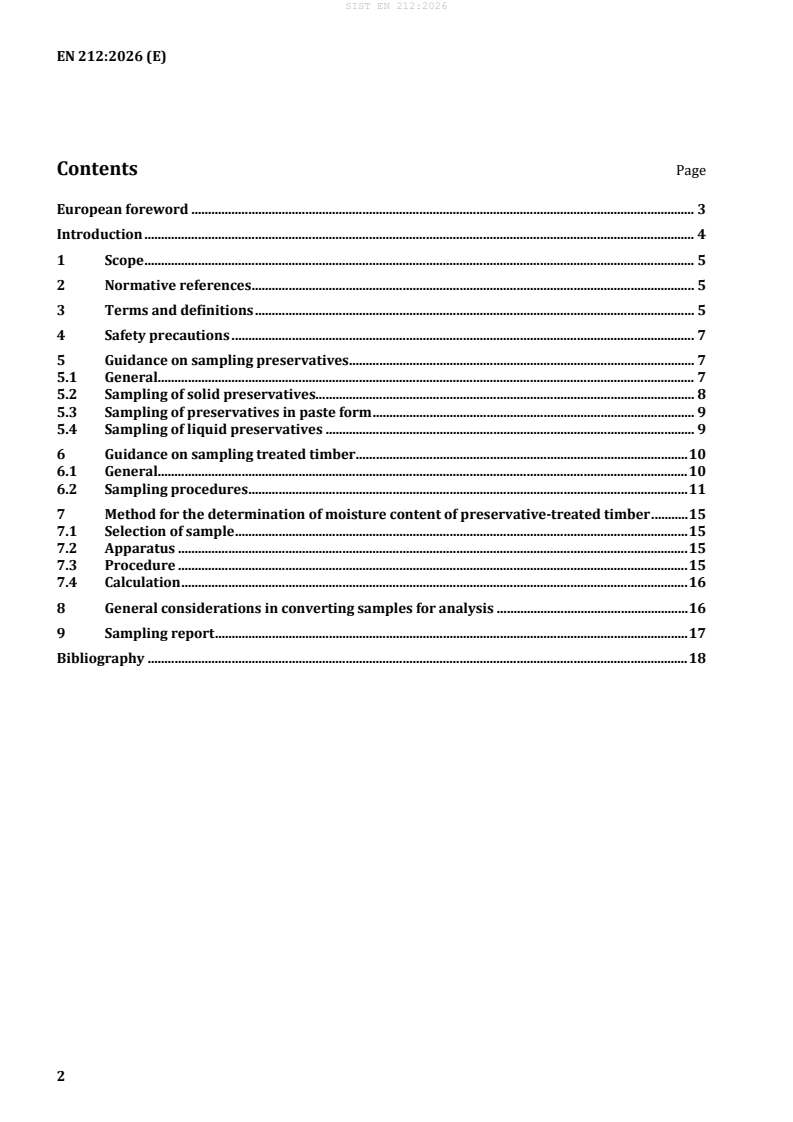
Contents Page
European foreword . 3
Introduction . 4
1 Scope . 5
2 Normative references . 5
3 Terms and definitions . 5
4 Safety precautions . 7
5 Guidance on sampling preservatives . 7
5.1 General. 7
5.2 Sampling of solid preservatives. 8
5.3 Sampling of preservatives in paste form . 9
5.4 Sampling of liquid preservatives . 9
6 Guidance on sampling treated timber . 10
6.1 General. 10
6.2 Sampling procedures . 11
7 Method for the determination of moisture content of preservative-treated timber . 15
7.1 Selection of sample . 15
7.2 Apparatus . 15
7.3 Procedure . 15
7.4 Calculation . 16
8 General considerations in converting samples for analysis . 16
9 Sampling report . 17
Bibliography . 18
European foreword
This document (EN 212:2026) has been prepared by Technical Committee CEN/TC 38 “Biological
durability of wood and wood-based products”, the secretariat of which is held by SIS.
This European Standard shall be given the status of a national standard, either by publication of an
identical text or by endorsement, at the latest by February 2027, and conflicting national standards
shall be withdrawn at the latest by February 2027.
Attention is drawn to the possibility that some of the elements of this document may be the subject of
patent rights. CEN shall not be held responsible for identifying any or all such patent rights.
This document supersedes EN 212:2003.
a) Figures 1 and 6 deleted;
b) Figures 2-5 updated and re-numbered 1-4.
Any feedback and questions on this document should be directed to the users’ national standards body.
A complete listing of these bodies can be found on the CEN website.
According to the CEN-CENELEC Internal Regulations, the national standards organisations of the
following countries are bound to implement this European Standard: Austria, Belgium, Bulgaria,
Croatia, Cyprus, Czech Republic, Denmark, Estonia, Finland, France, Germany, Greece, Hungary, Iceland,
Ireland, Italy, Latvia, Lithuania, Luxembourg, Malta, Netherlands, Norway, Poland, Portugal, Republic of
North Macedonia, Romania, Serbia, Slovakia, Slovenia, Spain, Sweden, Switzerland, Türkiye and the
United Kingdom.
Introduction
Sampling is a vital step in analysis and testing. Its importance is recognized in this document, which
gives guidance on general methods for the sampling of wood preservatives and preservative-treated
timber.
Such samples should be representative of the materials under examination and in a form that makes the
determination of the required data possible.
No attempt has been made here to define rigidly any detailed methodology to be followed in operations
in these areas because this can depend upon the nature of the preservative, the method of treatment
and the particular requirements of e.g. national authorities or quality control and certification bodies.
Furthermore, the objectives of each analysis, and the demands of the individual analytical techniques,
can impose their own requirements with regard to sampling and subsequent handling. Therefore, it is
essential that the sampling plan for each operation should be devised in the light of the particular
objective, using professional judgement based on experience.
The techniques described can be employed in a wide variety of applications ranging from laboratory
research to the checking of preservatives and treated timber for arbitration purposes.
1 Scope
This document gives guidance on the general procedures in the sampling and preparation for analysis
of wood preservatives and preservative-treated timber.
This document is applicable to the provision of appropriate samples for analysis which can be used to
check the content of active and other ingredients in preservative formulations, and the content of active
and other ingredients of wood preservatives in treated timber, either before, during or after the service
life of the timber.
NOTE 1 Methods of sampling creosote and creosote-treated timber are described in other standards: EN 1014-
1, EN 1014-2 and EN 12490.
NOTE 2 No attempt has been made in this document to lay down detailed procedures to be adopted for control
purposes at manufacturing plants where large volumes of preservatives are sampled. Nor does it attempt to
establish procedures for checking the compliance of batches of treated timber with specifications demanding a
defined level of treatment (see 6.2).
2 Normative references
The following documents are referred to in the text in such a way that some or all of their content
constitutes requirements of this document. For dated references, only the edition cited applies. For
undated references, the latest edition of the referenced document (including any amendments) applies.
EN 351-1, Durability of wood and wood-based products - Preservative-treated solid wood - Part 1:
Classification of preservative penetration and retention
EN 351-2, Durability of wood and wood-based products - Preservative-treated solid wood - Part 2:
Guidance on sampling for the analysis of preservative-treated wood
3 Terms and definitions
For the purposes of this document, the following terms and definitions apply.
ISO and IEC maintain terminology databases for use in standardization at the following addresses:
— ISO Online browsing platform: available at https://www.iso.org/obp/
— IEC Electropedia: available at https://www.electropedia.org/
3.1
sampling unit
defined quantity of material having a boundary which may be physical, for example a container, or
hypothetical, for example a particular time or time interval in the case of a stream of material
Note 1 to entry: A number of sampling units can be gathered together, for example in a package or box.
Note 2 to entry: In French, the term ”individu” is sometimes used as a synonym of ”unité d’échantillonnage”. In
English, the terms ”individual”, ”unit” and ”item” are sometimes used in practice as synonyms of ”sampling unit”.
[ISO 6206:1979]
3.2
sample
one or more sampling units taken from a larger number of sampling units, or one or more increments
taken from a sampling unit
[ISO 6206:1979]
3.3
representative sample
sample assumed to have the same composition as the material sampled when the latter is considered as
a homogeneous whole
[ISO 6206:1979]
3.4
sampling plan
planned procedure of selection, withdrawal and preparation of a sample or samples from a lot (3.6) to
yield the required knowledge of the characteristic(s) from the final sample (3.9) so that a decision can
be made regarding the lot
Note 1 to entry: Considerations of cost, effort and delay usually determine an acceptable sampling plan.
[ISO 6206:1979]
3.5
consignment
quantity of material covered by a particular order or shipping document
[Adapted from ISO 6206:1979]
3.6
lot
total quantity of material to be sampled using a particular sampling plan. A lot can consist of a number
of consignments, batches or items
[Adapted from ISO 6206:1979]
3.7
batch
definite quantity of material that can be one item or a number of items that belong together because of
their manufacture or production under conditions which are presumed to be uniform
[Adapted from ISO 6206:1979]
3.8
bulk sample
collect set of samples which do not maintain their individual identity
[ISO 6206:1979]
3.9
final sample
sample obtained or prepared under the sampling plan for possible subdivision into identical portions
for testing, reference or storage
[ISO 6206:1979]
4 Safety precautions
All preservatives should be considered potentially toxic both to man and to the environment and should
be handled with care and in accordance with the specific recommendations for safe use agreed with
National and International Authorities. The manufacturers’ instructions should also be observed.
In handling solid timber after treatment, protective gloves and glasses should be worn if the timber is
still wet or contains solvent. Once the timber has dried, unless preservative residues on the surface are
noted, no special precautions are necessary in handling such timber, other than the normal practice of
washing hands before handling food or smoking.
When treated timber is machined or mechanically sanded or sawn, an efficient dust extraction system
should be used or, failing this, the operator should be provided with, and should wear, appropriate
respiratory protection.
The organic solvents commonly used for applying preservatives are flammable and it is essential that
care be exercised in handling such materials.
NOTE Attention is drawn to the importance of complying with any statutory regulations that govern the use
and storage of flammable liquids.
5 Guidance on sampling preservatives
5.1 General
5.1.1 General
The method of sampling chosen should ensure that the sample obtained is as representative as possible
of the total consignment.
5.1.2 Suspect consignment
A consignment should be considered suspect if:
a) a container is damaged or defective;
b) there is any doubt as to the nature of the contents of a container, for example because of the
presence of an old label or incorrect markings;
c) obvious and unusual variations are observed in the consignment.
Such samples should be fully reported and should not be regarded as acceptable without mutual
agreement between the parties concerned.
5.1.3 Number of items in consignment
The least number of containers, e.g. drums, to be sampled from any given consignment of preservative
materials, irrespective of whether the materials are solid or liquid, should be the nearest whole number
to the square root of half the total number of containers in the consignment (see Table 1). The
containers to be sampled should be taken at random.
Table 1 — Sampling of containers
Number of containers x Number of containers to
in consignment (x) be sampled
10 2,24 2
20 3,16 3
30 3,87 4
50 5,00 5
100 7,07 7
5.1.4 Choice of materials for sample container and sampling devices
It is essential in all cases that the sampling devices and the sample container and its closure be made
from material which is inert to the particular preservative under investigation.
For preservatives with hydrocarbon solvents, polyethylene containers should be avoided and instead
glass containers recommended. For fluorine and boron-based preservatives, the recommendations are
the opposite, i.e. containers of polyethylene are recommended, and glass containers should not be used.
5.1.5 Marking and storage of samples
All sample containers should be clearly and permanently labelled as to their contents. All samples
should be stored in their containers in a cool, dark place prior to analysis.
5.2 Sampling of solid preservatives
5.2.1 Sampling device
A suitable sampling device for the purpose of sampling the preservative in a drum is a sampling spear of
internal diameter approximately 30 mm and sufficiently long to reach the bottom of the drum.
5.2.2 Procedure
Before sampling, mix the contents of the drum as thoroughly as possible. Take great care to minimize
the moisture picked up by the sample during the sampling, mixing and reducing processes. Using the
sampling device, take five samples, one from the centre of the drum and the other four from points on a
pair of diameters at right angles to each other, which are mid-way between the centre and the side of
each drum selected for testing. Ensure that the sampling spear reaches to the bottom of the drum.
NOTE To ascertain the homogeneity of the contents of a drum, individual spear samples can be analysed.
Combine the five samples in a clean, dry, airtight container. If necessary, grind the whole of the bulk
sample to pass a test sieve of nominal aperture size 2,00 mm, ensuring that no residue is left on the
sieve.
Mix the sample well. Transfer the entire sample to a clean dry surface and heap into a cone. Turn over
to form a new cone until the operation has been carried out three times. Form each conical heap by
depositing material on the apex of the cone so that the portions which slide down the side are
distributed as evenly as possible, and that the centre of the cone is not displaced. If some of the larger
aggregates of the mixture roll and scatter round the base, either push these back to the edge of the heap
or break them and distribute them evenly over the heap.
Flatten the final cone from the mixed contents of the container by repeated vertical insertions of the
edge of a board, commencing about the centre and working radially round the cone, lifting the board
clear of the material after each insertion. Carry out this operation so that the flattened heap is of
uniform thickness and diameter and the centre coincides with the centre of the original cone.
Quarter the heap along two diameters which intersect at right angles, using a suitable divider. Shovel
one pair of opposite quarters into a cone and reject the remainder. Mix the cone three times as
described above, flatten the cone and quarter along two diameters.
Repeat these operations until a reduced sample of about 200 g remains. Enclose the test sample in an
airtight container until required for analysis.
5.3 Sampling of preservatives in paste form
5.3.1 Sampling device
A suitable device is a wide-mouthed sampling can of about 500 ml capacity fitted with a long, stiff
handle so that it can be submerged in the material to be sampled. It should also carry a removable lid to
w
...