

EN 14823:2026
(Main)Biological durability of wood and wood-based products - Quantitative determination of pentachlorophenol in wood - Gas chromatographic method
- Abstract
This document specifies a laboratory method of determining the pentachlorophenol content of wood. The method is applicable to all types of pentachlorophenol (PCP) in woods and wood-based materials as well as for the analysis of waste timber with respect to its pentachlorophenol (PCP) content.
The method described has a measurement range from 250 µg/kg up to pentachlorophenol (PCP) contents of 5 mg/kg of dry matter. These figures refer to the given example (where an aliquot of 1 ml of the extract is used for acetylation, see 9.3).
NOTE 1 If lower quantification limits are required, a higher volume of extract aliquot can be used for derivatisation.
NOTE 2 This method could have some modifications with some wood species as hardwoods. In general, in the case of complex matrix, a method using mass spectrometry can be used.
- Status
- Published
- Publication Date
- 15-Sep-2026
- Technical Committee
- CEN/TC 38 - Durability of wood and derived materials
- Drafting Committee
- CEN/TC 38/WG 26 - Physical/chemical factors (analytical methods)
- Current Stage
- 6060 - Definitive text made available (DAV) - Publishing
- Start Date
- 16-Sep-2026
- Due Date
- 29-Jan-2027
- Completion Date
- 16-Sep-2026

EN 14823:2026, published by CEN, specifies a laboratory method for determining pentachlorophenol (PCP) in wood and wood-based materials by gas chromatography. It is intended for testing wood, wood-based products, and waste timber where PCP content needs to be measured in dry matter.
What does EN 14823:2026 specify?
EN 14823:2026 covers the laboratory determination of PCP in wood, including woods and wood-based materials and waste timber. The method is written for quantitative analysis, so it matters when a result has to be reported as a measured PCP content rather than a simple presence/absence check.
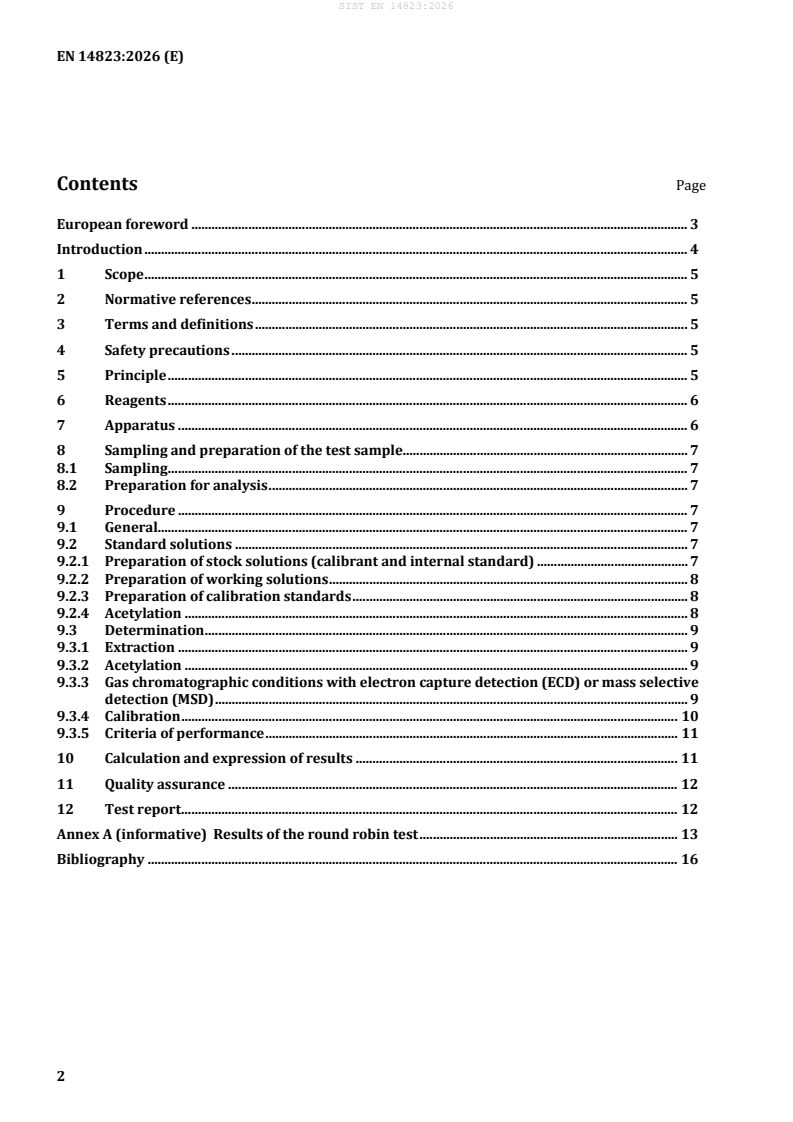
The document is organized into clauses on scope, references, terms, safety, principle, reagents, apparatus, sampling, procedure, calculation, quality assurance, and test reporting. It also includes informative Annex A with round robin results and a bibliography.
The scope states a measurement range from 250 µg/kg to 5 mg/kg of dry matter, based on the example procedure using 1 ml of extract for acetylation. For lower quantification limits, the method allows a larger extract aliquot, and for complex matrices the document points to mass spectrometry as a better option.
What are the key requirements of EN 14823:2026?
Sampling and sample preparation are tied to EN 212, EN 351-2, or another suitable standard. EN 14823:2026 requires a representative test sample, typically 5 g to 10 g, reduced to shavings or sawdust with particle size about 2.0 mm or smaller. This matters because uneven sampling is a major source of error in wood analysis.
PCP is extracted, derivatised, and then measured by gas chromatography. The method uses suitable solvents, converts PCP to PCP acetate with acetic anhydride in potassium carbonate solution, and analyses the derivative after transfer to n-hexane by gas chromatography with electron capture detection (ECD) or mass selective detection (MSD). In practice, this is the analytical workflow the laboratory must follow.
The method uses an internal standard, 2,4,6-tribromophenol (TBP). TBP is added before extraction and is used throughout calibration and calculation. That helps correct for losses during extraction, derivatisation, and injection.
Calibration is based on at least five points and the whole analytical procedure. EN 14823:2026 calibrates with PCP/TBP standard solutions and uses the ratio of the measured signals. This means the calibration reflects the full method, not just the instrument response.
Quality control is built into each batch. The standard calls for duplicate analysis, a repeat analysis if results differ by more than 15 %, a blank for each series, and a calibration check within each batch. The linear regression coefficient has to be above 0.985. In practice, the lab has to document that the method stayed under control for that run.
The document gives practical GC guidance and warns about matrix effects. It names a capillary column with (5 %-Phenyl)-methylpolysiloxane, helium carrier gas, and typical detector and oven conditions, and it notes that additional clean-up may be needed when wood extractives interfere. This helps the laboratory tune the method for difficult samples.
Results are reported as PCP content in mg/kg dry matter. The final value is the mean of independent determinations together with measurement uncertainty. That makes the result usable for technical records, conformity work, and comparative testing.
Who uses EN 14823:2026?
EN 14823:2026 is used by analytical laboratories, quality teams, and buyers who need to measure PCP in wood products or waste timber. It is also relevant to manufacturers and conformity teams for wood-based panels, flooring, solid wood products, and other construction products where PCP content is technically significant.
The method is especially useful when a product specification, incoming inspection, or waste-timber assessment needs a documented laboratory result. Because it includes sample preparation, calibration, QC, and reporting, it supports both routine testing and verification work.
What changed in EN 14823:2026 from the previous edition?
EN 14823:2026 supersedes CEN/TR 14823:2003. The European foreword states that the document has been fully revised and that the results of a round robin test have been added in Annex A.
Which standards are used with EN 14823:2026?
- EN 212 - gives general guidance on sampling and preparation for analysis of wood preservatives and treated timber.
- EN 351-2 - gives guidance on sampling preservative-treated wood for analysis.
- EN ISO 3696 - specifies the water quality used for analytical laboratory work.
What does the EN 14823:2026 document contain?
EN 14823:2026 contains the full laboratory procedure, from sample collection through reporting. It includes standard-solution preparation, acetylation, extraction by ultrasonic bath or pressurized fluid extraction (PFE), and gas chromatographic conditions for ECD or MSD.
It also includes calculation equations, calibration guidance, quality-control checks, and the required test-report items. Annex A summarizes an interlaboratory study with test samples, methods, and statistical performance data that support the method’s practical use.
Relations
- Effective Date
- 22-Dec-2021
- Effective Date
- 30-Sep-2026
- Effective Date
- 17-Sep-2026
- Effective Date
- 17-Sep-2026
- Referred By
EN 14342:2013 - Wood flooring and parquet - Characteristics, evaluation of conformity and marking - Effective Date
- 17-Sep-2026
- Referred By
EN 15228:2009 - Structural timber - Structural timber preservative treated against biological attack - Effective Date
- 17-Sep-2026
- Effective Date
- 17-Sep-2026
Get Certified
Connect with accredited certification bodies for this standard

ECOCERT
Organic and sustainability certification.

Eurofins Food Testing Global
Global leader in food, environment, and pharmaceutical product testing.

Gozdarski inštitut Slovenije
Slovenian Forestry Institute. Forest management certification support, timber testing.
Sponsored listings
Frequently Asked Questions
EN 14823:2026 is a standard published by the European Committee for Standardization (CEN). Its full title is "Biological durability of wood and wood-based products - Quantitative determination of pentachlorophenol in wood - Gas chromatographic method". This standard covers: This document specifies a laboratory method of determining the pentachlorophenol content of wood. The method is applicable to all types of pentachlorophenol (PCP) in woods and wood-based materials as well as for the analysis of waste timber with respect to its pentachlorophenol (PCP) content. The method described has a measurement range from 250 µg/kg up to pentachlorophenol (PCP) contents of 5 mg/kg of dry matter. These figures refer to the given example (where an aliquot of 1 ml of the extract is used for acetylation, see 9.3). NOTE 1 If lower quantification limits are required, a higher volume of extract aliquot can be used for derivatisation. NOTE 2 This method could have some modifications with some wood species as hardwoods. In general, in the case of complex matrix, a method using mass spectrometry can be used.
This document specifies a laboratory method of determining the pentachlorophenol content of wood. The method is applicable to all types of pentachlorophenol (PCP) in woods and wood-based materials as well as for the analysis of waste timber with respect to its pentachlorophenol (PCP) content. The method described has a measurement range from 250 µg/kg up to pentachlorophenol (PCP) contents of 5 mg/kg of dry matter. These figures refer to the given example (where an aliquot of 1 ml of the extract is used for acetylation, see 9.3). NOTE 1 If lower quantification limits are required, a higher volume of extract aliquot can be used for derivatisation. NOTE 2 This method could have some modifications with some wood species as hardwoods. In general, in the case of complex matrix, a method using mass spectrometry can be used.
EN 14823:2026 is classified under the following ICS (International Classification for Standards) categories: 71.100.50 - Wood-protecting chemicals; 79.040 - Wood, sawlogs and sawn timber. The ICS classification helps identify the subject area and facilitates finding related standards.
EN 14823:2026 has the following relationships with other standards: It is inter standard links to CEN/TR 14823:2003, EN 212:2026, EN 17331:2023, CEN/TS 17331:2019, EN 14342:2013, EN 15228:2009, EN 14041:2018. Understanding these relationships helps ensure you are using the most current and applicable version of the standard.
EN 14823:2026 is available in PDF format for immediate download after purchase. The document can be added to your cart and obtained through the secure checkout process. Digital delivery ensures instant access to the complete standard document.
Standards Content (Sample)
SLOVENSKI STANDARD
01-november-2026
Biološka odpornost lesa in lesnih proizvodov - Kvantitativno ugotavljanje
pentaklorofenola v lesu - Plinska kromatografska metoda
Biological durability of wood and wood-based products - Quantitative determination of
pentachlorophenol in wood - Gas chromatographic method
Biologische Dauerhaftigkeit von Holz und Holzprodukten - Quantitative Bestimmung von
Pentachlorphenol in Holz - Gaschromatographisches Verfahren
Durabilité biologique du bois et des matériaux dérivés - Analyse quantitative du
pentachlorophénol dans le bois - Méthode par chromatographie en phase gazeuse
Ta slovenski standard je istoveten z: EN 14823:2026
ICS:
71.040.50 Fizikalnokemijske analitske Physicochemical methods of
metode analysis
79.040 Les, hlodovina in žagan les Wood, sawlogs and sawn
timber
2003-01.Slovenski inštitut za standardizacijo. Razmnoževanje celote ali delov tega standarda ni dovoljeno.
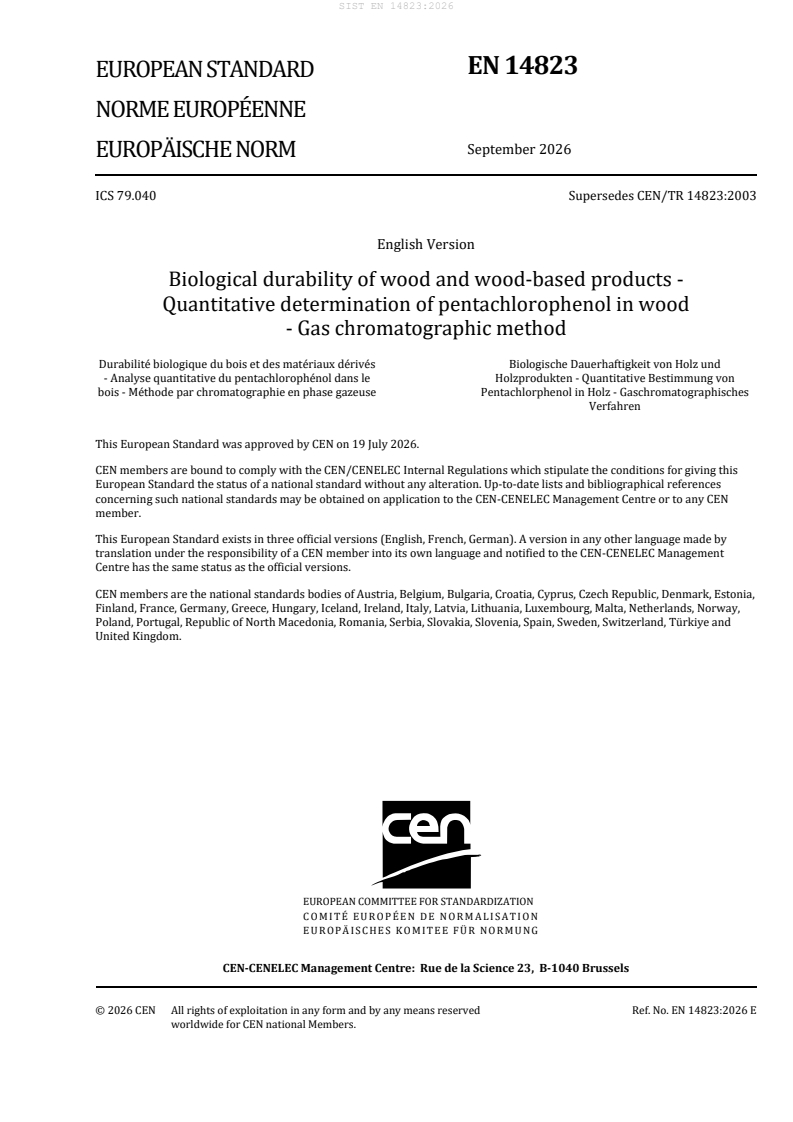
EN 14823
EUROPEAN STANDARD
NORME EUROPÉENNE
September 2026
EUROPÄISCHE NORM
ICS 79.040 Supersedes CEN/TR 14823:2003
English Version
Biological durability of wood and wood-based products -
Quantitative determination of pentachlorophenol in wood
- Gas chromatographic method
Durabilité biologique du bois et des matériaux dérivés Biologische Dauerhaftigkeit von Holz und
- Analyse quantitative du pentachlorophénol dans le Holzprodukten - Quantitative Bestimmung von
bois - Méthode par chromatographie en phase gazeuse Pentachlorphenol in Holz - Gaschromatographisches
Verfahren
This European Standard was approved by CEN on 19 July 2026.
CEN members are bound to comply with the CEN/CENELEC Internal Regulations which stipulate the conditions for giving this
European Standard the status of a national standard without any alteration. Up-to-date lists and bibliographical references
concerning such national standards may be obtained on application to the CEN-CENELEC Management Centre or to any CEN
member.
This European Standard exists in three official versions (English, French, German). A version in any other language made by
translation under the responsibility of a CEN member into its own language and notified to the CEN-CENELEC Management
Centre has the same status as the official versions.
CEN members are the national standards bodies of Austria, Belgium, Bulgaria, Croatia, Cyprus, Czech Republic, Denmark, Estonia,
Finland, France, Germany, Greece, Hungary, Iceland, Ireland, Italy, Latvia, Lithuania, Luxembourg, Malta, Netherlands, Norway,
Poland, Portugal, Republic of North Macedonia, Romania, Serbia, Slovakia, Slovenia, Spain, Sweden, Switzerland, Türkiye and
United Kingdom.
EUROPEAN COMMITTEE FOR STANDARDIZATION
COMITÉ EUROPÉEN DE NORMALISATION
EUROPÄISCHES KOMITEE FÜR NORMUNG
CEN-CENELEC Management Centre: Rue de la Science 23, B-1040 Brussels
© 2026 CEN All rights of exploitation in any form and by any means reserved Ref. No. EN 14823:2026 E
worldwide for CEN national Members.
Contents Page
European foreword . 3
Introduction . 4
1 Scope . 5
2 Normative references . 5
3 Terms and definitions . 5
4 Safety precautions . 5
5 Principle . 5
6 Reagents . 6
7 Apparatus . 6
8 Sampling and preparation of the test sample . 7
8.1 Sampling . 7
8.2 Preparation for analysis . 7
9 Procedure . 7
9.1 General. 7
9.2 Standard solutions . 7
9.2.1 Preparation of stock solutions (calibrant and internal standard) . 7
9.2.2 Preparation of working solutions . 8
9.2.3 Preparation of calibration standards . 8
9.2.4 Acetylation . 8
9.3 Determination . 9
9.3.1 Extraction . 9
9.3.2 Acetylation . 9
9.3.3 Gas chromatographic conditions with electron capture detection (ECD) or mass selective
detection (MSD) . 9
9.3.4 Calibration . 10
9.3.5 Criteria of performance . 11
10 Calculation and expression of results . 11
11 Quality assurance . 12
12 Test report . 12
Annex A (informative) Results of the round robin test . 13
Bibliography . 16
European foreword
This document (EN 14823:2026) has been prepared by Technical Committee CEN/TC 38 “Biological
durability of wood and wood-based products”, the secretariat of which is held by SIS.
This European Standard shall be given the status of a national standard, either by publication of an
identical text or by endorsement, at the latest by March 2027, and conflicting national standards shall be
withdrawn at the latest by March 2027.
Attention is drawn to the possibility that some of the elements of this document may be the subject of
patent rights. CEN shall not be held responsible for identifying any or all such patent rights.
This document supersedes CEN/TR 14823:2003.
The document has been fully revised and the results of a round robin test has been added in Annex A.
Any feedback and questions on this document should be directed to the users’ national standards body.
A complete listing of these bodies can be found on the CEN website.
According to the CEN-CENELEC Internal Regulations, the national standards organisations of the
following countries are bound to implement this European Standard: Austria, Belgium, Bulgaria, Croatia,
Cyprus, Czech Republic, Denmark, Estonia, Finland, France, Germany, Greece, Hungary, Iceland, Ireland,
Italy, Latvia, Lithuania, Luxembourg, Malta, Netherlands, Norway, Poland, Portugal, Republic of North
Macedonia, Romania, Serbia, Slovakia, Slovenia, Spain, Sweden, Switzerland, Türkiye and the United
Kingdom.
Introduction
This document has been issued to facilitate the analysis of pentachlorophenol (PCP) in woods and panels.
Pentachlorophenol (PCP) can be present as residues from old anti-sapstain treatment.
The EN status was adopted by the CEN/TC 38, considering the need of a European standard dealing with
this topic in particular for the wooden construction products such as wood-based panels or floorings,
which are concerned by a pentachlorophenol (PCP) content required by harmonized standards for the
Construction Product regulation.
1 Scope
This document specifies a laboratory method of determining the pentachlorophenol content of wood. The
method is applicable to all types of pentachlorophenol (PCP) in woods and wood-based materials as well
as for the analysis of waste timber with respect to its pentachlorophenol (PCP) content.
The method described has a measurement range from 250 µg/kg up to pentachlorophenol (PCP)
contents of 5 mg/kg of dry matter. These figures refer to the given example (where an aliquot of 1 ml of
the extract is used for acetylation, see 9.3).
NOTE 1 If lower quantification limits are required, a higher volume of extract aliquot can be used for
derivatisation.
NOTE 2 This method could have some modifications with some wood species as hardwoods. In general, in the
case of complex matrix, a method using mass spectrometry can be used.
2 Normative references
The following documents are referred to in the text in such a way that some or all of their content
constitutes requirements of this document. For dated references, only the edition cited applies. For
undated references, the latest edition of the referenced document (including any amendments) applies.
EN 212, Wood preservatives - General guidance on sampling and preparation for analysis of wood
preservatives and treated timber
EN 351-2, Durability of wood and wood-based products - Preservative-treated solid wood - Part 2: Guidance
on sampling for the analysis of preservative-treated wood
EN ISO 3696, Water for analytical laboratory use - Specification and test methods (ISO 3696)
3 Terms and definitions
No terms and definitions are listed in this document.
4 Safety precautions
Persons using this method should be familiar with normal analytical laboratory procedures and practice.
This method does not purport to address all the safety problems, if any, associated with its use.
It is the responsibility of the user to establish safety and health practices and to ensure compliance with
any European or national regulatory conditions.
5 Principle
Pentachlorophenol is extracted from the wood material using appropriate solvents. The extracted
pentachlorophenol is transformed to pentachlorophenol acetate by derivatisation of an aliquot of the
extract in aqueous potassium carbonate solution with acetic anhydride. The acetate derivative formed is
extracted from this aqueous solution with n-hexane and analysed by gas chromatography with electron
capture detection or mass selective detection.
Methanol, acetone or toluene are considered as convenient. Other solvents can be used. Some extraction
difficulties can occur with some wood species (e.g. hardwoods). It is recommended to crosscheck the
extraction efficiency of any other solvent or solvent mixture.
For complex mixtures, the method using mass spectrometry should be used.
6 Reagents
During the analysis, unless otherwise specified, use only reagents of recognized analytical grade, which
have been checked in advance as to not interfere with the analytical results, and water complying with
grade 3 as defined in EN ISO 3696.
6.1 Acetic anhydride (C H O ).
4 6 3
6.2 Methanol (CH OH).
6.3 Acetone (C H O).
3 6
6.4 Toluene (C H CH ).
6 5 3
6.5 n-Hexane (C H ).
6 14
6.6 Potassium carbonate, solution, c(K CO ) = 0,1 mol/l.
2 3
6.7 Sodium sulfate, anhydrous (Na SO ).
2 4
6.8 Pentachlorophenol (pentachlorophenol (PCP), (C Cl OH)) of GC quality.
6 5
6.9 2,4,6-tribromophenol (TBP, (C H Br OH)) of GC quality as an internal standard.
6 2 3
6.10 Certified Reference Material BCR-683 (PCP and PAH in wood).
6.11 Certified Reference Material BAM-U030 (PCP in wood).
7 Apparatus
Ordinary laboratory apparatus and the following.
Glassware should be thoroughly cleaned prior to use.
7.1 Analytical balance, accurate to 0,1 mg.
7.2 Ultra-sonic bath equipped with a thermostat capable of controlling and maintaining a
temperature of 40 °C.
7.3 Pressurized fluid extraction (PFE) system.
Pressurized fluid extraction (PFE) is an automated extraction technique that uses elevated temperature
and pressure.
7.4 Separating funnel.
7.5 Disposable Pasteur pipettes made of glass.
7.6 Volumetric pipettes.
7.7 Microlitre syringes.
7.8 Volumetric flasks.
7.9 Conical flasks, with screw caps provided with an insert of polytetrafluoroethylene (PTFE) or
alternatively with standard ground stoppers provided with PTFE standard ground sockets and conical
joint clips.
7.10 Extraction cell for PFE system.
7.11 Gas chromatograph equipped with a non-discriminating injection system and an electron
capture detector (ECD) or mass spectrometry (MS), with split/ splitless injector.
7.12 Separation column. Capillary column, with stationary phase of (5 %-Phenyl)-methylpolysiloxane.
NOTE Pre-column coated with deactivated silica could be used.
8 Sampling and preparation of the test sample
8.1 Sampling
Samples submitted to testing shall be prepared and conditioned in accordance with EN 351-2, EN 212, or
another suitable standard depending on the aim of the test, in particular the cutting area (sawdust or
shaving).
8.2 Preparation for analysis
Collect at least 5 to 10 g of the sample material taken according to e.g. EN 212. This sample material is
obtained with the appropriate cutting tools, thoroughly cleaned with acetone for example.
This sample material is cut by plane to shavings or ground under mild conditions (to avoid heating) to
sawdust with an approximate particle size ≤ 2,0 mm diameter.
Homogenize the ground sample material to obtain a representative sample and store it in a brown glass
vessel with screw caps with a PTFE insert. This is the test sample.
The mass submitted to test could be lower according to the shape and the type of the material tested.
9 Procedure
9.1 General
The analysis is carried out on duplicate. If results differ by more than 15 % an additional analysis shall be
carried out.
9.2 Standard solutions
9.2.1 Preparation of stock solutions (calibrant and internal standard)
Prepare or procure a standard solution containing the compounds in appropriate concentration
depending on the sensitivity of the system and the conditions diluted in an analytical solvent for
chromatography. By example:
Prepare the stock solutions by weighing about 12,5 mg of pentachlorophenol (PCP) (6.8) and TBP (6.9)
separately to the nearest of 0,01 mg and dissolve ea
...