

EN 13877-1:2023
(Main)Concrete pavements - Part 1: Materials
- Abstract
This document specifies requirements for the constituents (concrete and other materials) of concrete pavements, cast in situ. Concrete compacted by rollers is not covered by this document.
This document covers concrete pavements for roads and other traffic-bearing structures.
- Status
- Published
- Publication Date
- 31-Oct-2023
- Technical Committee
- CEN/TC 227 - Road materials
- Current Stage
- 6060 - Definitive text made available (DAV) - Publishing
- Start Date
- 01-Nov-2023
- Due Date
- 27-Jan-2023
- Completion Date
- 01-Nov-2023

Overview
EN 13877-1:2023 - "Concrete pavements - Part 1: Materials" (CEN) defines material requirements for cast in situ concrete pavements used on roads and other traffic-bearing structures. It specifies which constituent materials are permitted, how concrete properties for fresh and hardened states are measured, and additional safety and durability considerations specific to pavement applications. Roller‑compacted concrete is excluded. This standard supersedes EN 13877-1:2013 and is part of the EN 13877 series (Parts 1–3).
Key topics and technical requirements
- Scope and compliance: Constituent materials must conform to EN 206 and, where applicable, relevant national provisions or European Technical Approvals.
- Cement: Types must comply with EN 197-1 or EN 197-5 and be selected for the specified exposure class per EN 206.
- Aggregates: Must meet EN 12620. Maximum nominal aggregate size:
- ≤ 1/3 of pavement layer thickness;
- For jointed reinforced and continuously reinforced slabs: ≤ 1/4 of bar spacing.
- Mixing water: Must comply with EN 1008.
- Admixtures and additions: Use in accordance with EN 206.
- Fresh concrete:
- Consistence per EN 206 (class or target value suitable for construction equipment).
- Air content measured in situ per EN 12350-7.
- Cement content, fines (<0.250 mm) and chloride limits (≤ 0.40% of cement mass when embedded steel is unprotected) specified.
- Hardened concrete:
- Durability under freeze–thaw and de‑icing agents can be specified using CEN/TS 12390-9 or national methods.
- Mechanical strength may be verified by compressive, flexural or tensile tests (EN 12390-3, EN 12390-5, EN 12390-6 or EN 13863-6).
- Reinforcement: Includes bars, meshes and fibres (EN 14889-1 for steel fibres). Requirements for curing materials, surface retarders, joint sealants, tie bars and dowels are also covered.
Applications and who uses this standard
- Target users:
- Road and highway designers and engineers
- Contractors and concrete suppliers specifying mixes for in-situ pavements
- Public authorities and transport agencies issuing technical specifications
- Testing laboratories and quality control teams
- Practical uses:
- Preparing material specifications for new pavement construction or rehabilitation
- Ensuring durability against traffic loads, freeze-thaw cycles and de-icing salts
- Selecting aggregate grading and cement type to meet performance and safety requirements
Related standards
Relevant referenced standards include: EN 206, EN 197-1/5, EN 12620, EN 1008, EN 12350-7, EN 12390 series, EN 13863-6, EN 14188 (joint sealants), EN 14889-1 (fibres), and CEN/TS 12390-9.
For project compliance, always check national provisions and the companion EN 13877 parts (Part 2: Functional requirements; Part 3: Dowel specifications).
Relations
- Effective Date
- 18-Jan-2023
- Effective Date
- 11-Mar-2026
- Effective Date
- 11-Mar-2026
- Effective Date
- 28-Jan-2026
- Effective Date
- 28-Jan-2026
- Effective Date
- 28-Jan-2026
- Refers
EN 10080:2005 - Steel for the reinforcement of concrete - Weldable reinforcing steel - General - Effective Date
- 28-Jan-2026
- Effective Date
- 28-Jan-2026
- Effective Date
- 28-Jan-2026
- Effective Date
- 28-Jan-2026
- Effective Date
- 28-Jan-2026
- Refers
EN ISO 9227:2022 - Corrosion tests in artificial atmospheres - Salt spray tests (ISO 9227:2022) - Effective Date
- 28-Jan-2026
- Effective Date
- 28-Jan-2026
- Effective Date
- 28-Jan-2026
- Refers
EN 14188-1:2004 - Joint fillers and sealants - Part 1: Specifications for hot applied sealants - Effective Date
- 28-Jan-2026
Get Certified
Connect with accredited certification bodies for this standard

Zavod za gradbeništvo Slovenije (ZAG) - Inšpekcija
ZAG inspection body for construction products, structures, and materials.
Sponsored listings
Frequently Asked Questions
EN 13877-1:2023 is a standard published by the European Committee for Standardization (CEN). Its full title is "Concrete pavements - Part 1: Materials". This standard covers: This document specifies requirements for the constituents (concrete and other materials) of concrete pavements, cast in situ. Concrete compacted by rollers is not covered by this document. This document covers concrete pavements for roads and other traffic-bearing structures.
This document specifies requirements for the constituents (concrete and other materials) of concrete pavements, cast in situ. Concrete compacted by rollers is not covered by this document. This document covers concrete pavements for roads and other traffic-bearing structures.
EN 13877-1:2023 is classified under the following ICS (International Classification for Standards) categories: 93.080.20 - Road construction materials. The ICS classification helps identify the subject area and facilitates finding related standards.
EN 13877-1:2023 has the following relationships with other standards: It is inter standard links to EN 13877-1:2013, EN 206-2:2026, EN 206-1:2026, EN 10060:2003, EN 14889-1:2006, EN 1008:2002, EN 10080:2005, EN 12390-5:2019, EN 13877-3:2004, EN 12620:2013, EN 206:2013+A2:2021, EN ISO 9227:2022, EN 12620:2002, EN 13863-6:2024, EN 14188-1:2004. Understanding these relationships helps ensure you are using the most current and applicable version of the standard.
EN 13877-1:2023 is available in PDF format for immediate download after purchase. The document can be added to your cart and obtained through the secure checkout process. Digital delivery ensures instant access to the complete standard document.
Standards Content (Sample)
SLOVENSKI STANDARD
01-februar-2024
Nadomešča:
SIST EN 13877-1:2013
Betonska vozišča - 1. del: Materiali
Concrete pavements - Part 1: Materials
Fahrbahnbefestigungen aus Beton - Teil 1: Baustoffe
Chaussées en béton - Partie 1 : Matériaux
Ta slovenski standard je istoveten z: EN 13877-1:2023
ICS:
91.100.30 Beton in betonski izdelki Concrete and concrete
products
93.080.20 Materiali za gradnjo cest Road construction materials
2003-01.Slovenski inštitut za standardizacijo. Razmnoževanje celote ali delov tega standarda ni dovoljeno.
EN 13877-1
EUROPEAN STANDARD
NORME EUROPÉENNE
November 2023
EUROPÄISCHE NORM
ICS 93.080.20 Supersedes EN 13877-1:2013
English Version
Concrete pavements - Part 1: Materials
Chaussées en béton - Partie 1 : Matériaux Fahrbahnbefestigungen aus Beton - Teil 1: Baustoffe
This European Standard was approved by CEN on 25 September 2023.
CEN members are bound to comply with the CEN/CENELEC Internal Regulations which stipulate the conditions for giving this
European Standard the status of a national standard without any alteration. Up-to-date lists and bibliographical references
concerning such national standards may be obtained on application to the CEN-CENELEC Management Centre or to any CEN
member.
This European Standard exists in three official versions (English, French, German). A version in any other language made by
translation under the responsibility of a CEN member into its own language and notified to the CEN-CENELEC Management
Centre has the same status as the official versions.
CEN members are the national standards bodies of Austria, Belgium, Bulgaria, Croatia, Cyprus, Czech Republic, Denmark, Estonia,
Finland, France, Germany, Greece, Hungary, Iceland, Ireland, Italy, Latvia, Lithuania, Luxembourg, Malta, Netherlands, Norway,
Poland, Portugal, Republic of North Macedonia, Romania, Serbia, Slovakia, Slovenia, Spain, Sweden, Switzerland, Türkiye and
United Kingdom.
EUROPEAN COMMITTEE FOR STANDARDIZATION
COMITÉ EUROPÉEN DE NORMALISATION
EUROPÄISCHES KOMITEE FÜR NORMUNG
CEN-CENELEC Management Centre: Rue de la Science 23, B-1040 Brussels
© 2023 CEN All rights of exploitation in any form and by any means reserved Ref. No. EN 13877-1:2023 E
worldwide for CEN national Members.
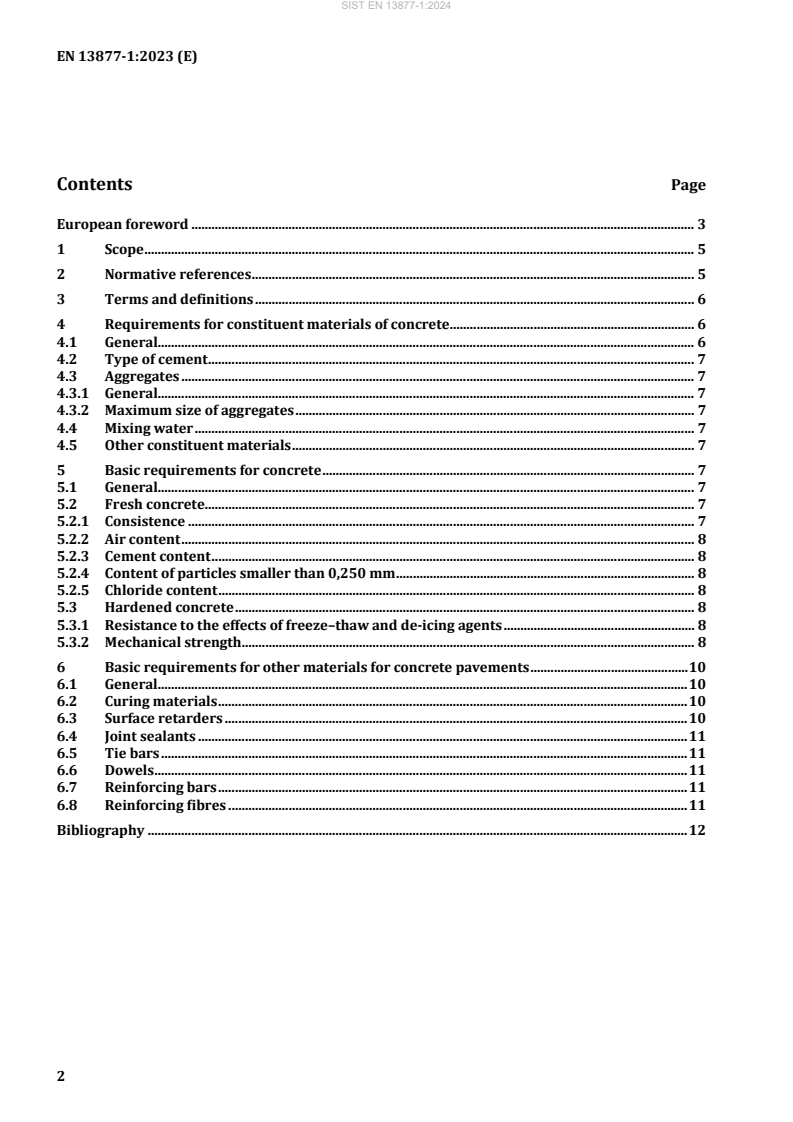
Contents Page
European foreword . 3
1 Scope . 5
2 Normative references . 5
3 Terms and definitions . 6
4 Requirements for constituent materials of concrete . 6
4.1 General. 6
4.2 Type of cement . 7
4.3 Aggregates . 7
4.3.1 General. 7
4.3.2 Maximum size of aggregates . 7
4.4 Mixing water . 7
4.5 Other constituent materials . 7
5 Basic requirements for concrete . 7
5.1 General. 7
5.2 Fresh concrete . 7
5.2.1 Consistence . 7
5.2.2 Air content . 8
5.2.3 Cement content . 8
5.2.4 Content of particles smaller than 0,250 mm . 8
5.2.5 Chloride content . 8
5.3 Hardened concrete . 8
5.3.1 Resistance to the effects of freeze–thaw and de-icing agents . 8
5.3.2 Mechanical strength . 8
6 Basic requirements for other materials for concrete pavements . 10
6.1 General. 10
6.2 Curing materials . 10
6.3 Surface retarders . 10
6.4 Joint sealants . 11
6.5 Tie bars . 11
6.6 Dowels . 11
6.7 Reinforcing bars . 11
6.8 Reinforcing fibres . 11
Bibliography . 12
European foreword
This document (EN 13877-1:2023) has been prepared by Technical Committee CEN/TC 227 “Road
materials”, the secretariat of which is held by BSI.
This European Standard shall be given the status of a national standard, either by publication of an
identical text or by endorsement, at the latest by May 2024, and conflicting national standards shall be
withdrawn at the latest by May 2024.
Attention is drawn to the possibility that some of the elements of this document may be the subject of
patent rights. CEN shall not be held responsible for identifying any or all such patent rights.
This document supersedes EN 13877-1:2013.
— the normative references have been updated;
— the scope has been adapted;
— lean concrete has been removed;
— the requirements on the density of fresh concrete have been removed;
— fibres have been included in the definition of reinforcement;
— the notes in Table 1 have been updated;
— Table 3, Dimensions for tie bars, has been removed;
— EN 197-1, EN 13863-6 and EN 14889-1 have been added to the normative references;
— the Bibliography has been updated.
EN 13877, Concrete pavements, is currently composed with the following parts:
— Part 1: Materials
— Part 2: Functional requirements for concrete pavements
— Part 3: Specifications for dowels to be used in concrete pavements
This document refers to EN 206. In accordance with the scope of EN 206 some additional or different
requirements are necessary for pavements, particularly to comply with safety of users, durability,
environment and health.
Any feedback and questions on this document should be directed to the users’ national standards body.
A complete listing of these bodies can be found on the CEN website.
According to the CEN-CENELEC Internal Regulations, the national standards organisations of the
following countries are bound to implement this European Standard: Austria, Belgium, Bulgaria, Croatia,
Cyprus, Czech Republic, Denmark, Estonia, Finland, France, Germany, Greece, Hungary, Iceland, Ireland,
Italy, Latvia, Lithuania, Luxembourg, Malta, Netherlands, Norway, Poland, Portugal, Republic of North
Macedonia, Romania, Serbia, Slovakia, Slovenia, Spain, Sweden, Switzerland, Türkiye and the United
Kingdom.
1 Scope
This document specifies requirements for the constituents (concrete and other materials) of concrete
pavements, cast in situ. Concrete compacted by rollers is not covered by this document.
This document covers concrete pavements for roads and other traffic-bearing structures.
2 Normative references
The following documents are referred to in the text in such a way that some or all of their content
constitutes requirements of this document. For dated references, only the edition cited applies. For
undated references, the latest edition of the referenced document (including any amendments) applies.
CEN/TS 14754-1, Curing compounds — Test methods — Part 1: Determination of water retention efficiency
of common curing compounds
EN 197-1, Cement — Part 1: Composition, specifications and conformity criteria for common cements
EN 197-5, Cement — Part 5: Portland-composite cement CEM II/C-M and composite cement CEM VI
EN 206, Concrete — Specification, performance, production and conformity
EN 1008, Mixing water for concrete — Specification for sampling, testing and assessing the suitability of
water, including water recovered from processes in the concrete industry, as mixing water for concrete
EN 10025-2, Hot rolled products of structural steels — Part 2: Technical delivery conditions for non-alloy
structural steels
EN 10060, Hot rolled round steel bars for general purposes — Dimensions and tolerances on shape and
dimensions
EN 10080, Steel for the reinforcement of concrete — Weldable reinforcing steel — General
EN 12350-7, Testing fresh concrete — Part 7: Air content — Pressure methods
EN 12390-3, Testing hardened concrete — Part 3: Compressive strength of test specimens
EN 12390-5, Testing hardened concrete — Part 5: Flexural strength of test specimens
EN 12390-6, Testing hardened concrete — Part 6: Tensile splitting strength of test specimens
EN 12620, Aggregates for concrete
EN 13863-6, Concrete pavements — Part 6: Test method for the determ
...