

EN 12975:2022
(Main)Solar collectors - General requirements
- Abstract
This document is applicable to all types of fluid heating solar collectors. This document specifies performance requirements for fluid heating solar collectors with respect to durability, reliability, safety and thermal performance.
This document deals with the solar collector and not with assemblies. This document is not applicable to those devices in which a thermal storage unit is an integral part to such an extent that the collection process cannot be separated from the storage process for making the collector thermal performance measurements.
- Status
- Published
- Publication Date
- 22-Mar-2022
- Technical Committee
- CEN/TC 312 - Thermal solar systems and components
- Drafting Committee
- CEN/TC 312/WG 1 - Solar collectors
- Current Stage
- 6060 - Definitive text made available (DAV) - Publishing
- Start Date
- 23-Mar-2022
- Due Date
- 25-Jul-2018
- Completion Date
- 23-Mar-2022

Overview
EN 12975:2022 - Solar collectors - General requirements (CEN) is a European standard that defines performance, durability, reliability and safety requirements for fluid-heating solar collectors. Applicable to all types of collectors where the collection process can be separated from thermal storage, this standard focuses on the collector itself (not assemblies or fully integrated storage devices). EN 12975:2022 supersedes EN 12975-1:2006+A1:2010 and aligns testing references with EN ISO 9806:2017, introduces the gross yield concept and formalizes collector family rules.
Key topics and requirements
- Scope: Applies to all fluid-heating solar collectors; excludes devices where storage is integral and inseparable from collection.
- Testing and performance:
- Requires testing largely according to EN ISO 9806:2017 (see Annex A for conversions from earlier test results).
- Reports gross solar yield (GSY) and, for cogenerating collectors, gross thermal yield (GTY) and gross electric yield (GEY).
- Gross yields must be reported for selected locations (Athens, Würzburg, Strasbourg, Davos) and operating temperatures 25 °C, 50 °C, 75 °C (Annex B).
- Durability, reliability and safety:
- Compliance criteria include passing required tests without "major failure" ratings per EN ISO 9806.
- Fire-safety guidance: reaction-to-fire and external-fire tests per EN 13501-1 and EN 13501-5 with sample preparation guidance in Annexes E and F.
- Documentation and labelling:
- Mandatory technical documentation: bill of materials, fully-dimensioned drawings, material specifications.
- Required labelling: manufacturer, model, serial number, production year, peak power, maximum operating pressure, empty weight, etc.
- Additional concepts:
- Collector families and design tolerances (Annex C).
- Retesting guidelines (Annex D).
- Recommended (but not always mandatory) tests such as pressure-drop measurement and specific fire tests.
Applications and practical value
EN 12975:2022 is used to:
- Demonstrate thermal performance, safety and durability of solar collectors for product certification and market access in Europe.
- Provide a consistent testing and reporting basis for manufacturers, independent test laboratories and certification bodies.
- Support procurement specifications, product comparison, and compliance checks for installers, system designers and building authorities.
- Inform product documentation and labelling required for installers and end users.
Keywords: EN 12975:2022, solar collectors, fluid heating, thermal performance, gross solar yield, EN ISO 9806:2017, fire safety, collector testing, collector families.
Related standards
- EN ISO 9806:2017 - Solar thermal collectors - Test methods
- EN ISO 9488 - Solar energy - Vocabulary
- EN 13501-1 / EN 13501-5 - Fire classification (reaction to fire / external roof exposure)
- EN 13823, EN ISO 11925-2 - Reaction-to-fire test methods
For manufacturers and test labs preparing product data, following EN 12975:2022 ensures consistent performance reporting, traceable test methods and better acceptance across CEN member states.
Relations
- Effective Date
- 30-Mar-2022
- Effective Date
- 04-Feb-2026
- Effective Date
- 28-Jan-2026
- Effective Date
- 28-Jan-2026
- Effective Date
- 28-Jan-2026
- Effective Date
- 28-Jan-2026
- Effective Date
- 28-Jan-2026
- Effective Date
- 28-Jan-2026
- Effective Date
- 28-Jan-2026
- Effective Date
- 28-Jan-2026
- Effective Date
- 28-Jan-2026
Get Certified
Connect with accredited certification bodies for this standard

DNV
DNV is an independent assurance and risk management provider.

Lloyd's Register
Lloyd's Register is a global professional services organisation specialising in engineering and technology.
DNV Energy Systems
Energy and renewable energy certification.
Sponsored listings
Frequently Asked Questions
EN 12975:2022 is a standard published by the European Committee for Standardization (CEN). Its full title is "Solar collectors - General requirements". This standard covers: This document is applicable to all types of fluid heating solar collectors. This document specifies performance requirements for fluid heating solar collectors with respect to durability, reliability, safety and thermal performance. This document deals with the solar collector and not with assemblies. This document is not applicable to those devices in which a thermal storage unit is an integral part to such an extent that the collection process cannot be separated from the storage process for making the collector thermal performance measurements.
This document is applicable to all types of fluid heating solar collectors. This document specifies performance requirements for fluid heating solar collectors with respect to durability, reliability, safety and thermal performance. This document deals with the solar collector and not with assemblies. This document is not applicable to those devices in which a thermal storage unit is an integral part to such an extent that the collection process cannot be separated from the storage process for making the collector thermal performance measurements.
EN 12975:2022 is classified under the following ICS (International Classification for Standards) categories: 27.160 - Solar energy engineering. The ICS classification helps identify the subject area and facilitates finding related standards.
EN 12975:2022 has the following relationships with other standards: It is inter standard links to EN 12975-1:2006+A1:2010, EN ISO 11925-2:2026, EN ISO 9488:2022, EN ISO 11925-2:2020, EN ISO 9806:2017, EN 13501-1:2018, EN 13823:2020+A1:2022, EN 13501-5:2016, EN 13203-3:2010, EN 16798-5-2:2017, EN 12976-1:2006. Understanding these relationships helps ensure you are using the most current and applicable version of the standard.
EN 12975:2022 is associated with the following European legislation: EU Directives/Regulations: 2006/42/EC, 2014/35/EU, 2014/68/EU, 206/2012, 305/2011, 811/2013, 812/2013, 813/2013, 814/2013; Standardization Mandates: M/071, M/129, M/369, M/396, M/481, M/511, M/534, M/535. When a standard is cited in the Official Journal of the European Union, products manufactured in conformity with it benefit from a presumption of conformity with the essential requirements of the corresponding EU directive or regulation.
EN 12975:2022 is available in PDF format for immediate download after purchase. The document can be added to your cart and obtained through the secure checkout process. Digital delivery ensures instant access to the complete standard document.
Standards Content (Sample)
SLOVENSKI STANDARD
01-julij-2022
Nadomešča:
SIST EN 12975-1:2006+A1:2011
Sprejemniki sončne energije - Splošne zahteve
Solar collectors - General requirements
Kollektoren - Allgemeine Anforderungen
Capteurs solaires - Exigences générales
Ta slovenski standard je istoveten z: EN 12975:2022
ICS:
27.160 Sončna energija Solar energy engineering
2003-01.Slovenski inštitut za standardizacijo. Razmnoževanje celote ali delov tega standarda ni dovoljeno.
EN 12975
EUROPEAN STANDARD
NORME EUROPÉENNE
March 2022
EUROPÄISCHE NORM
ICS 27.160 Supersedes EN 12975-1:2006+A1:2010
English Version
Solar collectors - General requirements
Capteurs solaires - Exigences générales Sonnenkollektoren - Allgemeine Anforderungen
This European Standard was approved by CEN on 31 January 2022.
CEN members are bound to comply with the CEN/CENELEC Internal Regulations which stipulate the conditions for giving this
European Standard the status of a national standard without any alteration. Up-to-date lists and bibliographical references
concerning such national standards may be obtained on application to the CEN-CENELEC Management Centre or to any CEN
member.
This European Standard exists in three official versions (English, French, German). A version in any other language made by
translation under the responsibility of a CEN member into its own language and notified to the CEN-CENELEC Management
Centre has the same status as the official versions.
CEN members are the national standards bodies of Austria, Belgium, Bulgaria, Croatia, Cyprus, Czech Republic, Denmark, Estonia,
Finland, France, Germany, Greece, Hungary, Iceland, Ireland, Italy, Latvia, Lithuania, Luxembourg, Malta, Netherlands, Norway,
Poland, Portugal, Republic of North Macedonia, Romania, Serbia, Slovakia, Slovenia, Spain, Sweden, Switzerland, Turkey and
United Kingdom.
EUROPEAN COMMITTEE FOR STANDARDIZATION
COMITÉ EUROPÉEN DE NORMALISATION
EUROPÄISCHES KOMITEE FÜR NORMUNG
CEN-CENELEC Management Centre: Rue de la Science 23, B-1040 Brussels
© 2022 CEN All rights of exploitation in any form and by any means reserved Ref. No. EN 12975:2022 E
worldwide for CEN national Members.
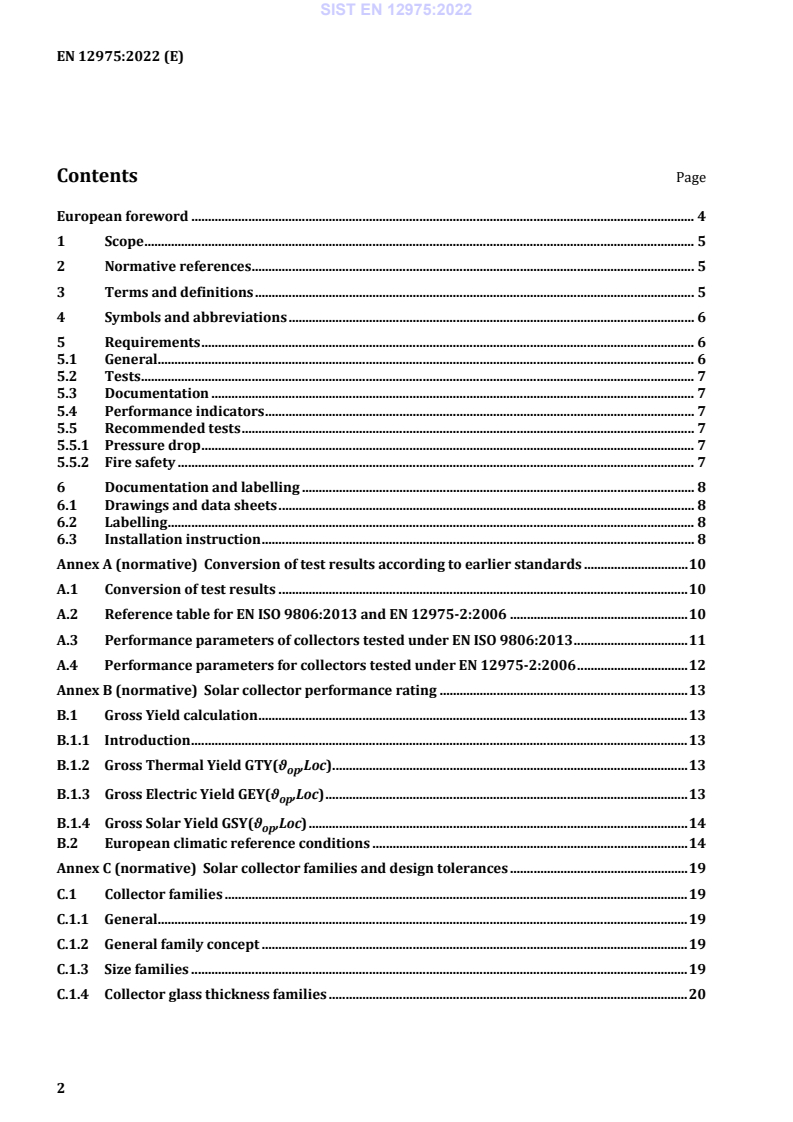
Contents Page
European foreword . 4
1 Scope . 5
2 Normative references . 5
3 Terms and definitions . 5
4 Symbols and abbreviations . 6
5 Requirements . 6
5.1 General. 6
5.2 Tests . 7
5.3 Documentation . 7
5.4 Performance indicators . 7
5.5 Recommended tests . 7
5.5.1 Pressure drop . 7
5.5.2 Fire safety . 7
6 Documentation and labelling . 8
6.1 Drawings and data sheets . 8
6.2 Labelling . 8
6.3 Installation instruction . 8
Annex A (normative) Conversion of test results according to earlier standards . 10
A.1 Conversion of test results . 10
A.2 Reference table for EN ISO 9806:2013 and EN 12975-2:2006 . 10
A.3 Performance parameters of collectors tested under EN ISO 9806:2013 . 11
A.4 Performance parameters for collectors tested under EN 12975-2:2006 . 12
Annex B (normative) Solar collector performance rating . 13
B.1 Gross Yield calculation . 13
B.1.1 Introduction . 13
B.1.2 Gross Thermal Yield GTY(ϑ ,Loc) . 13
op
B.1.3 Gross Electric Yield GEY(ϑ ,Loc) . 13
op
B.1.4 Gross Solar Yield GSY(ϑ ,Loc) . 14
op
B.2 European climatic reference conditions . 14
Annex C (normative) Solar collector families and design tolerances . 19
C.1 Collector families . 19
C.1.1 General. 19
C.1.2 General family concept . 19
C.1.3 Size families . 19
C.1.4 Collector glass thickness families . 20
C.2 Design tolerances . 20
C.2.1 General . 20
C.2.2 Coloured frames . 20
C.2.3 Riser distances . 20
C.2.4 Header tube diameters . 20
Annex D (normative) Solar collector retesting guideline . 21
Annex E (normative) Reaction to fire testing . 22
E.1 General . 22
E.2 Standard EN 13823 (Single burning item test) . 22
E.3 Standard EN ISO 11925-2 (Single flame source test) . 22
E.4 Field of direct application. 22
Annex F (normative) External fire exposure to roofs testing . 23
F.1 General . 23
F.2 Field of direct application. 23
Bibliography . 24
European foreword
This document (EN 12975:2022) has been prepared by Technical Committee CEN/TC 312 “Thermal
solar systems and components”, the secretariat of which is held by NQIS/ELOT.
This European Standard shall be given the status of a national standard, either by publication of an
identical text or by endorsement, at the latest by September 2022, and conflicting national standards
shall be withdrawn at the latest by December 2023.
Attention is drawn to the possibility that some of the elements of this document may be the subject of
patent rights. CEN shall not be held responsible for identifying any or all such patent rights.
This document supersedes EN 12975-1:2006+A1:2010.
In comparison with the previous edition, the following technical modifications have been made:
— the references to the underlying testing standard EN ISO 9806 were updated;
— the gross yield concept is introduced;
— the concept for families of similar collectors is introduced.
Any feedback and questions on this document should be directed to the users’ national standards body.
A complete listing of these bodies can be found on the CEN website.
According to the CEN-CENELEC Internal Regulations, the national standards organisations of the
following countries are bound to implement this European Standard: Austria, Belgium, Bulgaria,
Croatia, Cyprus, Czech Republic, Denmark, Estonia, Finland, France, Germany, Greece, Hungary, Iceland,
Ireland, Italy, Latvia, Lithuania, Luxembourg, Malta, Netherlands, Norway, Poland, Portugal, Republic of
North Macedonia, Romania, Serbia, Slovakia, Slovenia, Spain, Sweden, Switzerland, Turkey and the
United Kingdom.
1 Scope
This document is applicable to all types of fluid heating solar collectors. This document specifies
performance requirements for fluid heating solar collectors with respect to durability, reliability, safety
and thermal performance.
This document deals with the solar collector and not with assemblies. This document is not applicable
to those devices in which a thermal storage unit is an integral part to such an extent that the collection
process cannot be separated from the storage process for making the collector thermal performance
measurements.
2 Normative references
The following documents are referred to in the text in such a way that some or all of their content
constitutes requirements of this document. For dated references, only the edition cited applies. For
undated references, the latest edition of the referenced document (including any amendments) applies.
EN ISO 9488, Solar energy - Vocabulary (ISO 9488)
EN ISO 9806:2017, Solar energy - Solar thermal collectors - Test methods (ISO 9806:2017)
EN 13501-1:2018, Fire classification of construction products and building elements - Part 1:
Classification using data from reaction to fire tests
EN 13501-5, Fire classification of construction products and building elements - Part 5: Classification
using data from external fire exposure to roofs tests
EN 13823, Reaction to fire tests for building products - Building products excluding floorings exposed to
the thermal attack by a single burning item
EN ISO 11925-2, Reaction to fire tests - Ignitability of products subjected to direct impingement of flame -
Part 2: Single-flame source test (ISO 11925-2)
3 Terms and definitions
For the purposes of this document, the terms and definitions given in EN ISO 9488, EN ISO 9806 and the
following apply.
ISO and IEC maintain terminological databases for use in standardization at the following addresses:
— ISO Online browsing platform: available at https://www.iso.org/obp
— IEC Electropedia: available at https://www.electropedia.org/
3.1
Gross Thermal Yield
GTY(ϑ ,Loc)
op
thermal energy yield of a collector for the operating temperature ϑ and the ambient conditions Loc
op
3.2
Gross Electric Yield
GEY(ϑ ,Loc)
op
electric energy yield of a collector for the operating temperature ϑ and the ambient conditions Loc
op
3.3
Gross Solar Yield
GSY(ϑ ,Loc)
op
total energy yield of a collector for the operating temperature ϑ and the ambient conditions Loc
op
4 Symbols and abbreviations
For the purposes of this document, the following symbols and abbreviations apply.
ΔT Time span for gross yield calculations. The default value for ΔT is one year.
In some applications also monthly values are used, so that ΔT = Jan, Feb, … ;
Δt Sampling interval for the calculation, the default value is one hour Δt = 1h;
ϑ Fixed operating temperature equal to the mean temperature of the fluid;
op
Loc Geographical location;
Loc (t ) Set of tabulated ambient conditions {G (t ), G (t ) ϑ (t ), E (t ), u(t ),…} at Loc adapted
β,γ i b i d i a i L i i
for the solar collector installed under azimuth γ and tilt angle β. The default
orientation is due south (γ = 0) with a slope defined by the geographical latitude - 15°,
rounded to the nearest 5°. For tracked collectors, the azimuth and tilt angle are
variable depending on the type of tracking;
Coll Set of solar collector performance parameters {A , η a a a a a a a
G 0,b, 1, 2, 3, 4, 6, 7, 8,
K(θ,θ ), K } reported according to Annex A of EN ISO 9806:2017;
L T d
P Peak electric power of co-generating collectors under standard testing conditions
max
(STC);
δ Temperature coefficient δ for the electric power of co-generating collectors. If δ is not
known, a default value of 0,5 % / K shall be used.
5 Requirements
5.1 General
Solar collectors shall be tested according to 5.2.
Compliance with this standard is assumed if:
— the solar collectors fulfil the requirements of 5.2 and none of the findings is rated as “major failure”
according to Clause 17 of EN ISO 9806:2017;
— the solar collectors are accompanied with the documentation defined in 5.3;
— the performance is reported according to 5.4.
Annex C shall be considered for solar collector families and Annex D for modifications of solar
collectors.
5.2 Tests
Collectors shall be tested according to Table 1 of EN ISO 9806:2017 except for the pressure drop
measurement which is not required. The results shall be reported as required in the corresponding
clauses and as defined in Annex A of EN ISO 9806:2017. Results determined under the previous
standards EN ISO 9806:2013 and EN 12975-2:2006 can be converted according to Annex A. If Annex A
does not provide a conversion key, partial retesting is required.
5.3 Documentation
The solar collector shall be accompanied by technical documentation and shall be marked with a
product label, both providing at least the information listed in Clause 6. For families of collectors the
documentation shall cover all members of the family.
5.4 Performance indicators
The gross solar yield GSY(ϑ ,Loc) shall be reported at least for the locations Athens, Würzburg,
op
Strasbourg and Davos for operating temperatures of 25 °C, 50 °C and 75 °C following Annex B. For co-
generating collectors the gross thermal yield GTY(ϑ ,Loc) and the gross electric yield GEY(ϑ ,Loc)
op op
shall be reported accordingly.
5.5 Recommended tests
5.5.1 Pressure drop
The measurement of the pressure drop (Clause 27 of EN ISO 9806:2017) is recommended.
5.5.2 Fire safety
5.5.2.1 General
Harmful surface temperatures on a solar collector are linked to malfunctions that are rated as major
failure according to Clause 17 of EN ISO 9806:2017. The surface temperatures of parts associated with
the transmission of heat are excluded. No findings with a rating as “2 - major failure” according to
Clause 17 of EN ISO 9806:2017 thus confirms that no harmful temperatures on the surface of the
collector are expected.
5.5.2.2 Reaction to fire
If required, solar collectors which are not classified without testing, shall be tested according to
EN 13501-1 applying the standards therein as applicable and following Annex E for the selection,
preparation, mounting and fixing of the test samples and for the definition of the field of application.
5.5.2.3 External fire performance
If required, solar collectors embedded in the roof shall be tested and classified in accordance with
EN 13501-5 applying the standards therein as applicable and following Annex F for the selection,
preparation, mounting, fixing of the samples and for the definition of the field of application.
6 Documentation and labelling
6.1 Drawings and data sheets
The solar collector submitted for testing shall be accompanied by:
— a bill of materials;
— a set of fully dimensioned technical drawings which have an identification code, a date of issue, a
possible revision date and the date of release;
— all material specifications as defined in A.2 of EN ISO 9806:2017.
6.2 Labelling
Solar collectors shall carry a visible and durable label with at least the following information:
— name of manufacturer;
— model;
— serial number;
— year of production (can be included in the serial number);
— peak power (as defined in 24.3 of EN ISO 9806:2017);
— maximum operation pressure;
— weight of the empty solar collector;
— volume of heat transfer fluid.
6.3 Installation instruction
Solar collectors shall be accompanied by an installation instruction and/or by a technical datasheet
containing at least the following information:
— dimensions of the solar collector;
— weight of the solar collector;
— instructions about the transport and handling of the solar collector;
— standard stagnation temperature of the solar collector;
— description of the mounting procedure;
— recommendations about lightning protection;
— instructions about the coupling of the solar collectors to one another (if applicable) and the
connection of the solar collector field to the heat transfer circuit, including dimensions of pipe
connections for solar collector arrays, including also a reminder to follow the national
requirements for the thermal insulation of the piping;
— instructions about the heat transfer media which shall be used and precautions which shall be
taken during filling, operation and service;
— pressure drop;
— maximum and minimum tilt angle;
— maximum operating pressure;
— maximum operating temperature;
— permissible positive and negative mechanical load;
— maintenance requirements, including specific cleaning procedures if required;
— indications about the requirements concerning free airflow on the backside of the collector;
— indication on the impact resistance;
— climate class for testing.
If the collector can be integrated in the roof or in the building shell, the following recommendations
shall be included in the instruction manual, to be considered when the collector is integrated in the roof
or in the building shell.
— Permanent stagnation over longer periods shall be avoided. The stagnation time between
installation and commissioning of the system shall be less than one month.
— Ventilation behind the collector casing shall be sufficient and in accordance with national
regulations and building codes.
— No additional isolation shall be added to the rear side of the collector.
— Piping near the collector shall be installed and isolated such that they are not in contact with wood
or other inflammable materials.
— Preventive measures shall be taken to avoid that a leaking connection may lead to ingress of heat
transfer fluid into the collector.
Annex A
(normative)
Conversion of test results according to earlier standards
A.1 Conversion of test results
The test results of solar collectors tested according to the standards EN ISO 9806:2013 and
EN 12975-2:2006 are converted to the formats used in EN ISO 9806 as defined in this annex.
A.2 Reference table for EN ISO 9806:2013 and EN 12975-2:2006
If the solar collector is tested in accordance with one of the preceding versions of the test standard
EN ISO 9806 the references in Table A.1 apply:
Table A.1 — Reference table for EN ISO 9806:2013 and EN 12975-2:2006
EN ISO 9806 EN ISO 9806:2013 EN 12975-2:2006
Internal pressure tests for fluid channels Clause 6 Clause 6 5.2
Air leakage rate test Clause 7 Clause 7 –
(air heating collectors only)
Rupture or collapse test Clause 8 Clause 8 –
(air heating collectors only)
a a
Standard stagnation temperature Clause 9
Clause 10 Annex C
b c
Exposure and half-exposure test Clause 10
Clau
...