

EN 15048-2:2016
(Main)Non-preloaded structural bolting assemblies - Part 2: Fitness for purpose
- Abstract
This European Standard specifies the technical requirements for structural bolting assemblies in order to ensure the suitability for non-preloaded bolted connections in steel structures or aluminium structures.
A suitability test is specified to check the behaviour of the structural bolting assemblies.
It applies to bolting assemblies specified in FprEN 15048-1.
- Status
- Published
- Publication Date
- 19-Jul-2016
- Withdrawal Date
- 30-Jan-2017
- Technical Committee
- CEN/TC 185 - Threaded and nonthreaded mechanical fasteners and accessories
- Drafting Committee
- CEN/TC 185/WG 6 - Structural bolting
- Current Stage
- 9093 - Decision to confirm - Review Enquiry
- Start Date
- 16-Apr-2023
- Completion Date
- 21-Oct-2026

Overview
EN 15048-2:2016 - Non-preloaded structural bolting assemblies - Part 2: Fitness for purpose (CEN) defines the technical requirements and suitability testing for non‑preloaded structural bolting assemblies used in steel and aluminium structures. It complements EN 15048-1 (general requirements) and specifies how manufacturers must demonstrate that bolt + nut assemblies are fit for non‑preloaded connections through tensile testing, marking, manufacturing controls and delivery conditions.
Key topics and technical requirements
- Scope and purpose: Ensures bolting assemblies are suitable for structural, non‑preloaded connections and behave reliably under tensile loading.
- Manufacturer responsibility: Bolts, nuts and any coatings should be under the control of a single manufacturer who guarantees assembly performance.
- Composition and product selection: Components must comply with priority product standards (EN/ISO hexagon bolts/nuts standards) or suitable ETAs/national standards where applicable.
- Manufacturing controls:
- Free‑cutting steel must not be used for structural bolts/nuts.
- Hot‑dip galvanizing of nuts must be done before threading; nuts shall not be re‑threaded after galvanizing.
- Property class 10.9 bolts: heed hydrogen embrittlement risks during coating; appropriate processes must be used if risk cannot be avoided.
- Finish and coatings: Coatings must not impair mechanical or functional properties; all components of an assembly must have compatible coatings and equivalent corrosion resistance.
- Marking: Bolts and nuts must show manufacturer identification, property/grade markings and the special marking "SB" (Structural Bolting). Washers need not be marked.
- Washers: Where used, washers of product grade A or C can be combined with any bolting assembly grade. Minimum hardness guidance:
- ≥100 HV for washers combined with same‑type material assemblies.
- ≥300 HV for carbon/alloy steel washers used with property classes 8.8 and 10.9 in single lap joints (see EN 1993‑1‑8).
- Delivery and traceability: Assemblies must be supplied in sealed containers labeled with full designation, “SB”, lot number(s) and manufacturer ID. Suitability demonstrated by representative tensile testing per the standard.
- Tensile testing & reporting: A defined tensile test procedure, required failure mode and tensile resistance criteria are specified; test reports must meet revised documentation requirements.
Applications and users
Who uses EN 15048-2:2016:
- Structural engineers and designers specifying bolted connections (steel and aluminium)
- Fabricators and contractors implementing non‑preloaded bolted joints
- Fastener manufacturers and suppliers demonstrating compliance and traceability
- QA inspectors, project procurement and certification bodies enforcing assembly fitness for purpose
Practical benefits:
- Improves safety and reliability of non‑preloaded structural joints
- Provides clear traceability and acceptance testing for bolting assemblies
- Reduces variability by requiring manufacturer control over components and coatings
Related standards
- EN 15048-1:2016 (General requirements)
- EN 1993-1-8:2005 (Eurocode 3 - design of joints)
- EN ISO 898‑1/2, EN ISO 3506‑1/2 (mechanical properties)
- EN ISO 4014/4016/4017/4018, EN ISO 4032/4033/4034 (bolt & nut product standards)
- EN ISO 6892‑1, EN ISO 7500‑1 (tensile testing and test machine calibration)
Keywords: EN 15048-2:2016, non-preloaded structural bolting assemblies, fitness for purpose, structural bolting, tensile test, marking SB, bolting assembly manufacturer, coating compatibility.
Relations
- Effective Date
- 27-Nov-2013
- Effective Date
- 25-Aug-2026
- Effective Date
- 28-Jan-2026
- Effective Date
- 28-Jan-2026
- Effective Date
- 28-Jan-2026
- Effective Date
- 28-Jan-2026
- Effective Date
- 28-Jan-2026
- Effective Date
- 28-Jan-2026
- Effective Date
- 28-Jan-2026
- Effective Date
- 28-Jan-2026
- Effective Date
- 28-Jan-2026
- Effective Date
- 28-Jan-2026
- Effective Date
- 28-Jan-2026
- Effective Date
- 28-Jan-2026
- Effective Date
- 28-Jan-2026
Frequently Asked Questions
EN 15048-2:2016 is a standard published by the European Committee for Standardization (CEN). Its full title is "Non-preloaded structural bolting assemblies - Part 2: Fitness for purpose". This standard covers: This European Standard specifies the technical requirements for structural bolting assemblies in order to ensure the suitability for non-preloaded bolted connections in steel structures or aluminium structures. A suitability test is specified to check the behaviour of the structural bolting assemblies. It applies to bolting assemblies specified in FprEN 15048-1.
This European Standard specifies the technical requirements for structural bolting assemblies in order to ensure the suitability for non-preloaded bolted connections in steel structures or aluminium structures. A suitability test is specified to check the behaviour of the structural bolting assemblies. It applies to bolting assemblies specified in FprEN 15048-1.
EN 15048-2:2016 is classified under the following ICS (International Classification for Standards) categories: 21.060.01 - Fasteners in general. The ICS classification helps identify the subject area and facilitates finding related standards.
EN 15048-2:2016 has the following relationships with other standards: It is inter standard links to EN 15048-2:2007, ISO 273:1979, EN ISO 4034:2012, EN ISO 4033:2023, EN ISO 4018:2022, EN ISO 7500-1:2018, EN ISO 6892-1:2019, EN 28839:1991, EN 1993-1-8:2005, EN ISO 898-1:2013, EN ISO 898-2:2022, EN 1264-4:2001, EN ISO 3506-2:2020, EN ISO 4014:2022, EN ISO 4017:2022. Understanding these relationships helps ensure you are using the most current and applicable version of the standard.
EN 15048-2:2016 is associated with the following European legislation: EU Directives/Regulations: 305/2011; Standardization Mandates: M/120. When a standard is cited in the Official Journal of the European Union, products manufactured in conformity with it benefit from a presumption of conformity with the essential requirements of the corresponding EU directive or regulation.
EN 15048-2:2016 is available in PDF format for immediate download after purchase. The document can be added to your cart and obtained through the secure checkout process. Digital delivery ensures instant access to the complete standard document.
Standards Content (Sample)
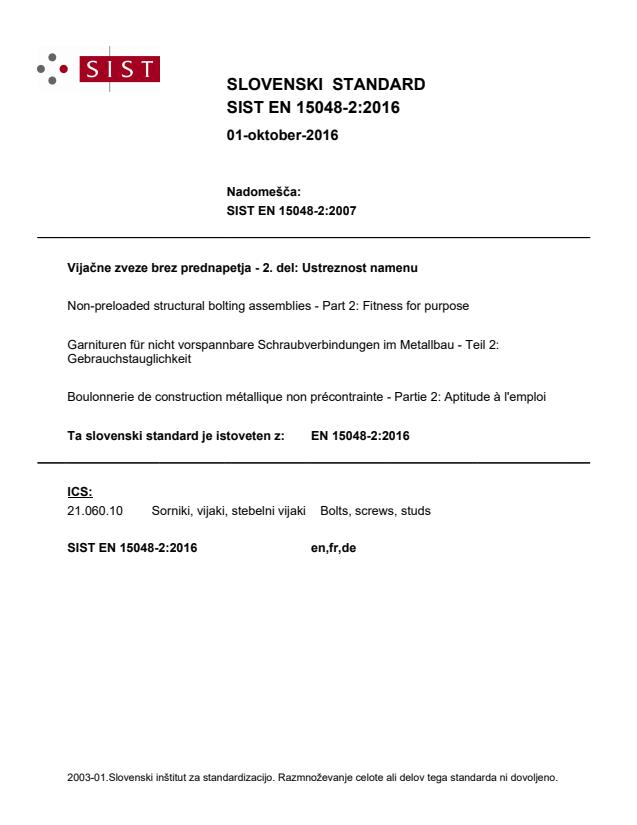
2003-01.Slovenski inštitut za standardizacijo. Razmnoževanje celote ali delov tega standarda ni dovoljeno.Garnituren für nicht vorspannbare Schraubverbindungen im Metallbau - Teil 2: GebrauchstauglichkeitBoulonnerie de construction métallique non précontrainte - Partie 2: Aptitude à l'emploiNon-preloaded structural bolting assemblies - Part 2: Fitness for purpose21.060.10Sorniki, vijaki, stebelni vijakiBolts, screws, studsICS:Ta slovenski standard je istoveten z:EN 15048-2:2016SIST EN 15048-2:2016en,fr,de01-oktober-2016SIST EN 15048-2:2016SLOVENSKI
STANDARDSIST EN 15048-2:20071DGRPHãþD
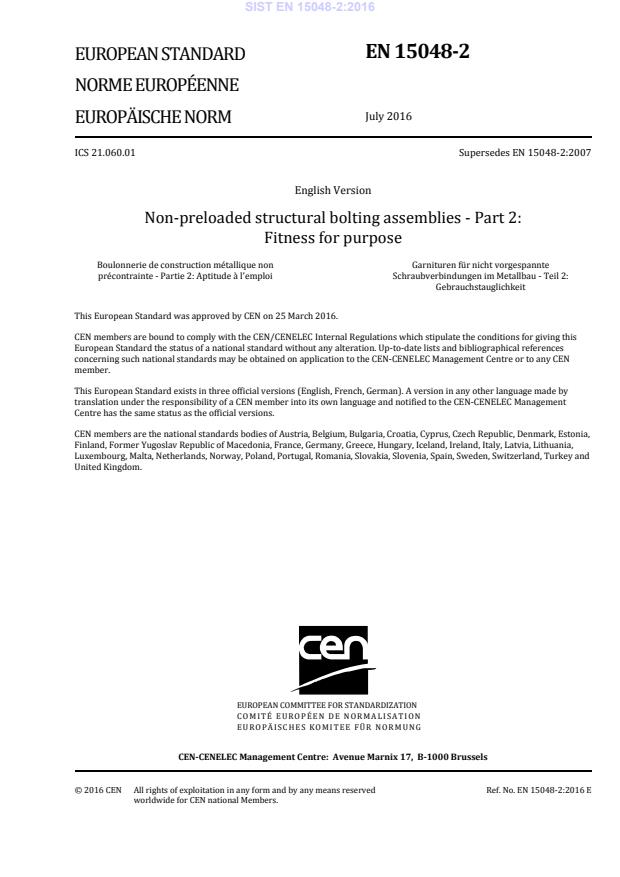
EUROPEAN STANDARD NORME EUROPÉENNE EUROPÄISCHE NORM
EN 15048-2
July
t r s x ICS
t sä r x rä r s Supersedes EN
s w r v zæ tã t r r yEnglish Version
Nonæpreloaded structural bolting assemblies æ Part
tã Fitness for purpose Boulonnerie de construction métallique non précontrainte æ Partie
tã Aptitude à l 5emploi
Garnituren für nicht vorgespannte Schraubverbindungen im Metallbau æ Teil
tã Gebrauchstauglichkeit This European Standard was approved by CEN on
t w March
t r s xä
egulations which stipulate the conditions for giving this European Standard the status of a national standard without any alterationä Upætoædate lists and bibliographical references concerning such national standards may be obtained on application to the CENæCENELEC Management Centre or to any CEN memberä
translation under the responsibility of a CEN member into its own language and notified to the CENæCENELEC Management Centre has the same status as the official versionsä
CEN members are the national standards bodies of Austriaá Belgiumá Bulgariaá Croatiaá Cyprusá Czech Republicá Denmarká Estoniaá Finlandá Former Yugoslav Republic of Macedoniaá Franceá Germanyá Greeceá Hungaryá Icelandá Irelandá Italyá Latviaá Lithuaniaá Luxembourgá Maltaá Netherlandsá Norwayá Polandá Portugalá Romaniaá Slovakiaá Sloveniaá Spainá Swedená Switzerlandá Turkey andUnited Kingdomä
EUROPEAN COMMITTEE FOR STANDARDIZATION COMITÉ EUROPÉEN DE NORMALISATION EUROPÄISCHES KOMITEE FÜR NORMUNG
CEN-CENELEC Management Centre:
Avenue Marnix 17,
B-1000 Brussels
t r s x CEN All rights of exploitation in any form and by any means reserved worldwide for CEN national Membersä Refä Noä EN
s w r v zæ tã t r s x ESIST EN 15048-2:2016
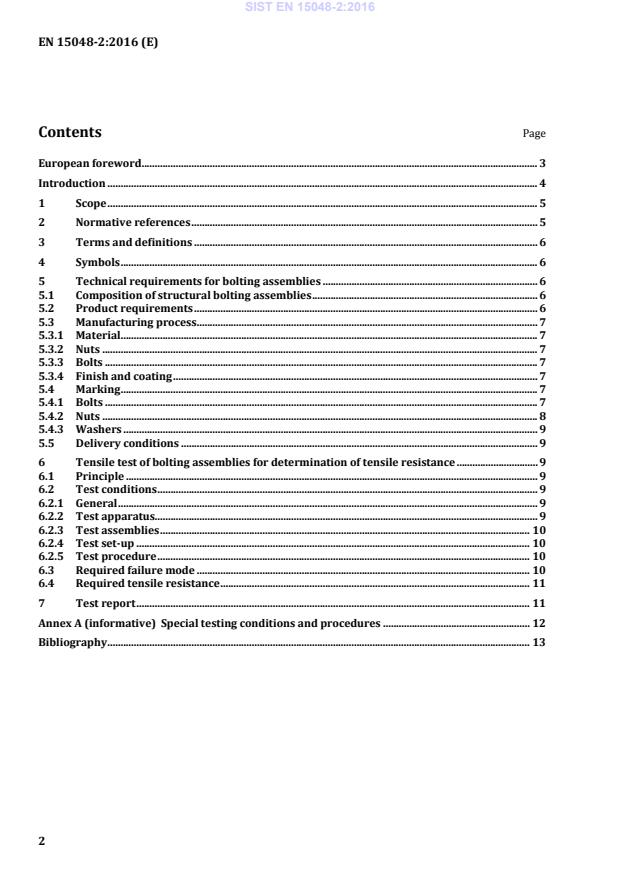
Special testing conditions and procedures . 12 Bibliography . 13
...