

prEN 13076
(Main)Devices to prevent pollution by backflow of potable water - Unrestricted air gap-Family A - Type A
- Abstract
This document specifies the characteristics and the requirements of unrestricted air gap Family A, Type A for nominal flow velocity not exceeding 3 m/s. Air gaps are devices for protection of potable water in water installations from pollution by backflow. This document applies to air gaps in factory-assembled products and to constructed air gaps in situ and specifies requirements and methods to verify and ensure compliance with this document during normal working use.
The fluid in the receiving vessel is assumed to have similar properties to the water supply. Where this is not the case, additional care or tests could be required to verify the efficacy of the solution in practical use.
The AA device is intended to be used in potable water installations according to EN 806 (series).
Sanitary tapware when installed onto a receiving vessel (e.g. washbasin etc.) might have some restriction of its overflow. This will not compromise the water supply as the tapware might have an air gap, as detailed for example in EN 200 (dimension E), that provides an air gap disconnection. If this is the case, then backflow protection will be assumed to be adequate, and no further testing/verification will be needed.
- Status
- Not Published
- Publication Date
- 10-Aug-2027
- Technical Committee
- CEN/TC 164 - Water supply
- Current Stage
- 4060 - Closure of enquiry - Enquiry
- Start Date
- 10-Sep-2026
- Due Date
- 22-Jul-2026
- Completion Date
- 10-Sep-2026

prEN 13076 is a CEN draft European Standard for unrestricted air gaps Family A, Type A used to protect potable water installations from pollution by backflow. It specifies the characteristics, materials, designation, marking and verification methods for factory-assembled products and for air gaps constructed in situ, for nominal flow velocity not exceeding 3 m/s.
What does prEN 13076 specify?
prEN 13076 specifies the requirements for an unrestricted air gap Family A, Type A and how to check that it performs as intended in normal use. It covers the air gap itself, the receiving vessel, the inlet arrangement, overflow conditions, marking and the technical documents supplied with the product.
The document is organized into clauses 1 to 9: Scope, Normative references, Terms and definitions, Designation, Symbolization, Materials, Requirements, Marking and Technical documents. The opening text also explains how the standard relates to potable water installations and when an existing air gap arrangement may already be considered adequate.
What are the key requirements of prEN 13076?
prEN 13076 requires the air gap to keep potable water physically separated from the receiving vessel fluid by a visible, permanent vertical distance. In practice, the point of the document is to prevent backflow contamination even when the system is in normal operation or under fault conditions.
Main technical points
- Scope limit - The standard applies to unrestricted air gaps Family A, Type A for nominal flow velocity up to 3 m/s. This matters because the verification methods are only intended for that operating range.
- Materials - Materials in contact with drinking water shall not create a health risk or change taste, smell, appearance or quality. This matters for product selection and for declarations in technical and commercial documents.
- Assembly and geometry - The feed pipe and any flow control device shall be external to the receiving vessel walls, and the assembly shall be fixed so the air gap remains permanent and unrestricted. This matters because movement or contact can defeat the protection.
- Overflow condition - The spillover level of the receiving vessel shall discharge immediately into free air. If the vessel has a lid, the lid opening and water entry shall be sized so all discharged water enters the vessel without splash or turbulence.
- Air gap distance A - Clause 7.6 defines how to measure A from the lowest point of the inlet orifice to the spillover level, or to the lid surface where a lid is fitted. For small inlet orifices, the document adds verification of the maximum level and possible contact with upstream parts.
- Single and multiple supplies - Clause 7.6 separates single supply and multiple supply arrangements and gives a method for calculating the equivalent diameter for multiple inlets. This matters when one vessel receives several water feeds.
- Backflow/back pressure - Where positive pressure backflow can occur, the standard requires the inlet orifice to be positioned so return fluid cannot contaminate it and the flow arrangement must not compromise overflow performance.
- Verification - Clause 7.7 provides two ways to check compliance: by measurement and by test. The test sequence includes closing vessel outlets, applying the specified flow or pressure, and confirming that upstream components are not contacted by the receiving vessel fluid.
What terms does prEN 13076 define?
- Air gap with unrestricted spillover Family A, Type A - The visible, permanent vertical separation between the inlet orifice and the spillover level, with complete and unrestricted spillover.
- Spillover level - The level at which water begins to overflow the receiving vessel when all outlets are closed.
- Maximum level - The highest water level reached above the spillover level under the specified flow condition with all outlets closed.
- Diameter of feed pipe outlet orifice (bore D) - The internal diameter of the outlet orifice, or the equivalent diameter calculated from the same cross-sectional area.
Who uses prEN 13076?
prEN 13076 is used by manufacturers of devices that prevent backflow pollution, by designers of potable water installations, and by installers and inspectors who need to verify an air gap arrangement on site. It is also relevant to quality managers, test laboratories and buyers who need to check whether a product or installation matches the Family A, Type A concept used in potable water systems.
The document is tied to potable water installations according to EN 806 (series), and it also matters where sanitary tapware or receiving vessels are part of the arrangement.
What changed in prEN 13076 from the previous edition?
prEN 13076 will supersede EN 13076:2003. The document states these changes:
- Figure 3 has been updated and redrawn.
- Dimension D has been redefined.
- A test was added to check that upstream components are not contaminated by downstream fluid through splashing, turbulence or similar effects.
- A validation procedure was introduced.
- The whole document was editorially revised.
Which standards are used with prEN 13076?
| Standard | What it contributes |
|---|---|
| EN 806-1 | General specifications for installations inside buildings conveying water for human consumption. |
| EN 806-5:2012 | Operation and maintenance requirements for those installations. |
| EN 1717 | General requirements for backflow protection and the AA protection unit symbol. |
| EN 806 (series) | The potable water installation context in which the AA device is intended to be used. |
| EN 200 | An example mentioned in the scope for sanitary tapware that may provide an air gap disconnection. |
What does the prEN 13076 document contain?
prEN 13076 contains a design principle figure, a graphic symbol, and installation-oriented requirements for the air gap, the receiving vessel and its overflow arrangement. It also includes measurement and test procedures for checking dimensions, flow conditions, clearance and contact with upstream components.
Clause 7.7 gives practical verification routes by measurement and by test. The test method is especially important for small bore sizes and for arrangements where the maximum level must be observed under flow or pressure.
The marking clause specifies what has to appear on the appliance itself, while the technical documents clause tells the manufacturer what installation and maintenance information has to accompany it.
Relations
- Effective Date
- 11-Jun-2025
Get Certified
Connect with accredited certification bodies for this standard

CIS Institut d.o.o.
Personal Protective Equipment (PPE) certification body. Notified Body NB-2890 for EU Regulation 2016/425 PPE.
Institut za varilstvo d.o.o. (Welding Institute)
Slovenia's leading welding institute since 1952. ISO 3834, EN 1090, pressure equipment certification, NDT personnel, welder qualification. Only IIW Au

Kiwa BDA Testing
Building and construction product certification.
Sponsored listings
Frequently Asked Questions
prEN 13076 is a draft published by the European Committee for Standardization (CEN). Its full title is "Devices to prevent pollution by backflow of potable water - Unrestricted air gap-Family A - Type A". This standard covers: This document specifies the characteristics and the requirements of unrestricted air gap Family A, Type A for nominal flow velocity not exceeding 3 m/s. Air gaps are devices for protection of potable water in water installations from pollution by backflow. This document applies to air gaps in factory-assembled products and to constructed air gaps in situ and specifies requirements and methods to verify and ensure compliance with this document during normal working use. The fluid in the receiving vessel is assumed to have similar properties to the water supply. Where this is not the case, additional care or tests could be required to verify the efficacy of the solution in practical use. The AA device is intended to be used in potable water installations according to EN 806 (series). Sanitary tapware when installed onto a receiving vessel (e.g. washbasin etc.) might have some restriction of its overflow. This will not compromise the water supply as the tapware might have an air gap, as detailed for example in EN 200 (dimension E), that provides an air gap disconnection. If this is the case, then backflow protection will be assumed to be adequate, and no further testing/verification will be needed.
This document specifies the characteristics and the requirements of unrestricted air gap Family A, Type A for nominal flow velocity not exceeding 3 m/s. Air gaps are devices for protection of potable water in water installations from pollution by backflow. This document applies to air gaps in factory-assembled products and to constructed air gaps in situ and specifies requirements and methods to verify and ensure compliance with this document during normal working use. The fluid in the receiving vessel is assumed to have similar properties to the water supply. Where this is not the case, additional care or tests could be required to verify the efficacy of the solution in practical use. The AA device is intended to be used in potable water installations according to EN 806 (series). Sanitary tapware when installed onto a receiving vessel (e.g. washbasin etc.) might have some restriction of its overflow. This will not compromise the water supply as the tapware might have an air gap, as detailed for example in EN 200 (dimension E), that provides an air gap disconnection. If this is the case, then backflow protection will be assumed to be adequate, and no further testing/verification will be needed.
prEN 13076 is classified under the following ICS (International Classification for Standards) categories: 13.060.20 - Drinking water; 23.060.01 - Valves in general. The ICS classification helps identify the subject area and facilitates finding related standards.
prEN 13076 has the following relationships with other standards: It is inter standard links to EN 13076:2003. Understanding these relationships helps ensure you are using the most current and applicable version of the standard.
prEN 13076 is associated with the following European legislation: EU Directives/Regulations: 305/2011. When a standard is cited in the Official Journal of the European Union, products manufactured in conformity with it benefit from a presumption of conformity with the essential requirements of the corresponding EU directive or regulation.
prEN 13076 is available in PDF format for immediate download after purchase. The document can be added to your cart and obtained through the secure checkout process. Digital delivery ensures instant access to the complete standard document.
Standards Content (Sample)
SLOVENSKI STANDARD
01-september-2026
Naprave za varovanje pred onesnaženjem pitne vode zaradi povratnega toka -
Neoviran prosti iztok - Družina A - Tip A
Devices to prevent pollution by backflow of potable water - Unrestricted air gap-Family A
- Type A
Sicherungseinrichtungen zum Schutz des Trinkwassers gegen Verschmutzung durch
Rückfließen - Ungehinderter freier Auslauf-Familie A - Typ A
Dispositifs de protection contre la pollution de l'eau potable par retour - Surverse totale -
Famille A, type A
Ta slovenski standard je istoveten z: prEN 13076
ICS:
13.060.20 Pitna voda Drinking water
23.060.01 Ventili na splošno Valves in general
91.140.60 Sistemi za oskrbo z vodo Water supply systems
2003-01.Slovenski inštitut za standardizacijo. Razmnoževanje celote ali delov tega standarda ni dovoljeno.
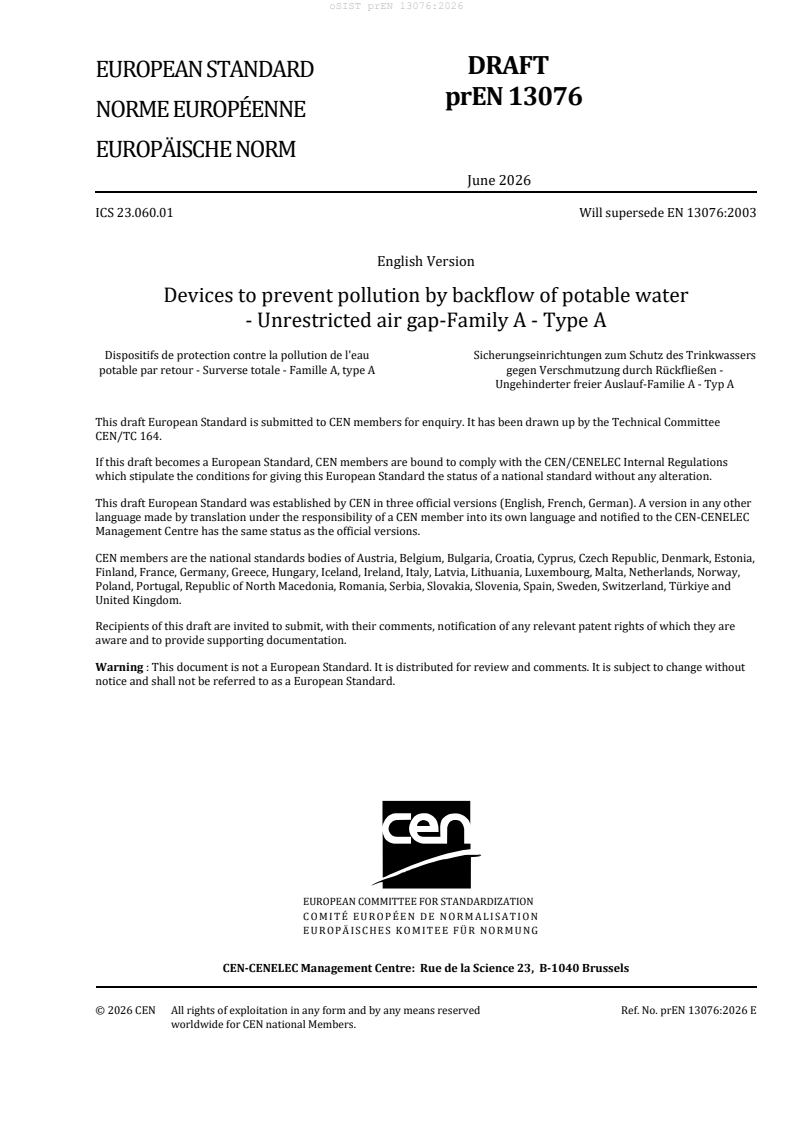
DRAFT
EUROPEAN STANDARD
NORME EUROPÉENNE
EUROPÄISCHE NORM
June 2026
ICS 23.060.01 Will supersede EN 13076:2003
English Version
Devices to prevent pollution by backflow of potable water
- Unrestricted air gap-Family A - Type A
Dispositifs de protection contre la pollution de l'eau Sicherungseinrichtungen zum Schutz des Trinkwassers
potable par retour - Surverse totale - Famille A, type A gegen Verschmutzung durch Rückfließen -
Ungehinderter freier Auslauf-Familie A - Typ A
This draft European Standard is submitted to CEN members for enquiry. It has been drawn up by the Technical Committee
CEN/TC 164.
If this draft becomes a European Standard, CEN members are bound to comply with the CEN/CENELEC Internal Regulations
which stipulate the conditions for giving this European Standard the status of a national standard without any alteration.
This draft European Standard was established by CEN in three official versions (English, French, German). A version in any other
language made by translation under the responsibility of a CEN member into its own language and notified to the CEN-CENELEC
Management Centre has the same status as the official versions.
CEN members are the national standards bodies of Austria, Belgium, Bulgaria, Croatia, Cyprus, Czech Republic, Denmark, Estonia,
Finland, France, Germany, Greece, Hungary, Iceland, Ireland, Italy, Latvia, Lithuania, Luxembourg, Malta, Netherlands, Norway,
Poland, Portugal, Republic of North Macedonia, Romania, Serbia, Slovakia, Slovenia, Spain, Sweden, Switzerland, Türkiye and
United Kingdom.
Recipients of this draft are invited to submit, with their comments, notification of any relevant patent rights of which they are
aware and to provide supporting documentation.
Warning : This document is not a European Standard. It is distributed for review and comments. It is subject to change without
notice and shall not be referred to as a European Standard.
EUROPEAN COMMITTEE FOR STANDARDIZATION
COMITÉ EUROPÉEN DE NORMALISATION
EUROPÄISCHES KOMITEE FÜR NORMUNG
CEN-CENELEC Management Centre: Rue de la Science 23, B-1040 Brussels
© 2026 CEN All rights of exploitation in any form and by any means reserved Ref. No. prEN 13076:2026 E
worldwide for CEN national Members.
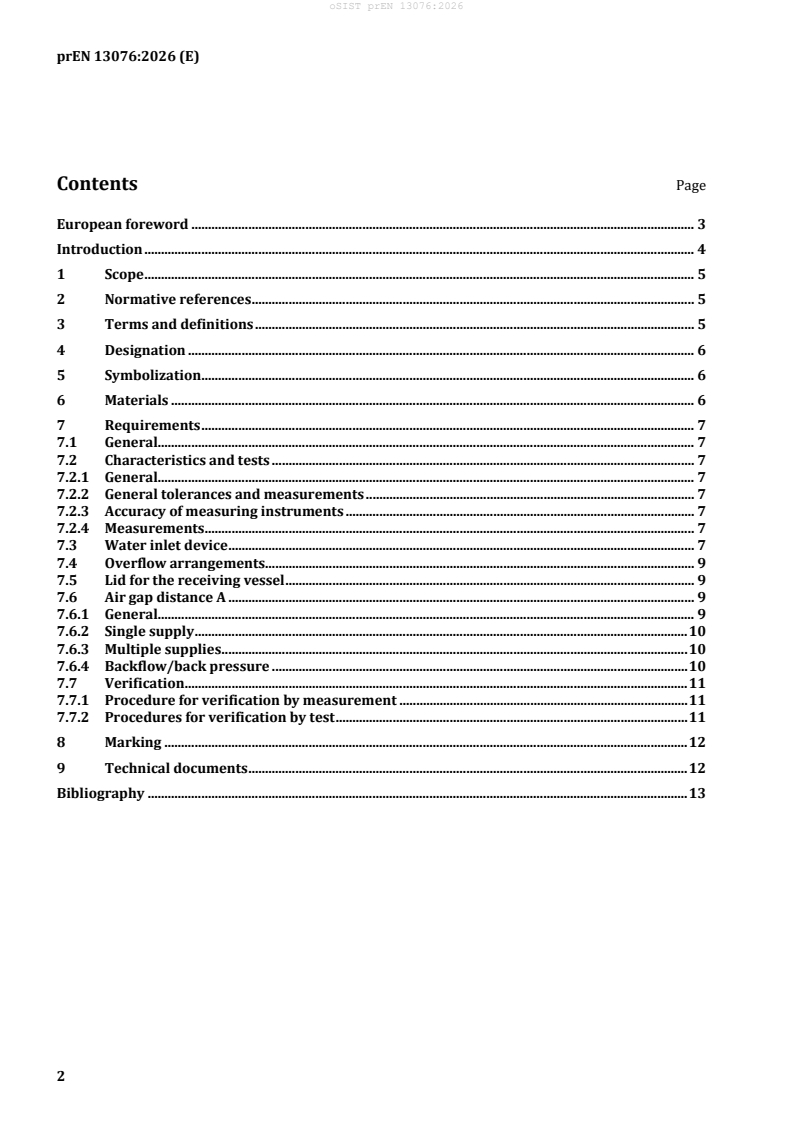
Contents Page
European foreword . 3
Introduction . 4
1 Scope . 5
2 Normative references . 5
3 Terms and definitions . 5
4 Designation . 6
5 Symbolization . 6
6 Materials . 6
7 Requirements . 7
7.1 General. 7
7.2 Characteristics and tests . 7
7.2.1 General. 7
7.2.2 General tolerances and measurements . 7
7.2.3 Accuracy of measuring instruments . 7
7.2.4 Measurements . 7
7.3 Water inlet device . 7
7.4 Overflow arrangements . 9
7.5 Lid for the receiving vessel . 9
7.6 Air gap distance A . 9
7.6.1 General. 9
7.6.2 Single supply . 10
7.6.3 Multiple supplies . 10
7.6.4 Backflow/back pressure . 10
7.7 Verification . 11
7.7.1 Procedure for verification by measurement . 11
7.7.2 Procedures for verification by test . 11
8 Marking . 12
9 Technical documents . 12
Bibliography . 13
European foreword
This document (prEN 13076:2026) has been prepared by Technical Committee CEN/TC 164 “Water
supply”, the secretariat of which is held by AFNOR.
This document is currently submitted to the CEN Enquiry.
This document will supersede EN 13076:2003.
This document includes the following significant technical changes with respect to EN 13076:2003:
— Figure 3 has been updated and redrawn;
— dimension D has been redefined;
— test introduced that verifies the upstream components aren’t contaminated by a downstream fluid
by splashing, turbulence etc.;
— validation procedure has been introduced;
— entire document has been editorially revised.
Introduction
In respect of potential adverse effects on the quality of water intended for human consumption, caused
by the product covered by this document:
a) this document provides no information as to whether the product might be used without restriction
in any of the Member State of the EU or EFTA;
b) while awaiting the adoption of verifiable European criteria, existing national regulations concerning
the use and/or the characteristics of this product remain in force.
1 Scope
This document specifies the characteristics and the requirements of unrestricted air gap Family A, Type A
for nominal flow velocity not exceeding 3 m/s. Air gaps are devices for protection of potable water in
water installations from pollution by backflow. This document applies to air gaps in factory-assembled
products and to constructed air gaps in situ and specifies requirements and methods to verify and ensure
compliance with this document during normal working use.
The fluid in the receiving vessel is assumed to have similar properties to the water supply. Where this is
not the case, additional care or tests could be required to verify the efficacy of the solution in practical
use.
The AA device is intended to be used in potable water installations according to EN 806 (series).
Sanitary tapware when installed onto a receiving vessel (e.g. washbasin etc.) might have some restriction
of its overflow. This will not compromise the water supply as the tapware might have an air gap, as
detailed for example in EN 200 (dimension E), that provides an air gap disconnection. If this is the case,
then backflow protection will be assumed to be adequate, and no further testing/verification will be
needed.
2 Normative references
The following documents are referred to in the text in such a way that some or all of their content
constitutes requirements of this document. For dated references, only the edition cited applies. For
undated references, the latest edition of the referenced document (including any amendments) applies.
EN 806-1, Specifications for installations inside buildings conveying water for human consumption —
Part 1: General
EN 806-5:2012, Specifications for installations inside buildings conveying water for human consumption —
Part 5: Operation and maintenance
EN 1717, Protection against pollution of water intended for human consumption in potable water
installations and general requirements for devices to prevent pollution by backflow
3 Terms and definitions
For the purposes of this document, the terms and definitions given in given in EN 806-1 and EN 1717 and
the following apply.
ISO and IEC maintain terminology databases for use in standardization at the following addresses:
— ISO Online browsing platform: available at https://www.iso.org/obp/
— IEC Electropedia: available at https://www.electropedia.org/
3.1
air gap with unrestricted spillover Family A, Type A
visible, permanent and vertical distance between the lowest point of the inlet orifice and the spillover
level of the receiving vessel having a complete and unrestricted spillover
Note 1 to entry: See Figure 1 for the design principle.
Figure 1 — Design principle
3.2
spillover level
level at which water will start to overflow the receiving vessel wi
...