

CEN/TR 15120:2022
(Main)Tanks for transport of dangerous goods - Guidance and recommendations for loading, transport and unloading
- Abstract
This document gives guidance and recommendations for loading at terminals and discharge at service stations or customer premises of tank-vehicles transporting dangerous substances of Class 3 of ADR – European Agreement concerning the International Carriage of Dangerous Goods by Road [2] – (flammable liquids) which have a vapour pressure not exceeding 110 kPa at 50 °C and petrol, and which have no sub-classification as toxic or corrosive.
- Status
- Published
- Publication Date
- 30-Aug-2022
- Technical Committee
- CEN/TC 296 - Tanks for transport of dangerous goods
- Current Stage
- 6060 - Definitive text made available (DAV) - Publishing
- Start Date
- 31-Aug-2022
- Due Date
- 02-Jun-2022
- Completion Date
- 31-Aug-2022



Overview
CEN/TR 15120:2022 - "Tanks for transport of dangerous goods - Guidance and recommendations for loading, transport and unloading" - is a CEN Technical Report that provides practical guidance for safe product and vapour transfer between loading gantries, tank‑vehicles and service stations. It covers Class 3 ADR flammable liquids (including petrol) with vapour pressure ≤ 110 kPa at 50 °C and that are not sub‑classified as toxic or corrosive. The report supports compliance with the EU VOC Directive (94/63/EC) and supersedes CEN/TR 15120:2013.
Key topics and technical requirements
- Scope and applicability: Loading at terminals and discharge at service stations or customer premises for compatible flammable liquids. Special notes on Arctic region practices.
- Bottom‑loading gantry function: Requirements for gantry equipment, couplers and vapour collection interfaces to ensure interoperability with tank‑vehicle adaptors (referenced EN 13083 and EN 13081).
- Overfill prevention:
- Primary system: gantry meter pre‑set by loader for each compartment.
- Secondary system: overfill prevention system (OPS) that stops flow if a tank sensor detects liquid; gantry components recommended to conform to EN 13922.
- Vapour management: Mandatory vapour collection connection and free vapour passage to comply with VOC control requirements; guidance on vapour manifold design and vent valve operation.
- Electrostatic and electrical safety: Recommendations on controlling static electricity (e.g., recommended electrical resistance across coupler/adaptor < 10 Ω) and protection against electrostatic hazards; reference to IEC/TS 60079‑32‑1 for loading velocity and v·d limits.
- Mechanical and operational factors: Tank‑vehicle compartment identification, breather devices/flame arresters, high‑level detection, metering, leak monitoring, unauthorized drive‑away restraints, and maximum delivery/loading rates (including notes on surge pressures up to 2 500 kPa for some footvalves).
- Informative annexes: Tank connection envelope, vapour manifold guidance, information plate format, overfill sensor settings, explosive atmosphere illustrations, loading pass schemes and loading velocity tables.
Practical applications & users
This Technical Report is intended for:
- Terminal and service station operators and managers
- Fuel distribution companies and transport operators
- Tank‑vehicle and gantry equipment designers, fabricators and integrators
- Safety engineers, compliance officers and regulators implementing VOC and ADR requirements
- Maintenance and training personnel responsible for loading/unloading procedures
Use cases include designing interoperable bottom‑loading systems, specifying OPS and vapour recovery interfaces, setting safe loading rates, and developing site procedures to reduce overfill, vapour emissions and electrostatic risks.
Related standards
- EN 13083 (bottom loading adaptors)
- EN 13081 (vapour collection adaptors)
- EN 13922 (gantry OPS components)
- IEC/TS 60079‑32‑1 (electrostatic hazards)
- ADR (European Agreement concerning the International Carriage of Dangerous Goods by Road)
- EU VOC Directive 94/63/EC
Keywords: CEN/TR 15120:2022, tanks for transport of dangerous goods, bottom loading, overfill prevention, vapour collection, VOC Directive, Class 3 flammable liquids, tank‑vehicle safety.
Relations
- Effective Date
- 07-Sep-2022
Get Certified
Connect with accredited certification bodies for this standard

CIS Institut d.o.o.
Personal Protective Equipment (PPE) certification body. Notified Body NB-2890 for EU Regulation 2016/425 PPE.
Institut za varilstvo d.o.o. (Welding Institute)
Slovenia's leading welding institute since 1952. ISO 3834, EN 1090, pressure equipment certification, NDT personnel, welder qualification. Only IIW Au

Kiwa BDA Testing
Building and construction product certification.
Sponsored listings
Frequently Asked Questions
CEN/TR 15120:2022 is a technical report published by the European Committee for Standardization (CEN). Its full title is "Tanks for transport of dangerous goods - Guidance and recommendations for loading, transport and unloading". This standard covers: This document gives guidance and recommendations for loading at terminals and discharge at service stations or customer premises of tank-vehicles transporting dangerous substances of Class 3 of ADR – European Agreement concerning the International Carriage of Dangerous Goods by Road [2] – (flammable liquids) which have a vapour pressure not exceeding 110 kPa at 50 °C and petrol, and which have no sub-classification as toxic or corrosive.
This document gives guidance and recommendations for loading at terminals and discharge at service stations or customer premises of tank-vehicles transporting dangerous substances of Class 3 of ADR – European Agreement concerning the International Carriage of Dangerous Goods by Road [2] – (flammable liquids) which have a vapour pressure not exceeding 110 kPa at 50 °C and petrol, and which have no sub-classification as toxic or corrosive.
CEN/TR 15120:2022 is classified under the following ICS (International Classification for Standards) categories: 13.300 - Protection against dangerous goods; 23.020.20 - Vessels and containers mounted on vehicles. The ICS classification helps identify the subject area and facilitates finding related standards.
CEN/TR 15120:2022 has the following relationships with other standards: It is inter standard links to CEN/TR 15120:2013. Understanding these relationships helps ensure you are using the most current and applicable version of the standard.
CEN/TR 15120:2022 is associated with the following European legislation: EU Directives/Regulations: 2008/68/EC. When a standard is cited in the Official Journal of the European Union, products manufactured in conformity with it benefit from a presumption of conformity with the essential requirements of the corresponding EU directive or regulation.
CEN/TR 15120:2022 is available in PDF format for immediate download after purchase. The document can be added to your cart and obtained through the secure checkout process. Digital delivery ensures instant access to the complete standard document.
Standards Content (Sample)
SLOVENSKI STANDARD
01-december-2022
Nadomešča:
SIST-TP CEN/TR 15120:2013
Cisterne za prevoz nevarnega blaga - Navodila in priporočila za polnjenje, prevoz
in praznjenje
Tanks for transport of dangerous goods - Guidance and recommendations for loading,
transport and unloading
Tanks für die Beförderung gefährlicher Güter - Leitlinien und Empfehlungen für
Befüllung, Beförderung und Entladung
Citernes destinées au transport de matières dangereuses - Lignes directrices et
recommandations pour le chargement, le transport et le déchargement
Ta slovenski standard je istoveten z: CEN/TR 15120:2022
ICS:
13.300 Varstvo pred nevarnimi Protection against dangerous
izdelki goods
23.020.20 Posode in vsebniki, montirani Vessels and containers
na vozila mounted on vehicles
2003-01.Slovenski inštitut za standardizacijo. Razmnoževanje celote ali delov tega standarda ni dovoljeno.
CEN/TR 15120
TECHNICAL REPORT
RAPPORT TECHNIQUE
August 2022
TECHNISCHER REPORT
ICS 13.300; 23.020.20 Supersedes CEN/TR 15120:2013
English Version
Tanks for transport of dangerous goods - Guidance and
recommendations for loading, transport and unloading
Citernes destinées au transport de matières Tanks für die Beförderung gefährlicher Güter -
dangereuses - Lignes directrices et recommandations Leitlinien und Empfehlungen für Befüllung,
pour le chargement, le transport et le déchargement Beförderung und Entladung
This Technical Report was approved by CEN on 22 August 2022. It has been drawn up by the Technical Committee CEN/TC 296.
CEN members are the national standards bodies of Austria, Belgium, Bulgaria, Croatia, Cyprus, Czech Republic, Denmark, Estonia,
Finland, France, Germany, Greece, Hungary, Iceland, Ireland, Italy, Latvia, Lithuania, Luxembourg, Malta, Netherlands, Norway,
Poland, Portugal, Republic of North Macedonia, Romania, Serbia, Slovakia, Slovenia, Spain, Sweden, Switzerland, Türkiye and
United Kingdom.
EUROPEAN COMMITTEE FOR STANDARDIZATION
COMITÉ EUROPÉEN DE NORMALISATION
EUROPÄISCHES KOMITEE FÜR NORMUNG
CEN-CENELEC Management Centre: Rue de la Science 23, B-1040 Brussels
© 2022 CEN All rights of exploitation in any form and by any means reserved Ref. No. CEN/TR 15120:2022 E
worldwide for CEN national Members.
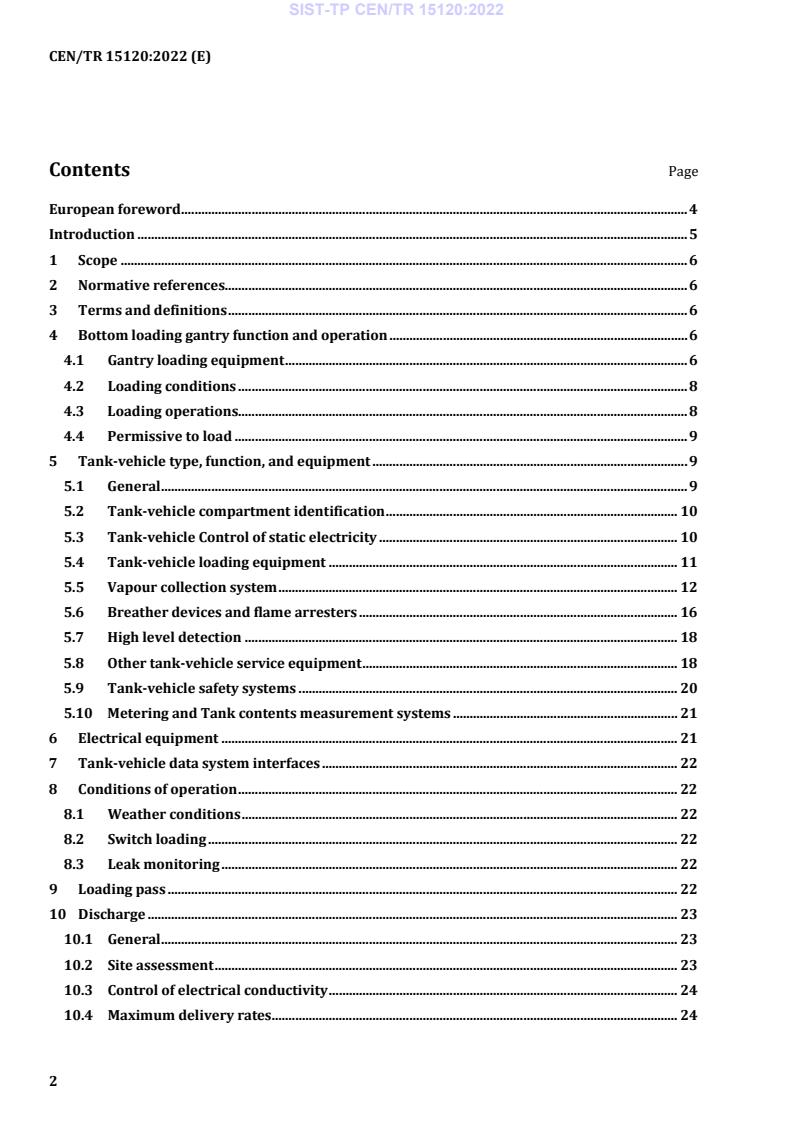
Contents Page
European foreword . 4
Introduction . 5
1 Scope . 6
2 Normative references. 6
3 Terms and definitions . 6
4 Bottom loading gantry function and operation . 6
4.1 Gantry loading equipment . 6
4.2 Loading conditions . 8
4.3 Loading operations. 8
4.4 Permissive to load . 9
5 Tank-vehicle type, function, and equipment . 9
5.1 General . 9
5.2 Tank-vehicle compartment identification . 10
5.3 Tank-vehicle Control of static electricity . 10
5.4 Tank-vehicle loading equipment . 11
5.5 Vapour collection system . 12
5.6 Breather devices and flame arresters . 16
5.7 High level detection . 18
5.8 Other tank-vehicle service equipment . 18
5.9 Tank-vehicle safety systems . 20
5.10 Metering and Tank contents measurement systems . 21
6 Electrical equipment . 21
7 Tank-vehicle data system interfaces . 22
8 Conditions of operation . 22
8.1 Weather conditions . 22
8.2 Switch loading . 22
8.3 Leak monitoring . 22
9 Loading pass . 22
10 Discharge . 23
10.1 General . 23
10.2 Site assessment . 23
10.3 Control of electrical conductivity . 24
10.4 Maximum delivery rates . 24
10.5 Safety precautions . 25
10.6 Checks prior to discharge . 25
10.7 Discharge procedure . 25
10.8 Frustrated deliveries . 26
10.9 Completion of delivery . 26
Annex A (informative) Tank connection envelope . 28
Annex B (informative) Guidelines for the design, fabrication and testing of a vapour manifold . 32
Annex C (informative) Information plate . 38
Annex D (informative) Overfill prevention sensor setting . 40
Annex E (informative) Illustration of when an explosive atmosphere might be present or might
arise during loading operations . 42
Annex F (informative) Loading pass scheme . 44
Annex G (informative) Vehicles and compartments suitable for high-speed loading . 48
Annex H (informative) Loading velocity rates for road tankers . 49
Bibliography . 50
European foreword
This document (CEN/TR 15120:2022) has been prepared by Technical Committee CEN/TC 296 “Tanks
for the transport of dangerous goods”, the secretariat of which is held by AFNOR.
Attention is drawn to the possibility that some of the elements of this document may be the subject of
patent rights. CEN shall not be held responsible for identifying any or all such patent rights.
This document supersedes CEN/TR 15120:2013.
In comparison with the previous edition, the following technical modifications have been made:
Total revision including:
— Redraft to reflect current format rules;
— Development of recommendations on:
— New mixtures and substances;
— Protection against electrostatic hazards;
— The difference between type 1 and type 2 tank-vehicle designs;
— Vapour collection breather device operation;
— Vapour Manifold Vent Valve operation;
— Vapour manifold design, fabrication, and test;
— Revision of annexes.
Any feedback and questions on this document should be directed to the users’ national standards body.
A complete listing of these bodies can be found on the CEN website.
Introduction
This document provides guidance and recommendations to enable the transfer of product and vapour
between the loading gantry, the tank-vehicle, and the service station.
The European Parliament and Council Directive 94/63/EC (VOC Directive) [1] requires operators to
ensure that petroleum vapours are not emitted into the atmosphere during loading and unloading. The
recommendations and guidance given in this document are intended to assist users in meeting the
requirements of this Directive.
This document acknowledges that, for historical, climatic, and logistical reasons, alternative technical
solutions are commonly used nationally and in the Arctic Region.
1 Scope
This document gives guidance and recommendations for loading at terminals and discharge at service
stations or customer premises of tank-vehicles transporting dangerous substances of Class 3 of ADR –
European Agreement concerning the International Carriage of Dangerous Goods by Road [2] –
(flammable liquids) which have a vapour pressure not exceeding 110 kPa at 50 °C and petrol, and which
have no sub-classification as toxic or corrosive.
2 Normative references
There are no normative references in this document.
3 Terms and definitions
No terms and definitions are listed in this document.
ISO and IEC maintain terminological databases for use in standardization at the following addresses:
— IEC Electropedia: available at https://www.electropedia.org/
— ISO Online browsing platform: available at https://www.iso.org/obp
4 Bottom loading gantry function and operation
4.1 Gantry loading equipment
4.1.1 General
It is recommended that arrangements to permit loading of a tank-vehicle, equipped according to this
document, are available to all gantries on loading facilities and at least one at each loading facility in arctic
regions.
NOTE The arctic region comprises Denmark, Finland, Iceland, Norway and Sweden.
4.1.2 Overfill prevention – gantry meter pre-set
The primary overfill prevention system is provided by the pre-setting of the gantry loading meter by the
tank-vehicle loader for each tank-vehicle compartment, separately, before it is loaded.
Therefore, it is recommended that bottom loading is only be permitted at gantries fitted with such pre-
set meters to limit the volume loaded into each tank-vehicle compartment.
NOTE 1 Overfill is the filling of a tank-vehicle or one or more of its compartments to the extent that the total
volume loaded into a compartment exceeds the maximum permitted volume for transport (see Annex D).
NOTE 2 Overloading is the loading of a tank-vehicle such that its total weight exceeds that permitted by local
road regulations, or the load imposed by one or more axles exceeds the local maximum authorized weight for that
axle and for a semi-trailer, when its coupling to the tractor is loaded to an extent that it exceeds its design load.
4.1.3 Overfill prevention – overfill prevention system (OPS)
The secondary overfill prevention system is provided by the overfill prevention system. The secondary
system is a safety system which comes into operation when the primary system fails to operate.
To ensure interoperability, it is recommended that the gantry-based components of the overfill
prevention system conform to EN 13922 [3].
Annex A shows the location envelope of the tank-vehicle socket.
NOTE The tank-vehicle component of the overfill prevention system (OPS) comprises the sensor or sensor
circuits, and interface socket and all connecting wiring and cables.
The gantry component of the OPS comprises the interface plug, cable, and gantry controller which, when a sensor
on the tank-vehicle detects liquid, provides an output to close the gantry control valve and stop product flow.
4.1.4 Coupler for bottom loading
For interoperability and safety reasons bottom loading gantries use couplers which are compatible with
the adaptors for bottom loading (EN 13083 [4]) installed on the tank-vehicle.
Annex A shows the tank connection envelope of these adaptors on a tank-vehicle.
NOTE 1 This envelope is defined by the VOC Directive.
Tank-vehicles fitted with pressure balanced footvalves that close against product flow, may cause a surge
pressure of 2 500 kPa within the loading coupler and pipework. It is important that loading facilities are
capable of absorbing such surge pressures without compromise or loss of function.
NOTE 2 The type of foot valve (pressure balanced or non-pressure balanced) installed on the tank-vehicle is
identified on an information plate attached to the tank-vehicle (see Annex C).
Loading facilities not capable of absorbing high surge pressures are not recommended to accept tank-
vehicles fitted with pressure balanced footvalves.
To prevent the accumulation of any electrostatic charge, it is recommended that the electrical resistance
across a metallic coupler and adaptor is less than 10 Ω, and less than 10 Ω in other cases (e.g. non-metallic
coupler/adaptor or devices isolated for product identification purposes), when connected.
NOTE 3 In the arctic region, couplers for bottom loading with the same functionality but able to connect with an
adaptor for bottom loading with a reduced diameter are commonly used.
4.1.5 Vapour collection system
For interoperability and safety reasons bottom loading gantries use vapour collection couplers which are
compatible with the vapour collection adaptors (EN 13081 [5]) installed on the tank-vehicle.
Annex A shows the tank connection envelope of these adaptors on a tank-vehicle.
NOTE 1 This envelope is defined by the VOC Directive.
For compliance with the VOC Directive, loading is not permitted unless the vapour collection hose has
been connected to the vehicle and there is a free passage for the displaced vapours to flow from the tank-
vehicle into the gantry’s vapour collection system. This interlock may either use the overfill prevention
system or be self-contained within the gantry’s control system.
NOTE 2 In the arctic region, vapour collection couplers with the same functionality but with a reduced diameter
are commonly used.
4.1.6 Unauthorized drive away restriction
It is recommended that methods to stop the unauthorized driving away of the tank-vehicle, either by
means of a gantry installed system or a system integrated within the vehicle controls, are installed at each
loading bay.
Whatever method is used, it is recommended that the restriction engages prior to and during loading and
is only able to be released after completion of loading and once all loading arms and other gantry
equipment are properly parked.
4.2 Loading conditions
4.2.1 Maximum loading rates per loading arm
As noted in IEC/TS 60079-32-1:2013 [6], many operations with flammable liquids produce flammable
atmospheres by evaporation of the liquid being handled. Where tanks are exposed to direct sunlight and
liquid temperatures are not monitored it may be assumed that a flammable atmosphere could be present
°
when handling liquids with flash points up to 60 C. In areas of high ambient temperature and strong
°
sunlight, flammable atmospheres may occur even with liquids that have flash points above 60 C.
In some circumstances, the flammable atmosphere is not due to the liquid being handled but due to
residues of volatile liquid or vapour from earlier operations with the same equipment or from nearby
operations. Residual vapours may occur during switch loading, in which a liquid having a high flash point
(e.g. diesel) is loaded into a tank which previously contained a liquid with a low flash point (e.g. petrol).
To minimize the danger of electrostatic hazards, IEC/TS 60079-32-1 recommends that, for petroleum
products, the maximum product of velocity and pipe diameter (vd) is 0,5 m /s subject to a maximum
product loading velocity of 7 m/s.
For a conventional (100 mm) bottom loading system, this vd is equivalent to a maximum loading rate of
2 400 l/m (see Annex H).
It is also recommended that the tank-vehicle be suitable for high-speed loading (see 5.3.2).
NOTE Refer to IEC/TS 60079-32-1:2013, Clause 7 for more details of these recommendations, and for
recommendations for other products and when new products are being considered for loading as their electrostatic
criteria might be significantly different from that of the more conventional products. For example, conventional
petroleum is classed as low conductivity whilst the addition of 10 % or more ethanol changes the classification to
high conductivity.
To prevent static discharge caused by spraying at the footvalve, it is recommended that the loading rate is kept low
until the footvalve is completely immersed in the product. Once the footvalve is fully submerged, the loading rate
may then be increased.
4.2.2 Maximum liquid pressure
Where systems include valves that can be closed against the loading flow, including pressure-balanced
valves, it is recommended that the maximum static pressure in the pipework upstream of these valves
never exceeds 1 000 kPa (10 bar). (See 5.4.3).
4.2.3 Maximum vapour back pressure
The maximum back pressure created by the gantry vapour recovery system is 5,5 kPa (55 mbar). Controls
may be provided by the terminal to ensure that this maximum back pressure is not exceeded, (e.g. limit
the number of tank-vehicles being loaded simultaneously).
NOTE The maximum back pressure of 5,5 kPa is a requirement of the VOC Directive 94/63/EC.
4.3 Loading operations
4.3.1 General
It is recommended that, before loading is permitted, procedures exist to ensure that:
— there is authorization to load (see note); and
— the tank-vehicle is immobilized; and
— the loading of both empty and not-empty compartments is accommodated; and
— overloading, overfilling or contaminations do not occur; and
— an earthing cable is connected.
NOTE The authorization of a tank-vehicle loader by a terminal operator to load the required goods into the
tank-vehicle follows the verification of his or her competence including any required certification and its associated
validity.
4.3.2 Earthing cable
As noted in IEC/TS 60079-32-1:2013, the earthing cable, which is connected to the tank-vehicle during
any loading operation, provides a resistance of less than 10 Ω between the tank-vehicle and the gantry’s
designated earthing point.
It is recommended that this earthing cable is part of a static earth monitoring system that continuously
monitors the resistance between the tank-vehicle and the gantry’s designated earthing point and
activates interlocks to prevent loading when this resistance exceeds 10 Ω. It is also recommended that
this earth monitoring system is be capable of differentiating between connection to the tank-vehicle’s
shell and any non-bonded metallic item.
It is recommended that an earthing connection is established before any other connections are made.
These functions may be provided by the overfill prevention system, through the plug/socket connection.
4.4 Permissive to load
It is recommended that product loading at a bottom loading vapour recovery gantry is permitted to
commence only once the following conditions are met:
— Tank-vehicle is parked and confirmed to be suitable for loading the nominated products; and
— The earthing cable is connected; and
— Vapour path from tank compartment through to gantry recovery system is open; and
— Overfill prevention system is connected and provides a permissive signal; and
— Any other local condition (e.g. product identification system) is confirmed as operational.
5 Tank-vehicle type, function, and equipment
5.1 General
As noted in the Scope, this guidance covers tank-vehicles coded as LGBF by the regulations.
NOTE 1 See ADR clause 4.3.4.1.1 for the explanation of this coding.
The design of the tank shell may be in accordance with EN 13094 [7], EN 14025 [8] or any other approved
procedure, however the coding will remain the same.
It is not recommended that tank shells manufactured from insulating materials are used for the transport
of flammable liquids (see IEC/TS 60079-32-1:2013, 7.3.4.6).
These tank-vehicles are considered to have Gravity Discharge shells and, as the classification suggests,
rely on gravity to fully discharge the liquid product. To prevent excessive VOC vapours being released to
atmosphere, and to accommodate the expansion and contraction of the liquid product caused by
atmospheric pressure and temperature change, these tanks are fitted with breather devices, and safety
devices to prevent the contents from spilling out if the tank overturns.
Gravity discharge tanks may also employ product approved cargo pumps to assist in the delivery process,
however, such assistance is not permitted to pressurize the tank shell.
The breather devices may breathe to atmosphere either directly (type 1) or through the vapour manifold
(type 2). (See 5.5.1).
These tank-vehicles may also be used for the transport of fuels containing bio substances which may not
be classed as dangerous goods.
NOTE 2 If the product’s flash point is above 60 °C then it is generally not classified as a dangerous good. Diesel,
Heating oil and Gasoil are classified as dangerous goods if their flash point is between 60 °C and 100 °C.
In all cases, it is recommended that the Competent Authority’s opinion is sought as to whether a product
is a dangerous good or not, as different Nations may have different rules.
Examples of biofuels are:
— Biodiesel – composed of vegetable-based oil, usually fatty-acid esters. This can be combined with
mineral-based diesel to a produce a mixture, a fuel classed as B5 would contain 5 % biodiesel and
95 % mineral diesel. A fuel classed as B100 would be composed of 100 % biodiesel. Biodiesel has a
higher flash point than mineral diesel. Biodiesel with a flash point above 100 °C is not classified as a
dangerous goods. Biodiesel with a flash point below 100 °C and above 60 °C is classified as UN 1202.
— Bioethanol – composed of ethanol usually mixed with petrol. A fuel classed as E5 would contain 5 %
ethanol and 95% petrol. Fuel classed as E100 would be composed of 100 % ethanol. Bioethanol is
classed as a dangerous good. Where ethanol is more than 10 % of the fuel mixture but less than
100 %, the mixture is classified as UN3475. For mixtures with less than 10 % ethanol, classification
would be UN1203 and if the mixture is 100 % ethanol, the classification is UN1170.
— Vegetable Oil – this has a flash point above 100 °C and is generally not classed as a dangerous good.
NOTE 3 Switch loading, and manifolded vapour recovery systems can result in the tank vehicle compartment
containing a mixture of residual products and vapours. (See 8.2.)
5.2 Tank-vehicle compartment identification
It is recommended that the tank-vehicle compartments are clearly identified with their number and their
maximum pre-set volume, starting from the front of the tank (see Annex C).
5.3 Tank-vehicle Control of static electricity
5.3.1 General
As an electrostatic charge is generated within the dangerous goods whenever they are being loaded into
a tank-vehicle, it is recommended that precautions are taken to ensure the safe dissipation of the charge.
Typical precautions being:
— Electrical continuity between metal-to-metal connections to be 10 Ω or less.
— Non-metallic conductive components are installed such that electrical continuity of 10 Ω or less
exists across the interface to the adjacent component.
— Where the functionality of an electrical system requires one or more insulating blocks to be inserted
between components, the electrical continuity across the components does not exceed 10 Ω.
— the electrical continuity between the tank-vehicle shell and the chassis to be 10 Ω or less.
— The tank shell to be mounted such that there is electrical continuity of 1 000 Ω or less between the
tank shell and wheel rims and 10 Ω or less between the tank shell and a conductive road surface.
— Spray deflectors or other methods may be used to minimize spraying and jetting of liquid from the
footvalves during the loading process.
NOTE The design of a footvalve bonnet or poppet might not provide a reliable means of determining whether,
as installed, the jetting or spraying of product during loading will occur since it can also be dependent on the
installation of the footvalve to its mounting flange and the flange to the tank.
5.3.2 Tank-vehicles suitable for high-speed loading
IEC/TS 60079-32-1:2013, 7.3.2.3.5.4, Table 11 specifies the requirements for a tank-vehicle to be
classified as suitable for high-speed loading (this table is shown in Annex G).
5.3.3 Earthing
It is recommended that the tank-vehicle is fitted with an easily identifiable earth fitting to which an
earthing cable, conforming to IEC/TS 60079-32-1, may be connected.
NOTE Reference can be made to ADR clause 6.8.2.1.27.
The earthing connection may be a separate cable (including clamp) or integrated with the overfill
prevention system as described in EN 13922.
In the arctic region where the alternative 2 wire PTC thermistor is used, a separate static earthing cable
is recommended.
5.4 Tank-vehicle loading equipment
5.4.1 Tank contents determination
For safety and operational purposes, it is important that the empty or not-empty condition of each tank-
vehicle compartment and run-off pipework is determined prior to loading.
This may be achieved by means of sight glasses or wet-leg sensors with the footvalve open.
NOTE 1 An empty compartment contains less than 0,2 % of the compartment’s nominal capacity or 5 l,
whichever is the least.
NOTE 2 Metrological requirements might be more severe.
The use of product grade indicators is recommended.
5.4.2 Adaptor for bottom loading and unloading
It is recommended that the bottom loading adaptors conform to EN 13083. If the system is fitted with
valves which can be closed against the loading flow, e.g. pressure balanced footvalves conforming to
EN 13316 [9], then the adaptor coupler combination is to be capable of accommodating a surge pressure
of 2 500 kPa without compromising their integrity or functions.
NOTE In the arctic region, bottom loading adaptors with the same functionality but with a reduced diameter
are commonly used.
The location of the adaptors to allow the connection of couplers, are described in Annex A.
It is recommended that a plate is fitted adjacent to the adaptor identifying its compartment and the
maximum (pre-set) volume of the compartment (see Annex C).
5.4.3 Footvalves
It is recommended that:
— Non-pressure balanced footvalves conform to EN 13308 [10];
— Pressure balanced footvalves conform to EN 13316;
— The tank-vehicle’s control system ensures that a compartment’s vapour transfer valve is opened
before the compartment’s footvalve, and that the footvalve is open before loading commences.
— For pipe systems with pressure balanced footvalves, a pressure relieving device is installed to
prevent over-pressurization of the run-off pipework from thermal expansion of the liquid.
The opening pressure of this relieving device is to be less than the design pressure of the run-off pipe and
within the region of 1 000 to 1 500 kPa.
NOTE Pressure balanced footvalves are typically used where:
— tank-vehicle controlled overfill prevention system is fitted; or
— tank-vehicle can be used for self-loading or topping-up away from a gantry; or
— a cross-over prevention system is fitted to prevent incorrect product being loaded into a non-empty
compartment.
5.4.4 Cap for the bottom loading/unloading adaptor
It is recommended that the cap fitted to the bottom loading/unloading adaptor conforms to EN 16249
[11]].
NOTE This cap is the third closure device reference in the tank coding (see 5.1).
5.4.5 Primary shutoff device
It is recommended that the pipe system requirements for tank-vehicles fitted with pressure balanced
footvalves apply also to tank-vehicles fitted with pneumatically operated primary shutoff devices which
also close against product flow.
5.5 Vapour collection system
5.5.1 General
To ensure that vapour is not emitted to atmosphere when the terminal vapour collection system
generates a backpressure of up to 5,5 kPa (55 mbar), it is recommended that care is taken when
designing, operating, and maintaining the vapour collection system of the tank-vehicle.
For example:
— service equipment fitted to the compartment, vapour manifold and vapour pipework is designed and
controlled such that vapours from the storage installations at the service stations or terminals are
retained, except for the release of internal overpressure and vacuum through the breather device.
NOTE 1 The release of internal overpressure and vacuum through the breather device is permitted by the
VOC Directive during transport.
— When bottom loading UN 1203 (petrol), the breather device pressure setting is sufficient to provide
enough operating pressure to drive the returned vapour from the tanker-vehicle compartment,
across the loading gantry and through the vapour recovery unit without releasing vapour from the
tank-vehicle. (Recommended breather settings are given in 5.6.)
NOTE 2 With a maximum back pressure from the loading gantry of 55 mbar, type 1 tank-vehicles fitted with
breather devices with an assured sealing pressure of 80 mbar, only provide a driving pressure of 25 mbar for
the vapour from each compartment to the vapour adaptor. A breather device with a lower assured sealing
pressure (less than 80 mbar) is unlikely to provide sufficient driving pressure for multi-arm loading.
— When delivering UN 1203 (petrol), the vacuum performance of the breather device is critical for
reliable vapour balancing. (Recommended breather settings are given in 5.6.)
NOTE 3 When starting to deliver petrol from a tank-vehicle into a service station tank (typical volume
30 000 l), the rate of change of pressure in the large service station tank is relatively slow compared with the
rate of change of vacuum in the road tanker compartment. The road tanker needs to draw vapour back into
itself in preference to drawing air in through its breather device otherwise towards the end of the delivery, the
displaced vapour from the service station will be expelled from the vent stack.
The vapour collection systems of tank-vehicles differ depending on whether they are of Type 1 or Type
2.
Type 1: The compartment breather device connects directly to atmosphere. See Figure 1.
Key
1 tank compartment
2 breather device complete with safety device and flame arrester
3 compartment footvalve
4 compartment vapour transfer valve
5 vapour manifold vent valve
6 vapour adaptor
Figure 1 — Typical type 1 tank-vehicle vapour system
Type 2: The compartment breather device connects into the vapour collection manifold and the vapour
manifold breathes through its vapour manifold vent valve. See Figure 2.
Key
1 tank compartment
3 compartment footvalve
4 compartment vapour transfer valve complete with flame arrester and incorporating breather device and
safety device
5 vapour manifold vent valve
6 vapour adaptor
7 vapour manifold
8 delivery side vapour collection connections
9 optional loading side vapour collection connections
NOTE This schematic shows a tank-vehicle which can be discharged on either side.
Figure 2 — Typical type 2 tank-vehicle vapour system
The following factors affect the number of compartments which can be loaded simultaneously without
vapours escaping into the atmosphere:
— opening pressure of the breather device (type 1 tanker-vehicle) or the VMVV breather (type 2 tanker-
vehicle); and
— the pressure drops of all components installed in the vapour collection system; and
— the pressure drops of vapour collection pipework; and
— the maximum permitted back pressure of 5,5 kPa (55 mbar); and
— Leak-proofness of the vapour collection system.
NOTE The applicable leakproof test is specified in EN 12972 [12].
5.5.2 Vapour collection manifold
It is recommended that a vapour collection manifold is used when loading or unloading a tank-vehicle
with more than one compartment.
A common manifold is suitable for vapour collection when loading or unloading. The manifold may be
either a separate pipe or the rollover protection coaming. Where the coaming is used as a vapour
manifold, it is considered to be part of the vapour pipework.
Typically, The vapour transfer valves seal the vapour collection manifold from the compartments during
transport, except where they incorporate a pressure and vacuum breather vent. Whichever system is
used, the manifold is sealed to atmosphere when a vapour recovery coupler is connected.
The vapour collection system may be either self-draining or provided with a facility to detect the presence
of liquid (e.g. sight glass).
Adequate protection against possible over-pressure due to thermal expansion, may be required.
5.5.3 Vapour collection valves and adaptor
It is recommended that:
— The vapour transfer valves conform to EN 13082 [13].
Vapour transfer valves are open before loading or discharge commences.
— The vapour manifold vent valves (VMVV) conform to EN 17110 [14].
Such valves allow the vapour manifold to be open to atmosphere as and when required by the tank-
vehicles’ pneumatic control system.
— For type 1 tank-vehicle, the vapour manifold vent valve is normally closed, opened when loading
or discharging product without vapour recovery.
— For type 2 tank-vehicle, the vapour manifold vent valve is normally open and closed when
loading or discharging with vapour recovery. The VMVV may also serve the function of a
breather device when closed (e.g. when vapour is being transferred).
— The vapour collection adaptor conforms to EN 13081.
The adaptor is operationally compatible with the coupler for vapour recovery and is located within
the tank connection envelope as described in Annex A.
NOTE In the arctic region, a vapour collection adaptor with the same functionality but with a reduced diameter
are commonly used.
5.5.4 Vapour collection interlocks
In addition to those noted in 4.1.5 and 4.1.6, it is recommended that the tank-vehicle vapour collection
system is fitted with interlocks to ensure that:
— the vapour collection coupler is connected to the vapour collection adaptor before loading can
commence.
— all vapour transfer valves are open, or the vapour transfer valve of the relevant tank compartment is
open before loading can commence.
NOTE Simply connecting the operation of a vapour transfer valve sequentially with a footvalve will not prevent
the start of loading of product into a tank-vehicle.
5.5.5 Vapour flow performance test/calculation
The design and fabrication of the vapour manifold is paramount to ensuring that, for the number of
compartments to be filled simultaneously with any product(s), the back pressure measured at the
mounting flange of the vapour adaptor does not exceed 5.5 kPa (55 mbar).
To achieve this, it is recommended that:
— The design and fabrication of the vapour manifold follows the guidelines in Annex B.
— If the design of the vapour collection system does not fully comply with these guidelines, then the
maximum number of tank compartments that may be loaded simultaneously is determined as
follows:
— For type 1 tank-vehicles, the test method in Annex B may be used, unless a new, untested type 1
tank-vehicle presents only minor changes from a previously tested type 1 tank-vehicle design,
in which case a calculation method may be used.
NOTE Minor changes can be where:
• the number of compartments is not increased; and
• the pipework bore and cross section are not reduced; and
• all intersections of pipework are identical in form; and
• the internal surfaces of the pipework and coaming are identical in form; and
• there are an equal or lower number of compartment vapour lines entering the coaming manifold on a
given side of the entrance into the vapour downpipe; and
• the vapour transfer vent valves are the same make and type; and
• the vapour adaptor is the same make and type.
— For type 2 tank-vehicles, either the test method in Annex B, or that specified in VDI 2291 [15], or
a calculation method can be used.
— The maximum number of tank compartments that may be loaded simultaneously without vapour
release is identified on a plate permanently attached to the tank-vehicle (see Annex C).
5.6 Breather devices and flame arresters
Where the regulations require, each compartment is fitted with a breather device and a safety device to
prevent the contents from spilling out if the tank overturns, conforming to EN 14595 [16].
NOTE 1 Reference can be made to ADR clause 6.8.2.2.6.
The pressure and/or vacuum breathing capacities are sized to accommodate changes in atmospheric
conditions without either the maximum working pressure or the maximum vacuum rating of the tank
shell being exceeded.
To ensure correct operation of the vapour recovery system, it is recommended that the breather devices
installed on tank-vehicles which are certified for the carriage of UN 1203 (Petrol) are set as follows:
Type 1 tanks:
Above atmospheric relieving pressure (pressure relief)
Opening between 8 kPa (gauge) and 12 kPa (gauge)
Below atmospheric relieving pressure (vacuum)
Opening between -1,6 kPa (gauge) and -2,5 kPa (gauge)
Type 2 tanks:
for the Vapour Manifold Vent Valve
Above atmospheric relieving pressure (pressure relief)
Opening between 8 kPa (gauge) and 12 kPa (gauge)
Below atmospheric relieving pressure (vacuum)
Opening between -0,4 kPa (gauge) and -2,5 kPa (gauge)
On a type 2 tank, the breather device connecting the compartment to the vapour manifold may have a
lower relieving pressure of typically 5 kPa (gauge).
Vacuum performance under pumped discharge may be increased with the use of a vapour manifold vent
valve (see 5.5.3).
For tanks specifically designed and certified for the carriage of substances other than UN 1203 (Petrol),
breather devices may be designed with the lowest possible pressure and vacuum settings.
NOTE 2 Generally, the lowest possible settings selected are to ensure that:
— Pressure – no liquid loss on severe inclines;
— Vacuum – where no VMVV is fitted, then the vacuum within any compartment does not exceed the shell’s vacuum
design pressure.
All subject to the competent authority’s approval.
If the shell of the tank is not designed to be explosion pressure shock resistant, then the regulations
require that the installation of the breather device is designed to prevent the immediate passage of flame
into the shell by means of a suitable protective device.
If the protective device consists of a flame arrester, positioned as close as possible to the corresponding
shell compartment (each compartment being protected separately), then flame arresters should meet the
requirements of EN 16522 [17].
NOTE 3 Reference can be made to ADR clause 6.8.2.2.3.
NOTE 4 Flame arrester type depends upon the tank vehicle type (1 or 2).
NOTE 5 Flame arresters are not required for an EPRV or vapour manifold vent valves on type 1 tanks.
NOTE 6 For 100 % ethanol and petroleum fuels containing more than 90 % ethanol, the gas group for testing
purposes is group IIB, otherwise for fuels containing less ethanol, gas group IIA can be used.
5.7 High level detection
5.7.1 Overfill prevention sensor
For compliance with the VOC directive, in each tank compartment, at least one overfill prevention sensor
is to be mounted directly adjacent to the vapour transfer valve and without any intervening obstruction
or shell reinforcement, and set in accordance with Annex D, to prevent liquid being loaded into the body
of the transfer valve in the event of an overfill.
If a vehicle is equipped with more than one overfill prevention system, the lowest level of activation is to
initiate the shutdown of the gantry loading system.
To ensure in
...