

prEN 18282
(Main)Artificial intelligence - Cybersecurity specifications for AI Systems
- Abstract
This document addresses organizational and technical solutions aimed at ensuring the cybersecurity of high-risk AI systems over the life cycle, appropriate to the relevant circumstances and the risks. The technical solutions to address AI-specific vulnerabilities include, where appropriate, measures to prevent, detect, respond to, resolve and control for attacks trying to manipulate the training dataset (data poisoning), or pre-trained components used in training (model poisoning), inputs designed to cause the model to make a mistake (adversarial examples or model evasion), confidentiality attacks or model flaws. This document provides objective criteria to enable decisions on whether a given technical or organizational solution adequately achieves a given vulnerability-related goal.
- Status
- Not Published
- Publication Date
- 09-Dec-2026
- Technical Committee
- CEN/CLC/JTC 21 - Artificial Intelligence
- Drafting Committee
- WG 5 - Joint standardization on Cybersecurity for AI systems
- Current Stage
- 4060 - Closure of enquiry - Enquiry
- Start Date
- 30-Jul-2026
- Due Date
- 19-Nov-2025
- Completion Date
- 30-Jul-2026
- Directive
- 2024/1689 - EU AI Act


prEN 18282 is a draft European Standard from CEN on cybersecurity specifications for AI Systems. It sets out organizational and technical measures for high-risk AI systems across the life cycle, and gives objective criteria for judging whether a technical or organizational solution meets a vulnerability-related goal. It focuses on AI-specific threats such as data poisoning, model poisoning, adversarial examples or model evasion, confidentiality attacks, and model flaws.
What does prEN 18282 specify?
prEN 18282 specifies how to organize AI-specific cybersecurity for high-risk AI systems, and how to select, verify, and document measures in relation to the system’s circumstances and risks. It is structured so a provider can link the environment, the vulnerabilities, the threats, the risks, the measures, and the testing in one traceable framework.
The document is organized into Clauses 1 to 12, followed by Annexes A, B, C, D, and ZA.
| Annex | What it covers |
|---|---|
| Annex A | Explanatory guidance for Clauses 5 to 12 |
| Annex B | Recommended organizational controls |
| Annex C | Other related standards |
| Annex D | AI-specific assets |
| Annex ZA | Relationship with Regulation (EU) 2024/1689 Article 15(5) |
In practice, this means the standard is not just a list of threats. It tells the reader how to decide what matters for a given AI system, what to protect, what to test, and what to document for conformity assessment and post-market work.
What are the key requirements of prEN 18282?
prEN 18282 requires the provider to build a cybersecurity framework around the AI system’s life cycle, then keep it updated as the system, its data, and its environment change. The main point is that AI cybersecurity is treated as a managed process: identify what is relevant, assess risk, choose measures, verify them, and keep records.
Build a life-cycle cybersecurity framework
Clause 5 requires a framework that starts with relevant circumstances, then identifies vulnerabilities and threats, determines cybersecurity risks, and selects measures to prevent, detect, respond, resolve, and control exploitation. Clause 5 also requires conventional cybersecurity measures throughout the life cycle as a prerequisite.
For a provider, this means AI-specific controls sit on top of baseline ICT security. The standard expects both to be considered together, not separately.
Define the relevant circumstances first
Clause 6 requires the provider to define the AI system’s scope and context, including intended purpose, deployment environment, interfaces, user access levels, foreseeable misuse, and cybersecurity-relevant assets. Those assets include datasets, AI models, configurations, software, hardware, interfaces, supply-chain components, system prompts, and embedded instructions.
In practice, this is the inventory step that makes later decisions credible. If the provider cannot say what is in scope and where the system runs, it cannot justify which risks and measures are relevant.
Identify vulnerabilities and threats by AI-specific attack surface
Clause 7 requires identification of vulnerabilities across training data, inference data, the AI model, interfaces, and the operational environment. Clause 8 requires systematic threat identification, with threat scenarios that describe entry points, exploitation mechanisms, expected effects, and preconditions.
This matters because the standard is looking for concrete AI attack paths, not generic security labels. Examples in Clause 8 include dataset manipulation, model manipulation, adversarial inputs, model theft, prompt injection, resource exhaustion, and unauthorized access to inference or deployment components.
Determine which risks are relevant and acceptable
Clause 9 requires the provider to assess the likelihood and impact of exploitation, the access opportunities of reasonably foreseeable unauthorized third parties, and the risks that need treatment. It also requires criteria for deciding whether a risk is acceptable or must be treated, and it links those decisions to residual risk.
For a buyer or quality manager, this is the decision point. The provider must show why some risks are treated, why others are accepted, and how the result feeds the overall AI system risk management.
Select measures by threat type
Clause 10 groups measures by attack type: data poisoning, model poisoning, adversarial attacks or model evasion, confidentiality attacks, model flaws, and threats related to generative AI models including LLMs. The clause covers prevention, detection, response, resolution, and control for each category.
In practice, the standard expects measures such as dataset provenance and integrity checks, model integrity verification, access control, anomaly detection, logging, isolation or rollback, retraining or replacement, privilege limitation, and human oversight where automated actions can create unacceptable impact.
Verify the measures with testing
Clause 11 requires cybersecurity testing before first deployment, after substantial modifications, and periodically during operation. It covers poisoning resistance testing, adversarial testing, confidentiality testing, model or algorithm exploitation testing, and composite or red-team testing when justified.
This is important because the standard does not accept measures on paper alone. The provider must produce objective test results and define measurable acceptance criteria before testing starts.
Document the whole cybersecurity case
Clause 12 requires documented information on circumstances, vulnerabilities, threats, risks, measures, testing, and instructions for use. The documentation must support conformity assessment and post-market activities, and it must explain the system’s tested cybersecurity level and any known circumstances that can affect it.
For readers in practice, this means the standard is as much about evidence as it is about controls. If a provider cannot document why a measure was chosen and how it was verified, it has not completed the framework.
What terms does prEN 18282 define?
prEN 18282 defines the AI cybersecurity vocabulary it uses so that risk, threat, vulnerability, and attack types are applied consistently.
- AI system - a machine-based system that can operate with varying autonomy, adapt after deployment, and infer outputs from input data.
- Cybersecurity for AI systems - the activities needed to keep an AI system resilient against malicious attempts to alter its use, behaviour, performance, or security properties.
- Cybersecurity risk for AI systems - the chance of loss or disruption from an incident, expressed as likelihood and severity together.
- Data poisoning attack - an attack where data used to train, fine-tune, infer, or retrieve information is manipulated to affect system behaviour.
- Model poisoning - an attack that intentionally manipulates model parameters, architecture, training processes, or pre-trained components.
- Model evasion - an attack where crafted inputs cause incorrect behaviour on specific inputs or input classes.
- Confidentiality attack - an attack that extracts or reconstructs sensitive information such as training data, model parameters, or proprietary behaviour.
- Application programming interface (API) - the interface used by the system for training, fine-tuning, or inference interactions.
Who uses prEN 18282?
prEN 18282 is mainly for providers of high-risk AI systems, but it is also relevant to deployers, operators, distributors, importers, product manufacturers, and authorized representatives. It is used by people who need to decide, implement, test, document, or review AI cybersecurity measures.
In practice, the main users are AI engineers, cybersecurity teams, risk managers, quality managers, test laboratories, and conformity assessment teams. The standard is also relevant for organizations that operate AI systems under their authority and need instructions for use, evidence for validation, and records for post-market monitoring.
Which standards are used with prEN 18282?
prEN 18282 is meant to be used alongside related standards for AI risk, quality, life cycle, data, and conventional cybersecurity.
- prEN 18228 - gives an example of an AI risk management process and supports the broader risk treatment context.
- prEN 18286 - covers AI quality management for EU AI Act regulatory purposes.
- prEN 18229 - supports trustworthiness topics such as accuracy, robustness, logging, oversight, and transparency.
- ISO/IEC 5338:2023 - supports AI system life cycle processes.
- ISO/IEC 5259:2024 series and ISO/IEC CD 5181 - support data quality and data provenance.
- ISO/IEC 27005:2022, ISO/IEC 27001:2022, and ISO/IEC 27002:2022 - support information security risk management and controls.
- ISO/IEC 15408-1:2022, ISO/IEC 27017:2015, ISO/IEC 27034:2011, and IEC 62443 - support conventional cybersecurity in IT, cloud, application, and industrial contexts.
- ISO/IEC 42001:2023 and ISO/IEC 23894:2023 - support AI management and AI risk management.
What does the prEN 18282 document contain?
The document contains a full workflow for AI cybersecurity: defining circumstances, identifying vulnerabilities and threats, assessing risk, choosing measures, testing effectiveness, and documenting the result. Clause 10 is organized by attack type and by action type, so the reader can see what is expected for prevention, detection, response, resolution, and control.
It also includes examples and guidance material in Annex A, organizational recommendations in Annex B, and a normative list of AI-specific assets in Annex D. Annex ZA maps the standard to Article 15(5) of Regulation (EU) 2024/1689, so readers can see how the clauses relate to the AI Act.
Get Certified
Connect with accredited certification bodies for this standard

BSI Group
BSI (British Standards Institution) is the business standards company that helps organizations make excellence a habit.

Bureau Veritas
Bureau Veritas is a world leader in laboratory testing, inspection and certification services.

DNV
DNV is an independent assurance and risk management provider.
Sponsored listings
Frequently Asked Questions
prEN 18282 is a draft published by the European Committee for Standardization (CEN). Its full title is "Artificial intelligence - Cybersecurity specifications for AI Systems". This standard covers: This document addresses organizational and technical solutions aimed at ensuring the cybersecurity of high-risk AI systems over the life cycle, appropriate to the relevant circumstances and the risks. The technical solutions to address AI-specific vulnerabilities include, where appropriate, measures to prevent, detect, respond to, resolve and control for attacks trying to manipulate the training dataset (data poisoning), or pre-trained components used in training (model poisoning), inputs designed to cause the model to make a mistake (adversarial examples or model evasion), confidentiality attacks or model flaws. This document provides objective criteria to enable decisions on whether a given technical or organizational solution adequately achieves a given vulnerability-related goal.
This document addresses organizational and technical solutions aimed at ensuring the cybersecurity of high-risk AI systems over the life cycle, appropriate to the relevant circumstances and the risks. The technical solutions to address AI-specific vulnerabilities include, where appropriate, measures to prevent, detect, respond to, resolve and control for attacks trying to manipulate the training dataset (data poisoning), or pre-trained components used in training (model poisoning), inputs designed to cause the model to make a mistake (adversarial examples or model evasion), confidentiality attacks or model flaws. This document provides objective criteria to enable decisions on whether a given technical or organizational solution adequately achieves a given vulnerability-related goal.
prEN 18282 is classified under the following ICS (International Classification for Standards) categories: 35.030 - IT Security; 35.240.01 - Application of information technology in general. The ICS classification helps identify the subject area and facilitates finding related standards.
prEN 18282 is associated with the following European legislation: EU Directives/Regulations: 2024/1689; Standardization Mandates: M/593, M/593, M/613, M/XXX AI, M/XXX AI. When a standard is cited in the Official Journal of the European Union, products manufactured in conformity with it benefit from a presumption of conformity with the essential requirements of the corresponding EU directive or regulation.
prEN 18282 is available in PDF format for immediate download after purchase. The document can be added to your cart and obtained through the secure checkout process. Digital delivery ensures instant access to the complete standard document.
Standards Content (Sample)
SLOVENSKI STANDARD
01-julij-2026
Umetna inteligenca - Specifikacije za kibernetsko varnost za sisteme UI
Artificial intelligence - Cybersecurity specifications for AI Systems
Künstliche Intelligenz - Cybersicherheitsspezifikationen für KI-Systeme
Intelligence artificielle - Spécifications en matière de cybersécurité pour les systèmes
d'IA
Ta slovenski standard je istoveten z: prEN 18282
ICS:
35.030 Informacijska varnost IT Security
35.240.01 Uporabniške rešitve Application of information
informacijske tehnike in technology in general
tehnologije na splošno
2003-01.Slovenski inštitut za standardizacijo. Razmnoževanje celote ali delov tega standarda ni dovoljeno.
EUROPEAN STANDARD DRAFT
NORME EUROPÉENNE
EUROPÄISCHE NORM
May 2026
ICS 35.030; 35.240.01
English version
Artificial intelligence - Cybersecurity specifications for AI
Systems
Intelligence artificielle - Spécifications en matière de Künstliche Intelligenz -
cybersécurité pour les systèmes d'IA Cybersicherheitsspezifikationen für KI-Systeme
This draft European Standard is submitted to CEN members for enquiry. It has been drawn up by the Technical Committee
CEN/CLC/JTC 21.
If this draft becomes a European Standard, CEN and CENELEC members are bound to comply with the CEN/CENELEC Internal
Regulations which stipulate the conditions for giving this European Standard the status of a national standard without any
alteration.
This draft European Standard was established by CEN and CENELEC in three official versions (English, French, German). A
version in any other language made by translation under the responsibility of a CEN and CENELEC member into its own language
and notified to the CEN-CENELEC Management Centre has the same status as the official versions.
CEN and CENELEC members are the national standards bodies and national electrotechnical committees of Austria, Belgium,
Bulgaria, Croatia, Cyprus, Czech Republic, Denmark, Estonia, Finland, France, Germany, Greece, Hungary, Iceland, Ireland, Italy,
Latvia, Lithuania, Luxembourg, Malta, Netherlands, Norway, Poland, Portugal, Republic of North Macedonia, Romania, Serbia,
Slovakia, Slovenia, Spain, Sweden, Switzerland, Türkiye and United Kingdom.
Recipients of this draft are invited to submit, with their comments, notification of any relevant patent rights of which they are
aware and to provide supporting documentation.Recipients of this draft are invited to submit, with their comments, notification
of any relevant patent rights of which they are aware and to provide supporting documentation.
Warning : This document is not a European Standard. It is distributed for review and comments. It is subject to change without
notice and shall not be referred to as a European Standard.
CEN-CENELEC Management Centre:
Rue de la Science 23, B-1040 Brussels
© 2026 CEN/CENELEC All rights of exploitation in any form and by any means
Ref. No. prEN 18282:2026 E
reserved worldwide for CEN national Members and for
CENELEC Members.
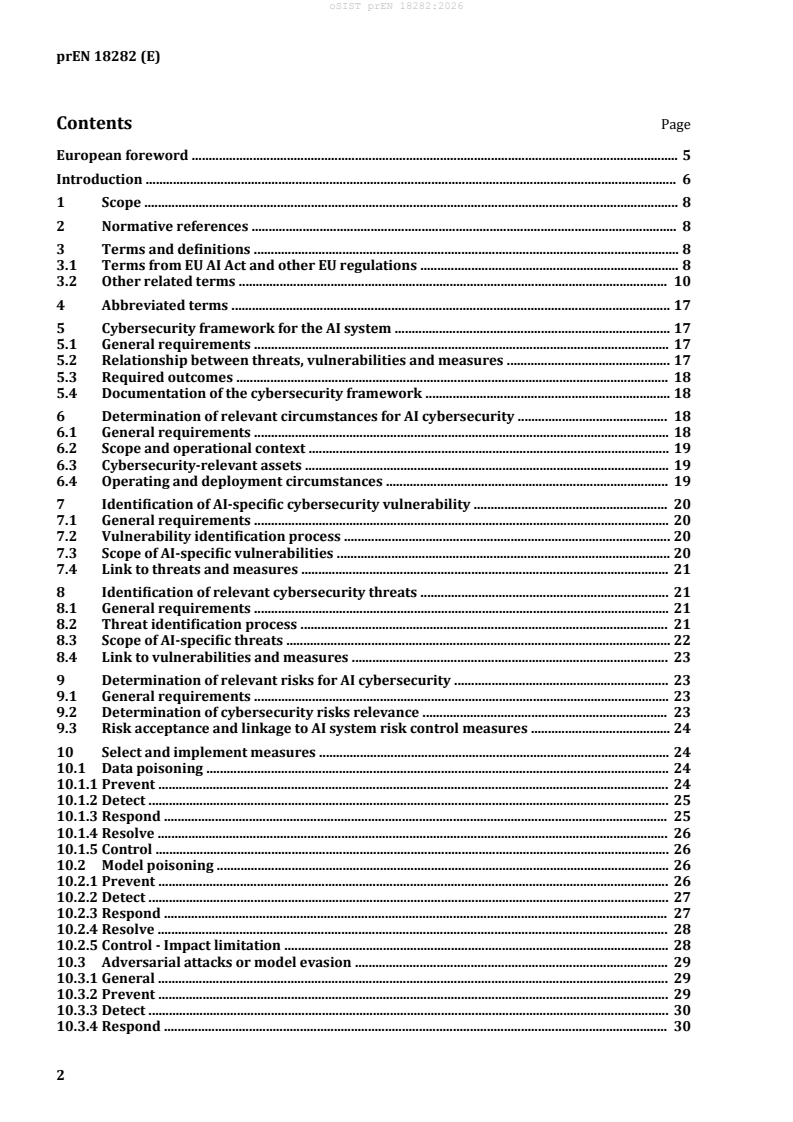
Contents Page
European foreword . 5
Introduction . 6
1 Scope . 8
2 Normative references . 8
3 Terms and definitions . 8
3.1 Terms from EU AI Act and other EU regulations . 8
3.2 Other related terms . 10
4 Abbreviated terms . 17
5 Cybersecurity framework for the AI system . 17
5.1 General requirements . 17
5.2 Relationship between threats, vulnerabilities and measures . 17
5.3 Required outcomes . 18
5.4 Documentation of the cybersecurity framework . 18
6 Determination of relevant circumstances for AI cybersecurity . 18
6.1 General requirements . 18
6.2 Scope and operational context . 19
6.3 Cybersecurity-relevant assets . 19
6.4 Operating and deployment circumstances . 19
7 Identification of AI-specific cybersecurity vulnerability . 20
7.1 General requirements . 20
7.2 Vulnerability identification process . 20
7.3 Scope of AI-specific vulnerabilities . 20
7.4 Link to threats and measures . 21
8 Identification of relevant cybersecurity threats . 21
8.1 General requirements . 21
8.2 Threat identification process . 21
8.3 Scope of AI-specific threats . 22
8.4 Link to vulnerabilities and measures . 23
9 Determination of relevant risks for AI cybersecurity . 23
9.1 General requirements . 23
9.2 Determination of cybersecurity risks relevance . 23
9.3 Risk acceptance and linkage to AI system risk control measures . 24
10 Select and implement measures . 24
10.1 Data poisoning . 24
10.1.1 Prevent . 24
10.1.2 Detect . 25
10.1.3 Respond . 25
10.1.4 Resolve . 26
10.1.5 Control . 26
10.2 Model poisoning . 26
10.2.1 Prevent . 26
10.2.2 Detect . 27
10.2.3 Respond . 27
10.2.4 Resolve . 28
10.2.5 Control - Impact limitation . 28
10.3 Adversarial attacks or model evasion . 29
10.3.1 General . 29
10.3.2 Prevent . 29
10.3.3 Detect . 30
10.3.4 Respond . 30
10.3.5 Resolve . 31
10.3.6 Control . 31
10.4 Confidentiality attacks . 31
10.4.1 Prevent . 31
10.4.2 Detect . 32
10.4.3 Respond . 33
10.4.4 Resolve . 33
10.4.5 Control . 33
10.5 Model flaws . 34
10.5.1 Prevent . 34
10.5.2 Detect . 34
10.5.3 Respond . 35
10.5.4 Resolve . 35
10.5.5 Control . 35
10.6 Threats related to generative AI models (including LLMs) . 35
11 Verification and testing requirements . 36
11.1 General requirements . 36
11.2 Life cycle triggers . 36
11.3 Types of cybersecurity testing . 37
11.4 Poisoning resistance testing . 37
11.5 Adversarial testing . 37
11.5.1 General requirements . 37
11.5.2 Identification of relevant adversarial attacks . 38
11.5.3 Test design and execution . 38
11.5.4 Attacker knowledge assumptions . 38
11.6 Confidentiality testing . 38
11.7 Model or algorithm exploitation testing . 39
11.8 Composite and red-team testing . 39
11.9 Acceptance criteria . 39
12 Documentation requirements for AI cybersecurity . 39
12.1 General requirements . 39
12.2 Documentation of relevant circumstances . 40
12.3 Documentation of vulnerabilities . 40
12.4 Documentation of threats . 40
12.5 Documentation of cybersecurity risks . 40
12.6 Documentation of technical measures and testing . 41
12.7 Documentation of instructions for use . 41
Annex A (informative) Explanatory guidance supporting Clause 5 to Clause 12 . 43
A.1 Purpose and use . 43
A.2 Overview of AI cybersecurity across the life cycle . 43
A.3 Relationship between clauses in this document . 43
A.4 Illustration of AI cybersecurity activities . 44
A.5 Application of AI cybersecurity measures . 44
A.6 Interaction with other standards . 45
A.7 Continuous improvement and evolution of threats . 45
A.8 Examples of circumstances, context and environment . 45
A.9 Examples of AI-specific threats . 46
A.10 Examples of AI-specific vulnerabilities . 47
A.11 Examples of measures . 47
Annex B (informative) Recommended organizational controls . 48
B.1 AI management system . 48
B.2 Apply software engineering best practice processes in AI development . 48
B.3 Include AI considerations in the information security management system . 48
Annex C (informative) Other related standards . 49
Annex D (normative) AI-specific assets . 50
Annex ZA (informative) Relationship between this European Standard and the essential
requirements of Regulation 2024/1689 aimed to be covered . 52
Bibliography . 55
European foreword
This document (prEN 18282:2026) has been prepared by Technical Committee CEN/CENELEC JTC21
"Artificial intelligence", Working Group 5 "Joint standardization on cybersecurity for AI systems", the
secretariat of which is held by DS.
This document is currently submitted to the CEN Enquiry.
This document has been prepared under a standardization request addressed to CEN/CENELEC by the
European Commission. The Standing Committee of the EFTA States subsequently approves these
requests for its Member States.
For the relationship with EU Legislation, see informative Annex ZA which is an integral part of this
document.
Introduction
The increasing use of artificial intelligence (AI) systems introduces new and evolving cybersecurity
challenges. These challenges arise from AI-specific attack surfaces, complex data pipelines, learning
mechanisms, and dependencies on software, hardware, and services. In addition to conventional
cybersecurity risks, AI systems can be exposed to threats such as data poisoning, model poisoning,
adversarial manipulation, confidentiality attacks, and exploitation of model flaws. Such threats can
compromise the accuracy, robustness, security, and trustworthiness of AI systems and can lead to harm
to safety, health, or fundamental rights.
This document specifies cybersecurity requirements and measures that address vulnerabilities, threats
and cybersecurity risks that are specific to AI systems.
The objective of this document is to support the implementation of cybersecurity requirements for AI
systems in accordance with Article 15(5) of Regulation (EU) 2024/1689 (AI Act).
This document focuses on cybersecurity aspects that arise from the characteristics of AI systems,
including AI models, training and inference data, and their interaction with the operational
environment.
This document does not establish a separate risk management system but provides methods to identify
AI-specific cybersecurity circumstances, vulnerabilities, threats and risks that can be considered within
the overall AI system risk management process.
In addition to the AI-specific cybersecurity aspects addressed in this document, the cybersecurity of AI
systems also depends on the security of the underlying ICT infrastructure, software components and
operational environments. These aspects are typically addressed by applicable ICT cybersecurity
standards and established cybersecurity practices.
The effectiveness of AI cybersecurity measures depends on their implementation and the relevant
circumstances, including operational constraints, properties of the training and inference data of the
used model and architecture, system scale, and the real-world environment in which the AI system
operates. It follows an approach, recognising that AI-specific cybersecurity risks cannot be fully
eliminated. This document therefore focuses on achieving an appropriate level of cybersecurity and
resilience against attempts by unauthorized third parties to alter the use, outputs or performance of
the AI system, taking into account the intended purpose, operational context and foreseeable misuse.
This document focuses exclusively on AI-specific cybersecurity aspects. It is intended to be used in
conjunction with other harmonized standards supporting the EU AI Act.
Conventional cybersecurity requirements for ICT infrastructure supporting AI systems remain
applicable but are outside the scope of this document.
This document needs to be interpreted and applied in accordance with the following principles:
Principle 1: This document applies to AI systems that qualify as high-risk AI systems under the EU AI
Act. It can also apply to AI systems that are not classified as high-risk under Regulation (EU) 2024/1689.
Principle 2: This document addresses AI-specific cybersecurity risks and complements other technical,
organizational, and legal measures required for AI systems including conventional cybersecurity
requirements. It does not replace non-cybersecurity requirements such as those related to data
governance, human oversight, or fundamental rights protection.
Principle 3: AI cybersecurity techniques, tools, and practices are evolving and cannot be equally mature
or available for all AI system types and contexts. Where specific techniques are not reasonably
attainable, the provider can apply alternative measures, provided these measures can be justified by
the provider in the technical documentation.
Principle 4: It is not possible to eliminate all cybersecurity risks. This document describes measures
aimed at achieving appropriate cybersecurity resilience and does not provide guarantees against all
possible attacks. Its objective is to support proportionate, evidence-based mitigation of AI-specific
cybersecurity risks in line with the state of the art.
1 Scope
This document addresses organizational and technical solutions aimed at ensuring the cybersecurity
of high-risk AI systems over the life cycle, appropriate to the relevant circumstances and the risks. The
technical solutions to address AI-specific vulnerabilities include, where appropriate, measures to
prevent, detect, respond to, resolve and control for attacks trying to manipulate the training dataset
(data poisoning), or pre-trained components used in training (model poisoning), inputs designed to
cause the model to make a mistake (adversarial examples or model evasion), confidentiality attacks or
model flaws. This document provides objective criteria to enable decisions on whether a given technical
or organizational solution adequately achieves a given vulnerability-related goal.
2 Normative references
There are no normative references in this document.
3 Terms and definitions
For the purposes of this document, the following terms and definitions apply.
ISO and IEC maintain terminology databases for use in standardization at the following addresses:
— ISO Online browsing platform: available at http://www.iso.org/obp
— IEC Electropedia: available at http://www.electropedia.org/
3.1 Terms from EU AI Act and other EU regulations
3.1.1
AI system
machine-based system that is designed to operate with varying levels of autonomy and that can exhibit
adaptiveness after deployment, and that, for explicit or implicit objectives, infers from the input it
receives, how to generate outputs such as predictions, content, recommendations, or decisions that can
influence physical or virtual environments
Note 1 to entry: The verb “can” represents a possibility, not all AI systems that fit the above definition have this
ability to adapt after deployment.
[SOURCE: EU AI Act 2024/1689 (Article 3(1)), modified - "a" has been removed, “may” replaced with
“can” based on the use of verbs in standards. Added Note 1 to entry.]
3.1.2
cybersecurity for AI systems
activities necessary to ensure that AI system (3.1.1) is resilient against attempts to alter its use,
behaviour, performance or compromise its security properties by malicious third parties exploiting the
system’s vulnerabilities
[SOURCE: EU AI Act 2024/1689 Recital 76]
3.1.3
cybersecurity risk for AI systems
potential for loss or disruption caused by an incident to an AI system (3.1.1) and expressed as a
combination of the magnitude of such loss or disruption and the probability (3.2.25) of the occurrence
of the incident
Note 1 to entry: Loss or disruption affecting an AI system (3.1.1) can result from impacts on the confidentiality
(3.2.6), integrity (3.2.24) or availability (3.2.4) of the AI system (3.1.1) or its assets.
Note 2 to entry: Cybersecurity risks for AI systems can arise when cybersecurity threats exploit vulnerabilities
in the AI system (3.1.1) or its supporting infrastructure.
Note 3 to entry: cybersecurity risk for AI systems (3.1.3) is associated with the potential that threats will exploit
vulnerabilities of an AI system’s asset or group of assets and thereby cause harm to an organization. This is based
on the Note 6 to entry of “risk” in EN ISO/IEC 27000 [1].
[SOURCE: EU CRA Article 3(37): modified with added text to set the scope for the incident and the risk
to be limited to an AI system. Notes 1, 2 and 3 to entry added.]
3.1.4
deployer
natural or legal person, public authority, agency or other body using an AI system (3.1.1) under its
authority except where the AI system (3.1.1) is used in the course of a personal non-professional activity
[SOURCE: EU AI Act 2024/1689 (Article 3(4)), modified removed “a”]
3.1.5
distributor
natural or legal person in the supply chain, other than the provider (3.1.9) or the importer, that makes
an AI system (3.1.1) available on the Union market
[SOURCE: EU AI Act 2024/1689 (Article 3(6))]
3.1.6
fundamental rights
basic rights and freedoms that apply to everyone within the EU, ensuring dignity, fairness, respect,
and equality
Note 1 to entry: These rights are enshrined in the Charter of Fundamental Rights of the European Union. The
Charter outlines these rights, which are legally binding on EU institutions and member states when implementing
EU law.
Note 2 to entry: The concept of fundamental rights (3.1.6) is defined in Regulation (EU) 2024/1689 and further
addressed in the horizontal harmonized standards developed under CEN-CLC/JTC 21.
[SOURCE: EU charter of fundamental rights.]
3.1.7
input data
data provided to or directly acquired by an AI system (3.1.1) on the basis of which the system produces
an output
[SOURCE: EU AI Act 2024/1689 (Article 3(33))]
3.1.8
operator
provider (3.1.9), product manufacturer, deployer (3.1.4), authorized representative, importer or
distributor (3.1.5)
[SOURCE: EU AI Act 2024/1689 (Article 3(8))]
3.1.9
provider
natural or legal person, public authority, agency or other body that develops an AI system (3.1.1) or a
general-purpose AI model (3.2.1) or that has an AI system (3.1.1) or a general-purpose AI model (3.2.1)
developed and places it on the market or puts the AI system (3.1.1) into service under its own name or
trademark, whether for payment or free of charge
[SOURCE: EU AI Act 2024/1689 (Article 3(3)), modified - "a" at the beginning has been removed based
on standard rules]
3.1.10
risk
combination of the probability (3.2.25) of an occurrence of harm and the severity of that harm
Note 1 to entry: there are slightly different definitions of risk (3.1.10) used by other European regulations, which
include but not limited to NIS2, CRA etc.
[SOURCE: EU AI Act, Art 3.3(2), modified — removing article “the” in front of “combination” to align
with ISO IEC CEN CLC directive part 2 rules for definition starting without article; Note 1 to entry added.]
3.1.11
testing data
data used for providing an independent evaluation of the AI system (3.1.1) in order to confirm the
expected performance of that system before its placing on the market or putting into service
[SOURCE: EU AI Act 2024/1689 (Article 3(32))]
3.1.12
training data
data used for training an AI system (3.1.1) through fitting its learnable parameters
[SOURCE: EU AI Act 2024/1689 (Article 3(29))]
3.1.13
validation data
data used for providing an evaluation of the trained AI system (3.1.1) and for tuning its non-learnable
parameters and its learning process in order, inter alia, to prevent underfitting or overfitting
[SOURCE: EU AI Act 2024/1689 (Article 3(30))]
3.2 Other related terms
3.2.1
AI model
computational model that generates outputs such as predictions, recommendations, classifications, or
decisions based on input data (3.1.7)
Note 1 to entry: An AI model (3.2.1) can be trained using machine learning (3.2.26) techniques or other
computational methods.
Note 2 to entry: An AI model (3.2.1) forms part of an AI system (3.1.1) together with other components such as
data processing, inference (3.2.21) mechanisms and system interfaces.
3.2.2
adversarial example
input that includes a small perturbation compared to a typical or expected input, which results in a
significantly different and unwanted behaviour of the AI system (3.1.1)
EXAMPLE Manipulating image recognition systems with artificial noise patterns to mislead classification or
detection.
Note 1 to entry: Adversarial attacks rely on carefully crafting or selecting adversarial example (3.2.2).
3.2.3
attack
attempt to destroy, expose, alter, disable, steal or gain unauthorized access to or make unauthorized
use of an asset
[SOURCE: ISO/IEC 27000:2018 [2], 3.2.]
3.2.4
availability
property of being accessible and usable on demand by an authorized entity
[SOURCE: ISO/IEC 27000:2018 [2], 3.7.]
3.2.5
circumstances
specific situational, short-term, internal and external condition of an AI system (3.1.1) in its environment
(3.2.16), that enables or shapes risk (3.1.10) in this situation
3.2.6
confidentiality
property that information is not made available or disclosed to unauthorized individuals, entities, or
processes
[SOURCE: ISO/IEC 27000:2018 [2], 3.10.]
3.2.7
confidentiality attack
cybersecurity attack (3.2.3) that compromises the confidentiality (3.2.6) of an AI system (3.1.1) for
instance by extracting, inferring, or reconstructing sensitive information related to training data
(3.1.12), model parameters, or proprietary system behaviour including proprietary system properties
such as system prompts or embedded instructions
Note 1 to entry: confidentiality attacks include model inversion, membership inference (3.2.21), and model
extraction.
Note 2 to entry: confidentiality attacks exploit observable system outputs, responses, or interfaces.
3.2.8
configuration
set of parameters, system prompts, execution settings, and integration settings that influence model
behaviour
3.2.9
control
measure (3.2.27) intended to limit, contain, or manage the consequences of cybersecurity threats or
attacks over time
Note 1 to entry: A control (3.2.9) can be technical or organisational and can operate continuously or conditionally.
Note 2 to entry: Controls support continued operation of the AI system (3.1.1) within acceptable risk levels by
reducing propagation, recurrence, or systemic impact of attacks.
3.2.10
conventional cybersecurity
non-AI-specific cybersecurity (3.1.2)
3.2.11
cybersecurity incident for AI systems
cybersecurity incident
event or series of events that compromise, or have the potential to compromise, the confidentiality
(3.2.6), integrity (3.2.24), or availability (3.2.4) of the AI system (3.1.1) or its assets
Note 1 to entry: In this document, the term “incident” refers to a cybersecurity incident (3.2.11) unless explicitly
specified otherwise.
Note 2 to entry: A cybersecurity event is any observable occurrence related to the operation of an AI system (3.1.1).
Note 3 to entry: A cybersecurity event becomes a cybersecurity incident (3.2.11) when it results in, or could result
in, adverse cybersecurity consequences.
[SOURCE: ISO/IEC 27000:2018 [2], 3.21, modified — the word “cybersecurity” has been added to clarify
the scope of the term and cybersecurity incident was added as admitted term.]
3.2.12
data poisoning attack
causative attack
attack (3.2.3) where the attacker manipulates data used to train the model, affecting the AI system's
behaviour including poisoning of data used during inference (3.2.21) or retrieval processes
Note 1 to entry: This attack (3.2.3) can also be referred to in ISO/IEC 19761 as “data manipulation” meaning “any
processing of the data other than a movement of the data into or out of a functional process, or between a functional
process and persistent storage” [ISO/IEC 19761, 2.6].
[SOURCE: ISO/IEC DIS 27090 [3]:—, 3.12, modified — Note 1 to entry added. Replace "data that the
model uses to train to affect the AI system’s behaviour" with "data used to train the model, affecting the
AI system's behaviour".]
3.2.13
deployment component
component responsible for integrating and operating a trained AI model (3.2.1) within a production or
operational environment (3.2.16)
3.2.14
detect
measure (3.2.27) intended to identify the occurrence or attempted occurrence of cybersecurity threats
or attacks affecting the AI system (3.1.1)
Note 1 to entry: Detection is based on monitoring, analysis of system behaviour, data characteristics, or deviations
from expected operation.
Note 2 to entry: Detection can occur during training, deployment, or operation of the AI system (3.1.1).
3.2.15
direct prompt injection
attack (3.2.3) where an attacker provides crafted input containing instructions directly to an AI system
(3.1.1) in order to influence its behaviour contrary to its intended use
Note 1 to entry: direct prompt injection (3.2.15) differs from indirect prompt injection (3.2.20) in that the
instructions are supplied explicitly as part of the input at the time of interaction with the AI system (3.1.1) .
Note 2 to entry: direct prompt injection (3.2.15) primarily affects AI systems that interpret user-provided inputs
as instructions, including generative AI systems.
3.2.16
environment
sum of all structural and long-term factors (physical, digital, organizational) of an AI system (3.1.1) that
influence the cybersecurity
Note 1 to entry: environment (3.2.16) is the asset landscape which needs protection as prevention.
3.2.17
model evasion
attack (3.2.3) where the attacker is able to alter correct behaviour of an AI system (3.1.1) on specific
input or classes of inputs
3.2.18
exposure-restricted data
data that represent an unacceptable risk when exposed to unauthorized parties
3.2.19
fine-tuning data
training data (3.1.12) used to further adapt a previously trained AI model (3.2.1) to improve
performance or adjust the model to a specific task or domain
Note 1 to entry: fine-tuning data (3.2.19) are a subset of training data (3.1.12) used after an initial model
training phase.
Note 2 to entry: Fine-tuning typically adjusts existing model parameters rather than training a model from scratch.
3.2.20
indirect prompt injection
attack (3.2.3) where an attacker embeds instructions within data that are later processed as input by
an AI system (3.1.1) in order to influence its behaviour contrary to its intended use
Note 1 to entry: indirect prompt injection (3.2.20) differs from direct prompt injection (3.2.15) in that the
instructions are not provided explicitly by the user at the time of interaction, but are introduced through data
sources such as documents, web content, or retrieved information.
Note 2 to entry: indirect prompt injection (3.2.20) primarily affects AI systems that process natural language or
other structured or unstructured content as part of their inputs, including generative AI systems.
3.2.21
inference
reasoning by which conclusions are derived from known premises
Note 1 to entry: In AI, a premise is either a fact, a rule, a model, a feature or raw data.
Note 2 to entry: The term "inference (3.2.21)" refers both to the process and its result.
[SOURCE: ISO/IEC 22989:2022 [4], 3.1.17.]
3.2.22
inference component
component of an AI system (3.1.1) responsible for executing a trained AI model (3.2.1) to generate
outputs based on input data (3.1.7)
Note 1 to entry: The inference component (3.2.22) processes inference data (3.2.23) and produces predictions,
classifications, recommendations or other outputs depending on the AI system (3.1.1) function.
3.2.23
inference data
data provided to an AI model (3.2.1) during its operational phase as part of input data (3.1.7) for
generating outputs
Note 1 to entry: This can include user inputs, system prompts, sensor data or contextual information.
3.2.24
integrity
property of accuracy and completeness
[SOURCE: ISO/IEC 27000:2018 [2], 3.36.]
3.2.25
likelihood
probability
chance of something happening
Note 1 to entry: In risk management terminology, the word “likelihood” is used to refer to the chance of something
happening, whether defined, measured or determined objectively or subjectively, qualitatively or quantitatively,
and described using general terms or mathematically (such as a probability or a frequency over a given time
period).
Note 2 to entry: The English term “likelihood” does not have a direct equivalent in some languages; instead, the
equivalent of the term “probability” is often used. However, in English, “probability” is often narrowly interpreted
as a mathematical term. Therefore, in risk management terminology, “likelihood” is used with the intent that it
can have the same broad interpretation as the term “probability” has in many languages other than English.
[SOURCE: ISO 31000:2018 [5], 3.7, modified — probability was added as admitted term.]
3.2.26
machine learning
ML
process of optimizing model parameters through computational techniques, such that the model's
behaviour reflects the data or experience
[SOURCE: ISO/IEC 22989:2022 [4], 3.3.5.]
3.2.27
measure
technical or organisational action implemented to address identified risks or ensure compliance with
applicable requirements
Note 1 to entry: In the context of cybersecurity, a measure (3.2.27) can be implemented to prevent (3.2.37), detect
(3.2.14), respond (3.2.38) to, resolve (3.2.40) or control (3.2.9) cybersecurity threats or attacks affecting an AI
system (3.1.1).
3.2.28
mitigation
limitation of any negative consequence of a particular incident
[SOURCE: ISO 22300:2021 [6], 3.1.154.]
3.2.29
model deserialization attack
attack (3.2.3) where malicious code or unintended executable behaviour is introduced into a model and
is triggered during model deserialization, loading, or execution
Note 1 to entry: Such attacks can exploit model components, metadata, or custom execution mechanisms to cause
code execution or other unintended behaviour.
Note 2 to entry: Examples include the use of custom or lambda layers, embedded scripts, or manipulated model
structures that result in execution during model loading or inference (3.2.21).
3.2.30
model flaw
weakness or deficiency in the design, architecture, configuration (3.2.8), or implementation of an AI
model (3.2.1) that is exploited to compromise the security, reliability, or intended behaviour of the AI
system (3.1.1)
Note 1 to entry: model flaw (3.2.30) arise from algorithmic design choices, implementation errors, or insufficient
constraints on model behaviour.
Note 2 to entry: Model flaws exist independently of external attacks and increase exposure to cybersecurity threats.
3.2.31
model input theft
unauthorized access to, extraction of, or disclosure of model input that compromises the confidentiality
(3.2.6) of the input data (3.1.7)
3.2.32
model poisoning
model manipulation
cybersecurity attack that compromises an AI system (3.1.1) by intentionally manipulating for instance
model parameters, model architectures, training processes, or pre-trained components
Note 1 to entry: model poisoning (3.2.32) introduces hidden behaviour, backdoors, or degraded performance.
Note 2 to entry: model poisoning (3.2.32) affects the integrity (3.2.24) of the AI model (3.2.1) itself rather than only
the data supplied to it.
3.2.33
model theft
model exfiltration attack
model exfiltration
model stealing attack
model extraction attack
attack (3.2.3) where the attacker is able to copy the model or its parameter (or sufficient parts thereof)
for example through direct access, or through (potentially repeated) use of attacker supplied inputs
and observing corresponding outputs of the AI system (3.1.1)
Note 1 to entry: model theft (3.2.33) constitutes a confidentiality attack (3.2.7).
[SOURCE: ISO/IEC DIS 27090 [3]: —, 3.15, modified — add "or its parameter" in the definition, Note 1
to entry added.]
3.2.34
model weights
numerical values associated with connections or components of a machine learning (3.2.26) model that
influence the model’s output during inference (3.2.21)
Note 1 to entry: model weights (3.2.34) are a type of model parameter (3.2.36) determined during the training or
fine-tuning process.
Note 2 to entry: In the context of this document, references to model parameters can include model weights (3.2.34)
as well as other parameters such as biases, configuration (3.2.8) parameters or hyperparameters.
3.2.35
operational vulnerability
weakness in the operational environment (3.2.16), configuration (3.2.8), or use of an AI system (3.1.1)
that can be exploited to compromise the cybersecurity of the AI system (3.1.1)
Note 1 to entry: operational vulnerability (3.2.35) can arise from system configuration (3.2.8), deployment
environment (3.2.16), inter
...