


EN ISO 4541:1994
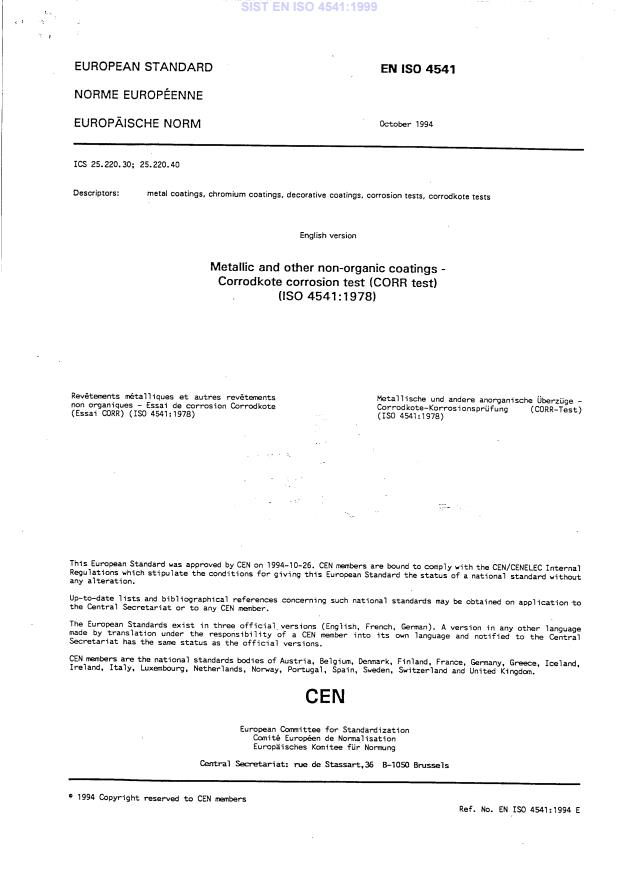
(Main)Metallic and other non-organic coatings - Corrodkote corrosion test (CORR test) (ISO 4541:1978)
Metallic and other non-organic coatings - Corrodkote corrosion test (CORR test) (ISO 4541:1978)
Specifies the reagent, the apparatus and the procedure for assessment of the quality of metallic and related coatings by the Corrodkode procedure. The method is primarily applicable to copper-nickel-chromium or nickel-chromium electroplated parts.
Metallische und andere anorganische Überzüge - Corrodkote-Korrosionsprüfung (CORR-Test) (ISO 4541:1978)
Diese internationale Norm beschreibt die Chemikalien, die Prüfeinrichtung und das Verfahren für die Prüfung der Qualität von metallischen und ähnlichen Schichten nach dem Corrodkote-Verfahren. Die Methode ist in erster Linie auf Teile mit Kupfer-Nickel-Chrom- oder Nickel-Chrom-Überzügen anwendbar.
Revêtements métalliques et autres revêtements non organiques - Essai de corrosion Corrodkote (Essai CORR) (ISO 4541:1978)
La présente Norme internationale spécifie le réactif, l'appareillage et le mode opératoire pour le contrôle de la qualité des revêtements métalliques et autres revêtements non organiques, par la méthode Corrodkote. La méthode est avant tout applicable aux éléments ayant reçu un dépôt électrolytique de cuivre-nickel-chrome ou de nickel-chrome.
Kovinske in druge anorganske prevleke – Korozijski preskus Corrodkote (preskus CORR) (ISO 4541:1978)
General Information
- Status
- Published
- Publication Date
- 27-Oct-1994
- Technical Committee
- CEN/TC 262 - Metallic and other inorganic coatings
- Current Stage
- 9093 - Decision to confirm - Review Enquiry
- Start Date
- 02-Nov-2009
- Completion Date
- 02-Nov-2009
Overview
EN ISO 4541:1994 is an international standard that specifies the Corrodkote corrosion test (CORR test) procedure designed for assessing the quality of metallic and other non-organic coatings. Developed under ISO 4541:1978 and adapted by CEN, this standard primarily applies to copper-nickel-chromium and nickel-chromium electroplated parts. It defines the preparation of reagents, test apparatus setup, and step-by-step guidelines for conducting controlled corrosion exposure to evaluate coating durability. The test is an accelerated method using a specially prepared slurry and controlled humidity conditions to simulate corrosive environments.
Key Topics
Corrodkote Slurry Preparation
The reagent slurry consists of copper(II) nitrate trihydrate, iron(III) chloride hexahydrate, ammonium chloride, and kaolin. The preparation method ensures consistent corrosive conditions for testing.Test Apparatus Requirements
The test uses a humidity chamber with temperature and relative humidity controls, specimen supports, and air circulation systems. The design prevents moisture droplets from falling on samples, avoiding uneven exposure.Specimen Preparation and Application
Test specimens should be solvent-cleaned without using corrosive solvents or those depositing protective films. The slurry is applied by brushing, with a wet film thickness between 0.08 mm and 0.2 mm. Careful handling prevents damage to coatings or contamination due to cutting or handling.Test Conditions and Cycles
Typical exposure involves continuous humidity at 38 ± 1 °C with 80-90% relative humidity for up to 16 hours per test cycle. Multiple cycles can be conducted, renewing slurry application each time and treating specimens between cycles as specified.Post-Test Treatment and Evaluation
After testing, specimens are cleaned to remove slurry residue without removing corrosion products that indicate failure points. Evaluation criteria commonly include visual appearance, corrosion defect distribution, and condition after removing superficial corrosion.Reporting Requirements
The standard specifies detailed documentation of testing conditions, specimen details, cleaning methods, humidity and temperature readings, and obtained results for transparency and reproducibility.
Applications
EN ISO 4541:1994 is widely utilized in quality control and product development within industries involving metal plating and coating processes, especially where decorative or protective electroplated layers are applied. Typical use cases include:
Automotive and Aerospace Components
Testing corrosion resistance of decorative or functional metallic coatings on parts subjected to harsh environmental conditions.Consumer Electronics and Appliances
Ensuring the durability and longevity of plated finishes under accelerated corrosive stress simulation.Industrial Machinery and Tools
Validating coating integrity for parts exposed to moisture, salt spray, and other corrosive elements.Research and Development
Comparative evaluation of plating processes, coating materials, and treatment methods aimed towards improved corrosion resistance.
Related Standards
ISO 1462 - Covers accelerated corrosion tests methods for metallic coatings other than anodic types, including evaluation guidelines complementary to ISO 4541.
ISO 3768 - Specifies conditions for the Neutral Salt Spray (NSS) test, another accelerated corrosion testing method frequently used alongside Corrodkote testing for verifying coating resilience.
EN ISO 4541:1999 - The Slovenian equivalent adaptation of EN ISO 4541:1994 reaffirming its international applicability and linguistic availability.
This standard is essential for professionals focused on metallic coating performance, providing a reproducible method for evaluating corrosion resistance with practical value for industrial quality assurance and research. The Corrodkote test facilitates predictive insights into coating behavior under specific corrosive stress conditions without direct service environment replication.


Frequently Asked Questions
EN ISO 4541:1994 is a standard published by the European Committee for Standardization (CEN). Its full title is "Metallic and other non-organic coatings - Corrodkote corrosion test (CORR test) (ISO 4541:1978)". This standard covers: Specifies the reagent, the apparatus and the procedure for assessment of the quality of metallic and related coatings by the Corrodkode procedure. The method is primarily applicable to copper-nickel-chromium or nickel-chromium electroplated parts.
Specifies the reagent, the apparatus and the procedure for assessment of the quality of metallic and related coatings by the Corrodkode procedure. The method is primarily applicable to copper-nickel-chromium or nickel-chromium electroplated parts.
EN ISO 4541:1994 is classified under the following ICS (International Classification for Standards) categories: 25.220.40 - Metallic coatings; 25.220.99 - Other treatments and coatings. The ICS classification helps identify the subject area and facilitates finding related standards.
You can purchase EN ISO 4541:1994 directly from iTeh Standards. The document is available in PDF format and is delivered instantly after payment. Add the standard to your cart and complete the secure checkout process. iTeh Standards is an authorized distributor of CEN standards.
Standards Content (Sample)
SLOVENSKI STANDARD
01-oktober-1999
Kovinske in druge anorganske prevleke – Korozijski preskus Corrodkote (preskus
CORR) (ISO 4541:1978)
Metallic and other non-organic coatings - Corrodkote corrosion test (CORR test) (ISO
4541:1978)
Metallische und andere anorganische Überzüge - Corrodkote-Korrosionsprüfung (CORR
-Test) (ISO 4541:1978)
Revetements métalliques et autres revetements non organiques - Essai de corrosion
Corrodkote (Essai CORR) (ISO 4541:1978)
Ta slovenski standard je istoveten z: EN ISO 4541:1994
ICS:
25.220.40 Kovinske prevleke Metallic coatings
2003-01.Slovenski inštitut za standardizacijo. Razmnoževanje celote ali delov tega standarda ni dovoljeno.
INTERNATIONAL STANDARD
INTERNATIONAL ORGANIZATION FOR STANDARDIZATION*ME>KLIYHAPOflHAR OPl-AHM3AUklfl fl0 CTAH~APTkl3AL(MM.ORGANISATION INTERNATIONALE DE NORMALISATION
Metallic and other non-organic coatings - Corrodkote
corrosion test (COR R test)
Rev&emen ts mballiques et autres revhemen ts non organiques -
Essai de corrosion Corrodko te
(Essai CO R R)
First edition - 1978-06-15
UDC 620.193.4
Ref. No. ISO 4541-1978 (E)
Descriptors : metal coatings, chromium coatings, decorative coatings, corrosion tests, corrodkote tests.
Price based on 3 pages
FOREWORD
ISO (the International Organization for Standardization) is a worldwide federation
of national Standards institutes (ISO member bodies). The work of developing
International Standards is carried out through ISO technical committees. Every
member body interested in a subject for which a technical committee has been set
up has the right to be represented on that committee. International organizations,
governmental and non-governmental, in liaison with ISO, also take part in the work.
It has been approved by the member bodies of the following countries :
Austral ia I taly Spain
Austria Japan Sweden
Bulgaria Korea, Rep. of Switzerland
Czechoslovakia Mexico Turkey
France Philippines United Kingdom
Germany Poland U.S.A.
Hungary Portugal U.S.S.R.
India Romania Yugoslavia
Israel South Africa, Rep. of
No member body expressed disapproval of the document.
63 international Organization for Standardkation, 1978 l
Printed in Switzerland
ISO 4541-1978 (E)
INTERNATIONAL STANDARD
Metallic and other non-organic coatings - Corrodkote
corrosion test (COR R test)
water and stirring into the Solution 30,O g of water-washed
0 INTRODUCTION
ceramic grade kaolin. Mix the slurry thoroughly with a
In many instances, there is no direct relation between
glass stirring rod and allow it to stand for about 2 min so
the results of an accelerated corrosion test and the resist-
that the kaolin becomes saturated. Mix the slurry thor-
ante to corrosion in other media, because several factors
oughly with a glass stirring rod just before using.
which influence the progress of corrosion, such as the
formation of protective films, vary greatly with the
NOTES
conditions encountered. The results obtained in the test
1 An alternative method of preparing the Corrodkote slurry is
should not, therefore, be regarded as a direct guide to the
as follows : Weigh 2,50 g of copper( II) nitrate trihydrate
corrosion resistance of the tested materials in all environ- [Cu(N0&.3H20] and dilute with distilled water to the mark in
a 500 ml one-mark volumetric flask. Weigh 2,50 g of iron(lll)
ments where these materials may be used. Furthermore,
chloride hexahydrate (FeC13.6H20), and dilute with distilled water
Performance of different materials in the test cannot always
to the mark in a 500 ml one-mark volumetric flask. Weigh 50,O g
be taken as a direct guide to the relative corrosion resist-
of ammonium chloride (NH&I) and dilute with distilled water
ante of these materials in Service. to the mark in a 500 ml one-mark volumetric flask. Then transfer
exactly 7,0 ml of the copper(lI) nitrate Solution, 33,0 ml of the
iron(lll) chloride Solution and IO,0 ml of the ammonium chloride
Solution to a beaker and add 30,O g of kaolin. Stir with a glass
1 SCOPE AND FIELD OF APPLICATION
stirring rod.
This International Standard specifies the reagent, the
2 Keep the iron(l II) chloride Solution in the dark in a flask fitted
apparatus and the procedure for assessment of the quality
with a rubber or glass stopper. The iron(l II) chloride Solution shall
not be more than 2 weeks Old, since older solutions become
of metallic and related coatings by the Corrodkote
unstable.
procedure.
The method is primarily applicable to copper-nickel-
chromium or nickel-chromium electroplated Parts.
5 APPARATUS
5.1 The apparatus shall consist of a humidity chamber,
2 REFERENCES
specimen supports, Provision for heating the chamber and
Provision for air circulation in the chamber.
ISO 1462, Metallic coatings - Coatings other than those
anodic to the basis metal - Accelera ted corrosion tes ts -
5.2 The design shall be such that drops of moisture which
Method for evaluation of the results.
might accumulate on the roof or Walls of the chamber, or
ISO 3768, Metallic coatings - Neutral salt Spray fest
on the specimen supports, do not fall on the test specimens.
(NSS tes t).
5.3 The materials of construction shall be such as not
to affect the test.
3 PRINCIPLE
Application of a slurry containing corrosive salts to test
specimens, allowing the slurry to dry, and exposure of the
6 TEST SPECIMENS
coated specimens to a high relative humidity for a specified
period of time.
6.1 Select the type and number of test specimens to be
used, as weil as the criteria for evaluation of the test results,
according to the specification for the coating or products
4 CORRODKOTE SLURRY
being tested.
Prepare the Corrodkote slurry in a glass beaker by dissolv-
6.2 The test specimens may be solvent cleaned Prior to
ing 0,035 g of reagent grade copper(ll) nitrate trihydrate
testing, using
...
Questions, Comments and Discussion
Ask us and Technical Secretary will try to provide an answer. You can facilitate discussion about the standard in here.
Loading comments...