

EN 1238:2011
(Main)Adhesives - Determination of the softening point of thermoplastic adhesives (ring and ball)
- Abstract
This European Standard specifies a method for the determination of the softening point of hot-melt adhesives.
- Status
- Published
- Publication Date
- 19-Apr-2011
- Withdrawal Date
- 30-Oct-2011
- Technical Committee
- CEN/TC 193 - Adhesives
- Current Stage
- 9093 - Decision to confirm - Review Enquiry
- Start Date
- 12-Jul-2023
- Completion Date
- 21-Oct-2026

Overview
EN 1238:2011 is a European Standard developed by CEN that specifies a precise method for determining the softening point of thermoplastic adhesives, commonly known as hot-melt adhesives. This standard covers the "ring and ball" technique, a widely accepted and reliable procedure used in adhesive testing laboratories to evaluate the temperature at which thermoplastic adhesives soften under defined conditions. The softening point is a critical property for adhesives used in various industrial and manufacturing applications, influencing their performance, processing, and end-use behavior.
EN 1238:2011 replaces the previous edition EN 1238:1999 and includes updated normative references and technical clarifications to improve testing accuracy and consistency across European countries. The standard provides detailed instructions on sampling, apparatus setup, sample preparation, testing procedure, and test report content.
Key Topics
Scope: EN 1238:2011 applies specifically to hot-melt adhesives, focusing on thermoplastics whose viscosity decreases progressively with temperature rise rather than melting at a fixed point.
Test Principle: A steel ball is placed on an adhesive sample contained within a metal ring. The assembly is heated at a controlled rate, and the temperature at which the ball passes through the adhesive by a specific distance is recorded as the softening point.
Apparatus Requirements:
- Steel balls of defined size and weight.
- Metal rings (tapered, shouldered, or cylindrical) with precise dimensions.
- Thermometers conforming to strict specifications to ensure temperature measurement accuracy.
- Heat-resistant glass bath and stirrer for uniform heating.
- Suitable heating liquids (water up to 80 °C, glycerol up to 200 °C, or specialized oils above 200 °C).
Sampling and Preparation:
- Adhesive samples must be obtained and prepared according to referenced standards EN ISO 15605 and EN 1067.
- Samples are heated and poured into rings to create homogeneous test specimens free from air bubbles.
- Special considerations for heat-sensitive adhesives include testing within inert atmospheres.
Test Procedure:
- Temperature increases at a controlled rate of 5 ± 1 °C per minute.
- Testing conditions vary slightly depending on the expected softening temperature range (below or above 80 °C).
- The temperature when the ball penetrates the adhesive to a fixed distance is recorded.
Result Reporting:
- Results are expressed as the average of duplicate tests.
- Temperature values are rounded according to defined precision criteria based on the temperature range.
- Test reports must detail adhesive type, ring type, heating fluid, atmospheric conditions, test temperature, and any relevant observations.
Applications
EN 1238:2011 plays a vital role in the quality control and specification of thermoplastic adhesives across many industries, including:
Packaging: Ensuring hot-melt adhesives used in carton sealing and flexible packaging maintain adhesion performance under processing conditions.
Automotive: Verifying adhesive softening points to ensure durability and performance in vehicle assembly and parts bonding at elevated temperatures.
Woodworking and Furniture: Controlling adhesive softening ensures reliable bonding in laminates and veneer applications.
Textile and Footwear: Assisting manufacturers in selecting adhesives with appropriate softening properties for flexible and durable product assembly.
Electronics: Helping to ensure adhesives maintain integrity at operating temperatures, especially in thermal management or component assembly.
By providing a standardized method to determine the softening point, manufacturers and users can compare adhesive products, ensure compliance with technical specifications, and optimize adhesive selection for specific thermal performance requirements.
Related Standards
To fully implement and understand EN 1238:2011, the following related standards should be consulted:
EN 923:2005+A1:2008 – Adhesives: Terms and definitions relevant to adhesive testing terminology.
EN 1067 – Adhesives: Examines preparation of adhesive samples for testing, ensuring consistency and reliability.
EN ISO 15605 – Sampling: Provides guidelines for sampling adhesive products to obtain representative test specimens.
These standards complement EN 1238 by standardizing terminology, sampling techniques, and specimen preparation, critical for achieving accurate and reproducible softening point measurements.
Keywords: EN 1238:2011, thermoplastic adhesives, hot-melt adhesives, softening point determination, ring and ball method, adhesive testing standards, CEN adhesives standard, adhesive quality control, thermoplastic adhesive properties, ISO adhesive sampling.
Relations
- Effective Date
- 23-Apr-2011
- Effective Date
- 28-Jan-2026
- Effective Date
- 28-Jan-2026
- Effective Date
- 28-Jan-2026
- Effective Date
- 28-Jan-2026
- Effective Date
- 28-Jan-2026
Get Certified
Connect with accredited certification bodies for this standard

DIN CERTCO
DIN Group product certification.

Smithers Quality Assessments
US management systems and product certification.
Sponsored listings
Frequently Asked Questions
EN 1238:2011 is a standard published by the European Committee for Standardization (CEN). Its full title is "Adhesives - Determination of the softening point of thermoplastic adhesives (ring and ball)". This standard covers: This European Standard specifies a method for the determination of the softening point of hot-melt adhesives.
This European Standard specifies a method for the determination of the softening point of hot-melt adhesives.
EN 1238:2011 is classified under the following ICS (International Classification for Standards) categories: 83.180 - Adhesives. The ICS classification helps identify the subject area and facilitates finding related standards.
EN 1238:2011 has the following relationships with other standards: It is inter standard links to EN 1238:1999, EN 1067:2005, EN ISO 15605:2004, EN 923:2005+A1:2008, EN 14628:2005, EN 14628-1:2020. Understanding these relationships helps ensure you are using the most current and applicable version of the standard.
EN 1238:2011 is available in PDF format for immediate download after purchase. The document can be added to your cart and obtained through the secure checkout process. Digital delivery ensures instant access to the complete standard document.
Standards Content (Sample)
2003-01.Slovenski inštitut za standardizacijo. Razmnoževanje celote ali delov tega standarda ni dovoljeno.LFDKlebstoffe - Bestimmung des Erweichungspunktes von thermoplastischen Klebstoffen (Ring und Kugel)Adhésifs - Détermination du point de ramollissement des adhésifs thermoplastiques (méthode bille et anneau)Adhesives - Determination of the softening point of thermoplastic adhesives (ring and ball)83.180LepilaAdhesivesICS:Ta slovenski standard je istoveten z:EN 1238:2011SIST EN 1238:2011en,fr,de01-julij-2011SIST EN 1238:2011SLOVENSKI
STANDARDSIST EN 1238:20001DGRPHãþD
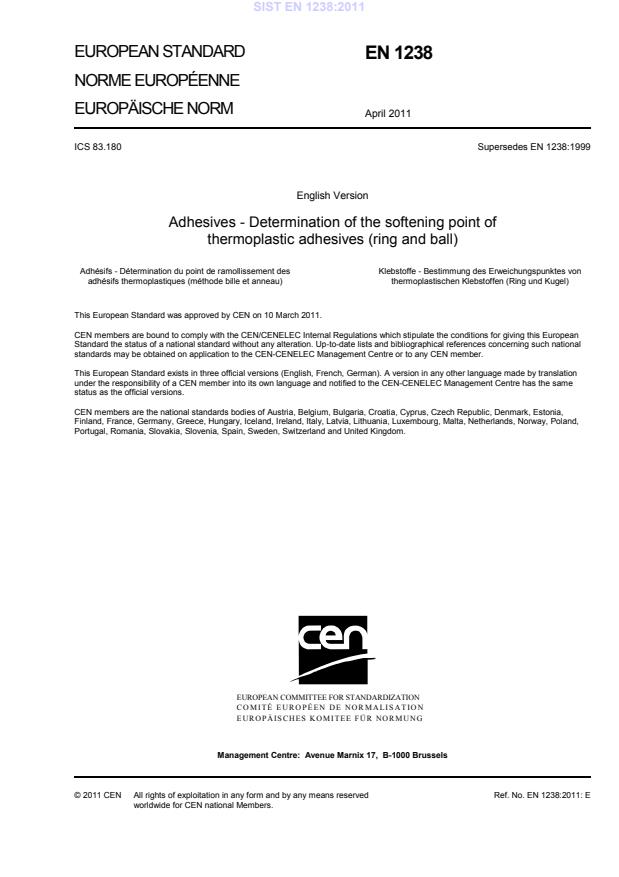
EUROPEAN STANDARD NORME EUROPÉENNE EUROPÄISCHE NORM
EN 1238
April 2011 ICS 83.180 Supersedes EN 1238:1999English Version
Adhesives - Determination of the softening point of thermoplastic adhesives (ring and ball)
Adhésifs - Détermination du point de ramollissement des adhésifs thermoplastiques (méthode bille et anneau)
Klebstoffe - Bestimmung des Erweichungspunktes von thermoplastischen Klebstoffen (Ring und Kugel) This European Standard was approved by CEN on 10 March 2011.
CEN members are bound to comply with the CEN/CENELEC Internal Regulations which stipulate the conditions for giving this European Standard the status of a national standard without any alteration. Up-to-date lists and bibliographical references concerning such national standards may be obtained on application to the CEN-CENELEC Management Centre or to any CEN member.
This European Standard exists in three official versions (English, French, German). A version in any other language made by translation under the responsibility of a CEN member into its own language and notified to the CEN-CENELEC Management Centre has the same status as the official versions.
CEN members are the national standards bodies of Austria, Belgium, Bulgaria, Croatia, Cyprus, Czech Republic, Denmark, Estonia, Finland, France, Germany, Greece, Hungary, Iceland, Ireland, Italy, Latvia, Lithuania, Luxembourg, Malta, Netherlands, Norway, Poland, Portugal, Romania, Slovakia, Slovenia, Spain, Sweden, Switzerland and United Kingdom.
EUROPEAN COMMITTEE FOR STANDARDIZATION
COMITÉ EUROPÉEN DE NORMALISATION EUROPÄISCHES KOMITEE FÜR NORMUNG
Management Centre:
Avenue Marnix 17,
B-1000 Brussels © 2011 CEN All rights of exploitation in any form and by any means reserved worldwide for CEN national Members. Ref. No. EN 1238:2011: ESIST EN 1238:2011
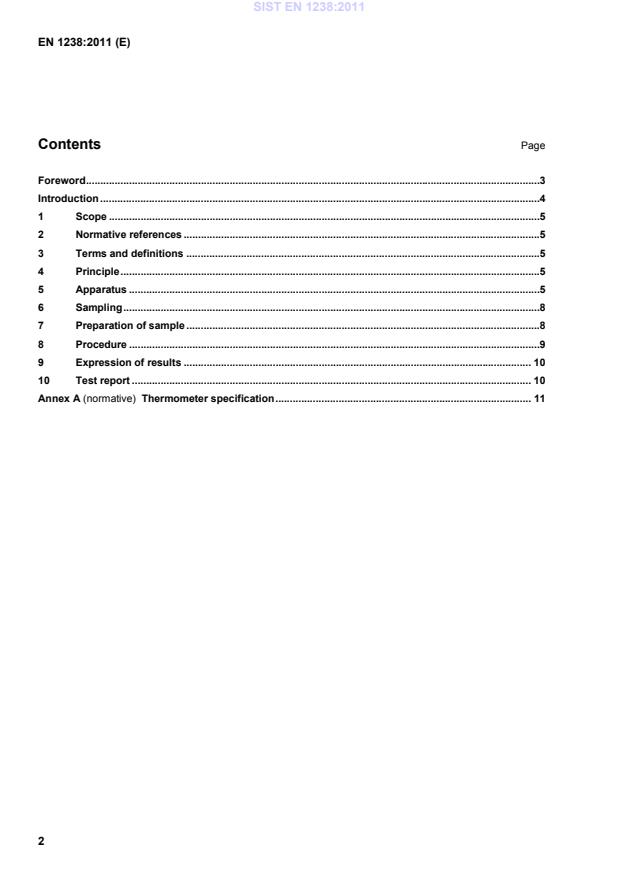
Thermometer specification . 11 SIST EN 1238:2011
Thermoplastic adhesives do not change from the solid to the liquid state at a fixed temperature, but their viscosity decreases progressively as the temperature rises. For this reason, the determination of the softening point shall be carried out by defined methods to obtain comparable results.
...