

EN 827:2005
(Main)Adhesives - Determination of conventional solids content and constant mass solids content
- Abstract
This European Standard specifies a method for the determination of conventional solids content and, where possible, constant mass solids content.
It is applicable to dispersion, emulsion and solvent based adhesives.
- Status
- Published
- Publication Date
- 20-Dec-2005
- Withdrawal Date
- 29-Jun-2006
- Technical Committee
- CEN/TC 193 - Adhesives
- Current Stage
- 9060 - Closure of 2 Year Review Enquiry - Review Enquiry
- Start Date
- 04-Jun-2026
- Completion Date
- 04-Jun-2026


Overview
The EN 827:2005 standard, developed by the European Committee for Standardization (CEN), defines a precise methodology for determining the conventional solids content and, where feasible, the constant mass solids content in adhesives. This standard is essential for manufacturers, quality control laboratories, and researchers working with dispersion, emulsion, and solvent-based adhesives, ensuring accurate evaluation and consistent quality. EN 827:2005 supersedes the earlier EN 827:1994, providing updated procedural clarity and enhanced testing reliability.
Key Topics
- Scope: The standard applies specifically to dispersion, emulsion, and solvent-based adhesives. It covers test methods to quantify the solids content in these materials by controlled drying and weighing processes.
- Test Methods:
- Conventional solids content is measured by drying a specified amount of adhesive at a defined temperature for a fixed time.
- Constant mass solids content involves continued drying until weight loss stabilizes, indicating complete evaporation of volatile components.
- Apparatus Requirements:
- Ovens with natural or forced ventilation capable of maintaining temperatures within ±1 °C.
- Analytical balances accurate to 0.1 mg.
- Flat-bottomed thin metal containers with specified dimensions.
- Desiccators with suitable desiccants for accurate cooling and conditioning.
- Safety Considerations: The procedure involves heating adhesives, which may release toxic, harmful, or flammable volatile components. Proper lab practices and equipment such as extraction fans are mandatory to ensure operator safety.
- Sampling and Preparation: Follow relevant standards EN ISO 15605 and EN 1067 for representative sampling and sample preparation, ensuring consistency and reliability.
- Drying Conditions: Drying times and temperatures vary based on adhesive type - including natural, synthetic, aqueous dispersion, and solvent-based adhesives - to prevent heat degradation or loss of active ingredients.
- Result Expression: Results are calculated as percentages by mass, with duplicate tests to ensure precision. Differences between duplicate results must remain within acceptable limits (1-2%), otherwise retesting is required.
- Test Report Requirements: Detailed documentation must specify the standard reference, adhesive type, test conditions, results, any procedural deviations, and test dates to ensure traceability and quality control.
Applications
EN 827:2005 is critically important for:
- Adhesive Manufacturers: To verify product composition, manufacturing consistency, and compliance with specifications.
- Quality Control Laboratories: Monitoring solids content to maintain adhesive performance and stability.
- Research and Development: Developing new adhesive formulations by understanding solids content's influence on properties.
- Regulatory Compliance: Ensuring products meet regulatory requirements related to volatile content and safety.
- End-Users: Including industries such as woodworking, automotive, packaging, and construction relying on adhesives with certified quality parameters for bonding performance.
Measuring solids content accurately impacts key adhesive properties such as viscosity, drying time, bonding strength, and environmental safety, making this standard indispensable for optimizing adhesive applications.
Related Standards
The EN 827:2005 method integrates with and references several other key standards for adhesive testing, including:
- EN 923 – Adhesives: Terms and Definitions - Provides essential terminology clarification.
- EN 1067 – Adhesives: Examination and Preparation of Samples for Testing - Sets foundational sample handling protocols.
- EN ISO 15605 – Adhesives: Sampling - Details procedures for obtaining representative adhesive samples.
Together, these standards create a comprehensive framework for adhesive characterization, supporting consistent, comparable, and reliable testing across the adhesives industry.
By adhering to EN 827:2005, professionals ensure precise evaluation of adhesive solids content, enabling superior product quality, regulatory compliance, and enhanced performance in various industrial adhesive applications. Keywords: adhesive solids content, conventional solids content, constant mass solids content, adhesive testing standard, dispersion adhesives, emulsion adhesives, solvent-based adhesives, EN 827, CEN adhesive standards.
Relations
- Effective Date
- 22-Dec-2008
- Effective Date
- 28-Jan-2026
- Effective Date
- 28-Jan-2026
- Effective Date
- 28-Jan-2026
- Effective Date
- 28-Jan-2026
- Effective Date
- 28-Jan-2026
Get Certified
Connect with accredited certification bodies for this standard

DIN CERTCO
DIN Group product certification.

Smithers Quality Assessments
US management systems and product certification.
Sponsored listings
Frequently Asked Questions
EN 827:2005 is a standard published by the European Committee for Standardization (CEN). Its full title is "Adhesives - Determination of conventional solids content and constant mass solids content". This standard covers: This European Standard specifies a method for the determination of conventional solids content and, where possible, constant mass solids content. It is applicable to dispersion, emulsion and solvent based adhesives.
This European Standard specifies a method for the determination of conventional solids content and, where possible, constant mass solids content. It is applicable to dispersion, emulsion and solvent based adhesives.
EN 827:2005 is classified under the following ICS (International Classification for Standards) categories: 83.180 - Adhesives. The ICS classification helps identify the subject area and facilitates finding related standards.
EN 827:2005 has the following relationships with other standards: It is inter standard links to EN 827:1994, EN 923:2015, EN ISO 22065:2020, EN ISO 15605:2004, EN 1720:1998, EN 1246:1998. Understanding these relationships helps ensure you are using the most current and applicable version of the standard.
EN 827:2005 is available in PDF format for immediate download after purchase. The document can be added to your cart and obtained through the secure checkout process. Digital delivery ensures instant access to the complete standard document.
Standards Content (Sample)
SLOVENSKI STANDARD
01-april-2006
Nadomešča:
SIST EN 827:1998
Lepila – Določevanje suhega ostanka in suhega ostanka po sušenju do
konstantne mase
Adhesives - Determination of conventional solids content and constant mass solids
content
Klebstoffe - Bestimmung des Feststsoffgehaltes nach Vereinbarung und bis zur
Massekonstanz
Adhésifs - Détermination de l'extrait sec conventionnel et de l'extrait sec a masse
constante
Ta slovenski standard je istoveten z: EN 827:2005
ICS:
83.180 Lepila Adhesives
2003-01.Slovenski inštitut za standardizacijo. Razmnoževanje celote ali delov tega standarda ni dovoljeno.
EUROPEAN STANDARD
EN 827
NORME EUROPÉENNE
EUROPÄISCHE NORM
December 2005
ICS 83.180 Supersedes EN 827:1994
English Version
Adhesives - Determination of conventional solids content and
constant mass solids content
Adhésifs - Détermination de l'extrait sec conventionnel et Klebstoffe - Bestimmung des Feststsoffgehaltes nach
de l'extrait sec à masse constante Vereinbarung und bis zur Massekonstanz
This European Standard was approved by CEN on 21 November 2005.
CEN members are bound to comply with the CEN/CENELEC Internal Regulations which stipulate the conditions for giving this European
Standard the status of a national standard without any alteration. Up-to-date lists and bibliographical references concerning such national
standards may be obtained on application to the Central Secretariat or to any CEN member.
This European Standard exists in three official versions (English, French, German). A version in any other language made by translation
under the responsibility of a CEN member into its own language and notified to the Central Secretariat has the same status as the official
versions.
CEN members are the national standards bodies of Austria, Belgium, Cyprus, Czech Republic, Denmark, Estonia, Finland, France,
Germany, Greece, Hungary, Iceland, Ireland, Italy, Latvia, Lithuania, Luxembourg, Malta, Netherlands, Norway, Poland, Portugal, Slovakia,
Slovenia, Spain, Sweden, Switzerland and United Kingdom.
EUROPEAN COMMITTEE FOR STANDARDIZATION
COMITÉ EUROPÉEN DE NORMALISATION
EUROPÄISCHES KOMITEE FÜR NORMUNG
Management Centre: rue de Stassart, 36 B-1050 Brussels
© 2005 CEN All rights of exploitation in any form and by any means reserved Ref. No. EN 827:2005: E
worldwide for CEN national Members.
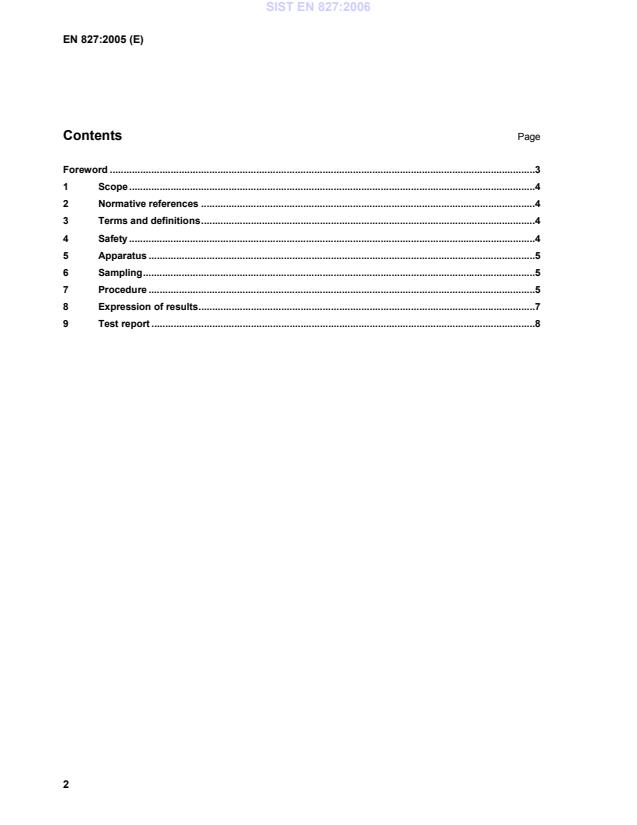
Contents Page
Foreword .3
1 Scope .4
2 Normative references .4
3 Terms and definitions.4
4 Safety .4
5 Apparatus .5
6 Sampling.5
7 Procedure .5
8 Expression of results.7
9 Test report .8
Foreword
This European Standard (EN 827:2005) has been prepared by Technical Committee CEN/TC 193
“Adhesives”, the secretariat of which is held by AENOR.
This European Standard shall be given the status of a national standard, either by publication of an identical
text or by endorsement, at the latest by June 2006, and conflicting national standards shall be withdrawn at
the latest by June 2006.
This European Standard supersedes EN 827:1994.
According to the CEN/CENELEC Internal Regulations, the national standards organizations of the following
countries are bound to implement this European Standard: Austria, Belgium, Cyprus, Czech Republic,
Denmark, Estonia, Finland, France, Germany, Greece, Hungary, Iceland, Ireland, Italy, Latvia, Lithuania,
Luxembourg, Malta, Netherlands, Norway, Poland, Portugal, Slovakia, Slovenia, Spain, Sweden, Switzerland
and United Kingdom.
SAFETY STATEMENT: Persons using this European Standard should be familiar with the normal
laboratory practice, in principle. This European Standard does not purport to address all of the safety
problems, if any, associated with its use. It is the responsibility of the user to establish appropriate
safety and health practices and to ensure compliance with any regulatory conditions.
1 Scope
This European Standard specifies a method for the determination of conventional solids content and, where
possible, constant mass solids content.
It is applicable to dispersion, emulsion and solvent based adhesives.
2 Normative references
The following referenced documents are indispensable for the application of this European Standard. For
dated references, only the edition cited applies. For undated references, the latest edition of the referenced
document (including any amendments) applies.
EN 923, Adhesives — Terms and definitions
EN 1067, Adhesives — Examination and preparation of samples for testing
EN ISO 15605, Adhesives — Sampling (ISO 15605:2000)
3 Terms and definitions
For the purposes of this European Standard, the terms and definitions given in EN 923 and the following apply.
3.1
conventional solids content
solids content obtained by heating a conventional amount of the sample placed in a given vessel at a given
temperature for a specific time
3.2
constant mass solids content
solids content obtained by heating the sample for successive intervals until the volatile components have
evaporated and the residue reaches a constant mass
4 Safety
...