

FprEN 124-7
(Main)Gully tops and manhole tops for vehicular and pedestrian areas - Part 7: Gully tops and manhole tops made of polyamide
- Abstract
This document applies to gully tops and manhole tops with a clear opening up to and including 1 000 mm for installation within areas subjected to pedestrian and/or vehicular traffic.
It applies for manhole tops and gully tops of classes A 15 to D 400 made from polyamide (PA 6 and PA 6.6) by casting or injection-moulding.
This document is only applicable in combination with EN 124-1 and prEN 124-700.
This document does not apply
- for fillings installed on site, e.g. concrete, paving blocks etc.,
- for gratings as part of prefabricated drainage channels according to EN 1433,
- to floor and roof gullies in buildings which are specified in EN 1253 (all parts) and to surface boxes.
- Status
- Not Published
- Publication Date
- 31-Mar-2027
- Technical Committee
- CEN/TC 165 - Waste water engineering
- Drafting Committee
- CEN/TC 165/WG 4 - Gullies and tops a.s.o.
- Current Stage
- 4599 - Dispatch of FV draft to CMC - Finalization for Vote
- Start Date
- 21-Sep-2026
- Due Date
- 19-Dec-2025
- Completion Date
- 21-Sep-2026

prEN 124-7 is a draft European Standard from CEN for gully tops and manhole tops made of polyamide for vehicular and pedestrian areas. It specifies requirements for products with a clear opening up to and including 1 000 mm, in classes A 15 to D 400, and it is used together with EN 124-1 and prEN 124-700.
What does prEN 124-7 specify?
prEN 124-7 applies to gully tops and manhole tops made from PA 6 and PA 6.6, produced by casting or injection-moulding, for installation in areas subject to pedestrian and/or vehicular traffic. It excludes site-installed fillings, gratings that belong to prefabricated drainage channels under EN 1433, floor and roof gullies in buildings under EN 1253, and surface boxes.
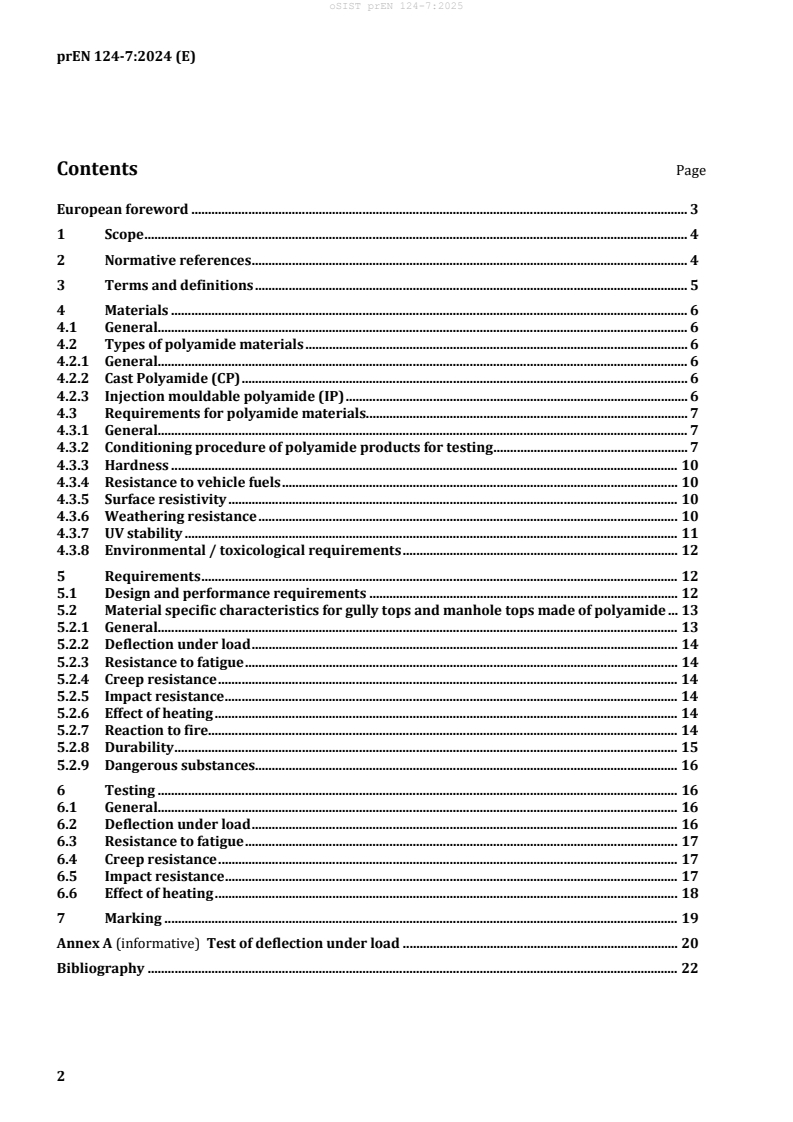
The document is organized into Scope, Normative references, Terms and definitions, Materials, Requirements, Testing, Marking, and informative Annex A. That structure matters in practice because it separates the material rules from the performance checks and from the identification marking that users need on the finished product.
What are the key requirements of prEN 124-7?
Material form and composition
prEN 124-7 requires the product to be moulded as a single structure made by a controlled automatic process, not by bonding multiple pieces together. Metal parts that carry structural load are not permitted, so the polyamide body must provide the load-bearing function itself.
The standard does allow metal keys and lifting housings to be incorporated, but not as part of the structural design, and any metallic fixing must be corrosion-resistant. For combined products using elements from other EN 124 material parts, the combined unit must meet the relevant design, performance and testing requirements, and the declared load class is limited by the lowest class of any constituent element.
Polyamide types and conditioning
prEN 124-7 distinguishes between cast polyamide (CP) and injection mouldable polyamide (IP). CP is based on anionic polymerization of caprolactam and is declared to contain at least 80 % PA 6, with no reinforcing fibres, while IP is made from thermoplastic PA 6 or PA 6.6 granules and can include reinforcing fibres within the matrix.
The document also treats moisture as a design and test variable because it affects stiffness, strength, elongation and toughness. Tests may therefore require conditioning to a defined moisture state, and the document gives two conditioning methods: an accelerated water-immersion route and a climate-chamber route. For type testing, the conditioned part must be tested within a defined time window, and the storage conditions before testing are controlled so the moisture state does not change unpredictably.
Material properties that must be checked
prEN 124-7 requires CP hardness to be checked on each lot of material used, using Shore D hardness on the top surface of the product. It also requires resistance to vehicle fuels to be verified on a finished product after exposure to specified fuel media, followed by confirmation that the load and permanent-set requirements are still met and that no cracking is visible.
Where static charge dissipation is needed, the document includes a surface resistivity requirement. It also requires resistance to artificial weathering, with test methods and acceptance based on retained tensile-impact strength, and it gives a separate route for UV-stable materials through defined carbon-black characteristics. In practice, these provisions tell the manufacturer whether the chosen formulation is suitable for exposed outdoor service and for special locations such as refuelling areas.
Design, performance and service conditions
prEN 124-7 requires conformance with the EN 124-1 design and performance framework, and Table 3 links each characteristic to the relevant clause and the applicable load classes. The table covers items such as vents, clear opening, insertion depth, compatibility of seatings, handling, flatness, surface condition, skid resistance and child safety.
The polyamide products are intended for use above -30 °C and below 100 °C. The manufacturer is also expected to provide installation guidance to avoid overheating from hot bitumen or asphalt, which matters because the material-specific tests include heating and impact checks after conditioning.
Testing, durability and marking
prEN 124-7 requires complete units to be tested in their intended position of use, with the cover or grating properly seated in the frame. The material-specific tests include deflection under load, fatigue resistance, creep resistance, impact resistance and the effect of heating.
The fatigue test uses class-dependent load and cycle requirements, while the impact test uses a cooled specimen and a defined drop impact on exposed areas. After the fatigue regime, the unit is checked again for load-bearing performance, securing method, skid resistance where required, and child-safety functionality where required. Marking must include the document reference, class, manufacturer identification, factory identification and date or week and year of manufacture, and the markings must be permanent and integral to the part.
What terms does prEN 124-7 define?
- Polyamide (PA) - A polymer family with recurring amide linkages in the chain; this is the base material family covered by the document.
- Cast polyamide (CP) - A polyamide made by anionic polymerization of caprolactam in heated moulds, used for cast gully tops and manhole tops.
- Injection mouldable polyamide (IP) - Compounded PA granules, including PA 6 or PA 6.6, that can be processed by injection moulding and may contain reinforcing fibres.
- Conditioning - The preparation of a sample before certain tests so that moisture content and temperature state are controlled and the test result is comparable.
Who uses prEN 124-7?
Manufacturers of gully tops and manhole tops use prEN 124-7 to select the polyamide type, design the structure, choose the test route and prepare product marking. Material suppliers use it to formulate CP or IP materials that can meet the weathering, hardness, fuel and UV requirements.
Testing laboratories and certification bodies use it for conditioning, load testing, fatigue testing, impact testing, heating checks and marking verification. Engineers, specifiers, buyers and road or wastewater authorities use it to identify the right product class and to confirm that a polyamide product belongs to the EN 124 system and is used with EN 124-1 and prEN 124-700.
Which standards are used with prEN 124-7?
| Reference | What it contributes |
|---|---|
| EN 124-1:2015 | Core definitions, classification, general design rules, performance requirements and test methods for the EN 124 series. |
| EN 124-2:2015 to EN 124-6:2015 | The companion material parts used when polyamide elements are combined with cast iron, steel or aluminium, steel reinforced concrete, composite materials, or PP/PE/PVC-U elements. |
| prEN 124-700 | Factory production control, third-party monitoring and certification for polyamide gully tops and manhole tops. |
| EN 1433 | Drainage channel requirements, relevant to the scope exclusion for gratings that are part of prefabricated drainage channels. |
| EN 513:2018 and EN ISO 4892-1/-2/-3 | Artificial weathering exposure methods used for weathering resistance and UV-related assessments. |
| EN ISO 868:2003 | Shore hardness test method used for CP hardness checks. |
| EN ISO 175 | Chemical immersion method used for the vehicle-fuel resistance check. |
| ISO 2878 | Electrical resistance method used when surface resistivity is needed for static charge dissipation. |
| EN ISO 291:2008 | Standard atmospheres for conditioning and testing. |
| EN ISO 3127 | Impact-test equipment reference used for the low-temperature impact test arrangement. |
| EN ISO 8256:2023 | Tensile-impact strength test method used in weathering and UV stability assessments. |
| EN 13501-1:2018 and EN 13823 | Reaction-to-fire classification framework and SBI test method for declared fire performance. |
What does the prEN 124-7 document contain?
prEN 124-7 contains the material definitions for CP and IP, the conditioning procedures needed before testing, and the technical requirements for hardness, fuel resistance, surface resistivity, weathering resistance and UV stability. It also contains the design and performance linkage to EN 124-1, including the characteristics that apply to each load class.
The document includes the test methods for deflection under load, fatigue resistance, creep resistance, impact resistance and effect of heating. Table 3 maps the design and performance characteristics to EN 124-1 clauses, Table 4 gives the fatigue-test severity by class, and Table 5 gives the impact striker mass by class.
Annex A is informative and gives the deflection-under-load test setup, sample preparation, apparatus, procedure and reporting. In practice, this annex supports type testing and conformity work because it shows how to measure deflection on complete units in service-like conditions.
Get Certified
Connect with accredited certification bodies for this standard

Zavod za gradbeništvo Slovenije (ZAG) - Inšpekcija
ZAG inspection body for construction products, structures, and materials.
Sponsored listings
Frequently Asked Questions
FprEN 124-7 is a draft published by the European Committee for Standardization (CEN). Its full title is "Gully tops and manhole tops for vehicular and pedestrian areas - Part 7: Gully tops and manhole tops made of polyamide". This standard covers: This document applies to gully tops and manhole tops with a clear opening up to and including 1 000 mm for installation within areas subjected to pedestrian and/or vehicular traffic. It applies for manhole tops and gully tops of classes A 15 to D 400 made from polyamide (PA 6 and PA 6.6) by casting or injection-moulding. This document is only applicable in combination with EN 124-1 and prEN 124-700. This document does not apply - for fillings installed on site, e.g. concrete, paving blocks etc., - for gratings as part of prefabricated drainage channels according to EN 1433, - to floor and roof gullies in buildings which are specified in EN 1253 (all parts) and to surface boxes.
This document applies to gully tops and manhole tops with a clear opening up to and including 1 000 mm for installation within areas subjected to pedestrian and/or vehicular traffic. It applies for manhole tops and gully tops of classes A 15 to D 400 made from polyamide (PA 6 and PA 6.6) by casting or injection-moulding. This document is only applicable in combination with EN 124-1 and prEN 124-700. This document does not apply - for fillings installed on site, e.g. concrete, paving blocks etc., - for gratings as part of prefabricated drainage channels according to EN 1433, - to floor and roof gullies in buildings which are specified in EN 1253 (all parts) and to surface boxes.
FprEN 124-7 is classified under the following ICS (International Classification for Standards) categories: 93.080.30 - Road equipment and installations. The ICS classification helps identify the subject area and facilitates finding related standards.
FprEN 124-7 is available in PDF format for immediate download after purchase. The document can be added to your cart and obtained through the secure checkout process. Digital delivery ensures instant access to the complete standard document.
Standards Content (Sample)
SLOVENSKI STANDARD
01-april-2025
Pokrovi za odtoke in jaške na voznih površinah in površinah za pešce - 7. del:
Pokrovi za odtoke in jaške iz poliamida
Gully tops and manhole tops for vehicular and pedestrian areas - Part 7: Gully tops and
manhole tops made of polyamide
Aufsätze und Abdeckungen für Verkehrsflächen - Teil 7: Aufsätze und Abdeckungen aus
Polyamid
Dispositifs de couronnement et de fermeture pour les zones de circulation utilisées par
les piétons et les véhicules - Partie 7: Dispositifs de couronnement et de fermeture en
polyamide
Ta slovenski standard je istoveten z: prEN 124-7
ICS:
93.080.30 Cestna oprema in pomožne Road equipment and
naprave installations
2003-01.Slovenski inštitut za standardizacijo. Razmnoževanje celote ali delov tega standarda ni dovoljeno.
DRAFT
EUROPEAN STANDARD
prEN 124-7
NORME EUROPÉENNE
EUROPÄISCHE NORM
January 2025
ICS 93.080.30
English Version
Gully tops and manhole tops for vehicular and pedestrian
areas - Part 7: Gully tops and manhole tops made of
polyamide
Dispositifs de couronnement et de fermeture pour les Aufsätze und Abdeckungen für Verkehrsflächen - Teil
zones de circulation utilisées par les piétons et les 7: Aufsätze und Abdeckungen aus Polyamid
véhicules - Partie 7: Dispositifs de couronnement et de
fermeture en polyamide
This draft European Standard is submitted to CEN members for enquiry. It has been drawn up by the Technical Committee
CEN/TC 165.
If this draft becomes a European Standard, CEN members are bound to comply with the CEN/CENELEC Internal Regulations
which stipulate the conditions for giving this European Standard the status of a national standard without any alteration.
This draft European Standard was established by CEN in three official versions (English, French, German). A version in any other
language made by translation under the responsibility of a CEN member into its own language and notified to the CEN-CENELEC
Management Centre has the same status as the official versions.
CEN members are the national standards bodies of Austria, Belgium, Bulgaria, Croatia, Cyprus, Czech Republic, Denmark, Estonia,
Finland, France, Germany, Greece, Hungary, Iceland, Ireland, Italy, Latvia, Lithuania, Luxembourg, Malta, Netherlands, Norway,
Poland, Portugal, Republic of North Macedonia, Romania, Serbia, Slovakia, Slovenia, Spain, Sweden, Switzerland, Türkiye and
United Kingdom.
Recipients of this draft are invited to submit, with their comments, notification of any relevant patent rights of which they are
aware and to provide supporting documentation.
Warning : This document is not a European Standard. It is distributed for review and comments. It is subject to change without
notice and shall not be referred to as a European Standard.
EUROPEAN COMMITTEE FOR STANDARDIZATION
COMITÉ EUROPÉEN DE NORMALISATION
EUROPÄISCHES KOMITEE FÜR NORMUNG
CEN-CENELEC Management Centre: Rue de la Science 23, B-1040 Brussels
© 2025 CEN All rights of exploitation in any form and by any means reserved Ref. No. prEN 124-7:2025 E
worldwide for CEN national Members.
prEN 124-7:2024 (E)
Contents Page
European foreword . 3
1 Scope . 4
2 Normative references . 4
3 Terms and definitions . 5
4 Materials . 6
4.1 General. 6
4.2 Types of polyamide materials . 6
4.2.1 General. 6
4.2.2 Cast Polyamide (CP) . 6
4.2.3 Injection mouldable polyamide (IP) . 6
4.3 Requirements for polyamide materials. 7
4.3.1 General. 7
4.3.2 Conditioning procedure of polyamide products for testing . 7
4.3.3 Hardness . 10
4.3.4 Resistance to vehicle fuels . 10
4.3.5 Surface resistivity . 10
4.3.6 Weathering resistance . 10
4.3.7 UV stability . 11
4.3.8 Environmental / toxicological requirements . 12
5 Requirements . 12
5.1 Design and performance requirements . 12
5.2 Material specific characteristics for gully tops and manhole tops made of polyamide . 13
5.2.1 General. 13
5.2.2 Deflection under load . 14
5.2.3 Resistance to fatigue . 14
5.2.4 Creep resistance . 14
5.2.5 Impact resistance . 14
5.2.6 Effect of heating . 14
5.2.7 Reaction to fire. 14
5.2.8 Durability . 15
5.2.9 Dangerous substances. 16
6 Testing . 16
6.1 General. 16
6.2 Deflection under load . 16
6.3 Resistance to fatigue . 17
6.4 Creep resistance . 17
6.5 Impact resistance . 17
6.6 Effect of heating . 18
7 Marking . 19
Annex A (informative) Test of deflection under load . 20
Bibliography . 22
prEN 124-7:2024 (E)
European foreword
This document prEN 124-7:2024 has been prepared by Technical Committee Technical Committee
CEN/TC 165 “Waste water engineering”, the secretariat of which is held by DIN.
This document is currently submitted to the CEN Enquiry.
The standard series EN 124 “Gully tops and manhole tops for vehicular and pedestrian areas” consists of
the following parts:
— Part 1: Definitions, classification, general principles of design, performance requirements and test
methods
— Part 2: Gully tops and manhole tops made of cast iron
— Part 3: Gully tops and manhole tops made of steel or aluminium alloy
— Part 4: Gully tops and manhole tops made of steel reinforced concrete
— Part 5: Gully tops and manhole tops made of composite materials
— Part 6: Gully tops and manhole tops made of Polypropylene (PP), Polypropylene with mineral
modifiers (PP-MD), Polyethylene (PE) or Polyvinyl-chloride (PVC-U)
— Part 7: Gully tops and manhole tops made of polyamide
— Part 700: Factory production control, third party monitoring and certification for gully tops and
manhole tops made of polyamide
prEN 124-7:2024 (E)
1 Scope
This document applies to gully tops and manhole tops with a clear opening up to and including 1 000 mm
for installation within areas subjected to pedestrian and/or vehicular traffic.
It applies for manhole tops and gully tops of classes A 15 to D 400 made from polyamide (PA 6 and PA 6.6)
by casting or injection-moulding.
This document is only applicable in combination with EN 124-1 and prEN 124-700.
This document does not apply
— for fillings installed on site, e.g. concrete, paving blocks etc.,
— for gratings as part of prefabricated drainage channels according to EN 1433,
— to floor and roof gullies in buildings which are specified in EN 1253 (all parts) and to surface boxes.
2 Normative references
The following documents are referred to in the text in such a way that some or all of their content
constitutes requirements of this document. For dated references, only the edition cited applies. For
undated references, the latest edition of the referenced document (including any amendments) applies.
EN 124-1:2015, Gully tops and manhole tops for vehicular and pedestrian areas — Part 1: Definitions,
classification, general principles of design, performance requirements and test methods
EN 124-2:2015, Gully tops and manhole tops for vehicular and pedestrian areas — Part 2: Gully tops and
manhole tops made of cast iron
EN 124-3:2015, Gully tops and manhole tops for vehicular and pedestrian areas — Part 3: Gully tops and
manhole tops made of steel or aluminium alloys
EN 124-4:2015, Gully tops and manhole tops for vehicular and pedestrian areas — Part 4: Gully tops and
manhole tops made of steel reinforced concrete
EN 124-5:2015, Gully tops and manhole tops for vehicular and pedestrian areas — Part 5: Gully tops and
manhole tops made of composite materials
EN 124-6:2015, Gully tops and manhole tops for vehicular and pedestrian areas — Part 6: Gully tops and
manhole tops made of polypropylene (PP), polyethylene (PE) or unplasticized poly(vinyl chloride) (PVC-U)
EN 513:2018, Plastics — Poly(vinyl chloride) (PVC) based profiles — Determination of the resistance to
artificial weathering
EN 1433, Drainage channels for vehicular and pedestrian areas — Classification, design and testing
requirements, marking and evaluation of conformity
EN ISO 868:2003, Plastics and ebonite — Determination of indentation hardness by means of a durometer
(Shore hardness) (ISO 868:2003)
EN ISO 3127, Thermoplastics pipes — Determination of resistance to external blows — Round-the-clock
method(ISO 3127)
EN ISO 8256:2023, Plastics — Determination of tensile-impact strength(ISO 8256:2023)
prEN 124-7:2024 (E)
EN 13501-1:2018, Fire classification of construction products and building elements — Part 1:
Classification using data from reaction to fire tests
EN 13823, Reaction to fire tests for building products — Building products excluding floorings exposed to
the thermal attack by a single burning item
EN ISO 175, Plastics — Methods of test for the determination of the effects of immersion in liquid chemicals
(ISO 175)
EN ISO 4892-1, Plastics — Methods of exposure to laboratory light sources — Part 1: General guidance and
requirements(ISO 4892-1)
EN ISO 4892-2:2013, Plastics — Methods of exposure to laboratory light sources — Part 2: Xenon-arc
lamps (ISO 4892-2:2013)
EN ISO 4892-3, Plastics — Methods of exposure to laboratory light sources — Part 3: Fluorescent UV lamps
(ISO 4892-3)
ISO 2878, Rubber, vulcanized or thermoplastic — Antistatic and conductive products — Determination of
electrical resistance
EN ISO 291:2008, Plastics — Standard atmospheres for conditioning and testing(ISO 291:2008)
3 Terms and definitions
For the purposes of this document, the terms and definitions given in EN 124-1 and the following apply.
ISO and IEC maintain terminology databases for use in standardization at the following addresses:
— ISO Online browsing platform: available at https://www.iso.org/obp/
— IEC Electropedia: available at https://www.electropedia.org/
3.1
polyamide
PA
polymers made of macromolecules having in the chain recurring amide linkages which are joined to
aliphatic or cycloaliphatic or partial aromatic units
Note 1 to entry: Polyamides are generally defined in EN ISO 16396. Further specifications see 3.2 and 3.3.
3.2
cast polyamide
CP
type of polyamide produced by an anionic polymerization process in which a melted solution of monomer
and up to 20 % modifiers (e.g. stabilisers, colour pigments, demoulding agents, catalysts, additives) is
transformed in heated moulds into polymeric material under the melting temperature of the polymer in
a mould
Note 1 to entry: Caprolactam is an organic substance which is used as monomer in anionic polymerization to
obtain PA 6.
prEN 124-7:2024 (E)
3.3
injection mouldable polyamide
IP
granules of compounded thermoplastic polyamide (PA) containing up to 60 % (by mass) of glass fibres
and up to 5 % of modifiers (e.g. stabilisers, colour pigments, demoulding agents) which can be processed
by injection moulding
3.4
conditioning
preparation of a part or sample which is required for certain tests according to this document
Note 1 to entry: Further specifications see 4.3.1 and 4.3.3.
4 Materials
4.1 General
Materials in accordance with this document shall be moulded as a single structure. They shall be
produced by using suitably controlled automatic processes that produce a single structure and that do
not contain multiple pieces bonded together.
The inclusion of metal components that contribute to the structural performance of the manhole top or
gully top shall not be permitted.
Components such as metal key and lifting housing can be incorporated within the structure but shall not
be part of the structural design. The material used for any metallic fixing shall be resistant to corrosion.
Any element made of the materials specified in 4.2 can be used in combination with elements of materials
specified in EN 124-2:2015, EN 124-3:2015, EN 124-4:2015, EN 124-5:2015 or EN 124-6:2015. In such
cases the manhole tops or gully tops shall comply with the relevant design and performance and testing
requirements as listed in Table 3
In addition, elements shall comply with the requirements for the material related EN 124-2, EN 124-3,
EN 124-4, EN 124-5 or EN 124-6 as applicable. Each element shall be marked accordingly. The load class
to be declared for the combined product shall be restricted to the lower class determined for any
constituent element according to the relevant part of EN 124 series.
4.2 Types of polyamide materials
4.2.1 General
Depending on the production process, the polyamide materials shall be distinguished as cast polyamide
(CP) or injection mouldable polyamide (IP).
4.2.2 Cast Polyamide (CP)
Manhole tops and gully tops made of cast polyamide shall be produced by anionic polymerization of flake
or melted caprolactam. CP manufacturers of different materials shall declare that their products contain
at least 80 % of PA 6 made by anionic polymerization of caprolactam.
Cast polyamide shall not contain reinforcing fibres.
4.2.3 Injection mouldable polyamide (IP)
Manhole tops and gully tops made of injection mouldable polyamide shall be made by injection moulding
thermoplastic PA 6 or PA 6.6 granules. Polyamide for injection moulding can contain reinforcing fibres
encapsulated within the matrix.
prEN 124-7:2024 (E)
4.3 Requirements for polyamide materials
4.3.1 General
Some properties like Young’s modulus, material strength, tensile strain and toughness are affected by the
humidity within the product. Therefore, some tests will require a defined conditioning, others may be
carried out on part which were just manufactured (these are always dry).
4.3.2 Conditioning procedure of polyamide products for testing
Elements to be tested shall be conditioned to water absorption, aiming to reach the equilibrium moisture
content in standard atmosphere (23 ± 2) °C/ (50 ± 1) % relative humidity and a sufficiently
homogeneous distribution of water-molecules within the polymer.
Part testing (type testing) shall be carried out latest 4 weeks after completing conditioning using either
Method A or Method B below. The part shall be stored in an environment not more than 30 °C and without
direct exposure to sun light or other heating sources. These storage conditions also apply to potential
transport to a testing institute and storage there.
Definitions:
V is the volume of the cover or grating [mm ]
S is the total surface of the cover or grating [mm ]
h is the equivalent thickness of the cover or grating [mm]
t is the maximum initial time step in hours (Method A)
t is the conditioning time in days (Method B)
t time step in hours in days (Method B)
C is 0,5 [hours/mm ]
M is the target moisture content [%]
M is 3,0 % for PA6 and 2,8 % for PA6.6
GF is the Glass Fibres Content [%]
Method A – Accelerated procedure
APPARATUS:
Water tank heated at controlled temperature of (60 ± 2) °C
Balance, accurate to 0,1 % of the element’s weight
PROCEDURE:
Weigh the element to be conditioned as manufactured, no later than 15 days from date of manufacturing.
If metal inserts are used, subtract their mass and determine the mass (m) of the Polyamide.
Determine the equivalent thickness h [mm] of the element to be tested using the formula:
h = 2V/S (1)
Define maximum time step t , which is a function of the average wall thickness:
t =C ∙ h
Water absorption shall be measured as percentage of mass increase relative to dry polyamide. The
following table indicates the conditioning values in terms of mass increase of the polyamide mass m to
achieve after conditioning:
prEN 124-7:2024 (E)
Table 1 — Target equilibrium moisture content after conditioning
Glass Fibres Content
0 % 10 % 20 % 30 % 40 % 50 %
PA6 (3,0 ± 0,1) (2,7 ± 0,1) (2,4 ± 0,1) (2,1 ± 0,1) (1,8 ± 0,1) (1,5 ± 0,1)
% % % % % %
PA6.6 (2,8 ± 0,1) (2,5 ± 0,1) (2,2 ± 0,1) (2,0 ± 0,1) (1,7 ± 0,1)% (1,4 ± 0,1)
% % % % %
Cast PA (3,0 ± 0,1) n. a. n. a. n. a. n. a. n. a.
%
The target equilibrium moisture content after conditioning for glass fibre content outside the Table 1
values is calculated by:
M = M ∙ (1 – GF) (2)
Step 1 - Absorption
This step is aiming to raise the moisture content by immersion in water at (60 ± 2) °C. The duration of
absorption will depend on the equivalent thickness of the element, and type of Polyamide. The absorption
step is aiming to achieve the target mass increase according to Table 1 Diagrams in Figure 1 provide
guidance for the expected duration of the absorption step.
Immerse the element in a water tank kept at constant temperature of (60 ± 2) °C. Weigh the element at
regular time steps ≤ t and plot values to predict the absorption duration to reach the target. Before every
weight measurement water should be removed from the surface using a dry cloth. Once the target mass
increase M (%) is reached proceed to step 2.
Values in Table 1or in Formula (1) are intended as minimum thresholds, mass increase can exceed the
values in the table.
prEN 124-7:2024 (E)
Key
PA 6 or CP at (60 ± 2)°C
Figure 1 — Estimated duration of conditioning in water at 60°C
Step 2 – Normalization
This step is aiming to achieve uniform distribution of humidity across the element’s thickness.
Remove water from the surface. Put the element inside a sealed polyethylene bag. Keep the element at
(60 ± 2) °C for the same total period of time as per step 1.
Upon completion of step 2 conditioning is complete.
Method B – Climate Chamber
NOTE The following method is related to EN ISO 1110 and adjusted for the material requirements for products
according to this document.
APPARATUS:
Cabinet, with closed air circulation by a fan, capable of maintaining temperature of 70 °C within a
tolerance of ± 1 °C and a relative humidity of (62 ± 1) %
PROCEDURE
Place the element to be tested in the preheated cabinet by suitable means to maximize the surface
exposure to the surrounding atmosphere.
After conditioning for a period of time t (days) ≥ h /3 remove the element from the cabinet, allow it to
cool for 1 hour in standard atmosphere 23 °C/50 % relative humidity and weigh. Thereafter, continue
the accelerated conditioning procedure in the cabinet at 70 °C and repeat the weighing, as above, at
intervals of time t (days) ≥ h /8. The time intervals t and t shall not be less than 1 day.
3 2 3
When three consecutive weighings lie within a tolerance of 0,1 %, the conditioning is assumed to be
completed (see note). Place the element in standard atmosphere 23 °C/50 % RH for at least 1 h before
testing
prEN 124-7:2024 (E)
NOTE Under these conditions the element will have acquired a moisture content equal at least 95 % of the
equilibrium value. A prolonged of conditioning beyond this point will have no noticeable effect on the properties of
the element.
4.3.3 Hardness
For CP, the mean Shore D hardness shall be measured at every lot of material used, inorder to ensure
correct composition at the factory. It shall be equal to or greater than 50 ShD when tested in accordance
with EN ISO 868:2003 on the top surface of the product.
4.3.4 Resistance to vehicle fuels
A finished product (cover or grating) shall be conditioned according to EN ISO 175 in either
— a solution of 60 % volume toluene, 40 % volume n-heptane or
— diesel
at (23 ± 2) °C for (168 ± 2) h.
At the end of the conditioning the manhole top or gully top shall meet the requirements of permanent set
specified in EN 124-1:2015, Table 5 and of the test load according EN 124-1:2015, Table 4. There shall be
no visible evidence of cracking after the test.
4.3.5 Surface resistivity
In the event that safety considerations require that a manhole top or gully top is capable of dispersing a
static electrical charge, the value of surface resistivity shall be less than 1 × 10 Ohms.
The test shall be carried out according to ISO 2878 where the outer surface of a manhole top shall be
tested at a point which provides a flat surface of sufficient surface area to accommodate the electrodes to
two areas in accordance with ISO 2878.
NOTE A typical application is the forecourt of a refuelling station.
4.3.6 Weathering resistance
Manhole tops and gully tops shall be resistant against artificial weathering when tested in accordance
with Table 2 Upon completion of the artificial weathering resistance test, the coupons shall meet the
requirements defined in Table 2.
UV resistant materials meeting the requirements of 4.3.7 shall be deemed to comply with Table 2 without
testing.
The test can be carried out by the material supplier.
prEN 124-7:2024 (E)
Table 2 — Artificial weathering resist
...