

EN 1634-3:2004
(Main)Fire resistance and smoke control tests for door and shutter assemblies, openable windows and elements of building hardware - Part 3: Smoke control test for door and shutter assemblies
General Information
- Abstract
This Part of EN 1634 specifies a method for determining the leakage of cold and warm smoke from one side of a door assembly to the other under the specified test conditions. The test can be applied to door and shutter assemblies of different types intended for purposes of controlling the passage of smoke in case of fire. This test can also be applied to lift landing doors and conveyor system doors and shutters. The principle of the test is explained briefly in annex A.
- Status
- Published
- Publication Date
- 19-Oct-2004
- Technical Committee
- CEN/TC 127 - Fire safety in buildings
- Drafting Committee
- CEN/TC 127 - Fire safety in buildings
- Current Stage
- 9093 - Decision to confirm - Review Enquiry
- Start Date
- 22-Nov-2018
- Completion Date
- 23-Sep-2026



Overview
EN 1634-3:2004 (CEN) - "Fire resistance and smoke control tests for door and shutter assemblies - Part 3: Smoke control test for door and shutter assemblies" - specifies a laboratory method to measure smoke leakage through door and shutter assemblies. The standard defines procedures for testing cold (ambient) and warm (medium temperature ~200 °C) smoke flow from one side of a door assembly to the other, supporting the smoke classification (S) used in fire performance ratings.
Key topics and technical requirements
- Scope: Applies to doors, shutters, lift landing doors and conveyor system doors intended to restrict smoke spread in fire scenarios.
- Test principle: Create a sealed enclosure around the test specimen and measure leakage under controlled pressure and temperature conditions (principle summarized in Annex A).
- Test apparatus:
- Test chamber with open front (typical opening ~3 m × 3 m).
- Fan system to generate a pressure differential (minimum 55 Pa).
- Heating system for medium temperature tests (200 ± 20 °C).
- Instrumentation:
- Thermocouples (bare metal or thin-sheathed) for air temperature; accuracy requirements differ for ambient-only and medium-temperature tests.
- Static pressure measurement (accuracy ~±10% of reading).
- Airflow measurement able to detect leakage up to at least 55 m3/h (accuracy 1 m3/h).
- Specimen requirements:
- Full-size assemblies where possible; if not, maximum possible with supporting/associated construction.
- Tests normally carried out from both sides; test numbers depend on application and temperature.
- Leakage metrics and limits:
- Measures total leakage (Qtot), apparatus leakage, supporting/associated construction leakage and linear leakage (Ql).
- Apparatus plus associated/supporting construction leakage shall not exceed 10 m3/h at 50 Pa (ambient) to validate the test setup.
- Reporting and application rules: Detailed test report requirements and guidance on direct field application (limitations on construction, size/aspect ratio, glazing, hardware and seals).
Applications and practical value
- Establishes measurable smoke leakage performance for smoke control doors used in commercial, residential and industrial buildings.
- Used to support product declarations, regulatory compliance, fire performance classification (S - Sa and Sm) and specification in building projects.
- Valuable for:
- Door and shutter manufacturers validating smoke-control designs.
- Independent test laboratories performing certification testing.
- Fire safety engineers, architects and specifiers selecting doors for smoke management strategies.
- Regulatory bodies and certification schemes assessing conformity to fire safety requirements.
Related standards
- EN 1634-1:2000 - Fire doors and shutters (Part 1)
- EN 1363-1:1999 - General requirements for fire resistance tests
- EN 13501-2:2003 - Fire classification using fire resistance test data (including S classification)
- prEN 14600 - Fire resisting and/or smoke control doorsets (requirements & classification)
- EN ISO 13943:2000 - Fire safety vocabulary
Keywords: EN 1634-3:2004, smoke control test, smoke leakage, door assemblies, fire resistance, smoke control doors, CEN, leakage rate, test chamber.
Relations
- Effective Date
- 22-Dec-2008
- Effective Date
- 28-Jan-2026
- Effective Date
- 28-Jan-2026
- Effective Date
- 28-Jan-2026
- Effective Date
- 28-Jan-2026
- Effective Date
- 28-Jan-2026
- Effective Date
- 17-Jun-2026
- Effective Date
- 09-Feb-2026
- Effective Date
- 09-Feb-2026
- Effective Date
- 28-Jan-2026
- Effective Date
- 28-Jan-2026
- Referred By
EN 15684:2012 - Building hardware - Mechatronic cylinders - Requirements and test methods - Effective Date
- 28-Jan-2026
- Effective Date
- 28-Jan-2026
- Effective Date
- 28-Jan-2026
- Effective Date
- 28-Jan-2026
Get Certified
Connect with accredited certification bodies for this standard

DIBt (Deutsches Institut für Bautechnik)
German Institute for Building Technology.
DIN CERTCO
DIN Group product certification.

Kiwa BDA Testing
Building and construction product certification.
Sponsored listings
Frequently Asked Questions
EN 1634-3:2004 is a standard published by the European Committee for Standardization (CEN). Its full title is "Fire resistance and smoke control tests for door and shutter assemblies, openable windows and elements of building hardware - Part 3: Smoke control test for door and shutter assemblies". This standard covers: This Part of EN 1634 specifies a method for determining the leakage of cold and warm smoke from one side of a door assembly to the other under the specified test conditions. The test can be applied to door and shutter assemblies of different types intended for purposes of controlling the passage of smoke in case of fire. This test can also be applied to lift landing doors and conveyor system doors and shutters. The principle of the test is explained briefly in annex A.
This Part of EN 1634 specifies a method for determining the leakage of cold and warm smoke from one side of a door assembly to the other under the specified test conditions. The test can be applied to door and shutter assemblies of different types intended for purposes of controlling the passage of smoke in case of fire. This test can also be applied to lift landing doors and conveyor system doors and shutters. The principle of the test is explained briefly in annex A.
EN 1634-3:2004 is classified under the following ICS (International Classification for Standards) categories: 13.220.50 - Fire-resistance of building materials and elements; 91.060.50 - Doors and windows. The ICS classification helps identify the subject area and facilitates finding related standards.
EN 1634-3:2004 has the following relationships with other standards: It is inter standard links to EN 1634-3:2001, EN ISO 13943:2000, EN 1363-1:1999, EN 13501-2:2003, EN 1634-1:2000, EN 14600:2005, EN 1303:2026, EN 50600-2-5:2016, EN 50600-2-1:2021, EN 14846:2008, EN 1125:2008, EN 15684:2012, EN 378-3:2008+A1:2012, EN 13637:2015, EN 378-3:2016. Understanding these relationships helps ensure you are using the most current and applicable version of the standard.
EN 1634-3:2004 is associated with the following European legislation: EU Directives/Regulations: 305/2011, 89/106/EEC; Standardization Mandates: M/101. When a standard is cited in the Official Journal of the European Union, products manufactured in conformity with it benefit from a presumption of conformity with the essential requirements of the corresponding EU directive or regulation.
EN 1634-3:2004 is available in PDF format for immediate download after purchase. The document can be added to your cart and obtained through the secure checkout process. Digital delivery ensures instant access to the complete standard document.
Standards Content (Sample)
SLOVENSKI STANDARD
01-maj-2005
Nadomešča:
SIST EN 1634-3:2002
Preskusi požarne odpornosti vrat in drugih zapornih sestavov - 3. del: Dimna vrata
in zapore
Fire resistance and smoke control tests for door and shutter assemblies, openable
windows and elements of building hardware - Part 3: Smoke control test for door and
shutter assemblies
Prüfungen zum Feuerwiderstand und zur Rauchdichte für Feuer- und
Rauchschutzabschlüsse, Fenster und Beschläge – Teil 3: Prüfungen zur Rauchdichte für
Rauchschutzabschlüsse
Essais de résistance au feu et d’étanchéité aux fumées des portes, fermetures, fenetres
et éléments de quincailleries – Partie 3: Essais d’étanchéité aux fumées des portes et
fermetures
Ta slovenski standard je istoveten z: EN 1634-3:2004
ICS:
13.220.50 Požarna odpornost Fire-resistance of building
gradbenih materialov in materials and elements
elementov
91.060.50 Vrata in okna Doors and windows
2003-01.Slovenski inštitut za standardizacijo. Razmnoževanje celote ali delov tega standarda ni dovoljeno.
EUROPEAN STANDARD
EN 1634-3
NORME EUROPÉENNE
EUROPÄISCHE NORM
October 2004
ICS 13.220.50 Supersedes EN 1634-3:2001
English version
Fire resistance tests for door and shutter assemblies - Part 3:
Smoke control doors and shutters
Essais de résistance au feu des portes et fermetures - Feuerwiderstandsprüfungen für Tür- und
Partie 3: Portes et volets pare-fumées Abschlusseinrichtungen - Teil 3: Rauchschutzabschlüsse
This European Standard was approved by CEN on 15 July 2004.
CEN members are bound to comply with the CEN/CENELEC Internal Regulations which stipulate the conditions for giving this European
Standard the status of a national standard without any alteration. Up-to-date lists and bibliographical references concerning such national
standards may be obtained on application to the Central Secretariat or to any CEN member.
This European Standard exists in three official versions (English, French, German). A version in any other language made by translation
under the responsibility of a CEN member into its own language and notified to the Central Secretariat has the same status as the official
versions.
CEN members are the national standards bodies of Austria, Belgium, Cyprus, Czech Republic, Denmark, Estonia, Finland, France,
Germany, Greece, Hungary, Iceland, Ireland, Italy, Latvia, Lithuania, Luxembourg, Malta, Netherlands, Norway, Poland, Portugal, Slovakia,
Slovenia, Spain, Sweden, Switzerland and United Kingdom.
EUROPEAN COMMITTEE FOR STANDARDIZATION
COMITÉ EUROPÉEN DE NORMALISATION
EUROPÄISCHES KOMITEE FÜR NORMUNG
Management Centre: rue de Stassart, 36 B-1050 Brussels
© 2004 CEN All rights of exploitation in any form and by any means reserved Ref. No. EN 1634-3:2004: E
worldwide for CEN national Members.
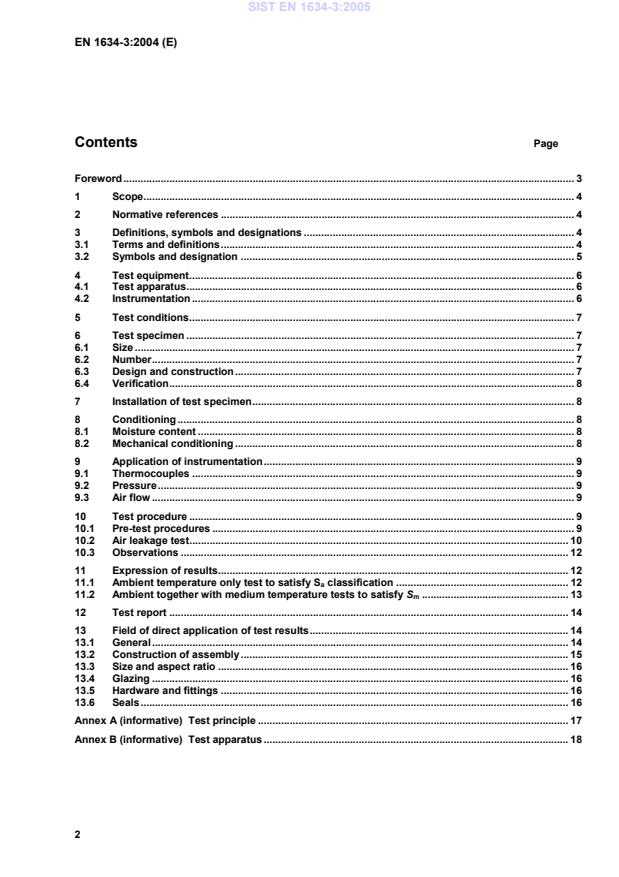
Contents Page
Foreword. 3
1 Scope. 4
2 Normative references . 4
3 Definitions, symbols and designations . 4
3.1 Terms and definitions. 4
3.2 Symbols and designation . 5
4 Test equipment. 6
4.1 Test apparatus. 6
4.2 Instrumentation . 6
5 Test conditions. 7
6 Test specimen . 7
6.1 Size . 7
6.2 Number. 7
6.3 Design and construction. 7
6.4 Verification. 8
7 Installation of test specimen. 8
8 Conditioning . 8
8.1 Moisture content . 8
8.2 Mechanical conditioning . 8
9 Application of instrumentation. 9
9.1 Thermocouples . 9
9.2 Pressure. 9
9.3 Air flow . 9
10 Test procedure . 9
10.1 Pre-test procedures . 9
10.2 Air leakage test. 10
10.3 Observations . 12
11 Expression of results. 12
11.1 Ambient temperature only test to satisfy S classification . 12
a
11.2 Ambient together with medium temperature tests to satisfy S . 13
m
12 Test report . 14
13 Field of direct application of test results. 14
13.1 General. 14
13.2 Construction of assembly. 15
13.3 Size and aspect ratio . 16
13.4 Glazing . 16
13.5 Hardware and fittings . 16
13.6 Seals. 16
Annex A (informative) Test principle . 17
Annex B (informative) Test apparatus . 18
Foreword
This document (EN 1634-3:2004) has been prepared by Technical Committee CEN/TC 127 “Fire
Safety in Buildings”, the secretariat of which is held by BSI.
This European Standard shall be given the status of a national standard, either by publication of an
identical text or by endorsement, at the latest by April 2005, and conflicting national standards shall
be withdrawn at the latest by April 2005.
This document has been prepared under mandate given to CEN by the European Commission and
the European Free Trade Association, and supports essential requirements of the Construction
Products Directive.
This document supersedes EN 1634-3:2001.
EN 1634 ‘Fire resistance tests for door and shutter assemblies’ consists of the following:
Part 1: Fire doors and shutters,
Part 2: Fire door hardware - Building hardware for fire resisting doorsets and openable windows (in
course of preparation),
Part 3: Smoke control doors and shutters.
According to the CEN/CENELEC Internal Regulations, the national standards organizations of the
following countries are bound to implement this European Standard: Austria, Belgium, Cyprus, Czech
Republic, Denmark, Estonia, Finland, France, Germany, Greece, Hungary, Iceland, Ireland, Italy,
Latvia, Lithuania, Luxembourg, Malta, Netherlands, Norway, Poland, Portugal, Slovakia, Slovenia,
Spain, Sweden, Switzerland and United Kingdom.
Caution
The attention of all persons concerned with managing and carrying out this test is drawn to the
following. Mechanical and operation hazards may arise during the construction of the test elements or
structures, their testing and disposal of test residues. An assessment of all potential hazards and risks
to health should be made and safety precautions should be identified and provided. Written safety
instructions should be issued. Appropriate training should be given to relevant personnel.
Laboratory personnel should ensure that they follow written safety instructions at all times.
1 Scope
This Part of EN 1634 specifies a method for determining the leakage of cold and warm smoke from
one side of a door assembly to the other under the specified test conditions. The test can be applied
to door and shutter assemblies of different types intended for purposes of controlling the passage of
smoke in case of fire. This test can also be applied to lift landing doors and conveyor system doors
and shutters. The principle of the test is explained briefly in annex A.
2 Normative references
The following referenced documents are indispensable for the application of this document. For dated
references, only the edition cited applies. For undated references, the latest edition of the referenced
document (including any amendments) applies.
EN 1363-1:1999, Fire resistance tests — Part 1: General requirements
EN 1634-1:2000, Fire resistance tests for door and shutter assemblies — Part 1: Fire doors and
shutters
EN 13501-2:2003, Fire classification of construction products and building elements — Part 2:
Classification using data from fire resistance tests, excluding ventilation services
prEN 14600, Fire resisting and/or smoke control doorsets and operable windows - Requirements and
classification
EN ISO 13943:2000, Fire safety — Vocabulary (ISO 13943:2000)
3 Definitions, symbols and designations
3.1 Terms and definitions
For the purposes of this document, the terms and definitions given in EN 1363-1:1999, EN 1634-
1:2000 and EN ISO 13943:2000, together with the following, apply:
3.1.1
smoke control door
door assembly which has the function of restricting the passage of smoke, when in a closed position,
to prescribed limits
3.1.2
ambient temperature
for the purpose of this standard ambient temperature is an air temperature of (20 ± 10) °C
3.1.3
medium temperature
for the purpose of this standard medium temperature is an air temperature of (200 ± 20) °C
3.1.4
smoke leakage Sa
ambient temperature smoke leakage classification as defined in 7.5.6.3.1 of EN 13501-2:2003
3.1.5
smoke leakage Sm
o
ambient plus medium temperature (200 C) smoke leakage classification as defined in 7.5.6.3.1 of
EN 13501-2:2003
3.1.6
test specimen
door or shutter assembly on which leakage measurements are to be made. It includes all the
components necessary for the use of the door when installed in a building e.g. side panels and over
panels
3.1.7
associated construction
specific form of construction in which the test specimen is mounted which is identical to that into which
the door or shutter assembly is designed to be installed in practice. The method of sealing the joint
between the test specimen and the associated construction is specific to that construction and forms
part of the construction being evaluated by the test
3.1.8
supporting construction
form of construction with adequate strength and stiffness which is used to support the test specimen
and to fill up the difference between the size of the test specimen and the opening in the test frame in
an impermeable manner. The seal between the test specimen and the supporting construction should
be impermeable and withstand the test temperature and is part of the test. The test frame may be
considered to be part of the supporting construction
3.1.9
test specimen leakage rate Q
spec
leakage through the test specimen (3.1.6) and seal between that and the test frame or any
supporting/associated construction used
3.1.10
test specimen linear leakage rate Q
l
leakage rate through the test specimen (3.1.6) and seal between and the test frame or any
supporting/associated construction used, excluding any leakage at the threshold, expressed in terms
of loss per linear metre of the perimeter bounded by the door frame when excluding the length of the
threshold
3.1.11
aspect ratio
fixed relationship of width divided by height of a four sided constructional component
3.2 Symbols and designation
The symbols and designation listed below define those used in this standard.
Symbol Unit Designation
Q m/h leakage rate
Q m /h apparatus leakage rate
app
Q m /h supporting/associated construction leakage rate
sup/assoc
Q m /h test specimen leakage rate
spec
Q m /h total leakage rate
t
Q m /h/m linear leakage rate
l
4 Test equipment
4.1 Test apparatus
The test apparatus consists of a test chamber with an open front where the test construction is
mounted to provide a sealed enclosure. The opening of the test frame shall be sufficient to
accommodate the test specimen with its associated or supporting construction, in general an opening
of 3 m × 3 m is sufficient for most door types.
A fan system is used to create the pressure differential and, for testing to evaluate S , a heating
m
system is used to generate the temperatures specified in clause 5. The fan and the heating system
shall be able to replace air at ambient and medium temperature, as required, in order to compensate
for leakage rates through the test assembly.
Annex B provides an outline specification for a suitable apparatus but other designs are possible to
achieve the same objectives.
4.2 Instrumentation
4.2.1 Air temperature
All thermocouples for the measurement of air temperature shall be of bare metal type with a wire
diameter of 0,5 mm or steel sheathed type with the overall diameter not exceeding 1,0 mm.
For ambient temperature only leakage evaluation test to satisfy S , the temperature measuring
a
o o
equipment shall be capable of measuring temperatures up to 50 C with an accuracy of ± 4 C.
For ambient together with medium temperature leakage evaluation test to satisfy S , the temperature
m
measuring equipment shall be capable of measuring temperatures up to 250 °C with an accuracy of
± 5 °C.
4.2.2 Pressure
A suitable instrument shall be provided to measure the static pressure difference between the inside
and outside of the test chamber. The pressure measuring equipment shall be capable of measuring
pressures with an accuracy of 10 % of the measured value.
4.2.3 Air flow
Instrumentation shall be provided to measure the volume, Q , and the temperature of air supplied to or
t
extracted from the apparatus to compensate for the total leakage. The apparatus shall be able to
3 3
measure leakage up to at least 55 m /h to an accuracy of 1 m /h.
5 Test conditions
A fan system shall be provided to create a pressure differential across the test specimen of at least
55 Pa.
When testing for ambient together with medium temperature leakage, s , provision shall be made to
m
heat the circulating air to the test temperature of (200 ± 20) °C within the test duration and to control
the temperature within the prescribed limits given in 10.2.2.2.
The test chamber shall be well sealed and the apparatus leakage rate together with the leakage rate
through an associated/supporting construction (Q + Q ) shall not exceed 10 m /h at 50 Pa
app sup/assoc
and ambient temperature.
6 Test specimen
6.1 Size
The test specimen and all its components shall be full size unless limited by the size of the front
opening of the test apparatus, which will normally be 3 m × 3 m. Door assemblies which cannot be
tested at full size shall be tested to the maximum size possible consistent with the use of supporting
or associated constructions. If an associated construction is used, a minimum zone shall be exposed
within the chamber, 200 mm wide each side and over the top of the aperture, into which the door
assembly is to be fixed.
6.2 Number
Leakage tests shall be carried out from both sides for full evaluation except for doors for special
applications. The number of tests shall be as given in Table 1.
Table 1 — Number of tests
Application Temperature Number of tests
One test for each side: the same door may be
used by either reversing the sample or by creating
General Ambient
under-pressure in the test chamber
One test for each side: a separate specimen is
General Medium
required in each case
Special Ambient/medium One test from the specified side
6.3 Design and construction
Test specimen construction and finish shall be fully representative of that intended to be used in
practice. Any seal used in the door or between the door assembly and the associated construction
shall be identical to that intended for application in practice.
6.4 Verification
Where practicable, the size, thickness and material specification of the door assembly shall be
determined before the test to check the construction of the door against the manufacturer’s
specification and to allow adequate description of the tested assembly.
All gaps through which smoke can leak shall be measured and recorded. Generally these are gaps
between the edge of the door leaf/leaves and the door frame, between door leaves and at sill level.
When testing for ambient temperature only leakage to satisfy S classification, the gap between the
a
bottom of the door and the sill level may be tightly sealed with an impermeable material.
A full description shall be given of the conditions prevailing at each edge of the door leaf/leaves and
the presence and the nature of any seals.
7 Installation of test specimen
The test specimen shall be mounted as in practice, in an associated or supporting construction, in
accordance with the manufacturer's instructions, with appropriate gaps and clearances between the
fixed and moveable parts.
All gaps between the supporting or associated construction and test frame shall be tightly sealed with
an impermeable material.
8 Conditioning
8.1 Moisture content
The test construction shall be conditioned in accordance with EN 1363-1. Door assemblies made
entirely of non-hygroscopic materials, e.g. metal or glass, shall be left in the laboratory for at least
three days before testing. Any additional conditioning requirements in the relevant product standard
shall also be observed.
8.2 Mechanical conditioning
For details of the requirements on mechanical testing conditioning of the test specimen before smoke
leakage testing e.g. operational test or self closing test refer to the requirement and classification
standard prEN 14600.
Durability requirements are given in the relevant product standard.
9 Application of instrumentation
9.1 Thermocouples
For the ambient temperature only test to evaluate S , two thermocouples shall be used to monitor the
a
temperature in the chamber. These shall be equally spaced across the chamber at mid-height of the
test speci
...