

FprCEN/TS 18443-3
(Main)Instrumental Odour Monitoring Systems (IOMS) - Part 3: Field validation
- Abstract
This document specifies requirements for instrumental odour monitoring systems for the monitoring of odour in ambient air and in emissions to ambient air.
This document is intended to assess the suitability of IOMS to generate relevant indicators for the presence and attributes of odour as would be perceived by human observers. A benefit of instrumental odour monitoring systems is that they can be used for continuous measurement.
Odour monitoring systems are typically limited in their ability to mimic human olfaction and its very specific sensitivity to a large number of odorants.
Odour monitoring systems currently give results limited to a reduced number of substances, that can help to estimate potential odorant impact.
In most applications, many compounds (e.g. non odorous compounds or background odorants) act as interferents for IOMS. Humidity and temperature are common interferences, too. Addictionally, some odorants that influence odour perception can be at low concentrations. This can lead to false results.
The metrological performance of IOMS and the validation of correlation of the measurement result (odour metric which is output of IOMS) with human odour perception are therefore key topics in this document.
This document is part 3 of a series of 3 standards, consisting of 2 EN's and 1 CEN/TS.
The three parts are:
• prEN xxxxx-1 "Instrumental Odour Monitoring Systems (IOMS) - Part 1: Definitions and general aspects"
• prEN xxxxx-2 "Instrumental Odour Monitoring Systems (IOMS) - Part 2: Technical specifications and QA/QC requirements"
• prCEN/TS xxxxx-3 "Instrumental Odour Monitoring Systems (IOMS) - Part 3: Field validation"
This document is applicable to instrumental odour monitoring in:
1) ambient air;
2) ambient air at the fence line of the source installation;
3) odorous gas emissions, including waste gases upstream of odorant abatement devices
This document is not applicable to:
a) Determination of the odour concentration in ouE/m3, for which the reference method is specified
in EN 13725. This document is not aimed to demonstrate the equivalency between the determination of odour concentration using a IOMS and the method described in EN 13725;
b) direct monitoring of hedonic tone (or pleasantness or unpleasantness) even if a qualitative data (attributes) can be supplied by a trained IOMS;
c) direct assessment of odour annoyance;
d) the technical design of the odour monitoring system;
e) the monitoring of air quality for purposes of environmental health and safety
This part 3 is related to the criteria to be used to validate an IOMS in the field due to specific application.
- Status
- Not Published
- Publication Date
- 10-Mar-2027
- Technical Committee
- CEN/TC 264 - Air quality
- Drafting Committee
- CEN/TC 264/WG 41 - Electronic sensors for odorant monitoring
- Current Stage
- 5020 - Submission to Vote - Formal Approval
- Start Date
- 22-Oct-2026
- Due Date
- 03-Mar-2027
- Completion Date
- 22-Oct-2026

FprCEN/TS 18443-3 is a CEN draft Technical Specification on field validation of Instrumental Odour Monitoring Systems (IOMS). It specifies how to check whether an IOMS can produce odour indicators that are relevant to human odour perception in ambient air, at the fence line of a source installation, and in odorous gas emissions. The document is written for users who need to validate an IOMS for a specific field application, not to design the instrument itself.
What does FprCEN/TS 18443-3 specify?
FprCEN/TS 18443-3 specifies the field validation of IOMS for odour monitoring in ambient air, ambient air at the fence line of the source installation, and odorous gas emissions, including waste gases upstream of odorant abatement devices. It is part 3 of a three-part series on IOMS.
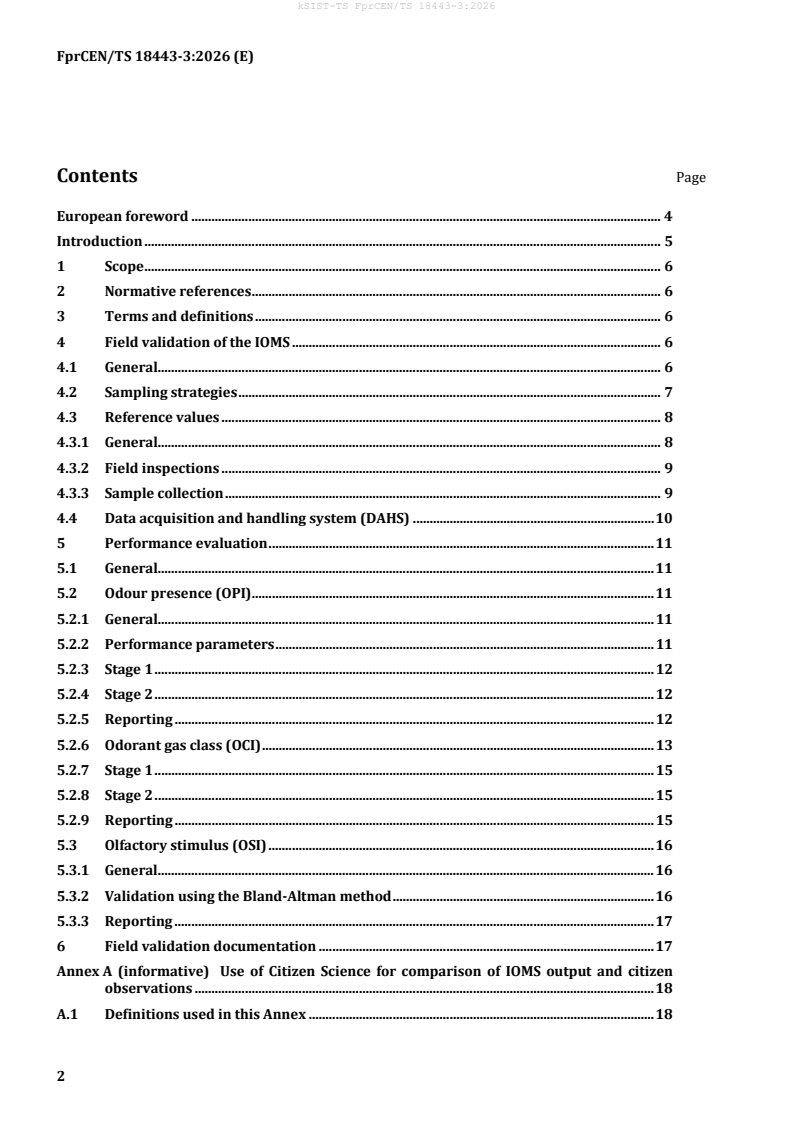
The document is organized around scope, normative references, terms and definitions, field validation, performance evaluation, and validation documentation. It also includes one informative annex on Citizen Science.
| Annex | What it covers |
|---|---|
| Annex A | Use of Citizen Science to compare IOMS output with citizen observations, including statistical tools and plausibility checks |
FprCEN/TS 18443-3 is not aimed at direct determination of odour concentration in ouE/m3 by the EN 13725 reference method, direct monitoring of hedonic tone, direct assessment of odour annoyance, technical design of the monitoring system, or environmental health and safety air monitoring. In practice, that means the document is for validating an odour-monitoring application, not for replacing olfactometry or for turning an IOMS into a general air-quality instrument.
What are the key requirements of FprCEN/TS 18443-3?
FprCEN/TS 18443-3 centers on proving, in the intended field context, that the odour metric produced by an IOMS meets specified metrological requirements. The main emphasis is on matching IOMS output with reference values under realistic site conditions, including weather and background changes.
- Clause 4.1 says validation must provide objective evidence for unattended operation in the intended context of application and within the rated operating condition of the IOMS. In practice, the validation protocol has to match the real task, site, and operating range.
- Clause 4.2 requires a sampling schedule that represents external influence quantities, background matrix changes, and time variation in emissions. This matters because an IOMS may behave differently in different humidity, temperature, or odour-background conditions, so the dataset has to cover those variations.
- Clause 4.3 requires reference values that are suitable for the metric under test. For odour presence and odorant gas class, the document allows field inspection methods and qualified assessor-based samples; for olfactory stimulus, it uses odorous gas samples with odour concentration determined by EN 13725.
- Clause 4.3.2 requires field inspections to be aligned in time and position with the IOMS reading, and it requires plausibility checks using wind direction. In practice, the validation record has to tie the human observation and the instrument output to the same event and location.
- Clause 4.3.3 sets the rules for sample collection. Depending on the application, samples may be taken at the emission source, at the fence line, or at the ambient/receptor site, then diluted to a concentration representative of the validation interval. This matters because the sample has to stay relevant to the actual monitoring scenario.
- Clause 4.4 states that validation of the data acquisition and handling system (DAHS) is covered by Part 2 of the series. So field validation in Part 3 assumes the data handling side is addressed elsewhere.
- Clause 5.2 defines the evaluation of the odour presence indicator (OPI). It uses sensitivity and specificity, a minimum of 15 validation records, and at least 5 samples with no odour. The procedure then applies a two-stage test using Fisher’s exact test and a binomial test to check both randomness and the performance claim.
- Clause 5.2.6 defines the odorant gas class indicator (OCI) evaluation. It requires at least 96 records for each class, aims for balanced class data where possible, uses sensitivity and specificity, and applies Wilson score confidence intervals. In practice, OCI validation is class-by-class, not just one overall score.
- Clause 5.3 defines the olfactory stimulus indicator (OSI) evaluation. It uses the ratio between OSI and reference odour concentration, converts the analysis to the logarithmic domain, and applies the Bland-Altman method. This gives bias and limits of agreement, which show how close the IOMS output is to the reference concentration across the measurement range.
- Clause 6 requires a validation report with the scope, validation intervals, experimental design, sample preparation, number of datasets, results, confusion matrices, simplifications, and any deviation from the document. That report is the main record an auditor or buyer would review.
What terms does FprCEN/TS 18443-3 define?
FprCEN/TS 18443-3 uses the terms from prEN 18443-1, and several key abbreviations are central to the validation procedure.
- IOMS - Instrumental Odour Monitoring System, the instrumented system being validated for odour monitoring.
- OPI - odour presence indicator, the output that shows whether the odour under study is present or absent.
- OCI - odorant gas class indicator, the output that classifies the odorous gas sample into an odorant gas class.
- OSI - olfactory stimulus indicator, the output compared with reference odour concentration in the OSI validation procedure.
- DAHS - data acquisition and handling system, the part of the system that captures, handles, and stores measurement data.
- Validation interval - the operating range and conditions over which the validation claim is checked.
- APCON - Activity Potentially Causing Odour Nuisance, the kind of odour-emitting activity discussed in Annex A.
- Citizen Science (CS) - active public participation in data collection and analysis, used in Annex A for comparison with IOMS output.
Who uses FprCEN/TS 18443-3?
FprCEN/TS 18443-3 is used by people who validate, operate, or assess odour-monitoring systems in the field. Typical users include IOMS manufacturers, test laboratories, environmental consultants, plant operators, and public or private organizations managing odour-sensitive sites.
It is especially relevant for ambient-air monitoring, fence-line monitoring, and monitoring of odorous emissions from industrial or waste-related sources. In practice, users apply it when they need to plan a validation campaign, choose reference methods, document performance claims, and demonstrate that an IOMS output is meaningful for the intended odour task.
Which standards are used with FprCEN/TS 18443-3?
- EN 13725 - provides the reference method for odour concentration by dynamic olfactometry and odour emission rate, and it is the basis for OSI reference values.
- EN 16841-1 - provides the grid method for field inspection of odour in ambient air, used as a reference path for odour presence.
- EN 16841-2 - provides the plume method for field inspection of odour in ambient air, and it supports plausibility checks based on wind direction.
- prEN 18443-1 - provides the definitions and general aspects for the IOMS series, including the terms used throughout Part 3.
- prEN 18443-2 - is the companion part for technical specifications and QA/QC requirements, and it covers DAHS validation referred to in Part 3.
What does the FprCEN/TS 18443-3 document contain?
FprCEN/TS 18443-3 contains the field-validation framework, the sampling rules, the reference-value approaches, and separate evaluation procedures for OPI, OCI, and OSI. It also contains the reporting items needed to document a validation campaign.
The technical core includes confusion-matrix based checks for presence and class outputs, Fisher’s exact test, binomial testing, Wilson score confidence intervals, and Bland-Altman analysis in the logarithmic domain. These are the methods used to turn paired field records into performance evidence.
The document also contains an informative Annex A on Citizen Science. Annex A discusses comparison of IOMS output with citizen observations, use of UNE 77270, chi-square testing, and analysis of unbalanced data with a zero-inflated negative binomial model.
Frequently Asked Questions
FprCEN/TS 18443-3 is a draft published by the European Committee for Standardization (CEN). Its full title is "Instrumental Odour Monitoring Systems (IOMS) - Part 3: Field validation". This standard covers: This document specifies requirements for instrumental odour monitoring systems for the monitoring of odour in ambient air and in emissions to ambient air. This document is intended to assess the suitability of IOMS to generate relevant indicators for the presence and attributes of odour as would be perceived by human observers. A benefit of instrumental odour monitoring systems is that they can be used for continuous measurement. Odour monitoring systems are typically limited in their ability to mimic human olfaction and its very specific sensitivity to a large number of odorants. Odour monitoring systems currently give results limited to a reduced number of substances, that can help to estimate potential odorant impact. In most applications, many compounds (e.g. non odorous compounds or background odorants) act as interferents for IOMS. Humidity and temperature are common interferences, too. Addictionally, some odorants that influence odour perception can be at low concentrations. This can lead to false results. The metrological performance of IOMS and the validation of correlation of the measurement result (odour metric which is output of IOMS) with human odour perception are therefore key topics in this document. This document is part 3 of a series of 3 standards, consisting of 2 EN's and 1 CEN/TS. The three parts are: • prEN xxxxx-1 "Instrumental Odour Monitoring Systems (IOMS) - Part 1: Definitions and general aspects" • prEN xxxxx-2 "Instrumental Odour Monitoring Systems (IOMS) - Part 2: Technical specifications and QA/QC requirements" • prCEN/TS xxxxx-3 "Instrumental Odour Monitoring Systems (IOMS) - Part 3: Field validation" This document is applicable to instrumental odour monitoring in: 1) ambient air; 2) ambient air at the fence line of the source installation; 3) odorous gas emissions, including waste gases upstream of odorant abatement devices This document is not applicable to: a) Determination of the odour concentration in ouE/m3, for which the reference method is specified in EN 13725. This document is not aimed to demonstrate the equivalency between the determination of odour concentration using a IOMS and the method described in EN 13725; b) direct monitoring of hedonic tone (or pleasantness or unpleasantness) even if a qualitative data (attributes) can be supplied by a trained IOMS; c) direct assessment of odour annoyance; d) the technical design of the odour monitoring system; e) the monitoring of air quality for purposes of environmental health and safety This part 3 is related to the criteria to be used to validate an IOMS in the field due to specific application.
This document specifies requirements for instrumental odour monitoring systems for the monitoring of odour in ambient air and in emissions to ambient air. This document is intended to assess the suitability of IOMS to generate relevant indicators for the presence and attributes of odour as would be perceived by human observers. A benefit of instrumental odour monitoring systems is that they can be used for continuous measurement. Odour monitoring systems are typically limited in their ability to mimic human olfaction and its very specific sensitivity to a large number of odorants. Odour monitoring systems currently give results limited to a reduced number of substances, that can help to estimate potential odorant impact. In most applications, many compounds (e.g. non odorous compounds or background odorants) act as interferents for IOMS. Humidity and temperature are common interferences, too. Addictionally, some odorants that influence odour perception can be at low concentrations. This can lead to false results. The metrological performance of IOMS and the validation of correlation of the measurement result (odour metric which is output of IOMS) with human odour perception are therefore key topics in this document. This document is part 3 of a series of 3 standards, consisting of 2 EN's and 1 CEN/TS. The three parts are: • prEN xxxxx-1 "Instrumental Odour Monitoring Systems (IOMS) - Part 1: Definitions and general aspects" • prEN xxxxx-2 "Instrumental Odour Monitoring Systems (IOMS) - Part 2: Technical specifications and QA/QC requirements" • prCEN/TS xxxxx-3 "Instrumental Odour Monitoring Systems (IOMS) - Part 3: Field validation" This document is applicable to instrumental odour monitoring in: 1) ambient air; 2) ambient air at the fence line of the source installation; 3) odorous gas emissions, including waste gases upstream of odorant abatement devices This document is not applicable to: a) Determination of the odour concentration in ouE/m3, for which the reference method is specified in EN 13725. This document is not aimed to demonstrate the equivalency between the determination of odour concentration using a IOMS and the method described in EN 13725; b) direct monitoring of hedonic tone (or pleasantness or unpleasantness) even if a qualitative data (attributes) can be supplied by a trained IOMS; c) direct assessment of odour annoyance; d) the technical design of the odour monitoring system; e) the monitoring of air quality for purposes of environmental health and safety This part 3 is related to the criteria to be used to validate an IOMS in the field due to specific application.
FprCEN/TS 18443-3 is available in PDF format for immediate download after purchase. The document can be added to your cart and obtained through the secure checkout process. Digital delivery ensures instant access to the complete standard document.
Standards Content (Sample)
SLOVENSKI STANDARD
01-december-2026
Instrumentalni sistemi za monitoring vonjav (IOMS) - 3. del: Validacija na terenu
Instrumental Odour Monitoring Systems (IOMS) - Part 3: Field validation
Instrumentelle Geruchsüberwachungssysteme (IOMS) - Teil 3: Feldvalidierung
Ta slovenski standard je istoveten z: FprCEN/TS 18443-3
ICS:
13.040.20 Kakovost okoljskega zraka Ambient atmospheres
2003-01.Slovenski inštitut za standardizacijo. Razmnoževanje celote ali delov tega standarda ni dovoljeno.
FINAL DRAFT
TECHNICAL SPECIFICATION
SPÉCIFICATION TECHNIQUE
TECHNISCHE SPEZIFIKATION
October 2026
ICS
English Version
Instrumental Odour Monitoring Systems (IOMS) - Part 3:
Field validation
Instrumentelle Geruchsüberwachungssysteme (IOMS)
- Teil 3: Feldvalidierung
This draft Technical Specification is submitted to CEN members for Vote. It has been drawn up by the Technical Committee
CEN/TC 264.
CEN members are the national standards bodies of Austria, Belgium, Bulgaria, Croatia, Cyprus, Czech Republic, Denmark, Estonia,
Finland, France, Germany, Greece, Hungary, Iceland, Ireland, Italy, Latvia, Lithuania, Luxembourg, Malta, Netherlands, Norway,
Poland, Portugal, Republic of North Macedonia, Romania, Serbia, Slovakia, Slovenia, Spain, Sweden, Switzerland, Türkiye and
United Kingdom.
Recipients of this draft are invited to submit, with their comments, notification of any relevant patent rights of which they are
aware and to provide supporting documentation.
Warning : This document is not a Technical Specification. It is distributed for review and comments. It is subject to change
without notice and shall not be referred to as a Technical Specification.
EUROPEAN COMMITTEE FOR STANDARDIZATION
COMITÉ EUROPÉEN DE NORMALISATION
EUROPÄISCHES KOMITEE FÜR NORMUNG
CEN-CENELEC Management Centre: Rue de la Science 23, B-1040 Brussels
© 2026 CEN All rights of exploitation in any form and by any means reserved Ref. No. FprCEN/TS 18443-3:2026 E
worldwide for CEN national Members.
Contents Page
European foreword . 4
Introduction . 5
1 Scope . 6
2 Normative references . 6
3 Terms and definitions . 6
4 Field validation of the IOMS . 6
4.1 General. 6
4.2 Sampling strategies . 7
4.3 Reference values . 8
4.3.1 General. 8
4.3.2 Field inspections . 9
4.3.3 Sample collection . 9
4.4 Data acquisition and handling system (DAHS) . 10
5 Performance evaluation . 11
5.1 General. 11
5.2 Odour presence (OPI) . 11
5.2.1 General. 11
5.2.2 Performance parameters . 11
5.2.3 Stage 1 . 12
5.2.4 Stage 2 . 12
5.2.5 Reporting . 12
5.2.6 Odorant gas class (OCI) . 13
5.2.7 Stage 1 . 15
5.2.8 Stage 2 . 15
5.2.9 Reporting . 15
5.3 Olfactory stimulus (OSI) . 16
5.3.1 General. 16
5.3.2 Validation using the Bland-Altman method . 16
5.3.3 Reporting . 17
6 Field validation documentation . 17
Annex A (informative) Use of Citizen Science for comparison of IOMS output and citizen
observations . 18
A.1 Definitions used in this Annex . 18
A.2 General . 18
A.3 UNE 77270 . 19
A.3.1 General . 19
A.3.2 Chi-square Statistical Test . 20
A.4 Analysis of unbalanced data with a predominance of absences. 21
A.4.1 General . 21
A.4.2 Zero-Inflated Negative Binomial Model (ZINB) . 22
Bibliography . 23
European foreword
This document (FprCEN/TS 18443-3:2026) has been prepared by Technical Committee CEN/TC 264 “Air
Quality”, the secretariat of which is held by DIN.
This document is currently submitted to the Vote on TS.
Introduction
This series of documents specifies requirements for instrumental odour monitoring systems for the
monitoring of odour in ambient air and in emissions to ambient air.
This series of documents is intended to assess the suitability of Instrumental Odour Monitoring System
(IOMS) to generate relevant indicators for the presence and attributes of odour as would be perceived by
human observers. A benefit of instrumental odour monitoring systems is that they can be used for
continuous measurement.
Instruments are limited in their ability to mimic human olfaction and its very specific sensitivity to
hundreds of odorants. Some odorants influence human odour perception even at very low
concentrations. The relation between the concentrations of odorants in a gas mixture and the resulting
human perception is highly complex and is never completely known. Instruments currently give results
limited to a reduced number of substances and are not able to replicate exactly that relation. In most
applications, many compounds (e.g. non odorous compounds or background odorants) act as interferents
for IOMS. Humidity and temperature are common influence quantities, too.
Key topics in this series of document are the qualification of metrological performance of IOMS and the
validation of correlation of the measurement result (odour metric which is output of IOMS) with human
odour perception.
The qualification of metrological performance of IOMS and the validation of the outputted odour metric
have significant peculiarities with respect to other automated measuring instruments:
— since odour presence/absence indicators and odorant gas class indicators are categorical indicators,
the performance characteristics specified in available standards about automated measuring
instruments are not suitable.
— the reference methods to validate the odour metric outputted by IOMS are based on human panels
and therefore have measurement uncertainties which are not generally negligible in the elaboration
of measurement results to obtain performance characteristics.
This series of documents does not apply to:
a) direct determination of the odour concentration in ou /m , for which the reference method is
E
specified in EN 13725. This document is not aimed to demonstrate the equivalency between the
determination of odour concentration using a IOMS and the method described in EN 13725 and
letting an IOMS to implement an alternative method to EN 13725
b) direct monitoring of hedonic tone (or pleasantness or unpleasantness) even if a qualitative data
(attributes) can be supplied by a trained IOMS
c) direct assessment of odour annoyance
d) the technical design of the odour monitoring system
e) the monitoring of air quality for purposes of environmental health and safety
This series of documents comprises three parts:
— Instrumental Odour Monitoring Systems (IOMS). Part 1: Definitions and general aspects
— Instrumental Odour Monitoring Systems (IOMS). Part 2: Technical specifications and QA/QC
requirements
— Instrumental Odour Monitoring Systems (IOMS). Part 3: Field validation
1 Scope
This document specifies and covers field validation relating to instrumental odour monitoring systems
(IOMS) in:
1) ambient air
2) ambient air at the fence line of the source installation
3) odorous gas emissions, including waste gases upstream of odorant abatement devices.
This document does not apply to:
a) demonstrate equivalence between the determination of olfactory stimulus quantity using an IOMS
and the method described in EN 13725 and implement an alternative method to EN 13725
b) validate an IOMS as an instrument for measuring odour annoyance or hedonic tone
c) validate an IOMS as an instrument for health and safety air monitoring.
2 Normative references
The following documents are referred to in the text in such a way that some or all of their content
constitutes requirements of this document. For dated references, only the edition cited applies. For
undated references, the latest edition of the referenced document (including any amendments) applies.
EN 13725, Stationary source emissions — Determination of odour concentration by dynamic olfactometry
and odour emission rate
EN 16841-1, Ambient air — Determination of odour in ambient air by using field inspection — Part 1: Grid
method
EN 16841-2, Ambient air — Determination of odour in ambient air by using field inspection — Part 2: Plume
method
prEN 18443-1, Instrumental Odour Monitoring Systems (IOMS) - Part 1: Definitions and general aspects
3 Terms and definitions
For the purposes of this document, the terms and definitions given in prEN 18443-1 apply.
ISO and IEC maintain terminology databases for use in standardization at the following addresses:
- ISO Online browsing platform: available at https://www.iso.org/obp/
- IEC Electropedia: available at https://www.electropedia.org/
4 Field validation of the IOMS
4.1 General
The aim of the validation of instrumental odour monitoring systems (IOMS) is to provide objective
evidence that, in the intended context of application (i.e. in the field) and in unattended operation, the
odour metric produced by the IOMS, compared to reference values, fulfils specified metrological
requirements.
The performance requirements indicate the correlations of indicators derived from an instrumental
odour monitoring system to values obtained by reference methods, which are based on human olfaction.
This document does not address the training of IOMS. When the validation process of the IOMS starts, it
is assumed that it is trained and ready for use for a measurement task in the specific context of
application, within its rated operating condition.
Performance claims, in order to be verified in the validation process, shall be accompanied by the
validation protocol
The validation interval(s) shall be within the rated operating condition of the IOMS.
Validation process shall cover atmospheric conditions (e.g. temperature, humidity) and variations in the
background matrix in the sampled air.
In accordance with prEN 18443-2, an IOMS is intended to produces one or more of the following odour
metrics:
a) odour presence indicator
b) odorant gas class indicator
c) olfactory stimulus indicator
Requirements for validation are specific for each context of application, which are:
1. odour monitoring of the odour(s) under study in ambient air at receptor level
2. odour monitoring of the odour(s) under study in ambient air at fence line
3. odour monitoring of the odour(s) under study in channelled/stack emissions and workplace air
Validation process covers the following topics:
• Comparison between values produced by the IOMS and reference produced by reference methods
listed in prEN 18443-2:2026, Annex A.
• Determination of the validation intervals.
• Assessment of the validity time and of the need to repeat the validation process
• Definition of the dataset required to attain the wanted uncertainty of the validation results,
• Determination of the performance characteristics, according to the validation protocol.
Validation protocol shall include each context of application, measurement task and combination of them
for which performance claims are specified.
4.2 Sampling strategies
To ensure representativeness of the validation, an appropriate validation protocol shall be defined, with
an associated sampling schedule, considering as much as possible:
• External influence quantities, e.g. temperature, relative humidity applicable to the specific site
• Periodic/typical variations of the odour emission producing the odour under study
• Interferent influence quantity, such as background matrix variations (e.g. due to other odour
emissions, environmental background odours, etc)
• Uncertainty and rated operating conditions specified with the performance claims.
This sampling schedule for the sampling protocol, which is specific to the context of application, requires
specific knowledge about the source, the IOMS and the context of application.
During validation process, a suitable number of validation records shall be generated based on the
sampling schedule within the validation protocol. The number of records shall be consistent with the
performance claim. A validation record shall contain a data pair of reference quantity value and IOMS
output metric and the meta data defining the boundaries of the validation interval.
The validation protocol shall include all expected variations of influence quantities. The sampling
schedule shall cover expected variations and combinations of the odour under study and the influence
quantities.
The sampling schedule shall account for different variations of the source emissions across different
times of day and seasonal emission changes and effects.
Some influence quantities cannot be manipulated experimentally for validation purposes: in this case
they shall be recorded and documented while carrying out the validation process. If the variations of
these influence quantities do not span the validation interval at the planned end of the validation process,
its prolongation can be necessary.
4.3 Reference values
4.3.1 General
4.3.1.1 Introduction
Use of human panel is allowed only when there is not any safety issue with the chemical contents (e.g.
cancerogenic compounds) in the air analysed.
Prior analytical composition of the flue gases if advisable to avoid danger.
4.3.1.2 Odour presence
The reference value for odour presence indicator and the odorant gas class indicator shall be obtained
using one or both of the following methods:
• a reference value for presence of the odour under study using the method for field inspection as
described in EN 16841 (all parts);
• a reference value for the presence of odour under study, obtained by presenting an odorant gas
sample to one assessor, qualified according to EN13725. The sample is created by diluting a known
concentration of the odour under study, taken from the emission source, with non-odorous ambient
air to a concentration representative of the odour recognition threshold [2].
4.3.1.3 Olfactory stimulus
The reference value for the olfactory stimulus indicator shall be obtained using the following method:
• a reference value for the olfactory stimulus indicator of an odorous gas sample of the odour under
study, obtained by adding a known dilution of an odorous gas sample of the odours under study with
a known odour concentration, determined according to EN 13725, achieving an odour concentration
/m³ associated with presence of the odour under study.
in ouE
In the following subclauses 4.3.2 and 4.3.3 are presented details for each of these methods.
4.3.2 Field inspections
Reference values for validation records shall be obtained by carrying out field inspections with human
panel members in the field based on direct sniffing of ambient air, according to EN 16481 (all parts).
Measurement of the panel member(s) shall be performed ensuring that the timing of the measurements,
the position (place, height) of the panel member and the IOMS coincide.
It is required to review the plausibility of the reference value on the basis of the wind direction according
to EN16841-2, subclause 8.1.
The influence quantities which are relevant to defining the validation interval shall be recorded with each
validation record, as well as the variability of the odour under study implies considering variations in
odour composition from one source or considering multiple sources or a combination of both, depending
on the scope of the definition of odour under study.
4.3.3 Sample collection
4.3.3.1 General
Reference values for validation records shall be obtained by collecting samples of the odour under study
in the field. There are three options for bag sampling of the odour under study:
• For all application contexts: At the emission source
• For the fence line and ambient air at receptor site application contexts: At fence line, providing the
odour concentration is above the limit of quantification for olfactometry according to EN 13725
• For the ambient air at receptor site application context: At ambient/receptor site, providing the
odour concentration is above the limit of quantification for olfactometry according to EN 13725
For each option, the odour under study shall be present and continuous when collecting the bag sample.
The chemical composition of a gas sample can evolve differently in time in a bag sample compared to
transformations occurring during atmospheric transportation and such aspect shall be taken into
account.
The odour samples shall be diluted to adjust the odour concentration to a value which is representative
for the application. Odour concentrations used for the validation shall be reported in the field validation
documentation.
The odour samples collected at the emission source shall be diluted with a gas divider with an expanded
uncertainty of less than 10 % using ambient air collected at the site of the IOMS as neutral gas to adjust
the odour concentration to a value within the validation interval, as defined in the validation protocol.
Air used for dilution shall be assessed for non-presence of the odour under study by a panel member
according to clause 4.3.1.
For the ambient air application context, a dilution factor Z ≥ 10 shall be applied to samples collected at
the emission source, so that the background matrix of the receptor ambient air is not significantly
modified.
For the ambient air application context, if the odour concentration in the ambient air sample is above the
limit of quantification for odour concentration measurement, the receptor level sample may be directly
applied to the IOMS.
The validation protocol shall define a sampling schedule that ensures to represent the variability in the
composition of the odour under study. Taking into account the variability of the odour under study
implies considering variations in odour composition from one source or considering multiple sources or
a combination of both, depending on the scope of the definition of “odour under study”.
4.3.3.2 Odour presence (OPI)
Background measurements (OPI = 0 i.e. absence of the odour under study) shall be done when sample
bag spiking method is implemented:
• presenting receptor ambient air to the IOMS, which is assessed for the non-presence of the odour
under study by a panel member according to EN 16841-2
• presenting an odorant gas sample of receptor ambient air to the IOMS collected in a sample bag,
which has been assessed negatively for the presence of the odour under study by a panel member
according to EN 16841-2
• determining that the wind direction is outside the sector for the plausibility check as defined in
EN 16841-2:2016, subclause 8.1
4.3.3.3 Odorant gas class (OCI)
For each odorant gas class under study one defined odour concentration range shall be considered and
at least the lower and upper limit shall be presented to the IOMS to generate a validation record.
4.3.3.4 Olfactory stimulus quantity (OSI)
Reference values for validation records can be obtained by collecting odorous gas samples at the emission
source of the odour under study and analysing these samples for odour concentration by dynamic
olfactometry according to EN13725.
At least three replicates of dynamic olfactometry measurements shall be obtained. If the measurement
uncertainty of dynamic olfactometry needs to be reduced further for the purpose of the validation plan,
a larger number of replicates can be considered. The measurement uncertainty of replicate analyses can
be calculated by dividing the uncertainty of dynamic olfactometry for one odour concentration
measurement by the square root of the number of replicates.
Within the odour concentration range defined in the validation protocol, depending on the specific
application, at least the lower and upper limit shall be presented to the IOMS to generate validation
records.
NOTE In prEN 18443-1:2016, Annex B typical ranges of odour concentration are shown.
Odour concentrations positioned between the upper and lower limit of the validation interval shall be
included. An exponential progression is recommended, as for example 10, 30, 100, 300, 1000 ou /m³.
E
Multiple validation records can be generated from one odorous gas sample, applying different dilution
factors. The influence quantities which are relevant to defining the validation interval shall be recorded
with each validation record.
If the validation protocol considers the validation of the OSI with more then one odorant gas class (i.e.
the IOMS can produce different OSI values depending on the odorant gas class of the odorant gas sample),
the validation interval may depend on the odour gas class, as well.
4.4 Data acquisition and handling system (DAHS)
The data acquisition and handling system validation is covered by part 2 of this series of documents.
5 Performance evaluation
5.1 General
Performance evaluations under field conditions for the different measurement tasks are presented in the
following subclauses of clause 5.
Starting point for each validation process is an IOMS which is well trained for the monitoring task in the
respective context of application within the defined rated operating conditions.
5.2 Odour presence (OPI)
5.2.1 General
OPI validation shall be conducted to prove that the OPI produced by the IOMS, compared to reference
values, fulfils specified metrological requirements.
5.2.2 Performance parameters
Validation shall be based on a minimum of 15 data records provided.
Each validation record shall include at least:
• the reference value for the odour presence indicator
• the odour presence indicator value produced by the IOMS
• values for relevant external influence quantities, e.g. relative humidity, temperature
• time stamp
At least 5 samples containing the class ‘no odour’ shall be sampled.
The performance parameters are sensitivity and specificity. They are calculated according to scheme
shown in Table 1.
Table 1 — Confusion matrix for validation of the IOMS indicator value for odour presence
Reference value: Reference value: Total
Presence of the odour under Non-presence / other
study gas
IOMS output: TP + FP
True positive (TP) False positive (FP)
Presence
IOMS output: FN + TN
False negative (FN) True negative (TN)
Non-presence
Total TP+FN FP+TN TP+FN+FP+TN
Performance Sensitivity Specificity -
parameters = TP/(TP + FN) = TN/(FP + TN)
NOTE A target value of 80 % is generally considered satisfactory when the context of application is odour
monitoring of an emission. Other target values can be proposed for measurements at the fence line or in ambient
air.
The number of validation records used (15 minimum) shall in any case be sufficient in relation to the
specific performance claim; more validation records can be required.
Following evaluation of sensitivity and specificity, the procedure consists of a two-stage test. Validation
is successful if both stages are fulfilled.
5.2.3 Stage 1
Stage 1 is aimed to exclude randomness of detection by applying Fisher’s exact test with the following
parameters:
• Null hypothesis H0: “IOMS is a random generator“
• One-sided
• Significance level α = 0,05
To carry out the test, based on the validation records, the following probability shall be calculated as the
sum of all probabilities of the same and a higher number of correctly classified inputs than TP+TN:
𝑇𝑇/2
𝑇𝑇/2
� �� �
𝑁𝑁/2 𝑁𝑁/2
𝑗𝑗
𝑖𝑖
𝑃𝑃(𝑘𝑘≥𝑇𝑇𝑃𝑃 +𝑇𝑇𝑇𝑇) =� �
𝑇𝑇
𝑖𝑖=𝑇𝑇𝑇𝑇 𝑗𝑗=𝑇𝑇𝑇𝑇
� �
𝑖𝑖 +𝑗𝑗
where
𝑛𝑛!
𝑛𝑛
� � =
𝑘𝑘
( )
𝑘𝑘! 𝑛𝑛−𝑘𝑘 !
is the binomial coefficient.
If P < α = 0,05, the null hypothesis is accepted.
5.2.4 Stage 2
Stage 2 is aimed to confirm the performance claim by applying a binomial test with the following
parameters:
• Null hypothesis H0: „IOMS classifies correctly with a probability of at least p0“
• Significance level α = 0,05
To carry ou
...