

EN 521:2019
(Main)Specifications for dedicated liquefied petroleum gas appliances - Portable vapour pressure liquefied petroleum gas appliances
- Abstract
This document specifies the construction and performance characteristics related to safety and the rational use of energy of portable appliances burning liquefied petroleum gases at the vapour pressure within the gas cartridge or gas cylinder, excepting those where the gas cartridge is inserted horizontally in the chassis.
NOTE These appliances are referred to in the body of the text as "appliances".
This document applies to various types of portable appliances burning liquefied petroleum gases at vapour pressure and designed to be used with cartridges as complying with EN 417 or gas cylinders.
This document covers appliances for outdoor or in well ventilated areas uses only.
For example the following types of appliances are covered:
a) cooking appliances (stoves, grills, barbecues...);
This document does not cover barbecues that can be used indoors;
b) lighting appliances;
c) heating appliances;
This document only applies to appliances with a maximum heat input of up to 3 kW (Hs) for outdoor use only;
d) blowtorches;
This document only applies to blowtorches without a flexible hose;
e) laboratory burners.
The requirements apply to these appliances or their functional sections whether or not the latter are independent or incorporated into an assembly.
Appliances covered by this document are not connected to a flue for the discharge of products of combustion and are not connected to the mains electricity supply.
This document covers neither appliances supplied with LPG in the liquid phase nor appliance with fixed integral container which may or may not be refilled by the user
It does not apply to lighters as defined in EN ISO 9994.
It does not apply to gas appliances operating with a valve cartridge which is horizontally integrated into the chassis of the appliance also called "flat portable gas stove".
Requirements for rational use of energy have been included for stove burners.
However, such requirements have not been included for the other types of appliances because:
- for grills and barbecues, this is a type of cooking which is achieved by various means such as radiant elements; in addition this type of cooking varies according to the type of food and region where the appliance is used;
- for lighting appliances, the consumption is insignificant because these appliances have a very low rate and are used only for a few hours in a year;
- for heating appliances, all the heat produced is discharged into the environment;
- for tools such as blowtorches which are not professional tools in regular use, the gas consumption depends very much on the way it is used.
- Status
- Withdrawn
- Publication Date
- 02-Apr-2019
- Withdrawal Date
- 20-Oct-2026
- Technical Committee
- CEN/TC 181 - Dedicated liquified petroleum gas appliances
- Drafting Committee
- CEN/TC 181/WG 1 - Flueless space heaters
- Current Stage
- 9960 - Withdrawal effective - Withdrawal
- Start Date
- 07-Aug-2019
- Completion Date
- 21-Oct-2026



Relations
- Effective Date
- 24-Jun-2015
- Effective Date
- 16-Jan-2023
- Effective Date
- 28-Jan-2026
- Effective Date
- 28-Jan-2026
- Effective Date
- 28-Jan-2026
- Effective Date
- 28-Jan-2026
- Effective Date
- 28-Jan-2026
- Effective Date
- 28-Jan-2026
- Effective Date
- 28-Jan-2026
Get Certified
Connect with accredited certification bodies for this standard

DNV
DNV is an independent assurance and risk management provider.

Lloyd's Register
Lloyd's Register is a global professional services organisation specialising in engineering and technology.
DNV Energy Systems
Energy and renewable energy certification.
Sponsored listings
Frequently Asked Questions
EN 521:2019 is a standard published by the European Committee for Standardization (CEN). Its full title is "Specifications for dedicated liquefied petroleum gas appliances - Portable vapour pressure liquefied petroleum gas appliances". This standard covers: This document specifies the construction and performance characteristics related to safety and the rational use of energy of portable appliances burning liquefied petroleum gases at the vapour pressure within the gas cartridge or gas cylinder, excepting those where the gas cartridge is inserted horizontally in the chassis. NOTE These appliances are referred to in the body of the text as "appliances". This document applies to various types of portable appliances burning liquefied petroleum gases at vapour pressure and designed to be used with cartridges as complying with EN 417 or gas cylinders. This document covers appliances for outdoor or in well ventilated areas uses only. For example the following types of appliances are covered: a) cooking appliances (stoves, grills, barbecues...); This document does not cover barbecues that can be used indoors; b) lighting appliances; c) heating appliances; This document only applies to appliances with a maximum heat input of up to 3 kW (Hs) for outdoor use only; d) blowtorches; This document only applies to blowtorches without a flexible hose; e) laboratory burners. The requirements apply to these appliances or their functional sections whether or not the latter are independent or incorporated into an assembly. Appliances covered by this document are not connected to a flue for the discharge of products of combustion and are not connected to the mains electricity supply. This document covers neither appliances supplied with LPG in the liquid phase nor appliance with fixed integral container which may or may not be refilled by the user It does not apply to lighters as defined in EN ISO 9994. It does not apply to gas appliances operating with a valve cartridge which is horizontally integrated into the chassis of the appliance also called "flat portable gas stove". Requirements for rational use of energy have been included for stove burners. However, such requirements have not been included for the other types of appliances because: - for grills and barbecues, this is a type of cooking which is achieved by various means such as radiant elements; in addition this type of cooking varies according to the type of food and region where the appliance is used; - for lighting appliances, the consumption is insignificant because these appliances have a very low rate and are used only for a few hours in a year; - for heating appliances, all the heat produced is discharged into the environment; - for tools such as blowtorches which are not professional tools in regular use, the gas consumption depends very much on the way it is used.
This document specifies the construction and performance characteristics related to safety and the rational use of energy of portable appliances burning liquefied petroleum gases at the vapour pressure within the gas cartridge or gas cylinder, excepting those where the gas cartridge is inserted horizontally in the chassis. NOTE These appliances are referred to in the body of the text as "appliances". This document applies to various types of portable appliances burning liquefied petroleum gases at vapour pressure and designed to be used with cartridges as complying with EN 417 or gas cylinders. This document covers appliances for outdoor or in well ventilated areas uses only. For example the following types of appliances are covered: a) cooking appliances (stoves, grills, barbecues...); This document does not cover barbecues that can be used indoors; b) lighting appliances; c) heating appliances; This document only applies to appliances with a maximum heat input of up to 3 kW (Hs) for outdoor use only; d) blowtorches; This document only applies to blowtorches without a flexible hose; e) laboratory burners. The requirements apply to these appliances or their functional sections whether or not the latter are independent or incorporated into an assembly. Appliances covered by this document are not connected to a flue for the discharge of products of combustion and are not connected to the mains electricity supply. This document covers neither appliances supplied with LPG in the liquid phase nor appliance with fixed integral container which may or may not be refilled by the user It does not apply to lighters as defined in EN ISO 9994. It does not apply to gas appliances operating with a valve cartridge which is horizontally integrated into the chassis of the appliance also called "flat portable gas stove". Requirements for rational use of energy have been included for stove burners. However, such requirements have not been included for the other types of appliances because: - for grills and barbecues, this is a type of cooking which is achieved by various means such as radiant elements; in addition this type of cooking varies according to the type of food and region where the appliance is used; - for lighting appliances, the consumption is insignificant because these appliances have a very low rate and are used only for a few hours in a year; - for heating appliances, all the heat produced is discharged into the environment; - for tools such as blowtorches which are not professional tools in regular use, the gas consumption depends very much on the way it is used.
EN 521:2019 is classified under the following ICS (International Classification for Standards) categories: 27.060.20 - Gas fuel burners. The ICS classification helps identify the subject area and facilitates finding related standards.
EN 521:2019 has the following relationships with other standards: It is inter standard links to EN 521:2006, EN 521:2019+AC:2019, EN 549:1994, EN 125:2010+A1:2015, EN 437:2018, EN 30-1-1:2021+A1:2023, EN 12952-8:2002, EN 417:2012, EN 16129:2013. Understanding these relationships helps ensure you are using the most current and applicable version of the standard.
EN 521:2019 is associated with the following European legislation: EU Directives/Regulations: 2009/142/EC, 2016/426; Standardization Mandates: M/BC/CEN/86/6. When a standard is cited in the Official Journal of the European Union, products manufactured in conformity with it benefit from a presumption of conformity with the essential requirements of the corresponding EU directive or regulation.
EN 521:2019 is available in PDF format for immediate download after purchase. The document can be added to your cart and obtained through the secure checkout process. Digital delivery ensures instant access to the complete standard document.
Standards Content (Sample)
SLOVENSKI STANDARD
01-junij-2019
Nadomešča:
SIST EN 521:2006
Specifikacije za plinske aparate na utekočinjeni naftni plin - Prenosni aparati, ki
delujejo s tlakom uparjenega plina
Specifications for dedicated liquefied petroleum gas appliances - Portable vapour
pressure liquefied petroleum gas appliances
Festlegungen für Flüssiggasgeräte - Tragbare, mit Dampfdruck betriebene
Flüssiggasgeräte
Spécifications pour les appareils fonctionnant exclusivement aux gaz de pétrole liquéfiés
- Appareils portatifs alimentés à la pression de vapeur des gaz de pétrole liquéfiés
Ta slovenski standard je istoveten z: EN 521:2019
ICS:
27.060.20 Plinski gorilniki Gas fuel burners
2003-01.Slovenski inštitut za standardizacijo. Razmnoževanje celote ali delov tega standarda ni dovoljeno.
EN 521
EUROPEAN STANDARD
NORME EUROPÉENNE
April 2019
EUROPÄISCHE NORM
ICS 27.060.20 Supersedes EN 521:2006
English Version
Specifications for dedicated liquefied petroleum gas
appliances - Portable vapour pressure liquefied petroleum
gas appliances
Spécifications pour les appareils fonctionnant Festlegungen für Flüssiggasgeräte - Tragbare, mit
exclusivement aux gaz de pétrole liquéfiés - Appareils Dampfdruck betriebene Flüssiggasgeräte
portatifs alimentés à la pression de vapeur des gaz de
pétrole liquéfiés
This European Standard was approved by CEN on 15 February 2019.
CEN members are bound to comply with the CEN/CENELEC Internal Regulations which stipulate the conditions for giving this
European Standard the status of a national standard without any alteration. Up-to-date lists and bibliographical references
concerning such national standards may be obtained on application to the CEN-CENELEC Management Centre or to any CEN
member.
This European Standard exists in three official versions (English, French, German). A version in any other language made by
translation under the responsibility of a CEN member into its own language and notified to the CEN-CENELEC Management
Centre has the same status as the official versions.
CEN members are the national standards bodies of Austria, Belgium, Bulgaria, Croatia, Cyprus, Czech Republic, Denmark, Estonia,
Finland, Former Yugoslav Republic of Macedonia, France, Germany, Greece, Hungary, Iceland, Ireland, Italy, Latvia, Lithuania,
Luxembourg, Malta, Netherlands, Norway, Poland, Portugal, Romania, Serbia, Slovakia, Slovenia, Spain, Sweden, Switzerland,
Turkey and United Kingdom.
EUROPEAN COMMITTEE FOR STANDARDIZATION
COMITÉ EUROPÉEN DE NORMALISATION
EUROPÄISCHES KOMITEE FÜR NORMUNG
CEN-CENELEC Management Centre: Rue de la Science 23, B-1040 Brussels
© 2019 CEN All rights of exploitation in any form and by any means reserved Ref. No. EN 521:2019 E
worldwide for CEN national Members.
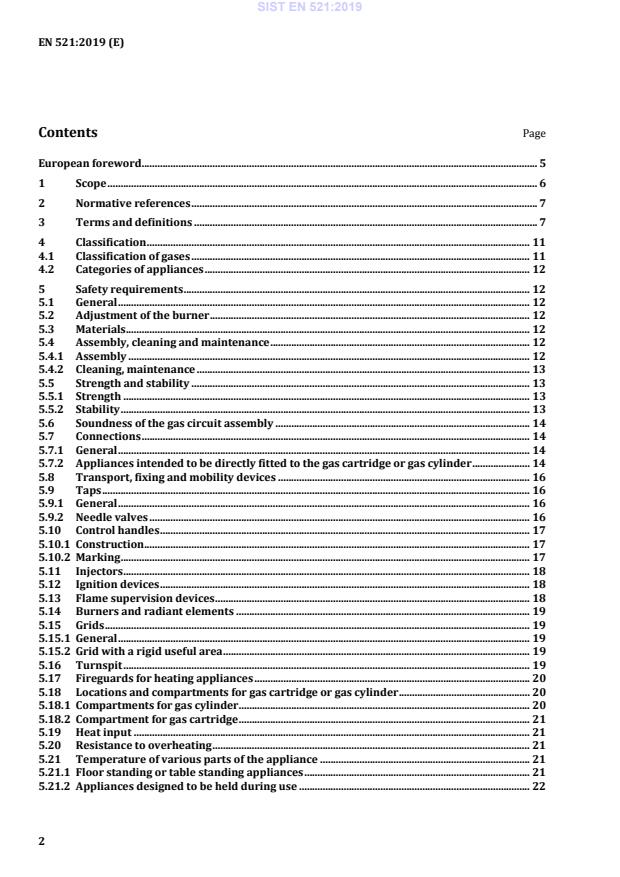
Contents Page
European foreword . 5
1 Scope . 6
2 Normative references . 7
3 Terms and definitions . 7
4 Classification . 11
4.1 Classification of gases . 11
4.2 Categories of appliances . 12
5 Safety requirements . 12
5.1 General . 12
5.2 Adjustment of the burner . 12
5.3 Materials . 12
5.4 Assembly, cleaning and maintenance . 12
5.4.1 Assembly . 12
5.4.2 Cleaning, maintenance . 13
5.5 Strength and stability . 13
5.5.1 Strength . 13
5.5.2 Stability . 13
5.6 Soundness of the gas circuit assembly . 14
5.7 Connections . 14
5.7.1 General . 14
5.7.2 Appliances intended to be directly fitted to the gas cartridge or gas cylinder . 14
5.8 Transport, fixing and mobility devices . 16
5.9 Taps . 16
5.9.1 General . 16
5.9.2 Needle valves . 16
5.10 Control handles . 17
5.10.1 Construction . 17
5.10.2 Marking . 17
5.11 Injectors . 18
5.12 Ignition devices . 18
5.13 Flame supervision devices . 18
5.14 Burners and radiant elements . 19
5.15 Grids . 19
5.15.1 General . 19
5.15.2 Grid with a rigid useful area . 19
5.16 Turnspit . 19
5.17 Fireguards for heating appliances . 20
5.18 Locations and compartments for gas cartridge or gas cylinder . 20
5.18.1 Compartments for gas cylinder . 20
5.18.2 Compartment for gas cartridge . 21
5.19 Heat input . 21
5.20 Resistance to overheating . 21
5.21 Temperature of various parts of the appliance . 21
5.21.1 Floor standing or table standing appliances . 21
5.21.2 Appliances designed to be held during use . 22
5.22 Temperature of panels (floors, walls or ceilings) . 22
5.22.1 Floor and table standing appliances . 22
5.22.2 Appliances intended for suspension . 22
5.23 Ignition, crosslighting and flame stability . 22
5.24 Resistance to draught . 23
5.25 Resistance to liquid spillage . 23
5.26 Combustion . 23
5.27 Accumulation of un-burnt gas . 23
5.28 Safety at high temperature . 23
5.29 Sooting - condensation. 23
5.30 Rational use of energy . 23
5.30.1 Efficiency of stove burners . 23
5.31 Durability of markings . 24
5.32 Strength and endurance requirements . 24
6 Test methods . 24
6.1 General . 24
6.1.1 Test gases. 24
6.1.2 Test conditions . 25
6.1.3 Test gases and pressures . 25
6.1.4 Test vessel . 26
6.2 Adjustment of the burner . 26
6.3 Materials . 26
6.4 Assembly, cleaning and maintenance . 26
6.5 Strength and stability . 26
6.5.1 Strength . 26
6.5.2 Stability . 27
6.6 Soundness of the gas circuit assembly . 28
6.6.1 Soundness of the appliance . 28
6.6.2 Soundness of flexible tube connections. 29
6.6.3 Soundness of burner assemblies . 29
6.7 Connections . 29
6.7.1 General . 29
6.7.2 Appliances directly connected to gas cartridge or gas cylinder . 29
6.8 Transport, fixing and mobility devices . 30
6.9 Taps . 30
6.10 Control handles . 30
6.11 Injectors . 31
6.12 Ignition devices . 31
6.13 Flame supervision devices . 31
6.13.1 General . 31
6.13.2 Ignition delay time . 31
6.13.3 Extinction delay time . 31
6.14 Burners and radiant elements . 31
6.15 Grids . 31
6.16 Turnspit. 31
6.17 Fireguards for heating appliances . 32
6.17.1 Strength of fireguards . 32
6.17.2 Dimensions . 32
6.18 Locations and compartments for gas cartridge or gas cylinder . 32
6.19 Verification of heat inputs . 32
6.19.1 Test . 32
6.19.2 Calculation of heat inputs . 33
6.20 Resistance to overheating . 33
6.21 Temperatures of the various parts of the appliance . 34
6.21.1 Test installation . 34
6.21.2 Test method . 34
6.22 Temperature of panels (floor, wall or ceiling) . 35
6.22.1 Floor standing appliances . 35
6.22.2 Fixed appliances . 35
6.23 Ignition, crosslighting and flame stability . 35
6.23.1 Test conditions . 35
6.23.2 Test on individual burners, others being extinguished . 36
6.23.3 Test on individual burners, others being lit . 36
6.24 Resistance to draught . 37
6.25 Resistance to liquid spillage . 37
6.26 Combustion . 38
6.26.1 General conditions . 38
6.26.2 Stove burners. 38
6.26.3 Analysis of the products of combustion . 38
6.27 Accumulation of un-burnt gases . 39
6.28 Safety at high temperature . 39
6.29 Sooting - condensation . 39
6.30 Rational use of energy . 40
6.30.1 Uncovered stove burners . 40
6.30.2 Covered burners . 41
6.31 Durability of the marking . 41
6.32 Strength and endurance test . 42
7 Markings . 42
7.1 Appliance marking . 42
7.2 Packaging marking . 43
8 Instructions for use, maintenance and assembly . 43
8.1 General . 43
8.2 Instruction contents . 43
Annex A (normative) Characteristics of test vessels (see 6.5.2.3) . 58
Annex B (normative) Tests on needle valves (see 6.9) . 60
B.1 Resistance to temperature . 60
B.2 Endurance . 60
Annex C (informative) Examples of authorized solutions . 61
Bibliography . 68
European foreword
This document (EN 521:2019) has been prepared by Technical Committee CEN/TC 181 “Appliances and
leisure vehicle installations using liquefied petroleum gas and appliances using natural gas for outdoor
use”, the secretariat of which is held by AFNOR.
This European Standard shall be given the status of a national standard, either by publication of an
identical text or by endorsement, at the latest by October 2019, and conflicting national standards shall
be withdrawn at the latest by October 2019.
Attention is drawn to the possibility that some of the elements of this document may be the subject of
patent rights. CEN shall not be held responsible for identifying any or all such patent rights.
This document supersedes EN 521:2006.
The main changes from the 2006 version are linked to the fact that the flat gas stoves have been
removed from the scope of this new version.
According to the CEN-CENELEC Internal Regulations, the national standards organisations of the
following countries are bound to implement this European Standard: Austria, Belgium, Bulgaria,
Croatia, Cyprus, Czech Republic, Denmark, Estonia, Finland, Former Yugoslav Republic of Macedonia,
France, Germany, Greece, Hungary, Iceland, Ireland, Italy, Latvia, Lithuania, Luxembourg, Malta,
Netherlands, Norway, Poland, Portugal, Romania, Serbia, Slovakia, Slovenia, Spain, Sweden, Switzerland,
Turkey and the United Kingdom.
1 Scope
This document specifies the construction and performance characteristics related to safety and the
rational use of energy of portable appliances burning liquefied petroleum gases at the vapour pressure
within the gas cartridge or gas cylinder, excepting those where the gas cartridge is inserted horizontally
in the chassis.
NOTE These appliances are referred to in the body of the text as “appliances”.
This document applies to various types of portable appliances burning liquefied petroleum gases at
vapour pressure and designed to be used with cartridges as complying with EN 417 or gas cylinders.
This document covers appliances for outdoor or in well ventilated areas uses only.
For example the following types of appliances are covered:
a) cooking appliances (stoves, grills, barbecues.);
This document does not cover barbecues that can be used indoors;
b) lighting appliances;
c) heating appliances;
This document only applies to appliances with a maximum heat input of up to 3 kW (H ) for outdoor
s
use only;
d) blowtorches;
This document only applies to blowtorches without a flexible hose;
e) laboratory burners.
The requirements apply to these appliances or their functional sections whether or not the latter are
independent or incorporated into an assembly.
Appliances covered by this document are not connected to a flue for the discharge of products of
combustion and are not connected to the mains electricity supply.
This document covers neither appliances supplied with LPG in the liquid phase nor appliance with fixed
integral container which may or may not be refilled by the user
It does not apply to lighters as defined in EN ISO 9994.
It does not apply to gas appliances operating with a valve cartridge which is horizontally integrated into
the chassis of the appliance also called “flat portable gas stove”.
Requirements for rational use of energy have been included for stove burners.
However, such requirements have not been included for the other types of appliances because:
— for grills and barbecues, this is a type of cooking which is achieved by various means such as
radiant elements; in addition this type of cooking varies according to the type of food and region
where the appliance is used;
— for lighting appliances, the consumption is insignificant because these appliances have a very low
rate and are used only for a few hours in a year;
— for heating appliances, all the heat produced is discharged into the environment;
— for tools such as blowtorches which are not professional tools in regular use, the gas consumption
depends very much on the way it is used.
2 Normative references
The following documents are referred to in the text in such a way that some or all of their content
constitutes requirements of this document. For dated references, only the edition cited applies. For
undated references, the latest edition of the referenced document (including any amendments) applies.
1)
EN 30-1-1:— , Domestic cooking appliances burning gas fuel — Part 1-1: Safety — General
EN 125:2010+A1:2015, Flame supervision devices for gas burning appliances — Thermoelectric flame
supervision devices
EN 437:2018, Test gases — Test pressures — Appliance categories
EN 549:1994, Rubber materials for seals and diaphragms for gas appliances and gas equipment
3 Terms and definitions
For the purposes of this document, the following terms and definitions apply.
ISO and IEC maintain terminological databases for use in standardization at the following addresses:
• IEC Electropedia: available at http://www.electropedia.org/
• ISO Online browsing platform: available at http://www.iso.org/obp
3.1
stove
cooking appliance incorporating one or several burners and a pan support(s) designed in such a way
that it(they) can support the vessels containing the food
3.2
flat portable gas stove
flat stove operating with a gas cartridge horizontally placed in the chassis for which the length or width
is bigger than its height
Note 1 to entry: Figure 2 gives an example of a flat portable gas stove
3.3
vapour pressure appliance
appliance for which the pressure at the gas inlet is equal to the pressure in the gas cartridge or gas
cylinder
Note 1 to entry: If the appliance is fixed directly to the gas cylinder by a rigid connection, the appliance inlet is
the part of the connection that takes the gas from the cylinder. A pressure reducing device may be incorporated in
the gas circuit, between the gas inlet and the injector.
Note 2 to entry: If the appliance is connected to the gas cylinder by a flexible hose, the pressure in the flexible
hose once it is connected to the gas cylinder is equal to the pressure in the gas cylinder. A pressure reducing
device may be incorporated in the gas circuit downstream of the flexible hose
)
Under preparation. Stage at the time of publication: prEN 30-1-1:2017
3.4
gas cylinder
refillable or non-refillable container fitted with a valve filled with gas or a gas mixture
3.5
gas cartridge
non-refillable container with a maximum capacity of 1 000 ml filled with gas or a gas mixture
Note 1 to entry: It may be fitted with a valve. If it is not fitted with a valve, the release of gas is carried out
following perforation of the cartridge by means of a device incorporated in the appliance
3.6
cooking device
device supplied with the appliance designed to hold or receive the food to be cooked
Note 1 to entry: Grid, turnspit, baking tray etc.
3.7
useful part of a cooking device
part of the device in contact with food during cooking
3.8
grid
cooking device designed to hold the food to be cooked
Note 1 to entry: Its useful component(s) can be rigid or flexible
3.9
grid with flexible useful components
cooking device made up of two jointed components enabling tight gripping of the food to be cooked
Note 1 to entry: Each component consists of a rigid frame on which metallic wires are fixed and form a flexible
mesh inside the frame distorting around the food
3.10
barbecue
appliance designed principally to roast and/or grill food
Note 1 to entry: Cooking is carried out by radiant heat and, possibly, by convection and conduction
3.11
griddle
part of a stove consisting of a plate placed above a burner, that allows the cooking of food by direct
contact with the surface of the plate which is brought to a high temperature
3.12
stabilizer
part of the appliance designed to increase mechanical stability
3.13
pan support
support placed above an open stove burner and designed to support the pan to be heated
3.14
turnspit
cooking device enabling the rotation of the food to be roasted
Note 1 to entry: The rotation can be manual or using a mechanical or electrical motor (battery)
3.15
glass panel
glass surface or part of a glass surface allowing the inside of an enclosure to be seen
3.16
fittings
safety devices, controlling devices or regulating devices and sub-assemblies thereof, designed to be
incorporated into an appliance or to be assembled to constitute an appliance
Note 1 to entry: for example valves, flame supervision devices
Note 2 to entry: cartridge is not considered as fittings
3.17
flame supervision device
device which, due to the presence of a flame on the sensing element, keeps open the gas flow to the
burner and any pilot and which cuts off the gas supply to the burner and possibly a pilot in the event of
extinction of the supervised flame
3.18
ignition delay time
time between the ignition of the supervised flame and the moment when the effect of this flame is
sufficient to keep the closing device open
3.19
extinction delay time
time between the extinction of the supervised flame and the closure of the gas supply to the burner and
possibly a pilot
3.20
tap
controlling device, part of the appliance, designed to isolate a burner from the internal gas pipework
and possibly to adjust its rate during use
3.21
control handle
component designed to be operated manually so as to operate a control of the appliance
Note 1 to entry: e.g. a tap, thermostat etc.
3.22
gripping area
outside part of the appliance designed to be handled during use
3.23
burner
component that allows the gas to burn
Note 1 to entry: two types of burners are distinguished
— ignition burner: small burner whose flame is designed to light a main burner. It is referred to as “pilot” in
this European Standard;
— main burner: burner designed to fulfil a thermal function of the appliance. It is referred to as “burner” in this
European Standard
3.24
injector
component part that admits the gas into a burner
Note 1 to entry: An injector is said to be calibrated when the section of the outlet orifice is fixed
3.25
ignition device
device to ignite one or more burners directly or indirectly
3.26
primary air adjuster
device allowing the modification of the primary air rate
Note 1 to entry: The action consisting in operating this device is termed “primary air adjustment”
3.27
means of sealing
static or dynamic device designed to ensure leak tightness
Note 1 to entry: for example: flat-faced joints, O-ring or conical joints, diaphragms, grease, pastes, putties etc.
3.28
detachable
possible to dismantle without using a tool
3.29
removable
removal only possible with a tool
3.30
soft solder
solder for which the lowest temperature of the melting range, after application, is less than 450 °C
3.31
flame stability
flames are stable at the burner ports when the phenomena of flame lift or light back do not occur
3.32
flame lift
phenomenon characterized by the partial or total movement of the base of the flame away from the
burner port
3.33
light back
phenomenon characterized by the return of the flame inside the body of the burner
3.34
calorific value
quantity of heat produced by the complete combustion, at a constant pressure equal to 1 013,25 mbar,
of a unit volume or mass of gas, the constituents of the combustible mixture being taken at reference
conditions and the products of combustion being brought back to the same conditions
Note 1 to entry: A distinction is made between:
— the gross calorific value Hs: the water produced by combustion is assumed to be condensed;
— the net calorific value Hi: the water produced by combustion is assumed to be in the vapour state
Note 2 to entry: The calorific value is expressed:
— either in megajoules per cubic metre (MJ/m3) of dry gas under the reference conditions;
— or in megajoules per kilogram (MJ/kg) of dry gas.
[SOURCE: EN 437:2018]
3.35
gas supply pressure
difference between the static pressure measured at the gas inlet connection of the appliance and the
atmospheric pressure. It is expressed in bar
4 Classification
4.1 Classification of gases
Gases likely to be used are classified in three groups according to their pressures:
a) butane:
Mixture of hydrocarbons containing mainly butanes and butenes having a maximum pressure of
8 bar gauge at 50 °C;
b) butane-propane mixture:
Mixture of hydrocarbons containing mainly butanes, butenes, propane and propene having a
pressure between 8 bar gauge and 12 bar gauge at 50 °C;
c) propane:
Mixture of hydrocarbons containing mainly propane and propene having a pressure above 12 bar
gauge at 50 °C.
4.2 Categories of appliances
Appliances are classified in three categories according to the gases likely to be used:
— category direct pressure – butane;
— category direct pressure - butane-propane mixture;
— category direct pressure - propane.
5 Safety requirements
5.1 General
The test methods and the means of verification are indicated in Clause 6.
The design shall make it impossible to incorrectly fit or refit any user-removable or replaceable part(s)
or component(s) that can have an adverse effect on combustion or cause CO emissions to exceed limits
in Clause 5.26.
5.2 Adjustment of the burner
For appliances of types a), b) and c) of the scope of this European Standard, not any adjustment of the
burner shall be possible.
5.3 Materials
Non-metallic materials used as radiant elements in appliances (for example volcanic rocks, refractory
blocks) shall be of a quality suitable to their use.
The quality and thickness of materials used in the construction of appliances shall be such that the
constructional and performance characteristics are not altered in use. In particular all the parts of the
appliance shall withstand mechanical, chemical and thermal actions to which they may be submitted
during use. In normal conditions of operation, of cleaning or of adjustment, they shall not be liable to
any alterations which might impair their safety.
Sheet-metal parts, not made of corrosion-resistant material, shall be effectively protected against
corrosion. This requirement does not apply to grilles supporting lava rocks nor to cooking devices.
Seals and joining compounds shall have characteristics suited to their use.
Rubber based materials shall comply with EN 549:1994 class A2 minimum, and LPG resistant.
Hoses being part of the appliance shall be LPG resistant.
Copper tubing shall be used upstream of the injector only if its temperature does not exceed 100 °C
when the test described in 6.21 is carried out.
Asbestos or asbestos based materials shall not be used.
5.4 Assembly, cleaning and maintenance
5.4.1 Assembly
The entire appliance gas circuit, including the injector and flexible hoses if any, shall be factory
assembled. If clamps are used, they shall be of the machine formed type. Removable clamps are not
permitted.
Parts, whose assembly is carried out by the user, shall be able to be assembled correctly by following
the instructions given in the instructions.
It shall not be possible to dismantle parts which are adjusted at the factory, which are not intended to
be dismantled by the user and whose dismantling would affect safety, without using tools. If
dismantling is possible using an open ended spanner or a screwdriver, direct access to such nuts and
screw heads shall not be possible, unless they are sealed.
If a pressure reducing device is integrated in the gas circuit, it shall not be removable nor replaceable by
the user.
NOTE This device can provide the functions of adjustment, opening and closing of the gas flow.
Connections shall allow the flexible hose to move freely without risk of coming into contact with a part
of the appliance whose temperature rise exceeds 70 K during the test defined in 6.21 when fitted in
accordance with the instructions.
5.4.2 Cleaning, maintenance
All parts of the appliance requiring frequent cleaning by the user shall be easily accessible. It shall be
possible to put these parts back correctly.
There shall be no sharp corners and edges on the accessible parts of an appliance which could give rise
to injury, for example during cleaning.
5.5 Strength and stability
5.5.1 Strength
5.5.1.1 General
The construction of an appliance shall be such that, during normal conditions of use:
— any displacement of parts;
— any distortion;
— any deterioration
likely to impair safe operation will not occur.
5.5.1.2 Stove pan supports
The application of a mass as described in 6.5.1.2 on the pan support shall not cause any breakage or
permanent distortion of the pan support exceeding 1 mm.
5.5.1.3 Glass components
The accessible edges of glass components shall not be sharp. They shall withstand the various stresses
to which they are subjected during the tests described in this European Standard without damage. In
particular they shall withstand the tests described in 6.5.1.3.1 (when they are a part of the appliance)
and in 6.5.1.3.2.
5.5.2 Stability
If the appliance is fitted with a foldable support, it shall be possible to lock this in the position of use (for
example: stop, locking device).
If the radiant device of a barbecue or a grill can have several positions, a stop shall be provided for each
of them.
The stability of an appliance designed to rest on a table or on the ground shall allow safe use on level
ground. In addition, the appliance shall not tilt or fall over when it is placed on a slope of 10° and any lid
shall not close.
This requirement shall also be met when the appliance is fitted with optional parts (for example: lamp
extension posts).
These requirements shall be met under the test conditions described in 6.5.2.
5.6 Soundness of the gas circuit assembly
Holes for screws, pins, etc, intended for the assembly of components shall not open into the space
reserved for the gas ways leading to the injector.
The soundness of parts and assemblies connected to the gas circuit shall be ensured by means of metal-
to-metal joints or joints with seals (for example, flat-faced joints, O-rings or gaskets), i.e. excluding the
use of any product which ensures soundness in the threads. For parts that do not require to be
dismantled during normal maintenance, for example taps, the use of thread sealing compounds is
permitted.
Removable components or the threaded parts of the gas pipework which may be dismantled during
maintenance described in the instructions shall remain sound after five disconnections and re-
connections in accordance with the instructions, if necessary after changing a gasket.
Soft solder (see definition in 3.30) shall not be used to ensure the soundness of the gas circuit. However
it is permitted for internal connections within the gas circuit when they do not involve soundness.
Under the test conditions defined in 6.6.1, during each of the tests no. One and 2, the leak shall not
exceed 0,07 l/h (1 013 mbar, 20 °C). This requirement shall also be met after all the tests on the
appliance have been carried out, but before any dismantling of parts subjected to t
...