

EN 549:2019
(Main)Rubber materials for seals and diaphragms for gas appliances and gas equipment
- Abstract
This document specifies requirements and associated test methods for rubber materials used in gas installations, gas equipment and gas appliances in contact with 1st, 2nd and 3rd family combustible gases as classified in EN 437:2018, additionally LPG, bio methane and bio LPG, in the same quality, are covered. It also establishes a classification based on temperature range and hardness. This document is applicable to materials from which homogeneous seals and homogeneous or reinforced diaphragms are manufactured.
Since the dimensions and shape of the components differ from those of standard test pieces taken from sheet material as used for type testing of the rubber materials according to this document, tolerances have been made in the requirements specified by Annex A for the components with respect to those specified for standard test pieces.
The range of operating temperatures covered by this document is –40 °C to +150 °C.
For applications with potential condensation, this document is not applicable for silicon rubber, e.g. above 200 hPa (200 mbar) nominal pressure or at temperatures below 0 °C with 3rd family gases.
- Status
- Withdrawn
- Publication Date
- 02-Jul-2019
- Withdrawal Date
- 20-Oct-2026
- Technical Committee
- CEN/TC 208 - Elastomeric seals for joints in pipework and pipelines
- Drafting Committee
- CEN/TC 208 - Elastomeric seals for joints in pipework and pipelines
- Current Stage
- 9960 - Withdrawal effective - Withdrawal
- Start Date
- 03-May-2023
- Completion Date
- 21-Oct-2026

Relations
- Replaces
EN 549:1994 - Rubber materials for seals and diaphragms for gas appliances and gas equipment - Effective Date
- 22-Jul-2015
- Merged Into
EN 549:2019+A1:2023 - Rubber materials for seals and diaphragms for gas appliances and gas equipment - Effective Date
- 15-Mar-2023
- Effective Date
- 25-Aug-2026
- Effective Date
- 25-Aug-2026
- Effective Date
- 25-Aug-2026
- Effective Date
- 25-Aug-2026
- Effective Date
- 09-Feb-2026
- Effective Date
- 09-Feb-2026
- Effective Date
- 09-Feb-2026
- Effective Date
- 09-Feb-2026
- Refers
ISO 188:2011 - Rubber, vulcanized or thermoplastic — Accelerated ageing and heat resistance tests - Effective Date
- 09-Feb-2026
- Effective Date
- 09-Feb-2026
- Effective Date
- 28-Jan-2026
- Effective Date
- 28-Jan-2026
- Effective Date
- 28-Jan-2026
Get Certified
Connect with accredited certification bodies for this standard

DIN CERTCO
DIN Group product certification.

Smithers Quality Assessments
US management systems and product certification.
Sponsored listings
Frequently Asked Questions
EN 549:2019 is a standard published by the European Committee for Standardization (CEN). Its full title is "Rubber materials for seals and diaphragms for gas appliances and gas equipment". This standard covers: This document specifies requirements and associated test methods for rubber materials used in gas installations, gas equipment and gas appliances in contact with 1st, 2nd and 3rd family combustible gases as classified in EN 437:2018, additionally LPG, bio methane and bio LPG, in the same quality, are covered. It also establishes a classification based on temperature range and hardness. This document is applicable to materials from which homogeneous seals and homogeneous or reinforced diaphragms are manufactured. Since the dimensions and shape of the components differ from those of standard test pieces taken from sheet material as used for type testing of the rubber materials according to this document, tolerances have been made in the requirements specified by Annex A for the components with respect to those specified for standard test pieces. The range of operating temperatures covered by this document is –40 °C to +150 °C. For applications with potential condensation, this document is not applicable for silicon rubber, e.g. above 200 hPa (200 mbar) nominal pressure or at temperatures below 0 °C with 3rd family gases.
This document specifies requirements and associated test methods for rubber materials used in gas installations, gas equipment and gas appliances in contact with 1st, 2nd and 3rd family combustible gases as classified in EN 437:2018, additionally LPG, bio methane and bio LPG, in the same quality, are covered. It also establishes a classification based on temperature range and hardness. This document is applicable to materials from which homogeneous seals and homogeneous or reinforced diaphragms are manufactured. Since the dimensions and shape of the components differ from those of standard test pieces taken from sheet material as used for type testing of the rubber materials according to this document, tolerances have been made in the requirements specified by Annex A for the components with respect to those specified for standard test pieces. The range of operating temperatures covered by this document is –40 °C to +150 °C. For applications with potential condensation, this document is not applicable for silicon rubber, e.g. above 200 hPa (200 mbar) nominal pressure or at temperatures below 0 °C with 3rd family gases.
EN 549:2019 is classified under the following ICS (International Classification for Standards) categories: 83.140.50 - Seals. The ICS classification helps identify the subject area and facilitates finding related standards.
EN 549:2019 has the following relationships with other standards: It is inter standard links to EN 549:1994, EN 549:2019+A1:2023, ISO 815-2:2014, ISO 1817:2015, ISO 23529:2016, ISO 815-1:2014, ISO 1407:2011, ISO 1431-1:2012, ISO 37:2017, ISO 4650:2012, ISO 188:2011, ISO 48-2:2018, EN ISO 9856:2016, EN ISO 1183-1:2019, EN ISO 1833-20:2019. Understanding these relationships helps ensure you are using the most current and applicable version of the standard.
EN 549:2019 is associated with the following European legislation: EU Directives/Regulations: 2009/142/EC, 305/2011; Standardization Mandates: M/131, M/BC/CEN/89/6. When a standard is cited in the Official Journal of the European Union, products manufactured in conformity with it benefit from a presumption of conformity with the essential requirements of the corresponding EU directive or regulation.
EN 549:2019 is available in PDF format for immediate download after purchase. The document can be added to your cart and obtained through the secure checkout process. Digital delivery ensures instant access to the complete standard document.
Standards Content (Sample)
SLOVENSKI STANDARD
01-september-2019
Nadomešča:
SIST EN 549:1996
Gumeni materiali za tesnila in membrane v plinskih aparatih in plinskih napravah
Rubber materials for seals and diaphragms for gas appliances and gas equipment
Elastomer-Werkstoffe für Dichtungen und Membranen in Gasgeräten und Gasanlagen
Matériaux à base de caoutchouc pour joints d'étanchéité et membranes destinés aux
appareils à gaz et appareillages pour le gaz
Ta slovenski standard je istoveten z: EN 549:2019
ICS:
83.140.50 Tesnila Seals
91.140.40 Sistemi za oskrbo s plinom Gas supply systems
2003-01.Slovenski inštitut za standardizacijo. Razmnoževanje celote ali delov tega standarda ni dovoljeno.
EN 549
EUROPEAN STANDARD
NORME EUROPÉENNE
July 2019
EUROPÄISCHE NORM
ICS 83.140.50 Supersedes EN 549:1994
English Version
Rubber materials for seals and diaphragms for gas
appliances and gas equipment
Matériaux à base de caoutchouc pour joints Elastomer-Werkstoffe für Dichtungen und Membranen
d'étanchéité et membranes destinés aux appareils à in Gasgeräten und Gasanlagen
gaz et matériels pour le gaz
This European Standard was approved by CEN on 22 April 2019.
CEN members are bound to comply with the CEN/CENELEC Internal Regulations which stipulate the conditions for giving this
European Standard the status of a national standard without any alteration. Up-to-date lists and bibliographical references
concerning such national standards may be obtained on application to the CEN-CENELEC Management Centre or to any CEN
member.
This European Standard exists in three official versions (English, French, German). A version in any other language made by
translation under the responsibility of a CEN member into its own language and notified to the CEN-CENELEC Management
Centre has the same status as the official versions.
CEN members are the national standards bodies of Austria, Belgium, Bulgaria, Croatia, Cyprus, Czech Republic, Denmark, Estonia,
Finland, France, Germany, Greece, Hungary, Iceland, Ireland, Italy, Latvia, Lithuania, Luxembourg, Malta, Netherlands, Norway,
Poland, Portugal, Republic of North Macedonia, Romania, Serbia, Slovakia, Slovenia, Spain, Sweden, Switzerland, Turkey and
United Kingdom.
EUROPEAN COMMITTEE FOR STANDARDIZATION
COMITÉ EUROPÉEN DE NORMALISATION
EUROPÄISCHES KOMITEE FÜR NORMUNG
CEN-CENELEC Management Centre: Rue de la Science 23, B-1040 Brussels
© 2019 CEN All rights of exploitation in any form and by any means reserved Ref. No. EN 549:2019 E
worldwide for CEN national Members.
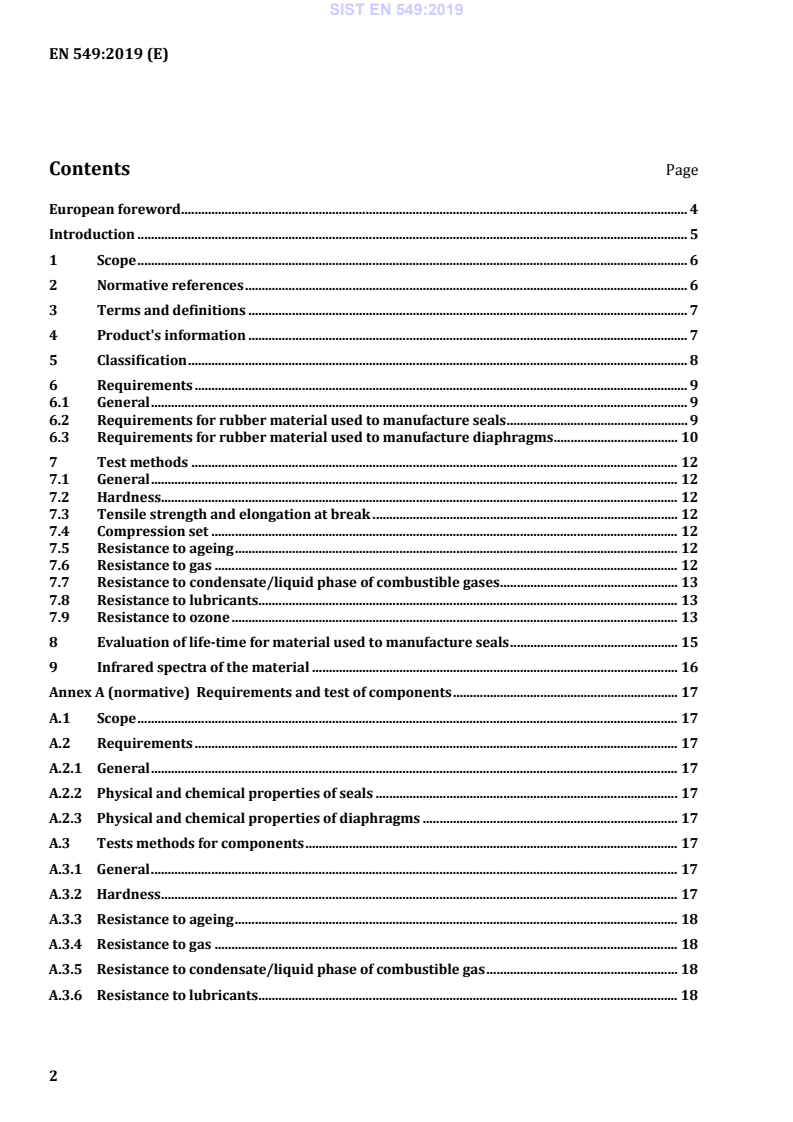
Contents Page
European foreword . 4
Introduction . 5
1 Scope . 6
2 Normative references . 6
3 Terms and definitions . 7
4 Product's information . 7
5 Classification . 8
6 Requirements . 9
6.1 General . 9
6.2 Requirements for rubber material used to manufacture seals . 9
6.3 Requirements for rubber material used to manufacture diaphragms . 10
7 Test methods . 12
7.1 General . 12
7.2 Hardness . 12
7.3 Tensile strength and elongation at break . 12
7.4 Compression set . 12
7.5 Resistance to ageing . 12
7.6 Resistance to gas . 12
7.7 Resistance to condensate/liquid phase of combustible gases . 13
7.8 Resistance to lubricants . 13
7.9 Resistance to ozone . 13
8 Evaluation of life-time for material used to manufacture seals . 15
9 Infrared spectra of the material . 16
Annex A (normative) Requirements and test of components . 17
A.1 Scope . 17
A.2 Requirements . 17
A.2.1 General . 17
A.2.2 Physical and chemical properties of seals . 17
A.2.3 Physical and chemical properties of diaphragms . 17
A.3 Tests methods for components . 17
A.3.1 General . 17
A.3.2 Hardness . 17
A.3.3 Resistance to ageing . 18
A.3.4 Resistance to gas . 18
A.3.5 Resistance to condensate/liquid phase of combustible gas . 18
A.3.6 Resistance to lubricants . 18
A.3.7 Resistance to ozone . 19
Annex B (normative) Infrared spectra of the material . 23
B.1 Scope . 23
B.2 Requirements . 23
B.2.1 General . 23
B.2.2 Solvent extract . 23
B.2.3 Infrared spectra . 23
B.2.4 Density . 23
B.3 Methods of test . 23
B.3.1 General . 23
B.3.2 Solvent extraction . 23
B.3.3 Infrared spectra . 24
B.3.4 Density . 24
Annex C (normative) Evaluation of lifetime for material used to manufacture seals by using
the compression set method . 25
C.1 General . 25
C.2 Requirements . 26
C.3 Test Procedure . 26
C.4 Evaluation of Test Results . 27
C.5 Documentation . 28
Annex D (informative) Verification of identity of material . 29
D.1 Scope . 29
D.2 Verification requirements . 29
D.2.1 General . 29
D.2.2 Solvent extract . 29
D.2.3 Infrared spectra . 29
D.2.4 Density . 29
Annex ZA (informative) Relationship between this European Standard and the essential
requirements of Regulation 2016/426 aimed to be covered . 30
Bibliography . 31
European foreword
This document (EN 549:2019) has been prepared by Technical Committee CEN/TC 208 “Elastomeric
seals for joints in pipework and pipelines”, the secretariat of which is held by BSI.
This European Standard shall be given the status of a national standard, either by publication of an
identical text or by endorsement, at the latest by January 2020, and conflicting national standards shall
be withdrawn at the latest by January 2020.
Attention is drawn to the possibility that some of the elements of this document may be the subject of
patent rights. CEN shall not be held responsible for identifying any or all such patent rights.
This document supersedes EN 549:1994.
This document has been prepared under a mandate given to CEN by the European Commission and the
European Free Trade Association, and supports essential requirements of EU Regulation 2016/426
relating to appliances burning gaseous fuels.
For relationship with EU Regulation 2016/426, see informative Annex ZA, which is an integral part of this
document.
The following main technical changes have been made compared to EN 549:1994:
a) Clause 8, “Evaluation of life-time for material used to manufacture seals” added;
b) Clause 9, “Infrared spectra of the material” added;
c) resistance to condensate/liquid phase of combustible gases added;
d) low temperature classes added;
e) ozone resistance for diaphragms is now mandatory;
f) informative Annex D added.
NOTE Verification of identity of material is described in the informative Annex D.
According to the CEN-CENELEC Internal Regulations, the national standards organisations of the
following countries are bound to implement this European Standard: Austria, Belgium, Bulgaria, Croatia,
Cyprus, Czech Republic, Denmark, Estonia, Finland, France, Germany, Greece, Hungary, Iceland, Ireland,
Italy, Latvia, Lithuania, Luxembourg, Malta, Netherlands, Norway, Poland, Portugal, Republic of North
Macedonia, Romania, Serbia, Slovakia, Slovenia, Spain, Sweden, Switzerland, Turkey and the United
Kingdom.
Introduction
This document specifies the requirements for rubber materials to be used for the manufacture of seals
and diaphragms. It specifies for that purpose, tests to be carried out on standardized test pieces taken
from sheets of material, since the small size of most components in general does not allow the preparation
of necessary test samples for carrying out the complete range of tests.
It may be necessary to carry out supplementary tests on the component mounted in the gas appliance or
in equipment, to confirm the functional suitability of the component. Such tests should be performed
under the most severe service conditions envisaged in the appropriate standards for the gas appliances
and/or equipment.
1 Scope
This document specifies requirements and associated test methods for rubber materials used in gas
installations, gas equipment and gas appliances in contact with 1st, 2nd and 3rd family combustible gases
as classified in EN 437:2018, additionally LPG, bio methane and bio LPG, in the same quality, are covered.
It also establishes a classification based on temperature range and hardness. This document is applicable
to materials from which homogeneous seals and homogeneous or reinforced diaphragms are
manufactured.
Since the dimensions and shape of the components differ from those of standard test pieces taken from
sheet material as used for type testing of the rubber materials according to this document, tolerances
have been made in the requirements specified by Annex A for the components with respect to those
specified for standard test pieces.
The range of operating temperatures covered by this document is –40 °C to +150 °C.
For applications with potential condensation, this document is not applicable for silicon rubber, e.g. above
200 hPa (200 mbar) nominal pressure or at temperatures below 0 °C with 3rd family gases.
2 Normative references
The following documents are referred to in the text in such a way that some or all of their content
constitutes requirements of this document. For dated references, only the edition cited applies. For
undated references, the latest edition of the referenced document (including any amendments) applies.
EN ISO 1183-1:2019, Plastics - Methods for determining the density of non-cellular plastics - Part 1:
Immersion method, liquid pycnometer method and titration method (ISO 1183-1:2019)
ISO 37:2017, Rubber, vulcanized or thermoplastic — Determination of tensile stress-strain properties
ISO 48-2:2018, Rubber, vulcanized or thermoplastic — Determination of hardness – Part 2: Hardness
between 10 IRHD and 100 IRHD
ISO 188:2011, Rubber, vulcanized or thermoplastic — Accelerated ageing and heat resistance tests
ISO 815-1:2014, Rubber, vulcanized or thermoplastic — Determination of compression set — Part 1: At
ambient or elevated temperatures
ISO 815-2:2014, Rubber, vulcanized or thermoplastic — Determination of compression set — Part 2: At low
temperatures
ISO 1407:2011, Rubber — Determination of solvent extract
ISO 1431-1:2012, Rubber, vulcanized or thermoplastic — Resistance to ozone cracking — Part 1: Static and
dynamic strain testing
ISO 1817:2015, Rubber, vulcanized or thermoplastic — Determination of the effect of liquids
ISO 4650:2012, Rubber — Identification — Infrared spectrometric methods
ISO 23529:2016, Rubber — General procedures for preparing and conditioning test pieces for physical test
methods
3 Terms and definitions
For the purposes of this document, the following terms and definitions apply.
ISO and IEC maintain terminological databases for use in standardization at the following addresses:
— IEC Electropedia: available at http://www.electropedia.org
— ISO Online browsing platform: available at http://www.iso.org/obp
3.1
rubber material
vulcanised mixture of rubber and ingredients used to manufacture rubber material
3.2
component
finished product manufactured from rubber material
Note 1 to entry For example. O-Rings, diaphragms, …
3.3
seal
component used as an interface between parts of a gas appliance or parts of gas equipment to ensure gas
tightness
3.4
diaphragm
component located in a fixture and serving as a flexible gas tight partition between two chambers
3.5
reinforcement
material arranged in or on the elastomeric material, thus reinforcing certain properties of such
Note 1 to entry: For example, the bursting strength of diaphragms.
3.6
rubber compound
mixture of raw rubber and ingredients used to manufacture rubber material
4 Product's information
The following information shall be documented:
— a unique rubber material reference;
— the nominal hardness;
— the maximum working temperature;
— the minimum working temperature;
— whether the material is resistant to ozone;
— whether the material is resistant to condensate/liquid phase of combustible gas;
— for reinforced material, a full specification of the reinforcement, including at least:
— type of material (for example polyester, nylon, cotton or silk);
— grammage (g/m );
— yarn type;
— basic construction;
— yarn count in warp and weft;
— yarn twist.
Diaphragms shall be ozone resistant. Due to the potential risk of damage of any protective surface coating,
such as waxes, by dynamic flexing such methods of protection against ozone attack shall not be used
without additional protective additives.
5 Classification
Materials shall be classified according to temperature range and hardness as given in Table 1 and Table 2
respectively.
Table 1 — Temperature classes
Range of operating temperature (°C)
Class
from to
A1 0 60
B1 0 80
C1 0 100
D1 0 125
E1 0 150
A2 −20 60
B2 −20 80
C2 −20 100
D2 −20 125
E2 −20 150
A3 −30 60
B3 −30 80
C3 −30 100
D3 −30 125
E3 −30 150
A4 −40 60
B4 −40 80
C4 −40 100
D4 −40 125
E4 −40 150
Table 2 — Hardness classes
Class H1 H2 H3
Nominal
hardness range
< 45 45 to 60 > 60 to 90
(IRHD-M)
EXAMPLE The classification of a rubber material applicable over the temperature range of –20 °C to +80 °C
with a declared nominal hardness of 70 IRHD-M would be B2/H3.
6 Requirements
6.1 General
Test pieces shall be free from internal and external defects such as porosity, inclusion, blisters and surface
imperfections visible to the naked eye.
6.2 Requirements for rubber material used to manufacture seals
When tested in accordance with the methods detailed in Clause 7 standard test pieces shall be used. The
material shall comply with the requirements given in Table 3.
Table 3 — Requirements for rubber material used to manufacture seals
Hardness class
Property Unit
H1 H2 H3
Hardness
Tolerance on stated nominal hardness IRHD-M ±5 ±5 ±5
Tensile strength MPa ≥ 5 ≥ 7 ≥ 7
Elongation at break % ≥ 125 ≥ 125 ≥ 125
Compression set
a % ≤ 40 ≤ 40 ≤ 40
— at high temperature
— at low temperature 0 °C % ≤ 40 ≤ 40 ≤ 40
— at low temperature −20 °C % ≤ 50 ≤ 50 ≤ 50
— at low temperature −30 °C % ≤ 70 ≤ 70 ≤ 70
— at low temperature −40 °C % ≤ 75 ≤ 75 ≤ 75
Resistance to ageing
— change in hardness, max. IRHD-M ±10 ±10 ±10
— change in tensile strength, max. % − 40 − 40 − 40
— change in elongation at break, max. % − 40 − 40 − 40
Hardness class
Property Unit
H1 H2 H3
b
Resistance to gas
— change in mass after immersion, max. %
+10 +10 +10
−5 −5 −5
— change in mass after drying, max. %
+5 +5 +5
−8 −8 −8
Resistance to condensate/liquid phase of
c
combustible gases
— change in mass after immersion, max. % + 20 + 20 + 20
— change in mass after drying, max. % − 15 − 12 − 10
d
Resistance to lubricant
— change in hardness, max. IRHD-M ±10 ±10 ±10
— change in mass, max. %
+15 +15 +15
−10 −10 −10
e no cracks
Resistance to ozone
a
The test piece shall not be damaged by adhering to the surface of the test apparatus.
b
For silicone material there is no requirement for change in mass after immersion as swelling by some such
materials may be substantial, the requirement for change in mass after drying, is ± 5 %.
c
This requirement is only applicable if the material has been declared as resistant to condensate/liquid phase
of combustible gases
+10
d
For silicone material the requirement for change in hardness and mass are ± 15 IRHD and % respectively.
-1
e
This requirement is only applicable if the material has been declared to be ozone resistant.
6.3 Requirements for rubber material used to manufacture diaphragms
When tested in accordance with the methods detailed in Clause 7standard test pieces shall be used.
The material used to manufacture diaphragms shall comply with the requirements given in Table 4.
Table 4 — Requirements for rubber material used to manufacture diaphragms
Hardness class
Property Unit
H1 H2 H3
Hardness
Tolerance on stated nominal hardness IRHD-M ±5 ±5 ±5
Tensile strength MPa ≥ 5 ≥ 7 ≥ 10
Elongation at break % ≥ 500 ≥ 300 ≥ 200
a
Compression set
— at high temperature % ≤ 35 ≤ 25 ≤ 25
— at low temperature 0 °C % ≤ 40 ≤ 40 ≤ 40
— at low temperature – 20 °C % ≤ 50 ≤ 50 ≤ 50
— at low temperature – 30 °C % ≤ 70 ≤ 70 ≤ 70
— at low temperature – 40 °C % ≤ 75 ≤ 75 ≤ 75
Resistance to ageing
— change in hardness, max. IRHD-M ±8 ±8 ±8
— change in tensile strength, max. % − 15 − 15 − 15
— change in elongation at break, max. % − 25 − 25 − 25
b
Resistance to gas
— change in mass after immersion, max. % ±10
+10 +10
−5 −5
— change in mass after drying, max. %
+5 +5 +5
−15 −10 −8
Resistance to condensate/liquid phase of combustible
c
gases
— change in mass after immersion, max. % + 20 + 20 + 20
— change in mass after drying, max. % − 15 − 12 − 10
Resistance to lubricant
— change in hardness, max. IRHD-M ±10 ±10 ±10
— change in mass, max. %
+15 +15 +15
−10 −10 −10
Resistance to ozone no cracks
a
The test piece shall not be damaged by adhering to the surface of the test apparatus.
b
This requirement excludes the use of silicone material. In some applications it may be possible to leave the
requirement for change in mass after immersion when care is taken that:
— there is no risk of formation of gas condensate in the application;
— the permeation rate is no problem in the application;
— the low tear resistance is compensated by reinforcement or construction.
c
This requirement is only applicable if the material has been declared as resistant to condensate/liquid phase
of combustible gases
7 Test methods
7.1 General
In addition to the conditions below, Table 5 shall be considered.
Test pieces shall be cut from a sheet of material of (2 ± 0,2) mm or (6,3 ± 0,3) mm thickness as specified
in the method of test. Measurements of thickness shall be carried out as specified in ISO 23529:2016.
The material shall be from the same compound formulation used to make the component, vulcanized
under conditions which are comparable to those used in production.
7.2 Hardness
Five measurements shall be taken using ISO 48-2:2018, method M on each of three test samples of sheet
material at a test temperature of (23 ± 2) °C.
7.3 Tensile strength and elongation at break
Measurements are carried out on six dumb-bell test pieces, type 2, in accordance with the test method
given in ISO 37:2017 at a test temperature of (23 ± 2) °C.
7.4 Compression set
7.4.1 Tests at ambient or elevated temperature shall be performed on three cylindrical disc test pieces
of (13 ± 0,5) mm diameter and (6,3 ± 0,3) mm thickness in accordance with the method given in
...