

EN 12574-2:2017
(Main)Stationary waste containers - Part 2: Performance requirements and test methods
General Information
- Abstract
This part of EN 12574 specifies the test methods for stationary waste containers (in the text also called containers) according to prEN 12574-1. It also specifies the target requirements to be reached either during or after the tests.
- Status
- Published
- Publication Date
- 31-Jan-2017
- Withdrawal Date
- 30-Aug-2017
- Technical Committee
- CEN/TC 183 - Waste management
- Drafting Committee
- CEN/TC 183/WG 1 - Waste containers
- Current Stage
- 9093 - Decision to confirm - Review Enquiry
- Start Date
- 03-Sep-2022
- Completion Date
- 30-Sep-2026


Overview
EN 12574-2:2017 - Stationary waste containers: Performance requirements and test methods (CEN) defines the test methods and target requirements for stationary waste containers described in EN 12574-1. This part sets out how to verify container performance, durability and safety through standardized tests and inspection procedures for containers (including lids, fittings and wheels) typically used for municipal and commercial waste collection (capacities up to those covered in EN 12574-1).
Key topics and technical requirements
- Scope of tests and inspection: Visual inspection before and after testing to verify no functional damage, conformity with EN 12574-1 (dimensions, capacities, components) and marking requirements.
- Capacity verification (tank method): Procedure to measure internal volume by filling container in a tank and measuring water volume (±1 % tolerance on stated capacity).
- Mass and colour: Limit deviation on declared mass ±5 %; colour to be agreed between supplier and purchaser.
- Conditioning temperatures: Tests are conducted after conditioning at standardized temperatures (including room temperature T1 = (23 ± 5) °C and a lower test temperature specified in the standard).
- Test loads and ballast: Two design densities for load calculation - 0.25 kg/dm3 (light waste) and 0.40 kg/dm3 (heavy waste). Test ballast commonly uses HDPE granules in 25 kg bags (specific mass ~0.5 kg/dm3) with upper mass limits applied.
- Mechanical and durability tests:
- Impact test by ball drop (5 kg steel cylinder with hemispheric end) on critical points (bottom, rims, hinges).
- Lateral impact on an inclined plane (specified impact velocities and sequence).
- Stability, dynamic tests (pulling and immobilization), lifting‑tilting tests (empty and loaded).
- Miscellaneous: internal stress‑cracking (thermoplastics), corrosion, weathering, locked‑lid and child mannequin tests for certain flap designs.
- Reporting and annexes: Specifies the sequence of tests, required test report content and includes normative/ informative annexes describing test apparatus (ball drop device, inclined plane, weathering procedures).
Applications and who uses it
- Manufacturers - design verification, production testing and compliance evidence for stationary waste containers.
- Test laboratories - standardized methods for performance and safety testing.
- Buyers / procurement teams (municipalities, waste management companies) - specification and acceptance testing to ensure durability and safe handling by refuse collection vehicles.
- Certification and conformity bodies - product assessment against EN 12574 series requirements.
Related standards
- EN 12574-1:2017 (Dimensions and design)
- EN 12574-3 (Safety and health requirements)
- Relevant vehicle and material standards referenced (EN 1501 series, EN ISO 1461, EN ISO 4892-2, etc.)
Keywords: EN 12574-2:2017, stationary waste containers, performance requirements, test methods, impact test, stability test, lifting-tilting test, waste management, CEN.
Relations
- Replaces
EN 12574-2:2006 - Stationary waste containers - Part 2: Performance requirements and test methods - Effective Date
- 08-Feb-2017
- Effective Date
- 09-Feb-2026
- Effective Date
- 28-Jan-2026
- Effective Date
- 28-Jan-2026
- Effective Date
- 28-Jan-2026
- Effective Date
- 28-Jan-2026
- Effective Date
- 28-Jan-2026
- Effective Date
- 28-Jan-2026
- Effective Date
- 28-Jan-2026
- Effective Date
- 28-Jan-2026
- Effective Date
- 28-Jan-2026
- Effective Date
- 28-Jan-2026
- Effective Date
- 28-Jan-2026
Get Certified
Connect with accredited certification bodies for this standard

CIS Institut d.o.o.
Personal Protective Equipment (PPE) certification body. Notified Body NB-2890 for EU Regulation 2016/425 PPE.

Kiwa BDA Testing
Building and construction product certification.
Kmetijski inštitut Slovenije
Agricultural Institute of Slovenia. Soil testing, plant health, agricultural product analysis.
Sponsored listings
Frequently Asked Questions
EN 12574-2:2017 is a standard published by the European Committee for Standardization (CEN). Its full title is "Stationary waste containers - Part 2: Performance requirements and test methods". This standard covers: This part of EN 12574 specifies the test methods for stationary waste containers (in the text also called containers) according to prEN 12574-1. It also specifies the target requirements to be reached either during or after the tests.
This part of EN 12574 specifies the test methods for stationary waste containers (in the text also called containers) according to prEN 12574-1. It also specifies the target requirements to be reached either during or after the tests.
EN 12574-2:2017 is classified under the following ICS (International Classification for Standards) categories: 13.030.40 - Installations and equipment for waste disposal and treatment. The ICS classification helps identify the subject area and facilitates finding related standards.
EN 12574-2:2017 has the following relationships with other standards: It is inter standard links to EN 12574-2:2006, ISO 2081:2008, EN 1501-3:2008, EN 1501-2:2021, EN 12574-1:2017, EN ISO 4892-2:2013, EN ISO 105-B02:2014, EN 1501-1:2021, EN 1501-5:2021, EN ISO 8256:2023, EN ISO 1461:2022, EN 10346:2015, EN 12574-3:2017. Understanding these relationships helps ensure you are using the most current and applicable version of the standard.
EN 12574-2:2017 is available in PDF format for immediate download after purchase. The document can be added to your cart and obtained through the secure checkout process. Digital delivery ensures instant access to the complete standard document.
Standards Content (Sample)
2003-01.Slovenski inštitut za standardizacijo. Razmnoževanje celote ali delov tega standarda ni dovoljeno.Stationäre Abfallsammelbehälter - Teil 2: Anforderungen an die Ausführung und PrüfverfahrenConteneurs fixes à déchets - Partie 2 : Exigences de performance et méthodes d'essaisStationary waste containers - Part 2: Performance requirements and test methods13.030.40Naprave in oprema za odstranjevanje in obdelavo odpadkovInstallations and equipment for waste disposal and treatmentICS:Ta slovenski standard je istoveten z:EN 12574-2:2017SIST EN 12574-2:2017en,fr,de01-april-2017SIST EN 12574-2:2017SLOVENSKI
STANDARDSIST EN 12574-2:20061DGRPHãþD
EUROPEAN STANDARD NORME EUROPÉENNE EUROPÄISCHE NORM
EN 12574-2
February
t r s y ICS
s uä r u rä v r Supersedes EN
s t w y væ tã t r r xEnglish Version
Stationary waste containers æ Part
tã Performance requirements and test methods Conteneurs fixes à déchets æ Partie
t ã Exigences de performance et méthodes d 5essais
Stationäre Abfallsammelbehälter æ Teil
tã Anforderungen an die Ausführung und PrüfverfahrenThis European Standard was approved by CEN on
t s November
t r s xä
egulations which stipulate the conditions for giving this European Standard the status of a national standard without any alterationä Upætoædate lists and bibliographical references concerning such national standards may be obtained on application to the CENæCENELEC Management Centre or to any CEN memberä
translation under the responsibility of a CEN member into its own language and notified to the CENæCENELEC Management Centre has the same status as the official versionsä
CEN members are the national standards bodies of Austriaá Belgiumá Bulgariaá Croatiaá Cyprusá Czech Republicá Denmarká Estoniaá Finlandá Former Yugoslav Republic of Macedoniaá Franceá Germanyá Greeceá Hungaryá Icelandá Irelandá Italyá Latviaá Lithuaniaá Luxembourgá Maltaá Netherlandsá Norwayá Polandá Portugalá Romaniaá Serbiaá Slovakiaá Sloveniaá Spainá Swedená Switzerlandá Turkey and United Kingdomä
EUROPEAN COMMITTEE FOR STANDARDIZATION COMITÉ EUROPÉEN DE NORMALISATION EUROPÄISCHES KOMITEE FÜR NORMUNG
CEN-CENELEC Management Centre:
Avenue Marnix 17,
B-1000 Brussels
t r s y CEN All rights of exploitation in any form and by any means reserved worldwide for CEN national Membersä Refä Noä EN
s t w y væ tã t r s y ESIST EN 12574-2:2017
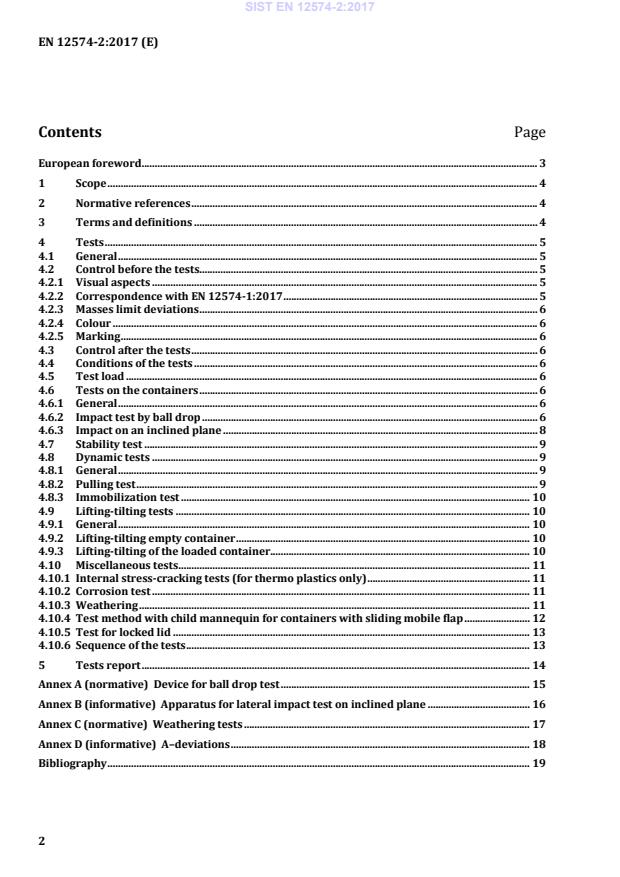
Device for ball drop test . 15 Annex B (informative)
Apparatus for lateral impact test on inclined plane . 16 Annex C (normative)
Weathering tests . 17 Annex D (informative)
A–deviations . 18 Bibliography . 19
Safety and health requirements; According to the CEN-CENELEC Internal Regulations, the national standards organisations of the following countries are bound to implement this European Standard: Austria, Belgium, Bulgaria, Croatia, Cyprus, Czech Republic, Denmark, Estonia, Finland, Former Yugoslav Republic of Macedonia, France, Germany, Greece, Hungary, Iceland, Ireland, Italy, Latvia, Lithuania, Luxembourg, Malta, Netherlands, Norway, Poland, Portugal, Romania, Serbia, Slovakia, Slovenia, Spain, Sweden, Switzerland, Turkey and the United Kingdom. SIST EN 12574-2:2017
4.3 Control after the tests In spite of variations in deflection and sizes, it shall be possible to lift and tilt the container loaded according to 4.5 with nominal load safely on a designated lifting device and to move the container on its wheels if any. 4.4 Conditions of the tests The tests shall be carried out at the following temperatures: T1 = (23 ± 5) °C T2 =
(-180-2)°C. The minimum duration of conditioning before testing shall be 12 h. If the test is carried out outside the conditioned room and if the duration of the test is more than 5 min, then for each 5 min period of testing the container shall be reconditioned for at least 15 min before continuing the test. For special purposes a temperature lower than
« s z °C or higher than +23 °C can be agreed; in this case it shall be indicated in the test report. 4.5 Test load For the calculation of test loads either of the two following density values shall be taken: — 0,25 kg/dm3 for light waste (e.g. for plastics, plastic bottles, flasks, mixed waste); — 0,40 kg/dm3 for heavy waste (e.g. for glass, paper, organic waste, cardboard). The test load shall be the value of density as above multiplied by nominal volume and shall be HDPE granules in 25 kg bags having a specific mass of 0,5 kg/dm3 but no more than
2 500 kg. 4.6 Tests on the containers 4.6.1 General All tests shall be carried out on new containers, as per the sequence of tests in 4.10.4. 4.6.2 Impact test by ball drop The ball drop test is not compulsory for steel containers. The ability of the sensitive points such as welds and corners of the container to resist under impacts at temperature T2 shall be tested. The stationary containers shall stand on their wheels (if they are fitted) or on their supports. Ball drop test shall b
...