

EN 10346:2026
(Main)Continuously hot-dip coated steel flat products for cold forming - Technical delivery conditions
- Abstract
This document specifies requirements for continuously hot-dip coated products made of low carbon steels for cold forming, of steels for construction and steels with high proof strength for cold forming coated with zinc (Z), zinc-iron alloy (ZF), zinc-aluminium alloy (ZA), aluminium-zinc alloy (AZ), zinc-magnesium alloy (ZM), aluminium-silicon alloy (AS) or aluminium (A) and for continuously hot-dip coated products made of multiphase steels for cold forming coated with zinc (Z), zinc-iron alloy (ZF), zinc-aluminium alloy (ZA) or zinc-magnesium alloy (ZM) in thicknesses of 0,20 mm ≤ t ≤ 6,5 mm.
By agreement at the time of enquiry and order, this document is applicable to continuously hot-dip coated flat products of an expanded validity range defined for thicknesses t < 0,20 mm with agreed mechanical properties and test specimens, adhesion of coating and surface condition requirements. This document is applicable to strip of all widths and to sheets cut from it (≥600 mm width) and cut lengths (<600 mm width).
NOTE The products covered by this document are used where cold formability, high strength, a defined minimum yield strength and/or corrosion resistance are the most important factors. Corrosion resistance of the product is depending on coating type and coating thickness, hence to its mass (see also 7.3.2). The products covered by this document can be used as substrates for organic coated flat products specified in EN 10169 for building and general engineering applications.
- Status
- Not Published
- Publication Date
- 13-Oct-2026
- Technical Committee
- ECISS/TC 109 - Coated and uncoated flat products to be used for cold forming
- Current Stage
- 6055 - CEN Ratification completed (DOR) - Publishing
- Start Date
- 31-Aug-2026
- Due Date
- 02-Sep-2026
- Completion Date
- 31-Aug-2026

EN 10346:2026 is a CEN standard for continuously hot-dip coated steel flat products for cold forming. It specifies technical delivery conditions for low carbon steels, steels for construction, steels with high proof strength for cold forming, and multiphase steels, with coatings such as zinc (Z), zinc-iron alloy (ZF), zinc-aluminium alloy (ZA), zinc-magnesium alloy (ZM), aluminium-silicon alloy (AS) and aluminium (A). It is intended for strip, sheets cut from strip, and cut lengths, where formability, strength and corrosion resistance matter in practice.
What does EN 10346:2026 specify?
EN 10346:2026 covers continuously hot-dip coated flat products in the thickness range 0,20 mm ≤ t ≤ 6,5 mm, with an expanded thickness range below 0,20 mm available by agreement. The document is organized as a delivery standard: it defines product families, ordering information, manufacturing and processing notes, material requirements, inspection, marking, packing, storage and transportation.
The document applies to strip of all widths, sheets cut from it with width at least 600 mm, and cut lengths below 600 mm. It also notes that these products can be used as substrates for organic coated flat products specified in EN 10169 for building and general engineering applications.
| Annex | What it covers |
|---|---|
| Annex A | Reference method for coating mass of Z, ZF, ZA and ZM |
| Annex B | Reference method for coating mass of AS and A |
| Annex C | Reference method for mass of the Al-Fe-Si alloy layer on AS coatings |
| Annex D | Tensile test results and coating impact |
| Annex E | Steel designations for multiphase steels for cold forming |
What are the key requirements of EN 10346:2026?
EN 10346:2026 sets the ordering, material, surface and inspection conditions that make these coated steels usable in production and fabrication. The most important point for users is that the steel family, coating type, coating mass, surface state and inspection route all have to be aligned at the time of enquiry and order.
Classification and ordering
Clause 4 classifies the steels by intended use and strength level, including low carbon steels for cold forming, steels for construction, steels with high proof strength for cold forming, and multiphase steels for cold forming. Steel names and steel numbers must follow EN 10027-1 and EN 10027-2, so buyers can order the exact grade without ambiguity.
Clause 5 lists the mandatory order information. This includes product form, dimensions, the dimensional standard, the standard number EN 10346, the steel name or number, coating type, nominal coating mass, coating finish, surface quality, surface treatment and, where relevant, the specimen choice for mechanical testing. In practice, this is the data that prevents wrong grades, wrong coatings or wrong finish from being supplied.
Chemical composition and mechanical properties
Clause 7.1 ties chemical composition to cast-analysis limits in Tables 1 to 5, with product-analysis deviations only when agreed. That matters because chemistry drives formability, strength and coating compatibility, and any extra elements need to be reported on the inspection document.
Clause 7.2 sets mechanical-property requirements by steel family and by test direction. It also states how long the stated properties apply after the products are made available, with different periods for low carbon steels, construction steels, bake-hardening steels, high strength steels and multiphase steels. For buyers, this means stock age and processing time matter, especially for grades sensitive to ageing or stretcher strains.
Coatings, coating mass and surface condition
Clause 7.3 limits the coating types to the specified metallic coatings for each steel family and defines the coating-mass designation. Table 12 gives the coating-mass classes, and different masses on each surface can be agreed. This affects corrosion resistance, but also formability and weldability, so coating selection is not just a corrosion decision.
Clause 7.4 and 7.5 define the finish and surface-quality system. The surface qualities A, B and C correspond to as-coated, improved and best quality surfaces, with skin passing used for B and C. In practice, this tells the purchaser what level of appearance, paintability and defect tolerance to expect.
Clause 7.6 lists surface treatments: chemically passivated, oiled, both, phosphated, phosphated and oiled, or sealed. The treatments are aimed at temporary corrosion protection and downstream processing, so the purchaser needs to decide whether transport protection or forming performance is the priority.
Inspection and acceptance
Clause 8 sets the inspection route. Unless otherwise agreed, delivery is with non-specific inspection and no inspection document. If specific testing is required, the type of inspection document must be agreed, and EN 10204 governs the document type. The test unit is limited to a maximum of 30 t or a fraction of 30 t of the same grade, thickness, coating mass and surface condition.
Clause 8 also defines the main tests: tensile testing, r- and n-value determination where specified, bake-hardening index where specified, and coating-mass determination. This is the basis for acceptance, claims and traceability.
What terms does EN 10346:2026 define?
- Nominal (specified) thickness - the ordered thickness of the metallic coated product, including both the steel core and the coating.
- Steel core thickness - the nominal thickness minus the metallic coating layers, used as the design thickness for calculations in EN 1993-1-3.
- Coating mass - the total coating mass on both surfaces, expressed in grams per square metre, and used in the coating designation.
- Bake-hardening steel (B) - steel that increases in proof strength after heating around 170 °C for 20 min, which helps formed parts resist denting.
- Dual-phase steel with improved formability (XH) - steel mainly made of ferrite and martensite with small amounts of bainite and retained austenite, giving higher uniform elongation.
- Complex-phase steel with improved formability (CH) - steel mainly made of martensite, bainite and retained austenite, with a high yield ratio at a given tensile strength.
- Transformation induced plasticity steel (T) - steel with retained austenite that transforms during forming, increasing work hardening and elongation.
- Surface quality A, B or C - the surface quality classes used to match appearance, defect tolerance and paintability to the intended use.
Who uses EN 10346:2026?
EN 10346:2026 is used by steel producers, coil coaters, stockholders, purchasers and quality staff who order, test or certify coated flat products. It is also relevant to fabricators and processors doing cold forming, welding, bonding or organic coating, because the standard links surface state and coating type to downstream processing.
Designers and suppliers working with cold-formed structural steel elements and roof, ceiling, floor and wall applications use it together with EN 1090-4 and the Eurocode references named in the document. The note in the scope also points to building and general engineering applications where corrosion resistance and formability are both important.
What changed in EN 10346:2026 from the previous edition?
The document states that it will supersede EN 10346:2015. The foreword lists these technical changes: the scope and normative references were updated; definitions were added in Clause 3; hot-dip aluminium coating was added and hot-dip aluminium-zinc alloy coating was deleted; new steel families XH, CH and AH were added; options for S550GDR and S650GDR were added; new construction and micro-alloyed grades were added, including requirements for minimum proportional elongation for some thicker products; new cold-rolled and hot-rolled multiphase steels were added; and new informative Annexes D and E were introduced.
Which standards are used with EN 10346:2026?
EN 10346:2026 relies on several companion standards for steel definition, designation, testing and delivery. EN 10020, EN 10021 and EN 10079 provide the general steel definitions and delivery-condition framework. EN 10027-1 and EN 10027-2 define steel names and numerical designations.
EN 10049 is used for roughness measurement, EN 10143 for tolerances on dimensions and shape, and EN 10204 for inspection documents. EN 10325, EN ISO 6892-1, EN ISO 10113 and EN ISO 10275 support the mechanical tests for bake-hardening, tensile properties, plastic strain ratio and strain-hardening exponent. The document also names EN 10373 for model-based property determination, EN 1090-4 and EN 1993-1-1/1-3 for structural use, EN 10169 for organic coated products, and EN ISO 14713-1 for corrosion-protection guidance.
What does the EN 10346:2026 document contain?
EN 10346:2026 contains chemistry tables for the steel families, mechanical-property tables by family and coating type, and coating-mass tables with designation rules. It also gives the available coating finishes, surface-quality classes and surface-treatments, so the purchaser can specify how the product should look and behave in service.
The inspection clauses define sampling, tensile testing, r- and n-value determination, bake-hardening index testing, surface inspection and coating-mass testing. Annexes A to C provide the chemical strip-off methods for coating mass and the Al-Fe-Si alloy layer, while Annex D explains how tensile results can differ depending on whether the coating is included in the calculation. Annex E links the multiphase steel names in this standard with the designations used in VDA 239-100.
Relations
- Effective Date
- 28-Apr-2021
Get Certified
Connect with accredited certification bodies for this standard

Element Materials Technology
Materials testing and product certification.

Inštitut za kovinske materiale in tehnologije
Institute of Metals and Technology. Materials testing, metallurgical analysis, NDT.
Sponsored listings
Frequently Asked Questions
EN 10346:2026 is a draft published by the European Committee for Standardization (CEN). Its full title is "Continuously hot-dip coated steel flat products for cold forming - Technical delivery conditions". This standard covers: This document specifies requirements for continuously hot-dip coated products made of low carbon steels for cold forming, of steels for construction and steels with high proof strength for cold forming coated with zinc (Z), zinc-iron alloy (ZF), zinc-aluminium alloy (ZA), aluminium-zinc alloy (AZ), zinc-magnesium alloy (ZM), aluminium-silicon alloy (AS) or aluminium (A) and for continuously hot-dip coated products made of multiphase steels for cold forming coated with zinc (Z), zinc-iron alloy (ZF), zinc-aluminium alloy (ZA) or zinc-magnesium alloy (ZM) in thicknesses of 0,20 mm ≤ t ≤ 6,5 mm. By agreement at the time of enquiry and order, this document is applicable to continuously hot-dip coated flat products of an expanded validity range defined for thicknesses t < 0,20 mm with agreed mechanical properties and test specimens, adhesion of coating and surface condition requirements. This document is applicable to strip of all widths and to sheets cut from it (≥600 mm width) and cut lengths (<600 mm width). NOTE The products covered by this document are used where cold formability, high strength, a defined minimum yield strength and/or corrosion resistance are the most important factors. Corrosion resistance of the product is depending on coating type and coating thickness, hence to its mass (see also 7.3.2). The products covered by this document can be used as substrates for organic coated flat products specified in EN 10169 for building and general engineering applications.
This document specifies requirements for continuously hot-dip coated products made of low carbon steels for cold forming, of steels for construction and steels with high proof strength for cold forming coated with zinc (Z), zinc-iron alloy (ZF), zinc-aluminium alloy (ZA), aluminium-zinc alloy (AZ), zinc-magnesium alloy (ZM), aluminium-silicon alloy (AS) or aluminium (A) and for continuously hot-dip coated products made of multiphase steels for cold forming coated with zinc (Z), zinc-iron alloy (ZF), zinc-aluminium alloy (ZA) or zinc-magnesium alloy (ZM) in thicknesses of 0,20 mm ≤ t ≤ 6,5 mm. By agreement at the time of enquiry and order, this document is applicable to continuously hot-dip coated flat products of an expanded validity range defined for thicknesses t < 0,20 mm with agreed mechanical properties and test specimens, adhesion of coating and surface condition requirements. This document is applicable to strip of all widths and to sheets cut from it (≥600 mm width) and cut lengths (<600 mm width). NOTE The products covered by this document are used where cold formability, high strength, a defined minimum yield strength and/or corrosion resistance are the most important factors. Corrosion resistance of the product is depending on coating type and coating thickness, hence to its mass (see also 7.3.2). The products covered by this document can be used as substrates for organic coated flat products specified in EN 10169 for building and general engineering applications.
EN 10346:2026 is classified under the following ICS (International Classification for Standards) categories: 77.140.50 - Flat steel products and semi-products. The ICS classification helps identify the subject area and facilitates finding related standards.
EN 10346:2026 has the following relationships with other standards: It is inter standard links to EN 10346:2015. Understanding these relationships helps ensure you are using the most current and applicable version of the standard.
EN 10346:2026 is available in PDF format for immediate download after purchase. The document can be added to your cart and obtained through the secure checkout process. Digital delivery ensures instant access to the complete standard document.
Standards Content (Sample)
SLOVENSKI STANDARD
oSIST prEN 10346:2025
01-julij-2025
Kontinuirno vroče prevlečeni jekleni ploščati izdelki za hladno preoblikovanje -
Tehnični dobavni pogoji
Continuously hot-dip coated steel flat products for cold forming - Technical delivery
conditions
Kaltgewalzte kontinuierlich schmelztauchveredelte Flacherzeugnisse aus Stahl -
Technische Lieferbedingungen
Produits plats en acier revêtus en continu par immersion à chaud pour formage à froid -
Conditions techniques de livraison
Ta slovenski standard je istoveten z: prEN 10346
ICS:
77.140.50 Ploščati jekleni izdelki in Flat steel products and semi-
polizdelki products
oSIST prEN 10346:2025 en,fr,de
2003-01.Slovenski inštitut za standardizacijo. Razmnoževanje celote ali delov tega standarda ni dovoljeno.
oSIST prEN 10346:2025
oSIST prEN 10346:2025
DRAFT
EUROPEAN STANDARD
prEN 10346
NORME EUROPÉENNE
EUROPÄISCHE NORM
May 2025
ICS 77.140.50 Will supersede EN 10346:2015
English Version
Continuously hot-dip coated steel flat products for cold
forming - Technical delivery conditions
Produits plats en acier revêtus en continu par Kaltgewalzte kontinuierlich schmelztauchveredelte
immersion à chaud pour formage à froid - Conditions Flacherzeugnisse aus Stahl - Technische
techniques de livraison Lieferbedingungen
This draft European Standard is submitted to CEN members for enquiry. It has been drawn up by the Technical Committee
CEN/TC 459/SC 9.
If this draft becomes a European Standard, CEN members are bound to comply with the CEN/CENELEC Internal Regulations
which stipulate the conditions for giving this European Standard the status of a national standard without any alteration.
This draft European Standard was established by CEN in three official versions (English, French, German). A version in any other
language made by translation under the responsibility of a CEN member into its own language and notified to the CEN-CENELEC
Management Centre has the same status as the official versions.
CEN members are the national standards bodies of Austria, Belgium, Bulgaria, Croatia, Cyprus, Czech Republic, Denmark, Estonia,
Finland, France, Germany, Greece, Hungary, Iceland, Ireland, Italy, Latvia, Lithuania, Luxembourg, Malta, Netherlands, Norway,
Poland, Portugal, Republic of North Macedonia, Romania, Serbia, Slovakia, Slovenia, Spain, Sweden, Switzerland, Türkiye and
United Kingdom.
Recipients of this draft are invited to submit, with their comments, notification of any relevant patent rights of which they are
aware and to provide supporting documentation.
Warning : This document is not a European Standard. It is distributed for review and comments. It is subject to change without
notice and shall not be referred to as a European Standard.
EUROPEAN COMMITTEE FOR STANDARDIZATION
COMITÉ EUROPÉEN DE NORMALISATION
EUROPÄISCHES KOMITEE FÜR NORMUNG
CEN-CENELEC Management Centre: Rue de la Science 23, B-1040 Brussels
© 2025 CEN All rights of exploitation in any form and by any means reserved Ref. No. prEN 10346:2025 E
worldwide for CEN national Members.
oSIST prEN 10346:2025
prEN 10346:2025 (E)
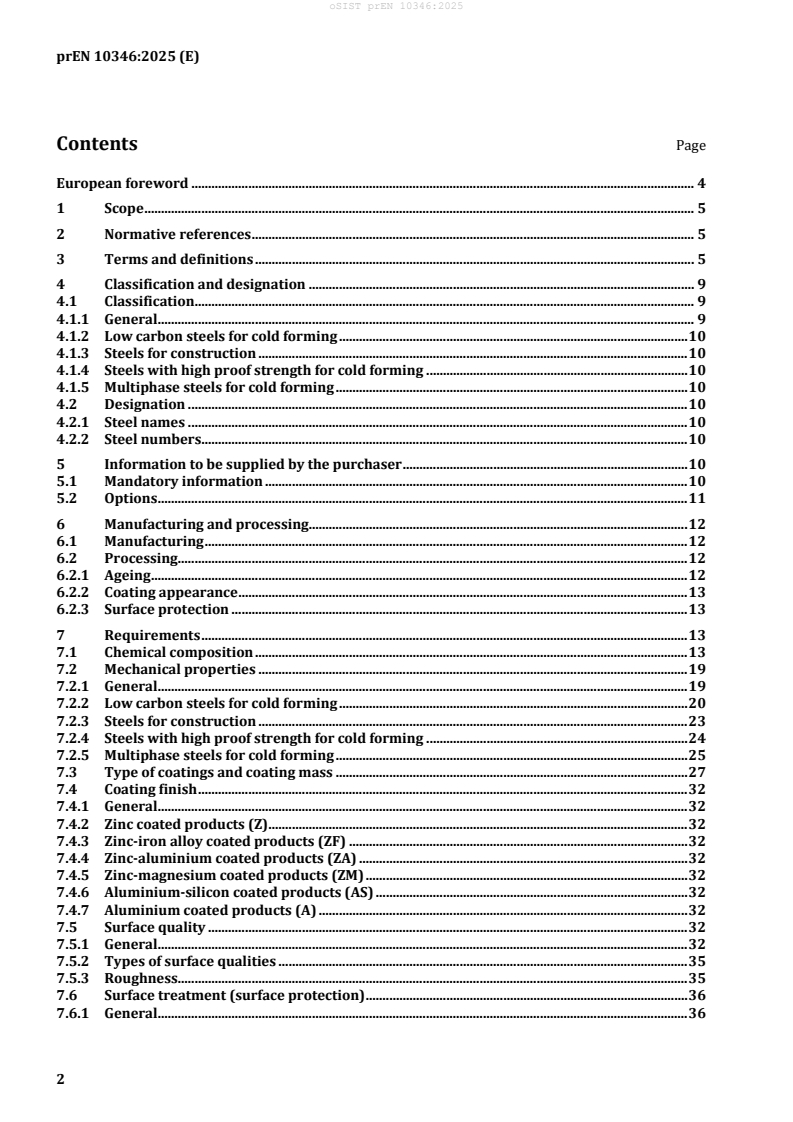
Contents Page
European foreword . 4
1 Scope . 5
2 Normative references . 5
3 Terms and definitions . 5
4 Classification and designation . 9
4.1 Classification . 9
4.1.1 General . 9
4.1.2 Low carbon steels for cold forming . 10
4.1.3 Steels for construction . 10
4.1.4 Steels with high proof strength for cold forming . 10
4.1.5 Multiphase steels for cold forming . 10
4.2 Designation . 10
4.2.1 Steel names . 10
4.2.2 Steel numbers . 10
5 Information to be supplied by the purchaser . 10
5.1 Mandatory information . 10
5.2 Options . 11
6 Manufacturing and processing. 12
6.1 Manufacturing . 12
6.2 Processing . 12
6.2.1 Ageing . 12
6.2.2 Coating appearance . 13
6.2.3 Surface protection . 13
7 Requirements . 13
7.1 Chemical composition . 13
7.2 Mechanical properties . 19
7.2.1 General . 19
7.2.2 Low carbon steels for cold forming . 20
7.2.3 Steels for construction . 23
7.2.4 Steels with high proof strength for cold forming . 24
7.2.5 Multiphase steels for cold forming . 25
7.3 Type of coatings and coating mass . 27
7.4 Coating finish . 32
7.4.1 General . 32
7.4.2 Zinc coated products (Z) . 32
7.4.3 Zinc-iron alloy coated products (ZF) . 32
7.4.4 Zinc-aluminium coated products (ZA) . 32
7.4.5 Zinc-magnesium coated products (ZM) . 32
7.4.6 Aluminium-silicon coated products (AS) . 32
7.4.7 Aluminium coated products (A) . 32
7.5 Surface quality . 32
7.5.1 General . 32
7.5.2 Types of surface qualities . 35
7.5.3 Roughness . 35
7.6 Surface treatment (surface protection) . 36
7.6.1 General . 36
oSIST prEN 10346:2025
prEN 10346:2025 (E)
7.6.2 Chemical passivation (C) . 36
7.6.3 Oiling (O) . 36
7.6.4 Chemical passivation and oiling (CO) . 36
7.6.5 Phosphating (P) . 37
7.6.6 Sealing (S) . 37
7.7 Coil breaks and bends (kinks) . 37
7.7.1 Freedom from coil breaks . 37
7.7.2 Bends (kinks) by winding on coiler drums . 37
7.8 Stretcher strains . 37
7.9 Coating mass . 37
7.10 Adhesion of coating . 38
7.11 Surface condition . 38
7.12 Tolerances on dimensions and shape . 38
7.13 Suitability for further processing . 38
8 Inspection . 38
8.1 Types of inspection and inspection documents. 38
8.2 Test units . 39
8.3 Tests to be carried out . 39
8.4 Sampling . 39
8.5 Test methods . 40
8.5.1 Tensile test . 40
8.5.2 Plastic strain ratio and hardening exponent . 41
8.5.3 Bake hardening index . 41
8.5.4 Surface inspection . 41
8.5.5 Coating mass . 41
8.6 Retests . 41
9 Marking . 41
10 Packing . 42
11 Storage and transportation . 42
Annex A (normative) Reference method for determination of the zinc, zinc-iron, zinc-
aluminium and zinc-magnesium coating mass . 43
Annex B (normative) Reference method for determination of the aluminium-silicon and
aluminium coating mass . 45
Annex C (normative) Reference method for determination of the mass of the Al-Fe-Si alloy
layer . 46
Annex D (informative) Tensile test results and coating impact . 47
Annex E (informative) Steel designations for multiphase steels for cold forming . 49
Bibliography . 51
oSIST prEN 10346:2025
prEN 10346:2025 (E)
European foreword
This document (prEN 10346:2025) has been prepared by Technical Committee CEN/TC 459/SC 9
“Coated and uncoated flat products to be used for cold forming”, the secretariat of which is held by
AFNOR.
This document is currently submitted to the CEN Enquiry.
This document will supersede EN 10346:2015.
prEN 10346:2025 includes the following significant technical changes with respect to EN 10346:2015:
— scope and normative references have been updated;
— addition of normative reference to:
o EN 10373, Determination of the physical and mechanical properties of steels using models;
o EN 1090-4, Execution of steel structures and aluminium structures - Part 4: Technical
requirements for cold-formed structural steel elements and cold-formed structures for roof, ceiling,
floor and wall applications
o EN 1993-1-1, Eurocode 3 - Design of steel structures - Part 1-1: General rules and rules for buildings
o EN 1993-1-3, Eurocode 3 - Design of steel structures - Part 1-3: General rules - Supplementary rules
for cold-formed members and sheeting
— definitions have been added in Clause 3;
— addition of hot-dip aluminium coating and deletion of hot-dip aluminium-zinc alloy coating;
— addition of three new steel families: dual-phase steels with improved formability (XH), complex-
phase steels with improved formability (CH) and multi-phase steels with improved formability (AH);
— addition of options referring to new steel grades S550GDR and S650GDR in Clause 5.2;
— addition of three new steel grades for construction: S500GD, S550GDR and S650GDR;
— addition of two new micro-alloyed steel grades: HX600LAD and HX700LAD;
— addition of minimum requirements regarding proportional elongation of steel grades for
construction and micro-alloyed steel grades with thickness ≥ 3,0 mm;
— addition of cold-rolled multiphase steels for cold forming: HCT780XG, HCT1180X, HCT1180XG,
HCT590XH, HCT780XH, HCT980XH, HCT1180XH, HCT1180C, HCT980CH, HCT1180CH, HCT1370CH,
HCT980AH and HCT1180AH;
— addition of hot-rolled multiphase steels for cold forming: HDT760C and HDT950C;
— addition of an informative Annex about tensile tests results and coating impact;
— addition of an informative Annex about steel designations for multiphase steels for cold forming.
oSIST prEN 10346:2025
prEN 10346:2025 (E)
1 Scope
This document specifies requirements for continuously hot-dip coated products made of low carbon
steels for cold forming, of steels for construction and of steels with high proof strength for cold forming
coated with zinc (Z), zinc-iron alloy (ZF), zinc-aluminium alloy (ZA), zinc-magnesium alloy (ZM),
aluminium-silicon alloy (AS) or aluminium (A) and for continuously hot-dip coated products made of
multiphase steels for cold forming coated with zinc (Z), zinc-iron alloy (ZF), zinc-aluminium alloy (ZA) or
zinc-magnesium alloy (ZM) in thicknesses of 0,20 mm ≤ t ≤ 6,5 mm.
By agreement at the time of enquiry and order, this document is applicable to continuously hot-dip coated
flat products of an expanded validity range defined for thicknesses t < 0,20 mm with agreed mechanical
properties and test specimens, adhesion of coating and surface condition requirements. This document
applies to strip of all widths and to sheets cut from it (≥600 mm width) and cut lengths (<600 mm width).
NOTE The products covered by this document are used where cold formability, high strength, a defined
minimum yield strength and/or corrosion resistance are the most important factors. Corrosion resistance of the
product is depending on coating type and coating thickness, hence to its mass (see also 7.3.2). The products covered
by this document can be used as substrates for organic coated flat products specified in EN 10169 for building and
general engineering applications.
2 Normative references
The following documents are referred to in the text in such a way that some or all of their content
constitutes requirements of this document. For dated references, only the edition cited applies. For
undated references, the latest edition of the referenced document (including any amendments) applies.
EN 10020, Definition and classification of grades of steel
EN 10021, General technical delivery conditions for steel products
EN 10027-1, Designation systems for steels — Part 1: Steel names
EN 10027-2, Designation systems for steels — Part 2: Numerical system
EN 10049, Measurement of roughness average Ra and peak count RPc on metallic flat products
EN 10079, Definition of steel products
EN 10143, Continuously hot-dip coated steel sheet and strip — Tolerances on dimensions and shape
EN 10204, Metallic products — Types of inspection documents
EN 10325, Steel — Determination of yield strength increase by the effect of heat treatment [Bake-
Hardening-Index]
EN ISO 6892-1, Metallic materials — Tensile testing — Part 1: Method of test at room temperature
(ISO 6892-1)
EN ISO 10113, Metallic materials — Sheet and strip — Determination of plastic strain ratio (ISO 10113)
EN ISO 10275, Metallic materials — Sheet and strip — Determination of tensile strain hardening exponent
(ISO 10275)
3 Terms and definitions
For the purposes of this document, the terms and definitions given in EN 10020, EN 10021, EN 10079,
EN 10204 and the following apply.
oSIST prEN 10346:2025
prEN 10346:2025 (E)
ISO and IEC maintain terminology databases for use in standardization at the following addresses:
— ISO Online browsing platform: available at https://www.iso.org/obp/
— IEC Electropedia: available at https://www.electropedia.org/
NOTE General definitions and guidelines for the protection of iron and steel can be found in EN ISO 14713-1.
3.1
nominal (specified) thickness
ordered thickness of the metallic coated product
Note 1 to entry: Nominal thickness includes both steel core and coating (t )
nom
3.2
steel core thickness
nominal (specified) thickness minus the metallic coating layers
Note 1 to entry: The steel core thickness is in accordance with the definition in EN 1993-1-3 (t ). It is the design
cor
thickness for calculations in accordance with EN 1993-1-3.
3.3
hot-dip zinc coating
Z
application of a zinc coating by immersing the prepared strip in a molten bath of zinc
Note 1 to entry: The zinc content is at least 98,5 mass %.
Note 2 to entry: See also 7.4.2.
3.4
hot-dip zinc-iron alloy coating
ZF
application of a zinc-iron coating by immersing the prepared strip in a molten bath of zinc and a
subsequent annealing
Note 1 to entry: The zinc content of the bath is at least 99 mass %.
Note 2 to entry: The annealing produces an iron-zinc coating with an iron content of normally 8 mass % to 12 mass
%.
Note 3 to entry: See also 7.4.3.
3.5
hot-dip zinc-aluminium coating
ZA
application of a zinc-aluminium coating by immersing the prepared strip in a molten bath of zinc-
aluminium
Note 1 to entry: The composition of the bath is approximately 5 mass % aluminium, small amounts of mischmetal
and the balance zinc.
Note 2 to entry: See also 7.4.4.
oSIST prEN 10346:2025
prEN 10346:2025 (E)
3.6
hot dip zinc-magnesium coating
ZM
application of a zinc-magnesium coating by immersing the prepared strip in a molten bath of zinc-
aluminium-magnesium
Note 1 to entry: The composition of the bath is sum of aluminium and magnesium from 1,5 mass % to 8 mass %,
containing minimum of 0,2 mass % magnesium and the balance zinc.
Note 2 to entry: For information on chemical composition and density, the manufacturer can be asked for advice.
Note 3 to entry: Due to differences in coating bath chemistry, the properties provided by each coating can differ
(e.g surface aspect, processability, corrosion resistance) and the manufacturer can be asked for advice.
Note 4 to entry: See also 7.4.5.
3.7
hot-dip aluminium-silicon alloy coating
AS
application of an aluminium-silicon coating by immersing the prepared strip in a molten bath of
aluminium-silicon
Note 1 to entry: The composition of the bath is 8 to 11 mass % silicon, up to 5 mass % iron, up to 1 mass %
additional elements and the balance aluminium.
Note 2 to entry: See also 7.4.6.
3.8
hot-dip aluminium coating
A
application of an aluminium coating by immersing the prepared strip in a molten bath of pure aluminium
Note 1 to entry: The iron content in the bath is less than 5 mass %.
Note 2 to entry: see also 7.4.7.
3.9
coating mass
total mass of coating given for both surfaces
Note 1 to entry: In combination with the symbol for the coating type (Z, ZF, ZA, ZM, AS,A), the nominal coating mass
is used as coating designation.
Note 2 to entry: The coating mass is expressed in grams per square metre.
Note 3 to entry: See 7.9.
oSIST prEN 10346:2025
prEN 10346:2025 (E)
3.10
bake-hardening steel
B
steel exhibiting an increase in proof strength following heating in the region of 170°C for 20 min
Note 1 to entry: These steels have a good suitability for cold forming and present a high resistance to plastic
straining (which is increased on finished parts during heat treatment) and a good dent resistance.
3.11
complex-phase steel
C
steel with a multiphase microstructure containing mainly bainite, ferrite, whereas martensite, tempered
martensite, retained austenite and pearlite may be present as additional phases
Note 1 to entry: The fine grained microstructure can be generated by retarded recrystallization or precipitation of
micro-alloying elements.
3.12
complex-phase steel with improved formability
CH
steel consisting mainly of martensite, bainite and retained austenite
Note 1 to entry: Depending on strength class, small amounts of ferrite can also be present.
Note 2 to entry: At a given high tensile strength, complex phase steels with improved formability show a high yield
ratio (Re/Rm).
3.13
dual-phase steel
X
steel consisting of mainly ferrite and martensite and possible bainite as a complementary phase
Note 1 to entry: According to their high tensile strength levels, dual phase steels show a low yield strength ratio
and a high work hardening rate.
3.14
dual-phase steel with improved formability
XH
steel consisting mainly of ferrite and martensite and small amounts of bainite and retained austenite
Note 1 to entry: According to their high tensile strength levels, dual phase steels with improved formability show
higher uniform elongation.
3.15
ferritic-bainitic steel
F
steel with a matrix of ferrite or strengthened ferrite containing bainite or strengthened bainite
Note 1 to entry: The strengthening of the matrix is caused by a high density of dislocations, by grain refinement
and precipitation of micro-alloying elements.
Symbol used in the steel name (see Tables 3, 4 and 5).
oSIST prEN 10346:2025
prEN 10346:2025 (E)
3.16
high strength interstitial free steel
Y
steel whose composition is controlled to achieve improved plastic strain ratio r and strain hardening
exponent n values
Note 1 to entry: These steels have both, a high mechanical strength and an excellent suitability for cold forming,
due to their solid solution hardening and interstitial free microstructure.
3.17
low alloy steel
micro-alloyed steel
LA
steel containing one or more of alloying elements Nb, Ti and V to achieve required proof strength levels
Note 1 to entry: Combined precipitation and grain refinement hardening modes allow reaching a high mechanical
resistance while reducing the content of alloying elements.
Note 2 to entry: Alternatively, carbon-manganese alloying concepts in combination with grain refinement can be
used.
3.18
low carbon steel
steel with low carbon content characterized by low yield strength and high ductility
3.19
multi-phase steels with high global formability
AH
steel containing a combination of tempered martensite, bainite and retained austenite
Note 1 to entry: Ferrite and martensite can be present.
3.20
steel for construction
steel with minimum strength levels and no special demand for suitability for cold forming
3.21
transformation induced plasticity steel
T
steel with a ferritic matrix containing retained austenite capable of transformation into martensite during
the forming process (TRIP effect)
Note 1 to entry: Because of high work-hardening rate the steel reaches high uniform elongation values and high
tensile strength levels.
4 Classification and designation
4.1 Classification
4.1.1 General
The steels covered by this document are either alloy quality steels or non-alloy quality steels in
accordance with EN 10020. All steels in Tables 1, 3, 4, 5 and steel grade S650GDR in Table 2 are alloy
quality steels. All steels in Table 2 with the exception of S650GDR are non-alloy quality steels.
oSIST prEN 10346:2025
prEN 10346:2025 (E)
4.1.2 Low carbon steels for cold forming
The steel grades are classified in accordance with their increasing suitability for cold forming as follows
(see Table 7):
— DX51D: bending and profiling quality;
— DX52D: drawing quality;
— DX53D: deep drawing quality;
— DX54D: special deep drawing quality;
— DX55D: special deep drawing quality (only +AS);
— DX56D: extra deep drawing quality;
— DX57D: super deep drawing quality;
— DX58D: extra super deep drawing quality.
Only steel grades DX51D, DX52D and DX53D can be ordered as hot rolled products.
4.1.3 Steels for construction
The steel grades are classified in accordance with their increasing minimum proof strength Rp (see
0,2
Table 8).
4.1.4 Steels with high proof strength for cold forming
The steel grades are classified in accordance with their increasing minimum proof strength Rp (see
0,2
Table 9).
Only low alloy/micro-alloyed steel grades can be ordered as hot rolled products.
4.1.5 Multiphase steels for cold forming
The steel grades are classified in accordance with their increasing minimum tensile strength Rm (see
Tables 10 and 11). See Annex E for the steel names and steel numbers of advanced high strength steels
(AHSS).
4.2 Designation
4.2.1 Steel names
The steel names shall be in accordance with EN 10027-1.
4.2.2 Steel numbers
The steel numbers shall be in accordance with EN 10027-2.
5 Information to be supplied by the purchaser
5.1 Mandatory information
The following information shall be supplied by the purchaser at the time of enquiry and order:
a) quantity to be delivered;
b) type of product (strip, sheet, cut length);
oSIST prEN 10346:2025
prEN 10346:2025 (E)
c) number of the dimensional standard in accordance with EN 10143;
d) nominal dimensions and the tolerances on dimensions and shape and, if applicable, letters denoting
relevant special tolerances;
e) term “steel”;
f) number of this document, i.e. EN 10346;
g) steel name or steel number and symbol for the type of hot-dip coating as given in Tables 1 to 5;
h) number designating the nominal mass of coating (e.g. 275 = 275 g/m including both surfaces, see
Table 12);
i) letter denoting the coating finish (N or M, see 7.4.2 and Table 13);
j) letter denoting the surface quality (A, B or C, see 7.5 and Tables 13 to 15);
k) letter denoting the surface treatment (C, O, CO, P, PO or S, see 7.6);
l) if relevant (see 8.5.1), selection of the test piece (proportional (A ) or non-proportional (A )
prop 80
specimen) for determination of the mechanical properties.
EXAMPLE 1 sheet, delivered with dimensional tolerances in accordance with EN 10143 with nominal
thickness of 0,80 mm, ordered with special thickness tolerances (S), nominal width 1 200 mm, ordered with special
width tolerances (S), nominal length 2 500 mm, ordered with special flatness tolerances (FS), made of steel
DX53D+Z (1.0951+Z) in accordance with EN 10346, coating mass 100 g/m (100), minimized spangle (M), surface
quality (B), surface treatment oiled (O):
1 sheet EN 10143 — 0,80Sx1200Sx2500FS — steel EN 10346 — DX53D+Z100–M–B–O
or:
1 sheet EN 10143 — 0,80Sx1200Sx2500FS — steel EN 10346 — 1.0951+Z100 –M–B–O.
5.2 Options
A number of options are specified in this document and listed below. lf the purchaser does not indicate a
wish to implement any of these options, the products shall be supplied in accordance with the basis
specification of this document (see 5.1).
1) specification of product thicknesses deviating from those generally covered in the scope (i.e.
t < 0,20 mm) (see Scope);
2) verification of the product analysis (see 7.1);
3) date of supply for products free from stretcher strains when cold forming (see 7.2.1.3);
4) products supplied suitable for the manufacture of a specific part (see 7.2.2.2 and 7.2.4.2);
5) supply of steel grade S550GDR with specified minimum ratio Rm/Re ≥ 1,10 and A ≥ 15 % for
prop
dimensioning in accordance with EN 1993-1-1 (see 7.2.3 – Table 8), where Re is either Rp or Re in
02 H
dependence of yield point phenomenon (footnote b, Table 8).
In case of organic coated steel, this option 5 is upon agreement of the manufacturer.
oSIST prEN 10346:2025
prEN 10346:2025 (E)
6) Supply of steel grade S550GDR or S650GDR with specified minimum ratio Rm/Re ≥ 1,05 for
dimensioning in accordance with EN 1993-1-1 (see 7.2.3 – Table 8), where Re is either Rp or Re in
02 H
dependence of yield point phenomenon (footnote b, Table 8).
In case of organic coated steel, this option 6 is upon agreement of the manufacturer.
7) coating masses different from those of Table 12 and/or special requirements for different coating
masses on each surface (see 7.3.2);
8) special coatings and/or surface qualities (see Tables 13 and 15, footnote a);
9) hot-dip zinc coated products with pronounced spangle (see 7.4.2.1);
10) special requirements for a maximum Al-Fe-Si alloy layer mass occurring during hot-dip aluminium-
silicon coating (see 7.4.7);
11) hot-dip coated products with surface quality A without skin passing (see 7.5.2.1);
12) requirement for special applications on bright appearance for aluminium-silicon coated products
(type B surface, see NOTE to 7.5.2.2);
13) range and verification of surface roughness (see 7.5.3);
14) selection of the protective oil (see 7.6.1);
15) type of S coating (see 7.6.6);
16) products free from coil breaks (see 7.7.1);
17) type of inspection and, if applicable, inspection document to be delivered (see 8.1);
18) notification of which surface has been inspected (see 8.5.4.2);
19) marking desired by branding of the products (see 9.2);
20) requirement for packing (see Clause 10);
21) according to EN 1090-4
i) determination of the ratio bend radius to thickness, if relevant;
ii) display of the result of the adhesion test in the inspection document (see 7.10).
6 Manufacturing and processing
6.1 Manufacturing
Unless there are restrictions by the selected steel grade, the processes used in steelmaking and the
manufacture of the products shall be left to the discretion of the manufacturer.
6.2 Processing
6.2.1 Ageing
Due to ageing, a reduction in formability can take place for all the products supplied according to this
document. Coil breaks or fluting can occur additionally during processing. The risk of coil breaks
increases, especially for thicknesses > 0,9 mm, with the duration of storage.
oSIST prEN 10346:2025
prEN 10346:2025 (E)
Therefore the user should process the products after their receipt as quick as possible (see 7.2.1.3).
6.2.2 Coating appearance
The coating surface can vary and change to a dark appearance by oxidation.
Due to ageing of the coating a certain cracking of the surface can appear during processing which can
consequently reduce abrasion resistance.
The user should take these characteristics into account.
6.2.3 Surface protection
Regarding surface protection during transport and storage the following should be taken into
consideration:
— Only a temporary corrosion resistance during transportation or storage is provided by any surface
protection applied. Colour changes can occur.
— In particular, protection by oiling is dependent on storage time. The primarily uniform oil film
becomes more and more unequal, and bare spots can develop. Different oils can show different
behaviour.
7 Requirements
7.1 Chemical composition
The chemical composition according to the cast analysis shall be as specified in Tables 1 to 5.
If a product analysis is agreed at the time of enquiry and order, the permitted deviations from the cast
analysis given in Tables 1 to 5 shall meet the requirements in Table 6.
Table 1 — Chemical composition (cast analysis) of low carbon steels for cold forming
Chemical composition
Designation % by mass
max.
Steel grade
Symbols for the types of
a
C Si Mn P S Ti
Steel Steel
available coatings
name number
DX51D 1.0917 +Z,+ZF,+ZA,+ZM, +AS 0,18 1,20 0,12
DX52D 1.0918 +Z,+ZF,+ZA,+ZM, +AS
DX53D 1.0951 +Z,+ZF,+ZA,+ZM, +AS
DX54D 1.0952 +Z,+ZF,+ZA,+ZM, +AS
DX55D 1.0962 +AS 0,12 0,50 0,60 0,10 0,045 0,30
DX56D 1.0963 +Z,+ZF,+ZA,+ZM, +AS
DX57D 1.0853 +Z,+ZF,+ZA,+ZM,+AS
DX58D 1.9946 +Z
a
By agreement at the time of enquiry and order, the content of Ti for the steel grades mentioned in
this Table may be lowered to < 0,05 % which means that the steel grade is non alloyed.
oSIST prEN 10346:2025
prEN 10346:2025 (E)
Table 2 — Chemical composition (cast analysis) of steels for construction
Chemical composition
Designation % by mass
max.
Steel grade
Symbols for the types of
C Si Mn P S
Steel
available coatings
Steel name
number
S220GD 1.0241 +Z,+ZF,+ZA,+ZM, +A
S250GD 1.0242 +Z,+ZF,+ZA,+ZM, +AS, +A
S280GD 1.0244 +Z,+ZF,+ZA,+ZM, +AS, +A
S320GD 1.0250 +Z,+ZF,+ZA,+ZM, +AS, +A
S350GD 1.0529 +Z,+ZF,+ZA,+ZM, +AS, +A
S390GD 1.0238 +Z,+ZF,+ZA,+ZM 0,20 0,60 1,70 0,10 0,045
S420GD 1.0239 +Z,+ZF,+ZA,+ZM
S450GD 1.0233 +Z,+ZF,+ZA,+ZM
S500GD 1.9527 +Z,+ZF,+ZA,+ZM
S550GD 1.0531 +Z,+ZF,+ZA,+ZM
Steels for construction with specified minimum ductility (R)
a
S550GDR 1.9541 +Z,+ZA,+ZM 0,20 0,60 1,70 0,10 0,045
a
S650GDR 1.9542 +Z, +ZA,+ZM 0,2 0,6 2,00 0,10 0,045
By agreement at the time of enquiry and order, if other chemical elements are added, they shall be
mentioned on the inspection document which may need a change of classification.
a
R means steel grade with specified minimum ductility, because these steels show a high total elongation in
relation to high strengths.
oSIST prEN 10346:2025
prEN 10346:2025 (E)
Table 3 — Chemical composition (cast analysis) of steels
with high proof strength for cold forming
Chemical composition
Steel grade
% by mass
+Z,+ZF,+ZA, +ZM, +AS C Si Mn P S Al Nb Ti
total
Steel name Steel number max. max. max. max. max. max. max.
HX160YD 1.0910 0,01 0,30 0,60 0,060 0,025 ≥ 0,010 0,09 0,12
HX180YD 1.0921 0,01 0,30 0,70 0,060 0,025 ≥ 0,010 0,09 0,12
HX180BD 1.0914 0,06 0,50 0,70 0,060 0,025 ≥ 0,015 0,09 0,12
HX220YD 1.0923 0,01 0,30 0,90 0,080 0,025 ≥ 0,010 0,09 0,12
HX220BD 1.0919 0,08 0,50 0,70 0,085 0,025 ≥ 0,015 0,09 0,12
HX260YD 1.0926 0,01 0,30 1,60 0,10 0,025 ≥ 0,010 0,09 0,12
HX260BD 1.0924 0,10 0,50 1,00 0,10 0,030 ≥ 0,010 0,09 0,12
HX260LAD 1.0929 0,11 0,50 1,00 0,030 0,025 ≥ 0,015 0,09 0,15
HX300YD 1.0927 0,015 0,30 1,60 0,10 0,025 ≥ 0,010 0,09 0,12
HX300BD 1.0930 0,11 0,50 0,80 0,12 0,025 ≥ 0,010 0,09 0,12
HX300LAD 1.0932 0,12 0,50 1,40 0,030 0,025 ≥ 0,015 0,09 0,15
HX340BD 1.0945 0,11 0,50 0,80 0,12 0,025 ≥ 0,010 0,09 0,12
HX340LAD 1.0933 0,12 0,50 1,4 0,030 0,025 ≥ 0,015 0,10 0,15
HX380LAD 1.0934 0,12 0,50 1,5 0,030 0,025 ≥ 0,015 0,10 0,15
HX420LAD 1.0935 0,12 0,50 1,6 0,030 0,025 ≥ 0,015 0,10 0,15
HX460LAD 1.0990 0,15 0,50 1,7 0,030 0,025 ≥ 0,015 0,10 0,15
HX500LAD 1.0991 0,15 0,50 1,7 0,030 0,025 ≥ 0,015 0,10 0,15
HX600LAD 1.9950 0,15 0,50 2,0 0,030 0,025 ≥ 0,015 0,10 0,15
HX700LAD 1.9951 0,15 0,50 2,0 0,030 0,025 ≥ 0,015 0,10 0,17
oSIST prEN 10346:2025
prEN 10346:2025 (E)
Table 4 — Chemical composition (cast analysis) of multiphase steels
for cold forming (cold rolled products)
Chemical composition
Steel grade % by mass
+Z,+ZF,+ZM
Cr + Nb +
C Si Mn P S Al B
total
Mo Ti
Steel name Steel number max. max. max. max. max. max. max. max.
Dual-phase steels (X)
0,015 to
HCT450X 1.0937 0,14 0,75 2,00 0,080 0,015
1,00 0,15 0,005
1,0
0,015 to
HCT490X 1.0995 0,14 0,50 1,80 0,050 0,010 1,00 0,15 0,005
1,0
0,015 to
HCT590X 1.0996 0,15 0,80 2,50 0,050 0,010 1,40 0,15 0,005
1,5
0,015 to
HCT780X 1.0943 0,18 0,80 2,50 0,050 0,010 1,40 0,15 0,005
2,0
0,015 to
a
HCT780XG 1.9926 0,18 0,80 2,50 0,05 0,01 1,4 0,15 0,005
1,0
0,015 to
HCT980X 1.0944 0,20 1,00 2,90 0,050 0,010 1,40 0,15 0,005
2,0
0,015 to
a
HCT980XG 1.0997 0,23 1,00 2,90 0,050 0,010 1,40 0,15 0,005
2,0
0,015 to
HCT1180X 1.9929 0,25 1,00 2,90 0,050 0,010 1,40 0,15 0,005
1,0
0,015 to
a
HCT1180XG 1.9930 0,20 1,00 2,90 0,050 0,010 1,40 0,15 0,005
1,0
Dual-phase steels with improved formability (XH)
0,015 to
HCT590XH 1.9931 0,15 0,80 2,50 0,050 0,010 1,40 0,15 0,005
1,0
0,015 to
HCT780XH 1.9932 0,18 0,80 2,50 0,050 0,010 1,40 0,15 0,005
1,0
0,015 to
HCT980XH 1.9933 0,23 1,20 2,90 0,050 0,010 1,40 0,15 0,005
1,0
0,015 to
HCT1180XH 1.9934 0,25 1,50 2,90 0,050 0,010 1,40 0,15 0,005
1,0
Transformation induced plasticity steels (T)
0,015 to
HCT690T 1.0947 0,24 2,00 2,20 0,050 0,010 0,60 0,20 0,005
2,0
0,015 to
HCT780T 1.0948 0,25 2,20 2,50 0,050 0,010 0,60 0,20 0,005
2,0
oSIST prEN 10346:2025
prEN 10346:2025 (E)
Chemical composition
Steel grade % by mass
+Z,+ZF,+ZM
Cr + Nb +
C Si Mn P S Al B
total
Mo Ti
Steel name Steel number max. max. max. max. max. max. max. max.
Complex-phase steels (C)
0,015 to
HCT600C 1.0953 0,18 0,80 2,20 0,080 0,015 1,00 0,15 0,005
2,0
0,015 to
HCT780C 1.0954 0,18 1,00 2,50 0,050 0,010 1,00 0,15 0,005
1,0
0,015 to
HCT980C 1.0955 0,23 1,00 2,70 0,050 0,010 1,00 0,15 0,005
1,0
0,015 to
HCT1180C 1.9928 0,23 1,00 2,90 0,050 0,010 1,00 0,15 0,005
1,0
Complex-phase steels with improved formability (CH)
0,015 to
HCT980CH 1.9935 0,20 1,20 3,00 0,050 0,015 1,00 0,15 0,005
1,0
0,015 to
HCT1180CH 1.9936 0,23 1,20 3,00 0,050 0,010 1,00 0,15 0,005
1,0
0,015 to
HCT1370CH 1.9937 0,26 1,20 3,00 0,050 0,010 1,00 0,15 0,005
1,0
Multi-phase steels with high global formability (AH)
0,015 to
HCT980AH 1.9938 0,26 2,20 2,50 0,050 0,010 1,40 0,15 0,005
2,0
0,015 to
HCT1180AH 1.9939 0,26 2,20 3,00 0,050 0,010 1,40 0,15 0,005
2,0
a
XG means dual-phase steel with increased yield strength.
oSIST prEN 10346:2025
prEN 10346:2025 (E)
Table 5 — Chemical composition (cast analysis) of multiphase steels
for cold forming (hot rolled products)
Chemical composition
Steel grade % by mass
+Z,+ZF, +ZM
Cr + Nb +
C Si Mn P S Al B
total
Mo Ti
Steel
Steel name max. max max. max. max. max. max. max.
number
Ferritic-bainitic steels (F)
0,015
HDT450F 1.0961 0,18 0,50 2,00 0,050 0,010 1,00 0,15 0,005
to 2,0
0,015
HDT580F 1.0994 0,18 0,50 2,00 0,050 0,010 1,00 0,15 0,01
to 2,0
Dual-phase steel (X)
0,015
HDT580X 1.0936 0,14 1,0 2,20 0,085 0,015 1,40 0,15 0,005
to 1,0
Complex-phase steels (C)
0,015
HDT760C 1.0998 0,18 1,00 2,20 0,050 0,010
1,00 0,25 0,005
to 1,2
0,015
HDT950C 1.0958 0,23 1,00 2,70 0,080 0,015 1,20 0,25 0,005
to 1,20
oSIST prEN 10346:2025
prEN 10346:2025 (E)
Table 6 — Permissible deviations of th
...