


EN 419211-6:2014
(Main)Protection profiles for secure signature creation device - Part 6: Extension for device with key import and trusted channel to signature creation application
Protection profiles for secure signature creation device - Part 6: Extension for device with key import and trusted channel to signature creation application
This European Standard specifies a protection profile for a secure signature creation device that may import signing keys and communicate with the signature creation application in protected manner: secure signature creation device with key import and trusted communication with signature creation application (SSCD KI TCSCA).
Schutzprofile für sichere Signaturerstellungseinheiten - Teil 6: Erweiterung für Einheiten mit Schlüsselimport und vertrauenswürdigem Kanal zur Signaturerstellungsanwendung
Diese Europäische Norm legt ein Schutzprofil für eine sichere Signaturerstellungseinheit fest, die Signatur-schlüssel importieren und in geschützter Weise mit der Signaturerstellungsanwendung kommunizieren darf: Sichere Signaturerstellungseinheit mit Schlüsselimport und vertrauenswürdigem Kanal zur Signaturerstellungs-anwendung (SSCD KI TCSCA).
Profils de protection pour dispositif sécurisé de création de signature électronique - Partie 6: Extension pour un dispositif avec import de clé et communication sécurisée avec l'application de création de signature
La présente Norme européenne spécifie un profil de protection pour un dispositif sécurisé de création de signature électronique pouvant importer des clés de signature et communiquer avec l'application de création de signature électronique d'une manière protégée : Dispositif sécurisé de création de signature électronique avec importation de clé et communication sécurisée avec l'application de création de signature électronique (SSCD KI TCSCA).
Profil zaščite sredstva za varno elektronsko podpisovanje - 6. del: Podaljšek za sredstvo, ki z vnosom ključa in zaupnim komuniciranjem z aplikacijo s podpisovanjem
Ta evropski standard določa profil zaščite sredstva za varno elektronsko podpisovanje, ki lahko v notranjosti tvori ključe in zaščiteno izvozi javni ključ: sredstvo za varno elektronsko podpisovanje s tvorjenjem ključa in zaupno komuniciranje z aplikacijo s tvorjenjem potrdila.
General Information
- Status
- Published
- Publication Date
- 07-Oct-2014
- Withdrawal Date
- 29-Apr-2015
- Drafting Committee
- CEN/TC 224/WG 17 - Protection Profiles in the context of SSCD
- Current Stage
- 9020 - Submission to 2 Year Review Enquiry - Review Enquiry
- Start Date
- 15-Jan-2026
- Completion Date
- 15-Jan-2026
Relations
- Effective Date
- 09-Feb-2026
- Effective Date
- 09-Feb-2026
- Effective Date
- 09-Feb-2026
- Refers
EN 419211-1:2014 - Protection profiles for secure signature creation device - Part 1: Overview - Effective Date
- 28-Jan-2026
- Effective Date
- 28-Jan-2026
- Effective Date
- 28-Jan-2026
- Referred By
CEN/TS 419241:2014 - Security Requirements for Trustworthy Systems Supporting Server Signing - Effective Date
- 28-Jan-2026
Overview
EN 419211-6:2014 is a CEN protection profile (PP) that extends the SSCD (secure signature creation device) family to cover devices that import signing keys and use a trusted channel to a signature creation application. Often referenced as SSCD KI TCSCA, this PP defines the security functional and assurance requirements for devices (the TOE) that import signature creation data (SCD), protect reference authentication data (RAD), and ensure integrity/confidentiality of the data-to-be-signed when communicating with a signature creation application (SCA).
Key facts:
- Part of the EN 419211 series (Part 6).
- CC version: Common Criteria 3.1 Revision 4; registration BSI-CC-PP-0076.
- Assurance level: EAL4 augmented with AVA_VAN.5.
- Intended to support compliance with EU Directive 1999/93/EC (Annex III) for advanced/qualified electronic signatures.
Key topics and technical requirements
- Scope: Protection profile for SSCDs that perform key import and trusted communication to an SCA (SSCD KI TCSCA).
- Security objectives: Protect confidentiality and integrity of SCD and RAD, restrict SCD use to its signatory, and ensure integrity of data-to-be-signed via a trusted channel.
- Operational environments covered:
- Preparation (importing SCD, initializing RAD, certificate generation interaction)
- Signing (SCA supplies DTBS or DTBS/R via trusted channel)
- Management (lifecycle and administrative operations)
- Functional requirements: Secure storage and use of signing keys, authentication of signatory, integrity protection of DTBS, trusted channel establishment between TOE and SCA.
- Assurance: Common Criteria evaluation at EAL4+AVA_VAN.5; follows ISO/IEC 15408 Parts 1–3.
Applications - who uses this standard
- Device manufacturers (smart cards, secure tokens, HSM vendors) implementing key-import-capable SSCDs.
- Trust service providers and certificate authorities that provision devices and issue certificates for use in qualified or advanced electronic signatures.
- System integrators and software developers building signature creation applications that must interoperate over a trusted channel with SSCDs.
- Evaluators and accreditation bodies conducting Common Criteria assessments against a recognized European PP.
Practical benefits include clearer evaluation targets for product certification, enabling devices to be used in complex signing scenarios (remote provisioning, multi-application environments) while supporting legal acceptance under EU rules when combined with qualified certificates.
Related standards
- EN 419211-1:2014 (Overview) and other parts of the EN 419211 series (Parts 2–5)
- ISO/IEC 15408 (Common Criteria) Parts 1–3
- EU Directive 1999/93/EC (electronic signatures)
Keywords: secure signature creation device, SSCD KI TCSCA, key import, trusted channel, electronic signature, digital signature, Common Criteria, EAL4, protection profile, CEN.


Get Certified
Connect with accredited certification bodies for this standard

BSI Group
BSI (British Standards Institution) is the business standards company that helps organizations make excellence a habit.

Bureau Veritas
Bureau Veritas is a world leader in laboratory testing, inspection and certification services.

DNV
DNV is an independent assurance and risk management provider.
Sponsored listings
Frequently Asked Questions
EN 419211-6:2014 is a standard published by the European Committee for Standardization (CEN). Its full title is "Protection profiles for secure signature creation device - Part 6: Extension for device with key import and trusted channel to signature creation application". This standard covers: This European Standard specifies a protection profile for a secure signature creation device that may import signing keys and communicate with the signature creation application in protected manner: secure signature creation device with key import and trusted communication with signature creation application (SSCD KI TCSCA).
This European Standard specifies a protection profile for a secure signature creation device that may import signing keys and communicate with the signature creation application in protected manner: secure signature creation device with key import and trusted communication with signature creation application (SSCD KI TCSCA).
EN 419211-6:2014 is classified under the following ICS (International Classification for Standards) categories: 03.160 - Law. Administration; 35.030 - IT Security; 35.040 - Information coding; 35.100.05 - Multilayer applications; 35.240.15 - Identification cards. Chip cards. Biometrics. The ICS classification helps identify the subject area and facilitates finding related standards.
EN 419211-6:2014 has the following relationships with other standards: It is inter standard links to ISO/IEC 15408-1:2009, ISO/IEC 15408-2:2008, ISO/IEC 15408-3:2008, EN 419211-1:2014, CEN/TS 16326:2013, CEN/TS 419261:2015, CEN/TS 419241:2014. Understanding these relationships helps ensure you are using the most current and applicable version of the standard.
EN 419211-6:2014 is associated with the following European legislation: EU Directives/Regulations: 910/2014; Standardization Mandates: M/460. When a standard is cited in the Official Journal of the European Union, products manufactured in conformity with it benefit from a presumption of conformity with the essential requirements of the corresponding EU directive or regulation.
EN 419211-6:2014 is available in PDF format for immediate download after purchase. The document can be added to your cart and obtained through the secure checkout process. Digital delivery ensures instant access to the complete standard document.
Standards Content (Sample)
2003-01.Slovenski inštitut za standardizacijo. Razmnoževanje celote ali delov tega standarda ni dovoljeno.SRGSLVRYDQMHPSchutzprofile für sichere Signaturerstellungseinheiten - Teil 6: Erweiterung für Einheiten mit Schlüsselimport und vertrauenswürdigem Kanal zur SignaturerstellungsanwendungProfils de protection pour dispositif sécurisé de création de signature électronique - Partie 6: Extension pour un dispositif avec import de clé et communication sécurisée avec l'application de création de signatureProtection profiles for secure signature creation device - Part 6: Extension for device with key import and trusted channel to signature creation application35.100.05UHãLWYHMultilayer applications35.040Nabori znakov in kodiranje informacijCharacter sets and information coding03.160Pravo. UpravaLaw. AdministrationICS:Ta slovenski standard je istoveten z:EN 419211-6:2014SIST EN 419211-6:2014en,de01-december-2014SIST EN 419211-6:2014SLOVENSKI
STANDARD
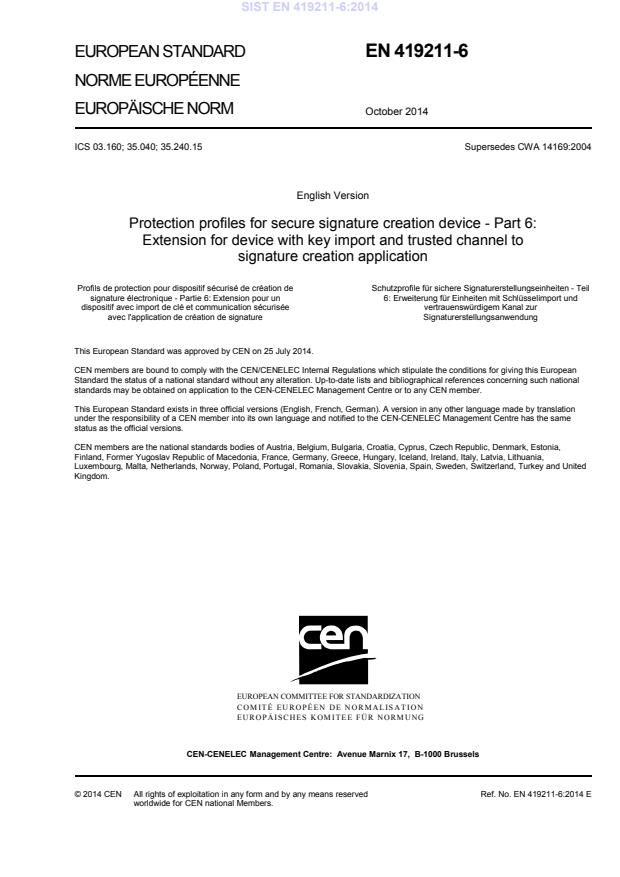
EUROPEAN STANDARD NORME EUROPÉENNE EUROPÄISCHE NORM
EN 419211-6
October 2014 ICS 03.160; 35.040; 35.240.15 Supersedes CWA 14169:2004English Version
Protection profiles for secure signature creation device - Part 6: Extension for device with key import and trusted channel to signature creation application
Profils de protection pour dispositif sécurisé de création de signature électronique - Partie 6: Extension pour un dispositif avec import de clé et communication sécurisée avec l'application de création de signature
Schutzprofile für sichere Signaturerstellungseinheiten - Teil 6: Erweiterung für Einheiten mit Schlüsselimport und vertrauenswürdigem Kanal zur Signaturerstellungsanwendung This European Standard was approved by CEN on 25 July 2014.
CEN members are bound to comply with the CEN/CENELEC Internal Regulations which stipulate the conditions for giving this European Standard the status of a national standard without any alteration. Up-to-date lists and bibliographical references concerning such national standards may be obtained on application to the CEN-CENELEC Management Centre or to any CEN member.
This European Standard exists in three official versions (English, French, German). A version in any other language made by translation under the responsibility of a CEN member into its own language and notified to the CEN-CENELEC Management Centre has the same status as the official versions.
CEN members are the national standards bodies of Austria, Belgium, Bulgaria, Croatia, Cyprus, Czech Republic, Denmark, Estonia, Finland, Former Yugoslav Republic of Macedonia, France, Germany, Greece, Hungary, Iceland, Ireland, Italy, Latvia, Lithuania, Luxembourg, Malta, Netherlands, Norway, Poland, Portugal, Romania, Slovakia, Slovenia, Spain, Sweden, Switzerland, Turkey and United Kingdom.
EUROPEAN COMMITTEE FOR STANDARDIZATION
COMITÉ EUROPÉEN DE NORMALISATION EUROPÄISCHES KOMITEE FÜR NORMUNG
CEN-CENELEC Management Centre:
Avenue Marnix 17,
B-1000 Brussels © 2014 CEN All rights of exploitation in any form and by any means reserved worldwide for CEN national Members. Ref. No. EN 419211-6:2014 ESIST EN 419211-6:2014
1) ISO/IEC 15408-1, ISO/IEC 15408-2 and ISO/IEC 15408-3 respectively correspond to Common Criteria for Information Technology Security Evaluation, Parts 1, 2 and 3.
2) This European Directive is referred to in this PP as “the Directive”. SIST EN 419211-6:2014
3) At a pure functional level the SSCD creates an electronic signature; for an implementation of the SSCD, in that meeting the requirements of this PP and with the key certificate generated as specified in the Directive, Annex I, the result of the signing process can be used as to create a qualified electronic signature. SIST EN 419211-6:2014
1) select a set of SCD if multiple sets are present in the SSCD,
2) authenticate the signatory and determine its intent to sign,
3) receive data to be signed or a unique representation thereof (DTBS/R) through a trusted channel with SCA,
4) apply an appropriate cryptographic signature creation function using the selected SCD to the DTBS/R. The TOE may implement its function for electronic signature creation to also conform to the specifications in ETSI/TS 101 733 (CAdES) [4], ETSI/TS 101 903 (XAdES) [5] and ETSI/TS 102 778 (PAdES) [6]. The TOE is prepared for the signatory's use by: a) importing at least one set of SCD, and b) personalizing for the signatory by storing in the TOE:
1) the signatory’s reference authentication data (RAD), SIST EN 419211-6:2014
2) optionally, certificate info for at least one SCD in the TOE. After import, the SCD is in a non-operational state. Upon receiving a TOE the signatory shall verify its non-operational state and change the SCD state to operational. After preparation, the intended legitimate user should be informed of the signatory’s verification authentication data (VAD) required for use of the TOE in signing. If the VAD is a password or PIN, the means of providing this information is expected to protect the confidentiality and the integrity of the corresponding RAD. If the use of an SCD is no longer required, then it should be destroyed (e.g. by erasing it from memory) as well as the associated certificate info, if any exists. 4.3.3 TOE lifecycle The TOE lifecycle is the same as defined in the PP SSCD KI [3], 4.3.3. 5 Conformance claims 5.1 CC conformance claim This PP uses ISO/IEC 15408-1. This PP is conforming to ISO/IEC 15408-2. This PP is conforming to ISO/IEC 15408-3. 5.2 PP claim, Package claim This PP is strictly conforming to the core PP SSCD KI [3] version 1.0.2 as dated of 2012-07-24. This PP is conforming to assurance package EAL4 augmented with AVA_VAN.5 defined in ISO/IEC 15408-3. 5.3 Conformance rationale This PP SSCD KI TCSCA conforms to the core PP SSCD KI [3]. This implies for this PP: a) The TOE type of this PP SSCD KI TCSCA is the same as the TOE type of the core PP SSCD KI: the TOE is a combination of hardware and software configured to securely create, use and manage signature creation data. b) The security problem definition (SPD) of this PP SSCD KI TCSCA contains the security problem definition of the core PP SSCD KI. The SPD for the SSCD KI TCSCA is described by the same threats, organisational security policies and assumptions as for the TOE in core PP SSCD KI. c) The security objectives for the TOE in this PP SSCD KI TCSCA include all the security objectives for the TOE of the core PP SSCD KI and add the security objective OT.TOE_TC_VAD_Imp (Trusted channel of TOE for VAD import) and OT.TOE_TC_DTBS_Imp (Trusted channel for DTBS). d) The security objectives for the operational environment in this PP SSCD KI TCSCA include all security objectives for the operational environment of the core PP SSCD KI except OE.HI_VAD and OE.DTBS_Protect. This PP adapts OE.HI_VAD and OE.DTBS_Protect to the support provided by the TOE by new security functionality (cf. OT.TOE_TC_VAD_Imp, OT.TOE_TC_DTBS_Imp) provided by the TOE and changes them into OE.HID_TC_VAD_Exp and OE.SCA_TC_DTBS_Exp (cf. 7.2 for details). SIST EN 419211-6:2014
Trusted channel of TOE for VAD import The TOE shall provide a trusted channel for the protection of the confidentiality and integrity of the VAD received from the HID as needed by the authentication method employed. Application note 1: This security objective for the TOE is partly covering OE.HID_VAD from the core PP. While OE.HID_VAD in the core PP requires only the operational environment to protect VAD, this PP requires the HID and the TOE to implement a trusted channel for the protection of the VAD: the HID exports the VAD and e
...
Questions, Comments and Discussion
Ask us and Technical Secretary will try to provide an answer. You can facilitate discussion about the standard in here.
Loading comments...