

prEN 18357
(Main)Digital declaration of performance and conformity (DoPC) of construction products - Methodology, general requirements and criteria to develop data templates
- Abstract
This document specifies a methodology, with general requirements and criteria, for the development of the data templates for the declaration of performance and conformity (DoPC) of construction products.
NOTE This document integrates a data template structure from EN ISO 23387:2025 [4] to be used for DoPC of construction products, together with a methodology for experts to develop domain specific data templates, following EN ISO 23386:2020 [3] and the standards from CEN/CLC/JTC 24.
Annex A provides guidance for the development of data templates for harmonized technical specifications (hTS) and European assessment documents (EAD), for product technical committees (TCs) and other stakeholders.
- Status
- Not Published
- Publication Date
- 27-Feb-2028
- Technical Committee
- CEN/TC 442 - Building Information Modelling (BIM)
- Current Stage
- 4060 - Closure of enquiry - Enquiry
- Start Date
- 01-Oct-2026
- Due Date
- 04-May-2026
- Completion Date
- 01-Oct-2026

prEN 18357 is a draft European Standard from CEN for the digital declaration of performance and conformity (DoPC) of construction products. It specifies a methodology, general requirements, and criteria for developing the data templates that carry DoPC content, so manufacturers, product technical committees, and other stakeholders can create machine-readable declarations that fit BIM and digital product passport use.
What does prEN 18357 specify?
prEN 18357 specifies how to develop the data templates for a digital DoPC for construction products. The document focuses on the structure of the information, the data point definitions behind each declared item, and the way those definitions are implemented in a data dictionary.
The scope is centered on DoPC content derived from harmonized technical specifications (hTS) or European assessment documents (EAD). The method is independent of the serialization syntax, so the same approach can be used whether the technical implementation is XML, JSON, or another format.
| Annex | What it covers |
|---|---|
| Annex A | Guidance for developing DoPC tables in hTS, including the tables for essential characteristics and common DoPC data points |
| Annex B | Standardized data dictionary elements, including subject properties, groups of properties, property relationships, and examples |
The document is organized into clauses on scope, normative references, terms and abbreviations, the DoPC structure, the process for defining and implementing digital DoPC, data point definition, development of tables, implementation in a data dictionary, and issuance of a digital DoPC.
What are the key requirements of prEN 18357?
prEN 18357 requires the DoPC to be built as a structured, machine-readable set of data points that can be traced back to defined templates in the hTS or EAD. In practice, that means each declared item must be identifiable, linked to its source, and implemented in a consistent data dictionary.
The DoPC structure follows the CPR model. Clause 5 says the data structure follows Annex V of Regulation (EU) 2024/3110. Unique identifiers for organizations or products should follow FprEN 18219:2026 where possible, and references to standards in the DoPC shall be dated. That matters because users need stable links and version control.
The process has three stages. Clause 6 separates the work into: developing the hTS tables, implementing the digital DoPC template in the data dictionary, and issuing the digital DoPC. This matters because product experts, data modelers, and publishers each have a different task and deliverable.
Data point definitions must be complete enough to make each declaration unique. Clause 7 requires metadata such as the performance characteristic, source document and clause, value kind, data type, permitted values or thresholds, quantity and unit, assessment process specifiers and conditions, and the applicable attestation and verification system (AVS). In practice, this prevents two different declarations from being confused in software.
Tables for DoPC are built from product definitions, intended use, essential characteristics, product requirements, and common data points. Clause 8 says the product definition shall include the product name, its composition, and intended use. If one product has several intended uses, each intended use is listed separately. This matters because many construction products change performance declaration depending on use.
One essential characteristics table and one product requirements table are defined per product definition. Clause 8.3 requires one, and only one, table of essential characteristics for each product definition, and Clause 8.4 requires one table of product requirements for each product definition. The essential characteristics table includes EC number, clause references, method reference, quantity, unit, value kind, value specification, AVS, and related entries. That gives each declared performance a clear technical lineage.
The value kind and AVS are controlled and explicit. Clause 8.3 uses defined value kinds such as less than, equal to, greater than, class, alphanumeric string, and multilanguage text, and AVS values such as AVS 1+, AVS 1, AVS 2+, AVS 3+, AVS 3, and AVS 4. This matters because users must know whether a result is a threshold, a class, or a text value, and what level of third-party involvement applies.
Common DoPC data points are standardized. Clause 8.5 and Annex A cover shared elements such as declaration code, version, date, signature, product identifier, batch and serial numbers, product family, product category, declared intended uses, dimensions, grading, key parts, service life, variants, deinstallation information, manufacturer details, links to REACH and general product information, certificates, technical reference documents, and declaration statements. This makes the header and administrative parts of a DoPC consistent across product families.
Implementation in the data dictionary is tightly modeled. Clause 9 requires the tables to be implemented in a data dictionary compliant with EN ISO 12006-3:2022, EN ISO 23386:2020, and EN ISO 23387:2025. Digital DoPC templates use a data template, intended use groups use a group of properties, and essential characteristics use a subject property. That matters because software can then resolve declarations, dependencies, and reusable definitions across products.
Dictionary references use defined URI structures. Clause 9.2 requires a dictionary reference to be a URI with a source identifier and a data-point-definition identifier, optionally with an entity identifier. This gives each declared data point a stable machine-readable address. Clause 10 then says the digital DoPC is issued as a set of data points, each linked to one and only one data point definition.
What terms does prEN 18357 define?
prEN 18357 defines the main data-model terms used to build and exchange a digital DoPC.
- digital declaration of performance and conformity (digital DoPC, dDoPC) - A machine-readable version of the required DoPC content for a construction product.
- data dictionary - A database that contains data point definitions and metadata about data points.
- declared data point - A structured data object in the DoPC that combines a declared value, an element identifier, and a reference to the relevant data dictionary entry.
- data point definition - Metadata describing a dictionary property and its relationships so the declared data point can be interpreted correctly.
- data template - A data structure used to describe the characteristics of objects.
- declaration of performance and conformity template (DoPC template) - A data template for a product category defined in an hTS or EAD.
- subject property - A dictionary representation of a data point definition that includes one declared property plus additional properties and filters that define its context.
- unique identifier (UID) / universally unique identifier (UUID) - Identifiers used to keep products, organizations, and data dictionary entries distinct.
Who uses prEN 18357?
prEN 18357 is used by manufacturers of construction products, economic operators placing those products on the market, and product technical committees preparing harmonized technical specifications. It is also relevant to domain experts who develop the tables, to data modelers who implement them in data dictionaries, and to organizations working on digital product passports and BIM interoperability.
In practice, the document supports the teams that prepare DoPC content, map declared performances to assessment methods, publish machine-readable product information, and link declarations to certificates, validation reports, and technical reference documents. It also helps notified bodies, Technical Assessment Bodies (TABs), and other conformity assessment actors understand how their outputs fit into the digital structure.
Which standards are used with prEN 18357?
prEN 18357 relies on several referenced standards and companion parts to define identifiers, data structures, quantities, units, and interoperability.
- EN ISO 12006-3:2022 - provides the object-oriented information framework and the data-dictionary meta level used for modeling.
- EN ISO 23386:2020 - provides the methodology for describing, authoring, and maintaining properties in interconnected data dictionaries.
- EN ISO 23387:2025 - provides the data template concepts adopted by this document.
- EN ISO 80000-1:2022 and EN ISO 80000-series - support quantities, units, quantity kinds, and dimensions.
- FprEN 18219:2026 - provides unique identifiers used for digital product passport elements and, where possible, for organizations and products.
- FprEN 18223:2026 - provides digital product passport system interoperability, which supports the way DoPC content is structured and grouped.
- ISO 639:2023 - provides language codes used for multilingual entries.
- ISO 8601-1:2019+A1:2023 - provides date and time representation rules.
What does the prEN 18357 document contain?
prEN 18357 contains a three-stage methodology, detailed table structures, and a data-dictionary model for digital DoPC content. Annex A provides templates and guidance for essential characteristics and common DoPC data points, including tables for product category, intended use, nominal dimensions, grading, key parts, manufacturer data, certificates, and declarations.
Annex B defines the standardized data dictionary elements behind those tables, including the meta-level relationships, common DoPC groups of properties, dictionary properties, value kinds, AVS values, and modeling rules for context specifiers and input specifiers. The annex also includes worked examples, such as a common cement template and example subject properties, to show how the method is meant to be implemented in practice.
Get Certified
Connect with accredited certification bodies for this standard

DIBt (Deutsches Institut für Bautechnik)
German Institute for Building Technology.
DIN CERTCO
DIN Group product certification.

Aboma Certification B.V.
Specialized in construction, metal, and transport sectors.
Sponsored listings
Frequently Asked Questions
prEN 18357 is a draft published by the European Committee for Standardization (CEN). Its full title is "Digital declaration of performance and conformity (DoPC) of construction products - Methodology, general requirements and criteria to develop data templates". This standard covers: This document specifies a methodology, with general requirements and criteria, for the development of the data templates for the declaration of performance and conformity (DoPC) of construction products. NOTE This document integrates a data template structure from EN ISO 23387:2025 [4] to be used for DoPC of construction products, together with a methodology for experts to develop domain specific data templates, following EN ISO 23386:2020 [3] and the standards from CEN/CLC/JTC 24. Annex A provides guidance for the development of data templates for harmonized technical specifications (hTS) and European assessment documents (EAD), for product technical committees (TCs) and other stakeholders.
This document specifies a methodology, with general requirements and criteria, for the development of the data templates for the declaration of performance and conformity (DoPC) of construction products. NOTE This document integrates a data template structure from EN ISO 23387:2025 [4] to be used for DoPC of construction products, together with a methodology for experts to develop domain specific data templates, following EN ISO 23386:2020 [3] and the standards from CEN/CLC/JTC 24. Annex A provides guidance for the development of data templates for harmonized technical specifications (hTS) and European assessment documents (EAD), for product technical committees (TCs) and other stakeholders.
prEN 18357 is classified under the following ICS (International Classification for Standards) categories: 91.010.10 - Legal aspects; 91.100.01 - Construction materials in general. The ICS classification helps identify the subject area and facilitates finding related standards.
prEN 18357 is associated with the following European legislation: EU Directives/Regulations: 305/2011. When a standard is cited in the Official Journal of the European Union, products manufactured in conformity with it benefit from a presumption of conformity with the essential requirements of the corresponding EU directive or regulation.
prEN 18357 is available in PDF format for immediate download after purchase. The document can be added to your cart and obtained through the secure checkout process. Digital delivery ensures instant access to the complete standard document.
Standards Content (Sample)
SLOVENSKI STANDARD
01-september-2026
Digitalna izjava o lastnostih in skladnosti (DoPC) gradbenih proizvodov -
Metodologija, splošne zahteve in merila za razvoj podatkovnih predlog
Digital declaration of performance and conformity (DoPC) of construction products -
Methodology, general requirements and criteria to develop data templates
Digitale Leistungserklärung von Bauprodukten - Methodik, allgemeine Anforderungen
und Kriterien für die Entwicklung von Datenvorlagen
Déclaration numérique de performance et de conformité (DoPC) des produits de
construction - Méthodologie, exigences générales et critères pour l’élaboration de
modèles de données
Ta slovenski standard je istoveten z: prEN 18357
ICS:
91.010.10 Pravni vidiki Legal aspects
91.100.01 Gradbeni materiali na Construction materials in
splošno general
2003-01.Slovenski inštitut za standardizacijo. Razmnoževanje celote ali delov tega standarda ni dovoljeno.
DRAFT
EUROPEAN STANDARD
NORME EUROPÉENNE
EUROPÄISCHE NORM
July 2026
ICS 91.010.10; 91.100.01
English Version
Digital declaration of performance and conformity (DoPC)
of construction products - Methodology, general
requirements and criteria to develop data templates
Déclaration numérique de performance et de Digitale Leistungserklärung von Bauprodukten -
conformité (DoPC) des produits de construction - Methodik, allgemeine Anforderungen und Kriterien für
Méthodologie, exigences générales et critères pour die Entwicklung von Datenvorlagen
l'élaboration de modèles de données
This draft European Standard is submitted to CEN members for enquiry. It has been drawn up by the Technical Committee
CEN/TC 442.
If this draft becomes a European Standard, CEN members are bound to comply with the CEN/CENELEC Internal Regulations
which stipulate the conditions for giving this European Standard the status of a national standard without any alteration.
This draft European Standard was established by CEN in three official versions (English, French, German). A version in any other
language made by translation under the responsibility of a CEN member into its own language and notified to the CEN-CENELEC
Management Centre has the same status as the official versions.
CEN members are the national standards bodies of Austria, Belgium, Bulgaria, Croatia, Cyprus, Czech Republic, Denmark, Estonia,
Finland, France, Germany, Greece, Hungary, Iceland, Ireland, Italy, Latvia, Lithuania, Luxembourg, Malta, Netherlands, Norway,
Poland, Portugal, Republic of North Macedonia, Romania, Serbia, Slovakia, Slovenia, Spain, Sweden, Switzerland, Türkiye and
United Kingdom.
Recipients of this draft are invited to submit, with their comments, notification of any relevant patent rights of which they are
aware and to provide supporting documentation.
Warning : This document is not a European Standard. It is distributed for review and comments. It is subject to change without
notice and shall not be referred to as a European Standard.
EUROPEAN COMMITTEE FOR STANDARDIZATION
COMITÉ EUROPÉEN DE NORMALISATION
EUROPÄISCHES KOMITEE FÜR NORMUNG
CEN-CENELEC Management Centre: Rue de la Science 23, B-1040 Brussels
© 2026 CEN All rights of exploitation in any form and by any means reserved Ref. No. prEN 18357:2026 E
worldwide for CEN national Members.
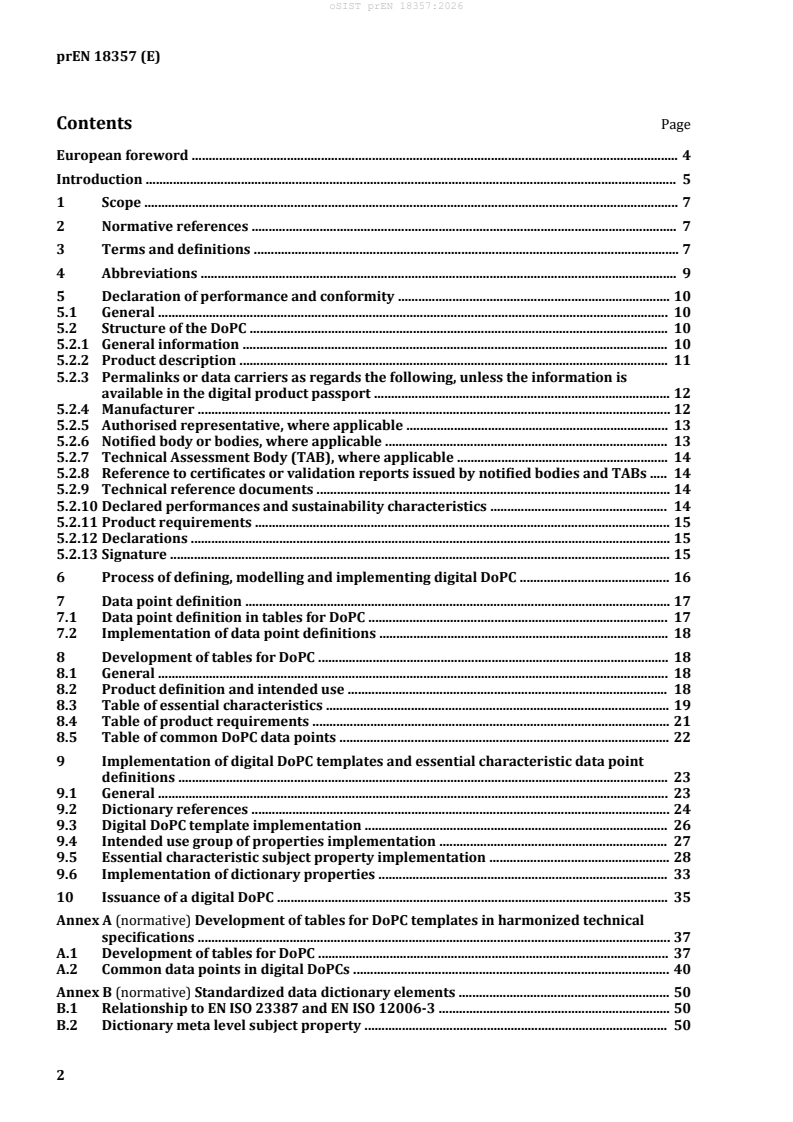
Contents Page
European foreword . 4
Introduction . 5
1 Scope . 7
2 Normative references . 7
3 Terms and definitions . 7
4 Abbreviations . 9
5 Declaration of performance and conformity . 10
5.1 General . 10
5.2 Structure of the DoPC . 10
5.2.1 General information . 10
5.2.2 Product description . 11
5.2.3 Permalinks or data carriers as regards the following, unless the information is
available in the digital product passport . 12
5.2.4 Manufacturer . 12
5.2.5 Authorised representative, where applicable . 13
5.2.6 Notified body or bodies, where applicable . 13
5.2.7 Technical Assessment Body (TAB), where applicable . 14
5.2.8 Reference to certificates or validation reports issued by notified bodies and TABs . 14
5.2.9 Technical reference documents . 14
5.2.10 Declared performances and sustainability characteristics . 14
5.2.11 Product requirements . 15
5.2.12 Declarations . 15
5.2.13 Signature . 15
6 Process of defining, modelling and implementing digital DoPC . 16
7 Data point definition . 17
7.1 Data point definition in tables for DoPC . 17
7.2 Implementation of data point definitions . 18
8 Development of tables for DoPC . 18
8.1 General . 18
8.2 Product definition and intended use . 18
8.3 Table of essential characteristics . 19
8.4 Table of product requirements . 21
8.5 Table of common DoPC data points . 22
9 Implementation of digital DoPC templates and essential characteristic data point
definitions . 23
9.1 General . 23
9.2 Dictionary references . 24
9.3 Digital DoPC template implementation . 26
9.4 Intended use group of properties implementation . 27
9.5 Essential characteristic subject property implementation . 28
9.6 Implementation of dictionary properties . 33
10 Issuance of a digital DoPC . 35
Annex A (normative) Development of tables for DoPC templates in harmonized technical
specifications . 37
A.1 Development of tables for DoPC . 37
A.2 Common data points in digital DoPCs . 40
Annex B (normative) Standardized data dictionary elements . 50
B.1 Relationship to EN ISO 23387 and EN ISO 12006-3 . 50
B.2 Dictionary meta level subject property . 50
B.3 Has subject property subject relationship . 51
B.4 Common DoPC groups of propertiesdata point definition identifieridentifier . 52
B.5 Common DoPC dictionary properties . 56
B.6 Modelling of dictionary properties . 65
B.7 Example of dDoPC template . 69
B.8 Example of intended use group of property . 70
B.9 Example of essential characteristic subject property . 71
Bibliography . 73
European foreword
This document (prEN 18357:2026) has been prepared by Technical Committee CEN/TC 442 "Building
Information Modelling (BIM)", the secretariat of which is held by Standards Norway.
This document is currently submitted to the CEN Enquiry.
Introduction
Manufacturers of construction products covered by the European Regulation 2024/3110[1] on the
marketing of construction products (CPR [1]) or economic operators who places such products on the
market will issue a digital copy of the declaration of performance and conformity (DoPC).
Whereas 38 of Regulation (EU) 2024/3110[1] states "an important prerequisite for machine-readable
declarations is a standardized IT format, which is required for each harmonized technical specificätion".
To ensure interoperability between product families, common criteria and requirements will be
provided to product TCs. This document intends to define such criteria and requirements.
This document introduces a methodology, independent of data serialization syntax (e.g. XML or JSON),
based on the following standards:
— EN ISO 12006-3:2022 [2]: provides a framework for object-oriented information related to
construction assets.
— EN ISO 23386:2020 [3]: explains how to establish, maintain and distribute data dictionaries.
— EN ISO 23387:2025 [4]: introduce new concepts on development and management of data
dictionaries and data templates.
— FprEN 18223:2026 [5]: explains how to structure contents of digital product passports.
This document enables compatibility with BIM standards developed by CEN/TC 442 and ISO/TC
59/SC 13. These standards include:
— EN ISO 16739-1 [6]Industry Foundation Classes (IFC) for data sharing in the construction and facility
management industries - Part 1: Data schema.
— EN 17549-2:2023 [7] Building information modelling – Information structure based on EN ISO
16739-1 to exchange data - Part 2: Configurable construction objects and requirements.
— EN 17632-1:2022 [8] Building information modelling (BIM) - Semantic modelling and linking (SML)
- Part 1: Generic modelling patterns.
— EN ISO 7817-1:2024 [9] Building information modelling — Level of information need Part 1: Concepts
and principles.
This document also considers the project in CEN/TC 442 WG 7 Building information modelling -
Methodology to enable design and product standards to support digitalization through using standards
developed by CEN/TC 442 . This document considers the Smart CE concept defined in CWA 17316:2018
[10] and UNE 41316:2020 [11]. Additional examples for the proposed methodology will be prepared
to facilitate the adoption of this document.
The DoPC will be integrated in the DPP of construction products.
NOTE 1 Article 75.2.a of Regulation (EU) 2024/3110[1] contains requirements that the CPR-DPP system to be
compatible with, interoperable with and based upon the DPP established by Regulation (EU) 2024/1781[12],
without compromising interoperability with BIM.
The DoPC includes predetermined environmental essential characteristics, and can refer to product
environmental requirements.
NOTE 2 Regarding predetermined environmental essential characteristics, see Annex II of Regulation (EU)
2024/3110[1].
NOTE 3 Regarding product requirements, see Annex III.3 of Regulation (EU) 2024/3110[1].
Working draft.
Environmental information follow the same data structure as other properties in the DoPC. The
predetermined environmental essential characteristics are generally life cycle assessment (LCA)
indicators or impact categories defined in EN 15804:2012 [13]. A BIM-compatible data template
structure for this information is provided in EN ISO 22057:2022 [14], which can also be used to digitize
generic LCA-data, providing useful information to be used in BIM and in building LCA tools. EN ISO
22057:2022 [14] applies to LCA-based environmental data calculated according to ISO 21930:2017
[15], UNE-EN 15804:2012+A1:2014 [16] and EN 15804:2012 [13].
1 Scope
This document specifies a methodology, with general requirements and criteria, for the development
of the data templates for the declaration of performance and conformity (DoPC) of construction
products.
NOTE This document integrates a data template structure from EN ISO 23387:2025 [4] to be used for DoPC of
construction products, together with a methodology for experts to develop domain specific data templates,
following EN ISO 23386:2020 [3] and the standards from CEN/CLC/JTC 24.
Annex A provides guidance for the development of data templates for harmonized technical
specificätions (hTS) and European assessment documents (EAD), for product technical committees
(TCs) and other stakeholders.
2 Normative references
The following referenced documents contain text which fully or in part is part of the requirements in
the document. For dated references, only the edition cited applies. For undated references, the latest
edition of the cited document applies (including amendments).
EN ISO 12006-3:2022, Building construction - Organization of information about construction works -
Part 3: Framework for object-oriented information (ISO 12006-3:2022)
EN ISO 23386:2020, Building information modelling and other digital processes used in construction -
Methodology to describe, author and maintain properties in interconnected data dictionaries (ISO
23386:2020)
EN ISO 23387:2025, Building information modelling (BIM) - Data templates for objects used in the life
cycle of assets (ISO 23387:2025)
EN ISO 80000-1:2022, Quantities and units - Part 1: General (ISO 80000-1:2022)
EN ISO 80000-series, Quantities and units (all parts)
FprEN 18219:2026, Digital product passport - Unique identifiers
FprEN 18223:2026, Digital Product Passport - System interoperability
ISO 639:2023, Code for individual languages and language groups
ISO 8601-1:2019+A1:2023, Date and time — Representations for information interchange — Part 1:
Basic rules
ISO 8601-1, Date and time — Representations for information interchange — Part 1: Basic rules
3 Terms and definitions
For the purposes of this document the following terms and definitions apply.
ISO and IEC maintain terminology databases for use in standardization at the following addresses:
— ISO Online browsing platform: available at http://www.iso.org/obp/
— IEC Electropedia: available at http://www.electropedia.org/
3.1
digital declaration of performance and conformity
digital DoPC
dDoPC
machine readable representation of the required content of a declaration of performance and
conformity
3.2
data dictionary
database that contains data point definitions and metadata about data points
[SOURCE: ISO/IEC 2382:2015 [17], 2121501, modified — The admitted term "information resource
dictionary" has been removed, the words "data point definitions and" and "about data points" are added.
The Notes to entry have been removed.]
3.3
unique identifier
unique ID
UID
identifier which is guaranteed to be unique among all identifiers used for a specific purpose
EXAMPLE 1 Globally unique identifiers (GUID) or universally unique identifiers (UUID) are examples of unique
identifiers generated by software systems.
EXAMPLE 2 Uniform resource identifiers (URI) or uniform resource locators (URL) are examples of unique
identifiers.
[SOURCE: ISO 29404:2015 [18], 3.26, modified – The words "for those objects and" are removed. The
Note to entry is removed. The abbreviated forms "Unique ID" and "UID" are added.]
3.4
uniform resource identifier
URI
sequence of characters that identifies an abstract or physical resource with a syntax
Note 1 to entry: The sequence of characters is defined in IETF RFC 3986 [19].
[SOURCE: ISO/IEC 2382-36:2019 [20], 3.11.7]
3.5
declared data point
data point
structured data object within a digital declaration of performance and conformity comprising a declared
value, a data point or element identifier and a reference to a specific entry in a data dictionary from
which the definition associated with the declared value can be retrieved
Note 1 to entry: The terms declared data point and key-value pair are sometimes used interchangeably.
Note 2 to entry: An entry in a data dictionary may be a dictionary property (3.9) or another data dictionary concept
or entity which can be associated with a value.
3.6
data point definition
structured data object containing metadata about a dictionary property (3.9) and possible relationships
between the specific data dictionary entry for a declared data point and other entries in the data
dictionary
3.7
object
part of the perceivable or conceivable world
[SOURCE: EN ISO 23387:2025 [4], 3.4,modified - Article deleted from start of definition.]
3.8
property
defined characteristic suitable for the description and differentiation of an object (3.7)
EXAMPLE 1 Length, density or sound reduction index are examples of properties of objects where the property
value represents a physical quantity.
EXAMPLE 2 Reaction to fire and compressive strength class are examples of properties of objects where the
property value represents a feature of the object.
EXAMPLE 3 “Being red” is not an example of a property in this meaning.
Note 1 to entry: The term physical property is used in CEN/CENELEC Guide 36 in a broad sense referring to the
property carrying the declared value of an essential characteristic of a construction product.
[SOURCE: ISO 22274:2013 [21], 3.25, modified - The words "the objects in a class" have been replaced
with "an object". Examples are replaced. A note to entry is added.]
3.9
dictionary property
data dictionary representation of a property (3.8) containing the definition of the property as an
expression that describes the property and differentiates it from other properties and references to
other data dictionary entries such as reference document(s), physical quantity and dimension, unit(s)
of measurement, and relationship(s) to other dictionary properties
3.10
data template
data structure used to describe the characteristics of objects (3.7)
[SOURCE: EN ISO 23387:2025 [4], 3.2]
3.11
declaration of performance and conformity template
DoPC template
data template (3.10) for digital declaration of performance and conformity (3.1) for a product category
defined in a harmonized technical specificätion or European assessment document
3.12
subject property
data dictionary representation of a data point definition (3.6) as a dictionary subject that specifies one
dictionary property whose value is associated with the subject, and a list of additional dictionary
properties and filters specifying the context of the associated value
4 Abbreviations
For the purposes of this document, the following symbols and abbreviations apply:
BIM Building information modelling
CEN European Committee for Standardization
CPR Construction Products Regulation (Regulation (EU) 2024/3110[1])
CLP Clässificätion, Labelling and Packaging Regulation (Regulation (EU) 1272/2008[22])
dDoPC Digital declaration of performance and conformity (3.1)
DoPC Declaration of performance and conformity
DPP Digital product passport
EAD European assessment document
EPD Environmental product declaration
hTS harmonized technical specificätion
NANDO New approach notified and designated organizations
TAB Technical assessment body
UID Unique identifier (3.3)
UUID Universally UID
5 Declaration of performance and conformity
5.1 General
Clause 5 defines a data structure for the digitalization of the declaration of performance and conformity
(DoPC) of construction products.
NOTE The data structure follows the model set out in Annex V of Regulation (EU) 2024/3110 on
construction products [1].
Unique identifiers of organizations or products shall be in accordance with FprEN 18219:2026, where
possible.
References to standards in the DoPC shall be dated.
5.2 Structure of the DoPC
5.2.1 General information
This group of elements shall contain the following information:
a) name of the manufacturer: This element shall include a UID for the manufacturer, in accordance
with FprEN 18219:2026.
b) declaration code: Unique (unequivocal) identificätion code (alphanumeric). This element shall be
assigned by the manufacturer per product and, together with the UID of the manufacturer, can be
considered globally unique.
c) version number: Identificätion code (number) of the version issued. The versions can be used to
include changes in the DoPC, for example the contact details of the manufacturer.
d) date of the version: The date shall be in accordance with ISO 8601-1, i.e. YYYY-MM-DD. As an
example, 2025-07-21. If more than one version is issued on the same day, the time shall be included
in Coordinated Universal Time (UTC).
e)
language of the DoPC : The code for the language shall be in accordance with ISO 639:2023 in
lowercase, e.g. nb for Norwegian or es for Spanish. The language element applies to the text included
in the DoPC. The technical content (e.g. values) shall be the same, regardless of the language used.
Some languages can require the use of special characters (e.g. “n�” or accents in Spanish). Therefore,
the encoding used shall support the use of any character used in an officiäl language of the
European Union.
8.5 and Table A.3 provide provisions and examples for development of tables for this group of elements.
9.3 and Table B.7 provide provisions for implementation of the tables in the data dictionary.
This element is not part of the structure defined in Annex V of Regulation (EU) 2024/3110[1]
5.2.2 Product description
This group of elements shall contain the following information:
a) unique identification code of the product type and, where available, the batch or serial number;
b) product category as defined by harmonized technical specifications or European assessment
documents;
c) declared uses of the product, within the scope of the applicable harmonized technical specification or
European assessment document;
d) nominal dimensions or grading of the product;
e) key parts of the product, where applicable;
f) estimated average and minimum service life time for the declared use (durability);
g) variants, if any, and their descriptions;
h) in cases where the product has been previously installed in a construction work, the date and place
of the latest deinstallation.
The UID assigned for the unique identificätion code element shall be assigned in accordance with
FprEN 18219:2026.
The product category should include a unique identificätion of the product category, for machine-
interpretation purposes. This UID should be provided in the digitalization annex of the hTS or the EAD.
The declared uses should include a unique identificätion of each possible declared use, for machine-
interpretation purposes. This UID should be provided in the digitalization annex of the hTS or the EAD.
The units and other relevant data for the nominal dimensions or grading of the product should be
provided in the digitalization annex of the hTS or the EAD.
The hTS or the EAD should include criteria for the declaration of the key parts of the product. Where
relevant, the parts should be identified with a UID, provided in the hTS or the EAD, to enhance machine-
interpretability.
The service life should be declared in years, unless otherwise specified in the hTS or the EAD.
The variant(s) element includes the name of the variant(s) within the same product type, including their
description. The variant(s) element can be repeated to include several variants.
The date and place of the latest deinstallation shall be in accordance with ISO 8601-1:2019+A1:2023,
i.e. YYYY-MM-DD. The place of deinstallation should follow the same criteria as for the location of the
manufacturing site defined in CEN/CLC/JTC 24 standards.
8.5 and Table A.3 provide provisions and examples for development of tables for this group of elements.
9.3 and Table B.7 provide provisions for implementation of the tables in the data dictionary.
5.2.3 Permalinks or data carriers as regards the following, unless the information is available
in the digital product passport
This group of elements shall contain the following information:
a) the manufacturer’s product registrations in Union databases, if any: This element shall include a
unique identificätion code for the manufacturer in accordance with FprEN 18219:2026.
b) information to be provided in relation to substances of concern, where applicable: This element shall
include reference (URI) to the document, where relevant, and information elements for H-, P-, EUH-
and GHS-records, where relevant.
c) general product information, instructions for use and safety information.
NOTE 1 Regarding URI references, Regulation (EC) No 1907/2006[23] concerning the registration, evaluation,
authorisation and restriction of chemicals (REACH) and Regulation (EC) 1272/2008[22] concerning clässificätion,
labelling and packaging of chemicals (CLP) can apply.
NOTE 2 Regarding general product information, Annex IV of Regulation (EU) 2024/3110[1] can apply.
8.5 and Table A.5 provide provisions and examples for development of tables for this group of elements.
9.3 and Table B.8 provide provisions for implementation of the tables in the data dictionary.
5.2.4 Manufacturer
This group of elements shall contain the following information:
a) name: name of the manufacturer.
b) registered trade name: Text field including the officiäl trade name, if different from the element
'name' above.
c) registered place of business: Main location, usually the headquarters, of the manufacturer.
d) postal address: Address for officiäl correspondence.
e) telephone: The telephone number including the area code; e.g. +34 123456789.
f) email address: Primary email for business communications.
g) website: Officiäl company website.
The name of the manufacturer can include a data carrier (e.g. a permalink) to the registration(s) in EU
database(s).
8.5 and Table A.6 provide provisions and examples for development of tables for this group of elements.
9.3 and Table B.9 provide provisions for implementation of the tables in the data dictionary.
5.2.5 Authorised representative, where applicable
This group of elements shall contain the following information:
a) name: name of the authorised representative.
b) registered trade name: text field including the officiäl trade name, if different from the element
'name' above.
c) registered place of business: main location, usually the headquarters, of the authorised
representative.
d) postal address: address for officiäl correspondence.
e) telephone: the telephone number including the area code; e.g. +34 123456789.
f) email address: primary email for business communications.
g) website: officiäl company website
The name of the manufacturer can include a data carrier (e.g. a permalink) to the registration(s) in EU
database(s).
8.5 and Table A.7 provide provisions and examples for development of tables for this group of elements.
9.3 and Table B.9 provide provisions for implementation of the tables in the data dictionary.
5.2.6 Notified body or bodies, where applicable
This group of elements shall contain the following information:
a) name: name of the notified body as registered in NANDO.
b) identification number: This code shall be taken from NANDO, with the structure NB followed by
the four-digit code, without any space. This element uniquely identifies the notified body.
c) registered trade name, where available: text field including the officiäl trade name, if different from
the element 'name' above.
d) registered place of business: main location, usually the headquarters, of the notified body.
e) postal address: address for officiäl correspondence.
f) telephone: the telephone number including the area code; e.g. +34 123456789.
g) email address: primary email for business communications.
h) website: officiäl company website.
8.5 and Table A.8 provide provisions and examples for development of tables for this group of elements.
9.3 and Table B.9 provide provisions for implementation of the tables in the data dictionary.
5.2.7 Technical Assessment Body (TAB), where applicable
This group of elements shall contain the following information:
a) name: name of the TAB as registered in NANDO.
b) identification number: This code shall be taken from NANDO, with the structure TAB followed by
the code, without any space.
c) registered trade name, where available: text field including the officiäl trade name, if different from
the element 'name' above.
d) registered place of business: main location, usually the headquarters, of the notified body.
e) postal address: address for officiäl correspondence.
f) telephone: the telephone number including the area code; e.g. +34 123456789.
g) email address: primary email for business communications.
h) website: officiäl company website.
Technical assessment bodies are handled similarly to Notified bodies as described in 5.2.6.
5.2.8 Reference to certificates or validation reports issued by notified bodies and TABs
8.5 and Table A.9 provide provisions and examples for development of tables for this group of elements.
9.3 and Table B.10 provide provisions for implementation of the tables in the data dictionary.
5.2.9 Technical reference documents
This group of elements shall contain the following information:
a) harmonized technical specifications laying down essential characteristics applied (reference number
and date of issue): code of the hTS, as defined in 5.1.
b) European assessment document applied (reference number and date of issue) and European technical
assessment issued (TAB, reference number and date of issue):
8.5 and Table A.10 provide provisions and examples for development of tables for this group of elements.
9.3 and Table B.11 provide provisions for implementation of the tables in the data dictionary.
5.2.10 Declared performances and sustainability characteristics
This group of elements shall contain the following information:
a) the complete list of essential characteristics, as determined in the harmonized technical specification
or European assessment document for the respective product category for which a performance is
declared and the applicable assessment and verification system applicable to them: the structure for
this element is specified in Clause 6, below.
b) the performance of the product, by calculated values, levels or classes, or in a description. Respective
values, levels or classes shall be reproduced in the declaration of performance itself and thus cannot
be expressed solely by inserting references to other documents. For essential characteristics where no
performance is declared, the word ‘NULL’ shall be inserted in the place for the declaration of the value.
The performance of structural behaviour of a product may be expressed by referring to attached
production documentation or structural design calculations: the structure for this element is defined
in Clause 6, below.
c) the environmental sustainability expressed, for the applicable essential characteristics of the
applicable life cycle modules : the structure for this element is defined in Clause 6, below.
d) reference to the version of the software used as provided by the Commission.
8.3 and Clause A.1 provide provisions and examples for development of tables for this group of elements.
9.5 and Clause B.2 provide provisions for implementation of the tables in the data dictionary.
5.2.11 Product requirements
This element covers the applicable product requirements specified by harmonized technical specifications,
the applicable assessment and verification system applicable to them and the reference to the voluntary
harmonized standard or common specifications or parts thereof applied including the date. Where
applicable, also information on the performance of the product measured in terms of its product
requirements.
8.4 provide provisions and examples and development of tables for this group of elements. 9.6 and
Clause B.6 provide provisions for implementation of the tables in the data dictionary.
5.2.12 Declarations
This group of elements shall contain the following information:
a) the performance of the product identified above is in conformity with the set of declared performances
referred to in point 9 : the structure for this element is defined in 8.5, below.
b) the sustainability data of the product identified above have been correctly calculated on the basis of
the product category rules applicable to it: the structure for this element is defined in 8.5, below.
c)
the product identified above is in conformity with the requirements listed under point 10 : the
structure for this element is defined in 8.5, below.
8.5 and Table A.11 provide provisions and examples for development of tables for this group of elements.
9.3 and Table B.12 provide provisions for implementation of the tables in the data dictionary.
5.2.13 Signature
This group of elements shall contain the following information:
a) Signed for and on behalf of the manufacturer by:
— [name of the person signing as legal representative of the manufacturer and their position or
function in the organization of the manufacturer]
b) At [place, defined as city and country]
c) on [date of issue, in accordance with ISO 8601-1:2019+A1:2023]
d) [signature]
NOTE The process of signature and its validation is not in the scope of this document.
8.5 and Table A.11 provide provisions and examples for development of tables for this group of elements.
9.3 and Table B.12 provide provisions for implementation of the tables in the data dictionary.
Regarding environmental sustainability, Article 15(2) of Regulation (EU) 2024/3110[1] can apply.
This information is defined in item 9 of Annex V of Regulation (EU) 2024/3110[1]
This information is defined in item 10 in Annex V of Regulation (EU) 2024/3110[1]
6 Process of defining, modelling and implementing digital DoPC
The process leading to the issuance of the digital DoPC itself is a three stage process, see also Figure 1;
a) Stage 1: Develop a harmonized technical specificätion and tables for DoPC.
b) Stage 2: Implementation of digital DoPC templates in the data dictionary.
c) Stage 3: Issuance of a digital DoPC.
Figure 1 — Graphical representation of the process stages from a standardization request until
the issuance of a digital DoPC and the target audience for each stage.
Stage 1 is the definition of the performance characteristics and, where relevant, product requirements
based on harmonized technical specificätions, and the development of tables for DoPC according to 7.1,
Clause 8 and Annex A.
Stage 1 is executed by domain experts.
NOTE Harmonized technical specificätions (hTS) requested by the European Commission are developed by
CEN product Technical Committees.
EXAMPLE European Organization of Technical Assessment (EOTA) coordinates domain experts developing
European assessment documents (EAD).
Stage 2 is the implementation of tables for DoPC developed in stage 2 in the data dictionary according
to 7.2, Clause 9 and Annex B.
Stage 3 is the issuance of a digital DoPC according to Clause 10.
The digital DoPC refers to the data dictionary from which a user system can retrieve and render the
content of the DoPC to the user correctly. Figure 2 shows a graphical representation of the relationship
between the results of stage 2 and 3.
Figure 2 — Graphical representation of how digital DoPC content refer to definitions in the data
dictionary and the scope of this document.
The same approach can be applied to European assessment documents (EADs), with the necessary
adaptations for the start of the process in Figure 1 and Stage 1.
7 Data point definition
7.1 Data point definition in tables for DoPC
Data point definitions (3.6) shall be derived from harmonized technical specificätions or European
assessment documents.
Data point definitions (3.6) in tables for DoPC shall include all metadata and specifiers that make the
declared data point (3.5) unique as specified in Clause 8 and Annex A.
Tables for DoPC shall be developed in English language.
Tables for DoPC may be translated into other languages by domain experts.
The necessary metadata and specifiers for making a declared data point (3.5) unique shall include the
following:
— a specificätion of the performance characteristic or property holding the declared value or
performance;
— a reference to the reference document and the clause in the document in which the performance
characteristic or property is defined;
— the value kind and data type of the declared value or performance;
— where relevant, a list of the enumerated values that are permitted to be declared as the value for
the data point in the context of the harmonized technical specificätion or European assessment
document;
— where relevant, applicable threshold values or ranges of values that are permitted to be declared
as the value for the data point in the context of the harmonized technical specificätion or European
assessment document;
— where relevant, the physical quantity, dimension and unit of measurement for the performance
characteristic or property;
— where relevant, assessment process specifiers and conditions (dependencies) for the performance
characteristic or property;
— where relevant, the attestation and verificätion system (AVS) specified for essential characteristics.
Each data point shall represent one, unique combination of assessment process specifiers and
conditions where multiple such combinations are possible.
7.2 Implementation of data point definitions
All data point definitions (3.6) in tables for DoPC shall be implemented in a data dictionary (3.2)
compliant with EN ISO 12006-3:2022 and EN ISO 23387:2025 and in accordance with Clause 9 and
Annex B.
A data point definition (3.6) shall be identified and accessible through a dictionary reference in
accordance with 9.2.
All entries implemented in the data dictionary shall be translated into all relevant languages.
Any dictionary property (3.9) referenced in a data point definition shall be implemented in a data
dictionary (3.2) compliant with EN ISO 12006-3:2022 and EN ISO 23387:2025 in accordance with 9.6.
Multiple data point definitions (3.6) may reference the same dictionary property (3.9).
Metadata pertaining to a data point definition (3.6) shall be implemented in a machine readable format.
NOTE Machine readable format means references to other entries in a data dictionary or enumerations from
EN ISO 12006-3:2022 [2].
8 Development of tables for DoPC
8.1 General
Product harmonized standards are developed in CEN technical committees based on Standardization
Requests (SR). Each SR specifies a list of requested new and revised standards within one product family.
NOTE Product families are listed in Annex VII of Regulation (EU) 2024/3110[1].
EXAMPLE 1 The standardization request on "cement, lime and other hydraulic binders" specifies a list of one
new standard to be developed and nine standards to be revised.
Each requested standard specifies one or multiple construction products and their intended uses to be
included in the harmonized standard.
EXAMPLE 2 The draft standardization request on "doors, windows and other related products" specifies for
the standard on "windows, hatches and pedestrian doorsets" the products "windows and hatches", "internal
pedestrian doorsets" and "external pedestrian doorsets".
The tables for the digital DoPC shall be developed according to Annex A and the following:
— product definition and intended use according to 8.2,
— table of essential characteristics according to 8.3,
— table of product requirements according to 8.4,
— tables for data points common to all construction products according to 8.5.
8.2 Produ
...