

EN 9300-003:2026
(Main)Aerospace series - LOTAR - LOng Term Archiving and Retrieval of digital technical product documentation such as 3D, CAD and PDM data - Part 003: Fundamentals and concepts
- Abstract
This document specifies the fundamentals and concepts for the long-term preservation of digital product and technical data. The EN 9300 series specifies various regulatory and business requirements, applicable domain specific methodologies and are extensible for future long-term archiving formats and data management practices.
- Status
- Published
- Publication Date
- 25-Aug-2026
- Technical Committee
- ASD-STAN - Aerospace
- Current Stage
- 6060 - Definitive text made available (DAV) - Publishing
- Start Date
- 26-Aug-2026
- Due Date
- 26-Aug-2026
- Completion Date
- 26-Aug-2026

EN 9300-003:2026 is a CEN European Standard in the Aerospace series LOTAR, which stands for LOng Term Archiving and Retrieval of digital technical product documentation such as 3D, CAD and PDM data. It specifies the fundamentals and concepts for the long-term preservation of digital product and technical data. In practice, it is aimed at organizations that need archived model-based product data to support legal, certification and business use.
What does EN 9300-003:2026 specify?
EN 9300-003:2026 specifies the basic concepts behind long-term archiving and retrieval of digital product and technical data, especially model-based product data used in aerospace and related industries. The standard is the conceptual foundation for the EN 9300 series, while the other parts carry more detailed regulatory, business and domain-specific rules.
The document is organized around:
- the scope, references and terms used across the series
- applicability of the EN 9300 series to model-based product data
- the fundamentals of LOTAR
- archiving of digital product data
- OAIS and STEP-based concepts for long-term archival and retrieval
- data descriptions, quality assurance and testing
Clauses 5 to 8 carry the technical content. Clause 5 explains the preservation concepts, Clause 6 explains how product data is archived, Clause 7 connects the series to OAIS and ISO 10303 (STEP), and Clause 8 explains data content, validation and test methods.
What are the key requirements of EN 9300-003:2026?
EN 9300-003:2026 sets the principles that make long-term archive data usable, trustworthy and retrievable over time. The most important points are invariance, standardized representation, controlled conversion, and verification and validation of the archived data.
Invariance must be addressed for archived data
Clause 5.2 states that invariance is mandatory for long-term archiving and retrieval. The standard distinguishes auditable, implicit and not-required invariance, with auditable invariance being the strongest form. In practice, this means an archive must be able to show that the data has not changed, or that any change would be detectable.
Use open and standardized formats for core models
Clause 5.4 says the core models, representations and formats used shall be open and standardized. Native proprietary formats may be useful in the short and medium term, but the archival target should be a standardized open neutral format. In practice, this means the archive should not depend on one application version or vendor-specific syntax.
Preserve design intent, not just file bytes
Clause 5.2.2 states that the main requirement is to preserve the engineering or design intent, not necessarily the original binary form. The standard recommends neutral formats and regular migration of media, and if necessary format migration. For a user, this means the archive strategy must keep the product knowledge readable over time, even when software changes.
Retention follows product and software life cycles
Clause 5.2.3 explains retention in relation to software versions, software generations and the longer life cycles of aerospace and shipbuilding products. Clause 5.3 links archival thinking to life cycle stages such as concept, development, production, utilization, support and retirement. In practice, this tells a reader to plan archiving around long product life spans, not around short software release cycles.
Archival data is structured as product information model, product model and use-case data
Clause 6.1 distinguishes the product information model from the product model, and Clause 6.2 links archival content to use cases. The archive must support the product data needed for the intended legal or business purpose, including original, accurate or approximate representations where appropriate. In practice, the archive should be designed around what users need to prove, inspect, review or reuse later.
Data packages must include content, metadata and quality information
Clause 8.2 divides information package content into the core model, required metadata, engineering approvals data and validation information. The metadata supports retrieval and provenance, while validation information supports checking the archive content. For a user, this means the archive is not just geometry or document content - it also needs identification and traceability data.
Validation and verification are part of the archival process
Clause 8.2.3 makes data quality assurance part of preparation, ingest and retrieval. Validation properties are used to compare representations and detect important errors, while verification rules check that the representation meets quality requirements within tolerance. In practice, the archive process needs testable checks before ingest and again when data is delivered back to a consumer.
LOTAR uses an OAIS-style process flow
Clause 7.2 and Clause 8.2.3 describe the process chain through data preparation, ingest, archival storage, access and retrieval, with SIP, AIP and DIP packages. The archive must preserve an unbroken validation chain across conversions. For users, this means every transformation needs to be controlled and traceable from source data to archived data and back to delivery.
What terms does EN 9300-003:2026 define?
EN 9300-003:2026 uses the terms and definitions from EN 9300-007, and several concepts are central to reading the document.
- Long-Term Archiving and Retrieval (LOTAR) - the preservation of digital product data so it can be stored and later recovered for record, certification, legal and reuse purposes.
- Open Archival Information System (OAIS) - the reference model used to describe archive functions and the relationships between ingest, storage, management, access and preservation planning.
- Submission Information Package (SIP) - the package prepared from source data and sent into the archive process.
- Archival Information Package (AIP) - the archival package stored as the archive copy and treated as the digital original in the archive context.
- Dissemination Information Package (DIP) - the package generated for delivery to a user during retrieval.
- Validation properties (VP) - compact checks used to compare source and target representations and detect important conversion errors.
- Product information model - an abstract description of facts, concepts and instructions about a product.
- Product model - an occurrence of a product information model for a particular product, such as a part geometry model.
Who uses EN 9300-003:2026?
EN 9300-003:2026 is used by aerospace and defence organizations, and its concepts are also relevant to automotive and shipbuilding users. It is also relevant to teams working with CAD, PDM, MBSE, simulation, manufacturing and quality systems.
Typical users include:
- archive and records teams that need long-term preservation
- engineering and configuration management teams that need model-based product data to remain usable
- quality, certification and legal teams that need evidential data and controlled provenance
- CAD, PDM and PLM teams that prepare data for conversion and archive ingest
- auditors and test teams that verify archive processes and validation properties
What changed in EN 9300-003:2026 from the previous edition?
EN 9300-003:2026 supersedes EN 9300-003:2012. The foreword states that the document was editorially revised.
Which standards are used with EN 9300-003:2026?
| Standard or part | What it contributes |
|---|---|
| EN 9300-007 | Provides the terms and definitions used in the document. |
| ISO 14721 | Supplies the OAIS reference model for archive functions, process phases and responsibilities. |
| EN 9300-001 | Gives further explanation of the applicability of the EN 9300 series. |
| EN 9300-005 | Is cited for authentication and verification, including checksum-based examples. |
| ISO 10303 (STEP) | Provides the standardized product data representation and exchange basis used for archive formats and interoperability. |
| ISO/IEC/IEEE 15288 | Supplies generic life cycle concepts used to explain product life cycle stages. |
| EN 9300-010 to EN 9300-015 | Describe the OAIS process modules in more detail. |
| EN 9300-115, EN 9300-200, EN 9300-210, NAS 9300-220 | Provide related product structure and product management data concepts used elsewhere in the LOTAR series. |
What does the EN 9300-003:2026 document contain?
EN 9300-003:2026 contains conceptual figures, life cycle tables and process views that explain how archival product data should be prepared, stored and retrieved. It includes a comparison between archival storage and retention, examples of product life cycle stages, and mappings between generic life cycle stages and NASA phases.
The document also includes OAIS-based process diagrams for SIP, AIP and DIP handling, together with validation property comparison. For data description, it covers the difference between physical documents and product models, the core model, metadata, and the three-level mapping approach from domain view to schema to format.
For testing, it presents good and bad test scenarios, process-level checks and tool-level validation. This supports design reviews, archive qualification, certification evidence and audit preparation.
Relations
- Effective Date
- 17-Jan-2024
- Effective Date
- 02-Sep-2026
- Effective Date
- 02-Sep-2026
- Effective Date
- 02-Sep-2026
- Effective Date
- 02-Sep-2026
- Effective Date
- 02-Sep-2026
- Effective Date
- 02-Sep-2026
- Effective Date
- 02-Sep-2026
- Effective Date
- 02-Sep-2026
- Effective Date
- 02-Sep-2026
- Effective Date
- 02-Sep-2026
- Effective Date
- 02-Sep-2026
- Effective Date
- 02-Sep-2026
- Effective Date
- 02-Sep-2026
- Effective Date
- 02-Sep-2026
Get Certified
Connect with accredited certification bodies for this standard

BSI Group
BSI (British Standards Institution) is the business standards company that helps organizations make excellence a habit.

Bureau Veritas
Bureau Veritas is a world leader in laboratory testing, inspection and certification services.

DNV
DNV is an independent assurance and risk management provider.
Sponsored listings
Frequently Asked Questions
EN 9300-003:2026 is a standard published by the European Committee for Standardization (CEN). Its full title is "Aerospace series - LOTAR - LOng Term Archiving and Retrieval of digital technical product documentation such as 3D, CAD and PDM data - Part 003: Fundamentals and concepts". This standard covers: This document specifies the fundamentals and concepts for the long-term preservation of digital product and technical data. The EN 9300 series specifies various regulatory and business requirements, applicable domain specific methodologies and are extensible for future long-term archiving formats and data management practices.
This document specifies the fundamentals and concepts for the long-term preservation of digital product and technical data. The EN 9300 series specifies various regulatory and business requirements, applicable domain specific methodologies and are extensible for future long-term archiving formats and data management practices.
EN 9300-003:2026 is classified under the following ICS (International Classification for Standards) categories: 01.110 - Technical product documentation; 35.240.30 - IT applications in information, documentation and publishing; 49.020 - Aircraft and space vehicles in general. The ICS classification helps identify the subject area and facilitates finding related standards.
EN 9300-003:2026 has the following relationships with other standards: It is inter standard links to EN 9300-003:2012, EN 9300-100:2026, EN 9300-013:2013, EN 9300-200:2018, EN 9300-120:2023, EN 9300-110:2018, EN 9300-115:2018, EN 9300-007:2017, EN 9300-011:2013, EN 9300-007:2025, EN 9300-121:2023, EN 9300-014:2013, EN 9300-002:2018, EN 9300-015:2013, EN 9130:2020. Understanding these relationships helps ensure you are using the most current and applicable version of the standard.
EN 9300-003:2026 is available in PDF format for immediate download after purchase. The document can be added to your cart and obtained through the secure checkout process. Digital delivery ensures instant access to the complete standard document.
Standards Content (Sample)
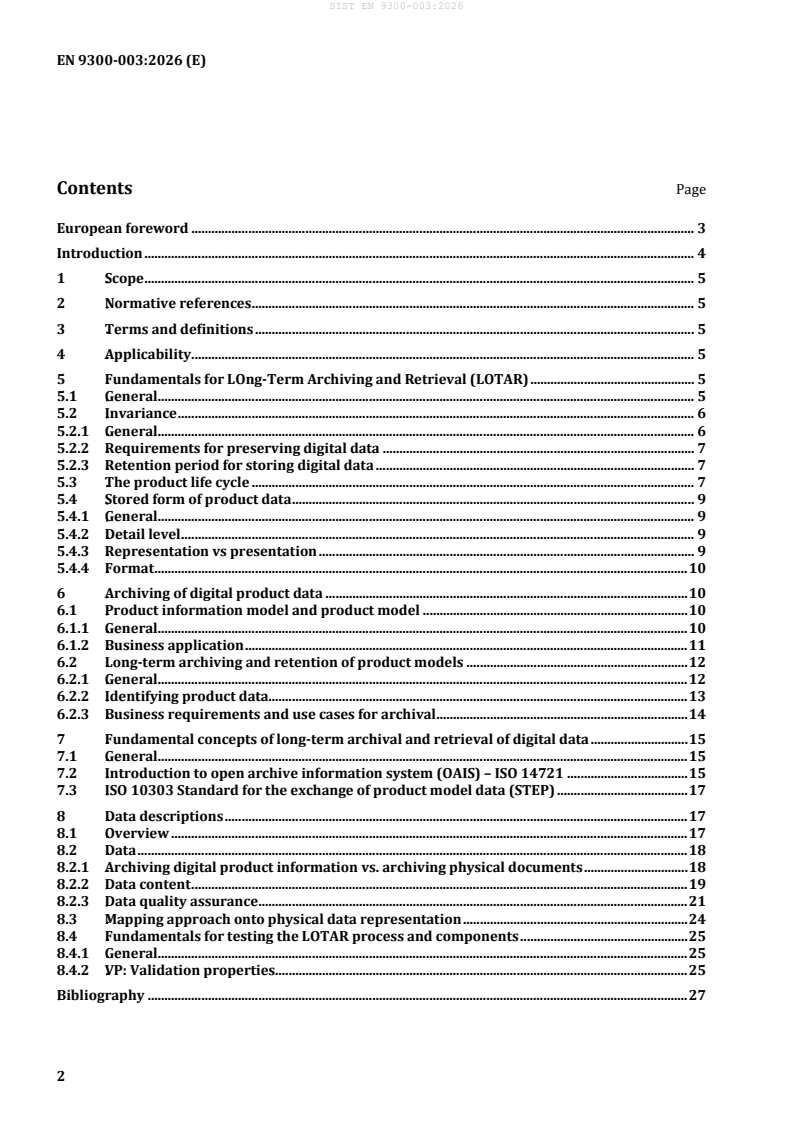
Contents
- 1BEuropean foreword
- 2BIntroduction
- 1 5BScope
- 2 6BNormative references
- 3 7BTerms and definitions
- 4 8BApplicability
- 5 9BFundamentals for LOng-Term Archiving and Retrieval (LOTAR)
- 5.1 13BGeneral
- 5.2 14BInvariance
- 5.2.1 26BGeneral
- 5.2.2 27BRequirements for preserving digital data
- 5.2.3 28BRetention period for storing digital data
- 5.3 15BThe product life cycle
- 5.4 16BStored form of product data
- 5.4.1 29BGeneral
- 5.4.2 30BDetail level
- 5.4.3 31BRepresentation vs presentation
- 5.4.4 32BFormat
- 6 10BArchiving of digital product data
- 6.1 17BProduct information model and product model
- 6.1.1 33BGeneral
- 6.1.2 34BBusiness application
- 6.2 18BLong-term archiving and retention of product models
- 6.2.1 35BGeneral
- 6.2.2 36BIdentifying product data
- 6.2.3 37BBusiness requirements and use cases for archival
- 7 11BFundamental concepts of long-term archival and retrieval of digital data
- 7.1 19BGeneral
- 7.2 20BIntroduction to open archive information system (OAIS) – ISO 14721
- 7.3 21BISO 10303 Standard for the exchange of product model data (STEP)
- 8 12BData descriptions
- 8.1 22BOverview
- 8.2 23BData
- 8.2.1 38BArchiving digital product information vs. archiving physical documents
- 8.2.2 39BData content
- 8.2.3 40BData quality assurance
- 8.3 24BMapping approach onto physical data representation
- 8.4 25BFundamentals for testing the LOTAR process and components
- 8.4.1 41BGeneral
- 8.4.2 42BVP: Validation properties
- 0BBibliography
1BEuropean foreword
This document (EN 9300-003:2026) has been prepared ASD-STAN.
After enquiries and votes carried out in accordance with the rules of this Association, this document has received the approval of the National Associations and the Official Services of the member countries of ASD-STAN, prior to its presentation to CEN.
This European Standard shall be given the status of a national standard, either by publication of an identical text or by endorsement, at the latest by February 2027, and conflicting national standards shall be withdrawn at the latest by February 2027.
Attention is drawn to the possibility that some of the elements of this document may be the subject of patent rights. CEN shall not be held responsible for identifying any or all such patent rights. This document supersedes EN 9300-003:2012.
EN 9300-003:2026 includes the following significant technical changes with respect to EN 9300-003:2012:
- document editorially revised.
Any feedback and questions on this document should be directed to the users’ national standards body. A complete listing of these bodies can be found on the CEN website.
According to the CEN-CENELEC Internal Regulations, the national standards organizations of the following countries are bound to implement this European Standard: Austria, Belgium, Bulgaria, Croatia, Cyprus, Czech Republic, Denmark, Estonia, Finland, France, Germany, Greece, Hungary, Iceland, Ireland, Italy, Latvia, Lithuania, Luxembourg, Malta, Netherlands, Norway, Poland, Portugal, Republic of North Macedonia, Romania, Serbia, Slovakia, Slovenia, Spain, Sweden, Switzerland, Türkiye and the United Kingdom.
2BIntroduction
The prostep ivip Association is an international non-profit association in Europe. For establishing leadership in IT-based engineering it offers a moderated platform to its nearly 200 members from leading industries, system vendors and research institutions. Its product and process data standardization activities at European and worldwide levels are well known and accepted. The prostep ivip Association sees this document and the related parts as a milestone of product data technology.
PDES, Inc. is an international non-profit association in USA. The mission of PDES, Inc. is to accelerate the development and implementation of the ISO 10303 series, enabling enterprise integration and PLM interoperability for member companies. PDES, Inc. gathers members from leading manufacturers, national government agencies, PLM vendors and research organizations. PDES, Inc. supports this standard as an industry resource to sustain the interoperability of digital product information, ensuring and maintaining authentic longevity throughout their product lifecycle.
Readers of this document should note that all standards undergo periodic revisions and that any reference made herein to any other standard implies its latest edition, unless otherwise stated. Within the context of the EN 9300 series the terms “shall” and “should” are to be used per the TOC-2 NAS Style Guide_2021 Clauses 3.1 and 3.2:
- “shall” is to be used in an imperative sense. All requirements will be prefaced with a “shall” statement denoting mandatory compliance;
- “should” is to be used to indicate a recommendation. All non-mandatory requirements or statements will be prefaced with a “should” statement denoting non-mandatory action;
- “includes” means “includes but is not limited to”.
1 5BScope
This document specifies the fundamentals and concepts for the long-term preservation of digital product and technical data. The EN 9300 series specifies various regulatory and business requirements, applicable domain specific methodologies that are extensible for future long-term archiving formats and data management practices.
2 6BNormative references
The following documents are referred to in the text in such a way that some or all of their content constitutes requirements of this document. For dated references, only the edition cited applies. For undated references, the latest edition of the referenced document (including any amendments) applies.
EN 9300-007, Aerospace series — LOTAR — LOng Term Archiving and Retrieval of digital technical product documentation such as 3D, CAD and PDM data — Part 007: Terms and definitions
ISO 14721, Space Data System Practices — Reference model for an open archival information system (OAIS)
3 7BTerms and definitions
For the purposes of this document, the terms and definitions given in EN 9300-007 apply. ISO and IEC maintain terminology databases for use in standardization at the following addresses:
- ISO Online browsing platform: available at https://www.iso.org/obp/
- IEC Electropedia: available at https://www.electropedia.org/
4 8BApplicability
The EN 9300 series is applicable to long-term archiving and retrieval of model-based product data. Since technical product documentation, such as design documents, are generated, exchanged, and used digitally, architecture, technology, processes, data formats, rules and regulations need to be adapted to enable digital retention and long-term archiving. The EN 9300 series closes this gap as a standard for long-term archival and retrieval of model-based product data.
For further explanation on applicability of this document and its series, see EN 9300-001.
5.1 13BGeneral
This clause discusses the fundamentals and concepts applicable to the long-term archiving and retrieval of digital product and technical data domain. It provides detailed clarification of these concepts into a context beyond basic definitions defined in EN 9300-007.
Various user communities such as aerospace and defence, automotive or shipbuilding demonstrate specific needs for long-term archiving and retrieval of their product and technical data. This is noted in their diverse retention and archival requirements as well as various data management processes. This clause explains the major differences of the terms “retention” and “archival” and their relation to the scope of the EN 9300 series. See Figure 1.
Figure 1 — Archival — Storage and retention
Companies within various industries need to keep data and records to fulfil, certification, legal and business requirements. For most modern applications, this data is digital. These requirements fall under four main categories regarding the retention of digital data:
invariance: how important is it to ensure that digital data is not altered; requirements: why and for which cases preservation of digital data is required or not; retention period: the required length of time for retaining digital data; stored form: the stored format of the digital data.
The following subclauses describe these four categories and are the foundation for this document.
5.2.1 26BGeneral
Invariance covers the need to ensure that the information has not changed over time and thus provide evidential weight that the design intent has not changed.
Three sub-categories further clarify invariance:
- auditable – where validation methods and test suites ensure that information cannot be changed without the change being detected; An example of validation methods and test suites in the auditable subcategory includes the comparison of stored secure hash algorithm (SHA) checksums of the record before and after archiving – (refer to EN 9300-005 “Authentication and Verification”, ISO 16363).
- implicit – where the system is designed to prevent changes; A system under the implicit subcategory shall supervise activities which would result in changes of the digital data. The supervision, for example, could be realized within a separate write-protected vault; e.g. write-once, read-many (WORM). The proof of “no change” is shown by an absence of change having been recorded and by showing that the system itself is reliable.
- not required – where changes to data are not explicitly controlled.
Of the three, auditable invariance is the strongest, and is likely to be the most suitable where the information is used in legal proceedings.
For long-term archiving and retrieval, invariance is mandatory to meet business, certification, and legal requirements.
5.2.2 27BRequirements for preserving digital data
For digital data, the challenge is that the data are often stored in a proprietary, native format and will most likely become non-interpretable after a certain amount of time. The use of a neutral archiving data format safeguards the interpretability of the stored data for a much longer time, perhaps for the entire retention period. The EN 9300 series recommends the use of standard formats for long-term archiving rather than native formats, accompanied by regular and frequent migrations of storage media and, if necessary, of data format. The use of secure archiving and retrieval processes ensures the data readability and integrity within current and future systems. This includes the use of secure hash algorithms (SHA) to ensure that archived data have not been altered over time. Such algorithms might need to be renewed over time with a standardized procedure, when cryptographic technologies used become unsecure (e.g. SHA1 replacement by SHA2). The main requirement is that the engineering or design intent is preserved not necessarily the ones (1) and zeros (0).
5.2.3 28BRetention period for storing digital data
The life cycle of software and hardware is relatively short compared to the life cycle of aerospace and shipbuilding. The life cycle of digital data can be described in terms of software versions and generations. The release of a new software version within a generation in general alters only a small part of the functionalities of the software without affecting the data format or data model. A generation change occurs when the software used changes substantially, for example, to a new architecture and data model. The change of a generation can result even in completely new data formats or eventually drop of support of older data formats.
Currently, for CAD software, the period between versions is of the order of 6 months to 12 months, while between generations is of the order of 4 years to 7 years. This should be compared to an aircraft or ship life cycle which includes the life of individual product or program.
This leads to the following definitions:
short-term within one or two versions 0–5 years; medium-term within one generation 6–10 years; long-term over multiple generations ≥11 years.
5.3 15BThe product life cycle
The following excerpts from ISO/IEC/IEEE 15288 assist in providing a working understanding of life cycle phases for the purpose of this document.
- Life cycle model: a framework of processes and activities concerned with the product life cycle that is organized into stages. The life cycle models consider both the business and the technical needs of all stakeholders. The stages are organized to provide a common reference for communication and understanding.
- Stage: a period within the life cycle of an entity that relates to the state of its description or realization. Stages within a system life cycle, alternatively referred to as “phases”, provide at least the following benefits:
- represent major life cycle periods of the product’s evolution;
- relate to the state of the system description or the system itself;
- describe major progress and achievement of milestones;
- give rise to the primary decision gates of the development or product life cycle.
Life cycle models vary dramatically across system types and institutional practices, and no single list of stages will encompass all models. The following list of generic stages provides a suitable foundation for representing life cycle models used throughout industry, government, or defence (see Table 1 and
Table 2).
3BTable 1 — Examples of life cycle stages
Stage Process objectives within stage
- Specify stakeholder needs, goals, and objectives; Concept
- explore solution feasibility;
- specify solution space, if feasible;
- evaluate technology readiness and associated risk.
- specify/refine system level requirements; Development
- specify/refine high-level architecture;
- specify/refine requirements decomposition;
- specify/refine complete system architecture;
- implement initial system;
- integrate, verify, and validate initial system;
- produce system; Production
- inspect/verify production system.
- Deploy and operate system.
a
Utilization a — Sustained system capabilities.
Support
Stage Process objectives within stage
- Support archival or disposal of system.
Retirement a
Utilization and support stages often run in parallel.
These generic stages can map to other life cycle models appropriate to the system type or institutional practices. For instance, the following diagram shows a mapping between the generic definitions and the life cycle phases specified by the NASA systems engineering process.
4BTable 2 — Comparison of life cycle stages and NASA life cycle phases Utilization
Retirement
Concept stage Development stage Production stage Support stage stage
Pre- Formulation Implementation formulation
Pre-phase A: Phase A: Phase B: Phase C: Phase D: Phase E: Phase F:
Concept Concept-tech Prelim Final design System Operations Closeout studies development design-tech and integration and development fabrication and test, sustainment
Launch
5.4.1 29BGeneral
Stored form has been divided into three main subcategories:
- detail level: the description level of model;
- representation and presentation: describing the different logical forms of data representation and presentation;
- format: describing the different physical formats of the data.
5.4.2 30BDetail level
- An accurate representation is where data elements are described in the original level of detail, independent of whether they are represented in a native or other format.
- An approximate representation is where data elements are described in a lower level of detail than the ac-curate representation, e.g. where a curved surface is approximated by a set of small, flat faces.
5.4.3 31BRepresentation vs presentation
A key distinction exists between representation and presentation of digital data. Within the representation of digital data, the data is “machine readable” i.e. the computer holds the information about the concept. However, in the presentation of digital data, the data is “human readable” in that the computer holds a form in which its appearance is understandable to a human.
For example, the representation of a linear dimension includes all of the information needed to understand the specification (e.g. the type of dimension, between which features it is defined), without any of the graphic components such as dimension lines and extension lines, their direction, arrowheads, and the dimension value.
Presentation relates to elements that are visible in the display of a 3D model and are either located (positioned) in 3D space, i.e. they rotate and move with the model, or in a fixed 2D plane. Elements of Presentation can typically be styled (e.g. coloured), organized (e.g. in specific views), and associated with other elements of the model. Presented types of data typically are geometry (e.g. 3D shapes, surfaces, curves, points) and characters (e.g. letters, numbers, symbols).
5.4.4 32BFormat
The format of data is a key driver for the level of accessibility as well as for how easy to use and how reliable to retain information over time. For the core models data, representations and formats used shall be open and standardized. “Open” means completely and precisely documented in syntax and semantics and shall be applicable for minimal cast (e.g. series of ISO 10303 (STEP) is available for no more than the publication costs). Standardization ensures the common understanding by the designated community and public availability and stability over many years. Standardization processes ensure regulated change processes.
Two main categories can be distinguished:
- a native format is a specific format of data in a syntax which is proprietary and dependent on a specific system or interface with specific capabilities. A native format depends directly on the life cycle (versions, generations) of the related system or interface and its functionalities;
- a standardized open neutral format is a format of data in a syntax, which is defined by a broad community, such as by ISO, and which is independent of specific system or interface. “Open” means completely and precisely documented in syntax and semantics and is applicable for free. In addition, standardization processes regulate the change processes for the standard. It might or might not provide the same level of functionality and data features to the users.
The motivation for including the accurate and approximate representation is that both can be archived in parallel in a standard representation such as ISO 10303-XXX (STEP), which is openly documented, and which can be stable for a much longer period than native formats.
6.1.1 33BGeneral
With regards to the terms product information model and product model, which are defined in
EN 9300-007, it is important to further specify their context and use within a long-term archival and retrieval system:
- the product information model represents an information model which provides an abstract description of facts, concepts, and instructions about a product:
- such model can be e.g. the STEP application reference model (ARM) or STEP application interpreted model (AIM)/module interpreted model (MIM) per ISO 10303-11;
- within the boundaries of long-term archival and retrieval of digital product and technical data it is important to ensure that the product information model utilized sufficiently considers the four main considerations presented in 5.1 and provides the minimum capabilities needed to fulfil legal and business requirements;
- the product model represents an occurrence of a product information model for a particular product, e.g. the geometric model of a part:
- product models can be further distinguished with regards to their persistence into (1) dynamic or temporary product model (e.g. in internal memory of a computer) and (2) static product model (e.g. in form of a file or as a database on permanent storage media);
- product models can be consulted and queried via applications only via the loading of the static form of the product model into the dynamic form in memory of the same product model;
- additionally, there are different usages of a product model, optimized for different functions and users’ intents. The EN 9300 series distinguishes:
- the working form product model, which is used for creation and modification by the native application; it corresponds generally to the design stage of the product model; this working form is often in the native format of the COTS (commercial off the shelf) application;
- in the context of certification and legal requirements, the original product model, which can be stored in a native or standardized format as an authorized source to use. From the authorized source copies are derived for downstream use.
Based on the above definitions, it is recommended that for the long-term archival and retrieval of the original and accurate product models be in a static standardized product information model and stored in an open format such as STEP. These product models, after retrieval, will be loaded in applications as temporary dynamic forms, enabling the check of validation properties and specified operations (e.g. consultation).
...