


EN 12390-6:2023
(Main)Testing hardened concrete - Part 6: Tensile splitting strength of test specimens
Testing hardened concrete - Part 6: Tensile splitting strength of test specimens
This document specifies the method for the determination of the tensile splitting strength of test specimens of hardened concrete. The reference specimens are moulded cylindrical specimens.
Cores of at least 75 mm diameter complying with the requirements of EN 12504-1 can be tested using this method.
The use of cubic or prismatic specimens is included in Annex A.
Prüfung von Festbeton - Teil 6: Spaltzugfestigkeit von Probekörpern
Dieses Dokument legt das Verfahren zur Bestimmung der Spaltzugfestigkeit von Probekörpern aus Festbeton fest. Die Bezugsprobekörper sind gegossene zylindrische Probekörper.
Mit diesem Verfahren können Bohrkerne mit einem Mindestdurchmesser von 75 mm, die den Anforderungen von EN 12504 1 entsprechen, geprüft werden.
Die Verwendung würfelförmiger oder prismatischer Probekörper ist in Anhang A enthalten.
Essai pour béton durci - Partie 6 : Détermination de la résistance en traction par fendage d’éprouvettes
Le présent document spécifie la méthode de détermination de la résistance en traction par fendage d’éprouvettes de béton durci. Les éprouvettes de référence sont des éprouvettes cylindriques moulées.
Des carottes d’au moins 75 mm de diamètre conformes aux exigences de l’EN 12504 1 peuvent être soumises à l’essai à l’aide de la présente méthode.
L'utilisation d’éprouvettes cubiques ou prismatiques est présentée à l’Annexe A.
Preskušanje strjenega betona - 6. del: Natezna razcepna trdnost preskušancev
Ta dokument določa metodo za ugotavljanje natezne razcepne trdnosti preskušancev iz strjenega betona. Referenčni vzorci so uliti valjasti vzorci.
S to metodo je mogoče preskusiti jedra s premerom vsaj 75 mm, ki ustrezajo zahtevam iz standarda EN 12504-1.
Uporaba kockastih in prizmatičnih vzorcev je zajeta v dodatku A.
General Information
- Status
- Published
- Publication Date
- 21-Nov-2023
- Technical Committee
- CEN/TC 104 - Concrete ( performance, production, placing and compliance criteria )
- Drafting Committee
- CEN/TC 104/SC 1 - Revision of ENV 206
- Current Stage
- 6060 - Definitive text made available (DAV) - Publishing
- Start Date
- 22-Nov-2023
- Due Date
- 01-Nov-2023
- Completion Date
- 22-Nov-2023
Relations
- Replaces
EN 12390-6:2009 - Testing hardened concrete - Part 6: Tensile splitting strength of test specimens - Effective Date
- 28-Jan-2023
- Effective Date
- 28-Jan-2026
- Effective Date
- 28-Jan-2026
- Effective Date
- 28-Jan-2026
- Effective Date
- 28-Jan-2026
- Refers
EN 12390-2:2019 - Testing hardened concrete - Part 2: Making and curing specimens for strength tests - Effective Date
- 28-Jan-2026
- Effective Date
- 28-Jan-2026
- Effective Date
- 28-Jan-2026
- Effective Date
- 28-Jan-2026
- Effective Date
- 28-Jan-2026
- Effective Date
- 28-Jan-2026
- Referred By
EN 1926:2006 - Natural stone test methods - Determination of uniaxial compressive strength - Effective Date
- 28-Jan-2026
- Referred By
EN 13877-2:2004 - Concrete pavements - Part 2: Functional requirements for concrete pavements - Effective Date
- 28-Jan-2026
- Referred By
EN 13877-2:2013 - Concrete pavements - Part 2: Functional requirements for concrete pavements - Effective Date
- 28-Jan-2026
- Effective Date
- 28-Jan-2026
Overview
EN 12390-6:2023, published by CEN, specifies a standardized method for determining the tensile splitting strength of hardened concrete test specimens. This European Standard is part of the EN 12390 series, which addresses various test methods for hardened concrete to ensure consistency and reliability in construction materials testing across Europe. The reference test specimens are cylindrical, typically moulded, but the standard also allows testing of concrete cores (minimum 75 mm diameter) and includes provisions for cubic or prismatic specimens in Annex A.
This standard supersedes previous editions (notably EN 12390-6:2009) by expanding its scope to cover cored specimens, harmonizing with the broader suite of standardized concrete testing procedures.
Key Topics
- Tensile Splitting Strength: The test measures the tensile splitting strength of hardened concrete, an essential mechanical property indicative of concrete’s ability to withstand tensile stresses.
- Reference Specimens: The primary method uses moulded cylindrical specimens, with the reference size typically being 150 mm in diameter and 300 mm in length.
- Cored Specimens: Concrete cores, with a minimum diameter of 75 mm extracted from structures (following EN 12504-1), may be tested using this method.
- Alternative Specimen Shapes: An annex provides procedures for testing cubic and prismatic specimens, recognizing ongoing practices in some countries.
- Test Apparatus: Requirements for the testing machine, jigs, and hardboard packing strips (as detailed in EN 316) to ensure repeatable and accurate results.
- Test Procedure: Guidance on specimen preparation, placement, loading rate (0.04 MPa/s to 0.06 MPa/s), and recording results.
- Reporting and Precision: Comprehensive requirements for test reporting, including specimen identification, condition, and detailed results. Repeatability and reproducibility data are included for the reference method.
Applications
EN 12390-6:2023 is a critical standard for:
- Quality Control in Construction: Ensures that concrete used in buildings, bridges, and infrastructure meets tensile strength requirements, minimizing the risk of cracks or structural failures.
- Performance Assessment: Enables comparison between different concrete mixes or structural components by providing a consistent method for measuring tensile properties.
- Material Specifications: Offers designers and engineers a reliable benchmark to specify concrete performance in contracts and technical documentation.
- Structural Investigations: The method for cored specimens allows assessment of concrete in existing structures, facilitating evaluation, repair, or retrofit projects.
- Laboratory and On-Site Testing: Suitable for both laboratory-prepared cylinders and cores extracted from completed structures, expanding its practical utility in diverse contexts.
Related Standards
- EN 12390 Series: Other parts of this standard address specimen preparation and dimensions (Part 1), curing (Part 2), compressive strength (Part 3), machine specifications (Part 4), flexural strength (Part 5), and additional durability or mechanical property tests up to Part 18.
- EN 12504-1: Specifies the procedures for taking and testing concrete cores from existing structures, ensuring compatibility with EN 12390-6 for core testing.
- EN 316: Provides requirements for hardboard, used for packing strips in this test method.
- EN 12350-1: Describes sampling and apparatus requirements for fresh concrete, relevant for specimen preparation.
- ISO 4108:1980: An international standard referenced concerning alternative testing platens.
EN 12390-6:2023 plays a vital role in quality assurance of concrete by providing a clear, reproducible method for testing tensile splitting strength, supporting regulatory compliance and structural reliability in the construction industry.

Get Certified
Connect with accredited certification bodies for this standard

DIBt (Deutsches Institut für Bautechnik)
German Institute for Building Technology.
DIN CERTCO
DIN Group product certification.

Aboma Certification B.V.
Specialized in construction, metal, and transport sectors.
Sponsored listings
Frequently Asked Questions
EN 12390-6:2023 is a standard published by the European Committee for Standardization (CEN). Its full title is "Testing hardened concrete - Part 6: Tensile splitting strength of test specimens". This standard covers: This document specifies the method for the determination of the tensile splitting strength of test specimens of hardened concrete. The reference specimens are moulded cylindrical specimens. Cores of at least 75 mm diameter complying with the requirements of EN 12504-1 can be tested using this method. The use of cubic or prismatic specimens is included in Annex A.
This document specifies the method for the determination of the tensile splitting strength of test specimens of hardened concrete. The reference specimens are moulded cylindrical specimens. Cores of at least 75 mm diameter complying with the requirements of EN 12504-1 can be tested using this method. The use of cubic or prismatic specimens is included in Annex A.
EN 12390-6:2023 is classified under the following ICS (International Classification for Standards) categories: 91.100.30 - Concrete and concrete products. The ICS classification helps identify the subject area and facilitates finding related standards.
EN 12390-6:2023 has the following relationships with other standards: It is inter standard links to EN 12390-6:2009, EN 12350-1:2019, EN 12390-4:2025, EN 316:2009, EN 12504-1:2019, EN 12390-2:2019, EN 12390-1:2021, EN 13747:2005+A2:2010, EN 13877-1:2004, EN 1992-1-1:2004, EN 13877-1:2023, EN 1926:2006, EN 13877-2:2004, EN 13877-2:2013, EN 12372:2006. Understanding these relationships helps ensure you are using the most current and applicable version of the standard.
EN 12390-6:2023 is associated with the following European legislation: EU Directives/Regulations: 305/2011. When a standard is cited in the Official Journal of the European Union, products manufactured in conformity with it benefit from a presumption of conformity with the essential requirements of the corresponding EU directive or regulation.
EN 12390-6:2023 is available in PDF format for immediate download after purchase. The document can be added to your cart and obtained through the secure checkout process. Digital delivery ensures instant access to the complete standard document.
Standards Content (Sample)
SLOVENSKI STANDARD
01-januar-2024
Nadomešča:
SIST EN 12390-6:2010
Preskušanje strjenega betona - 6. del: Natezna razcepna trdnost preskušancev
Testing hardened concrete - Part 6: Tensile splitting strength of test specimens
Prüfung von Festbeton - Teil 6: Spaltzugfestigkeit von Probekörpern
Essai pour béton durci - Partie 6 : Détermination de la résistance en traction par fendage
d’éprouvettes
Ta slovenski standard je istoveten z: EN 12390-6:2023
ICS:
91.100.30 Beton in betonski izdelki Concrete and concrete
products
2003-01.Slovenski inštitut za standardizacijo. Razmnoževanje celote ali delov tega standarda ni dovoljeno.
EN 12390-6
EUROPEAN STANDARD
NORME EUROPÉENNE
November 2023
EUROPÄISCHE NORM
ICS 91.100.30 Supersedes EN 12390-6:2009
English Version
Testing hardened concrete - Part 6: Tensile splitting
strength of test specimens
Essai pour béton durci - Partie 6 : Détermination de la Prüfung von Festbeton - Teil 6: Spaltzugfestigkeit von
résistance en traction par fendage d'éprouvettes Probekörpern
This European Standard was approved by CEN on 22 October 2023.
CEN members are bound to comply with the CEN/CENELEC Internal Regulations which stipulate the conditions for giving this
European Standard the status of a national standard without any alteration. Up-to-date lists and bibliographical references
concerning such national standards may be obtained on application to the CEN-CENELEC Management Centre or to any CEN
member.
This European Standard exists in three official versions (English, French, German). A version in any other language made by
translation under the responsibility of a CEN member into its own language and notified to the CEN-CENELEC Management
Centre has the same status as the official versions.
CEN members are the national standards bodies of Austria, Belgium, Bulgaria, Croatia, Cyprus, Czech Republic, Denmark, Estonia,
Finland, France, Germany, Greece, Hungary, Iceland, Ireland, Italy, Latvia, Lithuania, Luxembourg, Malta, Netherlands, Norway,
Poland, Portugal, Republic of North Macedonia, Romania, Serbia, Slovakia, Slovenia, Spain, Sweden, Switzerland, Türkiye and
United Kingdom.
EUROPEAN COMMITTEE FOR STANDARDIZATION
COMITÉ EUROPÉEN DE NORMALISATION
EUROPÄISCHES KOMITEE FÜR NORMUNG
CEN-CENELEC Management Centre: Rue de la Science 23, B-1040 Brussels
© 2023 CEN All rights of exploitation in any form and by any means reserved Ref. No. EN 12390-6:2023 E
worldwide for CEN national Members.
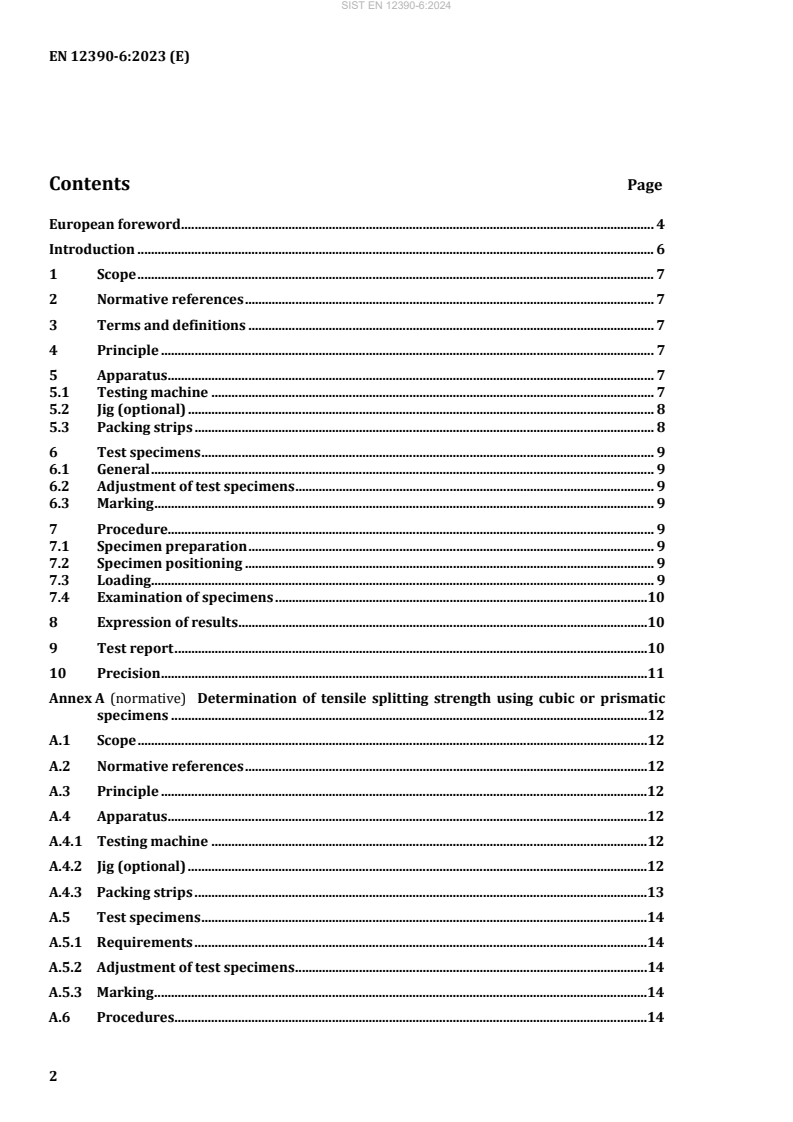
Contents Page
European foreword . 4
Introduction . 6
1 Scope . 7
2 Normative references . 7
3 Terms and definitions . 7
4 Principle . 7
5 Apparatus . 7
5.1 Testing machine . 7
5.2 Jig (optional) . 8
5.3 Packing strips . 8
6 Test specimens . 9
6.1 General . 9
6.2 Adjustment of test specimens . 9
6.3 Marking . 9
7 Procedure. 9
7.1 Specimen preparation . 9
7.2 Specimen positioning . 9
7.3 Loading. 9
7.4 Examination of specimens .10
8 Expression of results .10
9 Test report .10
10 Precision .11
Annex A (normative) Determination of tensile splitting strength using cubic or prismatic
specimens .12
A.1 Scope .12
A.2 Normative references .12
A.3 Principle .12
A.4 Apparatus .12
A.4.1 Testing machine .12
A.4.2 Jig (optional) .12
A.4.3 Packing strips .13
A.5 Test specimens .14
A.5.1 Requirements .14
A.5.2 Adjustment of test specimens .14
A.5.3 Marking .14
A.6 Procedures.14
A.7 Expression of results . 14
A.8 Test report . 14
A.9 Precision . 14
Bibliography . 15
European foreword
This document (EN 12390-6:2023) has been prepared by Technical Committee CEN/TC 104 “Concrete
and related products”, the secretariat of which is held by SN.
This European Standard shall be given the status of a national standard, either by publication of an
identical text or by endorsement, at the latest by month May 2024, and conflicting national standards
shall be withdrawn at the latest by May 2024.
Attention is drawn to the possibility that some of the elements of this document may be the subject of
patent rights. CEN shall not be held responsible for identifying any or all such patent rights.
This document supersedes EN 12390-6:2009.
The main change from the previous edition EN 12390-6:2009 of this document has been to include the
testing of cored specimens. The reference specimen for the test is a moulded cylindrical specimen.
This document is one of a series concerned with testing concrete.
EN 12390, Testing hardened concrete, consists of the following parts:
— Part 1: Shape, dimensions and other requirements for specimens and moulds
— Part 2: Making and curing specimens for strength tests
— Part 3: Compressive strength of test specimens
— Part 4: Compressive strength — Specification for testing machines
— Part 5: Flexural strength of test specimens
— Part 6: Tensile splitting strength of test specimens
— Part 7: Density of hardened concrete
— Part 8: Depth of penetration of water under pressure
— Part 10: Determination of the carbonation resistance of concrete at atmospheric levels of carbon dioxide
— Part 11: Determination of the chloride resistance of concrete, unidirectional diffusion
— Part 12: Determination of the potential carbonation resistance of concrete: Accelerated carbonation
method
— Part 13: Determination of secant modulus of elasticity in compression
— Part 14: Semi-adiabatic method for the determination of heat released by concrete during its hardening
process
— Part 15: Adiabatic method for the determination of heat released by concrete during its hardening
process
— Part 16: Determination of shrinkage of concrete
— Part 17: Determination of creep of concrete in compression
— Part 18: Determination of chloride migration coefficient
— Part 19: Determination of resistivity (in preparation)
Any feedback and questions on this document should be directed to the users’ national standards body.
A complete listing of these bodies can be found on the CEN website.
According to the CEN-CENELEC Internal Regulations, the national standards organisations of the
following countries are bound to implement this European Standard: Austria, Belgium, Bulgaria, Croatia,
Cyprus, Czech Republic, Denmark, Estonia, Finland, France, Germany, Greece, Hungary, Iceland, Ireland,
Italy, Latvia, Lithuania, Luxembourg, Malta, Netherlands, Norway, Poland, Portugal, Republic of North
Macedonia, Romania, Serbia, Slovakia, Slovenia, Spain, Sweden, Switzerland, Türkiye and the United
Kingdom.
Introduction
This test method was one of a number of test methods examined in a laboratory inter-comparison
programme. The work was partly funded by the EC under the Measurement and Testing programme,
contract MAT1-CT94-0043. The programme and other references showed the following:
a) Tensile splitting strengths measured between the normal plane platens of testing machines gave the
same results as those using the special curved platens, originally described in ISO 4108:1980 [1].
Although these curved platens have been optionall
...
Questions, Comments and Discussion
Ask us and Technical Secretary will try to provide an answer. You can facilitate discussion about the standard in here.
Loading comments...