


CEN/TS 15209:2021
(Main)Tactile paving surface indicators produced from concrete, clay and stone
Tactile paving surface indicators produced from concrete, clay and stone
This document specifies the method of measurement and acceptance criteria for the dimensions for surface profile features and patterns for the surface of pedestrian paving units, used to convey information for visually impaired people. It applies to paving units made of concrete, clay and stone where the tactile profiles are monolithic with the unit.
The surface profiles are intended to be applied to units manufactured to EN 1338, EN 1339, EN 1341, and EN 1344 which can be square or rectangular as specified by the designer.
It does not specify dimensions of a single tactile paving layout or profile but proposes ranges within which these dimensions should fall. Default dimensions are given in the absence of a national requirement.
This document proposes methods of measurement of profiles, light reflectance and colour but does not specify requirements for these characteristics. These properties will be decided by the designer taking into account the regulations, codes of practice, and guidance in the place of use of the units.
It does not specify material characteristics.
Taktile Bodenindikatoren gefertigt aus Beton, Ton und Stein
Dieses Dokument legt das Messverfahren und die Akzeptanzkriterien für die Maße der Elemente von Oberflächenprofilen und der Oberflächenmuster von Profilplatten für Fußgängerbereiche fest, die zur Übermittlung von Informationen an sehbehinderte Menschen verwendet werden. Es gilt für Profilplatten, die aus Beton, Ton und Stein gefertigt sind und bei denen die taktilen Profile monolithisch mit der Platte verbunden sind.
Die Oberflächenprofile sind für Platten vorgesehen, die nach EN 1338, EN 1339, EN 1341 und EN 1344 gefertigt werden und je nach Vorgabe des Gestalters quadratisch oder rechteckig sein können.
Es werden keine Maße von Layout oder Profil einer einzelnen taktilen Profilplatte festgelegt, sondern es werden Bereiche vorgeschlagen, in denen diese Maße liegen sollten. Beim Fehlen einer nationalen Anforderung werden Standardmaße angegeben.
Dieses Dokument gibt Verfahren zur Messung von Profilen, Lichtreflexionswert und Farbe an, legt aber keine Anforderungen für diese Merkmale fest. Diese Eigenschaften werden vom Gestalter unter Berücksichtigung der am Verwendungsort der Platten geltenden Vorschriften, Regeln der Technik und Leitlinien festgelegt.
Es werden keine Materialkennwerte festgelegt.
Surfaces tactiles d'indication au sol en béton, terre cuite et pierre naturelle
Le présent document spécifie la méthode de mesure et les critères d’acceptation des dimensions des caractéristiques de profil des surfaces des éléments de pavage soumis au trafic piétonnier, utilisés pour transmettre des informations aux personnes ayant une déficience visuelle. Il s’applique également aux éléments de pavage en béton, en terre cuite et en pierre dont les profils tactiles sont monolithiques avec l’élément.
Les profils de surface sont destinés à être appliqués aux éléments fabriqués conformément aux normes EN 1338, EN 1339, EN 1341 et EN 1344, qui peuvent être carrés ou rectangulaires selon les spécifications du concepteur.
Il ne précise pas les dimensions de la configuration ou du profil d’un seul élément de pavage tactile mais propose des plages de valeurs dans lesquelles ces dimensions doivent se situer. Les dimensions par défaut sont données en l’absence de toute exigence nationale.
Le présent document propose des méthodes de mesure des profils, de la réflexion lumineuse et de la couleur mais ne définit pas d’exigences pour ces caractéristiques. Ces propriétés seront décidées par le concepteur en tenant compte des règlements, codes de bonne pratique et recommandations en vigueur sur le lieu d’utilisation des éléments.
Il ne spécifie pas non plus les caractéristiques des matériaux.
Taktilni indikatorji tlakovane površine iz betona, opeke in kamna
Ta dokument določa metodo in kriterije sprejemljivosti za dimenzije površinskih profilov in vzorcev za tlakovane površine za pešce, ki se uporabljajo za prenos informacij slabovidnim osebam. Uporablja za tlakovce iz betona, opeke in kamna, pri katerih so taktilni profili monolitni z enoto.
Ne določa zahtev za profil in dimenzije posameznega taktilnega profila tlakovanja, ampak predlaga obsege, znotraj katerih naj bi bile te dimenzije. Navedene so privzete dimenzije, ki se lahko uporabljajo, če ni nacionalnih zahtev.
Ta dokument predlaga metode merjenja profilov, odbojnosti svetlobe in barv, vendar ne določa zahtev za te značilnosti. O teh lastnostih se bo odločil projektant ob upoštevanju predpisov, kodeksov ravnanja in navodil na mestu uporabe enot.
Ne določa značilnosti materiala.
General Information
- Status
- Published
- Publication Date
- 21-Dec-2021
- Technical Committee
- CEN/TC 178 - Paving units and kerbs
- Drafting Committee
- CEN/TC 178 - Paving units and kerbs
- Current Stage
- 9093 - Decision to confirm - Review Enquiry
- Start Date
- 03-Dec-2025
- Completion Date
- 17-Dec-2025
Relations
- Replaces
CEN/TS 15209:2008 - Tactile paving surface indicators produced from concrete, clay and stone - Effective Date
- 05-Dec-2018
Overview
CEN/TS 15209:2021 - Tactile paving surface indicators produced from concrete, clay and stone specifies measurement methods and acceptance criteria for the surface profile features and patterns of pedestrian paving units that convey information to visually impaired people. It applies to tactile indicators that are monolithic with the paving unit and intended for use on units manufactured to EN 1338, EN 1339, EN 1341 and EN 1344. The Technical Specification defines dimensional ranges and default values (where no national requirement exists) and proposes methods to measure profile geometry, colour and light reflectance value (LRV). It does not set material property requirements or mandate a single layout; local regulations and designers decide final layouts and contrast criteria.
Key topics and technical requirements
- Scope: Applicability to concrete, clay and stone tactile paving units with monolithic tactile profiles.
- Dimensional measurement and acceptance criteria: Methods for measuring profile features (width at base/top, spacing, profile height, length) and criteria for conformity - ranges and default values are provided rather than single fixed dimensions.
- Profile types and layouts: Definitions and ranges for common tactile profiles (e.g., blister and rib patterns) and edge/continuity considerations.
- Light reflectance value (LRV) and colour measurement: Procedures for determining LRV and colour of individual units to support visual contrast decisions; the document proposes measurement methods but does not set required LRV thresholds.
- Normative annexes: Detailed measurement procedures and conformity checks are included (annexes cover measurement apparatus, procedures, and LRV measurement methods).
- Market placement: Designed to support manufacturers placing products on the market (e.g., CE marking) while leaving layout/design decisions to local authorities.
Applications and who uses this standard
- Manufacturers of tactile paving units - to define production tolerances, measurement procedures and documentation for conformity.
- Specifiers and designers (urban designers, landscape architects, transport planners) - to choose tactile profiles and verify dimensions and contrast in line with local codes.
- Contractors and testing laboratories - for on-site and factory acceptance testing of tactile paving units.
- Accessibility officers and authorities - to ensure tactile indicators meet measurable dimensional and visual criteria that support safe wayfinding for visually impaired people.
Related standards
- EN 1338, EN 1339, EN 1341, EN 1344 (paving unit product standards)
- National regulations and local guidance on tactile paving layouts and LRV/contrast requirements
For implementation or purchase, obtain CEN/TS 15209:2021 from CEN or your national standards body.


Frequently Asked Questions
CEN/TS 15209:2021 is a technical specification published by the European Committee for Standardization (CEN). Its full title is "Tactile paving surface indicators produced from concrete, clay and stone". This standard covers: This document specifies the method of measurement and acceptance criteria for the dimensions for surface profile features and patterns for the surface of pedestrian paving units, used to convey information for visually impaired people. It applies to paving units made of concrete, clay and stone where the tactile profiles are monolithic with the unit. The surface profiles are intended to be applied to units manufactured to EN 1338, EN 1339, EN 1341, and EN 1344 which can be square or rectangular as specified by the designer. It does not specify dimensions of a single tactile paving layout or profile but proposes ranges within which these dimensions should fall. Default dimensions are given in the absence of a national requirement. This document proposes methods of measurement of profiles, light reflectance and colour but does not specify requirements for these characteristics. These properties will be decided by the designer taking into account the regulations, codes of practice, and guidance in the place of use of the units. It does not specify material characteristics.
This document specifies the method of measurement and acceptance criteria for the dimensions for surface profile features and patterns for the surface of pedestrian paving units, used to convey information for visually impaired people. It applies to paving units made of concrete, clay and stone where the tactile profiles are monolithic with the unit. The surface profiles are intended to be applied to units manufactured to EN 1338, EN 1339, EN 1341, and EN 1344 which can be square or rectangular as specified by the designer. It does not specify dimensions of a single tactile paving layout or profile but proposes ranges within which these dimensions should fall. Default dimensions are given in the absence of a national requirement. This document proposes methods of measurement of profiles, light reflectance and colour but does not specify requirements for these characteristics. These properties will be decided by the designer taking into account the regulations, codes of practice, and guidance in the place of use of the units. It does not specify material characteristics.
CEN/TS 15209:2021 is classified under the following ICS (International Classification for Standards) categories: 11.180.30 - Aids for blind or partially sighted people; 93.080.10 - Road construction. The ICS classification helps identify the subject area and facilitates finding related standards.
CEN/TS 15209:2021 has the following relationships with other standards: It is inter standard links to CEN/TS 15209:2008. Understanding these relationships helps ensure you are using the most current and applicable version of the standard.
CEN/TS 15209:2021 is associated with the following European legislation: EU Directives/Regulations: 305/2011; Standardization Mandates: M/119. When a standard is cited in the Official Journal of the European Union, products manufactured in conformity with it benefit from a presumption of conformity with the essential requirements of the corresponding EU directive or regulation.
You can purchase CEN/TS 15209:2021 directly from iTeh Standards. The document is available in PDF format and is delivered instantly after payment. Add the standard to your cart and complete the secure checkout process. iTeh Standards is an authorized distributor of CEN standards.
Standards Content (Sample)
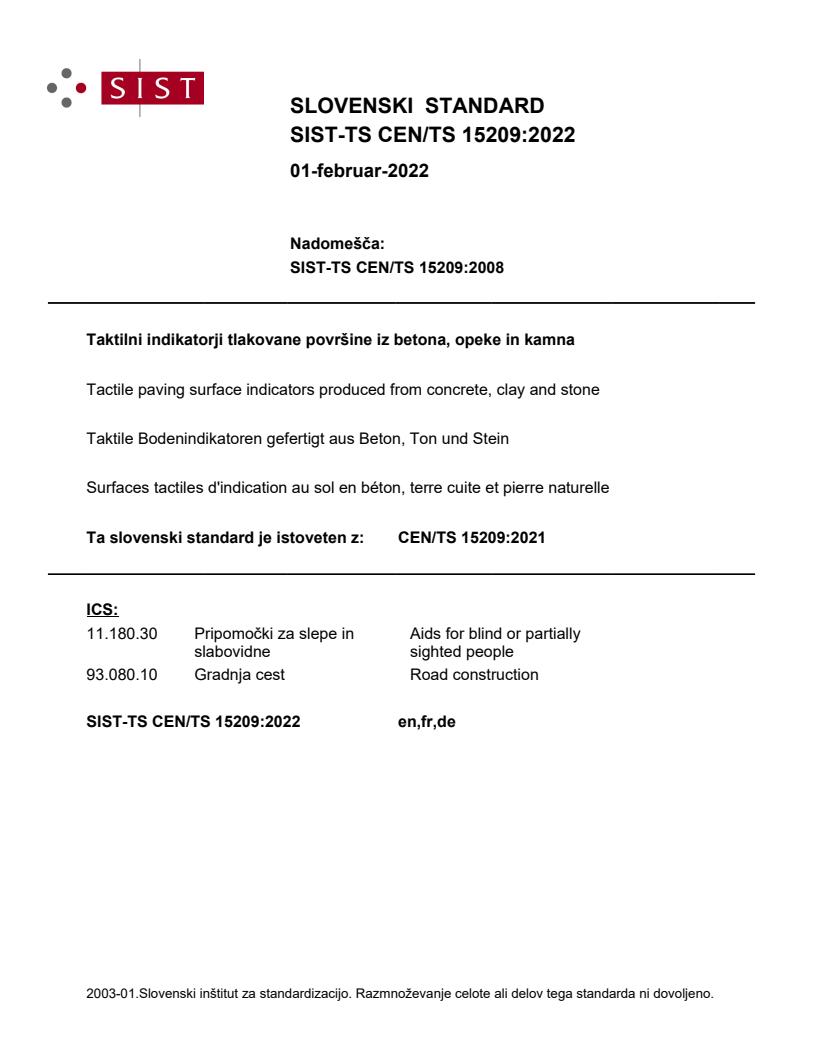
SLOVENSKI STANDARD
01-februar-2022
Nadomešča:
SIST-TS CEN/TS 15209:2008
Taktilni indikatorji tlakovane površine iz betona, opeke in kamna
Tactile paving surface indicators produced from concrete, clay and stone
Taktile Bodenindikatoren gefertigt aus Beton, Ton und Stein
Surfaces tactiles d'indication au sol en béton, terre cuite et pierre naturelle
Ta slovenski standard je istoveten z: CEN/TS 15209:2021
ICS:
11.180.30 Pripomočki za slepe in Aids for blind or partially
slabovidne sighted people
93.080.10 Gradnja cest Road construction
2003-01.Slovenski inštitut za standardizacijo. Razmnoževanje celote ali delov tega standarda ni dovoljeno.
CEN/TS 15209
TECHNICAL SPECIFICATION
SPÉCIFICATION TECHNIQUE
December 2021
TECHNISCHE SPEZIFIKATION
ICS 93.080.10; 11.180.30 Supersedes CEN/TS 15209:2008
English Version
Tactile paving surface indicators produced from concrete,
clay and stone
Surfaces tactiles d'indication au sol en béton, terre Taktile Bodenindikatoren gefertigt aus Beton, Ton und
cuite et pierre naturelle Stein
This Technical Specification (CEN/TS) was approved by CEN on 29 November 2021 for provisional application.
The period of validity of this CEN/TS is limited initially to three years. After two years the members of CEN will be requested to
submit their comments, particularly on the question whether the CEN/TS can be converted into a European Standard.
CEN members are required to announce the existence of this CEN/TS in the same way as for an EN and to make the CEN/TS
available promptly at national level in an appropriate form. It is permissible to keep conflicting national standards in force (in
parallel to the CEN/TS) until the final decision about the possible conversion of the CEN/TS into an EN is reached.
CEN members are the national standards bodies of Austria, Belgium, Bulgaria, Croatia, Cyprus, Czech Republic, Denmark, Estonia,
Finland, France, Germany, Greece, Hungary, Iceland, Ireland, Italy, Latvia, Lithuania, Luxembourg, Malta, Netherlands, Norway,
Poland, Portugal, Republic of North Macedonia, Romania, Serbia, Slovakia, Slovenia, Spain, Sweden, Switzerland, Turkey and
United Kingdom.
EUROPEAN COMMITTEE FOR STANDARDIZATION
COMITÉ EUROPÉEN DE NORMALISATION
EUROPÄISCHES KOMITEE FÜR NORMUNG
CEN-CENELEC Management Centre: Rue de la Science 23, B-1040 Brussels
© 2021 CEN All rights of exploitation in any form and by any means reserved Ref. No. CEN/TS 15209:2021 E
worldwide for CEN national Members.
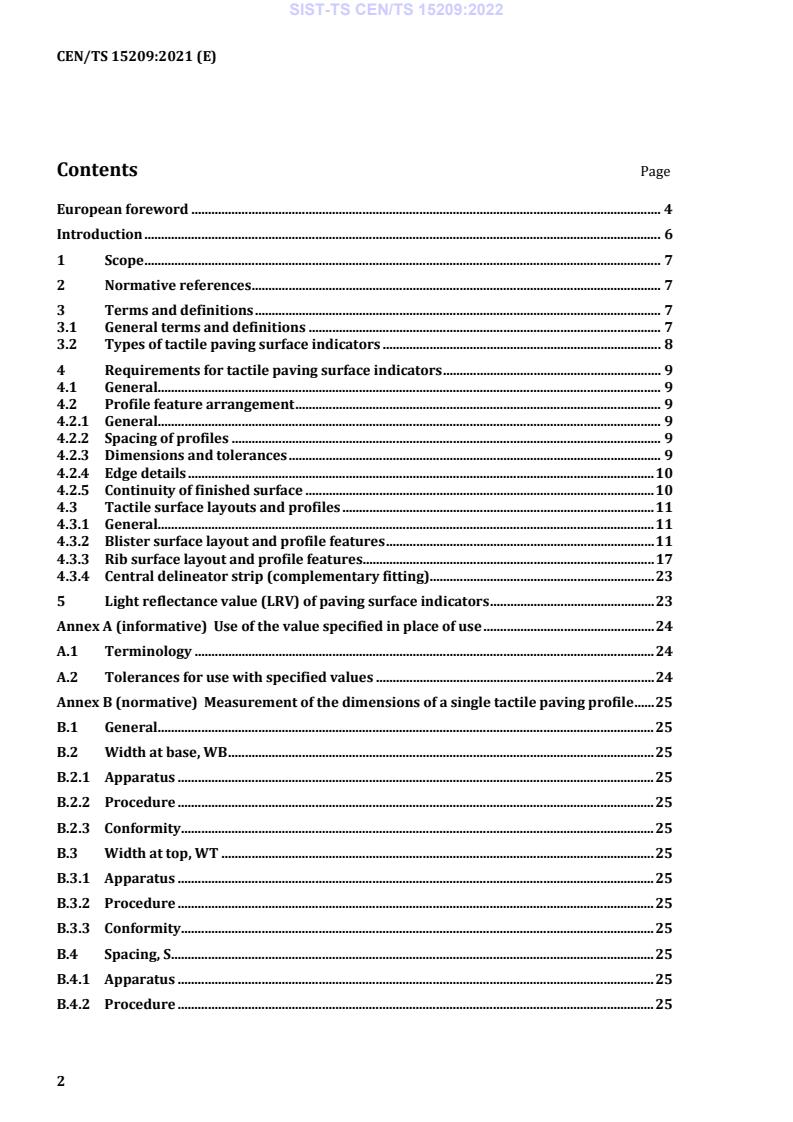
Contents Page
European foreword . 4
Introduction . 6
1 Scope . 7
2 Normative references . 7
3 Terms and definitions . 7
3.1 General terms and definitions . 7
3.2 Types of tactile paving surface indicators . 8
4 Requirements for tactile paving surface indicators . 9
4.1 General. 9
4.2 Profile feature arrangement . 9
4.2.1 General. 9
4.2.2 Spacing of profiles . 9
4.2.3 Dimensions and tolerances . 9
4.2.4 Edge details . 10
4.2.5 Continuity of finished surface . 10
4.3 Tactile surface layouts and profiles . 11
4.3.1 General. 11
4.3.2 Blister surface layout and profile features . 11
4.3.3 Rib surface layout and profile features. 17
4.3.4 Central delineator strip (complementary fitting). 23
5 Light reflectance value (LRV) of paving surface indicators . 23
Annex A (informative) Use of the value specified in place of use . 24
A.1 Terminology . 24
A.2 Tolerances for use with specified values . 24
Annex B (normative) Measurement of the dimensions of a single tactile paving profile . 25
B.1 General. 25
B.2 Width at base, WB . 25
B.2.1 Apparatus . 25
B.2.2 Procedure . 25
B.2.3 Conformity . 25
B.3 Width at top, WT . 25
B.3.1 Apparatus . 25
B.3.2 Procedure . 25
B.3.3 Conformity . 25
B.4 Spacing, S . 25
B.4.1 Apparatus . 25
B.4.2 Procedure . 25
B.4.3 Conformity . 26
B.5 Profile height, PH . 26
B.5.1 Apparatus . 26
B.5.2 Procedure . 26
B.5.3 Conformity . 26
B.6 Length at base of profile, LB. 26
B.6.1 Apparatus . 26
B.6.2 Procedure . 26
B.6.3 Conformity . 26
B.7 Length at top of profile, LT . 26
B.7.1 Apparatus . 26
B.7.2 Procedure . 26
B.7.3 Conformity . 26
B.8 Acceptance criteria . 26
Annex C (normative) Methods for determination of the light reflectance value (LRV) of a
single tactile paving unit . 27
C.1 General . 27
C.2 Method using a hand-held contact colourimeter . 27
C.3 Measurement with a non-contact type instrument – procedure of measurement . 28
C.4 Visual method using colour swatches . 28
Bibliography . 29
European foreword
This document (CEN/TS 15209:2021) has been prepared by Technical Committee CEN/TC 178 “Paving
units and kerbs”, the secretariat of which is held by BSI.
Attention is drawn to the possibility that some of the elements of this document may be the subject of
patent rights. CEN shall not be held responsible for identifying any or all such patent rights.
This document supersedes CEN/TS 15209:2008.
In comparison with the previous edition, the following technical modifications have been made:
a) Introduction
The introduction has been extended to cover the measurement of light reflectance values (LRVs) of
units to enable designers to implement adequate visual contrast between tactile units and adjacent
surfaces in accordance with standards in the place of use.
This introduction confirms that the given default values should be used where no standards exist.
b) Scope
The scope covers the method and acceptance criteria for the dimensions of the surface and profile
features for tactile paving units. It does not specify requirements for profile and dimensions of a
single tactile paving unit but proposes ranges within which these dimensions should fall. These
properties are decided by the designer taking into account the regulations, codes of practice, and
guidance in the place of use of the units.
c) Definitions
Generally updated to include light reflectance value, visual contrast and designer. Requirements for
tactile paving surface indicators.
Dimensions and tolerances restated. Consolidated layouts and profiles added with ranges and default
values given.
Light reflectance value (LRV) of paving surface indicators. Methods for determining light reflectance
values defined.
d) Annex A
Use of the value specified in place of use replaces guides to the various specifications of tactile
surfaces in a number of European countries.
e) Annex B
Guide to the preferred dimensions for tactile paving surface indicator profiles for use in a number of
European countries deleted and replaced with old Annex C (Measurement of the dimensions of a
single tactile paving unit).
f) Annex C
Measurement of the dimensions of a single tactile paving unit moved to Annex B.
Any feedback and questions on this document should be directed to the users’ national standards body.
A complete listing of these bodies can be found on the CEN website.
According to the CEN/CENELEC Internal Regulations, the national standards organisations of the
following countries are bound to announce this Technical Specification: Austria, Belgium, Bulgaria,
Croatia, Cyprus, Czech Republic, Denmark, Estonia, Finland, France, Germany, Greece, Hungary, Iceland,
Ireland, Italy, Latvia, Lithuania, Luxembourg, Malta, Netherlands, Norway, Poland, Portugal, Republic of
North Macedonia, Romania, Serbia, Slovakia, Slovenia, Spain, Sweden, Switzerland, Turkey and the United
Kingdom.
Introduction
The nature and extent of visual impairment varies considerably among individuals and are very different
from person to person. Generally, the result of different eye conditions can lead to the following types of
impairment:
— a limited field of vision, being unable to see to the sides or up and down;
— some loss of central vision limiting the ability to see fine detail;
— acute short-sightedness, seeing the world as a continuous blur;
— uncontrollable oscillations of the eyeball leading to an inability to see objects clearly;
— night blindness, a sensitivity to light and a tendency to be dazzled by glare;
— disease can also lead to vision loss and blindness.
Visually impaired people detect information about the environment by the use of non-visual features, for
example, audible and tactile features. A loss of sight is not accompanied by an increase in the effectiveness
of other non-visual senses. However, visually impaired people generally place more emphasis on
information received via other senses, for example the sense of touch.
The use of tactile information: when moving around the pedestrian environment, visually impaired
people, using a range of mobility equipment including the long cane, will actively seek and make use of
tactile paving surface information, particularly detectable contrasts in surface texture.
The ability to detect contrasts in texture underfoot varies from one individual to another. For example,
older visually impaired people and people who have lost their sight through certain medical conditions,
such as diabetes, can have reduced sensitivity in their feet.
It is important that tactile warnings of potential hazards, e.g. a road crossing or a stair, are rigorous
enough to be detectable by most people but without constituting a trip hazard or causing extreme
discomfort.
Considering the walking speed and the length of one step by a visually impaired pedestrian, the width of
any warning surface is a critical parameter.
Visually impaired people who have some residual vision will make use of the luminance contrast between
surfaces for orientation and guidance, in addition to tactile information. To provide visual and tactile
guidance as well as to accentuate the presence of hazards and amenities, luminance contrast between
tactile paving units and the adjacent surface needs to be considered by designers, planners, engineers
and others involved in the design of the built and pedestrian environments.
Whereas this document covers the measurement of light reflectance values of individual units, it does not
cover the required criteria necessary to enable designers to implement adequate luminance contrast
since this relies on the difference between adjacent surfaces, which do not both need to be tactile surfaces.
However, manufacturers should be aware of this issue in considering the range of colour and tones they
provide in their tactile products. Methods for measurement of light reflectance values and the colour of
individual units are proposed in this document.
This document is not intended to set requirements for the layout of tactile paving units, but to allow
manufacturers to place their products on the market with a CE marking. It is intended that layouts and
the specific layout of individual tactile profiles within units will be set locally taking into account
regulations, codes of practice, standards and guidance at the place of use and be within the ranges given
in this document. Where no local guidance is available default values are given which should be used.
1 Scope
This document specifies the method of measurement and acceptance criteria for the dimensions for
surface profile features and patterns for the surface of pedestrian paving units, used to convey
information for visually impaired people. It applies to paving units made of concrete, clay and stone
where the tactile profiles are monolithic with the unit.
The surface profiles are intended to be applied to units manufactured to EN 1338, EN 1339, EN 1341, and
EN 1344 which can be square or rectangular as specified by the designer.
It does not specify dimensions of a single tactile paving layout or profile but proposes ranges within which
these dimensions should fall. Default dimensions are given in the absence of a national requirement.
This document proposes methods of measurement of profiles, light reflectance and colour but does not
specify requirements for these characteristics. These properties will be decided by the designer taking
into account the regulations, codes of practice, and guidance in the place of use of the units.
It does not specify material characteristics.
2 Normative references
The following documents are referred to in the text in such a way that some or all of their content
constitutes requirements of this document. For dated references, only the edition cited applies. For
undated references, the latest edition of the referenced document (including any amendments) applies.
EN 1338, Concrete paving blocks - Requirements and test methods
EN 1339, Concrete paving flags - Requirements and test methods
EN 1341, Slabs of natural stone for external paving - Requirements and test methods
EN 1344, Clay pavers - Requirements and test methods
3 Terms and definitions
For the purposes of this document, the following terms and definitions apply.
ISO and IEC maintain terminological databases for use in standardization at the following addresses:
— IEC Electropedia: available at https://www.electropedia.org/
— ISO Online browsing platform: available at https://www.iso.org/obp
3.1 General terms and definitions
3.1.1
visually impaired
completely or partially blind, including those with some vision loss or residual sight
3.1.2
profile feature
single component of a tactile paving surface indicator
EXAMPLE dome, flat-topped dome, cylinder, bar or cuboid
3.1.3
tactile paving surface indicator
profiled paving finish used to convey information to visually impaired pedestrians about hazards and
amenities
3.1.4
light reflectance value
LRV
proportion of visible light reflected (Y) by a surface, weighted for the sensitivity to light of the human eye
Note 1 to entry: The LRV is measured under a D65 illumination.
Note 2 to ent
...
The standard CEN/TS 15209:2021 provides a comprehensive framework for the measurement and acceptance of tactile paving surface indicators produced from concrete, clay, and stone. Its scope is particularly relevant as it focuses on dimensions for surface profile features and patterns specifically designed to aid visually impaired individuals in navigating pedestrian spaces. One of the notable strengths of this standard is its clarity in specifying the types of pedestrian paving units it applies to, namely those made of concrete, clay, and stone, which are manufactured to established European standards such as EN 1338, EN 1339, EN 1341, and EN 1344. This alignment ensures that the tactile paving surface indicators are compatible with widely used materials, enhancing their applicability across various projects. The standard’s approach to not specifying exact dimensions for a single tactile paving layout allows for flexibility while still offering default ranges within which the dimensions should fall. This feature is crucial for designers who may need to adapt to different environmental conditions and project requirements, thus fostering innovation in design while adhering to essential safety and usability standards. Additionally, the provision of measurement methods for profiles, light reflectance, and color enhances the thoroughness of the standard. Although it does not impose specific requirements for these characteristics, it empowers designers to tailor solutions that comply with local regulations and codes of practice, thereby ensuring that the tactile paving units serve their intended purpose effectively. Nevertheless, it is worth noting that the standard does not include specifications for material characteristics. While this may limit the scope of material selection in some instances, it encourages collaboration between designers and manufacturers to determine the most appropriate materials that fulfil both functional and aesthetic criteria. In summary, CEN/TS 15209:2021 represents a significant advancement in standardizing tactile paving surface indicators, promoting safety and accessibility for visually impaired individuals. Its strength lies in its balance between mandatory guidelines and the essential flexibility for designers, making it a relevant and valuable resource in the development of pedestrian infrastructure.
Le document CEN/TS 15209:2021, intitulé "Indicateurs de surface tactile en pavé produits à partir de béton, d'argile et de pierre", se distingue par sa portée étendue qui encadre les méthodes d'évaluation et les critères d'acceptation des dimensions des caractéristiques et motifs de profil de surface pour les unités de pavage piéton. Ce standard est particulièrement pertinent pour les unités de pavage fabriquées en béton, en argile et en pierre, où les profils tactiles sont monolithiques avec l'unité. Parmi les points forts de cette norme, on peut souligner la clarté de ses spécifications concernant les unités fabriquées selon les normes EN 1338, EN 1339, EN 1341 et EN 1344, qui peuvent être carrées ou rectangulaires selon les choix du concepteur. Bien qu'elle n'indique pas de dimensions précises pour un agencement ou un profil tactile unique, elle fournit des plages dimensionnelles dans lesquelles les mesures doivent se situer, renforçant ainsi la flexibilité pour les concepteurs tout en garantissant la conformité avec des exigences minimales. Une autre force notable de ce document est sa capacité à proposer des méthodes de mesure pour les profils, la réflexion de la lumière et la couleur, tout en laissant aux designers la liberté de déterminer les exigences spécifiques en fonction des réglementations et des guides d'usage en vigueur. Cela permet une adaptation modulaire du pavage tactile aux différents environnements urbains, tout en s'assurant que les conditions d'accessibilité pour les personnes malvoyantes sont respectées. En conclusion, le standard CEN/TS 15209:2021 joue un rôle fondamental dans la standardisation des pavés tactiles, garantissant leur efficacité et leur sécurité. Il se positionne comme un document de référence essentiel tant pour les fabricants de pavés que pour les concepteurs soucieux de répondre aux besoins de mobilité des personnes visuellement handicapées.
CEN/TS 15209:2021は、視覚障害者のための情報を伝えるために使用される歩行者用舗装ユニットの表面プロファイル特性とパターンの寸法の測定方法と受入基準を規定しています。この標準の範囲は、コンクリート、粘土、石から製造された舗装ユニットに適用され、タクタイルプロファイルはユニットと一体であることが求められます。 この標準の強みは、EN 1338、EN 1339、EN 1341、EN 1344に基づいて製造されたユニットに適用できる表面プロファイルに関する明確な測定方法を提供している点です。デザイナーによって指定された四角形または長方形の形状に対して、適切な寸法範囲を提案しており、具体的なタクタイル舗装のレイアウトやプロファイルの寸法は特定しないことで、柔軟性を持たせています。 さらに、プロファイル、光反射率および色に関する測定方法を提案しているものの、これらの特性に対する具体的な要件は定めていません。これにより、ユニットの使用場所における規制、実践基準、指針を考慮しながら、デザイナーが必要な要件を決定できる自由度が与えられています。これは、異なる地域や用途に応じた適応性を持つ重要な要素となります。 この文書は、特定の材料特性に関しては記載していないため、施工現場や地域における要件に適した材料選びの重要性を再認識させるものとなります。このため、私たちはCEN/TS 15209:2021を、タクタイル舗装の標準に関連するクリティカルな参照資料として評価します。
CEN/TS 15209:2021 표준은 시각장애인을 위한 보도 포장 단위의 표면 프로파일 특징과 패턴의 치수에 대한 측정 방법 및 수용 기준을 규정하는 중요한 문서입니다. 이 표준의 주요 범위는 콘크리트, 점토, 석재로 제작된 보도 포장 단위에 적용되며, 촉각 프로파일이 해당 유닛과 일체형인 경우에 한정됩니다. 이 표준의 강점 중 하나는 유닛이 EN 1338, EN 1339, EN 1341, EN 1344 규격에 따라 제조되도록 하여, 설계자가 지정한 대로 정사각형 또는 직사각형 형태를 가질 수 있도록 한다는 점입니다. 이는 사용자와 설계자 모두에게 유연성을 제공하여, 다양한 환경에 적합한 지시 기능을 구현할 수 있게 합니다. 또한, CEN/TS 15209:2021은 특정 촉각 포장 배치나 프로파일의 차원을 명시하지 않고, 이 차원들이 포함될 범위를 제안합니다. 국가적인 요구사항이 부족할 경우 기본 치수가 제시되며, 이는 제조자나 설계자가 보다 적절하게 디자인할 수 있도록 지원합니다. 측정 방법과 빛 반사율, 색상에 대한 지침을 제공하지만, 이러한 특성에 대한 요구사항을 정하지 않음으로써, 설계자는 사용 장소의 규정, 실무 지침 및 가이드를 고려하여 필요한 특성을 결정할 수 있습니다. 이러한 접근은 다양한 조건과 환경을 고려한 맞춤형 솔루션을 창출할 수 있게 해 줍니다. 마지막으로, 이 문서는 재료 특성을 명시하지 않으므로, 사용자가 각기 다른 재료의 물리적 특성을 자유롭게 선택하고 적용할 수 있는 여지를 제공합니다. CEN/TS 15209:2021 표준은 시각장애인을 위한 안전하고 접근성 높은 보행 환경 조성을 위한 필수적인 기준으로 자리잡고 있으며, 모든 관련 이해관계자에게 유익한 지침을 제공합니다.
Die Norm CEN/TS 15209:2021 stellt einen wichtigen Rahmen für die Gestaltung und Verwendung von taktilen Pflasteroberflächenindikatoren dar, die aus Beton, Ton und Stein hergestellt werden. Ihr Umfang, der die Messmethoden und Akzeptanzkriterien für die Dimensionen der Oberflächenprofile und Muster von Gehwegplatten beschreibt, bietet eine essentielle Grundlage für die Gewährleistung von Barrierefreiheit. Ein wesentlicher Stärke dieser Norm liegt in ihrer spezifischen Ausrichtung auf die Bedürfnisse von visuell beeinträchtigten Personen. Indem sie klare Kriterien für die Gestaltung taktiler Profile festlegt, fördert sie die Sicherheit und Orientierung für diese Nutzergruppe. Die Tatsache, dass die Oberflächenprofile für Pflastereinheiten gelten, die gemäß EN 1338, EN 1339, EN 1341 und EN 1344 hergestellt werden, unterstreicht die Relevanz und Verknüpfung dieser Norm mit bestehenden europäischen Standards. Die Norm definiert zwar keine spezifischen Dimensionen für ein einzelnes taktiles Pflasterlayout, schlägt jedoch Bereiche vor, innerhalb derer diese Dimensionen liegen sollten. Dies ermöglicht es Designern, flexibel auf nationale Anforderungen und Gegebenheiten zu reagieren, ohne die grundlegenden Prinzipien der Barrierefreiheit zu gefährden. Zudem wird in der Norm ein innovativer Ansatz zur Messung von Profilen, Lichtreflexion und Farbe aufgezeigt, während sie gleichzeitig den Designern die Freiheit lässt, diese Eigenschaften entsprechend der spezifischen Vorschriften und Leitlinien vor Ort zu gestalten. Ein weiterer positiver Aspekt ist, dass die Norm nicht zu strengen Materialanforderungen führt, sondern den Herstellern und Planern die Möglichkeit gibt, geeignete Materialien je nach Verfügbarkeit und Gesetzgebung auszuwählen. Dies unterstützt eine breite Umsetzung von taktilen Pflasteroberflächen, die sowohl funktional als auch ästhetisch ansprechend sind. Insgesamt bietet die Norm CEN/TS 15209:2021 einen wertvollen Leitfaden für die Entwicklung und Anwendung von taktilen Pflasteroberflächen, die sowohl für Hersteller als auch für Planer von zentraler Bedeutung sind. Sie stellt sicher, dass Produkte gestaltet werden, die den Bedürfnissen visuell beeinträchtigter Personen gerecht werden und somit die Zugänglichkeit im öffentlichen Raum fördern.
Questions, Comments and Discussion
Ask us and Technical Secretary will try to provide an answer. You can facilitate discussion about the standard in here.
Loading comments...