

EN IEC 62443-4-2:2019/prAA:2026
(Amendment)Security for industrial automation and control systems - Part 4-2: Technical security requirements for ACS components
- Abstract
This document provides detailed technical control system component requirements (CRs) associated with seven foundational requirements (FRs) including defining the requirements for control system capability security levels and their components, SL-C(component). The seven foundational requirements (FRs) are: a) identification and authentication control (IAC), b) use control (UC), c) system integrity (SI), d) data confidentiality (DC), e) restricted data flow (RDF), f) timely response to events (TRE), and g) resource availability (RA).
- Status
- Not Published
- Publication Date
- 04-Jul-2027
- Technical Committee
- CLC/TC 65X - Industrial-process measurement, control and automation
- Drafting Committee
- CLC/TC 65X/WG 03 - Cyber Security
- Current Stage
- 4060 - Enquiry results established and sent to TC, SR, BTTF - Enquiry
- Start Date
- 05-Jun-2026
- Due Date
- 14-Aug-2025
- Completion Date
- 05-Jun-2026

Overview
EN IEC 62443-4-2:2019/prAA:2026 is a European draft amendment standard developed by the CLC/TC 65X technical committee. It outlines the technical security requirements for components of industrial automation and control systems (ACS), enhancing the cybersecurity posture of operational technology (OT) environments. This document targets the foundational needs for securing ACS components, taking into account the latest regulatory demands, specifically aligning with the EU Cyber Resilience Act (CRA) essential cybersecurity requirements.
The standard is intended for a broad audience, including product suppliers, integrators, system architects, security engineers, regulatory personnel, and others involved in development, deployment, integration, and assessment of industrial control system components. Its recommendations provide a roadmap for embedding security directly into ACS components or, where appropriate, integrating with system-level solutions.
Key Topics
- Scope and Structure: Defines detailed technical requirements for automation control system components (e.g., PLCs, sensors, network devices, software applications).
- Seven Foundational Requirements (FRs):
- Identification and Authentication Control (IAC): Secure user, device, and process identification mechanisms.
- Use Control (UC): Authorization enforcement and privilege management.
- System Integrity (SI): Protection against unauthorized modification and ensuring operational correctness.
- Data Confidentiality (DC): Safeguarding sensitive information during storage and transmission.
- Restricted Data Flow (RDF): Network and data segmentation to contain risks.
- Timely Response to Events (TRE): Detection, notification, and response to security-relevant incidents.
- Resource Availability (RA): Ensuring continuity and resilience of essential control functions.
- Security Levels (SL-C): Offering graded security controls based on risk and requirement, facilitating a risk-based approach.
- Security Evaluation Methodology: Integrates lifecycle-based practices for conformity assessment, including requirement-specific applicability, acceptance criteria, and evaluation artefacts.
- Alignment with Regulations: Maps requirements to satisfy EU Cyber Resilience Act and other regulatory frameworks.
Applications
The requirements set forth in EN IEC 62443-4-2:2019/prAA:2026 support a wide range of real-world industrial automation scenarios, including:
- Product Development: Guides manufacturers in designing and developing ACS components with in-built cybersecurity features that meet current and future regulatory expectations.
- System Integration: Enables integrators to select, deploy, and configure compliant ACS components, ensuring end-to-end security in larger industrial control networks.
- Vendor Assessment: Provides a standardized framework for evaluating third-party product security, simplifying procurement and due diligence.
- Regulatory Compliance: Facilitates demonstration of conformity with the EU Cyber Resilience Act and other sector-specific security mandates.
- Lifecycle Management: Supports ongoing risk assessment, incident response, and update management strategies to maintain security throughout the operational lifespan of ACS components.
Related Standards
EN IEC 62443-4-2:2019/prAA:2026 is part of the globally recognized IEC 62443 series for industrial automation security and closely interfaces with:
- EN IEC 62443-3-3:2019 – System security requirements and security levels for industrial communication networks.
- EN IEC 62443-4-1:2018 – Secure product development lifecycle requirements for ACS.
- CLC IEC/TS 62443-6-2:2025 – Security evaluation methodology.
- ISO/IEC 27001 – Information security management systems.
- Regulation (EU) 2024/2847 – European Cyber Resilience Act (in scope of Annex H and ZZ).
By meeting the technical and organizational needs detailed in this standard, organizations can achieve greater cybersecurity maturity, reduce operational risks, and demonstrate trustworthiness in the global industrial marketplace. Implementing EN IEC 62443-4-2:2019/prAA:2026 is essential for stakeholders seeking to secure modern industrial automation and control systems against evolving cyber threats.
Relations
- Effective Date
- 07-May-2024
Get Certified
Connect with accredited certification bodies for this standard

BSI Group
BSI (British Standards Institution) is the business standards company that helps organizations make excellence a habit.

Bureau Veritas
Bureau Veritas is a world leader in laboratory testing, inspection and certification services.

DNV
DNV is an independent assurance and risk management provider.
Sponsored listings
Frequently Asked Questions
EN IEC 62443-4-2:2019/prAA:2026 is a draft published by CLC. Its full title is "Security for industrial automation and control systems - Part 4-2: Technical security requirements for ACS components". This standard covers: This document provides detailed technical control system component requirements (CRs) associated with seven foundational requirements (FRs) including defining the requirements for control system capability security levels and their components, SL-C(component). The seven foundational requirements (FRs) are: a) identification and authentication control (IAC), b) use control (UC), c) system integrity (SI), d) data confidentiality (DC), e) restricted data flow (RDF), f) timely response to events (TRE), and g) resource availability (RA).
This document provides detailed technical control system component requirements (CRs) associated with seven foundational requirements (FRs) including defining the requirements for control system capability security levels and their components, SL-C(component). The seven foundational requirements (FRs) are: a) identification and authentication control (IAC), b) use control (UC), c) system integrity (SI), d) data confidentiality (DC), e) restricted data flow (RDF), f) timely response to events (TRE), and g) resource availability (RA).
EN IEC 62443-4-2:2019/prAA:2026 is classified under the following ICS (International Classification for Standards) categories: 25.040.40 - Industrial process measurement and control; 35.030 - IT Security. The ICS classification helps identify the subject area and facilitates finding related standards.
EN IEC 62443-4-2:2019/prAA:2026 has the following relationships with other standards: It is inter standard links to EN IEC 62443-4-2:2019. Understanding these relationships helps ensure you are using the most current and applicable version of the standard.
EN IEC 62443-4-2:2019/prAA:2026 is associated with the following European legislation: EU Directives/Regulations: 2024/2847; Standardization Mandates: M/606. When a standard is cited in the Official Journal of the European Union, products manufactured in conformity with it benefit from a presumption of conformity with the essential requirements of the corresponding EU directive or regulation.
EN IEC 62443-4-2:2019/prAA:2026 is available in PDF format for immediate download after purchase. The document can be added to your cart and obtained through the secure checkout process. Digital delivery ensures instant access to the complete standard document.
Standards Content (Sample)
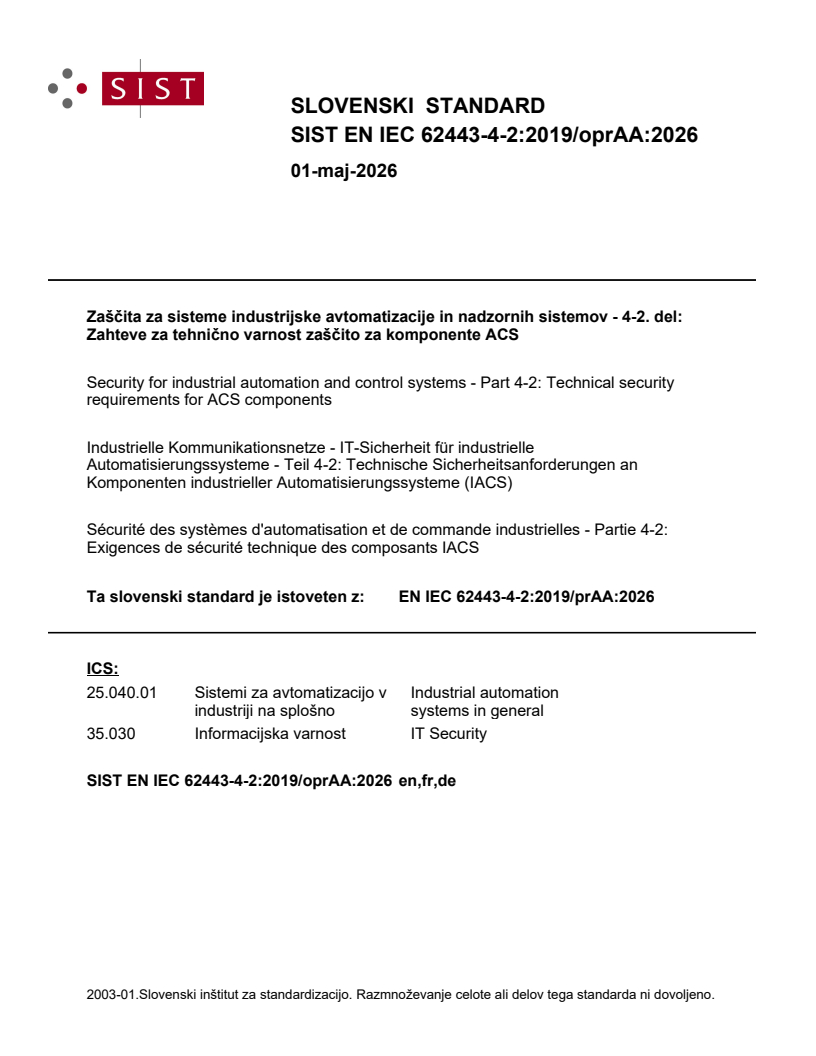
SLOVENSKI STANDARD
01-maj-2026
Zaščita za sisteme industrijske avtomatizacije in nadzornih sistemov - 4-2. del:
Zahteve za tehnično varnost zaščito za komponente ACS
Security for industrial automation and control systems - Part 4-2: Technical security
requirements for ACS components
Industrielle Kommunikationsnetze - IT-Sicherheit für industrielle
Automatisierungssysteme - Teil 4-2: Technische Sicherheitsanforderungen an
Komponenten industrieller Automatisierungssysteme (IACS)
Sécurité des systèmes d'automatisation et de commande industrielles - Partie 4-2:
Exigences de sécurité technique des composants IACS
Ta slovenski standard je istoveten z: EN IEC 62443-4-2:2019/prAA:2026
ICS:
25.040.01 Sistemi za avtomatizacijo v Industrial automation
industriji na splošno systems in general
35.030 Informacijska varnost IT Security
2003-01.Slovenski inštitut za standardizacijo. Razmnoževanje celote ali delov tega standarda ni dovoljeno.
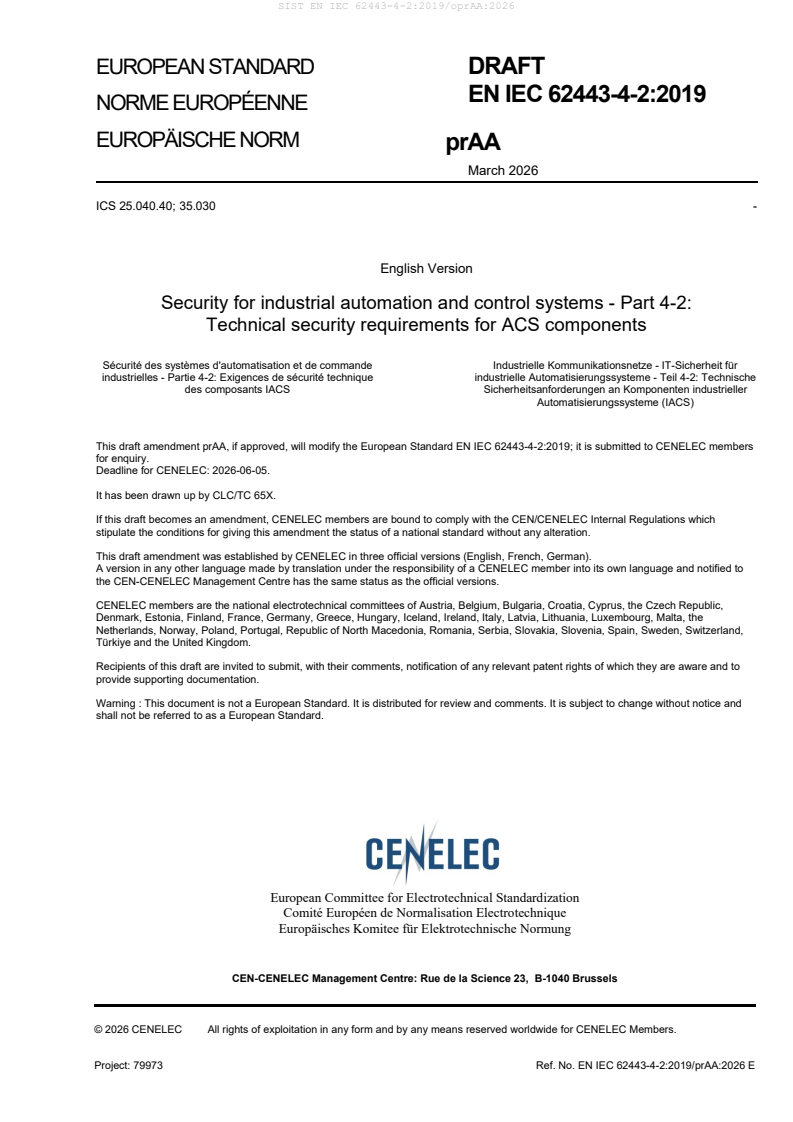
EUROPEAN STANDARD DRAFT
EN IEC 62443-4-2:2019
NORME EUROPÉENNE
EUROPÄISCHE NORM
prAA
March 2026
ICS 25.040.40; 35.030 -
English Version
Security for industrial automation and control systems - Part 4-2:
Technical security requirements for ACS components
Sécurité des systèmes d'automatisation et de commande Industrielle Kommunikationsnetze - IT-Sicherheit für
industrielles - Partie 4-2: Exigences de sécurité technique industrielle Automatisierungssysteme - Teil 4-2: Technische
des composants IACS Sicherheitsanforderungen an Komponenten industrieller
Automatisierungssysteme (IACS)
This draft amendment prAA, if approved, will modify the European Standard EN IEC 62443-4-2:2019; it is submitted to CENELEC members
for enquiry.
Deadline for CENELEC: 2026-06-05.
It has been drawn up by CLC/TC 65X.
If this draft becomes an amendment, CENELEC members are bound to comply with the CEN/CENELEC Internal Regulations which
stipulate the conditions for giving this amendment the status of a national standard without any alteration.
This draft amendment was established by CENELEC in three official versions (English, French, German).
A version in any other language made by translation under the responsibility of a CENELEC member into its own language and notified to
the CEN-CENELEC Management Centre has the same status as the official versions.
CENELEC members are the national electrotechnical committees of Austria, Belgium, Bulgaria, Croatia, Cyprus, the Czech Republic,
Denmark, Estonia, Finland, France, Germany, Greece, Hungary, Iceland, Ireland, Italy, Latvia, Lithuania, Luxembourg, Malta, the
Netherlands, Norway, Poland, Portugal, Republic of North Macedonia, Romania, Serbia, Slovakia, Slovenia, Spain, Sweden, Switzerland,
Türkiye and the United Kingdom.
Recipients of this draft are invited to submit, with their comments, notification of any relevant patent rights of which they are aware and to
provide supporting documentation.
Warning : This document is not a European Standard. It is distributed for review and comments. It is subject to change without notice and
shall not be referred to as a European Standard.
European Committee for Electrotechnical Standardization
Comité Européen de Normalisation Electrotechnique
Europäisches Komitee für Elektrotechnische Normung
CEN-CENELEC Management Centre: Rue de la Science 23, B-1040 Brussels
© 2026 CENELEC All rights of exploitation in any form and by any means reserved worldwide for CENELEC Members.
Project: 79973 Ref. No. EN IEC 62443-4-2:2019/prAA:2026 E
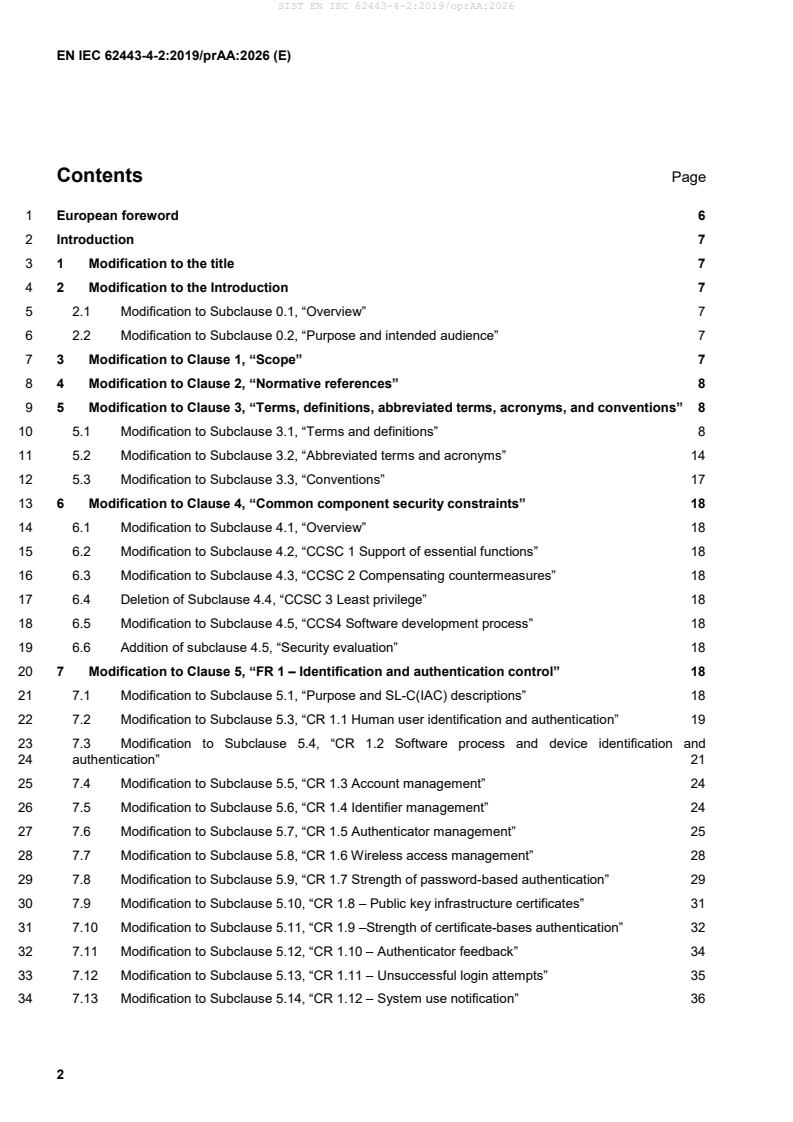
Contents Page
1 European foreword 6
2 Introduction 7
3 1 Modification to the title 7
4 2 Modification to the Introduction 7
5 2.1 Modification to Subclause 0.1, “Overview” 7
6 2.2 Modification to Subclause 0.2, “Purpose and intended audience” 7
7 3 Modification to Clause 1, “Scope” 7
8 4 Modification to Clause 2, “Normative references” 8
9 5 Modification to Clause 3, “Terms, definitions, abbreviated terms, acronyms, and conventions” 8
10 5.1 Modification to Subclause 3.1, “Terms and definitions” 8
11 5.2 Modification to Subclause 3.2, “Abbreviated terms and acronyms” 14
12 5.3 Modification to Subclause 3.3, “Conventions” 17
13 6 Modification to Clause 4, “Common component security constraints” 18
14 6.1 Modification to Subclause 4.1, “Overview” 18
15 6.2 Modification to Subclause 4.2, “CCSC 1 Support of essential functions” 18
16 6.3 Modification to Subclause 4.3, “CCSC 2 Compensating countermeasures” 18
17 6.4 Deletion of Subclause 4.4, “CCSC 3 Least privilege” 18
18 6.5 Modification to Subclause 4.5, “CCS4 Software development process” 18
19 6.6 Addition of subclause 4.5, “Security evaluation” 18
20 7 Modification to Clause 5, “FR 1 – Identification and authentication control” 18
21 7.1 Modification to Subclause 5.1, “Purpose and SL-C(IAC) descriptions” 18
22 7.2 Modification to Subclause 5.3, “CR 1.1 Human user identification and authentication” 19
23 7.3 Modification to Subclause 5.4, “CR 1.2 Software process and device identification and
24 authentication” 21
25 7.4 Modification to Subclause 5.5, “CR 1.3 Account management” 24
26 7.5 Modification to Subclause 5.6, “CR 1.4 Identifier management” 24
27 7.6 Modification to Subclause 5.7, “CR 1.5 Authenticator management” 25
28 7.7 Modification to Subclause 5.8, “CR 1.6 Wireless access management” 28
29 7.8 Modification to Subclause 5.9, “CR 1.7 Strength of password-based authentication” 29
30 7.9 Modification to Subclause 5.10, “CR 1.8 – Public key infrastructure certificates” 31
31 7.10 Modification to Subclause 5.11, “CR 1.9 –Strength of certificate-bases authentication” 32
32 7.11 Modification to Subclause 5.12, “CR 1.10 – Authenticator feedback” 34
33 7.12 Modification to Subclause 5.13, “CR 1.11 – Unsuccessful login attempts” 35
34 7.13 Modification to Subclause 5.14, “CR 1.12 – System use notification” 36
35 7.14 Modification to Subclause 5.15, “CR 1.13 – Access via untrusted networks” 37
36 7.15 Modification to Subclause 5.16, “CR 1.14 – Strength of symmetric key-based authentication” 39
37 8 Modification to Clause 6, “FR 2 – Use control” 39
38 8.1 Modification to Subclause 6.1, “Purpose and SL-C(UC) descriptions” 39
39 8.2 Modification to Subclause 6.2, “Rationale” 40
40 8.3 Modification to Subclause 6.3, “CR 2.1 – Authorization enforcement” 40
41 8.4 Modification to Subclause 6.4, “CR 2.2 – Wireless use control” 44
42 8.5 Modification to Subclause 6.5, “CR 2.3 – Use control for portable and mobile devices” 45
43 8.6 Modification to Subclause 6.6, “CR 2.4 – Mobile code” 45
44 8.7 Modification to Subclause 6.7, “CR 2.5 – Session lock” 47
45 8.8 Modification to Subclause 6.8, “CR 2.6 – Remote session termination” 48
46 8.9 Modification to Subclause 6.9, “CR 2.7 – Concurrent session control” 49
47 8.10 Modification to Subclause 6.10, “CR 2.8 – Auditable events” 50
48 8.11 Modification to Subclause 6.11, “CR 2.9 – Audit storage capacity” 53
49 8.12 Modification to Subclause 6.12, “CR 2.10 – Response to audit processing failures” 54
50 8.13 Modification to Subclause 6.13, “CR 2.11 – Timestamps” 55
51 8.14 Modification to Subclause 6.14, “CR 2.12 – Non-repudiation” 58
52 8.15 Modification to Subclause 6.15, “CR 2.13 – Use of physical diagnostic and test interfaces” 59
53 9 Modification to Clause 7, “FR 3 – System integrity” 61
54 9.1 Modification to Subclause 7.1, Purpose and SL-C(SI) descriptions 61
55 9.2 Modification to Subclause 7.3, CR 3.1 – Communication integrity 61
56 9.3 Modification to Subclause 7.4, “CR 3.2 – Protection from malicious code” 63
57 9.4 Modification to Subclause 7.5, “CR 3.3 – Security functionality verification” 65
58 9.5 Modification to Subclause 7.6, “CR 3.4 – Software and information integrity” 65
59 9.6 Modification to Subclause 7.7, “CR 3.5 – Input validation” 68
60 9.7 Modification to Subclause 7.8, “CR 3.6 – Deterministic output” 69
61 9.8 Modification to Subclause 7.9, CR 3.7 – Error handling 71
62 9.9 Modification to Subclause 7.10, “CR 3.8 – Session integrity” 72
63 9.10 Modification to Subclause 7.11, “CR 3.9 – Protection of audit information” 73
64 9.11 Modification to Subclause 7.12, “CR 3.10 – Support for updates” 75
65 9.12 Modification to Subclause 7.13, “CR 3.11 – Physical tamper resistance and detection” 77
66 9.13 Modification to Subclause 7.14, “CR 3.12 – Provisioning product supplier roots of trust” 79
67 9.14 Modification to Subclause 7.15, “CR 3.13 – Provisioning asset owner roots of trust” 80
68 9.15 Modification to Subclause 7.16, “CR 3.14 – Integrity of the boot process” 82
69 10 Modification to Clause 8, “FR 4 – Data confidentiality” 84
70 10.1 Modification to Subclause 8.1, “Purpose and SL-C(SI) descriptions” 84
71 10.2 Modification to Subclause 8.3, “CR 4.1 – Information confidentiality” 84
72 10.3 Modification to Subclause 8.4, “CR 4.2 – Information persistence” 86
73 10.4 Modification to Subclause 8.5, “CR 4.3 – Use of cryptography” 88
74 11 Modification to Clause 9, “FR 5 – Restricted data flow” 89
75 11.1 Modification to Subclause 9.1, “Purpose and SL-C(SI) descriptions” 89
76 11.2 Modification to Subclause 9.3, “CR 5.1 – Network segmentation” 90
77 11.3 Modification to Subclause 9.4, “CR 5.2 – Zone boundary protection” 91
78 11.4 Modification to Subclause 9.5, “CR 5.3 – General-purpose person-to-person communication
79 restrictions” 94
80 11.5 Modification to Subclause 9.6, “CR 5.4 – Application partitioning” 94
81 12 Modification to Clause 10, “FR 6 – Timely response to events” 94
82 12.1 Modification to Subclause 10.1, “Purpose and SL-C(SI) descriptions” 94
83 12.2 Modification to Subclause 10.3, “CR 6.1 – Audit log accessibility” 95
84 12.3 Modification to Subclause 10.4, “CR 6.2 – Continuous monitoring” 96
85 13 Modification to Clause 11, “FR 7 – Resource availability” 98
86 13.1 Modification to Subclause 11.1, “Purpose and SL-C(SI) descriptions” 98
87 13.2 Modification to Subclause 11.2, “Rationale” 98
88 13.3 Modification to Subclause 11.3, “CR 7.1 – Denial of service protection” 98
89 13.4 Modification to Subclause 11.4, “CR 7.2 – Resource management” 100
90 13.5 Modification to Subclause 11.5, “CR 7.3 – Control system backup” 101
91 13.6 Modification to Subclause 11.6, “CR 7.4 – Control system recovery and reconstitution” 102
92 13.7 Modifcation to Subclause 11.5, “CR 7.5 – Emergency power” 103
93 13.8 Modification to Subclause 11.8, “CR 7.6 – Network and security configuration settings” 104
94 13.9 Modification to Subclause 11.10, “CR 7.7 – Least functionality” 105
95 13.10 Modification to Subclause 11.10, “CR 7.8 – Control system component inventory” 106
96 13.11 Addition of Subclause 11.11, “CR 7.9 – Component Reset” 107
97 14 Deletion of Clause 12, “Software application requirements” 108
98 15 Deletion of Clause 13, “Embedded device requirements” 108
99 16 Deletion of Clause 14, “Host device requirements” 108
100 17 Deletion of Clause 15, “Network device requirements” 108
101 18 Modification to Annex A, “Device categories” 108
102 Annex A (informative) Mapping of CRs and REs to SL-Cs 109
103 19 Modification to Annex B, “Mapping of CRs and REs to FR SLs 1-4” 112
104 Annex B (normative) Security evaluation methodology 113
105 20 Addition of Annex C “Security evaluation methodology” 146
106 Annex C (informative) ACS component specification 147
107 21 Addition of Annex D, “Mapping of EN IEC 62443-4-1 requirement artefacts to the evaluation
108 activities” 148
109 Annex D (informative) Mapping of EN IEC 62443-4-1 requirement artefacts to the evaluation activities
110 149
111 22 Addition of Annex E, “Overview evaluation activities” 152
112 Annex E (informative) Overview evaluation activities 153
113 23 Addition of Annex F, “Mapping of the evaluation activities to CLC IEC/TS 62443-6-2:2025” 155
114 Annex F (informative) Mapping of the evaluation activities to CLC IEC/TS 62443-6-2:2025 156
115 24 Addition of Annex G, “Security test grades and security test modules” 157
116 Annex G (informative) Security test grades and security test modules 158
117 25 Addition of Annex H, “Threats mapping to EU CRA essential cybersecurity requirements” 183
118 Annex H (informative) Threats mapping to EU CRA essential cybersecurity requirements 184
119 26 Addition of Annex ZZ, “Relationship between this European standard and the essential
120 cybersecurity requirements of Regulation (EU) 2024/2847 aimed to be covered” 189
121 Annex ZZ (informative) Relationship between this European standard and the essential cybersecurity
122 requirements of Regulation (EU) 2024/2847 aimed to be covered 190
123 27 Modifications to the “Bibliography” 192
124 European foreword
125 This document (EN IEC 62443-4-2:2019/prAA:2026) has been prepared by CLC/TC 65X “Industrial-process
126 measurement, control and automation”.
127 This document is currently submitted to the Enquiry.
128 The following dates are proposed:
• latest date by which the existence of this (doa) dav + 6 months
document has to be announced at national level
• latest date by which this document has to be (dop) dav + 12 months
implemented at national level by publication of
an identical national standard or by
endorsement
• latest date by which the national standards (dow) dav + 36 months
conflicting with this document have to be (to be confirmed or
withdrawn modified when voting)
129 This document will amend EN IEC 62443-4-2:2019.
130 EN IEC 62443-4-2:2019/prAA:2026 includes the following significant technical modifications with respect to
131 EN IEC 62443-4-2:2019:
132 — update of existing requirements and introduction of new requirements;
133 — update by introducing a full evaluation methodology;
134 — updates of requirements to include requirement-specific applicability criteria, acceptance criteria and
135 evaluation artefacts.
136 This document has been prepared under a standardization request addressed to CENELEC by the European
137 Commission. The Standing Committee of the EFTA States subsequently approves these requests for its
138 Member States.
139 For the relationship with EU Legislation, see informative Annex ZZ, which is an integral part of this document.
140 Introduction
141 The purpose of this amendment is to identify and modify the requirements and associated clauses to align with
142 the EU Cyber Resilience Act essential cybersecurity requirements, so that the amendment
143 (EN IEC 62443-4-2:2019/prAA:2025), once made available by CENELEC, can be offered for citation under the
144 Cyber Resilience Act.
145 1 Modification to the title
146 Replace the title with the following:
147 “Security for industrial automation and control systems - Part 4-2: Technical security requirements for ACS
148 components”
149 2 Modification to the Introduction
150 2.1 Modification to Subclause 0.1, “Overview”
151 Replace the whole content of “0.1 Overview” with the following:
152 “This document defines cybersecurity technical requirements for components used in operational technology
153 (OT) environments. OT is the technology for detecting, managing or causing change through the monitoring or
154 control of physical entities – for example sensors, actuators, programmable logic controllers (PLCs), industrial
155 communication devices, supervisory control systems and related software applications.
156 These requirements can support interested parties (e.g. during conformity assessment activities) to achieve
157 comparability of assessment results. Annex B introduces a security evaluation methodology that integrates
158 lifecycle-based practices with component-level assurance criteria.”
159 2.2 Modification to Subclause 0.2, “Purpose and intended audience”
160 Replace the whole content of “0.2 Purpose and intended audience” with the following:
161 “This document is intended for product suppliers, but also other interested parties involved in the development,
162 integration, testing, and assessment of automation and control system components. Relevant stakeholders
163 include, but are not limited to, security engineers, software and hardware developers, system architects, product
164 managers, test engineers, compliance and regulatory personnel, security incident response personnel, and
165 documentation personnel.
166 This document helps product suppliers to understand the security requirements placed on ACS components.
167 An ACS component might not provide a required capability itself but might be designed to integrate with a
168 higher-level entity and thus benefit from that entity’s capability – for example a device might not be maintaining
169 a user directory itself but might integrate with a system wide authentication and authorization service and thus
170 still meet the requirements to provide individual user authentication, authorization and management capabilities.
171 This document will guide product suppliers as to which requirements can be allocated and which requirements
172 should be native in the components.”
173 3 Modification to Clause 1, “Scope”
174 Replace the whole content of “Scope” with the following:
175 “This document provides detailed technical control system component requirements (CRs) associated with the
176 seven foundational requirements (FRs) including defining the requirements for automation control systems
177 capability security levels and their components, SL-C(component).
178 The seven foundational requirements (FRs) are:
179 a) identification and authentication control (IAC),
180 b) use control (UC),
181 c) system integrity (SI),
182 d) data confidentiality (DC),
183 e) restricted data flow (RDF),
184 f) timely response to events (TRE), and
185 g) resource availability (RA).
186 These seven foundational requirements provide a basis for the technical security requirements in this document.
187 The first of these, FR-1, addresses the capabilities necessary to reliably identify and authenticate all users
188 (humans, software processes, and devices) attempting to access the component. FR-2 addresses the
189 capabilities necessary to enforce the assigned privileges of an authenticated user (human, software process,
190 and device) to perform actions on a component and monitor use of these privileges. FR-3 addresses the
191 capabilities necessary for the integrity of the component to protect against unauthorized manipulation or
192 modification. FR-4 addresses the capabilities necessary for the confidentiality of information on communication
193 data flows and in data stored at rest and processed by the component to prevent unauthorized disclosure. FR-
194 5 addresses the capabilities necessary to support segmentation of networks and data flows and limit
195 unnecessary and unwanted flow of data. FR-6 addresses the capabilities necessary to respond to security
196 violations by notifying the proper authority, reporting needed evidence of a violation and taking timely corrective
197 action when incidents are discovered. FR-7 addresses the capabilities necessary to protect the availability of
198 components against the degradation or denial of essential functions and services.
199 Within each FR, the technical security requirements are grouped into security levels as a basis for selection of
200 security measures as part of a risk-based approach.”
201 4 Modification to Clause 2, “Normative references”
202 Replace the second normative reference with the following:
203 EN IEC 62443-3-3:2019, Industrial communication networks - Network and system security - Part 3-3: System
204 security requirements and security levels
205 Replace the third normative reference with the following:
206 EN IEC 62443-4-1:2018, Security for industrial automation and control systems – Part 4-1: Secure product
207 development lifecycle requirements
208 5 Modification to Clause 3, “Terms, definitions, abbreviated terms, acronyms, and
209 conventions”
210 5.1 Modification to Subclause 3.1, “Terms and definitions”
211 Replace the content of subclause 3.1 with the following:
212 “
213 For the purposes of this document, the terms and definitions given in EN IEC 62443-3-3:2019 and
214 EN IEC 62443-4-1:2018, and the following apply.
215 NOTE Many of the following terms and definitions are originally based on relevant International Organization for
216 Standardization (ISO), International Electrotechnical Commission (IEC) and US. National Institute of Standards and
217 Technology (NIST) sources, sometimes with minor modifications to enhance suitability for ACS security requirements.”
As impacted by EN IEC 62443-4-1:2018/prAA:2026.
218 Add the following term entry 3.1.1:
219 3.1.1
220 ACS component specification
221 list of artefacts resulting from the application of an EN IEC 62443-4-1 secure development lifecycle to an ACS
222 component
223 Add the following term entry 3.1.2:
224 3.1.2
225 artefact
226 result of executing a secure development lifecycle or documented evidence according to the process
227 requirements of EN IEC 62443-4-1
228 EXAMPLE documented threat models, definitions and descriptions of security requirements, or test case specifications
229 and results
230 Note 1 to entry: Artefact is used with the same meaning as evidence but implies that the processes of EN IEC 62443-4-1
231 were applied to the product.
232 [SOURCE: CLC IEC/TS 62443-6-2:2025]
233 Replace the clause number of term entry “asset” to 3.1.3 from 3.1.1 and replace “IACS” with “ACS”.
234 Replace clause number of term entry “asset owner” to 3.1.4 from 3.1.2 and replace “IACS” with “ACS”.
235 Replace the clause number of term entry “attack” to 3.1.5 from 3.1.3 and replace “IACS” with “ACS”.
236 Add the following term entry 3.1.6:
237 3.1.6
238 authenticated security test
239 security test allowing a tester direct access to products or components using remote administrative protocols
240 and to authenticate to the products or components using provided credentials
241 EXAMPLE Secure shell (SSH) or remote desktop protocol (RDP) are examples of remote administrative protocols
242 Note 1 to entry: Authenticated security tests provide a more thorough view and more detailed insights of the tested product
243 compared to unauthenticated security tests. They can therefore identify additional vulnerabilities at the product which had
244 not been detected by unauthorized security tests.
245 Replace the clause number of term entry “authentication” to 3.1.7 from 3.1.4.
246 Replace the clause number of term entry “authenticator” to 3.1.8 from 3.1.5.
247 Replace the clause number of term entry “authenticator” to 3.1.9 from 3.1.6.
248 Add the following term entry 3.1.10:
249 3.1.10
250 automation and control system
251 collection of integrated components that provide functions for monitoring, controlling and managing the
252 operation of equipment under control
253 Add the following term entry 3.1.11:
254 3.1.11
255 automation and control system component
256 component developed and supported according to the secure development processes described in
257 EN IEC 62443-4-1 and implementing the applicable technical requirements of EN IEC 62443-4-2
258 Replace the clause number of term entry “availability” to 3.1.12 from 3.1.7.
259 Add the following term entry 3.1.13:
260 3.1.13
261 check
262 generate a verdict by a simple comparison
263 [SOURCE: ISO/IEC 18045:2022, 3.1]
264 Replace the clause number of term entry “communication channel” to 3.1.14 from 3.1.8.
265 Replace the clause number of term entry “compensating countermeasure” to 3.1.15 from 3.1.9 and replace
266 “IACS” with “ACS”.
267 Replace the clause number of term entry “component” to 3.1.16 from 3.1.10.
268 Replace the clause number of term entry “conduit” to 3.1.17 from 3.1.11.
269 Replace the clause number of term entry “confidentiality” to 3.1.18 from 3.1.2 and replace “IACS” with “ACS”.
270 Replace the clause number of term entry “conduit” to 3.1.19 from 3.1.13.
271 Replace the clause number of term entry “control system” to 3.1.20 from 3.1.14 and replace “IACS” with “ACS”.
272 Replace the clause number of term entry “compensating countermeasure” to 3.1.21 from 3.1.15.
273 Replace the clause number of term entry “degraded mode” to 3.1.22 from 3.1.16.
274 Replace the clause number of term entry “device” to 3.1.23 from 3.1.17.
275 Replace the clause number of term entry “embedded device” to 3.1.24 from 3.1.18.
276 Replace the clause number of term entry “environment” to 3.1.25 from 3.1.19 and replace “IACS” with “ACS”.
277 Add the following term entry 3.1.26:
278 3.1.26
279 equipment under control
280 equipment, machinery, apparatus, or plant used for manufacturing, process, transportation, medical, or other
281 activities
282 [SOURCE: IEC 61508-4:2010]
283 Replace the clause number of term entry “essential function” to 3.1.27 from 3.1.20.
284 Add the following term entry 3.1.28:
285 3.1.28
286 evaluation
287 systematic determination of the extent to which the target of evaluation meets its specified requirements by
288 either a check (3.1.13) or examine (3.1.33)
289 Note 1 to entry: In the EN IEC 62443 series evaluation is used during conformity assessment.
290 [SOURCE: CLC IEC/TS 62443-6-2:2025]
291 Add the following term entry 3.1.29:
292 3.1.29
293 evaluation activity
294 determination if the target of evaluation meets the referenced requirements of the standard
295 [SOURCE: CLC IEC/TS 62443-6-2:2025]
296 Add the following term entry 3.1.30:
297 3.1.30
298 evaluation criteria
299 criteria used to determine whether the target of evaluation fulfils the evaluated requirement in a suitable manner
300 [SOURCE: CLC IEC/TS 62443-6-2:2025]
301 Add the following term entry 3.1.31:
302 3.1.31
303 evaluator
304 individual or organization that performs the evaluation
305 [SOURCE: ISO 25040:2011, 4.25]
306 Replace the clause number of term entry “event” to 3.1.32 from 3.1.21 and replace “IACS” with “ACS”.
307 Add the following term entry 3.1.33:
308 3.1.33
309 examine
310 generate a verdict by analysis using evaluator expertise
311 [SOURCE: ISO/IEC 18045:2022, 3.9]
312 Add the following term entry 3.1.34:
313 3.1.34
314 external interface
315 physical or logical interface of a component that can be accessed from outside the component
316 EXAMPLE Machine, network, user interfaces, and API are types of external interfaces.
317 Replace the clause number of term entry “firecall” to 3.1.35 from 3.1.22.
318 Replace the clause number of term entry “host device” to 3.1.36 from 3.1.23.
319 Replace the clause number of term entry “identifier” to 3.1.37 from 3.1.24.
320 Replace the clause number of term entry “incident” to 3.1.38 from 3.1.25.
321 Delete the term entry 3.1.26 “industrial automation and control system” and replace the clause number of term
322 entry “integrity” to 3.1.39 from 3.1.27.
323 Add the following term entry 3.1.40:
324 3.1.40
325 intended use
326 use for which a product is designed by the product supplier, describing the explicit and implicit assumptions
327 about the product’s properties and capabilities
328 EXAMPLE The intended use of a network switch is to switch network traffic in an enterprise environment used by
329 skilled persons. The intended use does not describe specific product features, e.g. security update capability, authentication
330 mechanism.
331 Note 1 to entry: The product security context is derived from the intended use
332 Replace the clause number of term entry “least privilege” to 3.1.41 from 3.1.28 and replace “IACS” with “ACS”.
333 Replace term entry 3.1.29 “mobile code” with the following.
334 3.1.42
335 mobile code
336 code or script loaded, transferred or entered from a source external to the component that can be executed
337 without explicit installation by the recipient
338 EXAMPLE JavaScript, VBScript, Serialized Java objects, Shell scripts and other scripting languages.
339 Replace the clause number of term entry “mobile device” to 3.1.43 from 3.1.30.
340 Replace the clause number of term entry “network device” to 3.1.44 from 3.1.31.
341 Replace the clause number of term entry “non-repudiation” to 3.1.45 from 3.1.32.
342 Add the following term entry 3.1.46:
343 3.1.46
344 operational technology
345 technology for detecting, facilitating, managing or causing change, through automation, monitoring or control,
346 to a physical entity or environment
347 [SOURCE: IEC/TS 62443-1-1:2009]
348 Add the following term entry 3.1.47:
349 3.1.47
350 product
351 system, subsystem or component that is manufactured, developed or refined
352 Note 1 to entry: In the context of EN IEC 62443-3-3:2019 a product is an automation and control system (ACS).
353 Note 2 to entry: In the context of this document a product is an ACS component.
354 Add the following term entry 3.1.48:
355 3.1.48
356 product security context
357 security provided to the product by the environment (product user deployment) in which the product is intended
358 to be used
359 Replace the clause number of term entry “product supplier” to 3.1.49 from 3.1.33.
360 Replace the clause number of term entry “remote access” to 3.1.50 from 3.1.34.
361 Replace the clause number of term entry “role” to 3.1.51 from 3.1.35 and replace “IACS” with “ACS”.
362 Replace the clause number of term entry “safety instrumented system” to 3.1.52 from 3.1.36.
363 Replace term entry 3.1.37 “security level” with the following:
364 3.1.53
365 security level
366 set of security measures that supports a degree of risk reduction
367 Add the following term entry 3.1.54:
368 3.1.54
369 security test grade
370 defined set of security test modules
371 Add the following term entry 3.1.55:
372 3.1.55
373 security test module
374 specification of a security testing activity, describing the aim of the security test, the testing methodology and
375 acceptance criteria
376 Add the following term entry 3.1.56:
377 3.1.56
378 security verification and validation testing
379 testing performed to assess the overall security of a component, product or system when used in its intended
380 product security context and to determine if a component, product or system satisfies the product security
381 requirements and satisfies its designed security purpose
382 Note 1 to entry: Examples for security testing according to IEC 62443-4-1 are threat mitigation testing, vulnerability testing
383 and penetration testing.
384 Note 2 to entry: Security verification and validation testing is the term used in EN IEC 62443-4-1.
385 [SOURCE: EN IEC 62443-4-1:2018, 3.1.44, modified — the notes have been added]
386 Add the following term entry 3.1.57:
387 3.1.57
388 sensitive information
389 information and related data that needs to be protected under law or for which unavailability, disclosure,
390 modification or loss impacts security
391 Replace the clause number of term entry “session” to 3.1.58 from 3.1.38.
392 Replace the clause number of term entry “session ID” to 3.1.59 from 3.1.39.
393 Replace the clause number of term entry “setpoint” to 3.1.60 from 3.1.40.
394 Add the following term entry 3.1.61:
395 3.1.61
396 single purpose component
397 dedicated device that is exclusively allocated to a single entity and single application
398 EXAMPLE Sensor, actuator, unmanaged network switch
399 Replace the clause number of term entry “software application” to 3.1.62 from 3.1.41.
400 Add the following term entry 3.1.63:
401 3.1.63
402 supporting measure
403 functions (e.g. provided by the underlying software or hardware) and procedures (e.g. to ensure physical
404 protection) provided by the product security context to support the implementation of the component
405 requirement
406 Add the following term entry 3.1.64:
407 3.1.64
408 system
409 interacting, interrelated, or interdependent elements forming a complex whole
410 Replace the clause number of term entry “system integrator” to 3.1.65 from 3.1.42.
411 Add the following term entry 3.1.66:
412 3.1.66
413 target of evaluation
414 subject of a security evaluation
415 Note 1 to entry: the subject of a security evaluation is a product, i.e. either an automation and control system (ACS) or an
416 ACS component.
417 Replace the clause number of term entry “threat” to 3.1.67 from 3.1.43.
418 Add the following term entry 3.1.68:
419 3.1.68
420 time-related information
421 information or related data representing an absolute or relative time or that can be used to derive an absolute
422 or relative time
423 Note 1 to entry: Time-related information might be the period of time, in seconds, since power up of the component, or
424 simply the sequence of occurred events
425 Replace the clause number of term entry “trust” to 3.1.69 from 3.1.44.
426 Add the following term entry 3.1.70:
427 3.1.70
428 unauthenticated security test
429 security test performed without any authentication at the tested product or component
430 Replace the clause number of term entry “untraceability” to 3.1.71 from 3.1.45.
431 Replace the clause number of term entry “untrusted” to 3.1.72 from 3.1.46.
432 Replace the clause number of term entry “update” to 3.1.73 from 3.1.47.
433 Replace the clause number of term entry “update” to 3.1.74 from 3.1.48.
434 Add the following term entry 3.1.75:
435 3.1.75
436 verification
437 confirmation, through the provision of objective evidence, that specified requirements have been fulfilled
438 [SOURCE: IEC 60050-192:2024, 192-01-17, modified – all notes have been removed.]
439 Replace the clause number of term entry “update” to 3.1.76 from 3.1.49.
440 5.2 Modification to Subclause 3.2, “Abbreviated terms and acronyms”
441 Replace the whole content of subclause 3.2 with the following:
442 “
ACL access control list
ACS automation and control system
AD active directory
AES advance encryption standard
ANSI American National Standards Institute
API application programming interface
ASLR address space layout randomization
BSCA binary software composition analysis
CA certificate authority
CCSC common component security constraint
CMAC cipher-based Message Authentication Code
COTS commercial off the shelf
CR component requirement
CRL certificate revocation list
CVSS common vulnerability scoring system
DC data confidentiality
DCS distributed control system
DEP data execution prevention
DHCP dynamic host configuration protocol
DM defect management
DMZ demilitarized zone
DNS domain name service
DoS denial of service
EA evaluation activity
EDR embedded device requirement
EICAR European Institute for Computer Antivirus Research
EMI electromagnetic interference
FDA [US] Food and Drug Administration
FIPS [US NIST] Federal Information Processing Standard
FR foundational requirement
FTP file transfer protocol
GCM Galois/Counter mode
GMAC Galois message authentication code
GUID globally unique identifiers
HDR host device requirement
HMI human-machine interface
HSE health, safety and environmental
HTTP hypertext transfer protocol
HTTPS HTTP secure
IAC identification and authentication control
ID identifier
IDS intrusion detection system
IEC International Electrotechnical Commission
IED intelligent electronic device
IEEE Institute of Electrical and Electronics Engineers
IP Internet protocol
IPS intrusion prevention system
ISA International Society of Automation
ISO International Organization for Standardization
IT information technology
JTAG Joint Test Action Group
LDAP lightweight directory access protocol
MAC media access control
NDR network device requirement
NIST US. National Institute of Standards and Technology
NX No Execute
OCSP online certificate status protocol
OS operating system
OT operational technology
RM risk management
OWASP Open Web Application Security Project
PC personal computer
PDF portable document format
PKI public key infrastructure
PLC programmable logic controller
RA resource availability
RAM random access memory
RDF restricted data flow
RE requirement enhancement
RTOS real-time operating system
RTU remote terminal unit
SAR software application requirements
SD secure by design
SFTP secure FTP
SG security guidelines
SHA secure hash algorithm
SI system integrity
SI security implementation
SIEM security information and event management
SIF safety instrumented function
SIS safety instrumented system
SL security level
SL-A achieved security level
SL-C capability security level
SL-T target security level
SM security management
SNMP simple network management protocol
SoA statement of applicability
SOAP simple object access protocol
SP [US NIST] Special Publication
SQL structured query language
SR system requirement
SR security requirements
SSH secure socket shell
STG security test grade
STM security test module
SuC system under consideration
SUM security update management
SVV security verification and validation testing
TCP transmission control protocol
TLS transport layer security
ToE target of evaluation
TPM trusted platform module
TRE timely response to events
UC use control
USB universal serial bus
VLAN virtual large area network
VPN virtual private network
WLAN wireless large area network
443 “
444 5.3 Modification to Subclause 3.3, “Conventions”
445 Replace the whole content of subclause 3.3 with the following:
446 “This document expands the seven FRs into a series of CRs and REs for the components contained within an
447 ACS. Each CR has a baseline requirement and zero or more requirement enhancements (REs) to support a
448 risk-based approach to strengthen security.
449 Each of the seven FRs has a defined set of four control system security levels (SLs). The baseline requirement
450 and REs, if present, are then mapped to the component capability security level, with the notation SL-C (FR,
451 component) 0 to 4. The CRs and REs as grouped by the SLCs define sets of security measures. Each SL-C
452 contributes to supporting a degree of risk reduction.
453 A component’s security level is described per FR, using the notation SL-C (FR, component), with a
454 corresponding value of 0 through 4. The component security capability level 0 for a particular FR is implicitly
455 defined as no requirements. The baseline requirement and REs, if present, for each FR are then mapped to the
456 component capability security level, SL-C (FR, component) 1 to 4.
457 The associated four SLs and the assignment of CRs and REs are based on the following assumptions:
458 — SL 1 – Reduces at minimum the risk of casual or coincidental misuse
459 — SL 2 – Reduces at minimum the risk of misuse by entities using simple means with low resources, generic
460 skills and low motivation.
461 — SL 3 – Reduces at minimum the risk of misuse by entities using sophisticated means with moderate
462 resources, ACS specific skills and moderate motivation
463 — SL 4 – Reduces at minimum the risk of misuse by entities using sophisticated means with extended
464 resources, ACS specific skills and high motivation.
465 For each CR and RE additional criteria are specified:
466 — Applicability
467 Mandatory requirement specific applicability criteria supporting the requirement applicability assessment
468 as specified in EN IEC 62443-4-1 SR2, specifically the applicability assessment requirement AAR-1 (see
469 EN IEC 62443-4-1:2018, Annex C).
470 — Recommended requirement-specific evaluation artefacts
471 Informative list of artefacts which typically provide the information or parts thereof supporting the evaluation
472 activity EA-7 (B.2.2.2) evaluating the fulfilment of the respective applicable CR or RE.
473 — Acceptance criteria
474 Criteria used for verifying / evaluating the fulfilment of each applicable CR and RE according to EN
475 IEC 62443-4-1 SR2 (see EN IEC 62443-4-1:2018, 7.3).”
476 6 Modification to Clause 4, “Common component security constraints”
477 6.1 Modification to Subclause 4.1, “Overview”
478 Replace the whole content of Subclause 4.1 with the following:
479 “When reading, specifying and implementing the component CRs detailed in Clauses 5 through 11 of this
480 document, there are a number of common constraints that are required to be applied during the implementation
481 of the requirements described in this document.”
482 6.2 Modification to Subclause 4.2, “CCSC 1 Support of essential functions”
483 Replace the whole content of Subclause 4.2 with the following:
484 “If an ACS component, according to the intended use defined by the product supplier, is foreseen to be
485 integrated into a system, it shall adhere to specific constraints related to the essential functions of the system
486 (e.g. EN IEC 62443-3-3:2019, Clause 4).”
487 6.3 Modification to Subclause 4.3, “CCSC 2 Compensating countermeasures”
488 Replace the title with “CCSC 2: Supporting measures”.
489 Replace the whole content of Subclause 4.3 with the following:
490 “There will be cases where one or more requirements specified in this document cannot be met without the
491 assistance of a supporting measure provided by the product security context. When this is the case the
492 documentation for that component shall describe the appropriate supporting measure applied by the system to
493 allow the requirement to be met when the component is integrated into a system.”
494 6.4 Deletion of Subclause 4.4, “CCSC 3 Least privilege”
495 Delete the whole Subclause 4.4.
496 6.5 Modification to Subclause 4.5, “CCS4 Software development process”
497 Replace the subclause numbering to 4.4 and replace the subclause title with “CCS3 Software development
498 lifecycle”.
499 An ACS component, implementing the security requirements specified in this document, shall be developed and
500 supported following the secure product development lifecycle described in EN IEC 62443-4-1:2018 (Clauses 5
501 to 13).
502 For requirement SVV-7: Security test grade specified in EN IEC 62443-4-1:2018, Annex G of this document
503 shall be applied and the related pass criteria for all applicable STMs shall be fulfilled.
504 6.6 Addition of subclause 4.5, “Security evaluation”
...