

EN IEC 62443-4-1:2018/prAA:2026
(Amendment)Security for industrial automation and control systems - Part 4-1: Secure product development lifecycle requirements
- Abstract
This document specifies process requirements for the secure development of products used in industrial automation and control systems. It defines a secure development life-cycle (SDL) for the purpose of developing and maintaining secure products. This life-cycle includes security requirements definition, secure design, secure implementation (including coding guidelines), verification and validation, defect management, patch management and product end-of-life. These requirements can be applied to new or existing processes for developing, maintaining and retiring hardware, software or firmware for new or existing products. These requirements apply to the developer and maintainer of the product, but not to the integrator or user of the product. A summary list of the requirements in this document can be found in Annex B.
- Status
- Not Published
- Publication Date
- 19-Jul-2027
- Technical Committee
- CLC/TC 65X - Industrial-process measurement, control and automation
- Drafting Committee
- CLC/TC 65X/WG 03 - Cyber Security
- Current Stage
- 4060 - Enquiry results established and sent to TC, SR, BTTF - Enquiry
- Start Date
- 05-Jun-2026
- Due Date
- 30-Jun-2026
- Completion Date
- 05-Jun-2026
- Mandate
- M/XXX - M/XXX

Overview
EN IEC 62443-4-1:2018/prAA:2026 is a European draft standard developed by CLC/TC 65X under the CENELEC framework. It defines the secure product development lifecycle requirements for products used in industrial automation and control systems (IACS). This standard lays out comprehensive process requirements to ensure that hardware, software, and firmware for automation products are securely developed, maintained, and retired. The standard applies exclusively to product developers and maintainers, not to system integrators or end-users.
EN IEC 62443-4-1:2018/prAA:2026 is part of the broader EN IEC 62443 series, which provides an internationally recognized framework for cybersecurity in industrial automation. This edition incorporates updates to align with the EU Cyber Resilience Act, introduces risk management processes, and provides clearer definitions and applicability assessments for lifecycle security practices.
Key Topics
This standard is focused on implementing a secure development lifecycle (SDL) for industrial automation products. The key subject areas include:
- Security Risk Management: Integrating risk assessment throughout the development lifecycle, from requirements definition to end-of-life.
- Secure Requirements Definition: Identifying, documenting, and updating product security requirements.
- Secure Design: Applying robust design principles, defense-in-depth strategies, secure-by-default configurations, and design reviews.
- Secure Implementation: Enforcing secure coding guidelines and performing implementation reviews.
- Verification & Validation: Conducting comprehensive testing-including both authenticated and unauthenticated security tests-against defined requirements and security contexts.
- Defect and Issue Management: Managing vulnerabilities, tracking defect resolution, and handling disclosures throughout the product lifecycle.
- Security Patch and Update Management: Ensuring timely delivery, qualification, and documentation of security updates for products and third-party components.
- End-of-Life Security: Formalizing secure product retirement processes.
- Security Guidelines: Providing defense-in-depth strategies, secure disposal, operation guidelines, and account management best practices.
The document also offers updated terminology and detailed annexes such as product security context classifications and documentation templates aimed at enhancing compliance and auditability.
Applications
EN IEC 62443-4-1:2018/prAA:2026 is an essential framework for organizations that develop or support components, subsystems, or complete devices for industrial automation and control. The standard is particularly valuable for:
- Product Developers and Maintainers: Ensuring systems are engineered to resist evolving threats throughout their lifecycle.
- Manufacturers of Industrial Control Products: Achieving compliance with EU cybersecurity regulations and fostering customer trust.
- Quality Assurance and Security Teams: Aligning product development processes with international best practices using clear SDL guidelines.
- OEMs and Technology Partners: Streamlining integration with other products and services, while ensuring a consistent baseline of cybersecurity.
- Auditors and Regulatory Bodies: Providing a benchmark for assessing the security maturity of automation products and their suppliers.
By following the secure development lifecycle requirements in EN IEC 62443-4-1:2018/prAA:2026, organizations can reduce vulnerability exposure, respond more effectively to security incidents, and meet industry demands for robust IACS cybersecurity.
Related Standards
EN IEC 62443-4-1:2018/prAA:2026 is closely linked to several other standards that address industrial automation security, including:
- IEC 62443-4-2: Security requirements for IACS components.
- IEC 62443-2-4: Security program requirements for IACS service providers.
- IEC 61508: Functional safety of electrical/electronic/programmable electronic safety-related systems.
- ISO/IEC 27001: Information security management systems.
- ISO 31000: Risk management guidelines.
Together, these standards form a holistic approach to ensuring cybersecurity across product design, integration, deployment, and management in industrial environments.
By embracing the requirements of EN IEC 62443-4-1:2018/prAA:2026, organizations operating in industrial automation can demonstrate compliance, enhance product security, and effectively safeguard critical infrastructure from emerging cyber threats.
Relations
- Effective Date
- 04-Mar-2025
Get Certified
Connect with accredited certification bodies for this standard

BSI Group
BSI (British Standards Institution) is the business standards company that helps organizations make excellence a habit.

Bureau Veritas
Bureau Veritas is a world leader in laboratory testing, inspection and certification services.

DNV
DNV is an independent assurance and risk management provider.
Sponsored listings
Frequently Asked Questions
EN IEC 62443-4-1:2018/prAA:2026 is a draft published by CLC. Its full title is "Security for industrial automation and control systems - Part 4-1: Secure product development lifecycle requirements". This standard covers: This document specifies process requirements for the secure development of products used in industrial automation and control systems. It defines a secure development life-cycle (SDL) for the purpose of developing and maintaining secure products. This life-cycle includes security requirements definition, secure design, secure implementation (including coding guidelines), verification and validation, defect management, patch management and product end-of-life. These requirements can be applied to new or existing processes for developing, maintaining and retiring hardware, software or firmware for new or existing products. These requirements apply to the developer and maintainer of the product, but not to the integrator or user of the product. A summary list of the requirements in this document can be found in Annex B.
This document specifies process requirements for the secure development of products used in industrial automation and control systems. It defines a secure development life-cycle (SDL) for the purpose of developing and maintaining secure products. This life-cycle includes security requirements definition, secure design, secure implementation (including coding guidelines), verification and validation, defect management, patch management and product end-of-life. These requirements can be applied to new or existing processes for developing, maintaining and retiring hardware, software or firmware for new or existing products. These requirements apply to the developer and maintainer of the product, but not to the integrator or user of the product. A summary list of the requirements in this document can be found in Annex B.
EN IEC 62443-4-1:2018/prAA:2026 is classified under the following ICS (International Classification for Standards) categories: 25.040.40 - Industrial process measurement and control; 35.030 - IT Security. The ICS classification helps identify the subject area and facilitates finding related standards.
EN IEC 62443-4-1:2018/prAA:2026 has the following relationships with other standards: It is inter standard links to EN IEC 62443-4-1:2018. Understanding these relationships helps ensure you are using the most current and applicable version of the standard.
EN IEC 62443-4-1:2018/prAA:2026 is associated with the following European legislation: EU Directives/Regulations: 2024/2847; Standardization Mandates: M/606, M/XXX. When a standard is cited in the Official Journal of the European Union, products manufactured in conformity with it benefit from a presumption of conformity with the essential requirements of the corresponding EU directive or regulation.
EN IEC 62443-4-1:2018/prAA:2026 is available in PDF format for immediate download after purchase. The document can be added to your cart and obtained through the secure checkout process. Digital delivery ensures instant access to the complete standard document.
Standards Content (Sample)
SLOVENSKI STANDARD
01-maj-2026
Zaščita industrijske avtomatizacije in nadzornih sistemov - 4-1. del: Zahteve za
varnost izdelka v obdobju razvoja izdelka
Security for industrial automation and control systems - Part 4-1: Secure product
development lifecycle requirements
IT-Sicherheit für industrielle Automatisierungssysteme - Teil 4-1: Anforderungen an den
Lebenszyklus für eine sichere Produktentwicklung
Sécurité des automatismes industriels et des systèmes de commande - Partie 4-1 :
Exigences applicables au cycle de vie de développement sécurisé des produits
Ta slovenski standard je istoveten z: EN IEC 62443-4-1:2018/prAA:2026
ICS:
13.020.60 Življenjski ciklusi izdelkov Product life-cycles
25.040.01 Sistemi za avtomatizacijo v Industrial automation
industriji na splošno systems in general
35.030 Informacijska varnost IT Security
2003-01.Slovenski inštitut za standardizacijo. Razmnoževanje celote ali delov tega standarda ni dovoljeno.
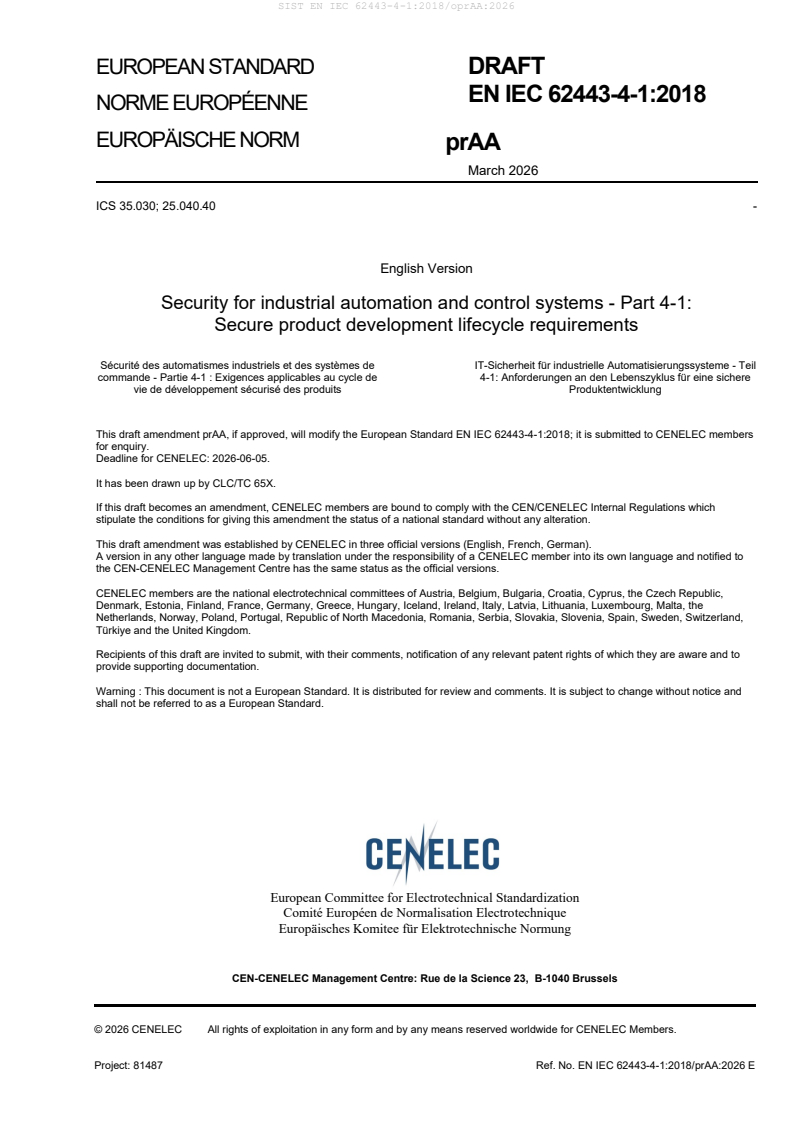
EUROPEAN STANDARD DRAFT
EN IEC 62443-4-1:2018
NORME EUROPÉENNE
EUROPÄISCHE NORM
prAA
March 2026
ICS 35.030; 25.040.40 -
English Version
Security for industrial automation and control systems - Part 4-1:
Secure product development lifecycle requirements
Sécurité des automatismes industriels et des systèmes de IT-Sicherheit für industrielle Automatisierungssysteme - Teil
commande - Partie 4-1 : Exigences applicables au cycle de 4-1: Anforderungen an den Lebenszyklus für eine sichere
vie de développement sécurisé des produits Produktentwicklung
This draft amendment prAA, if approved, will modify the European Standard EN IEC 62443-4-1:2018; it is submitted to CENELEC members
for enquiry.
Deadline for CENELEC: 2026-06-05.
It has been drawn up by CLC/TC 65X.
If this draft becomes an amendment, CENELEC members are bound to comply with the CEN/CENELEC Internal Regulations which
stipulate the conditions for giving this amendment the status of a national standard without any alteration.
This draft amendment was established by CENELEC in three official versions (English, French, German).
A version in any other language made by translation under the responsibility of a CENELEC member into its own language and notified to
the CEN-CENELEC Management Centre has the same status as the official versions.
CENELEC members are the national electrotechnical committees of Austria, Belgium, Bulgaria, Croatia, Cyprus, the Czech Republic,
Denmark, Estonia, Finland, France, Germany, Greece, Hungary, Iceland, Ireland, Italy, Latvia, Lithuania, Luxembourg, Malta, the
Netherlands, Norway, Poland, Portugal, Republic of North Macedonia, Romania, Serbia, Slovakia, Slovenia, Spain, Sweden, Switzerland,
Türkiye and the United Kingdom.
Recipients of this draft are invited to submit, with their comments, notification of any relevant patent rights of which they are aware and to
provide supporting documentation.
Warning : This document is not a European Standard. It is distributed for review and comments. It is subject to change without notice and
shall not be referred to as a European Standard.
European Committee for Electrotechnical Standardization
Comité Européen de Normalisation Electrotechnique
Europäisches Komitee für Elektrotechnische Normung
CEN-CENELEC Management Centre: Rue de la Science 23, B-1040 Brussels
© 2026 CENELEC All rights of exploitation in any form and by any means reserved worldwide for CENELEC Members.
Project: 81487 Ref. No. EN IEC 62443-4-1:2018/prAA:2026 E
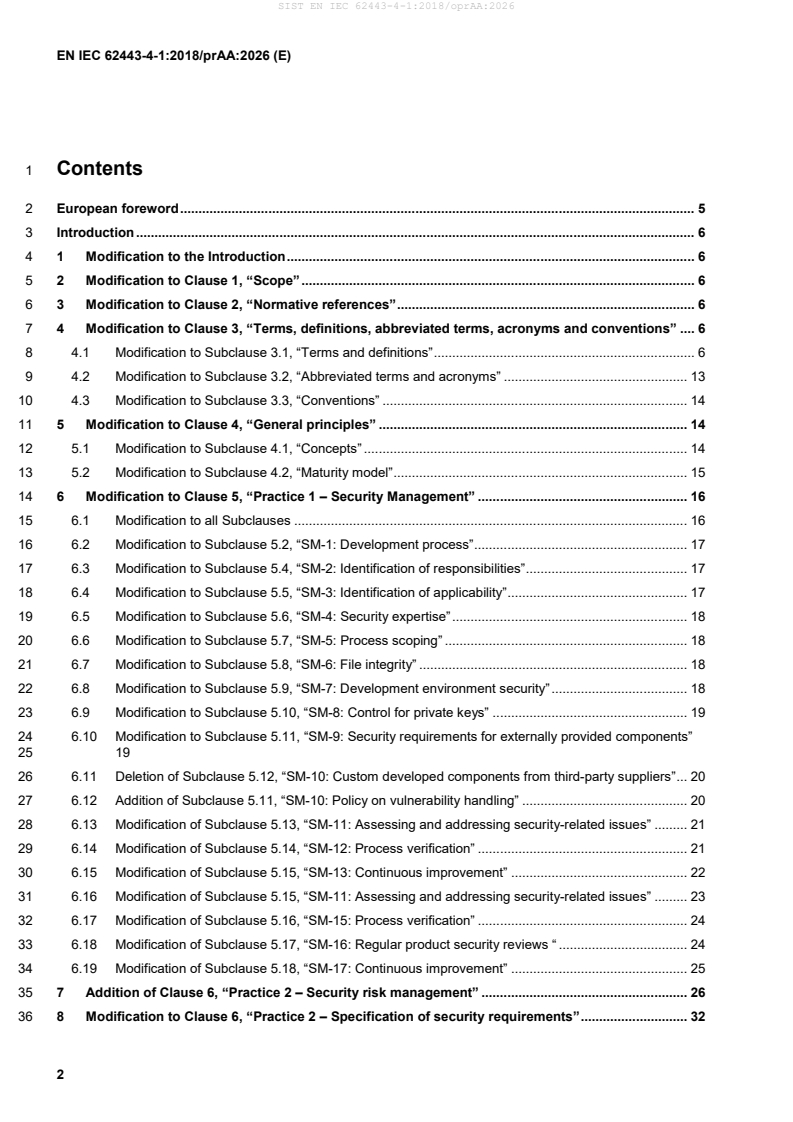
1 Contents
2 European foreword . 5
3 Introduction . 6
4 1 Modification to the Introduction . 6
5 2 Modification to Clause 1, “Scope” . 6
6 3 Modification to Clause 2, “Normative references” . 6
7 4 Modification to Clause 3, “Terms, definitions, abbreviated terms, acronyms and conventions” . 6
8 4.1 Modification to Subclause 3.1, “Terms and definitions” . 6
9 4.2 Modification to Subclause 3.2, “Abbreviated terms and acronyms” . 13
10 4.3 Modification to Subclause 3.3, “Conventions” . 14
11 5 Modification to Clause 4, “General principles” . 14
12 5.1 Modification to Subclause 4.1, “Concepts” . 14
13 5.2 Modification to Subclause 4.2, “Maturity model” . 15
14 6 Modification to Clause 5, “Practice 1 – Security Management” . 16
15 6.1 Modification to all Subclauses . 16
16 6.2 Modification to Subclause 5.2, “SM-1: Development process” . 17
17 6.3 Modification to Subclause 5.4, “SM-2: Identification of responsibilities” . 17
18 6.4 Modification to Subclause 5.5, “SM-3: Identification of applicability” . 17
19 6.5 Modification to Subclause 5.6, “SM-4: Security expertise” . 18
20 6.6 Modification to Subclause 5.7, “SM-5: Process scoping” . 18
21 6.7 Modification to Subclause 5.8, “SM-6: File integrity” . 18
22 6.8 Modification to Subclause 5.9, “SM-7: Development environment security” . 18
23 6.9 Modification to Subclause 5.10, “SM-8: Control for private keys” . 19
24 6.10 Modification to Subclause 5.11, “SM-9: Security requirements for externally provided components”
25 19
26 6.11 Deletion of Subclause 5.12, “SM-10: Custom developed components from third-party suppliers” . 20
27 6.12 Addition of Subclause 5.11, “SM-10: Policy on vulnerability handling” . 20
28 6.13 Modification of Subclause 5.13, “SM-11: Assessing and addressing security-related issues” . 21
29 6.14 Modification of Subclause 5.14, “SM-12: Process verification” . 21
30 6.15 Modification of Subclause 5.15, “SM-13: Continuous improvement” . 22
31 6.16 Modification of Subclause 5.15, “SM-11: Assessing and addressing security-related issues” . 23
32 6.17 Modification of Subclause 5.16, “SM-15: Process verification” . 24
33 6.18 Modification of Subclause 5.17, “SM-16: Regular product security reviews “ . 24
34 6.19 Modification of Subclause 5.18, “SM-17: Continuous improvement” . 25
35 7 Addition of Clause 6, “Practice 2 – Security risk management” . 26
36 8 Modification to Clause 6, “Practice 2 – Specification of security requirements” . 32
37 9 Modification to Clause 7, “Practice 3 – Secure by design” . 34
38 9.1 Modification to the clause number and title . 34
39 9.2 Modification to Subclause 7.1, “Purpose” . 34
40 9.3 Modification to Subclause 7.2, “SD-1: Secure design principles “ . 34
41 9.4 Modification to Subclause 7.3, “SD-2: Defense in depth design” . 36
42 9.5 Modification to Subclause 7.4, “SD-3: Security design review” . 37
43 9.6 Modification to Subclause 7.5, “SD-4: Secure design best practices” . 37
44 9.7 Addition of Subclause 8.6, “SD-5: Secure by default” . 38
45 10 Modification to Clause 8, “Practice 4 – Secure implementation”. 40
46 10.1 Modification to the Clause number . 40
47 10.2 Modification to Subclause 8.1, “Purpose” . 40
48 10.3 Modification to Subclause 8.2, “Applicability” . 40
49 10.4 Modification to Subclause 8.3, “SI-1: Security implementation review” . 40
50 10.5 Modification to Subclause 8.4, “SI-2: Secure coding standards” . 41
51 11 Modification to Clause 9, “Practice 5 – Security verification and validation testing”. 41
52 12 Modification to Clause 10, “Practice 6 – Management of security-related issues” . 46
53 12.1 Modification to Subclause 10.1, “Purpose” . 47
54 12.2 Modification to Subclause 10.2, “DM-1: Receiving notifications of security-related issues . 47
55 12.3 Modification to Subclause 10.3, “DM-2: Reviewing security-related issues” . 47
56 12.4 Modification to Subclause 10.4, “DM-3: Assessing security-related issues” . 47
57 12.5 Modification to Subclause 10.5, “DM-4: Addressing security-related issues” . 48
58 12.6 Modification to Subclause 10.6, “DM-5: Disclosing security-related issues” . 49
59 12.7 Modification to Subclause 10.7, “DM-6: Periodic review of security defect management practice” . 50
60 13 Modification to Clause 11, “Practice 7 – Security update management” . 50
61 13.1 Modification to Subclause 11.2 “SUM-1: Security update qualification”. 50
62 13.2 Modification to Subclause 11.3, “SUM-2: Security update documentation” . 51
63 13.3 Modification to Subclause 11.4 “SUM-3: Dependent component or operating system security update
64 documentation” . 51
65 13.4 Modification to Subclause 11.5, “SUM-4: Security update delivery” . 52
66 13.5 Modification to Subclause 11.6, “SUM-5: Timely delivery of security patches” . 52
67 13.6 Modification to Subclause 11 after 11.6 . 53
68 14 Modification to Clause 12, “Practice 8 – Security guidelines” . 54
69 14.1 Modification to Subclause 12.2, “SG-1: Product defense in depth” . 55
70 14.2 Modification to Subclause 12.3, “SG-2: Product defense in depth” . 55
71 14.3 Modification to Subclause 12.4, “SG-3: Security handling guidelines”. 56
72 14.4 Modification to Subclause 12.5, “ SG-4: Secure disposal guidelines”. 57
73 14.5 Modification to Subclause 12.6, “SG-5: Secure operation guidelines” . 57
74 14.6 Modification to Subclause 12.7, “SG-6: Account management guidelines” . 58
75 14.7 Modification to Subclause 12.8, ” SG-7: Documentation review” . 58
76 15 Deletion of Annex A, “Possible metrics” . 58
77 16 Modification to Annex B, “Table of requirements “ . 59
78 Annex A (informative) Table of requirements . 60
79 17 Addition of Annex B, “Product security context category” . 62
80 Annex B (normative) Product security context category . 63
81 18 Addition of Annex C, “Applicability of product security requirements and security risk
82 management workflow” . 64
83 Annex C (normative) Applicability of product security requirements and security risk management
84 workflow . 65
85 19 Addition of Annex D, “Identification and documentation of applicable product security test
86 modules” . 70
87 Annex D (normative) Applicability of product security requirements and security risk management
88 workflow . 71
89 20 Addition of Annex E, “Statement of Applicability – Documentation Template” . 72
90 Annex E (informative) Statement of applicability - Documentation template . 73
91 21 Addition of Annex F, “Mapping prEN 40000-1-2” . 74
92 Annex F (informative) Mapping of EN 40000-1-2 . 75
93 22 Addition of Annex G, “Mapping prEN 40000-1-3” . 76
94 Annex G (informative) Mapping EN 40000-1-3 . 77
95 23 Modification to the “Bibliography” . 79
96 European foreword
97 This document (EN IEC 62443-4-1:2018/prAA:2026) has been prepared by Technical Committee
98 CLC/TC 65X “Industrial-process measurement, control and automation”.
99 This document is currently submitted to the Enquiry.
100 The following dates are proposed:
• latest date by which the existence of this (doa) dav + 6 months
document has to be announced at national
level
• latest date by which this document has to be (dop) dav + 12 months
implemented at national level by publication of
an identical national standard or by
endorsement
• latest date by which the national standards (dow) dav + 36 months
conflicting with this document have to be (to be confirmed or
withdrawn modified when voting)
101 This document will modify EN IEC 62443-4-1:2018 (PR = 81847).
102 EN IEC 62443-4-1:2018/prAA:2026 includes the following significant technical modifications with respect to
103 EN IEC 62443-4-1:2018:
104 — update of existing requirements and introduction of new requirements;
105 — update by introducing an applicability assessment process;
106 — additon of new practice Risk management.
107 This document has been prepared under a standardization request addressed to CENELEC by the European
108 Commission. The Standing Committee of the EFTA States subsequently approves these requests for its
109 Member States.
110 Introduction
111 The purpose of this amendment is to identify and modify the requirements and associated clauses to align
112 with the EU Cyber Resilience Act essential cybersecurity requirements, so that the amendment
113 (EN IEC 62443-4-1:2018/prAA:2026), once made available by CENELEC, can be used as a normative
114 reference by EN IEC 62443-4-2:2019/prAA:2026.
115 1 Modification to the Introduction
116 Replace the content of the Introduction with the following:
117 “This document is part of a series of standards that addresses the issue of security for automation and control
118 systems (ACS). This document describes product development lifecycle requirements related to cyber
119 security for products intended for use in the automation and control systems environment and provides
120 guidance on how to meet the requirements described for each element.
121 This document is the part of the EN IEC 62443 series that contains security requirements for developers of
122 any automation and control products where security is a concern.”
123 2 Modification to Clause 1, “Scope”
124 Replace the content with the following:
125 “This part of EN IEC 62443 specifies process requirements for the secure development of products used in
126 automation and control systems. It defines a secure development lifecycle (SDL) for the purpose of
127 developing and maintaining secure products. This secure development lifecycle includes security risk
128 management, security requirements definition, secure design, secure implementation (including coding
129 guidelines), verification and validation, defect management, security update management and product end-of-
130 life. These requirements can be applied to new or existing processes for developing, maintaining and retiring
131 hardware, software or firmware for new or existing products. These requirements apply to the developer and
132 maintainer of the product, but not to the integrator or product user. A summary list of the requirements in this
133 document can be found in Annex B.”
134 3 Modification to Clause 2, “Normative references”
135 Replace the reference with the following:
136 IEC 62443-2-4:2015, Security for industrial automation and control systems – Part 2-4: Security program
137 requirements for IACS service providers
138 4 Modification to Clause 3, “Terms, definitions, abbreviated terms, acronyms and
139 conventions”
140 4.1 Modification to Subclause 3.1, “Terms and definitions”
141 Replace the 1st paragraph with the following:
142 “For the purposes of this document, the terms and definitions given in IEC/TR 62443-1-2 [1] and the following
143 apply.”
144 Replace term entry 3.1.3 with the following:
As impacted by IEC 62443-2-4:2015/AMD1:2017.
145 3.1.3
146 access control
147
148 process by which use of system resources is regulated according to a security policy and is permitted by only
149 authorized product users according to that policy
150 Note 1 to entry: Access control includes identification and authentication requirements specified in other parts of the
151 EN IEC 62443 series.
152 Replace term entry 3.1.4 with the following:
153 3.1.4
154 administrator
155 product user who has been authorized to manage security policies/capabilities for a product or system
156 Replace Note 1 to entry in 3.1.5 with the following:
157 Note 1 to entry: In this specific case, an asset is an object that is part of an ACS.
158 Delete term entry 3.1.6 “asset owner”.
159 Replace the clause number for term entry “attack surface” to 3.1.6 from 3.1.7.
160 Replace the clause number of term entry “audit log” to 3.1.7 from 3.1.8.
161 Replace the clause number of term entry “authentication” to 3.1.8 from 3.1.9 and replace the notes to entry
162 with the following:
163 Note 1 to entry: Not all credentials used to authenticate an identity are created equally. The trustworthiness of the
164 credential is determined by the configured authentication mechanism. Hardware or software-based mechanisms can force
165 product users to prove their identity before accessing data on a device. A typical example is proving the identity of a user
166 usually through an identity provider.
167 Note 2 to entry: Authentication includes verifying human product users as well as non-human product users such as
168 devices or processes.
169 Add the following term entry 3.1.9:
170 3.1.9
171 authenticated security test
172 test which allows the tester to directly access products using remote administrative protocols such as secure
173 shell (SSH) or remote desktop protocol (RDP) and to authenticate to the products using provided credentials
174 Note 1 to entry: Authenticated security tests provide a more thorough view and more detailed insights of the tested
175 product compared to unauthenticated security tests. They can therefore identify additional vulnerabilities at the product
176 which had not been detected by unauthorized security tests.
177 Replace term entry 3.1.10 “automation solution” with the following:
178 3.1.10
179 automation and control system
180 ACS
181 collection of integrated components that provide functions for monitoring, controlling and managing the
182 operation of equipment under control
183 Add the following term entry 3.1.11
184 3.1.11
185 automation and control system component
186 ACS component
187 component developed and supported according to the secure development processes described in
188 EN IEC 62443-4-1 and implementing the applicable technical requirements of EN IEC 62443-4-2
189 Add the following term entry 3.1.12:
190 3.1.12
191 automation and control solution
192 collection of people processes and automation and control systems with the purpose of monitoring, controlling
193 and managing the operation of equipment under control
194 Note 1 to entry: An automation and control solution includes the instantiation of one or more automation and control
195 systems.
196 Note 2 to entry: Automation and control solution is used as a proper noun in this part of the EN IEC 62443 series.
197 Note 3 to entry: The difference between the automation and control system and the automation and control solution is
198 that the automation and control system is incorporated into the automation and control solution design (for example, a
199 specific number of workstations, controllers and devices in a specific configuration), which is then implemented. The
200 resulting configuration is referred to as the automation and control solution.
201 Note 4 to entry: The automation and control solution can be comprised of components from multiple suppliers including
202 the product supplier of the automation and control system.
203 Replace the clause number of term entry “banned function” to 3.1.13 from 3.1.11.
204 Replace term entry 3.1.14 “best practices” with the following
205 3.1.14
206 best practices
207 guidelines for securely designing, developing, verifying and validating, maintaining or retiring products that the
208 supplier has determined are commonly recommended by both the security and industrial automation
209 communities
210 EXAMPLE least privilege, economy of mechanism and least common mechanism
211 Replace term entry 3.1.13 “component” with the following:
212 3.1.15
213 component
214 one of the parts that make up a product or system. A component may be hardware or software and may be
215 subdivided into other components
216 Replace term entry 3.1.14 “configuration management” with the following:
217 3.1.16
218 configuration management
219 discipline of identifying the components of an evolving system for the purposes of controlling changes to those
220 components and maintaining continuity and traceability throughout the secure product development lifecycle
221 Add the following term entry 3.1.17:
222 3.1.17
223 cryptographic mechanism
224 element of software or hardware that provides a cryptographic service, such as confidentiality, integrity,
225 source authentication, and access control
226 Note 1 to enrtry: The cryptographic mechanism can be, for example, a set of cryptographic algorithms or a protocol
227 utilizing cryptography.
228 Delete term entry 3.1.18 “externally provided component”.
229 Replace the clause number of term entry “defense in depth” to 3.1.18 from 3.1.15.
230 Replace the clause numberi of term entry “dependent component” to 3.1.19 from 3.1.16 and replace the
231 example with the following:
232 EXAMPLE Java run time environment or a driver
233 Delete term entry 3.1.20 “industrial automation and control system”.
234 Replace term entry 3.1.17 “deprecated function” with the following:
235 3.1.20
236 deprecated function
237 software method that is supported but whose use is no longer recommended
238 Add the following term entry 3.1.21:
239 3.1.21
240 equipment under control
241 equipment, machinery, apparatus, or plant used for manufacturing, process, transportation, medical, or other
242 activities
243 [SOURCE: IEC 61508-4:2010]
244 Add the following term entry 3.1.22:
245 3.1.22
246 essential function
247 function or capability that is required to maintain health, safety, the environment and availability for the
248 equipment under control
249 Note 1 to entry: Essential functions include, but are not limited to, the safety instrumented function (SIF), the control
250 function and the ability of the operator to view and manipulate the equipment under control. The loss of essential functions
251 is commonly termed loss of protection, loss of control and loss of view respectively. In some industries additional functions
252 such as history may be considered essential.
253 Replace the clause number of term entry “fuzz testing” to 3.1.23 from 3.1.19.
254 Add the following term entry 3.1.24:
255 3.1.24
256 information category
257 logical grouping of information that shares a common purpose and set of security requirements
258 Add the following term entry 3.1.25:
259 3.1.25
260 intended use
261 use for which a product is designed by the product supplier, describing the explicit and implicit assumptions
262 about the product’s properties and capabilities
263 Note 1 to entry: The intended use does not describe specific product features, e.g. security update capability,
264 authentication mechanism.
265 EXAMPLE The intended use of a network switch is to switch network traffic in an enterprise environment used by skilled
266 persons.
267 Replace term entry 3.1.22 “product” with the following:
268 3.1.26
269 product
270 system, subsystem or component that is manufactured, developed or refined
271 Note 1 to entry: in the context of EN IEC 62443-3-3 [4] a product is an automation and control system (ACS)
272 Note 2 to entry: in the context of EN IEC 62443-4-2 [5] a product is an ACS component
273 Replace term entry 3.1.23 “configuration management” with the following:
274 3.1.27
275 product security context
276 security provided to the product by the environment (product user deployment) in which the product is
277 intended to be used
278 Note 1 to entry: The security provided to the product by its intended environment can effectively restrict the threats that are
279 applicable to the product.
280 Note 2 to entry: The product security context is derived from the intended use.
281 Add the following term entry 3.1.28:
282 3.1.28
283 product security context category
284 structural categorization describing the product security context through different factors to support
285 comparable assumptions about the product's security context
286 Add the following term entry 3.1.29:
287 3.1.29
288 product security incident
289 security compromise that has a measurable impact on the product user, or an attempted compromise that, if
290 successful, would have resulted in a measurable impact on the product user
291 Replace the clause number of term entry “product supplier” to 3.1.30 from 3.1.24.
292 Replace term entry 3.1.25 “product users” with the following:
293 3.1.31
294 product user
295 user of the hardware and/or software product including administrator, integrator and maintenance personnel,
296 and vendor of other components or products that reuse or contain this product
297 Replace the clause number of term entry “record” to 3.1.32 from 3.1.26.
298 Replace the clause number of term entry “regression” to 3.1.33 from 3.1.27.
299 Add the following term entry 3.1.34:
300 3.1.34
301 review
302 activity undertaken to determine the suitability, adequacy and effectiveness of the subject matter to achieve
303 established objectives
304 [SOURCE: ISO 31073:2022, 3.3.41]
305 Replace the clause number of term entry “root cause” to 3.1.35 from 3.1.28.
306 Add the following term entry 3.1.36:
307 3.1.36
308 secure by default
309 state of the product being securely configured upon installation or deployment according to its intended use
310 and product security context
311 Replace the clause number of term entry “security defect” to 3.1.37 from 3.1.29.
312 Replace term entry 3.1.30 “security advisor” with the following:
313 3.1.38
314 security advisor
315 organizational role to guide team in the process of the SDL (Security Development Lifecycle)
316 Note 1 to entry: Security advisor may be part of the project team or may be consultant to the team to provide guidance
317 and assistance where required.
318 Replace the clause number of term entry “security-related issue” to 3.1.39 from 3.1.32 and add the following
319 example:
320 EXAMPLE A product vulnerability is a type of security-related issue.
321 Add the following term entry 3.1.40:
322 3.1.40
323 security support period
324 period during which a product supplier ensures that security support processes are active and security issues
325 in the product are handled
326 Note 1 to entry: The length and obligations of security support can be pre-determined by regulatory or contractual terms.
327 Add the following term entry 3.1.41:
328 3.1.41
329 security test grade
330 STG
331 defined set of security test modules.
332 Note 1 to entry: Security test grades are STG-1, STG-2, STG-3, and STG-4.
333 Add the following term entry 3.1.42:
334 3.1.42
335 security test module
336 STM
337 specification of a security testing activity, describing the aim of the security test, the testing methodology and
338 acceptance criteria.
339 Replace term entry 3.1.21 “patch management” with the following:
340 3.1.43
341 security update management
342 area of systems management that involves acquiring, testing and installing software security updates (code
343 changes) to a product
344 Note 1 to entry: See IEC/TR 62443-2-3 [2] for additional information.
345 Note 2 to entry: Security update management also applies to the process of keeping included 3rd party libraries current
346 before releasing a product.
347 Replace term entry 3.1.33 “security-related issue” with the following:
348 3.1.44
349 security verification and validation testing
350 testing performed to assess the overall security of a component or product when used in its intended product
351 security context and to determine if a component or product satisfies the product security requirements and
352 satisfies its designed security purpose
353 Note 1 to entry: Security verification testing supplements security validation testing with additional testing focused on the
354 product security context and defence in depth strategy
355 Add the following term entry 3.1.45:
356 3.1.45
357 software bill of materials (SBOM)
358 information in a structured format that allows the exchange of information for a software package, which might
359 usefully include name, version, origin, license, copyright and known vulnerabilities in a manner useful to third
360 parties
361 [SOURCE: ISO/IEC 18974:2023(en), 3.12, modified — a reference to SPDX as possible format was removed]
362 Add the following term entry 3.1.46:
363 3.1.46
364 supporting measure
365 functions and procedures external to the product to support the implementation of the product security
366 requirements
367 Note 1 to entry: Functions are e.g. provided by the underlying software or hardware.
368 Note 2 to entry: Procedures have e.g. the aim to ensure physical protection.
369 Add the following term entry 3.1.47:
370 3.1.47
371 system
372 interacting, interrelated, or interdependent elements forming a complex whole
373 Replace the clause number of term entry “system integrator” to 3.1.48 from 3.1.34.
374 Add the following term entry 3.1.49:
375 3.1.49
376 test
377 activity in which a system or component is executed under specified conditions, the results are observed or
378 recorded, and an evaluation is made of some aspect of the system or component
379 Note 1 to entry: A test is carried out to measure or classify a characteristic or a property of an item by applying to the item
380 a set of environmental and operating conditions and/or requirements.
381 [SOURCE: ISO/IEC/IEEE 29119-2:2021, 3.21]
382 Add the following term entry 3.1.50:
383 3.1.50
384 third-party component
385 component included in a product that is developed and maintained by a third-party supplier.
386 Note 1 to entry: This includes components which are specifically developed by a third-party supplier for the product
387 supplier.
388 Replace term entry 3.1.35 “third-party supplier” with the following:
389 3.1.51
390 third-party supplier
391 organization independent of the product supplier organization
392 Note 1 to entry: A third-party supplier can also mean a different legal entity of the corporation the product supplier
393 organization belongs to.
394 Replace the clause number of term entry “threat” to 3.1.52 from 3.1.36.
395 Replace the clause number of term entry “threat modelling” to 3.1.53 from 3.1.37.
396 Add the following term entry 3.1.54:
397 3.1.54
398 threat scenario
399 description of how a threat, exploiting one or more vulnerabilities could trigger an incident leading to adverse
400 impact
401 Replace the clause number of term entry “trust boundary” to 3.1.55 from 3.1.38.
402 Add the following term entry 3.1.56:
403 3.1.56
404 unauthenticated security test
405 unauthenticated security tests are security tests performed without any authentication at the tested products.
406 Replace term entry 3.1.39 “unit testing” with the following:.
407 3.1.57
408 unit testing
409 verification that an individual unit of computer software or hardware performs as intended
410 Note 1 to entry: Automated verification, or testing, is generally performed by computer test software.
411 Note 2 to entry: What constitutes a unit of source code is a design decision. A unit is often designed as the smallest
412 testable part of an application. It may include one or more computer program modules and may also include associated
413 control data, usage procedures and operating procedures. In procedural programming, a unit could be an entire module
414 but is more commonly an individual function or procedure. In object-oriented programming, a unit is often an entire
415 interface, such as a class, but could be an individual method.
416 Replace the clause number of term entry “user” to 3.1.58 from 3.1.40.
417 Replace the clause number of term entry “zone” to 3.1.59 from 3.1.41.
418 4.2 Modification to Subclause 3.2, “Abbreviated terms and acronyms”
419 Replace the list of abbreviated terms and acronyms with the following:
ACL Access control list
ACS Automation control system
CMMI Capability maturity model integration
CMMI- Capability maturity model integration for development
DEV
CMU Carnegie Mellon University
COTS Commercial off the shelf
CVSS Common vulnerability scoring system
DAST Dynamic application security testing
DM Defect management
FDIS Final Draft International Standard
HTTP Hypertext transfer protocol
IEC International Electrotechnical Commission
ISA International Society of Automation
ISO International Organization for Standardization
MIN Minimum
OWASP Open Web Application Security Project
QA Quality assurance
SAST Static Application Security Testing
SL-C Capability Security Level
SD Secure Design
SDL Security development lifecycle
SDLA Secure Development Lifecycle Assessment
SEI Software Engineering Institute
SG Security guidelines
SI Secure implementation
SL Security level
SL-C Capability security level
SM Security management
SR Security requirements
STG Security test grade
STM Security test module
STRIDE Spoofing, Tampering, Repudiation, Information disclosure, Denial of service, Elevation of
privilege
SVV Security verification and validation
TCP Transmission control protocol
TCP/IP Transmission control protocol/Internet protocol
TR Technical report
USB Universal serial bus
420 4.3 Modification to Subclause 3.3, “Conventions”
421 Replace the whole content with the following:
422 “Requirements defined in this document generally begin with the phrase “A process shall be employed…”.
423 This terminology is used to specify that the required processes have to be part of the product suppliers
424 documented secure product development lifecycle processes. The practice of these requirements is
425 dependent on the product supplier having product development projects that require the use of these
426 processes.
427 According to SM-3 (5.4), products requiring the use of these processes shall be identified.”
428 5 Modification to Clause 4, “General principles”
429 5.1 Modification to Subclause 4.1, “Concepts”
430 Replace the whole content with the following:
431 “The primary goal of these requirements is to provide a framework to address a secure by design, defense in
432 depth approach to designing, building, maintaining and retiring products used in industrial automation and
433 control products and systems. Application of the framework is intended to provide confidence that the product
434 has security commensurate with its expected level of risk throughout the product’s lifecycle. While the concept
435 of security levels is not discussed in this document, complying with this document will help ensure that the
436 security capabilities implemented in the product (see EN IEC 62443-4-2 [5] and EN IEC 62443-3-3 [4]) will
437 be implemented correctly and that security risks and any known security vulnerabilities in the product are
438 eliminated or mitigated.
439 Therefore, compliance with this document supports meeting the overall capability security level (SL-C) of
440 the product.
441 The secondary goal of these requirements is to align the development process with the security needs of
442 product users of ACSs (e.g. providers of EN IEC 62443-2-4 capabilities such as integrators and maintenance
443 contractors). This means that the process needs to generate items such as well-documented security
444 configurations and security update management policies and procedures, as well as providing clear and
445 succinct communications about security vulnerabilities uncovered in the product.
446 NOTE 1 For ACS, EN IEC 62443-3-2 [3] describes requirements for determining the expected level of risk associated
447 with the system’s zones and conduits.
448 There is no prescribed execution order of the practices specified in this document. The product supplier
449 developing a product using a process compliant with this document is required to perform all applicable
450 practices but may execute them in any order and iterate them as often as needed during the secure product
451 development lifecycle.
452 A key concept used throughout this document is the use of threat modelling. Design and implementation
453 reviews to refine records improve the security posture of a product. Reviews of any records (for example,
454 requirements, design records, implemented modules and verification/validation testing) through any means
455 (for example, manual, automated or a combination) are used to discover security-related issues in the
456 product. An impact analysis of each discovered issue assesses its security severity based on its potential
457 compromise (for example, availability, integrity and confidentiality) and its associated losses (for
458 example, control of the process, view of the process and intellectual property). Then, the resolution process
459 determines the most appropriate course of action based on the issue’s severity and the suitability of various
460 response options.”
461 5.2 Modification to Subclause 4.2, “Maturity model”
462 Replace the 2nd paragraph with the following:
463 “These benchmarks are defined by maturity levels as shown in Table 1. The maturity levels are based on the
464 Capability Maturity Model Integration (CMMI) for Development (CMMI-DEV) model [17]. Table 1 shows the
465 relationship to the CMMI-DEV in the description column.”
466 Replace the 3rd paragraph with the following:
467 “Maturity levels provide more details on how thoroughly a supplier has met these requirements. Therefore,
468 these levels can be used by system integrators and product users to assess the level of rigor used to develop
469 products.”
470 Delete the 4th paragraph.
471 Replace the 5th paragraph with the following:
472 “When designing and implementing a secure product according to this document (see EN IEC 62443-4-2 [5]
473 and EN IEC 62443-3-3 [4]), all applicable requirements as defined by SM-5 (5.6) in this document have
...