

EN 175300:1996
(Main)Sectional Specification: Rectangular connectors for frequencies below 3 MHz
General Information
- Abstract
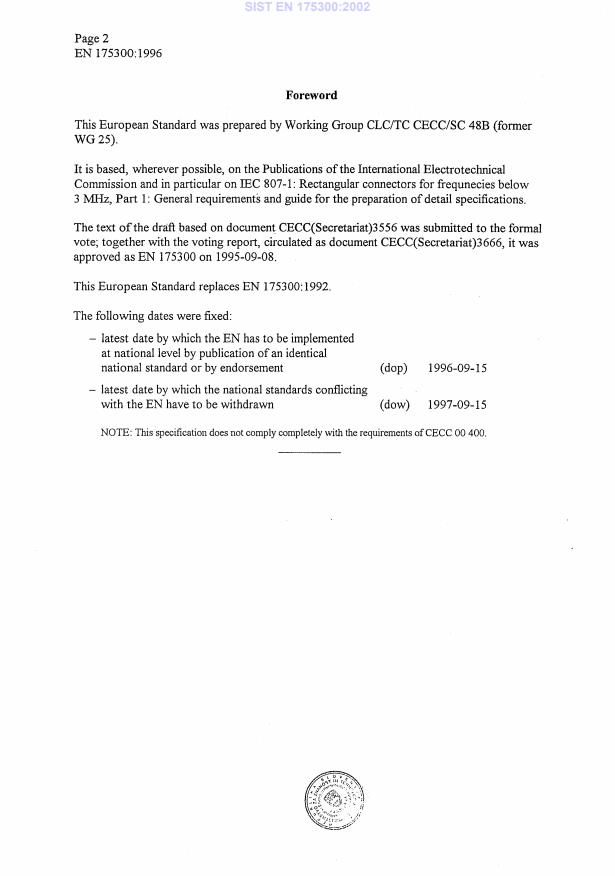
Supersedes EN 175300:1992 * D114/118: CLC/TC 48B disbanded
- Status
- Published
- Publication Date
- 23-Apr-1996
- Withdrawal Date
- 14-Sep-1997
- Technical Committee
- CLC/SR 48B - Connectors
- Drafting Committee
- IEC/SC 48B - IEC_SC_48B
- Parallel Committee
- IEC/SC 48B - IEC_SC_48B
- Current Stage
- 9093 - Decision to confirm - Review Enquiry
- Start Date
- 15-Feb-2024
- Completion Date
- 25-Aug-2026

Overview
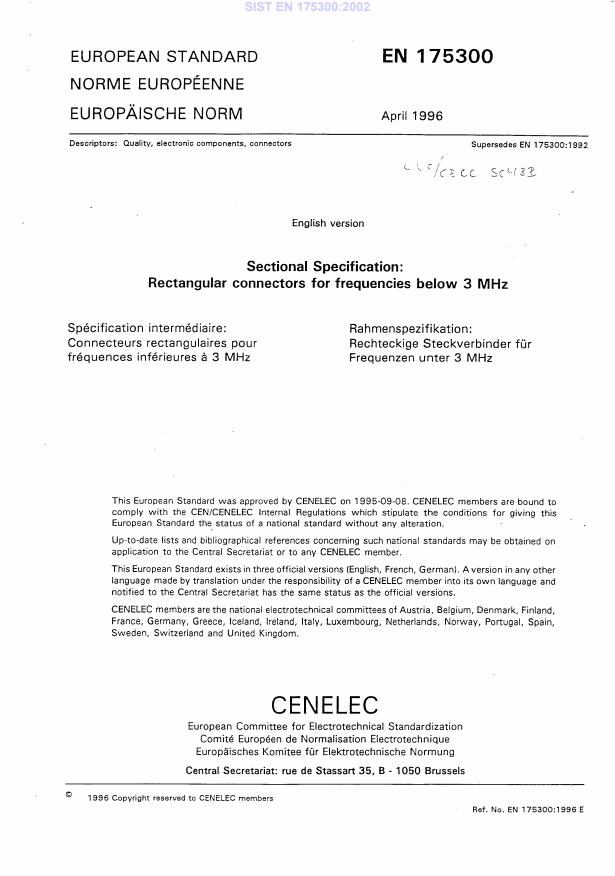
EN 175300:1996, Sectional Specification: Rectangular connectors for frequencies below 3 MHz is a European standard developed by CLC (Comité Européen de Normalisation Electrotechnique - CENELEC). This specification defines the general requirements applicable to rectangular plug-and-socket connectors that are designed for use at frequencies below 3 MHz. Superseding the earlier EN 175300:1992, this standard ensures compatibility and performance for a broad range of electrical and electronic applications, where reliable low-frequency signal or power connections are essential.
The standard is widely adopted within industries that demand standardized rectangular connectors, particularly where consistent performance, interchangeability, and safety are paramount. It forms a key reference in the field of connector technology and supports the harmonization of connector components across European and international markets.
Key Topics
EN 175300:1996 covers several crucial aspects related to rectangular connectors for frequencies below 3 MHz, thereby supporting interoperability and quality. Key focus areas include:
- Scope and field of application: Defining where and how the standard applies to rectangular connectors.
- General requirements: Outlining construction, material, and design prerequisites to meet performance and reliability criteria.
- Testing procedures: Specifying methods for testing connectors to ensure consistent quality, safety, and functionality.
- Performance characteristics: Detailing aspects like contact resistance, insulation, mechanical robustness, and suitability for specific environments.
- Marking and documentation: Requirements for product marking to facilitate identification and traceability across supply chains.
These topics serve as the foundation for manufacturing, testing, and evaluating plug-and-socket devices in compliance with regional and international standards.
Applications
The specifications provided by EN 175300:1996 are vital for sectors where robust and reliable electrical connections are critical. Typical applications include:
- Industrial automation and control systems: Ensuring reliable connections for equipment operating at frequencies under 3 MHz.
- Electrical power distribution equipment: Safe and standardized connectors for low-frequency power transmission.
- Consumer and commercial electronics: Use in appliances and devices needing dependable rectangular plug-and-socket solutions.
- Telecommunications hardware: Supporting low-frequency connectivity in communication devices and infrastructure.
- Test and measurement equipment: Reliable interfaces for both laboratory and field measurement instruments.
By adhering to EN 175300:1996, manufacturers and integrators guarantee compatibility, safety, and performance, helping reduce procurement risks and operational errors.
Related Standards
EN 175300:1996 is part of a broader family of standards related to connectors and electrical components. Standards that are closely associated or referenced alongside EN 175300:1996 include:
- IEC 60603 series: International specifications for connectors, often used as a global reference.
- IEC 61076 series: Standards for connectors for electronic equipment.
- EN 60664: Standards on insulation coordination for equipment within low-voltage systems.
- Relevant national adoptions: Such as SIST EN 175300:2002 in Slovenia.
EN 175300:1996 plays an important role in ensuring compliance across European and international markets, promoting cross-compatibility, and supporting high standards in quality and safety for rectangular connectors intended for low-frequency use.
For businesses, engineers, and procurement specialists, consulting this standard is essential for product development, quality assurance, and regulatory conformity involving plug-and-socket connector devices below 3 MHz.
Relations
- Effective Date
- 03-Feb-2026
Frequently Asked Questions
EN 175300:1996 is a standard published by CLC. Its full title is "Sectional Specification: Rectangular connectors for frequencies below 3 MHz". This standard covers: Supersedes EN 175300:1992 * D114/118: CLC/TC 48B disbanded
Supersedes EN 175300:1992 * D114/118: CLC/TC 48B disbanded
EN 175300:1996 has the following relationships with other standards: It is inter standard links to EN 175301-803:2006. Understanding these relationships helps ensure you are using the most current and applicable version of the standard.
EN 175300:1996 is available in PDF format for immediate download after purchase. The document can be added to your cart and obtained through the secure checkout process. Digital delivery ensures instant access to the complete standard document.
Standards Content (Sample)
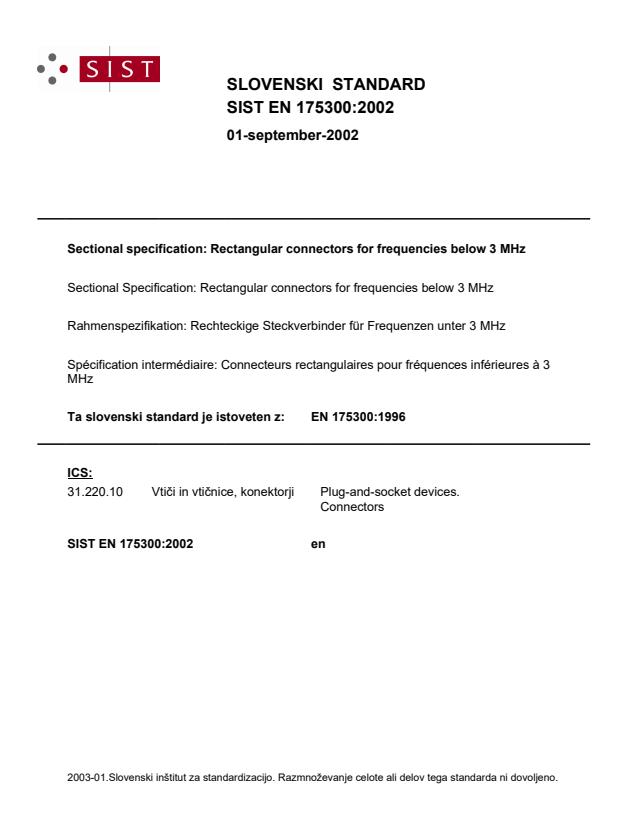
2003-01.Slovenski inštitut za standardizacijo. Razmnoževanje celote ali delov tega standarda ni dovoljeno.Sectional specification: Rectangular connectors for frequencies below 3 MHzRahmenspezifikation: Rechteckige Steckverbinder für Frequenzen unter 3 MHzSpécification intermédiaire: Connecteurs rectangulaires pour fréquences inférieures à 3 MHzSectional Specification: Rectangular connectors for frequencies below 3 MHz31.220.10Plug-and-socket devices. ConnectorsICS:Ta slovenski standard je istoveten z:EN 175300:1996SIST EN 175300:2002en01-september-2002SIST EN 175300:2002SLOVENSKI
STANDARD
...