

prEN IEC/ASTM 63470:2025
(Main)Cooking fume extractors - Methods for measuring the capture efficiency
- Status
- Not Published
- Publication Date
- 16-Sep-2026
- Technical Committee
- CLC/TC 59X - Consumer information related to household electrical appliances
- Current Stage
- 4060 - Enquiry results established and sent to TC, SR, BTTF - Enquiry
- Start Date
- 04-Jul-2025
- Completion Date
- 04-Jul-2025

Overview
prEN IEC/ASTM 63470:2025 - Cooking fume extractors - Methods for measuring the capture efficiency (CDV stage) defines a laboratory test method to quantify how effectively cooking fume extractors (CFEs) capture cooking emissions before they mix with room air. The method applies to CFEs as defined in IEC 61591 and covers devices such as wall, island, ceiling and built‑in range hoods, microwave‑hood combinations and down‑draft systems. The procedure uses tracer gas techniques in a controlled test chamber and is limited to airflows up to 720 m³/h.
Key topics and technical requirements
- Capture efficiency (CE): CE is defined as the fraction of emitted tracer gas directly exhausted by the CFE.
- Tracer gas: CO2 is specified as the tracer gas for measurements.
- Test conditions: Chamber start temperature 23 °C ± 2 °C, with maximum 5 °C variation during a test.
- Instrumentation & accuracy: Minimum resolutions and accuracies are specified for key parameters:
- Tracer gas concentration: resolution 1 µmol/mol, accuracy ±1%
- Volumetric airflow: ±9 m³/h or ±2% (whichever greater)
- Tracer gas mass flow: ±1%
- Air temperature in chamber: resolution 0.1 °C, accuracy ±0.2 °C
- Pressure: 1 Pa resolution, ±1% accuracy
- Linear dimensions for cabinetry, countertops and CFE widths: ±10 mm
- Test set‑up and positioning: Detailed requirements for positioning CFEs and tracer gas emitters for different installations (wall, island, ceiling, down‑draft), filters, cabinets, countertop dimensions and installation distances.
- Measurement procedure and reporting: Procedures for conducting tests, required measurements, and data to be reported to ensure repeatable, comparable CE results.
- Annexes & figures: Informative annexes include additional requirements and sketches (e.g., test chamber layouts, tracer gas emitter assemblies) for special configurations.
Practical applications and users
This standard is designed for:
- Appliance manufacturers developing and validating range hoods, microwaves with integrated extractors, and down‑draft systems.
- Testing and certification laboratories performing repeatable capture efficiency measurements for product performance claims.
- Regulatory bodies and energy/environment programs that assess indoor air quality, ventilation performance and energy/environmental impact of cooking appliances.
- Product designers and R&D teams aiming to optimize hood geometry, airflow and filter systems to improve capture efficiency.
- Indoor air quality researchers comparing extractor performance across device types and operating conditions.
Related standards
- IEC 61591 - Cooking fume extractors - Methods for measuring performance (definitions and broader performance tests)
- IEC 60350‑2 - Household electric cooking appliances - Hobs: performance methods
- ISO 80000‑1 - Quantities and units (rounding and units)
- IEC 60751, IEC 60584 - Instrumentation and sensor references
Keywords: cooking fume extractors, capture efficiency measurement, CO2 tracer gas, test chamber, range hood testing, down‑draft systems, IEC/ASTM 63470, airflow up to 720 m³/h, instrumentation accuracy.
Frequently Asked Questions
prEN IEC/ASTM 63470:2025 is a draft published by CLC. Its full title is "Cooking fume extractors - Methods for measuring the capture efficiency". This standard covers: Cooking fume extractors - Methods for measuring the capture efficiency
Cooking fume extractors - Methods for measuring the capture efficiency
prEN IEC/ASTM 63470:2025 is classified under the following ICS (International Classification for Standards) categories: 97.040.20 - Cooking ranges, working tables, ovens and similar appliances. The ICS classification helps identify the subject area and facilitates finding related standards.
prEN IEC/ASTM 63470:2025 is available in PDF format for immediate download after purchase. The document can be added to your cart and obtained through the secure checkout process. Digital delivery ensures instant access to the complete standard document.
Standards Content (Sample)
SLOVENSKI STANDARD
01-junij-2025
Odvajalniki kuhinjskih hlapov - Metode za merjenje učinkovitosti zajemanja
Cooking fume extractors - Methods for measuring the capture efficiency
Ta slovenski standard je istoveten z: prEN IEC/ASTM 63470:2025
ICS:
97.040.20 Štedilniki, delovni pulti, Cooking ranges, working
pečice in podobni aparati tables, ovens and similar
appliances
2003-01.Slovenski inštitut za standardizacijo. Razmnoževanje celote ali delov tega standarda ni dovoljeno.
59K/411/CDV
COMMITTEE DRAFT FOR VOTE (CDV)
PROJECT NUMBER:
IEC/ASTM 63470 ED1
DATE OF CIRCULATION: CLOSING DATE FOR VOTING:
2025-04-11 2025-07-04
SUPERSEDES DOCUMENTS:
59K/379/CD, 59K/388B/CC
IEC SC 59K : PERFORMANCE OF HOUSEHOLD AND SIMILAR ELECTRICAL COOKING APPLIANCES
SECRETARIAT: SECRETARY:
Germany Ms Susanne Stolz
OF INTEREST TO THE FOLLOWING COMMITTEES: HORIZONTAL FUNCTION(S):
ASPECTS CONCERNED:
Energy Efficiency,Environment
SUBMITTED FOR CENELEC PARALLEL VOTING NOT SUBMITTED FOR CENELEC PARALLEL VOTING
Attention IEC-CENELEC parallel voting
The attention of IEC National Committees, members of
CENELEC, is drawn to the fact that this Committee Draft for
Vote (CDV) is submitted for parallel voting.
The CENELEC members are invited to vote through the
CENELEC online voting system.
This document is still under study and subject to change. It should not be used for reference purposes.
Recipients of this document are invited to submit, with their comments, notification of any relevant patent rights of which
they are aware and to provide supporting documentation.
Recipients of this document are invited to submit, with their comments, notification of any relevant “In Some Countries”
clauses to be included should this proposal proceed. Recipients are reminded that the CDV stage is the final stage for
submitting ISC clauses. (SEE AC/22/2007 OR NEW GUIDANCE DOC).
TITLE:
Cooking fume extractors - Methods for measuring the capture efficiency
PROPOSED STABILITY DATE: 2027
NOTE FROM TC/SC OFFICERS:
electronic file, to make a copy and to print out the content for the sole purpose of preparing National Committee positions.
You may not copy or "mirror" the file or printed version of the document, or any part of it, for any other purpose without
permission in writing from IEC.
59K/411/CDV – 2 – IEC/ASTM CDV 63470 © IEC/ASTM 2025
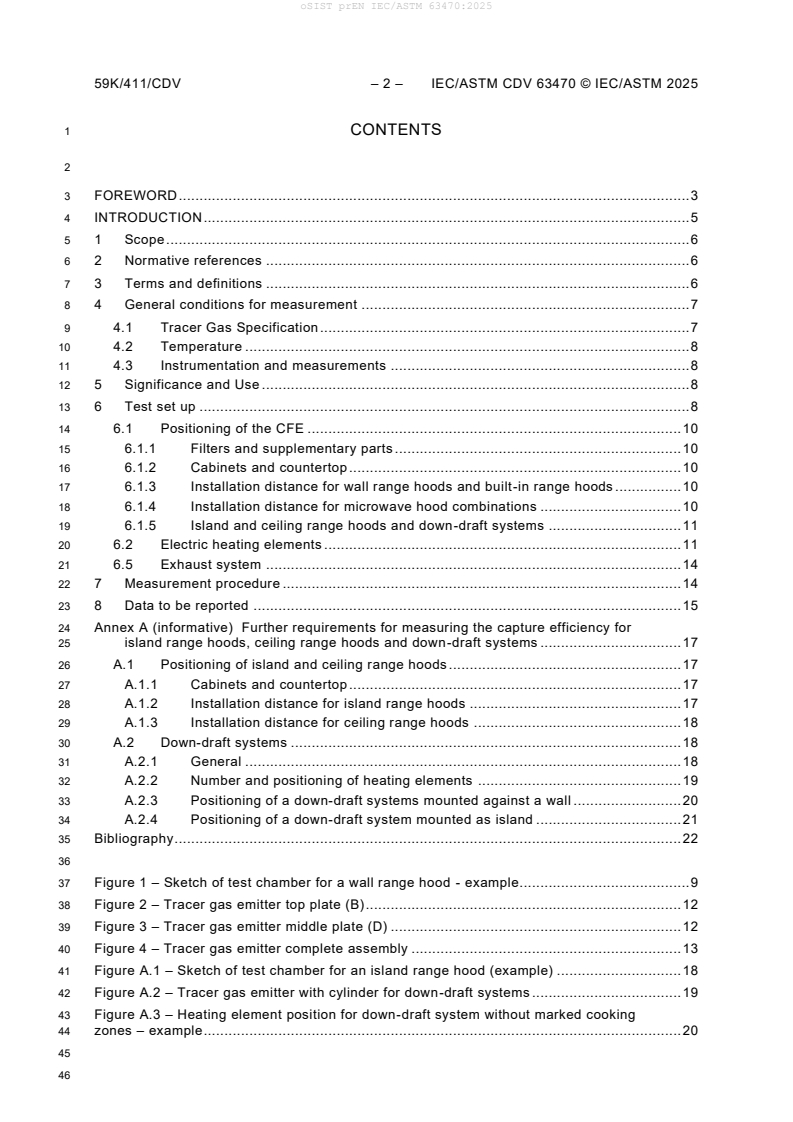
1 CONTENTS
3 FOREWORD . 3
4 INTRODUCTION . 5
5 1 Scope . 6
6 2 Normative references . 6
7 3 Terms and definitions . 6
8 4 General conditions for measurement . 7
9 4.1 Tracer Gas Specification . 7
10 4.2 Temperature . 8
11 4.3 Instrumentation and measurements . 8
12 5 Significance and Use . 8
13 6 Test set up . 8
14 6.1 Positioning of the CFE . 10
15 6.1.1 Filters and supplementary parts . 10
16 6.1.2 Cabinets and countertop . 10
17 6.1.3 Installation distance for wall range hoods and built-in range hoods . 10
18 6.1.4 Installation distance for microwave hood combinations . 10
19 6.1.5 Island and ceiling range hoods and down-draft systems . 11
20 6.2 Electric heating elements . 11
21 6.5 Exhaust system . 14
22 7 Measurement procedure . 14
23 8 Data to be reported . 15
24 Annex A (informative) Further requirements for measuring the capture efficiency for
25 island range hoods, ceiling range hoods and down-draft systems . 17
26 A.1 Positioning of island and ceiling range hoods . 17
27 A.1.1 Cabinets and countertop . 17
28 A.1.2 Installation distance for island range hoods . 17
29 A.1.3 Installation distance for ceiling range hoods . 18
30 A.2 Down-draft systems . 18
31 A.2.1 General . 18
32 A.2.2 Number and positioning of heating elements . 19
33 A.2.3 Positioning of a down-draft systems mounted against a wall . 20
34 A.2.4 Positioning of a down-draft system mounted as island . 21
35 Bibliography . 22
37 Figure 1 – Sketch of test chamber for a wall range hood - example . 9
38 Figure 2 – Tracer gas emitter top plate (B) . 12
39 Figure 3 – Tracer gas emitter middle plate (D) . 12
40 Figure 4 – Tracer gas emitter complete assembly . 13
41 Figure A.1 – Sketch of test chamber for an island range hood (example) . 18
42 Figure A.2 – Tracer gas emitter with cylinder for down-draft systems . 19
43 Figure A.3 – Heating element position for down-draft system without marked cooking
44 zones – example . 20
IEC/ASTM CDV 63470 © IEC/ASTM 2025 – 3 – 59K/411/CDV
47 INTERNATIONAL ELECTROTECHNICAL COMMISSION
48 ____________
50 COOKING FUME EXTRACTORS – METHODS FOR MEASURING THE
51 CAPTURE EFFICIENCY
53 FOREWORD
54 1) The International Electrotechnical Commission (IEC) is a worldwide organization for standardization comprising
55 all national electrotechnical committees (IEC National Committees). The object of IEC is to promote international
56 co-operation on all questions concerning standardization in the electrical and electronic fields. To this end and
57 in addition to other activities, IEC publishes International Standards, Technical Specifications, Technical Reports,
58 Publicly Available Specifications (PAS) and Guides (hereafter referred to as “IEC Publication(s)”). Their
59 preparation is entrusted to technical committees; any IEC National Committee interested in the subject dealt with
60 may participate in this preparatory work. International, governmental and non-governmental organizations liaising
61 with the IEC also participate in this preparation. IEC collaborates closely with the International Organization for
62 Standardization (ISO) in accordance with conditions determined by agreement between the two organizations.
63 2) The formal decisions or agreements of IEC on technical matters express, as nearly as possible, an international
64 consensus of opinion on the relevant subjects since each technical committee has representation from all
65 interested IEC National Committees.
66 3) IEC Publications have the form of recommendations for international use and are accepted by IEC National
67 Committees in that sense. While all reasonable efforts are made to ensure that the technical content of IEC
68 Publications is accurate, IEC cannot be held responsible for the way in which they are used or for any
69 misinterpretation by any end user.
70 4) In order to promote international uniformity, IEC National Committees undertake to apply IEC Publications
71 transparently to the maximum extent possible in their national and regional publications. Any divergence between
72 any IEC Publication and the corresponding national or regional publication shall be clearly indicated in the latter.
73 5) IEC itself does not provide any attestation of conformity. Independent certification bodies provide conformity
74 assessment services and, in some areas, access to IEC marks of conformity. IEC is not responsible for any
75 services carried out by independent certification bodies.
76 6) All users should ensure that they have the latest edition of this publication.
77 7) No liability shall attach to IEC or its directors, employees, servants or agents including individual experts and
78 members of its technical committees and IEC National Committees for any personal injury, property damage or
79 other damage of any nature whatsoever, whether direct or indirect, or for costs (including legal fees) and
80 expenses arising out of the publication, use of, or reliance upon, this IEC Publication or any other IEC
81 Publications.
82 8) Attention is drawn to the Normative references cited in this publication. Use of the referenced publications is
83 indispensable for the correct application of this publication.
84 9) Attention is drawn to the possibility that some of the elements of this IEC Publication may be the subject of patent
85 rights. IEC shall not be held responsible for identifying any or all such patent rights.
86 IEC/ASTM 63470 has been prepared by a Joint Working Group of subcommittee 59K:
87 Performance of household and similar electrical cooking appliances of IEC technical
88 committee TC 59: Performance of household and similar electrical appliances and ASTM
89 Committee ASTM E06.41, Air leakage and ventilation performance. It is an International
90 Standard. It is published as a dual logo standard.
91 The text of this IEC/ASTM 63470 is based on the following documents:
Draft Report on voting
XX/XX/FDIS XX/XX/RVD
93 Full information on the voting for its approval can be found in the report on voting indicated in
94 the above table.
95 The language used for the development of this International Standard is English.
96 This document was drafted in accordance with ISO/IEC Directives, Part 2, and developed in
97 accordance with ISO/IEC Directives, Part 1 and ISO/IEC Directives, IEC Supplement, available
59K/411/CDV – 4 – IEC/ASTM CDV 63470 © IEC/ASTM 2025
98 at www.iec.ch/members_experts/refdocs. The main document types developed by IEC are
99 described in greater detail at www.iec.ch/standardsdev/publications.
100 The committee has decided that the contents of this document will remain unchanged until the
101 stability date indicated on the IEC website under "http://webstore.iec.ch" in the data related to
102 the specific document. At this date, the document will be
103 • reconfirmed,
104 • withdrawn,
105 • replaced by a revised edition, or
106 • amended.
IEC/ASTM CDV 63470 © IEC/ASTM 2025 – 5 – 59K/411/CDV
108 INTRODUCTION
109 The International Electrotechnical Commission (IEC) draws attention to the fact that it is claimed
110 that compliance with this document may involve the use of a patent. IEC takes no position
111 concerning the evidence, validity, and scope of this patent right.
112 The holder of this patent right has assured IEC that s/he is willing to negotiate licences under
113 reasonable and non-discriminatory terms and conditions with applicants throughout the world.
114 In this respect, the statement of the holder of this patent right is registered with IEC. Information
115 may be obtained from the patent database available at http://patents.iec.ch.
116 Attention is drawn to the possibility that some of the elements of this document may be the
117 subject of patent rights other than those in the patent database. IEC shall not be held
118 responsible for identifying any or all such patent rights.
59K/411/CDV – 6 – IEC/ASTM CDV 63470 © IEC/ASTM 2025
120 Cooking Fume Extractors – Methods for Measuring the Capture Efficiency
122 1 Scope
123 This document establishes a method to determine and quantify the capture efficiency of
124 cooking fume extractors in a test chamber under controlled laboratory conditions using tracer
125 gas techniques. The capture efficiency is the fraction of the cooking fumes that are directly
126 captured by the fume extractor and do not mix with the room air.
127 The method applies to cooking fume extractors as defined in IEC 61591.
128 This test method only applies to airflows up to 720 m /h.
129 2 Normative references
130 The following documents are referred to in the text in such a way that some or all of their content
131 constitutes requirements of this document. For dated references, only the edition cited applies.
132 For undated references, the latest edition of the referenced document (including any
133 amendments) applies.
134 IEC 61591, Cooking fume extractors – Methods for measuring performance
135 ISO 80000-1:2009, Quantities and units – Part 1: General
136 IEC 60584-3:2021, Extension and compensating cables - Tolerances and Identification System
137 IEC 60751, Industrial platinum resistance thermometers and platinum temperature sensors
138 IEC 60350-2:2025, Household electric cooking appliances – Part 2: Hobs – Methods for
139 measuring performance
140 3 Terms and definitions
141 For the purposes of this document, the following terms and definitions apply.
142 ISO and IEC maintain terminological databases for use in standardization at the following
143 addresses:
144 • IEC Electropedia: available at http://www.electropedia.org/
145 • ISO Online browsing platform: available at http://www.iso.org/obp
146 For the purposes of this document, the following terms and definitions given in IEC 61591 apply.
147 3.1
148 capture efficiency
149 CE
150 fraction of emitted tracer gas that is directly exhausted from the test chamber by the cooking
151 fume extractor to be tested
152 3.2
153 cooking fume extractor
154 CFE
155 appliance with fan and filter intended to collect and treat cooking fumes, which can be operated
156 in recirculation mode or extraction mode
IEC/ASTM CDV 63470 © IEC/ASTM 2025 – 7 – 59K/411/CDV
157 [SOURCE: IEC 61591, 3.2]
158 3.3
159 range hood
160 cooking fume extractor installed over a cooking appliance
161 [SOURCE: IEC 61591, 3.3]
162 3.3.1
163 wall range hood
164 range hood mounted to the wall
165 [SOURCE: IEC 61591, 3,3,1]
166 3.3.2
167 island range hood
168 range hood mounted to the ceiling
169 [SOURCE: IEC 61591, 3.3.2]
170 3.3.3
171 ceiling range hood
172 range hood integrated onto or into the ceiling
173 [SOURCE: IEC 61591, 3.3.3]
174 3.3.4
175 built in range hood
176 range hood mounted onto or into a cabinet
177 [SOURCE: IEC 61591, 3.4]
178 3.4
179 microwave hood combination
180 cooking fume extractor integrated in a microwave oven
181 [SOURCE: IEC 61591, 3.4]
182 3.5
183 down-draft system
184 cooking fume extractor intended for installation adjacent to a cooking appliance or integrated
185 in a cooking appliance that draws vapour down into a duct
186 Note 1 to entry: A down-draft system can also be a system where the fan is mounted separately from the appliance
187 but controlled by the appliance.
188 [SOURCE: IEC 61591, 3.6]
189 4 General conditions for measurement
190 4.1 Tracer Gas Specification
191 CO2 shall be used as the tracer gas.
59K/411/CDV – 8 – IEC/ASTM CDV 63470 © IEC/ASTM 2025
192 4.2 Temperature
193 Tests shall be conducted at a starting chamber air temperature of 23 °C ± 2 °C and have no
194 more than 5 °C variation during the course of a test. The chamber air temperature shall be
195 measured at the same location as the chamber tracer gas air concentration.
196 4.3 Instrumentation and measurements
197 Instruments used and measurements made for this document shall comply with the specification
198 in Table 1. The accuracy is applied to the measured value.
199 Table 1 – Instruments and Measurements
Parameter Unit Minimum resolution Accuracy Additional
requirements
Temperature °C 0,1 °C Thermocouple type
1,5 °C
J or K in
accordance with
IEC 60584-1 or a
PT 100 sensor in
accordance with
IEC 60751.
Air temperature in °C 0,1 °C
0,2 °C
the test chamber
Tracer gas mol/mol 1 mol/mol ± 1% of
concentration measurement
3 3
Flowmeter – m /h ± 9 m /h or 2 % of
volumetric airflow measured flow
(whichever is
greater)
Tracer gas mass kg/s ± 1% of
flow measurement
Pressure Pa 1 Pa ± 1% of
measurement
Linear Dimensions mm 1 mm ± 10 mm
for cabinet,
countertop and
width of CFE
200 If numbers have to be rounded, they shall be rounded to the nearest number in accordance with
201 ISO 80000-1:2009, Clause B.3, Rule B. If the rounding takes place to the right of the comma,
202 the omitted places shall not be filled with zeros.
203 5 Significance and Use
204 Cooking can be one of the most polluting activities commonly and regularly occurring in
205 residential environments. Capturing airborne cooking contaminants before they can mix with
206 the indoor air is a critical indoor air quality control method. Cooking fume extractors are used
207 in homes to remove cooking-generated contaminants above cooking surfaces before they mix
208 with air in the rest of the house. This test method is used to measure the capture efficiency
209 under specific conditions that permit comparisons and ratings of cooking fume extractors.
210 Cooking fume extractors can be manufactured and intended to operate at different flow rates
211 or using different inserts such as filters. This test method can be used to determine capture
212 efficiency over the range of rated air flows and operating configurations of a cooking fume
213 extractor.
214 6 Test set up
215 The capture efficiency testing shall be performed inside a test chamber. The chamber shall
216 have the following dimensions:
IEC/ASTM CDV 63470 © IEC/ASTM 2025 – 9 – 59K/411/CDV
+0,50 𝑚
217 Chamber height: 2,50 m
−0,15 𝑚
+1,00 𝑚
218 Chamber width: 2,50 m
−0 𝑚
+1,00 𝑚
220 Chamber length: 3,50 m
−0,30 𝑚
221 The volume (V) of the test chamber shall be calculated. A sketch of an example test chamber is shown in NOTE
222 Tolerance for chamber dimensions is given in the text.
223 Figure 1. Dashed lines show location of air inlets. Red point shows location of chamber tracer gas
224 concentration sampling point.
225 Dimensions in millimetres
227 NOTE Tolerance for chamber dimensions is given in the text.
228 Figure 1 – Sketch of test chamber for a wall range hood - example
229 The test chamber air leakage shall be measured with intentional inlets and outlets sealed and
230 any access doors or panels closed. Intentional inlets and outlets include the CFE exhaust duct.
231 A blower shall be connected to the test chamber and pressure sampling tubes installed to
232 measure the pressure difference between inside and outside the test chamber. The blower shall
233 be used to depressurize the test chamber to 50 Pa relative to ambient pressure ( 1,5 Pa). The
234 airflow required to maintain this pressure (Q ) shall be measured and recorded. This flow shall
235 be converted into Air Changes per Hour (Ah) using equation (1):
𝑄
236 𝐴 = for Q50 in m /h (1)
ℎ
𝑉
o
...